Showing posts with label west 92nd street. Show all posts

Tuesday, December 23, 2025

The Edwin and Carolyn Inslee House - 49 West 92nd Street


photograph by Anthony Bellov

Sidney C. Genin was among the first of the developers to recognize the potential of what was called the West End--the rural land west of the still uncompleted Central Park.  In 1870, just five years after the end of the Civil War, he began construction of a long row of high-stooped brownstones on the north side of 92nd Street between Eighth and Ninth Avenues (renamed Central Park West and Columbus Avenue in 1883 and 1890, respectively).  

Genin's choice of location is somewhat surprising.  The transformation of the Upper West Side from rocky terrain to streets and avenues, on the most part, started at 59th Street and moved northward.  Sidney Genin, however, leap-frogged far north.  It would be at least a decade before sewers and other infrastructures would reach this far.

Construction of the ambitious row would not be completed until 1872.  Builder John Barry most likely used style books to design the identical homes.  Architects working on the Upper West Side during the frenzy of development during the 1880s and '90s would fill the district with fanciful and exotic structures.  But this early on, Barry followed the ubiquitous Italianate style seen throughout the city.  Ironically, the homes, which would be rather commonplace elsewhere, today are surprising and unusual in the Upper West Side.

Like its neighbors, 49 West 92nd Street was faced in brownstone.  Three stories tall above a rusticated English basement, its windows sat within molded architraves.  Above the double-doored, arched entrance, an arched pediment sat upon richly carved foliate brackets.  The residence was crowned with a pressed metal, bracketed and paneled cornice.  

Sidney C. Genin leased 49 West 92nd Street until his death in 1890.  In March, his estate sold the house to Edwin Wright Inslee and his wife, the former Clara Gamble.  The couple was married on October 21, 1875 and had a daughter, Grace Baker, born in 1879.  The Inslees paid $17,000 for the house--about $605,000 in 2025.

The Inslees would make major interior improvements.  The New York Times would later say, "$10,000 has been spent on the house by the present owner."  (The figure would translate to $245,000 today.)  The renovations included a "tiled bath," four toilets, or water closets, and electricity.  It was most likely during the renovations that the striking Aesthetic-style stoop and areaway ironwork were installed.

By the time the Inslees moved in, the Upper West Side was nearly fully developed.  Like her neighbors, Clara had domestic help.  On May 1, 1891, she advertised in the New York Herald, "Wanted--A young girl for general housework; small private family; no fine washing.  49 West Ninety-second st.,"  And on May 11, 1897, she posted, "Wanted--Competent young colored girl to cook, wash and iron; references required."

In 1897, Inslee visited Dr. Edward Livingston Trudeau for which the physician deemed, "a trifling illness."  During their conversation, Trudeau described his Adirondack Cottage Sanitarium, a tuberculosis facility at Saranac, New York.  In his autobiography, Trudeau writes that Inslee, "was a successful business man, with a big heart, ready to help all about him."  Edwin Inslee donated the Inslee Cottage at the facility, which housed four patients.  Trudeau said, "the Inslee Cottage was the first cottage to be provided with hot water heat and a bathroom."

The octagonal Inslee Cottage was donated in 1897. from the Historic Saranac Lake Collection.

Once Grace debuted, her name was included in the society pages.  On February 4, 1900, the New York Herald announced, "Mrs. Edward [sic] W. Inslee, of No. 49 West Ninety-second street, will give a reception on Wednesday evening next from seven until ten o'clock.  She will be assisted in receiving by her daughter, Miss Inslee."

The parlor was the scene of Grace's wedding to Leonard Ferris Hepburn on November 25, 1902.  A more somber ceremony was held there the following year.  Clara Gamble Inslee died on October 21, 1903 at the age of 55.  Her funeral was held on the morning of October 24.

Edwin now lived by himself, with two live-in servants.  He placed an advertisement in The New York Times on October 4, 1911 that read:

Cook--An experienced white woman, to do cooking and part of laundry work, (no collars, cuffs, or shirts) for gentleman living alone in private house; second girl kept; wages $25; must have recent references.

His solitary life ended on July 26, 1913 when he married Carolyn Elizabeth McKemie, known as Callie.  Born in 1860, she was a descendant of Bishop Francis McKemie, "said to have been the first Presbyterian minister in the United States," according to The New York Times.   Born in Georgia, Callie was president of the Dixie Club.

In 1917, the Inslees leased the house to George W. and Alice M. Hanley.  Theirs was a rocky relationship.  On August 26 that year, The Sun reported that Alice had filed for separation, charging that George "abused her at 49 West Ninety-second street...both verbally and physically."  She further alleged, "On May 26, in the presence of a large number of persons" in a restaurant, "he said to her: 'You are nothing but a rat.'"  Alice said he also called her a "tattletale," and tried to choke her.

Edwin transferred title to 49 West 92nd Street to Callie as "a gift," according to The New York Times on November 20, 1918.  The couple, who now lived at 40 East 54th Street, continued to lease the house.  In March 1919, Callie leased it to John H. Bensen.  Finally, in September 1922, she sold 49 West 92nd Street to Samuel and Mary A. Sargeant.

(Interestingly, the Inslees would both live to the age of 92.  Edwin would die on January 21, 1942 and Carolyn Elizabeth McKemie Inslee on November 23, 1952.)

The Sargeants were guardians of their orphaned grandson, George S. Earle.  Their daughter, and the boy's mother, died two months before they purchased the house, and his father had died in July 1915.  Only a month after the family moved in, trouble ensued.

On November 23, 1922, The Evening World reported, "Stories of hilarious parties at the home of Mrs. Mary A. Sargeant of No. 49 West 92d Street, maternal grandmother of George S. Earle 2d, eight years old, at which beer, wines, gin, absinthe and whiskey were consumed, were told to-day in the Bronx County Supreme Court."  The accusations were filed by George's paternal grandfather, George S. Earle, Sr.

Justice Tierney interrupted the testimony of a witness, Edna V. Conroy, saying, "You must be telling of parties that occurred prior to the adoption of the Prohibition Amendment."

"Oh, no, your Honor," she replied.  "One of these parties of which I speak occurred this year."

It may have been the humiliating press that prompted the Sargeants to sell 49 West 92nd Street two months after they purchased it.  On December 21, 1922, The New York Times reported that Samuel and Mary A. Sargeant had sold the house to a purchaser who "will occupy."

The Devine family lived here in 1927.  On June 18 that year, 15-year-old James Devine became a hero of sorts.  That afternoon he and two friends were standing in front of a jewelry store at the corner of Columbus Avenue and 92nd Street when suddenly two robbers ran out, heading in separate directions.  

The three teens pursued one of them, James Wilson.  He ran to Central Park and vaulted the stone wall with the boys right behind.  Unable to outrun them, Wilson jumped the wall again and boarded a southbound Eighth Avenue street car.  The New York Times reported, "Devine jumped on the car after the man and the other boys ran to a near-by patrolman who commandeered a passing taxi and, accompanied by the boys, chased the street car to Ninetieth Street."  James Devine had managed to hold the crook, who was then arrested.

image via the NYC Dept of Records & Information Services.

Photographers Phyllis and Robert Massar owned the house as early as 1949.  Phyllis Dearborn Massar was born in 1917 and graduated from the University of Washington.  Included in her studies of photography was a series of courses at the Museum of Modern Art taught by Ansel Adams.  She focused on architectural photography.

Like Phyllis, Robert Massar graduated from the University of Washington.  He earned his degree in architecture in 1940.  The couple's photographic business was named Dearborn-Massar.

The Massars rented rooms to, mostly, artistic figures.  In 1949, dancer Janet Collins arrived in New York City and moved into the Massars' house.  According to YaĆ«l Tamar Lewin in her 2011 Night's Dancer, the Life of Janet Collins, "their paths had first crossed years before when the troupe performed in Seattle, Phyllis's hometown."  She writes, "living above the kitchen were a composer and his wife, on the [parlor] floor."  The Massars occupied the second floor, and Collins moved into the top floor.

This portrait of Janet Collins was taken in 1951, while she lived at 49 West 92nd Street.  from the collection of the Library of Congress

Janet Collins, who remained here at least through 1951, was a pioneer in black ballet and would perform on Broadway, in films and on television.

The Massars owned and lived here through the 1960s.  A renovation begun in 2019 returned 49 West 92nd Street to a single family residence.

many thanks to historian Anthony Bellov for suggesting this post

Tuesday, August 2, 2022

The 1917 Central Baptist Church - Amsterdam Avenue and 92nd Street


As early as 1898 Central Baptist Church, located on West 42nd Street near Broadway, was closely affiliated with the West Park Baptist Church at 92st Street and Amsterdam Avenue.  That year Central Baptist's Embroidery Class and its Carpentry and Chair Caning Class were held at the uptown location.  The relationship would become even closer a decade later.

Central Baptist was an outgrowth of the 1842 Laight Street Baptist Church.  When the congregation erected its handsome church at 220 West 42nd Street, the Longacre Square district was the center of the carriage making industry, its side streets lined with brownstone homes.  The New-York Times remarked in 1911, "It was one of the first Baptist churches to be built in the upper part of New York, which at that time was considered a suburb of the city."  But at the time of that article, Longacre Square had been renamed Times Square and was the center of Manhattan's theater district.

On March 29, 1910, The New York Times reported that "The changed conditions in the Times Square district led the officers of the Central Baptist Church to contemplate moving to a more residential locality."  The article said that the West Park Baptist Church had been authorized by the State Supreme Court "to transfer the church property on the southeast corner of Amsterdam Avenue and Ninety-second Street to the Central Baptist Church of West Forty-second Street."  The two congregations had merged and "a new Central Baptist Church will be organized."

Services continued in both locations until October 1911 at which time The Sun reported that the theatrical firm of Frazee & Lederer and P. Chauncey Anderson had purchased the vintage 42nd Street church as the site of a theater for $500,000--a substantial $14.7 million today.  The article noted that the old West Park Church was also for sale.  "When this is disposed of a new edifice that will accommodate both congregations will be erected in the neighborhood of the uptown church."

But the Central Baptist Church trustees decided not to sell the Amsterdam Avenue structure, but to replace it.  On March 2, 1912 the New York Globe reported that the congregation intended to build "a splendid new edifice" which would be "one more important, influential church added to the residential section of New York's upper west side."  Architects Walter Cook and Edward F. Pallme were hired to design the structure.

The plans, filed in June 1915, placed the cost of construction at $200,000.  The Real Estate Record & Guide noted it would be 78 feet wide on Amsterdam Avenue, and stretch back 115 feet on 92nd Street.  "The building will contain accommodations for a Sunday school and parish house.  The church auditorium will seat approximately 1,000 people."  (That left little room for increasing membership, which was currently at 700.)

The New-York Tribune reported, "Simplicity is to be the feature of the exterior, and utility of the interior."  The article noted, "So extensive is the Central's new enterprises that it is not expected to complete it before September, 1916."

Demolition of the old church along with a house on 92nd Street began on August 1, 1915.  Nine months later, on May 6, the cornerstone was laid "with a simple service of hymns and Scripture readings by the Rev. Dr. Frank M. Goodchild, the pastor," according to The New York Times.  Inside the box were the church's yearbook and annual report, a history of the Baptist Church, newspapers, 1916 coins, and such.  With World War I raging in Europe, Dr. Goodchild commented, "Let us hope that when this stone is removed and this box taken out a hundred years from today there will be peace on earth and accord of nations."  It was an optimistic wish.

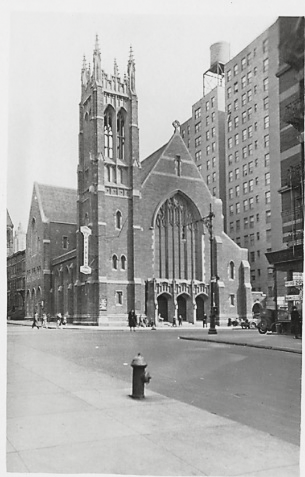
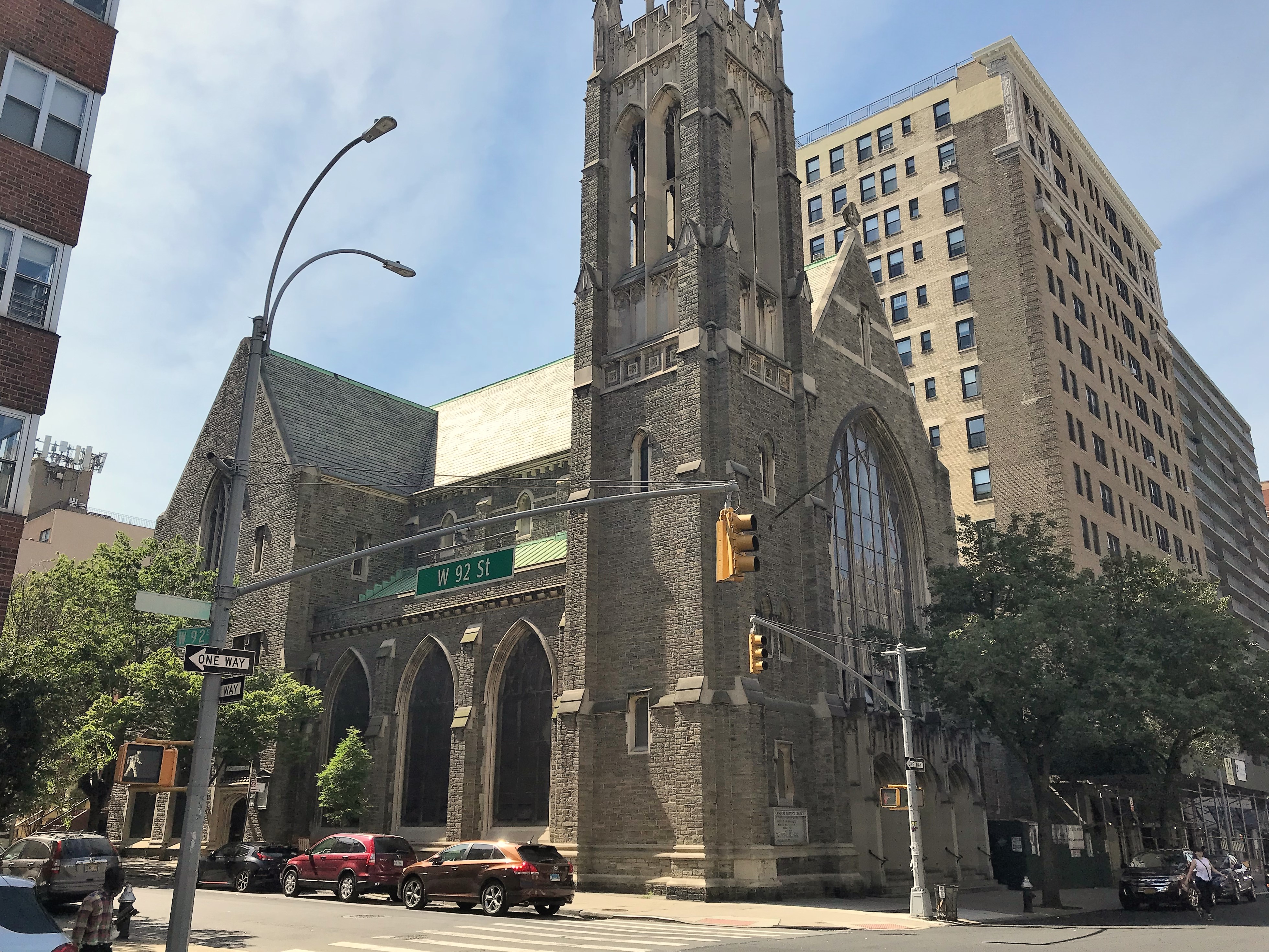
Completed in 1917, Central Baptist Church was designed in "the modified English Gothic order."  Built of Germantown stone (a type of granite) and Indiana limestone, a corner tower,  118-feet high, dominated the design.  

from the collection of the New York Public Library

Although the New-York Tribune had promised that the interior would be designed with utility in mind, the stained glass windows, by Gorham Studios, were by no means utilitarian.  The New York Globe, on October 6, 1917, said "But the glory of the auditorium is the great west window, thirty-eight feet in height by twenty-two feet wide.  It consists of seven panels in three groups...and the whole is of such marvelous depth and splendor of color as is impossible to describe."  Gorham Studios also designed the ten side windows which depicted scenes of the Life of Christ.

The great West Window.

The Rev. Dr. Frank Marsden Goodchild had been pastor of Central Baptist Church since 1895.  It was he who recognized the need to relocate the church immediately upon taking the pulpit.  Seemingly indefatigable, he wrote three religious books, was a "visiting preacher," and was president of the American and Foreign Bible Society, president of the Ministers' Home Society, and vice president of the Baptist Union for Ministerial Education.

As the church rose, he got into a heated confrontation with U. S. Army General Frederick Funston for the latter's "attitude toward the activities of clergymen in the army."  Goodchild insisted that clergymen be permitted "to preach without restrictions to soldiers," while the general demanded that preachers "must not tell the soldiers that they were lost and were in need of being saved."  He added that he did not "wish the emotions of the soldiers stirred, and wanted no such thing as a revival," said The New York Times on November 21, 1916.  From the pulpit, Dr. Goodchild called Funston a "religious dictator" and demanded that Congress investigate conditions in the army."  The well-publicized feud prompted other Baptist ministers to distance themselves from the fiery pastor.

Goodchild's health began to fail in 1923.  That year he and his wife sailed to France for six months "in the hope that the long vacation would restore his health," said The New York Times.  Instead, upon his return he suffered a stroke.  He preached his farewell sermon on January 6, 1924, during which he dedicated the life of his six-month-old grandson, Robert Mardsden Goodchild, "to the Christian life, and to the Christian ministry, if God so wills."  (He presumably did not consult his infant grandson on the decision.)  In tribute to his long service to the church, the congregation gave him cash equal to a year-and-a-half's salary.  Goodchild died on February 18, 1928.

Dr. Goodchild was replaced by the Rev. Dr. John Falconer Fraser, who, in 1931, also found himself in a heated confrontation.  In his sermon on November 1, he declared that the name of the Central Baptist Church had been dragged "into scandalous notoriety by the reckless villainy operating in the name of the United States Government."  The previous week the church had been named as co-defendant in a "padlock suit" for running a speakeasy disguised as a bird store on West 91st Street.

Falconer told his congregants that he was not used to speaking about political issues from the pulpit, but "It seems incumbent on your minister to make a statement on this unseemly subject."  He insisted the church had no connection with the owners of that building nor the shop and said, "God knows, the speakeasies stoop low enough in their practices in evading the law, but it is doubtful if they an equal the latest publicity stunt of the Federal authorities in New York City."

As the decades passed, the neighborhood, the congregation, and the church's outreach changed.  The youth of the neighborhood caught the attention of Richard "Pee Wee" Kirkland in 1994, who began the School of Skillz basketball camp at Central Baptist Church every Saturday. 

Kirkland was born in Harlem in 1945 and learned basketball on the streets.  A sensation in high school and college, he was drafted by the Chicago Bulls in 1969, but he turned down the offer, presumably because he was making more money as a drug dealer, money launderer and jewel thief on the streets.  He was arrested in 1971 and sent to the Lewisburg Federal Penitentiary in Pennsylvania on a ten-year sentence.

He told The New York Times journalist Vincent M. Mallozzi in January 1997, "Thirty years ago, I was part of the problem.  Thirty years later, I'm part of the solution."  The solution included mentoring young Upper West Side boys through basketball.  He said that while in prison he thought of the people who had wanted to see him go into the N.B.A.  "I knew the only way to repay those people was to one day work with kids, because somewhere out there there's another Pee Wee Kirkland, and until that kid turns his life around, I will always feel his pain."  Kirkland ran his School of Skillz at Central Baptist Church for years.

In the summer of 1997, Mayor Rudolph W. Giuliani created a task force to examine the relations between the city residents and the New York City Police Department.  It followed the beating and torture of Abner Louima in a Brooklyn precinct station house.  Among the members was Central Baptist Church minister Rev. Michel Faulkner.  He called the group "the most diverse task force in the history of New York City," saying the members "poured their heart and soul into a process that they truly believed in."

Faulker was crestfallen when, a year later, Giuliani essentially dismissed the task force's findings, saying "the panel had failed to recognize the department's recent success in reducing crime."  Of the task force's recommendations, he said "Some of the things we've already done.  Some of the things I've opposed in the past, I'll continue to oppose them.  And some of the things are unrealistic and make very little sense."

The uneasy relationship between Faulker and Giuliani continued.  In March 2000 an unarmed Black man, Patrick M. Dorismond, was shot dead by police.  Three months later Giuliani had still not expressed condolences to the victim's family.  On June 3, Elisabeth Bumiller, writing in The New York Times, reported, "He has not reached out to Representative Charles B. Rangel of Harlem...or to former allies like the Rev. Calvin O. Butts and the Rev. Michel Faulkner."

Faulkner told Bumiller, "I've sent him a couple of messages.  I haven't heard back from him.  I don't know what it means, to be honest with you.  To me it's not good."


The Central Baptist Church continues to serve a noticeably dwindling congregation.  And while the handsome 1917 structure with its stunning stained glass windows is little changed, rumbles on the street speak of a possible sale and demolition of the structure, which has no landmark protection.

 photographs by the author
LaptrinhX.com has no authorization to reuse the content of this blog

Tuesday, May 25, 2021

The Nahan Franko House - 296 West 92nd Street


Architect Clarence F. True rarely practiced outside of the Upper West Side district.  After having worked in the office of Richard M. Upjohn, he opened his own office in 1884 and within a few years was the most prolific architect within the developing neighborhood. True worked in historic styles, often playing with period accuracy either to create a slightly lighthearted air or simply to conform the structure to modern tastes and needs.  

His success was such that by the early 1890's he acted as his own developer for some speculative work.  Such was the case in 1894 when he designed an 18-foot wide residence at 296 West 92nd Street.  True loosely drew his inspiration from Elizabeth architecture, but the resulting structure was purely 1890's.

The English basement and parlor levels were faced in brownstone.  The lintels of the parlor windows were given graceful ogival arches and the entrance sat within a pointed Gothic arch.  Carved ribbons fluttered from a heraldic shield above the doorway.


The contrast between limestone and brownstone is lost under a coat of white paint.

Limestone shared the stage with brownstone in the two-story midsection and the windowless attic floor.  By extending the lines of the pointed pediment atop the roofline, True tricked the eye into seeing a full-height gable.

On January 16, 1894 Clarence True sold the house to Louis and Rosalie Bowsky.  Louis was an engineer whose office was nearby on West 87th Street.

The city had trouble keeping up with the infrastructure of the rapidly developing Upper West Side and Bowsky's clients found themselves sometimes stepping through mud to get to his office.  On August 20, 1901 he joined influential property and business owners--including Mrs. Alfred Corning Clark, Peter Gilsey, and Alexander Walker--in signing a petition to the Municipal Assembly asking "that the carriageway of [87th Street between Broadway and West End Avenue] be repaved with asphalt pavement."

He would be dealing with a problem much closer to home on February 18, 1904.  At around 4:00 that morning one of the largest water mains in the city broke at Broadway and 92nd Street.  The Brooklyn Daily Eagle reported, "Several basements were flooded, so that the water reached the ceilings.  Chairs, tables, trunks and everything that would float was carried by the water from room to room and windows were broken and walls injured by the contact of hard objects against them."

The article noted, "The house at 296 West Ninety-second street is owned by Louis Bowsky, engineer and inventor.  The water here rushed through from the rear yard, which was boxed in, and entered his private parlor, damaging relics and valuables.  The cellar was also flooded."

The following year, in October, Bowsky sold the house to well-known violinist and conductor Nahan Franko and his wife, German actress Anna Braga.   Born in New Orleans on July 23, 1861, Franko was a violin prodigy who toured the world with Adelina Patti at the age of 8.  In 1883 Franko became the concert master of the Metropolitan Opera Orchestra, and a year before purchasing the 92nd Street house he was made its conductor.  His salary for the eight-month 1904-05 season was $4,045--or about $120,000 today.

The Frankos' housewarming was an event.  On November 12, 1905 The New York Times reported, "Nahan Franko was happier last night than a young girl in a conservatory whose instructor has acknowledged at least that she has taken high 'C' and sustained it as he would have her.  He ran up and down the stairs of his new home, 296 West Ninety-second Street, singing."

The party began at 11:00, conveniently after the closing curtain for the couples' musical guests.  The article said the neighbors soon realized that the night "promised grand opera, opera comique, and songs by singers of international repute...The neighbors sat at their windows in their furs to hear four tenors and twice as many bassos sing."

The New York Times listed three dozen celebrated musicians by name, including Enrico Caruso, conductor Willem Mengelberg, Antonio Scotti and Otto Wehl.  "The neighbors heard the popping of corks.  Selections from 'Goterdammerung' filled the streets with bass harmony.  There were 'Hochs' for this, that, and the other, mostly for the host.  There were vivas and bravos, too, now and then.  Then every man tried to imitate a trombone in rendering 'Oh, Thou So Fine, the Evening Star.'"  The party lasted until dawn.

Anna settled into her social routine in the new house.  On December 17 the New York Herald announced, "Mrs. Nahan Frank, of 296 West Ninety-second street, gave the first of her at homes for this season on Friday last.  Mrs. Franko will also receive on January 12 and February 9 from three until six o'clock in the afternoon."

In 1907 Franko left the Metropolitan Opera to form his own ensemble, the Nahan Franko Orchestra.  It performed regularly at the Plaza Hotel and at private, opulent balls in Newport and Manhattan mansions.

Franko had a well-publicized temper, one which often got the best of him.  On April 26, 1906, for instance, The New York Times reported on a incident at Grand Central Depot.  Franko was returning from San Francisco and Anna was at the station to meet him.  She was not permitted to pass through the gate leading to the inner platform.

"She protested, but the guard was obdurate.  When the train came in, Mrs. Franko, catching sight of her husband, ran to greet him.  The guard caught her by the arm," recounted the article.  Seeing his wife struggling with the guard, Franko dropped his satchel and rushed to her defense.

"He struck the guard, who struck back, and was soon joined by another guard.  There was trouble for half a minute.  Then explanations followed.  Nevertheless Mr. Franko said that he would do his best to have both of the guards arrested."

Two years later Franko attempted to break through the police lines to cross Fifth Avenue during a parade celebrating the 100th anniversary of the New York Roman Catholic Diocese.  When Patrolman Edward Xenodochious blocked his way, Franko became combative and was arrested.  At the station house he refused to apologize to the officer, preferring to pay the $2 fine instead.

Franko filed a complaint against the policeman and they appeared before Police Commissioner Hanson on May 12.  According to the New-York Daily Tribune, Franko charged that he was "grabbed roughly and shoved back" by Xenodochious.  He said that the wife of a prominent businessman would have testified on his behalf if her husband had not objected to the notoriety.

Xenodochious denied the charges, and said, "Why, Mr. Franko thought that he would have two hundred witnesses marching to the station house behind him, with slow music being played."  The jab was too much for the conductor.

"You have no right to comment on my profession, I would not exchange mine for yours.  Mine is more intellectual," he spat.

When he had restored order, the Deputy Commissioner made his decision.  "This complaint is dismissed.  You have lost your temper here probably in the same way that you lost it when the patrolman prevented you from going through the police lines."  Nahan Franko stormed out of court grumbling that "he could get justice nowhere," said the article.

Franko conducts his orchestra at the Sheepshead Bay Speedway on August 31, 1918.  from the collection of the Library of Congress


The Frankos continued to host glittering entertainments in their West 92nd Street home.  On February 19, 1911, for instance, The New York Times reported, "Nahan Franko, the musician, gave a reception and supper last night at his home, 296 West Ninety-second Street, to a number of his friends."  Among the musical celebrities present were Mr. and Mrs. Victor Herbert, Mr. and Mrs. Gustav Mahler, and Metropolitan Opera stars AndrĆ©s Perelló de Segurola and Giuseppe Campanari.  Others on the guest list were Mrs. Randolph Guggenheim and the German writer and expert on Richard Wagner, Baron Hans von Wolzogen.

In the spring of 1930 Franko suffered a stroke as he approached his 69th birthday.  He was left partially paralyzed and unable to speak.  He was taken to a sanitarium in Amityville, Long Island where he died on June 7 of a blood clot on the brain.  In reporting his death, The New York Times called him "one of the most colorful figures in local music circles during the last half century" and said he "met with varied experiences, which included shipwrecks and cyclones."

Although Anna Franko retained possession of 256 West 92nd Street, she left in 1937 and leased it to The Apostolic Faith Christian Church.  She moved to 55 West 94th Street, a few blocks closer to Central Park.  

On September 11 the following year Anna attended a musicale at the home of Mrs. Hugo Lieber.  The New York Times reported, "She collapsed during the evening and died before a doctor could arrive."  The article said that patrons of the old Irving Place Theatre, "will remember her as Anna Braga, the beautiful German-speaking actress, who reigned as leading lady there for many years."

In the early 1940's the unpainted facade still retained its upper floor carvings.  via the NYC Dept of Records & Information Services.

The Apostolic Faith Christian Church continued to occupy the former house.  It applied for permission to install an electric sign on the building in 1938.  It remained here until the early 1950's when the property became home to the New York City branch of the United Pentecostal Church.

At some point the dual-colored stone facade was given a coat of white paint, disguising Clarence F. True's purposeful contrast in colors, and the intricate carvings of the top floor were shaved off.

Happily, the decorative carvings at the parlor level were preserved.

The house was returned to a single family residence in 2000.  Surprisingly, a few of True's 1894 interior details survive.  It was recently sold for just over $6 million.

photographs by the author
LaptrinhX.com has no authorization to reuse the content of this blog

Tuesday, June 23, 2020

The 1902 J. Edgar Willing House - 310 West 92nd Street


photo via streeteasy.com


In 1901 the partnership of Elisha Harris Janes and Richard Leopold Leo was only three years old, but the architects were being noticed for their work like the striking Alimar Apartments on West End Avenue and 105th Street.    That year Daniel Hallecy and John J. Egan, partners in the Egan & Hallecy Construction Company, tried their hand at real estate development and hired Leo & Janes to design four upscale rowhouses on West 92nd Street between Riverside Drive and West End Avenue.

The plans, filed in July 1901, placed the cost of construction at $215,000--or about $1.33 million each.  Completed the following year, the four-story Beaux Arts style residences would have held their own on the Upper East Side or Riverside Drive.  


No. 310 sits in the center of the impressive row of homes.
No. 310 was the centerpiece of the five.  The decorative reserve of its base was more than atoned for by the three-story midsection.  A double-height angled bay was anchored by a stone balustrade that created a faux balcony.   The French windows at this level were topped by a pediment sumptuously overflowing with carved fruits, below which garlands of fruit trailed from lions' heads.  The third floor terminated in decorative carvings above the windows, and scrolled brackets that upheld a wrought iron railed balcony.  Two French cartouches flanked the top floor below the modillioned cornice.


Carved fruit completely fills the pediment above the second story French windows.
In September 1902 Egan & Hallecy sold the newly-completed house to Mary A. G. McLochlin.  Although she bought and sold real estate regularly, the widow purchased No. 310 as her permanent home.  At least for a while.

Four years later, in October 1906 she sold it to Frances Sprague.  Like Mary, Frances was a widow.  She moved into the house with her baby daughter, also named Frances.

The mother and daughter lived quietly, garnering no social comment.  Their low-key existence did not preclude the expected travels to summer resorts and such.  A trip in 1914, possibly to Europe, was extensive enough to warrant Frances's leasing the East 92nd Street house to Harry Lesser.

Society columnists finally had something to report in the summer of 1917.  On June 24 The Sun announced "Arrangements have been completed for the wedding of Mrs. Frances Sprague, daughter of Mrs. Lewis Whitlock, to John Watson Dixon in the chantry of St. Thomas's Church."  The article noted "the bride's only attendant will be her little daughter, Frances Sprague."


photo via streeteasy.com
Dixon was a highly-educated attorney who held two degrees from the University of Nebraska and another from Yale University.  

On June 14, 1919 The Real Estate Record & Builders' Guide reported that Frances had sold No. 310 for $50,000 (about $740,000 today) to a buyer "for occupancy."  That buyer was the Philadelphia-born architect J. Edgar Willing.

As a tragic side note, seven years later, on July 26, 1926, the Buffalo Evening News reported that the four-day heat wave had taken 160 lives.  "Among the New York victims were John Watson Dixon, lawyer and president of the Yale club."  His funeral was held in St. Thomas's Church, where he and Frances had been married just nine years earlier.  His prominence in the community was reflected in the names of the high-ranking mourners present, including Cornelius Vanderbilt, Irving E. Burdick, Charles E. Merrill, Jr., and Alfred E. Schermerhorn.

J. Edgar Willing's wife, the former Grace Lee Smidt, had died in 1911.  As Frances Sprague had done, he moved in with a daughter, Louise.  And as those two had done, the father and daughter traveled to fashionable resorts and abroad.  On August 30, 1921, for instance, The New York Herald reported that they had just arrived in Paris.  And, after the pair had spent the following summer season in Lenox, the New-York Tribune announced on September 3, 1922 that they had just arrived at the Greylock Hotel in Williamstown, Massachusetts.

William was a member of the Architectural League, the University Club, the Players and the American Institute of Architects.  Following his marriage to Aline Lee, around 1927, the family moved to a home in Westbrook, Connecticut.  
No. 310 next became home to the New York School of Music.  Headed by Ralfe Leech Sterner, the institution provided "dormitory accommodations" for out of town students.  

Among the students to earn press attention in 1932 was Mildred P. Greenwood.  She was one of three solo artists invited to play in the grand ballroom of the Hotel Astor before the Drama Comedy Club on February 5 that year.  The young pianist from Atlanta was studying under Arthur Friedham, a former pupil of Franz Liszt, and musical interpretation under Frederick Riesberg.  The Pittsburgh Courier made a special note that "Miss Greenwood is the first colored girl from Georgia to receive a Rosenwald scholarship in music."

On August 26, 1938 The New York Sun reported that Ralfe Leech Sterner had leased the five story mansion at No. 34 Riverside Drive, noting that the New York School of Music Art "has been located at 310 West Ninety-second street for eleven years."  The school remained in No. 310 into 1939 as its new home was renovated.  

In 1946 the Aleena Realty Corporation purchased the former Willing house for $47,000, or around $615,000 today.  It is unclear if it remained a private house for the next two decades or was rented as unofficial apartments.  But in 1964 a conversion resulted in one apartment on the first floor, three each on floors two through four, and two on the top floor.

A subsequent renovation in 2000 nearly returned to house to a single-family residence.  Only the two top floor apartments now remained.  That all changed when No. 310 was recently purchased by owners who are returning the striking residence to a private home.