Showing posts with label new York theater. Show all posts

Monday, April 24, 2023

The Lost Majestic Theatre - Columbus Circle at 59th Street


The gently curved structure conformed to the rounded shape of Columbus Circle.  from the collection of the New-York Historical Society

At the turn of the last century, the Upper West Side was fully developed.  Mass transit had been extended northward into the district now filled with lavish homes and apartment buildings.  Residents, who already enjoyed shops and social clubs in the relatively new neighborhood, saw entertainment venues beginning to arrive.  In 1902 developers E. D. Stair and A. L. Wilbur broke ground for a lavish new theater on the western side of Columbus Circle, between 58th and 59th Streets.

Designed by John H. Duncan, the crescent-shaped Beaux Arts style structure gently followed the curve of Columbus Circle.  Four stories tall, the ground floor held two restaurants, one for men and the other for ladies.  The main entrance was protected by a glass-and-iron marquee.  Above it a broken pediment was fronted by a carved lyre, a symbol of entertainment.  Directly above was a round window surmounted by a carved female portrait and palm fronds.  But stealing the show was the tower, carved with a dramatic figure of a winged male and topped by a domed roof and electric-lighted finial.

photo by Byron Company, from the collection of the Museum of the City of New York

Inside, patrons found themselves in a grand lobby with a double staircase, marble wainscoting, and white columns.  The auditorium, which could seat 1,584, was inspired by European opera houses, and featured two balconies and two sets of box seats.   On either side of the proscenium were trumpeting figures and gilded eagles.  The state-of-the-art 80-foot-wide stage was equipped with all the latest mechanics necessary for elaborate productions.  And it would be tested on opening night with the new play based on L. Frank Baum's book The Wizard of Oz. 

photo by Byron Company, from the collection of the Museum of the City of New York

On January 11, 1903, the New-York Tribune reported, "January 16 is the date set for the opening of the new Majestic Theatre, with a performance of 'The Wizard of Oz,' in which Montgomery and Stone, as the Scarecrow and the Tin Woodman, play leading parts."  And on Monday, January 19, 1903 Theatrical Notes hinted that this would be no run-of-the-mill production:

"The Wizard of Oz" will wave his magic wand before the gaze of New Yorkers for the first time on Tuesday night next, when he begins his reign at the Majestic Theatre, 59th street and Broadway, or what is known as the Grand Circle.  "The Wizard of Oz" is described as an entertainment compounded of the most attractive elements of smart up-to-date musical comedy, extravaganza and old-fashioned Christmas pantomime.

The lavish production featured a jaw-dropping on-stage tornado scene, an all female poppy field, and vaudevillian Fred Stone as the Scarecrow whose "boneless" performance made him more famous than he already was.  Audiences came back multiple times and the play prompted a flurry of sales of Baum's book, phonograph records, sheet music and piano rolls.  The Wizard of Oz played for nine months.

Dorothy meets Glinda after having crash-landed in Munchkinland.  from the collection of the New York Public Library

On October 14, 1903 The New York Times wrote, "The great success of 'The Wizard of Oz' at the Majestic has caused a good many persons to wonder how the management could follow it with an attraction that by contrast would not seem 'stale, flat, and unprofitable.'  Well, 'The Babes in Toyland' is not stale, it is not flat, and it certainly will prove highly profitable."  Once again the Majestic debuted a new extravaganza suitable for family fare.   The article said "'Babes in Toyland,' had its first production before an audience that for two hours and a half took everything that came its way and then greedily cried for more."  The critic from The Evening World pronounced, "Scenically and musically, though not humorously, 'Babes in Toyland' outshines 'The Wizard of Oz.'"

A much more somber event took place the following month.  On November 8, 1903 it was the scene of the memorial service for Emma Booth-Tucker, daughter of the founder of the Salvation Army, killed in a train crash on her way to Chicago.  The New York Times reported, "The theatre was crowded, and not a few wept as Capt. Norma Durand sang 'She Died at Her Post."

The success of Babes In Toyland fostered a close relationship between Victor Herbert and the Majestic Theatre.  Plays were outlawed on Sundays, but concerts were not.  Starting in 1904, Victor Herbert gave weekly concerts, continuing at least through 1905.  On December 5, 1904 The New York Times said, "The popularity of the Victor Herbert Sunday night concerts at the Majestic Theatre was demonstrated again last evening by an audience that filled the house, and that applauded each number on the programme."

In February 1906 the management staged what unnecessarily became a controversial production, Abyssinia.  The all-Black musical featured music by Will Marion Cook and Bert A. Williams.  The Freeman reported on March 17, "Shipp and Rogers' 'Abyssinia,' with music by Will Marion Cook, is scoring at the Majestic in Broadway and 59th street, and is indeed a worthy achievement of Negro ideals, playwrights and performers."  

Unfortunately, not all white critics were pleased with a play written and played by Blacks.  Charles Darnton, writing in The Evening World, compared Bert William's performance of the song "Nobody" as being "reminiscent of the howl of a pensive coyote across a lonely prairie (prairies are always lonely), an asthmatic calliope getting up steam for the circus parade, or Marie Dressler getting her second wind."  Another, Alan Dale, accused the actors of "trying to be too much like white people."

The Freeman's critic, Sylvester Russell, lashed back on May 19, 1906.  He wrote in part, "If color is the ground upon which white critics build their nests, it is up to the black critic to throw rotten eggs...Let this be the last time that otherwise critics of New York will overlook art for the mere mortification of color."

Robert Warwick and Virginia Harned were the lead actors in the 1907 production of Anna Karenina here.  For some reason or other, before the October 5 show the two "had a lively discussion," as worded by The New York Times, "over the presence of mind of men and women in moments of excitement."  Warwick believed that women "had no presence of mind" in emergencies, while Harned insisted they were more dependable than men.  As fate would have it, the debate would be solved on stage.

During the third act, Warwick, was on stage when a actor playing a servant entered and accidentally overturned an oil lamp.  The New York Times reported, "in an instant the entire top of the table was ablaze."  Warwick realized something was wrong by the murmurings of the audience.  The article said, "Glancing quickly around, he saw that the actor who impersonated the servant was doing his best to put out the fire, but without success."  The action on stage stopped and the audience was now focused on the fire.

Virginia Harned, as Anna Karenina, was not to appear on stage yet.  Nevertheless, she jumped into action and entered the scene.  She whispered to Warwick, "get the cushion from the chair!"   He did so, and in a moment smothered the fire.  The actress saved the scene and proved her point.

Frank McKee and William Harris leased the venue in 1911.  The New-York Tribune reported on August 25, "with the beginning of their lease of the Majestic Theatre at 59th street and Broadway it will be renamed the Park Theatre.  This is due to their desire to apply an historic name to a New York theatre."  Indeed, there had been a Park Theatre in New York City since 1798.

The Park Theatre opened with The Quaker Girl on October 23, 1911.  It ran for 240 performances.  Before long, however, The Park Theatre was staging vaudeville.  Eva Tanguay, known as the Queen of Vaudeville, opened here on March 24, 1913.  She headlined what the program called "cyclonic vaudeville."  The New York Times remarked, "there was no doubt that she won her audience completely."

The sometimes naughty Eva Tanguay.  from the collection of the New York Public Library

The Park Theatre began showing motion pictures in 1913, starting with a controversial film, The Inside of the White Slave Traffic.  Produced by the Social Research Film Corporation and endorsed by the Sociological Fund of the Medical Review of Reviews, it dealt with a serious problem at the time--abduction and forced prostitution.  Not all New Yorkers were convinced of its educational value.  The New York Times reported on December 20 that complaints had "flowed" into Police Headquarters.

On December 19 the theater was raided and closed down.  The Park's manager, Alfred P. Hamburg, was charged with showing a picture "of a character likely to impair the morals of young girls."  The action drew the wrath and indignity of women like Alva Belmont, Carrie Chapman Catt, and the associate editor of Harper's magazine.

photo by Byron Company, from the collection of the Museum of the City of New York

A month later, on January 18, 1914, The New York Times reported that Kinemacolor had taken over the lease of the Park Theatre.  The article said, "The Kinemacolor people aim to make the Park in the moving-picture world what the Princess theatre is to the legitimate--a theatre of thrills for the silent drama."  The venue opened with the four-reel film Sin, and silent shorts of "Ethel Barrymore and her children at home," a comedy, The Note in the Skirt, and "a trick picture which contains the very highest art known to the producers in this sort of work," said The New York Times.

The stint as a silent movie theater was short lived.  On July 19, 1914 The New York Times reported on the opening of the play The Garden of Paradise.  The article described the production as "a vast spectacular offering."  The following fall, the famous actress Mrs. Patrick Campbell appeared here in George Bernard Shaw's Pygmalion.

In 1917, the Park Theatre turned to opera and operettas, staging The Pirates of Penzance in November 1918, for instance.  The following year, on October 12, the New-York Tribune reported "Von Suppe's 'Boccacio' is the opera which will open the Society of American Singers' third season at the Park Theatre to-morrow evening."

Change came again in the fall of 1922.  On September 16 the New-York Tribune reported, "'Burlesques--Girls, Travesties, Laughs.'  Presented last night at the Park Music Hall by the Minsky Brothers...At the Park Music Hall the Minsky Brothers spell it 'burlesques.'  They declare that the final letter makes a difference."  The article said the brothers "have made a brave start to build a permanent institution in Columbus Circle."  The New York Times noted, "The theatre recently underwent complete renovation, and its interior was almost entirely rebuilt...at an expense of $62,000."

But the Minsky's Park Music Hall did not survive.  On August 2, 1923 The New York Times reported that William Randolph Hearst had purchased, remodeled and redecorated the venue, renaming it the Cosmopolitan Theatre (most likely after his popular magazine of the same name).  Now a motion picture theater, perhaps not coincidentally it opened with the film Little Old New York starring Marion Davies, Hearst's mistress.  More coincidentally, however, it was accompanied by Victor Herbert and his orchestra.

In 1925 Hearst turned the operation over to Florenz Ziegfeld who hired architect Joseph Urban to update the interiors.  On January 11 The New York Times reported, "Mr. Ziegfeld will convert the former Park Theatre to the drama again...The late Park, which is now Mr. Hearst's Cosmopolitan, will be opened in four weeks or so with 'The Comic Supplement' as its attraction."  The deal was always intended to be temporary, however.  The article noted that Hearst was in the process of erecting the Ziegfeld Theatre for the impresario on Sixth Avenue.

The Ziegfeld Theatre opened in February 1927.  The Cosmopolitan continued, without the famous Ziegfeld, to stage plays and operettas.  In May that year Gilbert and Sullivan's Ruddigore opened.  In February 1928 Robert Warwick was back to star in William Gillette's Sherlock Holmes; and in December 1929 the melodrama Damn Your Honor opened.  That would be the last production for some time to come.  The Cosmopolitan closed its doors and did not reopen until 1931, once again a motion picture and vaudeville venue.

After undergoing several more incarnations--the legitimate Theatre of Young America in 1934, the Park Theatre again in 1935, the International Theatre in 1944, and the Columbus Square Theatre in 1945--the the building sat vacant until early 1949 when it was acquired by the National Broadcasting Company as a television studio.  It opened with the premier of the Your Show of Shows starring Sid Caesar and Imogene Coca.

The end of the line for the building came with Robert Moses's "Slum Clearance" of Columbus Circle.  In 1954 he assembled the Slum Clearance Committee, of which he was chairman.  The New York Times noted on July 5, 1954, "Columbus Circle is not, of course, the only project" in his slum removal vision.  Also included were "Morningside-Manhattanville, West Park, Harlem, North Harlem, Corlears Hook, Fort Greene and Pratt Institute."  But it was Columbus Circle--and the Majestic Theatre--that was first in his crosshairs.

The Majestic Theatre in the course of demolition (lower left).  The New York Times June 22, 1954

The New York Times, June 15, 1954

In his 2015 book Blue-Collar Broadway - The Craft and Industry of American Theater, Timothy R. White notes, "As in many other Moses projects, wrecking crews got to work before local leaders understood what was happening."  The "stately playhouse," as described by White, was razed to make way for the New York Coliseum, designed by Leon and Lionel Levy.

from the collection of the Library of Congress.

That structure was replaced in 2003 by the current Time Warner Center.

no permission to reuse the content of this blog has been granted to LaptrinhX.com 

Monday, July 18, 2022

The Lost Miner's Eighth Avenue Theatre - 312 Eighth Avenue


from the collection of the New-York Historical Society 

Henry C. Miner had one of the most varied resumes of his day.  After graduating from the American Institute School he became a pharmacist.  The New-York Tribune would say of him, “He grew tired of the drug business and studied medicine under his brother, Dr. Edward Miner.”  When the Civil War broke out he enlisted as a pharmacist in the Mechanics and Artisans’ Regiment.

A string of careers followed the war: a stint as manager for magician and bird trainer Signor Blitz; manager of the Thayer & Noyes Circus; secretary of the Crystal Palace in 1868; and a policeman stationed at the Mercer Street Stationhouse.  (The last profession was Miner's lease favorite.  “This was even more unpleasant than being a drug clerk and Mr. Miner decided to get into something else,” said the New-York Tribune.)  He then turned to theater management, building and operating a series of theaters including the London Theatre in the Bowery, the Fifth Avenue Theatre, and Miner’s Bowery Theatre.

On May 7, 1881, The Real Estate Record reported, "A new variety theatre, capable of seating 3,000 persons, is soon to be built on the west side of Eighth avenue, between Twenty-fifth and Twenty-sixth streets.  It will be T shaped, and be known as Harry [sic] Miner's Eighth Avenue Theatre.  Thomas Canary is connected with Mr. Miner."

The partners, in fact, did not erect a new building, but substantially renovated the existing structure.  Architect William Graul filed plans a month later that included modifications like new girders and posts, roof, and "interior alterations, front repaired, new iron cornice."   It was a significant savings, the total project costing the equivalent of $65,300 by today's standards.

Miner's Eighth Avenue Theatre building included a cafĂ©, entered south of the main entrance.  Graul reserved most of the ornamentation for the ground floor, where stained glass fan lights lined up below signage, also in stained glass, that read "Vaudeville" and "Burlesque."  A half-circle, cast metal pediment directly above the entrance announced the theater's name.  The three stories of cream-colored brick above were sparsely adorned with classical cast iron garlands and a wreath-enclosed cartouche with Miner's initial.  The openings were embellished with ancient Roman style lattice work.

The seating capacity upon completion was slightly smaller  than originally anticipated, at 2,300.  Opened on November 21, 1881, Miner's Eighth Avenue was, indeed, a variety house.  Patrons would enjoy a diversity of entertainments including boxing contests, minstrel shows, political rallies and debates, burlesque shows and vaudeville.  King's Handbook of New York put it succinctly, saying that it "furnishes variety entertainment for the West Side of the City."

Thomas Canary and Henry Miner went their separate ways in July 1893 with Miner buying out Canary's portion.  The Sun reported, "Mr. Miner is having improvements made to the theatre in the way of decorating and is also having a complete electric plant put in."

The wide mix of programs was evidenced on October 30, 1894 when The Evening World reported that champion middle-weight boxer had appeared the previous evening.  "He gave exhibitions of his fistic skill with Ike Williams."  The bout was followed by vaudeville skits.  "The specialty company included the Fitzgibbons family, Joe Hardman, John R. Harty, Miss Nellie Franklyn, Gordon and Lick, Barron and Forrest, the Tremonts, William E. Whittle, and Hawley and Doyle."

Vaudeville theaters too often attracted rowdy patrons, one of whom a month earlier, had provided more excitement in the balcony than was presented on the stage.  Robert Jones, described by The Evening World as "a six-foot youth of twenty," bought a ticket for the matinee on September 25.  The newspaper said, "He had more liquor aboard than was good for him."

Jones took his seat in the front row of the balcony, and just as the curtain rose, he jumped to his feet and "fired a volley of oaths at the stage and shouted that he could lick any man in the house."  Special Officer Carroll, one of the New York Police Department's "theatre force," tried to take control of Jones.  As the two struggled at the railing high above the orchestra pit, Jones tried to wrestle his opponent over the railing.

"The women in the balcony had fled to the rear, while the occupants of the orchestra chairs had risen en masse and rushed into the aisle to escape the expected downpour of arms and legs that were seen wildly flying in the upper regions," said the article.  Twice Jones managed to get one of Carroll's legs over the railing, but two audience members helped pull him back.  In the meantime, Carroll had managed to land a "dazing blow on Jones's nose," causing blood to pour forth that added to the excitement," according to the writer.

Finally, "With much cursing and howling on the part of the captive, Jones was got outdoors by Policemen Riley and Carroll."  He was sent to prison for ten days.

Among the political meetings held here that same year was a Tammany Hall rally on November 4, 1894.  The New-York Tribune did not disguise its contempt for the group, saying "John A. Grow, a renegade Republican, presided, and an ill-smelling mob of blear-eyed, besotted thugs, tramps, toughs and vagabonds, whose Democratic enthusiasm had been wrought up to a high pitch by a liberal distribution of free rum, howled and shouted for Hill and other candidates on the Democratic and Tammany tickets."

The Evening World reported on a typical evening's fare on November 6, 1894.  "Robert Manchester's French Folly Company supplied the entertainment at Miner's Eighth Avenue Theatre, yesterday...The after-piece, entitled 'The King's Daughter,' caused much laughter."

A broadside, or announcement, of the acts presented the week of February 5, 1894 (copyright expired)

A notable incident took place on stage on September 10, 1896.  The Colored Sports, an all-Black song and dance troupe, was performing that week.  The New York Times reported, "David Barton, a mulatto comedian, and Edith Hughes, a singer and dancer and an exceedingly pretty octoroon, were married last night, with great theatrical effect, on the stage of Miner's Eighth Avenue Theatre."

The theater was crowded with an audience eager to witness the marriage of two performers.  "The event had been well advertised, and the 'cream of society' of Thompson Street, Seventh Avenue, and other centres of the colored population was well represented," said the article.

After "a long variety bill," the stage manager stepped on stage and announced that "just before the cakewalk, a marriage between two members of the company would take place."  Then, led by the "champion cake walkers, Mr. and Mrs. George Weston," fifteen couples in evening dress processed onto the stage and formed an aisle.

Edith Hughes was the daughter of Elizabeth Taylor Greenfield, known internationally as the Black Swan.  "Then down the centre of the stage marched the bride, leaning upon the arm of the bridegroom.  She was clad in white silk, with a long train, and her head was covered with a long, white veil."

After rings were exchanged and David Barton "implanted a kiss upon her lips," the show went on.  The New York Times reported, "the cakewalk then proceeded.  Of course, the bridal couple carried off the honors, according to the judgment of the spectators...There was a wedding banquet on the stage after the theatre had been closed."

On New Year's Eve 1901, the Merry Maidens burlesque troupe closed the night.  Shortly afterward, disaster struck.  The following morning the New-York Tribune reported, "the audience had been out of the building only about fifteen minutes when the fire started.  It was caused by a lighted cigarette which one of the chorus girls dropped while smoking in a dressing room on the Twenty-sixth-st. side of the building."

The fire spread rapidly, causing the chorus girls and other employees to flee into the street in panic.  "Many of the girls were only half clad when they reached the street," said the New-York Tribune.  "They wept hysterically."  The thousands of people celebrating New Year's Eve in the neighborhood soon crowded around the burning building.  The Sun reported, "At 3 A. M. only the walls remained and the front wall, facing Eighth avenue, was in danger of falling.  Men were summoned from the Building Department to shore it up."

By now Henry Miner's sons operated the theater.  Just two days after the blaze, Edward Miner told reporters "the theater would be rebuilt at once."  Architect George M. McCabe was hired to renovate the burned out shell.  He encountered problems with the Department of Buildings when his plans called for repairing a building that predated the current fire laws.  The Department of Buildings rejected his plans, saying that "the reparation necessary to restore it to its original condition is equivalent to the 'erection' of a theatre."  An agreement was finally reached, and McCabe's altered plans went forward.

The restored structure gave little hint of the inferno that had gutted it.  photograph by Byron Company, from the collection of the Museum of the City of New York

The remodeled theater opened in 1903.  In April that year the fireman who had been detailed to the building on December 31, 1901 was found guilty for not enforcing the theater fire laws.  Fire Commissioner Sturgis found that he should have prevented the chorus girls from smoking in the theater and, especially, discarding their still-smoldering cigarettes.

On September 1, 1917 the Estate of Henry C. Miner leased the building to the Criterion Theatre Company for a term of five years.  The Real Estate Record & Guide commented, "The theatre will be used for motion pictures."

Now a movie theater, by the end of World War I the building had been renamed the Chelsea Motion Picture Theatre.  On April 26, 1925, The New York Times entitled an article, "Famous Old Theatre Swept By Flames," and reported that a porter had discovered smoke coming from a dressing room and turned in an alarm.  When firefighters arrived, the blaze had spread from the rear of the building, and "flames were sweeping across the balcony which surrounded the centre part of the building and leaping toward the gallery."  Interestingly Fire Chief Joseph B. Martin had also responded to the 1901 fire.  The New York Times reported that most of the seats in the balcony and gallery were destroyed, and "The dressing room in which the fire started was burned out."

image via cinematreasures.org

As had been the case a quarter of a century earlier, the damage was repaired and the theater reopened.  It survived another quarter century.  Demolition permits were issued in 1959 and the venerable building was razed in 1960.

image via compass.com

The Chelsea Park apartment building, completed in 2013, occupies the site today.

no permission to reuse the content of this blog has been granted to LaptrinhX.com 

Monday, August 2, 2021

The Lost Daly Theatre - 1221 Broadway


from the collection of the New-York Historical Society

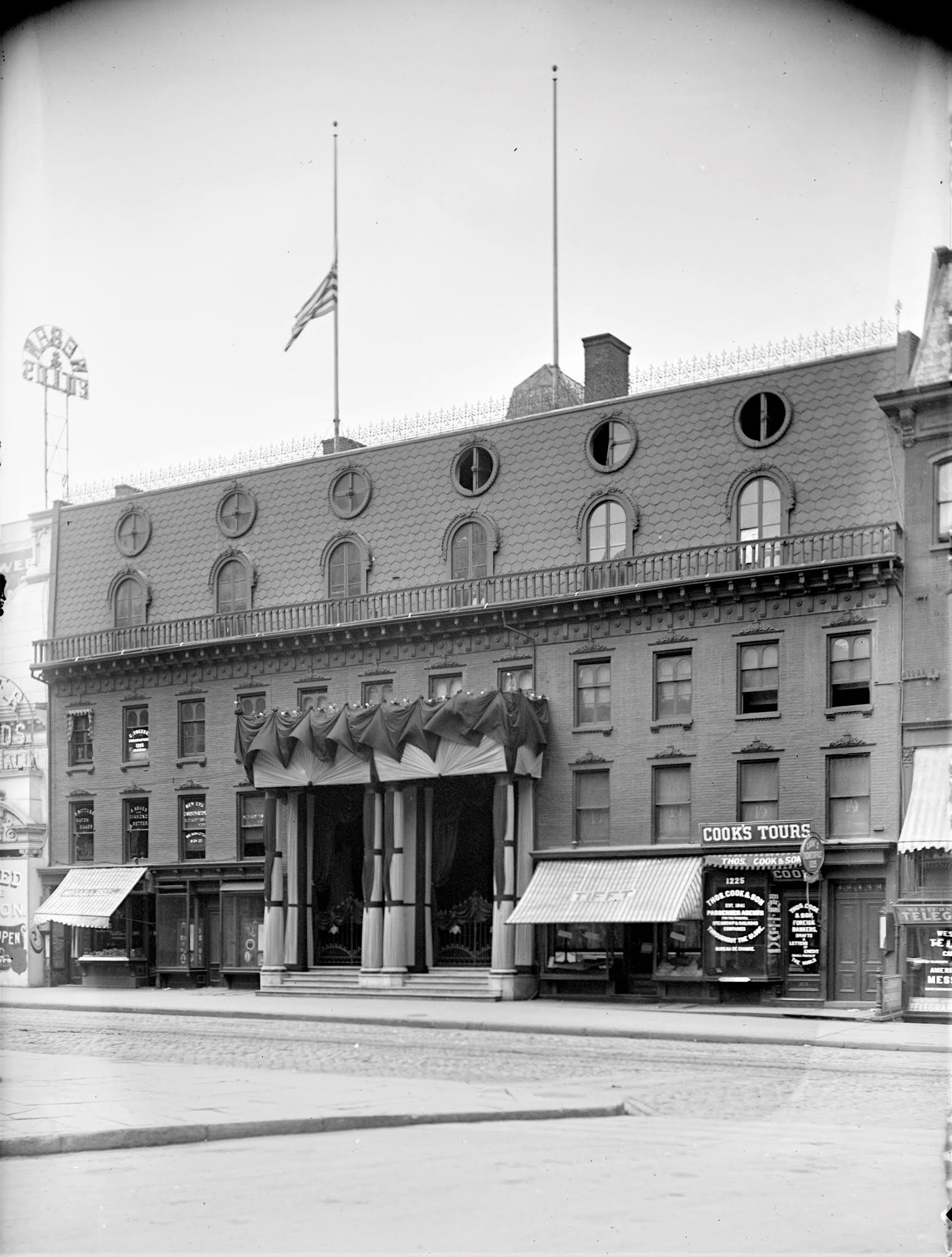
On June 13, 1867 The Brooklyn Union anticipated that the theater portion of the nearly-completed Banvard's Museum would be a failure.  "In the first place, the stage is altogether too small for any respectable scenic show, and the orchestra is perched up in the proscenium arch, facing the audience.  This is an obsolete French idea."  The article said, "If Mr. Banvard had a little more experience in the theatrical business he would know better than to waste his money in so foolish an experiment."

Banvard's double-purpose structure--a museum on the lower levels and a theater on the main floors--was a rather inelegant take on the recent French Second Empire style.  Shops occupied the ground floor on either side of the centered entrance doors.  Three stories of red brick supported a double-height mansard fronted by a cast iron balcony.

The museum section featured the expected curiosities like stuffed animals and exotic attractions of questionable origin.  Yet Banvard offered a feature that might today be considered a house of horrors.  The Buffalo Sunday Morning News described "a representation of an extremely orthodox and old-fashioned hell, with as many of the traditional horrors of eternal punishment as could be depicted in the space at command."  The article described "real flames" which erupted here and there as actors dressed as demons "made sport of as many tormented beings," and "nondescript animals crawled in and out of darksome grottoes, and pandemonic music mingled with human groans and yells."

Banvard's Museum opened in July 1867 with a variety show that did not especially please the critic of The New York Times.  He ended his column saying the acts were "not strictly entertaining."  Only a month, despite a hit play, a review in the Brooklyn Daily Eagle hinted that Banvard's Museum was closing under his ownership.  It said that Nobody's Daughter "has been so decided a success...that it seems a pity to withdraw it from the boards.  In fact, if the Museum were not about to pass into the hands of other parties...we have no doubt Nobody's Daughter would run to a paying business down to the holidays."

Banvard's failure was due not only to the lackluster theatrical performances, but disappointment in the museum.  The New York Times reported on March 18, 1868, "When Banvard's Museum was started a year or two ago, we were led to expect that it would become a repository for scientific collections and natural wonders, and a place which, while furnishing delight to our country cousins and our city juveniles, would also offer means for study, thought and observation...Those who entertained such ideas soon discovered that they were doomed to disappointment."

George Wood had taken over the establishment, which was closed "in order that it may be enlarged, restocked, and furnished with novelties for the entertainment of the curious," reported The New York Times.  Wood's Museum and Theatre opened for the 1868 fall season.  A 30-cent ticket admitted the buyer to "ALL the attractions," according to an advertisement on December 16, 1869.  Another ad on the same page note "all for One Admission, including the Wonderful Stone Giant."

That attraction was touted to be The Cardiff Giant--the 10-foot tall petrified body reputedly discovered on a farm in Cardiff, New York.  Almost immediately a letter to the editor signed by four gentlemen appeared in The New York Times.  It said in part, "We desire to inform the public through your columns that the statue now on exhibition at Wood's Museum is a plaster cast taken from the original by C. F. Otto, an artist of Syracuse, without our knowledge and consent."  The real giant, it said, was on display in the State Geological Hall in Albany.

George Wood's venture lasted a decade.  When veteran theater operator Augustin Daly took it over in 1879, he initiated a complete make-over.  The museum portion was eliminated ("except the Cardiff Giant," said The New York Times on September 16, 1879, "which, being an exceptionally ponderous wonder, still lies quietly inurned in some place in the building"), and the building renovated.  The New York Times said, "Mr. Augustin Daly having taken the old pile in hand, has wrought in it a wondrous transformation."

Augustin Daly -- original source unknown

Among the exterior changes was the addition of a two-story portico, "the pillars of which are a curious but very effective combination of the Egyptian and fluted Doric styles of art."  The interior renovations cost, according to The New York Times, $20,000--or about $529,000 today.  "It is the picture of a parlor in a gentleman's mansion," said the newspaper.  "There are mantlepieces, magnificent mirrors, a piano, rich tapestry, soft Persian carpets, to tread upon which is luxury, and a wall-paper of a most beautiful pattern."  The auditorium had been enlarged, now seating 1,400 persons.  "The general style of the house is a modification of the Elizabeth, the style of Queen Anne's time prevailing in the private boxes, which are unusually spacious and well appointed," said the article.

The foyer of the redecorated theater.  Memories of Daly's Theatres, 1897 (copyright expired)

Augustin Daly presented his own plays starring some of the best known and popular thespians of the day.  On October 1, 1879 The New York Times said his "well-known play, 'Divorce,' was revived last evening under pleasant circumstances, and was received with a good deal of favor...The drama is full of excellent theatrical material."  Clara Morris starred and the critic raved that her "genius...lit up the scenes of the drama."

President James A Garfield was shot on July 2, 1881 and died on September 19.  The entertainment industry nationwide shut down out of respect.  After his body lay in state in the Capitol Rotunda, the President's funeral was held in Cleveland on September 26.  Daly's decision to open his theater that night caused some serious indignation.

Daly added the portico with its lacy cast iron railing overhead.  from the collection of the New-York Historical Society

The New York Times reported that a man named Edward T. McDonald, "took his stand in front of the building, and by his vehement language and gesticulations soon caused a crowd of several hundred people to gather about him."  Cries of "Down with the theater!" "Burn the building!" erupted.  Barrels were rolled to the theater, one of them filled with tar, and McDonald attempted to set them on fire.  Luckily, police responded before any damage could occur.  "None of the people inside of the theatre were aware of the disturbance until it was all over," said the article.

Daly refurbished the theater again during the summer of 1885.  A new marble-tiled lobby floor was installed, new chandeliers brought in, new seating, and the entire interior redecorated.  In the auditorium, said The New York Times on September 6, "the same mahogany dado noticed in the rotunda has been carried around the whole interior of the house."  The redecorating cost Daly a quarter of a million in today's dollars.

Star actress Ada Rehan was appearing in The Taming of the Shrew in March 1889.  On March 20 a notable figure occupied a box during the matinee--Florence Cleveland whose husband's administration as President of the United States had ended only two weeks earlier.  In the decades before Secret Service men would have surrounded a former First Lady, she entered the theater with her friends like the other patrons.

The New York Times reported, "Mrs. Cleveland was among the leaders of the applause which was liberally showered on this excellent actress.  The wife of the ex-President apparently thoroughly enjoyed the magnificent performance given by Mr. Daly's company, and after the curtain had fallen she and her party lingered for some time in the foyer examining the collection of rare pictures."

Augustin Daly died unexpectedly on June 7, 1899.  Even before his funeral the fate of his theater was being discussed.  On June 9 The New York Times reported, "Mingled with the general sentiment of regret at Mr. Daily's sudden demise there was much anxiety and concern regarding the future of the theatre established by him.  Persons who for many years have regarded Daly's Theatre as one of the worthy institutions of New York were eager to learn whether there was any provision for its permanent continuant."

from the collection of the New-York Historical Society

On July 23, 1899 The New York Times reported that the theatre was not sold yet, but offers to negotiate were flowing in.  Florenz Ziegfeld cabled the Daly estate's attorneys saying "Please inform executors I desire to negotiate."  Another article said, "Managers from all over the country and from abroad have been telegraphing and cabling their intentions to negotiate for the property."

The process proceeded with lightning speed.  On July 25 The New York Times reported, "Daly's Theatre passed yesterday into the hands of Charles Frohman."  The impresario paid "about $100,000" according to the article, over $3 million in today's money.  As part of the deal Ada Rehan "secures all the scenery, properties, and wardrobe of the Shakespearean repertoire and comedies of her selection."

Charles and Daniel Frohman retained the profitable Daly's Theatre name.  It opened under their management in September 1899 with The King's Musketeer starring the popular actor Edward Hugh Sothern.  

An elaborate stage set for The Cingalee in 1904.  photo by Byron Company from the collection of the Museum of the City of New York

Four years earlier Oscar Hammerstein had erected his massive Olympia Theatre on Longacre Square.  It had signaled the first step in the migration of the theater district to what would be renamed Times Square.   Daly's Theatre would hold on for several years even as newer, more elaborate venues opened ten blocks to the north.

A surprising actor appeared in George Bernard Shaw's Cashel Byron's Profession on January 8, 1906--prize fighter James J. Corbett.  Perhaps surprisingly, The New York Times theater critic was not totally negative, saying in part, "For a few moments--notably during the first act--there seemed to be some method in this madness."  Nevertheless, he concluded Corbett would be best advised to continue boxing.

The following year the Schuberts took over the theater, only to almost immediately pass its management to Henry Miller and Margaret Anglin before the 1907 season opened.  Once again the name remained Daly's Theatre.  The pair managed to provide legitimate theater until 1914, when Charles A. Taylor took over the lease.  The end of Shakespeare and Shaw was evident when, on January 12, 1915, The New York Times ran the headline "Alas, Poor Daly's! Burlesque Reigns."  The article began: 

Shades of Augustin Daly; shades of Ada Rehan's Katharine; shades of all the traditions of the spot where John Drew played when he was young and where Mrs. Gilbert played when she was old!  In streaming red letters a huge sign yesterday announced to Broadway, Daly's Theatre, The Home of Burlesque.

In the lobby, where once had hung photographs of famous actors in historic roles were now "garish pictures of 'queens' in fleshlings."

Daly's Theatre (right) sat along a much-changed block in 1910.  from the collection of the New York Public Library


It may have been that article which prompted a raid on Daly's Theatre less than a month later, on March 3.  More than 1,000 men paid to see The Merry Maids followed by "a chorus girls' contest."  They would see only a portion of the first attraction.

Later that year the venerable theater was converted to a silent movie venue.  It opened on December 12 with a screening of Virtue (which had been banned by Philadelphia censors).   The theater lasted only five more years.  On July 3, 1920 The New York Times reported that the "famous home of the drama will soon be torn down for [an] eight-story structure."

The New York Times, July 11, 1920 (copyright expired)

That building, designed by Louis Allen Abramson, was recently demolished to make way for a glass and steel tower.

LaptrinhX.com has no authorization to reuse the content of this blog

Wednesday, May 15, 2019

The 1913 Shubert Theatre - 233 West 44th Street


On June 17, 1905 the Chicago Eagle reported distressing news--among the 22 persons kills in "the terrible railroad disaster near Harrisburg, Pa." was 23-year-old Sam S. Shubert.  The young man's rise from near poverty to a nationally-known theatrical manager smacked of a Horatio Algier story.  "Sixteen years ago he was selling papers on the streets of Syracuse, N. Y. and at the time there was nothing to distinguish him from the hundreds of other newsboys in that city," said the newspaper.

The course of his life took a decisive turn when he landed a job as an usher in a theater.  By the time he was 18 he managed a road company, and not long after leased a theater and then another, until by the time of his death he owned or controlled around two dozen playhouses in America and two in England.  His amazing, 15-year career generated an estate of $500,000--about $14.7 million today.

Shubert had taken his brothers Lee and Jacob (familiarly known as J. J.) into the business.  The Chicago Eagle advised "they will carry on the many undertakings of which he was the head."  And indeed they did.

The following year, on July 27, 1906, The New York Times ran the headline "Another Shubert Theatre."  In reporting on the upcoming opening of the Lincoln Square Theatre, the article noted it would be the seventh Shubert-owned playhouse in Manhattan.

And then on June 8, 1912 The Real Estate Record & Builders' Guide reported that Henry Beaumont Herts had filed plans for still another--a $150,000 theater to be built at 221-233 West 44th Street.  It was half of a joint project by the Shubert brothers and Winthrop Ames.  Herts also designed the abutting theater facing 45th Street to be operated by Ames.  A unique characteristic of the site was the private roadway connecting the two streets, eventually named Shubert Alley.  It allowed Herts to design what otherwise would be mid-block buildings as corner structures.

Shubert Alley accommodated automobiles at the time of this photograph, around 1915.  To the west foundations are being excavated for another theater.  photograph by Wurts Bros. from the collection of the Museum of the City of New York
In honor of their brother, the Shuberts named the venue the Sam B. Shubert Memorial Theatre.  Competed in the summer of 1913, the five-story theater was designed in what is loosely termed "Venetian Renaissance."  Herts's ornamentation relied as much on sgraffito--a process of etching and coloring plaster while wet--as on carvings.  Delicate panels recalled the frescoes of Pompeii.


The intricate decorations were painstakingly executed on wet plaster.
Herts left his mark on his work by placing an oval sgraffito depiction of a winged fairy-like figure directly above the corner entrance.  She holds in a plaque announcing the architect's name and the construction date.


Despite the overall stately appearance of the design, Herts managed to sneak in playful details.  The Corinthian capitals of the rusticated piers at the corner, for instance, depict pairs of goats apparently trying to escape from the snarling lions' heads directly above them.

The press never seem to have warmed to the official name of the venue and from the first referred to it simply as the Shubert Theatre.  The Shubert brothers scored a coup for opening night.   British actor Sir Johnston Forbes-Robertson was hailed as one of the finest thespians of his time; and now he was retiring.  In September 1913 he arrived in New York to begin his farewell tour, which would begin with Hamlet on October 2 at the Shubert.  Co-starring with him as Ophelia would be his wife, Gertrude Elliott.

Following the performance Forbes-Robertson addressed the audience after numerous curtain calls.  The New York Times reported "Then...he spoke to the standing audience very briefly, dwelling upon the beauties of the new theatre which he had opened and speaking of what a fitting monument it was to the late Sam Shubert."


The auditorium features sumptuous plaster work and painted panels. photo via shubert.nyc
The overflow crowd, prompted both by the last appearance of the celebrated thespian and curiosity to see the theater, proved the efficiency of Hertz's many exits and of Shubert Alley.  The Times said "despite the lateness of the hour, many persons in the audience spent some time in inspecting the new theatre.  Outside the congestion of vehicles of all sorts was greatly relieved by the private roadway connecting Forty-fourth and Forty-fifth Streets."


The Evening Telegram, November 14, 1920 (copyright expired)
With a seating of about 1,400, the Shubert was the scene of benefit performances early on, like the spectacular variety show to benefit disabled World War I soldiers in 1920.

An unusual event took place on March 3, 1922 when the memorial service for Ellin Prince Lowery Speyer was held here.  Speyer was the founder and president of the Women's League for Animals.    A headline in The Evening Telegram on March 1 announced "Actresses to Honor Memory of Woman Friend of Animals" and the article reported "Women of the stage will conduct memorial services in honor of Mrs. James Speyer in the Shubert Theatre...Actresses regarded Mrs. Speyer as their especial friend."  Along with recognized names like Elizabeth Marbury, Elsie De Wolfe and Julia Arthur, a sole male, producer Daniel Frohman, served on organizing committee.

Mrs. Speyer's would not be the last memorial service in the Shubert Theatre.  For years, into the 1930's, it was the scene of the annual Police Department ceremonies to honor officers who had died the previous year.

The Greenwich Village Follies had been staged for several years at the Greenwich Village Theatre.  But by 1918 its success had outgrown the neighborhood venue.  On November 19, 1922 The Evening Telegram reported on the fourth annual production at the Shubert.  It had run 11 weeks at the time with no end in sight.

The Shubert Theatre saw illustrious plays and illustrious thespians throughout the decades.  On March 28, 1939 Katharine Hepburn opened in Philip Barry's The Philadelphia Story; the following year in August 1941 Pal Joey moved here from the Barrymore Theatre because of the Shubert's larger capacity.   The Rodgers & Hart musical starred the 29-year-old Gene Kelly opposite the significantly older Vivienne Segal.

Two months later, on October 22, Maxwell Anderson's Candle in the Wind opened, starring Helen Hayes.  It was directed by Alfred Lunt and the cast included actress and singer Lotte Lenya.


Among the Othello cast members in this 1943 photo are Richard Basehart and Jose Ferrer.  from the collection of the New York Public Library
Productions which became American classics that opened here included Paint Your Wagon, Will Success Spoil Rock Hunter?, Bye Bye Birdie, Oliver!, The Roar of the Greasepaint-The Smell of the Crowd, and A Little Night Music.  In 1975 A Chorus Line opened in the Shubert and ran for fifteen years--a total of 6,137 performances.  It set the record for the longest running play on Broadway.

The large capacity of the auditorium has made it a repeat venue for the Tony Awards ceremonies.

Other than the removal of the pediments of the rooftop dormers, inside and out the Shubert Theatre has changed little.  Its location on Shubert Alley makes it one of the most recognizable of the Broadway theater icons.

photographs by the author