Showing posts with label israels & harder. Show all posts

Thursday, May 29, 2025

The 1900 Century Hotel - 119 West 45th Street


photo by Sean Khorsandi

Maxwell S. Mannes, a highly active real estate operator and developer, purchased the three-story former house at 119 West 45th Street from Lefferts and Agnes M. Strebeigh on June 29, 1899.  In the rear yard was a two-story brick building.  Mannes paid $25,000 for the property--about $975,000 in 2025 terms.

Within a year, Mannes opened the Century Hotel on the site.  Designed by the architectural firm of Israels & Harder, the six-story structure was clad in red brick and limestone.  Drawing from Tudor and Italian Renaissance precedents, the architects focused greatly on fenestration--the facade being as much glass as masonry.  The second and third floor windows were flanked by brick panels framed in stone.  The elliptically arched second-floor openings were capped with layered, scrolled keystones and those of the square, angled bays of the third floor wore dignified molded cornices.  

Israels & Harder framed the fourth and fifth floors with stone quoins.  The windows, including faceted oriels at the fourth, shared limestone frames.  Paneled brick pilasters separated the openings of the sixth floor under a cast metal cornice with foliate brackets.

The Century Hotel was a "bachelors' hotel," a concept that was popularized in the 1880s.  The number of unmarried men in the city skyrocketed between 1870 to 1890, when about 45 percent of the male population was single.  In 1890, The Real Estate Record & Builders Guide called the bachelor flat, “a product of our modern life.  It is not a social fad, ready to disappear directly.  It has ceased to be a novelty.  It has come to stay, for it filled a gap in the life of every unmarried man who has become weary of the boarding house, the furnished room, or the hotel.”

Bachelors' hotels offered the necessities of an unmarried man--a parlor, a bedroom and a bathroom.  Bachelors were presumed to be unable or unwilling to cook for themselves, so bachelor apartments did not have kitchens.  The Century Hotel had four apartments per floor--two in the front and two in the rear.

Architectural Record, July 1901 (copyright expired)

Rents ranged from $35 to $50 per month, about $1,930 for the most expensive today.  Occupants would enjoy "hotel services," which included maid service and hall boys, who delivered mail and other sundry tasks.

Among the early residents was Henry Romeike, born in Riga, then part of Russia, on November 17, 1855.  Educated in Russia and Germany, he began collecting press clippings while living in England.  Romeike opened the first press clipping bureau in the world.  He immigrated to New York City in 1885 and established his business here.  The New York Times explained, "Politicians, lawyers, and heads of great enterprises found it of great value to know what the newspapers had to say of themselves and of their adversaries."  

Romeike's clients included, according to The Times, "Americans of prominence and many royal personages."  The newspaper said, "Few persons of any prominence were disappointed when they applied to him to learn the world's opinion of themselves as reflected in the public press."

On June 3, 1901, the 48-year-old suffered a heart attack in his apartment.  Newspaperdom reported, "His death was almost instantaneous.  Dr. Frauenthal...was hastily summoned, but he found Mr. Romeike beyond aid."

The Sun, July 18, 1900 (copyright expired)

Living in the Century at the time were James E. McGahen, the treasurer of the American Bridge Company; and Dr. John English McWhorter, a clinical assistant in diseases of the genito-urinary system at the Medical School of Columbia University.

"Jack" C. Wilmerding moved into the Century Hotel in 1907.  Fifteen years earlier, on March 25, 1892, the New-York Tribune reported, "Miss Marie de Lex Allen, daughter of Colonel Vanderbilt Allen, was married to John Christopher Wilmerding, jr. yesterday at noon in the chantry of Grace Church."  The bride was the great-granddaughter of Cornelius Vanderbilt I.  The marriage had a rocky start.

In March 1898, Marie was committed to the Bloomingdale Insane Asylum.  Asylums were a common means by which spouses or relatives disposed of troublesome family members.  Marie's society friends rallied to her aid, prompting a hearing that summer.

Marie testified that she had been forced to marry Wilmerding by her stepmother.  On August 9, 1898, the Chicago Tribune quoted her, "I was obliged to marry Jack Wilmerding by the influence that woman brought to bear upon my father...Jack Wilmerding was a brute.  Why, he struck me in the face in a ballroom even before we were married.  I was obliged to marry him under threats that my character would be ruined if I didn't."  She told the court, "He beat me, and insulted me, and cried our troubles from the rooftops."

Now, in the spring of 1907, Jack Wilmerding was living alone in the Century Hotel.  He sued for divorce on April 6, alleging that Marie had fled to England where she was living with James Coates.  Although she and Wilmerding were still married, she and Coates had an "alleged marriage ceremony" in London on January 14, 1907, according to Wilmerding.

Edmund Mitchell moved into the Century Hotel in October 1916 on an extended business trip.  His permanent home was in Los Angeles where his wife and daughter lived.  An author and journalist, he was born in 1861 in Glasgow, Scotland.  Mitchell graduated from Aberdeen University in 1881 and became an editorial writer for The Glasgow Herald, The Melbourne Times and The Los Angeles Times.  Among his several fictional books are The Temple of Death, Plotters of Paris and The Despoilers.  

On April 1, 1917, the New York Herald reported that a maid entered Mitchell's apartment to make the bed and "found the body of the author lying across it."  Mitchell had suffered a heart attack.

The property was sold and renovated in 1920.  Now called the Rialto Apartments, an advertisement in the New York Herald on July 12, 1921, offered, "just completed" and "newly furnished" two-room-and-bath apartments at $30 and up weekly, and $125 and up monthly.  (The least expensive monthly rent would equal about $2,000 today.)

Like Jack Wilmerding, motion picture actor Kenneth D. Harlan moved into a Rialto apartment amid marital upheaval.  On October 15, 1921, his wife, Florence C. Harlan, filed suit for separation.  Prior to her marriage, she was Flo Hart, a showgirl with the Ziegfeld Follies.  The couple was married in June 1920 and soon afterward Harlan "began treating her cruelly."  Florence testified, "on Christmas Day he threw her around the room and on December 31 hurled her against a window so that she almost fell out," reported The New York Times.  On July 24, 1921, she alleged, he "threw her into the gutter, banged her head on the sidewalk, and then abandoned her."

A 1918 publicity photo Kenneth Harlan  (copyright expired)

Florence told The New York Clipper that while they were in California where he was making a movie, they were happy.  "Kenneth didn't get much attention.  Women didn't pet him or make a fuss over him."  That changed, she said, when they moved back to New York.  "When we came here they went wild about him.  He treated me in an inhuman manner, beating me."  She told the reporter, "I don't want to cause my husband any trouble.  He was a good boy.  Women spoiled him."

Harlan would have a 25-year career in motion pictures, making 200 feature films and serials.  His most famous role came in 1923 in the title role of The Virginian.  Florence would not be the last of his wives to file for divorce--there would be a total of nine.

Novelist and poet Maxwell Bodenheim had an apartment here in 1928.  Born in 1892, he and other writers including Carl Sandburg, Edgar Lee Masters and Theodore Dreiser founded The Chicago Literary Times in 1923.  In New York, he became a favorite of the Greenwich Village Bohemian community, including being a member of the Raven Poetry Circle.  His books of verse, including his 1923 Against This Age and the 1928 The King of Spain made him a leading American author.

Maxwell Bodenheim, New York World-Telegram & Sun, 1919 (copyright expired)

Bodenheim apparently used this apartment as a pied-à-terre at best, or for extra-marital trysts at worst.  He was married and had an eight-year-old son.  

On July 19, 1928, the body of 24-year-old Virginia Drew was pulled from the Hudson River.  The New York Times reported that she had committed suicide, "shortly after she had left the apartment of Maxwell Bodenheim...whom she had chosen as her adviser in letters."  Virginia had gone to Bodenheim's apartment in the Rialto supposedly to show him the manuscripts of two novels she had written.  She was seen leaving the apartment around 1:30 the next morning.  Virginia went directly to the river and threw herself in.

Detectives who attempted to interview Bodenheim, "found he had left his apartment," reported The New York Times.  He had left New York the day after Virginia's death with two suitcases and a portable typewriter.  One of Virginia's friends told detectives that she had told her of a "suicide compact" she had made with "a literary light."

Maud Drew, Virginia's mother, thought her daughter's death was not merely a suicide.  "It was foul play," she told officials.  "Virginia did not jump into the water.  She was killed."  She pointed out that Virginia was the second pupil of Bodenheim who "became despondent recently."  She said that less than two weeks ago, "a 19-year-old girl was found unconscious in her apartment in Greenwich Village" with gas escaping from the stove.

The teenaged girl was Gladys Loeb.  Now, she too, was missing.  When her father, Dr. Martin J. Loeb, read the reports of Virginia's suicide, he trailed Bodenheim to Provincetown, Massachusetts.  He searched house-to-house, according to The New York Times, asking for the whereabouts of the novelist.  With police accompanying him, he confronted Bodenheim, who admitted that Gladys was on the way there from Boston.  Before leaving for the train station to intercept Gladys, Loeb warned Bodenheim to stay away from his daughter.  "I'll be very pleased to stay away from her," he replied.

A renovation completed in 1929 resulted in a store on the ground floor.  The hotel was renamed the Hotel Normandie.  

A sign on the Normandy notes that transient guests were now accommodated. via the NYC Dept of Records & Information Services.

Living here in 1937 was empresario Mischa Ross (born Mischa Rosenbaum).  The 31-year-0ld was estranged from his 20-year-old wife and their 3-year-old daughter.  The estrangement was likely the result of Ross's romantic affair with a violinist, 24-year-old Julia Nussenbaum.  

The couple met in 1935 at an audition for Ross's and his brother's musical troupe.  Julia was hired at $40 per week to play in an act with five other musicians and three dancers.  An affair developed.  According to Julia's sister, Edith Schnee, Julia was unaware that Ross was married. 

On Sunday afternoon April 18, 1937, Julia's "hammer-bludgeoned body," as described by The New York Times, was discovered in a rehearsal studio.  A bloodied hammer was found at the scene.  Investigators went to the Hotel Normandie.  Among those they interviewed was the superintendent, James Cockrell.  He recognized the hammer as being his.  He told investigators, "he went to Ross's fifth-floor room Thursday morning to repair some drapery.  He left a kit of tools inadvertently and returning later discovered the hammer was missing."  A grand jury indicted Mischa Ross for first-degree murder on April 21, 1937.

By the early 1980s, the name of the Hotel Normandie was spelled Normandy.  It was now being operated by the city as a welfare hotel.  City Council President Carol Bellamy declared that the families housed here had "an average of three school-age children each."  

The Normandy operated as a welfare hotel until around the turn of the century, when the building was converted to the Big Apple Hostel.  Then, in 2018, it returned to a main-line hostelry, the Merrion Hotel.  On December 31, 2018, The New York Times food critic Florence Fabricant commented on the ground floor restaurant.  "Named for a street in central Dublin, this theater-district pub in a new boutique hotel takes a fairly traditional route when it comes to pub fare, like fish and chips, burgers, smoked salmon and a seafood chowder."

image via michelin.com

Throughout its several phases, the former Century Hotel building has survived without extensive outward changes.

Friday, February 21, 2025

The 1902 Warrington Hotel - 161 Madison Avenue


At the turn of the last century, the era of refined mansions and stately carriages along the Madison Avenue block between 32nd and 33rd Streets had ended.  While the Murray Hill side streets retained their quiet, residential personality, the avenue had been invaded by commerce.

In 1902, developer Frank P. Bloodgood erected a residential hotel on the site of 161 and 163 Madison Avenue.  Designed by Israels & Harder, the 11-story structure cost $300,000 to build, or about $11 million in 2025 terms.  It was clad in red brick and trimmed in terra cotta and limestone above a rusticated stone base.

There were two retail spaces on the ground floor.  Between them was the residential entrance, its elaborate cornice supported by engaged Scamozzi columns.  The Beaux Arts design of the upper floors featured a full-width balcony at the fourth floor.  Supported by oversized stone brackets, it was protected by an ornate iron railing.  Between the brackets were French-style bay windows at the third floor.  Elaborate, foliate terra cotta tiles framed the fourth to eleventh floors, and massive scrolled brackets with wreaths sat at either end of the cornice.


In this fuzzy photo from 1941, the original cornice and over-blown end brackets can be seen.  from the NYC Dept of Records & Information Services.

Occupants of residential hotels signed leases, as in an apartment building.  But the apartments did not have kitchens.  Instead, the residents of the Warrington took meals in the ground floor restaurant, included in the rent.  An advertisement offered, "unfurnished apartments from 2 to 6 rooms and baths; maids' rooms."

Among the first to move in were the Cameron sisters, whose decision to move in highlighted the change in the neighborhood.  On March 4, 1904, the New-York Tribune reported,

Miss Margaret, Miss Catherine and Miss Isabel Cameron, daughters of the late Sir Roderick Cameron, have given up their house at Madison-ave. and Thirty-fourth-st., and have taken an apartment at No. 161 Madison-ave., which they will occupy until they open Clifton Berley, their country place at Rosebank, Staten Island, for the summer.

The names of the affluent residents of the Warrington appeared in the newspapers mostly for engagements, debutante receptions, and deaths.  Elizabeth Flournoy Mariani's taking an apartment in April 1907, however, raised intrigue.

The daughter of the Mayor of Cleveland, Tom Loftin Johnson, Elizabeth (known as Bessie) married Frederico Mariani, "the dashing young Italian," as described by The Evening World, on March 23.  An aspiring writer, The Evening World said, "She was working on a serious drama when she met Sig. Mariani at Monte Carlo."  Calling him, "very good looking and splendidly educated, " the article said, "After they met at Monte Carlo they were much in each other's company at various Continental capitals, and when Miss Johnson returned to her Cleveland home, Mariani soon followed to resume his wooing in America."

Elizabeth "Bessie" Flournoy Johnson Mariani.  (original source unknown)

The couple was married in the Johnsons' "Cleveland mansion with considerable ceremony."  Their first stop on what was to be "an extended honeymoon" was New York City.  But on May 10, The Evening World reported that Bessie, "has been spending two weeks alone at the Hotel Warrington," while her husband of a month, "has been in the seclusion of his former bachelor quarters at Stratford House."  The newlyweds were unable to reconcile.  Elizabeth never remarried and went on to a successful career on the stage.

Bessie's choice, given her later career, was coincidental.  Living among the affluent families here were several theatrical figures.  Among them in 1911 was actor Jameson Lee Finney, who was appearing in The Deep Purple at the time.  In June, the bachelor fell ill and a good friend, Emily D. Jex visited him and "helped to nurse him," according to the New-York Tribune.  The article said Emily was "a wealthy young woman who, with her mother, Mrs. Josiah P. Jex, and her sister, Mrs. Gregory Sutton, lives at the Hotel Plaza during the winter months of each year."

The actor and Emily Jex had known one another for about five years, and he "was often seen with her at the Plaza," said the New-York Tribune.  In July, when he was well enough, Finney went abroad, and he met Emily and her mother and sister there.  

Jameson Lee Finney in costume.  (original source unknown)

Finney remained in London at the Hotel Carlton while the Jex women went "for a tour of the Continent."  On August 10, 1911, The New York Times titled an article, "J. L. Finney, Actor, Dies In London Fire."  A blaze in the Hotel Carlton broke out in the kitchens and rapidly spread upward.  Finney's body was discovered in the bathroom of his suite, "so charred to be beyond recognition," said the article.  A month later, on September 16, 1911, New Yorkers received a shock when the New-York Tribune reported that Finney, "was married less than a month before his death to Miss Emily D. Jex."  The couple had kept their marriage secret.

Another resident with theatrical ties was George Hammond McLean.  Although a well-to-do insurance man (he was vice-president of the Citizens' Fire Insurance Company when he retired in 1903), McLean had several friends in London in the theater.  In 1874, according to the New-York Tribune, he "brought the idea of a Lambs' club from London."  With four friends, they founded the Lambs in New York.

The affluence of the Warrington residents was evidenced by a break-in in the apartment of Samuel Chittenden in 1912.  The family returned on November 2 to discover that $2,000 in jewelry was missing.  The New-York Tribune reported, "The stolen jewels, which were heirlooms, have more than their money value for Mr. Chittenden."  (Nevertheless, their value would translate to about $64,800 today.)  Suspiciously, the elevator man, Charles H. Rosenthal, "disappeared the same day," reported the article.

Two months later, on January 2, 1913, Charles H. Rosenthal, alias Rogers, was arrested in Los Angeles.  Three pieces of the stolen jewelry was found on Rosenthal at the time of his arrest.  Three years earlier, Rosenthal had been arrested in Chicago "for the theft of jewels valued at $30,000 from Helen Dwelle Jenkins," according to the New-York Tribune.

Living here in 1917 were Mary Newman Kennedy and her daughter, Marion.  Mary was the widow of actor H. Custer Kennedy who died in 1914.  Mary issued invitations to Marion's wedding to William Gage Brady, Jr. in October 1917.  The couple was married in St. Bartholomew's Church (where the Vanderbilt family worshiped) on November 10.

Resident Count Edward Zichy upset the wedding plans of young Charlotte Gardiner Demarest and millionaire Max Bernheimer on May 9, 1922.  That day, "a few hours" before the wedding, according to The Evening World, Count Zichy whisked the bride-to-be away and they married at City Hall.   The next day, Warren G. Demarest, Charlotte's father, told reporters, "This whole affair is a great surprise and shock to me."  Although he wanted only his daughter's happiness, he said, "What I most regret is the publicity that has come of it...She is nothing but a child."

On May 18, just a week after the wedding, the Count and Countess returned to the Warrington after an evening out.  "They had dismissed the cab when out of the early morning drizzle there appeared four men who had kept a vigil in the shelter of nearby doorways for more than three hours," reported the New York Herald.  The surprised count was served with a summons in a suit for $1,000 damages for a taxicab and injuries to the cabbie in an earlier collision.  Count Zichy countersued for $1,000 damages to his Simplex speedster.

In September 1924, William C. Orr, Jr. signed a lease for the northerly store for his restaurant.  The other store was home to the Behr, Inc. florist.

A restaurant would occupy the northern store for decades.  It was possibly Orr who severely altered the storefront.  via the NYC Dept of Records & Information Services.

By the third quarter of the century, the Warrington Hotel, once home to affluent socialites, was operated as a single-room occupancy hotel.  With the change came a series of violent incidents and tragedies.

Among the tenants in the summer of 1970 was 53-year-old Amelia Muhlin.  On July 19 that year, she entered the 14th Street station of the Lexington IRT subway.  As the train entered the station, she threw herself onto the tracks and was killed instantly.

At 4:28 on the morning of December 21, 1971, a fire broke out.  The New York Times reported, "Many elderly people reside at the hotel."  Before the blaze was extinguished, Joseph Blair and his wife, Nancy, who were 57 and 56 years old respectively, were killed.

Saraj Bardharahedya worked here as a maid at the time.  She arrived for work at 9:00 a.m. on December 30, 1972.  Later, complaints were received at the desk that their rooms were not made up.  Neither Saraj nor the laundry basket that she wheeled from room to room could be found.

The New York Times reported, "The police searched for four hours most of the 150 rooms in the old 11-story building."  At one point, they knocked on room 605 and the occupant said he had not seen the maid.  He also refused to divulge his name.

In the afternoon, police retraced their search.  This time no one answered to the knock on room 605.  "As they opened the door they saw the maid's body in the laundry basket," reported The New York Times.  "It had been covered with sheets."

Three hours later, around 8:00 that night, the occupant, James Mitchell, returned.  The 25-year-old who was from Philadelphia, was arrested on charges of homicide and possession of cocaine.

A 13-year-old girl and two 15-year-old friends arrived at the Port Authority Bus Terminal on September 29, 1977 after running away from their homes in Baltimore.  Outside the terminal, they were approached by a man, later identified as Homer Bryant, who offered to find them work.  He brought them to his room in the Warrington Hotel.

There he proposed that they work for him as prostitutes, "promising them large amounts of money and protection," reported The New York Times on November 2.  The two older girls agreed, but the 13-year-old refused.  Bryant sent the other two into an adjoining room, then beat and raped her.

The following day, when Bryant left with the two girls, "to deliver them to a pimp," the 13-year-old escaped.  The only place she knew in Manhattan was the bus terminal.  That afternoon, Port Authority police found her crying on a bench.  Bryant was arrested at the Warrington Hotel "on charges of rape, assault, unlawful imprisonment and endangering the welfare of a minor."  The girl was reunited with her parents.  At the time, the other teens were still missing.

The Warrington Hotel was closed in 1983 for a renovation.  On September 30, The New York Times reported it would be reopened, "But instead of hotel rooms, behind the building's turn-of-the-century facade will be medical offices."


The $12 million gut renovation by developer McFarlane Company resulted in 29 medical spaces.  The ground floor was entirely remodeled, erasing any surviving elements of Israels & Harder's 1902 details.

photographs by the author

Tuesday, April 17, 2018

The 1904 Hotel Walton - 104 West 70th Street


One of the most important design elements, the elaborate cornice, is conspicuously absent.

At the turn of the last century developer Elizabeth A. Wilcox held her own among her male counterparts.  She was responsible for erecting large office buildings and hotels, most often working with builder Ranald H. Macdonald & Co.

In May 1903 the two teamed up for another project--the Hotel Walton on the southwest corner of Columbus Avenue and West 70th Street.  Elizabeth's architects, Israels & Harder, filed plans for a "12-story apartment hotel" to cost $600,000--a significant $17.2 million today.

Completed the following year, the architects' toned down design was a bit of a surprise.  At a time when other Beaux Arts-style residence hotels were overladen with a profusion swags and wreaths and other frothy decorations, the Hotel Walton was shockingly restrained.  Its red brick facade above the two-story stone base included limited stone embellishments.  Two-story copper clad projecting bays graced the fifth and sixth floors, adding interest and dimension.

Nevertheless, Israel & Harder let loose Beaux Arts resplendence on the entrance (located on the side street).   Carved bell flowers dripped from the banding of the double-height fluted Corinthian columns of the entrance.  A French-railed balcony sat on scrolled brackets, and a feathery fan filled the semi-round pediment.   Eleven stories above, the elaborate metal cornice sat on heavy brackets.


Ranald H. Macdonald defended the scaled back decoration in June 1908.  He told a journalist from The Real Estate Record & Guide, "The exterior of the building is certainly plain, but I consider it in good taste.  It is not so expensive as some in the city, but the result of giving people something worth while for their money has borne fruit.  I believe there is a waiting list of about forty families desiring to rent suites there."

Residence hotels like the Walton were designed to relieve well-to-do families of the necessity of maintaining a large domestic staff.  Meals could be taken in a common dining room and the building management provided basic services like cleaning, "hall boys" (who delivered packages and handled small chores), and such.   Families could make do with a single maid in most cases.


The Hotel Walton was designed with income-producing stores along Columbus Avenue.  A handsome cornice finished the design.  from the collection of the New York Public Library

The tenants of the Hotel Walton were financially comfortable, if not wealthy.  Among the early occupants was Althea Randolph Bedle, the widow of former New Jersey Governor Joseph D. Bedle.   Her grown sons had both gone into the legal profession.  Randolph had graduated from Princeton University and was a practicing lawyer, and Joseph was a former judge.

Althea suffered some public embarrassment in December 1910.  A year earlier she had been concerned that Randolph had a drinking problem.  Therefore, on October 6, 1909 she and Joseph had him committed to the New Jersey State Asylum for the Insane in Morris Plains.  Their belief was that "the close confinement there would assist in saving him from a too strong craving for alcoholic liquors."

Randolph felt otherwise.  He pleaded with friends to help in his release and told Robert O'Donnell, for instance, "Because I drank too much fourteen months ago is not a good reason for keeping me locked up with lunatics.  During the first few days I was a prisoner here I was ill from the effects of the drinking I had done.  As soon as I recovered I realized that unless I was released I was doomed to a living death of horrors."

Randolph's friends rallied to his cause and hired lawyer Alexander Simpson to fight for his release.  Newspapers in several states carried the story as the case played out in court and the Bedles' good name was loosely linked with insanity and alcoholism.

Pianist and writer Harriette Moore Brower lived in the Hotel Walton at the time.  She wrote the column "Page for Pianists" in The Musician and contributed articles to Musical America.  Eventually she would publish ten books, like The Art of the Pianist and Home Help in Music Study.

The rent for the least expensive apartment listed in this 1915 would be equal to about $1,050 a month today.  New-York Tribune, September 12, 1915 (copyright expired)

Nobel McConnell was a partner with his brother in the dry goods commission agency Edward A. McConnell & Co.  But it was his wife, the former Adelaide Dorn, who drew attention.  Adelaide held a physician's degree; although she does not appear to have ever practiced nor used her title.  Instead, she focused on philanthropy and music.

She was the founder and president of the New York Mozart Society, which staged concerts and musicales that often featured some of the most recognized soloists in the country.  Possibly to maintain enthusiasm among the younger members she hosted a monthly dance during the winter seasons.   On October 29, 1916, for instance, The Sun reported "Mrs. Noble McConnell will resume her monthly dance for the choral members, bachelor girls, junior cabinet and ushers of the New York Mozart Society, of which she is president, on the first Wednesday in December at Bretten Hall."

Adelaide McConnell was a visible presence in the Hotel Walton.  Musical Courier, December 25, 1919 (copyright expired)

The McConnell's country residence was upstate and that particular winter season they kept it open.  Although they were back in the Hotel Walton, The Sun noted "but [they] will keep their country home at Scarsdale open throughout the winter and will entertain week end parties there."

Another colorful resident was Colonel N. B. Thurston of the 74th New York Regiment.  Thurston had enlisted in the National Guard in 1877 and saw action in the Spanish-American War.  He assumed command of the 13th Regiment of the Coast Artillery in June, 1914.  In 1902 he had been appointed First Deputy Police Commissioner by Mayor Seth Low.

Rather surprisingly, given his age, he was sent to the Mexican border after President Woodrow Wilson ordered 117,000 National Guardsmen to reinforce U.S. Army garrisons along the border line in 1916.  His wife received devastating news on September 9.  Major George H. Robinson's succinct telegram read "Thurston died tonight of dysentery.  Every one broken-hearted."

In 1910 Manuel Quevedo, Sr. was appointed Cuba's vice-consul in New York City.  He partnered eight years later with his son, Manuel Quevedo, Jr. and J. A. Arroyo to form the Havana Hotel Corporation.  On June 22 that year The Hotel World reported that the new group had taken over the lease of the Hotel Walton and purchased its furniture and equipment.

Little changed in the operation of the Hotel Walton under the Cuban organization.  It did, however, become home to notable Cuban nationals who split their time between New York and their homeland.  Among them was Gabriel Menocal, who owned sugar plantations and a cattle ranch.  The brother of former Cuban President Mario Garcia Menocal, he was here with his wife, Marie, and five children in the winter of 1922.  Four days after he contracted influenza on February 9 the 53-year old died in his apartment.

On June 30 that year 35-year old George Hill entered the dining room of the Hotel Walton with another man and two women.  When their meal was nearly over, Hill called over the head waiter, Alexander Haggis, flashed a shield, and identified himself as a Prohibition agent.  He pointed to the two drinks sitting on the table.

The waiter staunchly denied he had served the drinks, and later told Haggis he had seen Hill remove a flask from his pocket and pour the whisky himself.  As Hill wrote out two summonses, the two waiters continued to protest their innocence.  Then the agent "indicated that everything might be 'fixed up' for $200."

Unwilling to be bullied into paying for a crime that was not committed, Haggis and the Hotel Walton management went to authorities.   As it turned out, Hill was not a Government employee at all.  He was arrested at his home on Amsterdam Avenue on the night of August 26, charged with extortion and impersonating a Federal agent.  The following day The New York Herald reported "in about twenty cases [he] got money from waiters by similar threats."

In 1928 Cuba President Geraldo Machado brought an end to the republic by declaring himself the only legal candidate, thereby ensuring his uncontested election.   His dictatorial actions, including the assassination of revolutionary Julio Antonio Mella, led to a revolt in 1933.

Albert Barreras had been President of the Cuba Senate and was a close friend of the ousted dictator.  He and his family left Havana for their safety.  When his daughter, Sofia, and her husband Carlos Montalvo arrived in New York on August 24, 1933, they moved into the Hotel Walton, well-known among Cubans for decades.

But New York had a substantial community of anti-Machado Cubas, as well; and they quickly discovered where the Montalvos lived.  On the night of September 8, Carlos was standing in the lobby with "two other refugees," as described by The New York Times, when they were "set upon by a group of young Cubans."  There were six or seven in the angry group, but they were bested by the three hard-hitting refugees.   The Times reported Montalvo and his friends "stood off the attacking party with their fists," and that "after an exchange of fisticuffs the assailants fled."

Residents were understandably shaken and one called the police.  The newspaper said "Senor Montalvo...ignored a police warning that he remain indoors until the unrest in Cuba subsides.  When the excitement had died down he took up a post at the hotel's entrance.  Conspicuous in his linen suit, smoking a long, black cigar, he admitted he was waiting for his assailants' return."

He told a reporter "I took care of three of them myself.  They are cowards.  They cannot fight."

The Hotel Walton played a minor part in world politics again in 1946 when one of the store spaces became the offices of the Political Action Committee for Palestine, Inc.  Despite its unassuming headquarters, the group was significant.  In June that year it announced the appointment of a board of seven to investigate conditions in the prison camps of Palestine and the concentration camps of Eritrea, Africa.  Concurrently it announced the appointment of eight new members of the executive board, including Governor Lester C. Hunt of Wyoming, Joseph E. Davis, former United States Ambassador to Russia, and Dr. Wallace W. Atwood, president of Clark University in Massachusetts.


In 1950 a renovation resulted in 13 apartments per floor.  Among the residents in the now-smaller spaces in 1955 was Marie Monell.  Although her second floor apartment contained just one bedroom; she still brought her 12 year old niece, Olga Cassanova, from the Virgin Islands to live with her.

The two managed for two years.  In 1957 Olga was enrolled as an eighth grade student at the Blessed Sacrament Roman Catholic School on West 70th Street.   But on the night of May 20 that year, she and her aunt got into a serious argument.  Olga stormed out of the apartment and, unknown to Marie, headed upstairs rather than to the street.

At about 9:15 someone noticed the 14-year old girl standing on the edge of the roof.  Police arrived and pleaded with her not to jump as a growing crowd assembled on the street.  The police worked with Olga for about 20 minutes.  The Times reported "Several hundred persons watched as the girl threatened to jump.  She plunged from the ledge at 9:42 o'clock."  Olga died instantly.

In 1958 Cuba was once again on the brink of revolution.  And once again the Hotel Walton played a small part.  Despite its tradition of being a refuge of the Cuban establishment--or perhaps because of it--it was the scene of a press conference by Dr. Mario Lierena, chairman of the Committee in Exile of the 26th of July Movement, and Judge Manuel Urrutia, Fidel Castro's choice for Provisional President to replace President Fulgencio Batista.

During the event, the men predicted "that President Batista would fall from power by the end of the month," according to The Times on April 4, 1958.  "At the same time, the spokesman also declared that the 26th of July Movement, headed by Senor Castro, would reject any cooperation from Communists in Cuba."

As the decades passed, the Hotel Walton settled into a much less political role and disappeared from the news.  It was to most just another brick apartment building.   In 1980 another renovation resulted in eight apartments per floor, and an added penthouse level that includes three apartments and half of a duplex which extends to the 11th floor.  Sadly, the cornice--all-important to the 1903 design--was removed, leaving a decidedly unfinished appearance.


photographs by the author

Thursday, December 8, 2016

The J. W. Dimick Building - Nos. 268-270 Canal Street


In the decade prior to the Civil War the five-story brick National Hall stood at Nos. 268-270 Canal Street.  An advertisement in The New York Herald on September 20, 1859 offered "One large room in the National Hall...suited for a meeting room or manufacturing."  Briefly the building was used by Noah Wheaton, "purveyor of Doors, Sashes, Blinds" and other housewares, including oaken ice boxes. The wealthy merchant and his family lived far to the north in the former Gracie Mansion.

The building was owned by Jeremiah W. Dimick, Sr. in the post war years.  He had formed the J. W. Dimick Co. in 1840, manufacturing and selling carpeting.  Dimick leased the building to Thomas Ryan for his paper box factory.  On August 13, 1868 disaster struck.  About 40 girls were at work at 5:00 that afternoon.  The weight of the large quantities of cardboard and paper, and the cutting machines proved too much for the aging structure.  The third floor gave way, plummeting workers and equipment through the floors.  Amazingly, only three teen-aged girls were injured.  One, 19-year old Mary F. Fallon, died the following day.

In 1886  Jeremiah W. Dimick, Jr. demolished the old brick structure and commissioned architect Lansing C. Holden to design a showroom building for his business, with rentable upper lofts.  Completed in 1887, the Queen Anne-style structure had nothing in common with the old National Hall.  Faced in cast iron, vast expanses of glass flooded the interiors with sunlight.  Holden used many expected elements, possibly chosen from the Atlantic Iron Works catalogue, like fluted Ionic pilasters, rusticated piers, and pencil-like colonnettes.  But he unleashed fanciful Queen Anne sunbursts and freckles in the spandrels above the second and fourth floors; and bow-tie like designs around frothy rosettes above the fifth.

Delightful details are splashed across facade.  The more restrained upper floor was added in 1907.
The J. W. Dimick Co. moved into the street level showroom.  An advertisement in The New York Herald announced "Carpeting--Just Received.  200 pieces of John Crosley & Son's new pattern English Brussels Tapestry; $1.25, in quantities to suit purchasers."  The price point seems to have held steady in 1874, when Dimick offered Kidderminster carpets "excelling Brussels and threeplies" for $1 per yard.  (The price would translate to about $21.50 per yard in 2016.)

At Christmastime that same year J. W. Dimick advertised "Save your carpets during the Holidays; 500 Crumb Cloths and Mats at reduced prices for cash."

In the meantime, the upper lofts were leased to tenants like Benjamin Marks, dealer in "woolens," here in 1884.

Jeremiah Dimick moved his carpeting business uptown and the showroom was taken by auctioneer Benjamin S. Wise by 1897.  An exciting three-day auction was held here beginning on June 29.  The cycling fad had swept the nation and bicycles were still highly expensive.  An 1897 Fowler bicycle retailed for $100--nearly $3,000 in today's dollars.

The 1897 Fowler was considered the top of the line.  Unwinding Fowler Facts catalog, 1897 (copyright expired)

Benjamin Wise auctioned off 500 1897 Fowlers, along with other makes (Victors, Peerless Mfg. Co.'s Crown Toledos, &c, &c.) and accessories.  Wise's auction ad promised "This is first opportunity the public has ever had to purchase 1897 $100 Fowlers at less than list."

The year after the bicycle auction Isaac H. Blanchard leased Nos. 268-270 from the Dimick family.  The principal of the Blanchard Press, he had become interested in printing while he was working for the Newark High School newspaper in the 1870s.

The New York Times later explained "In 1883, with $450 in savings and a note for the same amount, he bought a half interest in the printing business of Fred Oberhauser...and with his earnings paid his way through Princeton."  In 1891 he bought the other half of the business from Oberhauser's widow.  When he took Ancel J. Brower as a partner in 1898, the name was changed to the Isaac H. Blanchard Company.  It was at that time that the move into the Canal Street building occurred.

Labor disputes in the early 20th century were often violent and dangerous.  Printers went on strike in February 1906.  The strikers were not happy with workers who remained on the job and they intended to make their point well known.  On February 27 Thomas B. Dumphy left work with three other workers.  Three strikers, Edward Fister, George M. Michaud, and William J. Anderson followed them, issuing threats from behind.

Instead of being intimidated, Dumphy summoned a policeman.  The strikers were arrested and charged with disorderly conduct in the West 47th Street Station house.  Two of the men refused to give their names; and one said he was Charles A. Meyer of Sussex, New Jersey and that his companions were also from Sussex.  Their victims, of course, corrected that information.


The building's location on little Cortlandt Alley allowed for windows on the side.  Holden wrapped the cast iron slightly around the corner.

On the night of May 6, 1907 fire engulfed the three upper floors of No. 268-270.  About 2,000 people crowded Canal Street to watch as firefighters scrambled to rescue Blanchard Press employees.  The New York Times remarked "the scene was made more interesting by the use of a powerful search-light which lighted up the front of the building and brought out the men on the ladder in strong relief."

The employees had been working overtime on the top floor and were unaware of the fire, which began on the second, until an automatic alarm sounded.  Walter Deans, a lithographer, brothers Abe and Moe Levine, and one other worker found themselves trapped by the flames.  They hurried to the roof hatch, but it was tightly locked.  "They only gave up their attempts when the place was so full of smoke that they had to take to the fire escape to save themselves from suffocation," reported The Times.

When firefighters arrived "The flames were roaring from every window of the burning floors."  Extension ladders were raised to the fire escapes and the four men were rescued.  Isaac Blanchard later told reporters that the June issue of Burr McIntosh's Monthly had just been completed and was reach for delivery, but "the entire issue was destroyed."  He estimated his loss at $150,000.

The building was in the name of Jeremiah Dimick's daughter, Theresa D. Browning at the time.  Within the month she hired respected architects Israels & Harder to renovate the burned out floors.  A sixth floor was added at the same time, at a cost of $18,000.  While the architects continued the flow of Holden's design, theirs was a much more toned-down, neo-Classical take. 

While the Blanchard Press continued operating upstairs, Damsky & Katz moved its Empire Carpet Co. showroom into the first floor in November 1907.  On April 9, 1919 a rash of robberies took place throughout the city.  The following day The Times noted "Police reports of robberies in the city yesterday began early in the morning."  One was from the Empire Carpet Co.

Joseph Stanton was the engineer of Nos. 268-270 Canal Street; a position more widely known as a superintendent or maintenance man today.  When he arrived at work he found the door of the Empire Carpet Company's office open and the safe's contents scattered around.  When office workers arrived, they reported that the burglars had made off with $28 in cash and $2,000 in Liberty Bonds belonging to the employees.  "The police found the burglars had entered over the roof," said The Times.

In 1924 the New York Edison Company purchased the building.   The electric company found an innovative use for the showroom space.  On August 17 that year The New York Times reported "In view of the increasing improvement of electric trucks for frequent-stop city delivery routes, the New York Edison Company has set aside a portion of its new showroom at 270 Canal Street for a permanent display of electric trucks, charging boards, and batteries."  The showroom was set up to show "three street trucks, two industrial trucks, together with charging and battery exhibit[s].  The exhibits will be changed every three months."

Eight months later a massive blaze engulfed the five-story building across the street at No. 269 Canal in the Knickerbocker Doll Company factory.  At least 24 firefighters were overcome or sickened by the noxious fumes.  A triage center was set up in the New York Edison Company showrooms, described by one newspaper as "an emergency hospital."

An equal number of firefighters would be overcome three decades later when fire broke out in No. 268-270 Canal Street.  By now the street was filled with second-rate stores crammed with flammable merchandise.  The ground floor of No. 268-270 was home to the Self-Service Cut Rate Store.

In the second half of the 20th century No. 268-270 suffered abuse.  photo by Edmund Vincent Gillon from the collection of the Museum of the City of New York

The fire broke out in the store's basement at 5:50 on the afternoon of August 28, 1959.  Responding firefighters dealt with scorching temperatures around 90 degrees, as well.  Before the fire was extinguished 25 firefighters had been treated for heat exhaustion and smoke inhalation.


Like almost all of the cast iron structures in the Canal Street neighborhood, No. 268-270 suffered neglect in the second half of the 20th century.  But around 2000 it received a full exterior restoration, and today Lansing C. Holdens effervescent Queen Anne factory building shines.

photographs by the author

Thursday, August 13, 2015

The 1902 Arlington Hotel, Nos. 18-20 West 25th Street


At the turn of the last century resident hotels had, for the most part, obtained social acceptance.   The major difference between these and apartment houses were the rooms and suites held for transient guests.   Well-heeled residents enjoyed pampered lifestyles while passing the cost and bother of maintaining a domestic staff to hotel management.

In 1901 the Madison Square neighborhood of West 25th Street between Fifth and Sixth Avenues was in flux.   While the fashionable Trinity Chapel still was the site of the weddings and funerals of Manhattan’s wealthiest families, and the upscale Fifth Avenue Hotel around the corner still hosted the cream of European society; commerce was seriously invading the area.

On May 18, 1901 the two 25-foot wide brownstone houses at Nos. 18 and 20 West 25th Street were sold.  The New York Times reported the following day “Work will at once be begun on a 12-story fireproof apartment hotel.”   The buyer was developer and builder Frank P. Bloodgood.   While he sometimes worked as his own architect, in this case he commissioned the firm of Israels & Harder to design his building.  The architects filed plans on June 28. 

The firm was busy in the area at the time and almost simultaneously filed plans for a 10-story mercantile building at 31 West 31st. Street.  By August 25 work had commenced, prompting The New York Times to report the cost of construction to be about $300,000--in the neighborhood of $6 million today.

The Arlington Hotel was complete in 1902 and, as was often the case with developers, Frank P. Bloodgood quickly put the upscale hotel on the market.  The Real Estate Record & Builders’ Guide jumped the gun on December 20, 1902, when it reported he had successfully sold the building.  It would actually be another three weeks before title was transferred to Elizabeth A. Wilcox of Jersey City.

Israels & Harder had created an 11-story confection of limestone, red brick and glistening white terra cotta.  The Beaux Arts style hotel exuded taste and refinement.   The entrance was centered in the two-story base.   The second story cornice was upheld by scrolled brackets, assisted by slightly smaller brackets over each opening.  These featured cartouches in the form of stylized pineapples—the symbol of hospitality.

Wurts Bros. captured the new hotel from a block away on 26th Street, shooting through the churchyard of Trinity Chapel.  Fanciful cresting sprouts from the cornice.  from the collection of the Museum of the City of New York http://collections.mcny.org/C.aspx?VP3=SearchResult&VBID=24UAYWFWCA52&SMLS=1&RW=1536&RH=747

Terra cotta quoins ran up the sides of the structure, and decorative bands adorned with mini-versions of the second floor brackets, delineated each floor.  The metal-framed openings, each faceted to capture passing breezes, were separated by elaborate terra cotta-framed panels; and above the third story windows were exquisite tympanums filled with palm fronds.  The architects created movement by the use of cast iron balconettes.   They were stacked on atop the other at the end windows of the fourth and fifth floors, then at the center openings of the sixth and seventh, and so forth to the top.


Although it was intended to be a residential hotel, the Arlington quickly established itself as a mostly transient hotel that catered to the wealthy and celebrated.  The city’s social columns regularly reported on the important political and social figures arriving and departing from the Arlington. 

Typical of the guests were Mr. and Mrs. Lawrence I. Scott of San Francisco who checked into the hotel on November 24, 1905.  Scott’s father, Irving M. Scott, was best known for building the battleship Oregon.   Among the couple’s friends in New York City were Mary Harrison, the wife of millionaire Francis Burton Harrison, who lived at No. 561 Fifth Avenue, and her brother Charles Templeton Crocker.  Mary and Charles had each inherited $4 million upon the death of their railway magnate father Charles F. Crocker.

The day after the Scotts arrived, Mary and Charles picked up the Scotts at the Arlington Hotel, headed for Mineola, Long Island to visit a mutual friend, W. Bourke Cockran.  Francis Burton Harrison, being tied up in his office, promised to meet the party there later in the afternoon.

The group arrived on the Long Island City side of the river around 11:00.  New York Times reported the following day “Mrs. Harrison’s chauffeur went slowly until he passed the old court house and got the clear stretch of road.  Then he increased speed and put the big machine to its fullest power.  At that time the machine seemed to be in perfect working order, and the occupants were laughing and chatting.”

To the terror of Constan Ravert, the chauffeur, as the big car started down a steep hill, the brakes would not respond.  He desperately pulled on the emergency brake, but the touring car continued to pick up speed.  The New-York Tribune said that Ravert “cannot speak English, and his version of the accident could not obtained;” however witnesses reported that the automobile “swung off to the right side of the avenue, straight for a telegraph pole, but just before reaching the pole it swung around and struck the pole a glancing blow.  This was heavy enough to cut off the face of the pole as if it had been done with a broadaxe.”

Ravert valiantly attempted to regain control of the careening vehicle but, according to witnesses, just before reaching the center of the roadway, “it turned over on its left side. The crash of the automobile was heard by the occupants of a cottage fully a block distant.”

The New York Times’ account gave an idea of the terror the passengers must have gone through.  When the car first struck the pole “The shock threw the occupants to one side…For about fifteen seconds the automobile served and plunged from side to side, while the occupants clung to one another.  Mrs. Harrison was in the rear seat between Mr. and Mrs. Scott, while Mr. Crocker sat with the chauffeur.”

Everyone but Mary Harrison was thrown from the vehicle as it overturned; “but Mrs. Harrison, who had been pinioned in the middle of the machine, fell under it when it turned over.”  Her neck was broken in the accident causing immediate death.


Among the permanent residents of the Arlington that year was Frances Donstater who received a scare on August 28.  Along with Frances in the elevator that day were three chambermaids and the elevator boy, Frederick Farge.   Just as Farge was opening the door on the 11th floor, one of the cables snapped, sending the car plummeting down he shaft.

According to police, “The boy clung to the sides of the cage, and in this way escaped the final shock when the car hit the bottom of the shaft.”  The New-York Tribune reported “The screams of the women aroused the hotel folk, and when the crash of the car as it reached the bottom echoed through the building the guests rushed out in great alarm.  The car was wrecked.”

Rather amazingly, the injuries to the women, while somewhat serious, were not life-threatening.  Mollie Holland had a broken ankle and ribs; Maggie Flaherty also suffered a broken ankle; and Frances received contusions of the face and a sprained ankle.  She was treated by the hotel doctor.

In the meantime, no one could find Frank Farge.  The Tribune explained “The elevator boy was so badly scared that he ran to his room and tried to hide under the bed covers.  He was found there later by other employes and a patrolman, but was not arrested.”  The newspaper added “The boy announced his intention of resigning forthwith.”

An interesting guest arrived at the Arlington Hotel in 1907 in the form of “the distinguished French writer and student of social conditions, Mme. Laurence Fiedler,” as described by The Evening World writer Alice Rohe.   Madame Fiedler was conducting an international study of social conditions, “with the view of bettering the lives of her countrywomen [and] has as her chief purpose in life the prevention of tuberculosis.”

Having investigated France and Germany, she was stunned by the low ratio of tuberculosis among the working women of New York as compared to those of Paris.  Alice Rohe visited her in her Arlington Hotel suite of rooms on April 23, 1907 and was told the difference “is attributed by Mme. Fiedler to the very characteristics which she most admires in American women.”

“The life of the American woman, her delightful camaraderie with her men friends, her wholesome view point on social conditions her respect for work, and the equality of working women, have the greatest effect upon the physical problem with which I have been struggling for twelve years,” said the French woman.

Saying “American women have no equals in the world,” she added “The American woman practically holds the solution to the problem of woman’s advancement.  Her freedom, her breadth of thought, her personal charm, her culture, her manner of dress, place her as a distinct type of superiority.”


 Madame Laurence Fiedler arrived at the Arlington Hotel in the spring of 1907.  The Evening World, April 23 1907 (copyright expired)
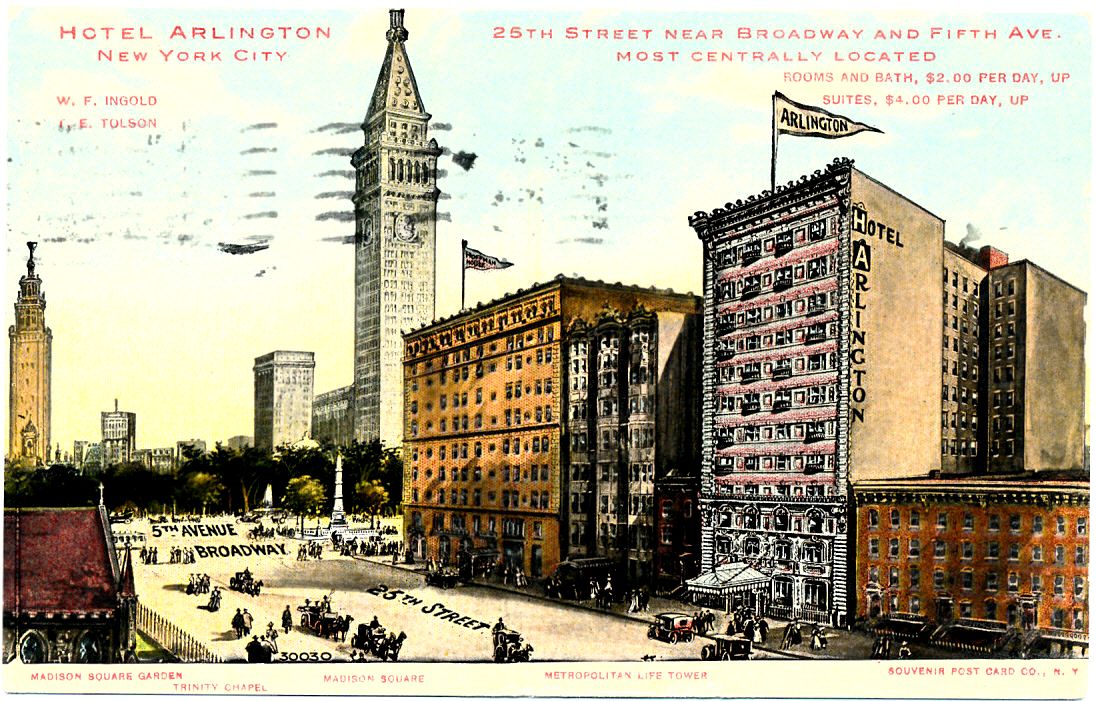
In 1911 the hotel was still being marketing as an upscale establishment and advertisements clearly noted “opposite Trinity Chapel.”  By now it had gained a long glass and iron marquee that protected guests from the weather as they disembarked from their vehicles.  An ad in The Outlook that year said “It is the aim of the management to maintain a high class transient hotel, with comfort and good service at reasonable rates.”  Those rates ranged from $1.50 for a room with a lavatory, $2.00 and up for one with a bath, and $3.00 and up for suites.


This postcard, mailed in 1911, pictures both horse-drawn carriages and motorcars.  The glass-and-iron marquee stretches to the curb.  The tower of Madison Square Garden looms at far left.
Among the celebrated guests staying at the Arlington Hotel in 1914 were Hungarians Baron Otto von Sejer, Barn Jenoe von Kaiser, Baron A. von Peractyanesky, and Counsellor Begnard von Pasky.  The men arrived on the Austro-Hungarian liner Kaiser Franz Josef I on the evening of January 19 and went straight to the Arlington.

The Evening World reported the following day “Four men who are to spend $8,000,000 for the Hungarian Government are in New York to-day sightseeing. It is the first day of their visit to this city and to-morrow they will get down to business, for practically all of the $8,000,000 is to be spent here.”  The dignitaries were in New York to study the American “party line system of telephoning.  The system is to be installed in Hungary and it is probably that American equipment, purchased here, will be employed.”

In 1916 the Arlington Hotel was still offering permanent and transient accommodations.  Calling itself a “Hotel with a Personality,” it charged monthly rates of $30 and up for a single room with running water and the “use” of a bath; $45 and up for a single room with private bath; and $70 and up for a parlor, bedroom and bath.   Weekly rates for the same accommodations were $8 and up, $10.50 and up, and $18 and up. Those residents wishing to take their meals in the hotel were charged $10.50 a week extra.

Well-dressed guests head toward a limousine in 1916.  The New-York Tribune, June 11 1916 (copyright expired)

While the neighborhood around the Arlington continued to change, the residents of the hotel remained upscale.  In 1920 one family living here prepared for the summer by listing advertisements for three positions of its staff of four in its country house.  The advertisements, placed in The Sun and the New York Herald were published on March 19.

CHAMBERMAID (white), good experienced, under 35, required, country house, near New York; family one, help four; two days holiday monthly.

COOK (white), very good, experienced, required at once, country house, near New York; family one, help four; two days holiday monthly.

PARLORMAID, young, with good references, assist waiting and pantry; country house, near New York; family one, help four; two days holiday monthly.


Living in the hotel at the time was Louise C. Ellis.  When she moved in in 1918 at the age of 76, she was intent on claiming her birthright as well as the right to be buried with her parents. The odd chain of events began in 1840 when George M. Chapman and Jane Compton Wells were married in Scotland. 

Louise was born two years later and in 1847 the family came to New York.  Chapman established himself as a fur merchant.  Court documents later said “George M. Chapman was apparently content with his wife and entertained no doubts as to the legality of his marriage until he desired to possess another woman.”

That woman was Louise Wyeth and in 1855 he left his wife and daughter to live with Louise Wyeth.  The pair had a son, Hawley Chapman.  

In June 1922 a reporter from The New York Times visited Louise Ellis, now 80 years old, to interview her regarding her recent court victory.  Louise had received the legal right to be buried in Greenwood Cemetery with her parents “and to establish that they were her parents in law as well as fact.” The victory also meant that Louise expected to obtain half of Chapman’s more than $1 million estate.

“The money comes almost too late,” she told the reporter. “Some years ago I could have used it to a very good advantage, but there are remaining for me but a few years, and all that I can do with the money is to give it to charity.”

Louise described a few of the organizations she felt worthy of receiving her money; but she also talked about current affairs.  When she was asked her opinion of Prohibition, she flatly said she did not like it.  She felt beer was a good tonic and that it had done her a lot of good.

The feisty woman added “Of course, if there are a lot of people who want to kill themselves drinking, I say let them kill themselves, but that is no reason the privilege of drinking what one pleases should be taken away from the rest of the people.”

Eventually, of course, the fashionable tenor of the aging hotel would pass.  In 1937 it was home to gangster Sam Krantz who was tried for racketeering.  Following the murder of mobster Jules Martin, Krantz had taken over control of the racket that controlled the city’s restaurant industry.

In 1950 the hotel, still called the Arlington, received a renovation that resulted in five apartments and five hotel rooms per floor.  In 1954 Miles Davis was still struggling with drug addiction when he briefly moved into the hotel.  Later that year he moved back to his father’s home in St. Louis where he sought to conquer his problem.

Even the iron balconettes, regimentally staggered up the facade, survive.

Before the end of the century the Arlington Hotel finally lost its name, becoming a Comfort Inn.  Most of the former lobby is now a Chinese restaurant and the old glass marquee has been replaced by a sleek modern one.  And yet Israels & Harder’s handsome façade survives almost perfectly intact, a reminder of a more elegant period in the Madison Square neighborhood’s history.

photographs by the author