Showing posts with label east 7th street. Show all posts

Friday, September 4, 2026

Jobst Hoffman's 1880 29 East 7th Street


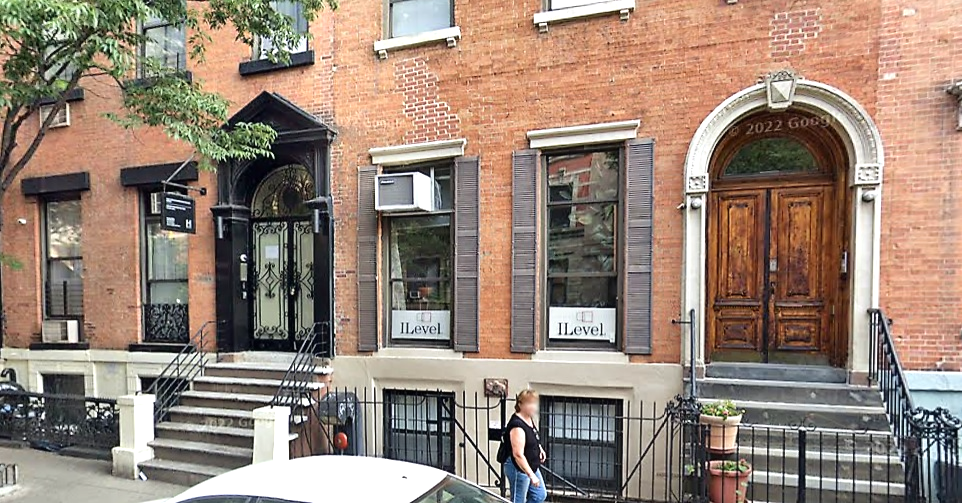
German-born architect Jobst Hoffmann filed plans for a "five-story brick apartment house" at 29 East 7th Street in February 1880 for developer Isaak Horchster.  Hoffmann's plans projected the cost of construction at $11,000, or about $357,000 in 2026 terms.  Seven months later, the Real Estate Record & Builders' Guide's "Watch The Records" column noted that liens had been filed against the owners of 25 and 27 East 7th Street.  The new owner of that property, Z. H. Miller, hired Hoffman to design two apartment buildings that would 
exactly match 29 East 7th Street, already under construction.

Hoffman's design was a blend of Queen Anne and neo-Grec styles.  And he introduced a splash of the Esthetic style in the whimsical cast iron fencing and stoop railings, composed of stylized sunflowers.

The stylized sunflowers were echoed in the incised carving of the stone stoop newels.


The paired ground floor openings shared a lintel decorated with a small rosette.  The centered entrance was crowned with an earred cornice inspired by ancient Greece.  The four upper stories were clad in red brick and trimmed in sandstone.  Hooded lintels decorated the second and fourth floor openings and between the third and fourth, Hoffmann added colorful encaustic, quilt-like tiles.

Colorful Queen Anne tiles and a fanciful cast iron ornament (the left half of which has been lost) decorate the facade.

The brick piers of the top floor wore cast metal capitals decorated with bosses.  They upheld the corbels of the elaborate pressed metal cornice.


No. 29 East 7th Street was known as a "double flat," meaning there were two apartments per floor.  Among the initial tenants was Auguste Schelcher.  He was on his way with friends to the ball of the Société Culinaire Philanthropique on the evening of April 30, 1883, when his night of gaiety turned to horror.  The New York Times reported that the group "were in a pleasant mood."  As they passed 404 Sixth Avenue, Désiré L. Houvet, a French chef and another member of the Société Culinaire Philanthropique, exited the building.  The New York Times reported:

Two or three were in a convivial condition, and they made jocose remarks when Houvet ran out...placing his hands on the shoulders of H. Barbier, of No. 49 West Twenty-seventh-street, and Auguste Schelcher, of No. 29 East Seventh-street, [and] sank to the pavement.  But their merriment changed to fear when they saw Houvet gasping and unable to speak.

The "elegantly dressed" Houvet had just been stabbed in the back by Elizabeth Quinquinet.  The New York Times would later explain, "Houvet, who was single, had led Mrs. Quinquinet astray and they had quarreled."  The 33-year-old Houvet died on the scene and, presumably, the evening that Auguste Schelcher's had looked forward to came to an end.

Josephine Frank, who lived here with her 10-year-old daughter in 1885, was in financial straits.  She was married to Lippman Frank on April 17, 1876, and "lived together for one year and a half.  Then they separated by mutual consent," according to the New-York Tribune.  In January 1886, she sued her husband for support, charging him with abandonment.

In court on January 19, Josephine presented a letter from the Commissioners of Charities and Correction, "stating that it was likely that she would become a burden on the taxpayers, unless her husband was compelled to support her," reported the New-York Tribune.  She, however, had to explain to the court what she had done with the money her husband had provided for.  When they separated, he gave her two houses on East 11th Street.  Josephine claimed that they were "in a bad condition and were torn down soon afterward."  She lost the properties in foreclosure.

Josephine had also neglected to mention that she and Lippman were not separated, they were divorced.  Lippman Frank presented a decree of divorced dated 1878 and Justice Power, "said that Mrs. Frank's claims fell to the ground."  He told the disappointed woman that she could, however, initiate a new suit for the support of the child.

image via the NYC Dept of Records & Information Services

The Hessler family occupied an apartment here in 1896 when their 15-year-old son, Charles, became a hero of sorts.  At 2:00 on the afternoon of July 7, Charles was on the Bowery near Catharine Street.  He saw 68-year-old John M. Sweitzer, who  was inebriated and lived in Utica, staggering along the sidewalk.  Suddenly three men rushed up and robbed him of $40.  The New-York Tribune explained that Sweitzer, "was unable, owing to his condition, to furnish any description of the robbers." 

Young Hessler, however, was quite able to describe them.  He told police that two had boarded a Second Avenue street car and the other went away on foot.  The article said, "With the boy, Detective Cahill entered a corner saloon, and Hessler pointed out [John] Long as the man whom he had seen standing to one side while the robbery was committed."  Charles Hessler countered Long's testimony that he "knew nothing of the affair."  On the weight of teen's affidavit, Long was committed to the Tombs Prison for further investigation.

Pauline Zelba lived here in 1913.  She and two friends, Emma Stern and Celia Shubert partnered in running two cider stubes on East 4th and East 5th Streets.  (Cider stubes were taverns, patronized mostly by German Americans, that sold light food and cider made from fermented apples.)  The women were offering more than cider and sausages, as it turned out.  On April 16, 1913, the New-York Tribune reported that all three were arrested and "charged with keeping disorderly houses in cider stubes."  (A "disorderly house" was the polite term for a brothel.)

By 1924, the basement level of 29 East 7th Street had been converted to two commercial spaces.  Operating from one of them that year was George Withers Music Co.

Music Supervisors' Journal, December 1924 (copyright expired)

There are still just two apartments per floor in 29 East 7th Street.  Because Z. H. Miller wisely decided to have Hoffmann recreate his design at Nos. 25 and 27, the trio has an enhanced presence.


photographs by the author

Monday, June 22, 2026

The Lost Bowery Village M. E. Church - 24-28 E. 7th Street


from the collection of the New York Public Library

Founded in 1794, the name of the Two-Mile-Stone Methodist Episcopal Church was derived from the stone marker that told travelers that the nearby house in which the congregation worshipped was two miles north of Federal Hall.  A later pastor, Reverend F. Bottome, would recall the location 
in his 1864 Bowery Village M. E. Church: A Discourse, saying it "was a rugged belt of land, with here and there a garden and a solitary house to diversify the barrenness of the stunted pasture lots with their dilapidated fences."  

Its rural origins resulted in the makeup of the church's leadership to be slightly different from those in more populated areas.  Kyle B. Roberts writes in his Evangelical Gotham, that because it was located within a "plebeian belt" at the northern boundary of the city, "tradesmen, rather than merchants, served as trustees, class leaders and elders."

Despite its remoteness, the fledgling congregation grew and moved in 1810 from the house to a small building.  (At that time of the move, the name was changed to the Bowery Village Church.)  It moved again in 1818, into a wooden church structure.  Then, in 1835, it began construction of a brick and stone church on the south side of Seventh Street (later East 7th Street) between Second Avenue and the one-block-long Hall Place.  (Hall Place was renamed Taras Shevchenko Place in the late 20th century.)

Completed in 1836, the edifice was an early and striking example of the Greek Revival design.  Its entrance sat within a recessed portico above a broad flight of stairs.  Two monumental, fluted Doric columns flanked by Doric pilasters supported the entablature and Greek temple inspired triangular pediment.  

By then, the city had expanded northward and engulfed the neighborhood.  The New York Times would recall in 1885, "It was at this time one of the wealthiest and strongest churches of the city."  The changes to the formerly rural district were reflected in January 1851 when the city's Committee on Lamps and Gas approved the "placing of two Gas Lamps in front of the Bowery Village Methodist Church in Seventh-st."

The congregation was scandalized in the winter of 1870.  On Friday afternoon, January 7, its married pastor, Reverend Horace Cook, went to a local school and "made arrangements" for him to remove 16-year-old Mattie Johnson.  The cleric and the teen "eloped."

A week later, Mattie's father received an anonymous tip that she was in Philadelphia.  He and his son rushed there and "instituted a diligent search and succeeded in finding her at one of the leading uptown establishments," reported the New York Herald.  Mr. Johnson brought his "prodigal daughter" home.

The family attempted to repair Mattie's ravished reputation.  Rev. Cook, they told reporters, had not shared the room with the teen.  The New York Herald was convinced, writing...

there is not the slightest reason to suppose that Miss Johnson is not as chaste a young lady as when she left her parents' home last week; on the contrary it is asserted that she is in no wise harmed save in the matter of unenviable and unfortunate notoriety.

In the meantime, Reverend Cook's whereabouts was unknown until 10:00 on the night of January 12 when, "as the reporters of the World were closing up their reports, a violent kick was heard at the editorial room door," reported the newspaper.  It was Horace Cook, who slammed his fist on a desk and demanded: "I come here to get satisfaction for the slanderous article published in your paper this morning concerning me."

Rather than succeeding in getting a retraction from The New York World, the editor called for a policeman.  Reverend Cook was arrested.  The Johnson family did not press charges, maintaining that the trip to Philadelphia was innocent, and so Cook was later released.  The following Sunday, the church was jammed with members and outsiders.  They were disappointed to find that a substitute minister, Rev. Dr. Browning, would be giving the sermon.  The New York Daily Herald explained on January 17, "The Rev. Mr. Cook has gone to his family in Williamsburg."  The article said that he would soon return "so that before long the last sensation will have been buried and forgotten."

Four months later, nothing had changed.  A temporary pastor was appointed and on April 7, 1870, the New York Herald said, "Mr. Cook is now in the bosom of his family, over in Williamsburg, restored to the affections of his wife and extremely penitent for his past and wayward conduct."  The newspaper's earlier prediction that Cook would soon--or ever--return did not come to pass.

On October 21, 1872, the New York Herald reported that the church had reopened after "extensive repairs" had been made.  It was most likely at this time that a Georgian Revival style cupola, oddly crowned with onion domes, was installed.

from the collection of the New York Public Library

Around 1880, the name of the congregation was changed to the Seventh-Street Methodist Episcopal Church.  The demographics of the neighborhood had also changed.  It was starkly evidenced in 1882 when the Manual of the Methodist Episcopal Church reported that the Chinese Sunday-School in New York City, established in 1879, had "lately been transferred to the Seventh-street Methodist Episcopal Church."  And the following year, on July 21, 1893, the New-York Tribune reported that Reverend J. V. Saunders, "has begun afternoon services at 4 o'clock in the German language."  The article noted, "The music is good, the seats are free."

By the turn of the century, the East Village district was one of tenement buildings and working class immigrants.  In 1905 the Little Missionary Day Nursery operated from the church, and as early as 1910, physical examinations of underprivileged children who hoped to be sent to the Fresh Air Fund's summer camp were held.  On June 28 that year, the New-York Tribune remarked, "The pitiful thing about these physical examinations is that so small a proportion of the applicants pass."  Most, said the article, suffered with "eye and throat afflictions" and were not "up to the standard of cleanliness."

The following year, the Seventh Street Methodist Episcopal Church melded with the Hedding Methodist Episcopal Church.  The congregation moved into that group's structure on East 17th Street.  On March 26, 1911, The New York Times reported that the Seventh Street church building had been sold.  The buyer was the Ukrainian Greek Catholic Church for the parish of St. George Ukrainian Church.

In 1976 the congregation broke ground for a substantial new church building on the abutting corner property.  Designed by Apollinaire Osadca, it was completed in 1978.  

The old church was dwarfed by the new St. George Ukrainian Cathlic Church building.  photograph by Edmund Vincent Gillon from the collection of the Museum of the City of New York.

With the congregation now in its new home, it demolished the historic 1836 building, replacing it with a modern brick building.  

image via the NYC Dept of Records & Information Services.

That was supplanted in 1992 with a 12-story apartment building.

image via cityrealty.com

Thursday, June 11, 2026

The 1892 Middle Church House - 50 East Seventh Street


photograph by Carole Teller

In 1891, the Middle Collegiate Church hired architect Samuel B. Reed to design its newest church building, at 112 Second Avenue.  This would be its third structure.  The congregation was established in 1729  at Cedar and Nassau Streets.  In 1859 it moved north to Lafayette Place and Fourth Street.

Included in Reed's commission was the designing of the multi-purpose Middle Church House around the corner at 50 East 7th Street.  While he designed the church in the Gothic Revival style, he turned to Romanesque Revival for the church house.  Five stories tall above an English basement, the upper four floors were clad in beige Roman brick.  Reed faced the first floor with undressed limestone--the same material used for the church.  The asymmetrical design included grouped windows at the second and third floors within an arch crowned with a stone eyebrow.  The charming fifth floor design was composed of a tower-like western portion with a triple arcade and pyramidal cap, while the eastern portion was distinguished by a wide dormer with a hipped roof, fronted by a stone balcony.

via the NYC Dept of Records & Information Services

Inside were living accommodations for the minister and his family, an auditorium for lectures and services, a gymnasium, Sunday school rooms, and administrative offices.

The year 1918 was especially noteworthy for Reverend Edgar Franklin Romig.  He was ordained in March, was married to Ella Woodruff Dutcher on May 11, and was appointed minister of Middle Collegiate Church in 1918.  Rev. Romig and his bride moved into the Middle Church House.

Romig had a fascinating past.  Born in Allentown, Pennsylvania on March 22, 1890, he graduated valedictorian from Franklin & Marshall College in 1911 and graduated from the Union Theological Seminary in 1918.  (He would earn an M. A. degree from Columbia University in 1923.)  From 1913 to 1916, he was an instructor at Syrian Protestant College (now American University) in Beirut, Syria.  In August 1914 he served in the American Consulate in St. Petersburg, Russia.

At some point, the building became the repository of William Leverich Brower's extensive collection of historical memorabilia.  A catalogue published in 1926 said, "This collection comprises one hundred and thirty prints and photographs of persons and places chiefly identified with the earlier history of the City and Nation."

The 1930 Year Book of the (Collegiate) Reformed Protestant Dutch Church of the City of New York outlined some of the activities offered in the Middle Church House.  In addition to the "large number of boys and young men at the Sunday School services," said the article, there were Sunday school classes for girls and young women.  Young men were offered physical education and health classes, and a Boy Scouts troop was organized here in 1929.

photograph by Carole Teller

As the East Village neighborhood changed, the offerings within the Middle Church House adapted.  In May 11, 1960, for instance, The Villager reported, "A film, 'Voices Across the Miles,' will be shown...in the Middle Church House" on May 17.  The following year, on February 2, 1961, the newspaper reported on the Middle Collegiate Church's upcoming production of Mascagni's Cavalleria Rusticana.  The article mentioned that dramatic soprano Susan Griska, who would be singing the lead role, "is directing the costuming and staging of the production in the Middle Church House."

Neighborhood outreach was reflected in programs hosted here.  A "Game Night" for the benefit of the Warwick Fund was held here on October 19, 1962.  (The Warwick Fund, administered by the American Philosophical Society, helped orphans of World War II.)  As early as the following year, volunteers from the Society of Illustrators offered art classes to teenagers here as part of the Blue Curtain Youth Program in the neighborhood.  And on April 4, 1983, as reported by The New York Times, the second East Village Arts Festival would open here.  The article said, "Artists, musicians, dancers and other performers who live in the East Village will take part."

With the AIDS crisis ravaging New York City in 1986, Celebrate Life Meal for Persons Living with HIV/AIDS was established here.  At a time when HIV victims were often seen as pariahs, Reverend Gordon R. Dragt, explains in his One Foot Planted in the Center, the Other Dangling off the Edge,

Every Monday night a meal was served, vegetables and groceries were distributed, people were greeted and hugged, a social worker, nurse and nutritionist were available, entertainment was provided, and special event parties were planned.

Around 1987, the Divine Theater was established in the auditorium, staging productions like Bertolt Brecht's theater-dance piece, Dog and Bone in November that year.  The name was changed to the Cooper Square Theater in 1989.  The venue would continue to offer performing and visual arts.  On May 11, 2001, The New York Times reported, "A choreographic collective, De Facto Dance," would be performing for two days at "Middle Collegiate Church Performance Space, 50 East Seventh Street."

Tragedy came on December 4, 2020 when Middle Collegiate Church was destroyed by fire.  Executive minister Amanda Ashcroft summed up the catastrophe to the New York Post.  "This has been a year already with racial inequity, economic inequity, a global pandemic and now our church is burning."

The extended columns give the appearance of having always been there.  photograph by Carole Teller

The shaken congregation rallied.  After holding services online and in East End Temple, plans were initiated to convert Middle Church House to the new worship space.  Recently completed, the facade was deftly altered by the removal of the stoop and lowering of the entrance to grade.  The architects seamlessly extended its engaged columns and installed a two-paneled transom to fill the resultant void.  A double-doored entrance to the worship space was installed to the side.

many thanks to artist Carole Teller for suggesting this post

Saturday, June 21, 2025

Julius Kaster's 1886 46 East 7th Street


photo by Anthony Bellov

Unlike some architects, Julius Kastner did not necessarily specialize.  Instead, his works ranged from warehouses to upscale apartment buildings, and from commercial structures to tenements.  In 1886, developer Jacob H. Miller demolished the vintage house at 46 East 7th Street and commissioned Kastner to design a replacement tenement building on the site.  

The former structure was one of the elegant private homes erected in the early part of the century.  By the Civil War, however, the neighborhood had changed as thousands of immigrants flooded the district.  Tenement buildings like this one would relieve the resultant housing problem.  Five stories tall, it was faced with red brick and trimmed in sandstone and terra cotta.  Kastner created a potpourri of currently popular styles.  Renaissance Revival appeared in the ornate terra cotta plaques and bandcourses; while the neo-Grec style was reflected in the stone lintels, connected to one another by stone bands.  The two-step stoop was flanked by beefy cast iron newels and railings, while handsome Aesthetic style fencing protected the areaways.

Called a "double-flat," 46 East 7th Street had two apartments per floor.  Among the early tenants were a German-born woman, who was struggling to make an income.  She placed an advertisement in The Sun in September 16, 1892 that read, "A young lady as cashier in a cafe saloon, Walter, 46 East 7th st., ground floor, left," and seven days later advertised, "A young German lady gives piano lessons at home."  She tried another tack in October, when a new ad read: "A young German widow wants place as housekeeper. 46 East 7th st. ground floor left.  Walter."

Four years later, another female tenant was creatively looking for work.  She placed two advertisements in the New York Herald on Christmas Eve 1896.  The first read, "Respectable young lady as housekeeper. Mrs. Schach, 46 East 7th st., ground floor," and the second read, "Lady manicure wishes more customers, home or out.  Mrs. Schach 46 East 7th, ground floor."

The Cook family lived here in 1909.  On July 5 that year, 18-year-old Florence Cook went to Pelham Bay Park in the Bronx with two other teen girls.  The Sun reported that they were "crossing [Eastern Boulevard] on their way home...when they heard an automobile horn close upon them.  The other two jumped aside, but Miss Cook was thrown several feet."  The driver sped off but Florence's astute friends were able to remember the license plate number.

Florence was taken to Fordham Hospital with a fractured skull.  She died there two days later without having regained consciousness.  On July 10, The New York Times reported that the hit-and-run driver, "a merchant, now living in Troy," had been tracked down.

Isaac Swimer, his wife and their 12-year-old daughter, lived here as early as 1913.  A marine engineer, Swimer had served in the Spanish-American War.  On April 23, 1913, he was robbed by three holdup men at Sixth Avenue and 14th Street.  They took a ring valued at $150 (nearly $5,000 in 2025).  The three men were arrested, but the Grand Jury refused to indict them "upon their plea that the ring had been taken as a gambling debt in a crap game," reported The New York Times.

Swimer regained his ring, but he was soon back in court over the incident.  The New York Times said, "Later he was fined $10 for beating one of the witnesses who had testified against him."  Because of the holdup, Swimer began carrying a revolver for his protection.

Things were looking well for the family and Swimer opened his own machine shop at 501 East Houston Street early in 1914.  On March 19, he went to Fensterheim's Turkish Baths on Third Street.  He was wearing the ring that was involved in the earlier robbery and another one valued at $60 (about $1,960 today).  He fell asleep in the "cot room" and awakened to discover his rings had been taken from his fingers.  The New York Times reported, "Swimer glared angrily at the two men who had been sleeping at either side of him and asserted that he would have back his rings."

Swimer sent another patron, Arthur Cohen, to report the theft as "he kept his eyes on his nearest neighbors, Sam Connors, alias 'Whitey,' alias 'Spunky'...and Louis Baumgarten."  The newspaper said that both men "had unsavory reputations in the neighborhood."  Cohen returned with a detective but when Swimer could not produce proof of their guilt, the policeman could not pursue the charge and left.

With the officer gone, according to other patrons, Connors "announced that Swimer would never have another chance to 'squeal.'"  The detective had just reached the ground floor when he heard shots coming from above and "a dozen men, most of them clad only in bath towels and sheets, piled pell-mell downstairs."  He returned upstairs to find Swimer "flourishing a revolver."  Swimer said to the officer, "I couldn't help it.  I had to do it."

Swimer had shot Connors through the left temple and Baumgarten just above the heart.  Both were unconscious.  Connors died a few hours later and the following day Baumgarten had little hopes of survival.  Despite the statements by witnesses, Swimer was held in The Tombs charged with homicide.

On August 16, 1924, Herman Tubb, who lived at 247-09 Jamaica Avenue in Queens, walked out of his house to discover that his $500 Chevrolet sedan was gone.  Police found it at Jamaica Avenue and 178th Street being driven by Charles Hammasher, who lived at 46 East 7th Street.  He was charged with grand larceny.

The original stoop ironwork survived in 1941.  image via the NYC Dept of Records & Information Services.

The Lower East Side was the epicenter of Socialist and Communist activities in the first half of the 20th century.  Residents Mike Holvowitz, Ann Segen, and Sophie Semchyn voted for the Communist Party in the 1936 general election (and their names were quickly documented by the Congressional Special Committee on Un-American Activities).

By the Depression years, the first floor apartments were converted to business.  In the 1970s, the film company Parnasses Productions and Contract Aftercare, an abuse treatment center, were located in the building.

Among the residents by the early 1980s was sculptor Michi Raphael.  Born in 1925, she studied with Bruno Luccesi and Manuel Pasquel.  In reporting on her exhibition at the Lowe-Levinson Art Gallery in Miami Beach, The Miami News noted on December 17, 1980, "The artist sculpts most of her works in bronze and stainless steel."

Michi Raphael's La Valse.  image via mutualart.com

At some point in the second half of the 20th century, the brawny stoop ironwork was replaced with modern, much less charismatic railings.  Otherwise, Julius Kastner's 1886 design is essentially intact.

photograph by Anthony Bellov


many thanks to historian Anthony Bellov for suggesting this post

Wednesday, August 17, 2022

The James F. Griffen House - 260 East 7th Street


Around 1848 a row of brick-faced homes was completed on the south side of Seventh Street, between Avenues C and D.  Three stories tall and 22-feet-wide, they displayed expected elements of the Greek Revival style--such as the wide fascia boards and dentiled cornices--but showed hints of the rising Italianate style, as well, in the molded window lintels and tiny brackets below the sills.  Most striking, perhaps, was the ornate ironwork of the stoop, which suggests that while the homes sat apart from the fashionable neighborhoods, they were intended for financially comfortable families.


Shipwright James M. Griffen moved his family into 260 Seventh Street (the "East" would come decades later).  The location just a block from the riverfront was convenient to his work.  Living with Griffen and his wife, the former Mary S. Wheaton, was Mary's mother, Olive, and two boarders, Nehemiah and Electa R. Miller.

Taking in boarders was common even within well-do-to families.  Miller was a real estate agent and the couple was affluent enough to own a summer home in Rye, New York.

New York, Past, Present and Future, September 1851 (copyright expired)

In 1854 an outbreak of cholera broke out in New York.  It grew to an epidemic, eventually killing 2,509 people.  It may have been cholera that claimed Mary S. Griffen on November 19, 1855.  She was 43 years old.  Her funeral was not held in the parlor, as was normal, but in the nearby Church of the Nativity on Avenue C.  A week later Olive Wheaton died at the age of 63.  Oddly enough (given that Mary Griffen's was held elsewhere), her funeral was held in the Seventh Street house.

Griffen left 260 Seventh Street in 1858, as did the Millers.  It became home to the Theodore Forster family, including the Forsters' grown sons, Charles, who was in the shoe business; Isaac, an upholsterer; and Henry and his wife, the former Sarah Nichols.

The family's financial condition was reflected in Isaac's 1862 donation of $45.67 to the Western Floating Hospitals and wounded soldiers.  The contribution would translate to about $1,200 today.

The house was again the scene of a funeral in 1862.  Henry and Sarah's son, Theodore, died on February 5, two months before his 12th birthday.  His casket sat in the parlor until his funeral on Friday morning.

Francis I. A. Boole followed the Forster family in the house in 1864.  The City Inspector, he had a highly responsible occupation.  He had previously held the civic positions as councilman for two years and alderman for six.  The Booles' residency would be short, just two years.  During that time they took in an interesting boarder, Harriet Ray.  The widow of Joseph Ray, she was listed in city directories as "clairvoyant."

In 1867 Nathan Rossman purchased the house.  He and his wife, Adelina (known by her family and friends as "Lina"), had four daughters, Mary, Caroline (known as Carrie), Hannah and Sarah.

Rossman ran a jewelry and china shop at 25 Avenue B.  Profoundly devout, in 1865 he was among the founding members of Chevra Agudeth Achim congregation and served as its president.  Its original 25 members in November 1865 came mostly from the Norfolk Street Synagogue.  The year the Rossmans moved into the Seventh Street house, the shul's membership had grown to 94.

The first of the Rossman daughters to leave was Mary.  She was married to Nathaniel L. Nathan on April 22, 1868 in the synagogue her father helped to found.  In Victorian prose, the announcement in New York Herald wished, "May the happy couple's ship of futurity have a peaceful and peasant passage over the stormy and turbulent sea of life."
 
Nathan Rossman's health began to fail around 1882, and on October 29, 1883, he died "after a lingering illness," according to The Jewish Messenger.  He was 68 years old.

Lina remained in the house, taking in boarders to help with finances.  In 1888, for instance, they included Aaron Hanover and his widowed mother, Sophia; and Gustavus A. Wolfe, who made his living as a clerk.

Lina Rossman sold the property in October 1891 to Sigmund Kraus.  (She moved to Brooklyn where she died on March 29, 1915 at the age of 95.)  Kraus paid $16,500 for the house, or about $484,000 today.  It was almost assuredly Kraus who replaced the entrance doors with modern, multi-paneled examples.

After Kraus sold 260 East 7th Street to R. Sadowsky, it was operated as a rooming house.  Living on the third floor in 1906 was Bertha Cohen, her 17 year old daughter, also named Bertha, and her widowed son-in-law Henry Diamond.

Henry was born in Austria and made his living as a tailor.  Now without a wife had died, he turned his attentions to her sister, Bertha.  Her mother refused to entertain the idea, angering Henry Diamond.  Her disapproval may have been caused, in part, my Diamond's dependency on opium.

It came to a head on September 8, 1906.  Diamond and his mother-in-law got into a loud, heated argument.  Neighbors called for Patrolman Coleman, who was hurrying up the stairs to arrest Diamond, when gun shots rang out.   When he entered the Cohen rooms, Bertha was dead on the floor and Diamond had shot himself twice in the chest.

He was taken to Bellevue Hospital, where he told police he had shot Bertha "because she would not give him money and jewelry belonging to his deceased wife," as reported by The Evening Post.  The newspaper added, "A sister-in-law, Bertha Cohen, seventeen years old, denied this, and said that he had quarreled with her mother because the latter would not allow Diamond to marry her."

In court, Diamond expounded on his story.  On December 17, The Evening World said, "Diamond's wife had died, leaving him childless after seven years married life.  He wanted to marry the deceased wife's sister.  Diamond scolded his mother-in-law because his wife had left him childless, and then shot Mrs. Cohen."

Interestingly, drugs played a major part in Diamond's sentencing.  On the advice of District Attorney William Travers Jerome, Diamond pleaded guilty to first degree manslaughter.  Jerome argued "that the man was an opium fiend at the time of the shooting and that it was unpremeditated," according to The Evening World.  He was sentenced to 20 years in Sing Sing prison, rather than being executed.

The following year Dr. Samuel Herzstein purchased 260 East 7th Street, and opened his medical office in the house.  A well-respected gynecologist, in addition to his practice he published academic articles, such as "Scarlet Fever Complicating Pregnancy, Labor, and Puerperium," published in the September 16, 1911 issue of the New York Medical Journal.

A month before that article appeared, Herzstein's marriage to Esther Kaplan had made news.  On August 23, 1911, The Paterson Morning Call wrote, "Can a mayor elected under the commission government plan perform a marriage ceremony?  He can.  This fact was proved by Mayor Frederick W. Donnelly within half an hour after he had been inducted into office today."  Trenton's new mayor married the couple "in the office of the board of health in the city hall," said the article.  It noted, "The bride was a widow and the bridegroom a widower."

The Herzsteins would remain in the house until the early Depression years.  By 1935 it was again being operated as a rooming house, not all of its residents being upstanding citizens.  That year 39 year old Lewis Hoffman was picked out in a lineup after having been arrested the day before for stealing $3,800 in clothing and furs from the R. W. Clothing Company in Brooklyn.


Although the house has never officially been converted to a multi-family structure, it has three apartments.  Unlike its once-identical neighbors along the row, other than the entrance doors, the venerable house has seen little exterior change.  And its remarkably handsome stoop railings survive mostly intact.

photographs by the author
many thanks to reader Joe Ciolino for prompting this post
LaptrinhX.com has no authorization to reuse the content of this blog

Saturday, July 30, 2022

The William G. Edwards House - 35 East 7th Street


By the 1830's attorney and banker Thomas E. Davis had become, perhaps, more interested in real estate development than his primary professions.  He would become a major player in the East Side east of the exclusive Bond Street neighborhood as it transformed from farmland to residences.  Beginning around 1831, he erected rows of speculative brick homes in the area.

Partnering with Louis Wilcox in 1832, he began construction of one such row on East 7th Street between Second and Third Avenues.  The handsome Federal style residences were completed the following year, valued at $6,000 each—about $191,000 today.

Among them was 35 Seventh Street (the "East" would come later).  Identical to its neighbors, the 25-foot-wide residence was clad in warm orange brick laid in Flemish bond and rose three stories high above an English basement.  Diminutive carved brackets supported the stone window sills and a prim denticulated cornice capped the facade.  The intricate doorway was an upscale element, reflecting that the home was intended for a financially-comfortable family.  Here the round arched door surround with its faceted keystone featured delicate carving and suggested upscale interiors behind its double doors.

The entrance originally matched that of 37 East 7th Street (right).

By the mid-1840's the house was home to William G. Edwards, a fur merchant, and his family.  As was common, they took in a boarder.  William C. Booth an unmarried woolens merchant on Cedar Street, moved in with the family in 1845 and would remain throughout their residency.

A servant made an unsettling discovery that fall.  On September 24, 1845, The Evening Post reported:

Several days ago a male infant was left at the door of the house No. 35 Seventh street.  It was taken into the house, and every effort made to save its life, but it died yesterday.  If the unnatural mother had a heart, this news would wring it to the core.

In 1850 the Edwards family moved down the block to 43 Seventh Street.  Their relationship with their boarder was obviously quite close, and he moved with them.

No. 35 Seventh Street became home to attorney and writer Richard Burleigh Kimball and his wife, the former Julia Caroline Tomlinson.  The couple had married in 1844 and would have five children.

Born in Plainfield, New Hampshire on October 11, 1816, he had graduated from Dartmouth at the age of 17 in 1834 before studying law in New York and Paris.  Kimball traced his American ancestry to Richard Kimball, who landed at Boston in 1634.  

Three years after moving into the Seventh Street house, Kimball left his law practice and ventured into the development of Texas and into writing.  An advertisement for the Texas Land and General Agency said, "The Proprietor of the above Establishment instituted at the City of Houston in March 1843, can be found to day at Richard B. Kimball's, Esq.; No. 35 Seventh-street."  He founded the town of Kimball, Texas and built a portion of the first Texas railroad.

Through his extensive travels he became acquainted with important American and European figures.  According to Appletons Encyclopedia, "He knew Dickens intimately and had met Lamartine, Thackeray, Lord Palmerston, and the elder Peel, and among prominent Americans knew Washington Irving, Webster, and Clay." 

Richard Burleigh Kimball in 1854. original source unknown

Among his many works were the 1850 Cuba and the Cubans; Romance of a Student Abroad, published in 1852; and the 1870 To-Day in New York.

It was most likely one of his many trips that prompted Kimball to first lease his home in 1855.  An advertisement in the New York Herald read:

To Let--The three story furnished house, 35 Seventh street.  It is completely and handsomely furnished, and fitted with gas and water, and all the modern improvements.

The well-respected Kimball suffered a blow to his reputation in the summer of 1885.  On July 24 The New York Times reported, "Richard B. Kimball, a lawyer, was arrested yesterday on an order of arrest...at the instance of Mary A. and Louise Crotty."  The sisters accused him of  appropriating "about $2,689 of the property" of their deceased father's estate for his own use.

In the meantime, around 1861 two widows, Mary A. Rogers and Ann E. Cox, were living in the East 7th Street house--most likely renting it from Kimball.  It is quite possible that the two were sisters.  They remained until 1878 when it was purchased by William Wicke.

It may have been Wicke who replaced the areaway ironwork with extremely eye-catching Aesthetic style fencing.  He sold the house in January 1885 to real estate operator George Roll for $14,500 (about $403,000 in today's money).  By then the neighborhood had changed from one of monied professionals to immigrants, many from Germany.  The once-proud house was now home to several families.  

The Aesthetic period ironwork replaced the original Federal fencing.

When Gustave Solomon purchased the house from  George Roll's estate in 1896, it was described as a "three-story brick tenement."  Interestingly, the property values had not fallen since Roll purchased it.  Solomon paid $15,000 for the house, or $477,000 in today's terms.  Solomon immediately made renovations, hiring architect William C. Sommerfield to remove and reconfigure walls on the second and third floors.

Among the tenants was Dr. Alexander W. Beck.  He was called to the room of Pauline Barnett (described by The New York Press as "a most consummate actress") at 11:00 on the night of November 9, 1896.  The newspaper also mentioned that she "did not bear a reputation beyond reproach," however.  In fact, it appears that Pauline engaged in prostitution with the full knowledge of her husband.

Pauline had been "choked and robbed" the night before, according to the article.  There had been two similar assaults on women recently, causing the newspaper to opine this "might suggest the existence of some maniacal strangler." 

Pauline's husband had not called police.  "It is explained that he thought his wife might recover, and exposure would make their mode of living the harder for them," said the article.  By the time Dr. Beck was summond, he "found the woman violated and unable to recognize any one."  The New York Press said, "He administered morphine, but feared that insanity, if not death, might result."

Although two men were arrested, Pauline denied that either was her assailant.  The New York Press reported, "Some of the police go so far as to say that the woman may be shamming to avoid being dispossessed."  (Prostitution was a sure grounds for eviction in most rooming houses.)

Dr. Beck responded to another disturbing case, this one just across the street, in 1898. On December 11 The Sunday Telegraph reported on "a strange death certificate handed in by Dr. Alexander W. Beck, of 35 Seventh street" to the City Coroner.  "The certificate stated that David Goldberg, aged 2 years and 1 month, of 32 Seventh street, had died Friday afternoon of asphyxia, the burning of one-quarter of his body, and opium poisoning."

The baby had been "horribly scalded by hot coffee" on December 8.  His parents' home treatment was peculiar by today's viewpoint.   They "applied oil and limewater to the burned parts and then poured ink over them."  When that did not work, they called for Dr. Beck, who prescribed a powder containing bismuth, boric acid and opium.  It was to be used sparingly, but the Goldbergs "put the powder on the child very freely," according to the article, "and in two hours the boy was unconscious."  Dr. Beck blamed the parents for not following his instructions, while the Goldbergs maintained that he gave them no directions.

Mrs. Jennie Dorf purchased 35 East 7th Street in 1906.  There were four families living in the house three years later when she hired the architectural firm of Harrison & Sackheim to make significant alterations.  The height was raised to four floors, and the entrance given with a Renaissance inspired triangular pediment.  The alterations cost Dorf the equivalent of more than $175,000 today.

The proportions of the arched 1832 dooway survive within the substantially altered entrance.  The stone pedestals at the foot of the stoop very likely once held wrought iron basket newels.  

A renovation completed in 1955 resulted in a doctor's office on the parlor floor and one apartment each on the others.  The Lower East Side neighborhood was dealing with a raft of problems like poverty and substance abuse at the time.  Living at 35 East 7th Street in 1964 was 19-year old Shirley Neff.  On June 19 that year, undercover police posed as out-of-town college students and visited the East 80th Street apartment of Margaret Hagopian.  They arrested Hagopian for "living off the proceeds of prostitution" and jailed three "alleged call girls," including Shirley Neff.


The venerable house was remodeled once again in 2006.  There are now five apartments in the building, one per floor.  The Edwards house, with its riveting history, stands out among the row with its somewhat quirky 1909 entranceway.

many thanks to reader Joe Ciolino for prompting this post.
photographs by the author
LaptrinhX.com has no authorization to reuse the content of this blog