Showing posts with label east 27th street. Show all posts

Saturday, April 16, 2022

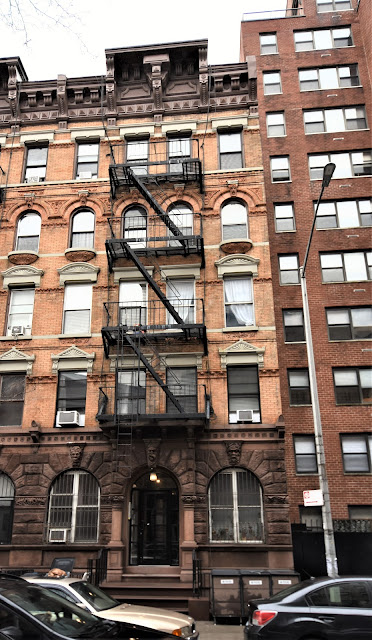
Charles Rentz's 218 East 27th Street


In March 1890, Louis M. Jones purchased the four, four-story stores and tenements at 218 through 224 for $65,000--about $1.9 million in today's money.  Two months later, the Real Estate Record & Guide commented, "Louis M. Jones, of Hoboken, N. J., is quite active in the purchase of down-town lots suitable for improvement."  Jones would not thoroughly carry out this project, however.  On May 28 he sold the properties to Justus H. Zimmerman for $70,500, reaping a satisfying quick profit.  In reporting the sale, the Record & Guide noted, "new buildings projected."

Zimmerman hired Charles Rentz to design his tenement buildings.  The architect was responsible for the sprawling Webster Hall on East 11th Street, completed three years earlier.  The five story structures were designed in the Romanesque Revival style.  Like its identical neighbors, the base of 218 East 27th Street was faced in undressed brownstone.  The centered entrance above a short stoop was flanked with polished granite columns with brownstone capitals.  While the other first-floor portrait keystones along the row took the shape of expected "green men" and Vikings, these are tongue-in-cheek.
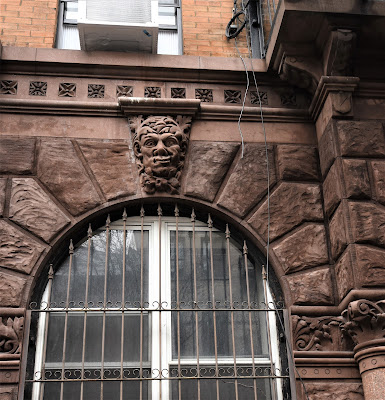
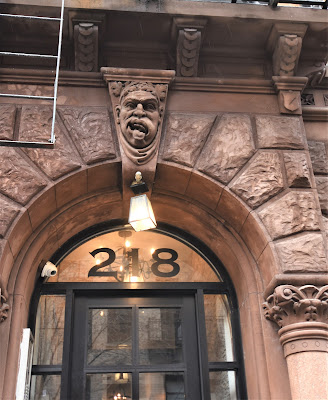

Rentz decorated the brick-faced upper floors with terra cotta and stone elements and capped the row with ambitious pressed metal cornices.

Expectedly, the four-room apartments filled with working class tenants.  One, named Duffy, placed a detailed position-wanted advertisement in the New York Herald on August 3, 1902:

Coachman, medium sized, thoroughly experienced' unsurpassed personal recommendations from prominent families; skillful driver; smart appearance; temperate, obliging, industrious, respectful, trustworthy.  Duffy.  218 East 27th

Hansom cab driver Max Kaufmann and his wife, Mary Emma, lived here at the time with their three young children.  For extra income the Kaufmanns took in a boarder, Adolph Koenig.  But a flirtation between Mary Emma and the boarder soon enraged Kauffman.  The New-York Tribune reported, "Owing to Koenig's attentions to Mrs. Kaufmann, Kaufmann had ordered the boarder to leave the house.  He had done so, but had returned."

It was the last straw for Kaufman, who now ordered his wife to leave.   Mary Emma and Koenig moved into a flat at 319 West 40th Street in March 1904.  The romance quickly deteriorated.  According to a neighbor, Harry Haas, "the man and woman often quarreled, and that more than once he had heard Koenig threaten to kill her."

On the night of May 2, just two months after they moved into the apartment, Haas heard them quarreling again.  He told police, "There was a stormy time."  At one point Koenig slammed a door "so loudly that it shook the house."  Haas and his wife said they assumed that "the quarrel would be fought out and that the couple would go to sleep."  That did not happen.

The following morning Koenig's cries drew attention.  He was found on the floor with a stab wound in his abdomen.  Mary Emma's body lay near him.  Koenig, who was "suffering greatly," explained to detectives that he had gone out for some beer and when he returned around midnight, he found Mary Emma dead.  He then decided to commit suicide and stabbed himself with a butcher knife.

The evidence, however, refuted his story.  Marks on Mary Emma's throat "indicated that she had struggled fiercely before she died," and the cause of her death was determined to be strangulation.  Koenig was arrested on a charge of attempting suicide.  At hearing the news back at 218 East 27th Street, Max Kauffman was resigned.  The New-York Tribune reported he "said last evening that such a termination of his wife's relations with Koenig was not unexpected by him."


Other tenants had similar, respectable jobs.  Edwin Saville was an elevator operator at the Siegel-Cooper department store, for instance; and Luke Monahan was a bartender looking to improve his lot in 1907.  That year he filed for a position as patrolman with the New York Police Department.

George McGee, who worked as a compositor in a printing firm, was involved in a frightening incident on May 18, 1916.  That evening at around 6:00 he sat at the lunch counter at Karn's CafĂ© in Brooklyn.  Sitting next to him was former Long Beach Chief of Police Charles W. Hewlett.  When Joseph Blommer handed McGee his sandwich, he refused it, saying the meat was too fat.  Blommer then offered it to Hewlett, who also refused it.

Blommer became enraged.  The South Side Observer reported, "Angry words ensued and the lunchman...seized a long and sharp carving knife and slashed Hewlett with it five times.  One blow nearly severed the former police chief's nose.  Another cut the back of his neck.  The third sweep of the blade opened his left cheek, the fourth his forehead, while the last took a piece of one ear."

At this point McGee "interfered" and he, too, was slashed on the face.  Finally, other patrons were able to subdue Blommer and hold him until a policeman arrived.   McGee appeared in court as a witness against the attacker on May 25.

Intricate terra cotta elements decorate the upper floors.

John McCartney, who lived here in 1917, was the manager of the Lincoln Giants baseball team.  On April 27, The New York Times reported that he and three other men were arrested and "charged with violating the Sabbath law by indulging in a game of baseball on Sunday."  In court, Inspector Morris testified that he had received a complaint from the New York Sabbath Society that games were being played in the park at 138th Street and Fifth Avenue.

Unfortunately for the amateur players, Sundays were about the only days game could be held.  Most worked six days per week, having only Sunday off.  He told the judge that the previous Sunday he had taken a squad of plain clothed officers to the park and watched a game between the Lincoln Giants and the Bronx Eagles.  The patrons paid a few cents at the gate for a score card.  The offense was considered serious.  McCartney was held in $100 bail--a significant $2,000 in today's money.

A month before the incident, on March 20, President Woodrow Wilson had declared war on Germany.  Later that year a five-mile parade of troops heading off to war was viewed by more than 2 million New Yorkers along Fifth Avenue.  Among them was Mary Flynn, who lived at 218 East 27th Street.  It is possible that her son was among the boys marching, but for whatever reason, she was overcome.  The New York Herald reported that she was afflicted with "hysteria," attended to by a physician in a nearby house, and taken home.

One tenant who fought was James E. McGuire who departed for France on April 6, 1918 with the 308th Infantry.

The demographics of the Kips Bay neighborhood was changing by the Depression Years.  The tenants' surnames, once German and Irish, now represented a wide-variety of ethnicities.  Living here in 1934, for instance, was the Sumpandian family.  That summer Rose Sumpandian and her five-year-old daughter, Surie, had the bad luck to be on the southbound Second Avenue bus that skidded on wet pavement and smashed into an elevated railroad pillar at 37th Street.  They and 11 other passengers were injured, although not seriously.
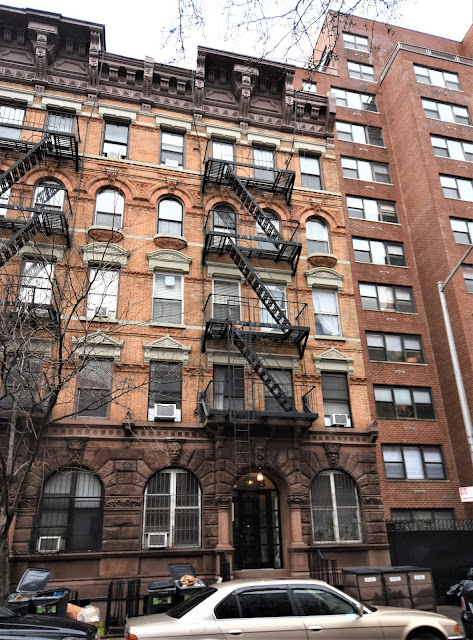

Other than replacement windows, the building is remarkably little changed since 1891.  And it's whimsical portrait keystones are worth a pause.

photographs by the author
no permission to reuse the content of this blog has been granted to LaptrinhX.com

Wednesday, February 2, 2022

The Rose Hill M. E. Church (St. Illuminator's) - 221 East 27th Street


John Watts, Sr. served in the Colonial government--a member of the Colonial Assembly and of the King's Council.  The Watts country estate, Rose Hill, covered more than 130 acres from the East River to what would become Park Avenue, from 21st to about 30th Street.  By the time his son, John Watts, Jr., died in 1836, he had already begun parceling off portions of the Rose Hill estate, as the expanding city slowly encroached on the district.

On August 15, 1842 a single-sentence article appeared in The Evening Post:  "The corner stone of the Methodist Episcopal Mission church on Rose Hill is to be laid this afternoon at 4 o'clock."  The site, purchased in February 1842, was on the north side of East 27th Street, between Second and Third Avenues.

The church would have a permanent home after years of having moved around.  Years later, 1885, The New York Times would recall, "The church had its origin in School No. 24, of the old Female Union Society, which was organized in 1824.  The meetings were then held in the house of Joseph Brewster, on what was then the Boston road, where Thirty-fifth-street crosses Lexington-avenue."  It then moved to O'Dell's tavern near 31st Street and Lexington Avenue, and around 1830 into the Disbrow Academy, on 28th Street near Third Avenue.  The congregation was incorporated as The Methodist Episcopal Mission Church at Rose Hill on April 13, 1835.  

The building was completed within the year, at a cost of $7,000--around a quarter of a million in today's dollars.  It was dedicated by the Rev. Dr. Stephen Olin, President of Wesleyan University.  The congregants would not enjoy their new home for long, however.

Just after midnight on November 18, 1848, fire broke out in the large livery stables of J. & M. Murphy, at the corner of 27th Street and Third Avenue.  The blaze spread quickly and before help could arrive at least 115 horses had died, and scores of omnibuses, sleighs and carriages were destroyed.  The inferno spread down the block, The Evening Post reporting, "The flames extended to and destroyed the Rose Hill Twenty-seventh street Methodist Church, Public School No. 15, and one or two brick and frame dwelling houses on the same block, and opposite the stables."

A new church building was erected within a year's time.  The somewhat severe Greek Revival style structure was faced in red brick.  Four large antae, or pilasters, projected slightly away from the facade.  The entrance sat within an enclosed portico.

The original entrance was strait-laced.  To the right is Public School 14.  photo by Samuel Landsman, from the collection of the Museum of the City of New York

As was the case with most churches, the female members threw themselves into the war effort following the outbreak of the "War of the Rebellion."  They organized the Rose Hill Soldiers' Aid Society, and on October 31, 1862, The New York Times reported, "A reunion of the most cordial character took place on Wednesday evening in the Rose Hill Methodist Episcopal Church.  Its object was to assist, by subscription and immediate donation of money, the self-sacrificing and patriotic efforts of the Society of ladies."

Scattered among the "patriotic glees" and short speeches were testimonials from "the poor invalids themselves, who came forth maimed and halt to bear witness to the worthiness of the appealing cause."  They spoke of the mistreatment in prison camps, the appalling lack of sanitation, and the happiness gifts of "wines, brandies and jellies" brought to the soldiers.  The newspaper said, "a spirit of generosity was aroused quite unusual in a meeting of the kind."

The men, too, responded.  The New York Times would eventually report, "Fifty-three members of the church and Sunday school enlisted in the service, seven of whom died in battle."

In the mid-1870's the church offered its auditorium for meetings of The Universal Peace Union.  The group turned its attention to the Indian Wars during a meeting on January 17, 1876.  One speaker, A. B. Meacham, had served as a missionary to the Modoc tribe.  "He accused the Government of having violated its promises to the Modocs," reported The New York Times.  "Fifteen days after the armistice with the Indians had been made, he said, and while it was still in full force, it was broken by the Army of the United States, seizing the Modocs' horses and keeping them in spite of all remonstrance."

As the decades passed, the Rose Hill neighborhood filled with tenements.  In one of them, at 492 Second Avenue, lived Bella Cooke, perhaps the church's most well-known congregant.  She joined the church in 1847 and had dedicated her life to helping the impoverished families around her.  Later, her doctor, Mrs. Joseph Pullman, would write, "When Mrs. Cooke went to live at No. 492 Second Avenue there were green fields stretching down to the river.  When the neighborhood became what it is--noisy and crowded--her children wanted to move her away."  But Bella could not be moved.  A spinal affliction made her bedridden in the 1850's.

Bella Cooke distributed charity from the bed in which she was confined for more than half a century.  from Rifted Clouds, or The Lift Story of Belle Cooke, 1909 (copyright expired)

Born in England in 1821, she and her husband had come to America a few years after their marriage.  He died of cholera shortly after arriving in New York.  When Bella's spinal condition became so bad that her doctors informed her she would never even sit up again, she turned her attention to helping the poor.  She provided money to needy neighbors and her work became known to wealthy socialites.  "The rich made her their almoner, and through her the poor received coals, clothing, food and money."

In 1897 a special "jubilee" service was held in Rose Hill Methodist Episcopal Church, celebrating Bella's 50th anniversary of membership.  In its January issue, The Record of Christian Work wrote, "Though having nothing, she possessed all things, and besides helping the church constantly from then till now, she has been made by hundreds of wealthy people in this city the medium of relieving thousands of needy sick and starving people."

In August 1900 renovations were made to the church by the architectural firm of James E. Ware & Son.  The modifications, costing nearly $24,000 in today's money, were relegated to the interior.

When Bella Cooke died on November 18, 1908 at the age of 87, she had been removed from her bed only twice in more than half a century.  Newspapers across the city reported on the funeral of Bella Cooke in the Rose Hill Methodist Episcopal Church.  The New York Herald said, "The church was filled with friends of the dead woman, many children among them," and noted she was "known as the 'Second Mother of the Children of Second Avenue.'"  Among the floral tributes was a wreath of orchids from Mrs. Frederick Vanderbilt; a cross of white roses, orchids and lilies-of-the-valley from Catherine Bliss; and lilies from Mary Callender.  The Daily Tribune wrote, "Among those who looked into her coffin were some who were rich and some who were poor.  Behind a woman in rich furs walked a bareheaded, white-haired woman in a faded shawl."

In 1915 the congregation merged with the Crawford Memorial Church, and on February 21 the New-York Tribune reported, "Justice Page has signed an order permitting the Rose Hill Methodist Episcopal Church to sell its church property, at 221 East Twenty-seventh Street, for $50,000, and to apply the proceeds to paying off a mortgage on the Derbyshire apartments, at 217 and 219 East Twenty-seventh Street, adjoining the church and owned by it."

The building became home to the Armenian-language St. Illuminator's Church, founded in 1910 after a schism within St. Gregory the Illuminator resulted in two congregations.  

It was the starting-off point of a parade on Saturday, November 10, 1917.  President Woodrow Wilson had declared it "tag day," in response to the mass genocide of Armenians and Syrians by the Ottoman Empire.  The Brooklyn Daily Eagle reported, "In line were 3,500 Armenians and Syrians who succeeded in escaping the wholesale massacre in Armenia, 200 girls from the Teachers College, Columbia University, and 300 Camp Fire Girls.

It was not until October 1920 that the title of the building was transferred from Crawford Memorial Methodist to the congregation of St. Illuminator's.

On August 2, 1923, President Warren G. Harding suffered a fatal heart attack.   A high mass was held in St. Illuminator's Apostolic church on August 12, The New York Times saying, "During the requiem, which is used by the Armenians only on rare occasions, every member of the congregation remained standing and each held a lighted candle.  The latter is for the illumination of the soul."

The church was closed for a year in 2008 for major renovations.  On August 31, 2009, upon its reopening, The Armenian Weekly noted, "The Mayr Yegeghetzi has always been known as the 'Ellis Island' to New York's Armenian immigrants because of the very important role it played in welcoming them to Manhattan from all over the world."  On September 19 His Eminence Archbishop Oshagan Choloyan, Prelate of the Armenian Apostolic Church of the Eastern United Sates led the re-consecration services.


Unlike its neighborhood, other than the remodeled entrance portico, the appearance of the nearly 175-year old church is little changed.

photographs by the author
no permission to reuse the content of this blog has been granted to LaptrinhX.com

Tuesday, October 27, 2020

The Eleazar Parmly House - 137 East 27th Street


In the early 1850's attractive brick-faced residences rose along East 27th Street, between Lexington and Third Avenues.  The owner of No. 83 East 27th Street (renumbered 137 in 1868) was taking in boarders by 1853 when Peter Mead and Frederick Somers, both printers located in the Bible House, and policeman Daniel Vandewater listed their addresses here.

On August 22, 1855 an advertisement appeared in the New-York Daily Times offering:

Small Cottage House for Sale--In 27th-st, near Lexington av.  The house is three stories, basement and sub cellar, and built in the best masonry; has all the modern improvements, and is in every respect desirable for a small family.  Price $5,700, which includes gas fixtures and furnace.

At the time Dr. Eleazar Parmly and his family lived at No. 1 Bond Street.  His dental office was also in the house, which sat within what was known the Bond Street District.  It had been among the most exclusive residential neighborhoods in New York in the 1830's.  Now, however, it was the center of Manhattan's dental district.  While Parmly kept his office in the Bond Street house, he moved his family to East 27th Street.

In 1895 America's Successful Men of Affairs would remember Parmly as "the father of American dentistry."  Born on a farm in Braintree, Vermont on March 13, 1797, he had shown remarkable intelligence and capability early in his life.  At the age of 16 he passed the examination for the position of district school teacher so successfully that the School Board voted him extra pay.  After just one year of teaching he went to Montreal where he worked in a newspaper office.

Shortly afterward, he moved to Boston where his brother, Levi S. Parmly, was a dentist and through him "acquired a thorough knowledge of the professional."  The brothers went into partnership as itinerate dentists, traveling from city to city in the South.  

America's Successful Men of Affairs recounted a story from that period to illustrate Parmly's "character and determination."  He was escorting a lady to her home after attending a ball and was jostled by a young man "prominent in local society."  The article said "Dr. Parmly did not submit tamely to this insult.  He was tall, athletic, and finely proportioned, and the aggressor received a severe blow in punishment."

He was handed a written challenge the next day by a friend of the young man.  Parmly said "You are as well aware as I am that your friend's conduct was unwarranted and unjustifiable.  By bringing me this note, you have made yourself a participator in his insolence.  I propose to thrash you with your own cane, and if your friend will call I'll thrash him also, after which I am entirely willing to fight a duel with him."

Parmly then grabbed the man's cane, "administered a sound drubbing, and put him out of the house."  Justice and chivalry were far different in the 1810's and he after his arrest on charges of assault, the judge "looked admiringly at him, patted him on the shoulder and said, 'Young man, you did right.  You are perfectly safe in this city from this time.'"

In 1821 Parmly and his brother went to Europe where they studied under the most famous dental surgeons of Paris and London.  Parmly arrived in New York in 1823 and "for a half a century stood at the head of his profession in the metropolis," according to America's Successful Men of Affairs.

He married Ann Maria V. Smith on August 22, 1827, and they had five children who survived to adulthood--Anna, Alexander Ehrick (who went by his middle name), Mary, Julia and Louisa.  Ehrick followed in his father's footsteps, graduating with high honors from the New York College of Dental Surgery in Syracuse in March 1851.  And like his father, he then spent about a year in Paris "industriously pursuing a course of medical and surgical studies," according to the American Journal of Dental Science in 1853.

Dr. Eleazar Parmly around 1850.  via thefamilyparmelee.com

Around the time his father purchased the 27th Street house, Ehrick married Lucy Dubois, of Montbeliard, France.  Both he and his father were artistically as well as medically inclined.  A talented poet, Eleazar wrote his autobiography in verse.  Ehrick was a musician who offered his services to the Oceanic Presbyterian Church, of which he was the treasurer and a trustee.

Despite what America's Successful Men of Affairs called Eleazar's "large income," he and Ann Maria took in boarders.  Martin Wilbur, a streetcar conductor, remained through 1859.  Their other boarder in 1856 was Joseph Wordsdell, a cabinetmaker.

Although he retained possession of the house, Parmly was no longer listed at the address in 1861.  Surprisingly, Frederick Somers, who had lived here as early as 1853, was back with his family.  His son, Frederick D. Somers, was earning a living as a clerk.  Also renting rooms were artist Theodore L. Angerstein and William Foster, a mason.

In 1864 Parmly leased the house to Aaron Rutherford and his wife, Margaret.  Rutherford ran a provisions business on East 27th Street.  The couple apparently considered moving out in the spring of 1869, when an advertisement in the New York Herald offered "To Let--Completely furnished, the three story high stoop brick House, 137 East Twenty-seventh street, with all modern improvements."  The asking rent was $1,800 a year, or about $3,000 per month today.

But instead a deal was worked out and in March 1870 Eleazar Parmly transferred title to the house to Margaret Rutherford.  (Deeds were commonly placed in the wife's name in the 19th century, assuring her of financial stability in the case of her husband's death.)

The Rutherfords housed boarders, as well.  In the spring of 1880 they took in a young father, 27-year old R. S. Checkley, and his three year old daughter, Lilly.  Checkley's story was striking.

Four years earlier, just as he was about to graduate from medical school, he took on the case of 41 year old Adelaide E. Swett.  He explained later that she "was a lady of some means, but a confirmed invalid, having been given up by several physicians."  He was convinced he could help her, or at least prolong her life for several years.

The Sun reported on June 15, "To begin with, he married her."  But four years later he was informed that she was already married, and so he left her and came to New York.  He explained, according to The Sun, "The reason why he took the child with him was that its mother persisted in feeding it on medicated food when the child stood in no need of it.  Besides, he was very much attached to it, and could not bear to part with it."

Adelaide had no intention of parting with the child, either.  She arrived in New York in May with a warrant for her husband's arrest on a charge of abandonment.  She searched for three weeks before spotting him on the street.  She grabbed a policeman, saying "I want you to arrest that man.  He is my husband, and he has run away from me for another woman."

R. B. Checkley was taken in.  At the stationhouse he was forced to reveal Lilly's location.  Adelaide rushed to No. 137 East 27th Street and came back with her daughter.  The following day in court she said she would not press charges.  "She had secured the child, and that, it seems, was all she wanted."

On the evening of June 11 Adelaide and the toddler boarded the steamboat Narragansett headed back to Boston.  The vessel was on the Long Island Sound when it collided with the steamer Stonington.  The following day the Memphis Daily Appeal reported "the present report is that the Narragansett took fire and sunk."   At least 83 fatalities had been confirmed at the time.

On June 20 The Sun reported "Among the victims of the disaster was Mrs. R. S. Checkley, of Boston."  As the Narragansett burned, "a lifeboat manned by men who in the excitement had forgotten to take any oars aboard, floated under the stern of the sinking vessel.  There, by the light of the fire, a woman was discovered on her back upon the surface of the water, with a little child riding upon her breast."

The two were Adelaide and Lilly.  They were both alive and pulled into the lifeboat.  The article said "Mrs. Checkley was exhausted and almost unconscious.  When she found herself aboard the boat she thought she had been rescued without her child, and after moaning some tender words about her 'lost baby' she died."  Checkley received a telegram at the 27th Street house on Sunday, informing him of the tragedy.  "He took the next train for Boston, and by this time he is on his way back in the undisputed possession of his child," said the article.

The following year the Rutherfords moved to Irvington, Iowa and sold the house to De L'Orme Knowlton for $5,000--just under $130,000 today.  He resold it in 1886 to Cacielle Stein for twice the amount he had paid.   She hired architect H. Simberlund to enlarge the house to the rear in May 1887 with a two-story addition.  

Cacielle Stein retained possession of the house into the 20th century, renting rooms to blue collar tenants like Joseph Pierro who endured the embarrassment in 1902 of having his name published for owing "noncollectable" property taxes dating back to 1899.

In 1920 the owners called themselves a "Christian business couple" in their advertisement to rent three rooms at $25 rent (about $320 per month today).

The house was converted to one apartment per floor above a store in the former basement in 1941.  The stoop was removed and all traces of Victorian detailing were removed.  The building was used by a variety of businesses throughout the 20th century—in the 1950's the Helen Goodman Gallery was here, as well as the Davenport Theatre.  In 1956 the first and second story apartments were combined into one duplex.

Seth Ryan lived in the building in 1960.   On January 26 the 21-year old and two friends, Hugh Bruce and Gilbert Demillo went to a rally of 8,000 persons in Union Square who were protesting Nazism and anti-Semitism.  But they were not there to lend support.  At around 7:30, as Rabbi Harold Maraleck was speaking to survivors of Nazi concentration camps, the young men shouted "Heil Hitler" and gave the Nazi salute.  They were arrested and held in $15,000 bail each, charged with disorderly conduct.


Today the masonry of the venerable Parmly house is painted and the former English basement could best be described as an eyesore.  But the stories that have played out within its walls are fascinating.

photographs by the author

Monday, May 6, 2019

The Lost American Jockey Club - Madison Avenue and 27th Street


In the foreground is a portion of a Madison Square Garden porch. photograph from the collection of the New York Public Library
The Civil War was barely over before wealthy New Yorkers turned their attention--and their money--to the sport of kings: horse racing.  Taking the reins, so to speak, was Leonard Jerome who, with other millionaires like August Belmont, founded the American Jockey Club in 1866 and then set out to erect for it a substantial clubhouse and a fashionable racecourse, Jerome Park.

On October 10, 1867 the New-York Daily Tribune wrote "The 'Jerome Day' has become with us almost as familiar as the 'Derby' in England, and though on its annual recurrence 200,000 people do not blacken the highways leading to the Course, still it summons forth a number sufficient to elevate it into the dignity of at last a New-York holiday."

The article waxed poetic.  "In those early October days, with the purple and gold of Autumn on mead and wood, and the glories of the Indian Summer enveloping the earth in their short-lived brilliancy, Mr. Leonard W. Jerome and the American Jockey Club summon us forth to witness the exhibition of all that is admirable in the American race-horse--strength and speed, and beauty and blood." 

Club members had given the 230-acre park priority over their city accommodations.  The course had opened on September 25, 1866 with Ulysses S. Grant as guest of honor.  The crowd was diverse--from millionaires and their wives to the middle class.  Harper's Weekly said "ladies of fashion, ladies domestic, ladies professionally literary, ladies of birth and culture" were there.   The members' wives were buffered within the elegant clubhouse from the less financially fortunate in the stands and infield.

Attendance at Jerome Park, at least from a feminine point of view, was more a social than sporting event.  The following year The New York Times pointed out that one-third of the 10,000 people at a race were women, "far less intent on the races than on meeting friends and having a free and easy social chat.  Not one in ten probably knew or cared a straw about the horses, and their running was merely a pleasant incident in the day's enjoyment."


Non-members in the infield at Jerome Park participate in the 1886 version of tailgating.  Even these spectators were decked out in silk top hats and other finery.  Harper's Weekly, June 19, 1886 (copyright expired)
On July 13, 1867 The New York Times mentioned "We understand that Mr. Jerome intends also to place the superb building, which he is now completing on Madison-avenue, at the command of members of the Jockey Club.  For the purposes of a first-class Club-house there is no building in the country that an compare with it; nor has there ever been an American club organized which offered so many attractions and privileges as this Jockey Club, which, although it has been organized less than a year, already numbers about a thousand members."

Jerome's choice of the clubhouse site, on the southwest corner of Madison Avenue and 27th Street, may have been a bit self-serving.  In his 1872 book Lights and Shadows of New York Life, James Dabney McCabe said of men's clubs in general, "The location of these clubs is very desirable.  They are all in the most fashionable quarter of the city, and their houses are in keeping with their surroundings.  They are elegantly furnished, and often contain valuable and beautiful works of art."

And while the American Jockey Club would, indeed, be filled with costly furniture and artworks, it was removed from the "club district" and sat among the high-class stables and carriage houses of the Madison Square mansion owners.  Among them was Leonard Jerome, whose magnificent residence was just a block away, at Madison Avenue and 26th Street.

The Italianate style, four-story clubhouse sat above a rusticated English basement.  The first floor, accessed by two sideways stoops on 27th Street, was faced in Novia Scotia stone--a light colored sandstone.  Two sturdy stone balconies clung to the Madison Avenue windows, and another appeared on the side street.  The upper floors were clad in brick and trimmed in stone.  The chamfered corner admitted more light and ventilation, and accommodated two more balconies.  

Because much of the club's business was handled in the Jerome Park clubhouse, members did not seem at all perturbed when the New York Yacht Club took most of the second floor in November 1872.  But then again, many of its members--James Gordon Bennett, August Belmont, the Schuylers and the Vanderbilts among them--were also members of the American Jockey Club.  The consolidation of clubhouses was, in fact, a convenience.

In 1873 Wood's Illustrated Hand-Book to New York advised "The New York Yacht Club is situated over the Jockey Club Rooms, on the corner of Twenty-seventh Street and Madison Avenue.  These rooms are beautifully fitted up, and contain a perfect museum of nautical curiosities, comprising some handsome pictures, and a complete set of models of all the yachts that have belonged to the club."

The Yacht Club's three rooms were, according to club historian Joseph Florimond Loubat in 1887, "comfortably and luxuriously furnished."  The reading, or "front room," overlooking Madison Avenue held magazines, newspapers and other light reading.  Here were the more than 120 yacht models.  The room behind that was furnished with sofas and writing tables, and the third room was the bar.  

In the meantime, the American Jockey Club offered what today might be called off-site betting in the Madison Avenue clubhouse.  On January 10, 1874 the New York Herald reported that "A betting book on the Belmont Stakes, to be run for at the spring meeting at Jerome Park, will be opened in a few days at the room of the American Jockey Club...Persons desirous of betting on any of the horses in the stakes will be accommodated in wagers ranging from $10 to $10,000."  That cap was a staggering amount--more than a quarter of a million dollars today.

A rush of bettors besieged the clubhouse as the running of the Belmont Stakes neared.  On June 13 The New York Herald announced "The attendance was very large at the rooms of the American Jockey Club in Madison avenue last evening, and the bidding was very spirited and excited.  The Belmont Stakes was the most important event of the evening, and it is said that $20,000 was put on this race last evening."

The club leased space to two other racing organizations as their city space by 1881.  The Coney Island Jockey Club's offices were in the basement and the Monmouth Park Association had its offices here.  By now August Belmont had taken over as the American Jockey Club's president.

The New York Yacht Club moved into its own quarters at No. 67 Madison Avenue in 1884.  Along with the yacht paintings and models, the members took along the black cat Sam, the club's de facto mascot.

Sam had wandered into the second floor rooms several years earlier while still a kitten.  The New York Times explained "In accordance with a popular superstition his advent under the circumstances was considered 'good luck,' and he was consequently made quite at home, and he remained there.  Sam soon became a general pet of the habitues, and never sought fresh pastures excepting, indeed, for a nocturnal gambol on the roof once in a while."

Sam earned his room and board.  "It is also to be said of him that, though well fed, he was an industrious ratter, and kept the building free from the ravages of the destructive rodent," said the article.

The cat was familiar with each member, welcoming them by "gracefully passing around their legs or sitting under their chairs."  He refused to sleep until the last of the member had left, no matter how late.

Relocating Sam was no easy task and it required trapping him in a bag.  Sam, like all cats, was a creature of habit and when he did not recognize his new surroundings, made a quick escape back to the old clubhouse.  But, "not finding his household gods there, [he] meekly returned to the place, and soon made himself at home."  Members were heart sick when he was found dead in his little bed two years later.

Newspapers took sides in the early 1890's when a bitter battle ensued between the New-York Jockey Club and the American Jockey Club.  One publication wrote that "the New-York Jockey Club was endeavoring to drive the American Jockey Club off the face of the earth" by holding its races on the same days as the Jerome Park events.

As Leonard Jerome had done, the New-York Jockey Club's president, John A. Morris, had constructed a magnificent track, Morris Park, in Westchester County.  The New-York Tribune said "He spent money there on the most lavish scale on the buildings and on the grounds."  

The newspaper reported in August 1893, "Mr. Morris brought about the destruction and dissolution of the American Jockey Club."  By scheduling the conflicting races, said the article, "he dealt the American Jockey club a death-blow."  The writer lamented "No other racing association ever formed in America has approached the American Jockey Club in the dignity, the substantial merit and the excellence of its membership."

The club hung on under the name of The Jockey Club and August Belmont continued as its president.  But New York State's outlawing of track betting in 1908 was a major blow.  That year the club moved into the Windsor Arcade on Fifth Avenue and the clubhouse was sold.  

On December 5 the Record & Guide reported that the Neptune Realty Co. paid $115,000 for the property; a significant $3.25 million today.  Within the year abutting properties were added to the site and in August 1909 plans for the Neptune Realty Building, designed by Maynicke & Franke, were announced.  The building survives.


Real Estate Record & Guide, August 21, 1909 (copyright expired)

Saturday, March 17, 2018

The 1905 Hotel Broztell - 3-7 East 27th Street


The first years of the 20th century saw a flurry of residential hotels being constructed throughout the city.  Their similar brick-and-stone Beaux Arts facades were intended to attract moneyed residents and to imply respectability and prosperity.

On July 1, 1903 The New York Times reported that real estate operators Campbell & Clement and purchased the "three four-story buildings" at Nos. 3 to 7 East 27th Street.  "The buyers will erect a twelve-story apartment hotel on the site."  Under the name of the Argyle Realty Co., they commissioned William H. Birkmire to design the structure.

The old buildings were demolished that year, and then things ground to a halt.  On January 9, 1904 the Real Estate Record & Builders' Guide noted "The Argyle Realty Co's plot at 3, 5, and 7 continues vacant, though plans were filed some time ago and the excavations dug."  Then, five months later on May 7 the journal reported that work was "suspended."

The long delay may have had to do with the Argyle Realty Co.'s cooperative meetings with other hotel developers in the immediate neighborhood.  Progress on three other residential hotels planned on the East 27th Street block had also stopped.

It may have been explained by The New York Times on March 20, 1904 in an article entitled "Solving A Problem With Inside Lots."  It explained that the "struggle for the greatest amount of light and air with the least sacrifice of space" had been solved by the "closely allied" developers who agreed to give up square footage.  "Thus a large T-shaped court will be created, the benefits of which will be shared by three of the buildings."

The dotted lines show the property lines.  The T-shaped light court was shared by the Broztell, the block-through Prince George Hotel to the right, and the Latham Hotel directly behind.  The New York Times, March 20, 1904 (copyright expired)
Originally called the Argyle Hotel, it was the Hotel Broztell by the time of its completion in 1905.  Birkmire's design toned down much of the gushing carved ornament seen on similar hotels.  The rusticated limestone base was punctured by four expansive arched openings, including the entrance with its glass and metal marquee.

The Official Hotel Red Book & Directory, 1903 (copyright expired)
Metal-framed angled bays in the mid-section not only added dimension to the facade, but caught wafting breezes during the summer months.  Baroque parapets rose on either side of the cornice.

From its opening the Broztell saw a surprising array of residents and guests.  Mrs. Leslie Carter was considered "the American Sarah Bernhardt."   On July 15, 1906, the day after her marriage to actor William H. Payne, her 26-year old son Leslie Dudley Carter, gave a dinner in a private room in the hotel.  The guest list included many theatrical figures, including actors Jack Devereaux and William Courtenay, theatrical manager W. J. Dun, and Norma Munro.  Norma was the daughter of wealthy publisher George Munro and lavishly backed theaters and productions.  She was also the closest friend of Mrs. Leslie Carter.

The actress and her new husband were not at the affair, so she missed out on a shocking announcement.  "After the dinner it was reported along Broadway that in the course of the evening young Mr. Carter had announced at it his engagement to marry Miss Munro," reported The New York Times.  It quoted him as saying "Mother doesn't know a word about it and it will be a deuce of a surprise to her."

While the patronage of theatrical types would have made some other hotels socially distasteful; the Broztell's eclectic mix of guests successfully co-existed.  Madeline Howard lived here in September 1907, for instance, when she went on a drive to Coney Island with Austrian Counts Frank and Felix Hoyas in their hired limousine.  (It ended horribly when the chauffeur, traveling at a "whirlwind speed," crashed in the surrey, seriously injuring its occupants.)  And on November 17, 1909 The Times reported "The Princess Lillian de la Pointe registered at the Hotel Broztell from Paris, en route to Chicago."

An electric sign perched above the glass marquee in 1906.  Note the tightly-pleated fabric inside the arched entrance.  The lamps and areaway fencing were removed in 1914 by City orders as "encroachments."  photo by Byron Company from the collection of the Museum of the City of New York

In October 1910 Pittsburgh steel tycoon Alexander R. Peacock purchased the Hotel Broztell for $750,000--about $19.5 million today.  Like his partner, Andrew Carnegie, Peacock was born in Scotland and, also like Carnegie, was an art collector and millionaire.

Under Peacock's ownership the Broztell became exclusively transient.  In July 1912 Silk magazine noted "A hotel that has become very popular with the silk and ribbon buyers during their semi-annual visits to the New York silk market in August and February, is the Broztell on Twenty-seventh street near Fifth avenue...It is an ideal place to lunch, the dining rooms being cool and attractive."  The hotel's 250 rooms at the time (each "with bath and shower") went from $2 to $6 per day--just over $50 for the cheapest.

All hotels dealt with the occasional and unfortunate press coverage of deaths and suicides.  But the Broztell seems to have had more than its fair share.  Among the earliest was that of Mrs. Blanche Carson, the wealthy widow of Dr. Edward Carson.  The Evening World described her as "one of the most prominent clubwomen in San Francisco."  She arrived in New York following an extensive trip through Europe on Monday, March 18, 1912.  Like other wealthy dowagers, she did not travel lightly.  It took five steamer trunks to accommodate her wardrobe and jewelry.

As she passed through Customs, she declared nothing dutiable.  In fact, she had been patronizing the shops of European jewelers and in addition to the $20,000 in jewels she had left with, she had $12,000 in new jewelry.  And she was caught.  After admitting her guilt she was released on $2,000 bail awaiting a hearing.

The 55-year old took an eighth floor room in the Broztell and considered her fate.  The San Francisco Call said "There was no one in [New York] to whom she could appeal for friendly guidance."  And The Evening World described her as being "overwhelmed by the disgrace."

At around 4:00 on the morning of March 19 she untied the 25-foot long rope from one of her trunks, tied one end around the radiator and the other around her neck.  About four hours later a tenant of the Knickerbocker Apartments on Fifth Avenue looked out his window to see "the body, clad in a blue dressing down, swinging on the wall of the Broztell."

Equally tragic and bizarre was the death of Dr. Solomon Fishel the following year.  The 43-year old physician was internationally known for his work with infant incubators.  On Saturday, October 18, 1913 he married Anna Winter.  At 11:30 that night, following a wedding dinner, the newlyweds arrived at the Broztell where they had booked rooms for three weeks before leaving for San Francisco.

At 4:00 in the morning Fischel woke his bride, complaining of stomach pains.  Dr. Maurice M. Berger arrived.  "For two hours the doctor worked with his patient, but at 6:10 Dr. Fishel died," reported The Times the following day.  Fischel had been married less than 10 hours.

The Broztell flexed its wartime patriotism with special military rates.  New-York Tribune, April 7, 1918, (copyright expired)
In 1920 60-year old Samuel Angrnai, the secretary of the Swedish Consulate, lived at No. 60 East 124th Street.  But like many despondent persons, he preferred not to end his life at home.  He checked in to the Broztell on November 28 where he was found the following morning suffering an overdose of morphine.  He left two notes, one to an undertaker and the other explaining his actions, saying "he had grieved much over the death of his daughter last April," according to The Times.

The hotel was popular among buyers.  This ad calls it "headquarters for Carpet Men." Price's Carpet and Rug News, December, 1921 (copyright expired) 

A similar tragedy occurred on August 18, 1921.  Robert Rosenfeld, a Madison Avenue apparel manufacturer, lived in Great Neck, Long Island.  He visited David Bell, a buyer from Cleveland, in his Broztell room that day.  When Bell realized he had a conflicting appointment, he asked Rosenfeld to wait and he would be back shortly.  Rosenfeld agreed.

When Bell returned he found Rosenfeld dead.  The New York Herald reported "A glass containing cyanide of potassium in solution was on the table."  He left a sealed note addressed to his wife.

But perhaps no suicide in the Broztell Hotel drew more attention than that of author Frederic Van Rensselaer Dey, whose prolific works included the famous Nick Carter detective stories.   Dey was close friends with high-ranking police officials, including Commissioner Joseph Faurot.  Faurot's tales of crime-fighting provided Dey with fodder for his weekly fiction.

By by the early 1920's the days of pulp fiction were waning.  In 1919 The Atlanta Constitution published his The Lady of the Night Wind in daily installments; but The New York Times deemed it "somewhat cheap and dime novelish."  Concerned that his long literary career was drying up, he checked into the Broztell on April 25, 1922 as J. W. Dayer of Nyack, New York.

After being in his room for a while, he returned to the lobby with sealed notes and asked manager Frank Pierce to have them delivered the following morning.  One was addressed to Commissioner Faurot, and another was to Ormond G. Smith, president of the publishing firm Street & Smith.

Upon opening the note, Smith rushed to the Broztell.  Dey's room was forced open and he was found with a gunshot wound to the head.  His note to Faurot read:

Dear Old Joe:  Please forgive me.  Be good to and help Hattie, my wife.  I can't stand the gaff, Joe, so I am going out.  Everything has gone to smash and me with it.  Goodby [sic] and God bless you.  V.R.D.

When Alexander R. Peacock died in 1928, Prohibition had been in effect for eight years.  The law not only dealt a heavy blow to hotels and restaurants, it put many of them out of business and their employees out of work.  Some, like the Hotel Broztell, struggled to survive by surreptitiously side-stepping the issue.   It was an especially gutsy move on the part of Broztell's management, since Prohibition Headquarters was located on the same street, just two blocks away at Nos. 45-47 West 27th Street.

Suspicious that alcohol was being sold here, on April 17, 1931 undercover agents staked out the hotel.  The following day The Times reported "Louis Kaufman and Murray Fogel were arrested in an automobile parked in front of the Hotel Broztell in East Twenty-seventh Street when...they were about to make a delivery of liquor in the hotel."  The agents seized two cases of scotch and one and a half cases of rye.

The third floor balcony was originally fronted by stone balustrades.
On February 9, 1934 Columbia University purchased the Broztell at an auction sale.  It sold it just two years later, on April 7, 1936 for $350,000.  In reporting on the sale, The New York Times said "The new owner will modernize the structure and install new furniture."  That new owner, Latham Hotel Realty Corp., went well beyond new furniture.  It connected the Broztell and the Latham Hotel on East 28th Street internally.   In 1941 the ground floor was altered by architect Sampson Gray to create a storefront.

The Broztell Hotel limped along, eventually becoming a welfare hotel, until it was purchased by Urs B. Jakob in 1992.  Once again separated from the Latham Hotel, it was renamed the Gershwin.  On February 20, 1994 Alan S. Oser, writing in The Times noted that Jakob "is gradually converting it to a dormitory-style hostelry.  Sixty-five of the 164 room are run as dormitories, usually with four beds to a room.  The charge is $17 a bed per night."  To attract his targeted audience, Jakob installed Pop Art sculptures in the lobby and created small lounges "to help young international travelers get to know each other."

Jakob owned a soup can signed by Andy Warhol which became his inspiration for a party on what would have been the artist's 67th birthday in August 1995.  The event attracted 250 guests from as far away as Nice, France, the home of painter, author and star of several Warhol movies, Ultra Violet.  The following year, in March, a memorial service for playwright, director and producer Anthony Ingrassia was held in the hotel.

In December 2014 a $20 million, year-long renovation was completed by Triumph Hotels.  Included was a name change from the Gershwin to the Evelyn, in honor of the colorful actress Evelyn Nesbit, the love interest of architect Stanford White.  Crain's New York Business, on December 16, said the name switch "is meant to reflect the evolution of the hip neighborhood in which the hotel is located."


Triumph Hotels's CFO, Ronny Apfel, concurred, adding "We needed to bring the hotel up to the standards of NoMad."  The upgrades were reflected in the room rates, which started at $400 per night.  The Evelyn was given a 21st century face lift with giant illuminated tear drops that cascaded down the 1905 facade.

The well-known tear drops are gone now, giving the Evelyn a less edgy appearance.  The vibrant history that has played out within its walls far outshines the statley Beaux Arts design on the outside.

photographs by the author

Wednesday, July 8, 2015

The Bromhall Playhouse -- 138 East 27th Street


The handsome brick-faced house at 138 East 27th Street between Lexington and Third Avenues had suffered indignation by 1886.  Constructed for an upper-middle class family, it boasted little extras that only a financially comfortable owner could afford—an ornate foliate-bracketed cornice, carved stone lintels, rich arched double entrance doors, and a lacy cast iron porch.

But now the parlor and basement levels had been converted to commerce as the garment district engulfed the neighborhood.  Oddly enough, while a vast protruding shop window had been installed above the ground floor, the stoop, porch, and original doors survived.

The coat manufacturer who operated out of the lower level advertised on October 18, 1886, “Operators wanted on linen and alpaca coats; work given out to good hands.  Ring basement bell.”   The mention of “work given out” referred to the practice of allowing women to work on garments at home, earning money by the piece.

In the meantime, the rooms were rented out upstairs.   Here on Sunday, January 27, 1889 the unmarried Faith Lomvise Kerr died.

In August 1891, the Welsh Baptist Tabernacle purchased the house and hired architect Charles Rentz to make interior renovations.  Just two years later the organization sold the property to the First Swedish Baptist Church.  Founded in 1867, it had conducted services at the Mariners’ Temple Baptist Church until now.   The ground floor housed the church auditorium, while the pastor, The Rev. Andrew P. Ekman, lived on one floor; the sexton, Joel Vichman, lived on another; and the parlor level shop became the home and business of Anna Baker, a dressmaker.


A dressmaker did business on the converted parlor level.  The fancy cast iron porch remained.

Trouble came in 1895 when Charles Simon attempted to open his saloon at 98 Lexington Avenue.  The New York Times, on August 21, reported “The pastor and Trustees of the Swedish Baptist Church are anxious that he shall do nothing of the kind, as they say there are already too many saloons in the neighborhood.” 

The church opposed Simon’s application for a liquor license, saying that his saloon would be within 200 feet of their church and in violation of liquor laws.  When his license was refused, Simons went to court.  His argument was, according to The New York Times, “The building in which the Swedish Baptist Church is worshiping was originally a private residence.  The ground floor was remodeled for church purpose, and the upper floors are let out as flats.”

Amasa Thornton, the attorney for Simon, did not contest that the saloon was within 200 feet of the building.  “We do say, however, that this case does not come under the statute, as the building is not used exclusively for church purposes.  Surely if they let out part of their place for a dressmaking establishment, the objection to our license fails.”

Anna Baker became a victim of the legal squabble. 

When the church’s attorney, Julius Mayer, countered in court that there was no dressmaking establishment in the building, Thornton replied, “No, there is not.  After we began these proceedings they made the poor woman get out.  On the very day we served notice of this order, she was served with notice to quit.”

“That was only a coincidence.  Nothing but a coincidence,” insisted Mayer.

Thornton was unmoved.  “Perhaps, but a very peculiar coincidence.  But, aside from that, the place is a sort of boarding house.”

Two days later Judge Giegerich ordered the Excise Board to issue Simon his liquor license.

Not long afterward, the First Swedish Baptist Church moved to 141 East 55th Street and the 27th Street house was taken over by the Greek Holy Trinity Church.  But that arrangement, too, would not last.  In March 1904 the church purchased property on 72nd Street between Third and Lexington Avenues. 

The Knights of Columbus used the house as a headquarters for a few years, calling it the Alcazar.  On July 21, 1905 a meeting was held here “for the purpose of perfecting arrangements for the erection of a Roman Catholic Chapel on Blackwell’s Island,” as reported in the Real Estate Record & Builders’ Guide. 

In the spring of 1907, the house saw a rapid turnover of owners.  On May 5, The New York Times reported that real estate agent R. Wilmarth Appleton had not only sold, but resold the building.  In reporting on the sales it mentioned “The building is now occupied by the Knights of Columbus.”

This particular group was a specialized faction called the “Order of Alhambra.”  In 1908 The Catholic Fortnightly Review wrote that the order, “as our readers are probably aware, is a secret society within a secret society, its membership being restricted to ‘Knights of Columbus.’”

Once a year the group made a “pilgrimage to the shrine of Mecca” (the Yorkville Casino on 86th Street between Second and Third Avenues).  On November 16, it met at the Alcazar to complete arrangements.  The Catholic Fortnightly Review reported on the meeting in florid, tongue-in-cheek prose:

There was a large and imposing gathering of ‘Nobles,’ and the pedigrees of the neophytes were handed in and the mettle of which they are made was discussed, for only those who have proven their ability to sustain the fatigues of a day of battle can travel over the burning sands toward those sunny lands where sweet aromas scent the air, and the sight of roses always in bloom rises the spirits of the traveler to that seventh heaven promised by the prophet to each one of his faithful followers who will make this pilgrimage.

Following the meeting was a “feast of fun.”  The Review noted, “No doubt all this is excruciatingly funny to the average ‘Knight of Columbus’ and agrees perfectly with his exalted notions of ‘true knighthood;’" but it cautioned “Old-fashioned Catholics, however, are inclined to view such antics with a degree of scandal and alarm.”

In 1912 the house was home to an even more peculiar group.  The New York State Association of Spiritualists used it as the New York City “spirit temple.”  In March that year it was the scene of the Spiritualists’ Convention.  Hank R. Savage, uncle of renowned spiritualist Floy Cottrell, was president of the State Association.  On March 8, he told the convention of events that had occurred in Cotrell’s home.

The Sun reported that “once he made a sewing table in Miss Floy’s home on a farm twelve miles south of Buffalo go across the room, slip two of its feet into Miss Floy’s Uncle Hank’s rubbers and then go out through the sitting room to the kitchen and climb into the sink.”

The days of psychics and rappings and tappings in the building came to an end in October 1914 when its owner, Max Goebel, leased the property to the Bromhall Players of Stamford, Connecticut.  The New York Times reported that “Benjamin B[utler]. Davenport, who is the leading factor of the Bromhall Players which is a theatrical and musical organization, intends to remodel this building by putting in balconies, club rooms, reception rooms, &c.  The lease is for ten years.”

The Bromhall Players intended to have the remodeled building ready by Thanksgiving.  But that was not to be.  The renovations were not completed until spring, but were worth the wait.  On March 27, 1915, The New York Times reported on the outcome.

Calling it “Manhattan’s tiniest theatre,” the newspaper announced “What was the first two floors has been converted into an attractive little lobby and auditorium.  The lobby is not much larger than that of a private house, and its capsule box office is just about big enough to hold the receipts for a capacity audience if every one pays in bills.”

The gray-and-gold auditorium with its small balcony was capable of holding 225 people, and the stage was of normal size.   “A novel indirect lighting scheme has been adopted, the illumination coming through many French windows down either side of the room.”  The upper floors had been transformed into dressing rooms and offices. 
Through it all the wonderful porch and Victorian entrance doors survived.

The plays presented at the Bramhall Playhouse were written by Butler Davenport himself.   A new performance was presented every three weeks.  Opening nights were for the 90 subscribers only, and the playhouse had an impressive list of season-ticket holders.  Among them were Mr. and Mrs. Otto Kahn, Mr. and Mrs. Edward Curtiss, Mr. and Mrs. Edward De Forest, and the J. B. Whitneys.

Eventually, Davenport staged productions by other playwrights—Moliere, Maugham, Galsworthy and Racine, for example.  The successful venture was such that before the lease was up the Bramhall Players purchased 138 East 27th Street.  In July 1920 it added to its holdings by purchasing the three story house next door at No. 140.

Davenport leased the auditorium, as well, to small theatrical groups.  In March 1921, The Hungarian Players Society gave a five-night performance, and in May that year The Stockbridge Stocks produced the three-act drama Jezebel here.  The New-York Tribune pointed out that the company “began operations on the roof of a New York house last summer.”

In February 1931, as the Depression raged, the bank foreclosed on the building.  Butler Davenport, refusing to lose his theater, appealed to the public for donations to prevent the closing of what was now known as the People’s Playhouse.  When the property came up for auction on February 27, Davenport was successful in re-purchasing the building.

With Depression era audiences unwilling or unable to afford the luxury of a night at the theater, Davenport stopped charging admission.  In 1939, the Federal Writers’ Project’s New York City Guide wrote “General admission is free, and only the few reserved seats are paid for.”

Davenport would later say “I have dedicated my life to spreading the idea that nobody should pay for theatre admissions.  We have free schools, free art museums, free symphony concerts and libraries.  Why not theatres?”

Four years later on October 6, 1943, Sam Zolotow, theater critic for The New York Times, remarked “Year in and year out the venerable Davenport Free Theatre operates at 138 East Twenty-seventh Street, with the indefatigable Butler Davenport in charge of every department from the front of the house to backstage, and oftentimes doing most of the work himself.”

The relentless actor, playwright, and producer appeared in a solo performance here in March 1955.  The production was entitled An Evening With Davenport.

Davenport lived in an apartment on an upper floor of the building.   He died at the age of 86 in 1958. 

The following season, beginning in March, the theater was leased to Harvey Cort, who had been with the Columbia Broadcasting System.  “Mr. Cort’s first bill there will be a revival of ‘The Innocents,’ which he will stage with Peggy Feury in the leading role,” announced The New York Times on March 19, 1959.

Called the Gramercy Arts Theatre in 1972, it became home to Repertorio Espanol.  The company offered a venue for Hispanic actors and filled a void for Spanish-language audiences.   Repertorio Espanol continues here today.


Through its widely-varied history, 138 East 27th Street has astonishingly retained its original doorway and its marvelous cast iron porch.  Despite the many alterations, its layers of use—private home, church, dressmaker shop, and theater—comfortably coexist and testify to the building’s rich history.

photographs by the author