Showing posts with label de lemos and cordes. Show all posts

Thursday, October 17, 2024

De Lemos & Cordes's 1890 247-251 Elizabeth Street


The architectural firm of De Lemos & Cordes would be best known for the Beaux Arts commercial buildings it designed in the 1890s, like the massive Siegel-Cooper Department Store on Sixth Avenue.  In October 1889, six years before designing that building, De Lemos & Cordes filed plans for a much different commission--two five-story store-and-tenements at 247 through 251 Elizabeth Street.  Interestingly, because the two buildings would occupy three 20-foot wide plots--splitting the middle plot in half--the southern building had two addresses, 247-249, while the identical northern building went by 251 Elizabeth Street.

At a time when tenement buildings often displayed overblown ornamentation, De Lemos & Cordes designed the two buildings in a dignified take on Renaissance Revival.  Faced in red brick above the cast iron storefronts, the buildings were divided into three horizonal sections by terra cotta intermediate cornices--each decorated with a frieze of terra cotta ornaments.   A frieze of blind rondels and fluted pilasters ran below the terminal cornice.  Each of the buildings cost $18,000 to construct--equal to about $615,000 in 2024.  There were two apartments per floor in each building, and two stores each at ground level.

The new structures sat within what newspapers called the "Italian community" and nearly all the tenants had Italian surnames and, most likely, spoke Italian as their first language.  


Among the initial residents of 251 Elizabeth Street were Antonio Gravallese, a tailor, and his family.  He had left his wife and children in Italy and established himself in New York before sending for them in 1886.  Life in America was good for the family.  The Evening World commented, "All the family were industrious and they prospered.  The eldest daughter married a young Italian tailor and then Filomena went out to sew and help swell the family treasury."

Filomena was 18 years old in 1891, described by the newspaper as, "a pretty, plump, red-cheeked Italian girl."  Boarding with the family was Antonio Cerriglio.  Although he did not have a regular job, The Evening World said he "made money nevertheless in speculating and acting as a real estate agent."  Unknown to the family, who considered him "more like a relative than a boarder," he was falling in love with Filomena.

Filomena found a job working in a shop where she had caught the eye of Cyrille Buhot, "a dashing Frenchman, thirty-three years old," according to The Evening Word, which added, "It is little wonder that her brilliant black eyes and cherry lips captivated Cyrille."  The two fell in love and, after Cyrille found a better paying job in a Fifth Avenue tailoring shop, he asked Filomena to marry him.

The proposal caused heated arguments in the Gravallese apartment.  Filomena's father reportedly said, "Do not wed a Frenchman.  Wed one of your own countrymen.  You are too young to marry, anyway."  The love-struck teen rebelled, threatening to elope.  In the meantime, Antonio Cerriglio listened in, his jealousy mounting.  Not long afterward, in April 1891, he stalked the couple along the Bowery.  The Evening World said he, "glowered threateningly."

On May 8, Antonio Gravallese and Filomena argued again, this time because she stayed out late.  The following day, Filomena and Cyrille decided to get married secretly.  As she waited outside Cyrille's boarding house, Filomena noticed Antonio Cerriglio.  When Cyrille appeared, she whispered, "See! There is Cerriglio following us.  I fear he means harm."

Cyrille replied, "Never mind, let us hasten along."

They had walked about a block when Filomena heard the report of a pistol.  As she whirled around, Cerriglio fired two more shots into Cyrille's back.  The young assassin turned to flee, but ran directly into the arms of Detective Sergeant Cosgrove.

The Gravellese family was shocked.  The Evening World said,  "Her family had never considered [Cerriglio] as Filomena's lover, thinking she was too young to marry."  The article added, "They knew little about Buhot, but objected to his attentions to Filomena simply because he was a Frenchman and not an Italian."

In 1893 a small pox epidemic broke out on New York City.  City officials struggled to educate tenement house residents about vaccinations.  The often ill-educated group distrusted the life-saving inoculations.  On April 30, 1894, The Evening World reported that 15-month-old Victoria Francesco, whose family lived at 251 Elizabeth Street, was one of six new cases of the disease.  A month later, on May 21, 1894, The Evening World headlined an article, "More Small-Pox Patients," and listed among the afflicted 37-year-old Mary Farra, who lived at 247 Elizabeth Street.  Somewhat interestingly, the article noted she "recently left the Ward's Island Insane Asylum."  She and little Victoria Francesco were now transported to another facility, the North Brother Island quarantine hospital.  

Like Antonio Cerriglio, the Italian-born residents of the buildings often settled their differences violently.  On June 13, 1896, Marie Nuccio was told that a neighborhood woman, Marie Franz, was repeating unkind rumors about her.  She stormed off to the Franz apartment at 129 West Third Street "for the purpose of asking what Mrs. Franz meant by spreading reports detrimental to her character," said The New York Times.

"Before she and Mrs. Franz had talked for three minutes they were pulling each other's white hair and punching each other in the face," said the article.  Zeni Franz came to his wife's aid just as a passing policeman heard the uproar and intervened.  While Franz was released because he "had only interfered to save his wife," Marie Franz was arrested on a charge of assault.

At the turn of the last century, the two commercial spaces in 247-249 Elizabeth Street held the Banco Italiano and Nicola Centocosti's cafe.  The private bank was run by Dominico Bonomolo.  Like Nicola Centocosti, he and his family lived in the rear of the commercial space.

The rooms behind the bank were apparently well-filled.  According to The New York Times, living with Dominico Bonomolo and his wife, Gracia, were "his cousins, his aunts, and a bright green parrot."  On January 16, 1900, Gracia Bonomolo attempted to light the kitchen stove using kerosene.  The Times said she, "absently spilled the oil, and when she added the lighted match the partition and its hangings blazed up."

 The Evening Post reported, "The occupants of the house rushed shrieking into the street, but Bonomolo rushed to the window of the bank, where there were several hundreds of dollars in gold and foreign exchange, and began throwing the money into a bag."

As passersby watched, Bonomolo was overcome by smoke and fell to the floor.  Seemingly fearing more for the money than for the banker, they smashed the window and "began sweeping the money into their aprons and pockets."  Happily, firefighters soon arrived and extinguished the blaze.  Bonomolo was rescued.  As it turned out, his neighbors had been concerned for his financial well-being.  "None of the money was lost," said the article.

The only casualty was the parrot.  On January 17, The New York Times wrote, "Bonomolo was in his counting room in the afternoon attending to business as usual, while Little Italy filed into the rear room, where the parrot lay in state."

Coffee, wine and pasta were not the only things served at the Centocosti cafe.  On January 26, 1901, two plain-clothes detectives "made a raid" on the establishment.  The New-York Tribune reported, "The policemen say that an Italian gambling game known as 'segment' was being played."  All the patrons escaped, but Nicola Centocosti was arrested.

The Formosa family lived at 247 Elizabeth Street in 1901.  On February 5 that year their son, Rosario, was hanging out with a gang of boys on Varick Street.  The New York Times reported that they, "resolved that it would be a great joke to kill the first policeman who passed.  Rosario was selected by lot in true Mafia style."  The teen was well equipped for the job.  The newspaper noted he, "whetted the edge of a stiletto, placed another in his belt, and unlimbered his trusty revolver."

A pedestrian who overheard the gang warned Policeman Wooley of its intentions.  So when he turned the corner, he had his nightstick ready.  As Formosa lunged with his knife, Wooley knocked it aside with his stick.  Changing to his stiletto, Formosa lunged again.  "Misjudging the location of the officer's vital organs on account of his girth, the point of the weapon landed on the patrolman's belt buckle," said The Times.

Rosario Formosa yelled, "He's got on a coat of mail," and ran, tossing his weapons one-by-one into snowbanks.  Policeman Wooley was right behind and captured the teen after a chase of three blocks.  He was held on $1,000 bail awaiting trial--a significant $37,000 in today's money.

Frank Bareale ran a grocery store in 251 Elizabeth Street by 1906.  At the time, the Italian community was plagued by a terroristic group called La Mano Nera, or the Black Hand.  The Italian-American group used violence, including assassinations and bombings, to extort money from well-to-do Italians.

On December 31, 1906, The Sun reported, "The ten families in the big tenement at 251 Elizabeth street were thrown into a panic early yesterday morning by an explosion under the window of Frank Bareale's grocery store on the ground floor."  The loud boom "alarmed all the tenants, who rushed from the building scantily clad and shrieking."

The significant explosion blew out windows across the street.  Bareale and his wife and three children had been asleep in the apartment behind the store.  He told police that he had never received any Black Hand letters and he knew of no enemies.  The Sun reported, "The police, however, believe that Black Hand agents have been after him and that he is afraid to talk, fearing that they might resort to something more effective."  The article commented, "This is the third explosion that has occurred in the immediate vicinity within the last three months."

The lives of the tenants of both buildings continued to be marked by violence.  On December 25, 1916, the New York Herald reported that Salvatore Costa, a 28-year-old bricklayer who lived at 247 Elizabeth Street, had been arrested for "attempting to shoot Detectives Santanello and Terra."  The article explained, "Costa attacked a drunken man early in the morning at Elizabeth and Prince streets and when they interferred [siche drew a revolver and pulled the trigger twice, but the cartridges failed to explode."

By 1912, one of the ground floor spaces in 251 Elizabeth Street was home to the Goritza Social Club.  The Italian-American club was raided in December 1918 and 25 members arrested for gambling.  The New-York Tribune reported on December 16, "Evidence to show that the men had gathered to collect money for the Red Cross was given."  Whether or not the alibi was true, Magistrate Joseph Corrigan dismissed the charges, saying (surprisingly), "If a man wishes to bet on a ball game or a horse race it is his privilege to do so."

Residents of the two buildings, described as "cold water flats," continued to be the perpetrators or the victims of violence over the years.  In February 1920, 20-year-old Michael Romano, who lived at 251 Elizabeth Street, was arrested for armed robbery.  He and an accomplice had entered an elevator at 716 Broadway and held up the passengers.  

Salvatore Lolacano and his wife ran an Italian restaurant at 247 Elizabeth Street that year.  On the night of December 10, 1920, they were counting the day's receipts when the door burst open.  The Evening World reported, "three bullets sped over Mrs. Lolacano's left shoulder and her husband fell dead at her feet."

And on January 23, 1921, Angelo Patriocola was "shot and killed at 249 Elizabeth Street," according to the New-York Tribune.

The original storefronts can be seen in this 1941 photograph.  image via the NYC Dept of Records & Information Services.

A renovation completed in 1947 resulted in new storefronts and four apartments per floor.  The second half of the 20th century saw the Italian community being supplanted by Chinese immigrants.

Among the residents of 247 Elizabeth Street in 1973 was the Wong family.  Theresa Wong was 17 years old that year when she attended a party of about 100 Chinese American youths in the basement of a building on West 51st Street on March 18.  At around 3 p.m. five shots were fired through the basement window.  Theresa was shot in the right arm, one of three injured teens.

Theresa Hak-Kyung-Cha and her husband lived at 247 Elizabeth Street in 1982.  On November 5, a woman's body was found in a Lower Manhattan parking lot with a belt wrapped around her neck at around 7:15 p.m..  She was naked from the waist down.  After searching for his wife for two days, Theresa was identified by her husband on November 7.


The ground floor of De Lemos & Cordes's 1889 building has been brutalized.  The upper portion, however, retains much of its original appearance.

many thanks to historian Anthony Bellov for suggesting this post.
photographs by the author
LaptrinhX.com has no authorization to reuse the content of this blog

Thursday, April 15, 2021

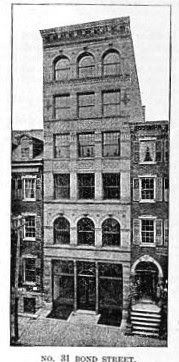
The 1889 Hornthal & Co. Building - 31 Bond Street


The brick-faced former mansion at No. 31 Bond Street was nationally infamous in 1887.  It had been the scene of the brutal murder of Dr. Harvey Burdell in 1857 and 30 years later no one had forgotten.  It was perhaps its gruesome reputation that resulted in a rapid turnover of owners.

On January 15, 1887 the Mutual Life Insurance Co. sold the property to Siegmund T. Meyer for $22,500.  Within four months he reaped a tidy profit by reselling it to John N. Hayward for $35,000.  The game of realty hot potato came to an end the following year, on  September 5, 1887, when Abraham Wolff purchased it for $36,000--just over $1 million in today's money.  Wolff was a founder of the investment banking firm Kuhn, Loeb & Co. and he recognized the changing personality--and opportunity--of the Bond Street neighborhood.

He hired the recently-organized firm of De Lemos & Cordes to design a replacement building.  The partnership of Theodore de Lemos and A. W. Cordes would go on to produce massive commercial buildings, like the Siegel-Cooper department store building on Sixth Avenue and the Macy's department store on Herald Square.  But their commission to replace the Bond Street house for Abraham Wolff would be significantly less grand.

Completed in 1889 the six-story loft and store building was faced in beige brick above a granite-and-iron base.  The upper floors were trimmed in brownstone and color-matching terra cotta.  The arched openings at the second and sixth floors and delicate decoration prompted the Real Estate Record & Builders' Guide to deem the structure "a fine business building."

Federal style former mansions, with marble stoops and trim, survived on either side of the new building.  Real Estate Record & Guide, May 10, 1890 (copyright expired)

The initial tenant was Hornthal & Co., manufacturers of "coffins and caskets."  The firm was run by Joseph Hornthal, his brother-in-law Moses Hatch, and William J. Noble.  It held a patent on the innovative "ice casket."  Decades before air conditioning, when bodies lay for two days in the parlors of their former homes, conditions could become unpleasant in hot months.  The casket held a compartment to hold ice, helping to cool the body and slow decomposition.

This model also came with the amenity of a fold-up viewing window over the corpse's face.  (copyright expired)

Interestingly, before many years Hornthal & Co. would change from manufacturing coffins to building hearses.

Following the departure of Hornthal & Co., there were several tenants in the building at the century, all of them involved in the millinery or apparel trade.  In the first decade of the 20th century it was home to firms like Dauziger Bros., skirt manufacturers; A. Smith, hat "ornaments';" women's hat maker H. Seller; W. Tompkins & Co., makers of flowers and feathers for women's headgear; and the Paris Millinery Supply Manufacturer.

A. Smith manufactured accessories for apparel makers here.  The Illustrated Milliner, July 1910 (copyright expired)

Nothing changed until the Depression years when around 1935 Max Goldberg, a "dealer in rags," and Goldseal Textiles took over the building.   The two firms remained for four decades, until 1975 when Yasuko Harada purchased the building for the newly-organized Kampo Cultural Center, a branch of the Japan Calligraphy Education Federation.

The organization initiated a renovation, completed in 1987.  It resulted in a multipurpose gallery and recording space on the first floor, a recording studio on the second, a video room and classrooms on the third and four floors, and artists' joint living-working quarters on the two upper floors.

The first floor venue was the scene of presentations, like the concert in October 1987 by Japanese koto (Japanese zithers) player and composer Tsutomu Sakamoto.

A subsequent renovation, completed in 2019, resulted in offices throughout.  De Lemos & Cordes's handsome commercial building, which erased the memory of a grisly murder, survives with little change.

photograph by the author

Saturday, October 10, 2020

The 1895 Boskowitz Building - 704-706 Broadway


In the early 1830's the neighborhood of Broadway and West 4th Streets was exclusively residential.  Handsome Federal-style mansions lined Broadway, Lafayette Place and the adjoining side streets.  In 1833 Samuel L. Gouveneur, the City Postmaster, lived at No. 704 Broadway.

That all changed over the next 60 years as this section of Broadway became a major commercial thoroughfare.  In 1894 developer Adolf Boskowitz  added his mark by beginning construction on a 10-story store and loft building.  The plans filed by the architectural firm of De Lemos & Cordes in January placed the cost of construction at $150,000--or about $4.6 million in today's money.

Completed in 1895, the Boskowitz Building was faced in gray brick above a rusticated limestone base and trimmed in terra-cotta.  Its Renaissance Revival design featured a four story mid-section embellished with a pseudo balcony with stone balustrades which upheld a three floor angled bay, pretend Renaissance balconies at the sixth and seventh floors, and, most impressive, magnificent nude sculptures which recline, Michelangelo-like, atop the seventh floor pediments.

Striking Renaissance-style sculptures, little noticed from the street, adorn the pediments.


Originally an ornate cornice sat above the swag molding above the tenth floor.

This section of Broadway was the center of the apparel and millinery industry.  Among the early tenants of the Boskowitz Building was Simon Ross & Sons, clothing manufacturers.   The firm was the target of a burglar in June 1896 who was brazen enough to return two weeks later.  He got away with a total of $1,000 worth of men's clothing--a heist equal to about $31,500 today.

On July 17 Detective Larkin were tipped off that a tailor, Joseph Stern, "was offering some phenomenal bargains in clothing," according to The Standard Union.  Larkin quietly investigated and discovered that buttons on the clothing bore the stamp of Simon Ross & Sons.  He came back to the store with a member of Simon Ross & Sons, who identified the goods as the stolen merchandise.

Stern was arrested and testified in court that he had purchased the goods from a clothing salesman, August Von Farnish.  The 24-year-old was arrested and his criminal career came to an end.  He refused to give any information at all, including his name, prompting the police to call him "The Silent Burglar."  But a letter in his pocket identified him and provided a home address.  There police found "a complete set of burglar tools and a bunch of keys.  They also found some of the stolen clothing," said The Standard Union.  Joseph Stern was released and he returned all the unsold property to Simon Ross & Sons.


Also in the building were Leo Goodman & Bros., neckwear manufacturers; Henry H. Bell's Sons Company, makers of "eiderdown cloth, knit goods, smoking jackets &c.," and H. F. Sawyer Co., manufacturers of ladies' and children's straw hats.

On November 14, 1897 Leo Goodman & Bros. placed a help-wanted ad in The Sun seeking "Experienced puff hands in men's neckwear."  A puff was just one of the many types of neckwear necessary in a gentlemen's wardrobe unheard of today.  Another ad two years later sought "Experienced slip stitchers, Teck, puff and four-in-hand makers."

A catalogue page depicts a puff (left center) and a teck (middle).  copyright expired

The building continued to house nearly a dozen clothing and hat related firms in the first decades of the 20th century.  Among the tenants in the post-World War I years were Zeeman & Buchalter, men's clothing; Posner-Ackerman Co., hat makers; clothing makers J. Friedman & Co.; and men's boy's clothing manufacturer Stanley Manly.

The most expensive of the sale prices advertised in 1920 would equal $319 today.  The Evening World June 4, 1920 (copyright expired)


On July 16, 1926 security agents from a protective firm received an alarm from the fourth floor shop of J. Friedman & Co.  They arrived at the premises and found nothing disturbed.  The New York Evening Post reported that they were "about to leave when a gnawing sound was heard from the south wall."  The security officers went to the building next door to investigate.  They made enough noise that the would-be burglars who were trying to burrow a hole through the wall had time to escape.  They left behind "an acetylene torch, three jimmies and fourteen drills."  They not failed in the burglary attempt, but lost expensive burglary tools after all their hard work.

The Great Depression struck a major blow to the owners of the building.  And when the Emigrant Industrial Savings Bank foreclosed in April 1933 the 704-706 Broadway Corporation presented what The Daily Record termed "a novel defense."  The firm's attorneys told the judge that in the depressed real estate climate renting space was nearly impossible, making paying the mortgage equally difficult.  Therefore, the defense, held, the bank should pay them an equitable fair-market price for the property, rather than simply seize it.

At some point around mid-century the cornice was lost, leaving the Boskowitz Building looking a bit unfinished.   

In the third quarter of the 20th century the Broadway area around New York University had earned the nickname LoBro (one that did not pass the test of time).  Former storefronts became buzzing nightspots.  On September 20, 1985 The New York Times columnist Michael Gross explained "LoBro borders NoHo, SoHo, and Little Italy.  It is north of Chinatown and the Financial District, southeast of the West Village and N.Y.U. and southwest of the East Village."  He said it was an area where "the more clearly defined neighborhoods surrounding it meet and let their differences blur."

As an example he pointed to Bayamo's restaurant and bar, in the Boskowitz Building.  Here "three young businessmen doffed their jackets, loosened their ties and collars and checked out a bottle blond in a periwinkle blue jumpsuit and a college woman in a brown dirndl, white blouse and medal-laden vest.  A young man with punk-style blue-black hair strolled past.  Cross-cultural minglings such as this are common in this uncommon neighborhood."

Bayamo's, which served Cuban-Chinese food, was a hot spot for a decade before The New York Times food critic Florence Fabricant reported on April 17, 1996, "Bayamo...is about to become a brewery.  It may be the only established restaurant to add a brewery to its operation."  One of the owners, Stewart Rosen, told her,  "it's time for more sophisticated food to go with beer.  And the food we serve is perfect."

In the early 1990's the Manhattan Center for Living was in the building.  The organization staged events to benefit AIDS victims.

A renovation was begun in 1996 by architect Arpad Baska.  The two-year project resulted in artists lofts and a three-story, 11,000 square foot penthouse.  An article in the Daily News on May 17, 2007 said "If you're really rolling in it, you could buy the expansive triplex penthouse at 704 Broadway.  It comes with a private rooftop pool and teak sundeck."  The apartment was marketed at $18.75 million.

It was purchased for a bit less--$17 million--by California supermarket mogul Ron Burkle.  In reporting the sale Deepa Thukral wrote in Luxury Launches, "this house was quite a star in its own right.  It was featured in a few episodes of the much watched Sex and the City as the bachelor pad of Samantha Jones's boyfriend [and] also master comedian Jerry Seinfeld married his wife, Jessica Klar, in the venue."

photo via FSI-architecture.com

De Lemos & Cordes's handsome loft building survives--albeit without its cornice--greatly intact.  And sadly, the wonderful Renaissance-style sculptures are mostly ignored by busy passersby.

photographs by the author

Friday, September 11, 2015

The 1902 Siegel-Cooper Warehouse -- No. 249 West 17th Street


In 1902 the massive Siegel-Cooper Department Store on Sixth Avenue laid plans for a new warehouse nearby.  The store was just seven years old and had been leasing a combined store-warehouse building at Nos. 214-216 West 17th Street—a structure erected especially for Siegel-Cooper.   But by now that facility was no longer sufficient for the store’s extensive stable of horses,  delivery wagons, and large stocks of goods.

A postcard captured the scope of the 85,560 square foot store.

On May 18, 1902 The New York Times reported that it was the Siegel-Cooper Company who had purchased “that part of the old Colonial Brewery property running through from 249 to 255 West Seventeenth Street to 236 to 242 West Eighteenth Street.”  The large plot stretched 97 feet along both streets.  The store announced its intentions to “erect a large storage warehouse.”

Within a week De Lemos & Cordes--the architectural firm that had designed Siegel-Cooper's exuberant Beaux Arts department store building--began work on the plans for the new building.  On May 24 it announced that the five-story building would be of “steel construction, with electric elevators, etc.”

By the time of the structure’s completion the five stories had grown to seven.  Matching facades on 17th and 18th Streets were understandably understated as compared with the Sixth Avenue store.  Yet the utilitarian structure boasted its own architectural flair.  The tripartite design was defined by two thick bandcourses.  Red brick rusticated piers that rose the height of the building along with segmental arched openings at the fifth floor comprised the sparse ornamentation of the upper floors.


For the first two floors, however, the architects used lusty terra cotta ornaments to distinguish the façade.  Each pier culminated with winged orbs bearing a sash emblazoned with SC&Co; and the bay doors were flanked by large, intricate wreaths.  These, most likely, originally framed the supports of decorative lamps.  Terra cotta keystones over the bays included the firm’s entwined monogram.  Directly above, brick pilasters with prim terra cotta capitals supported a metal entablature that announced the store’s name.

The up-to-date amenities of the 125,000 square foot warehouse went beyond electric elevators.  The Spectator, on March 31, 1904, noted “The plant is splendidly equipped with every modern fire-resisting and extinguishing appliance.”

The intricate terra cotta wreaths most likely served as frames for lamp brackets.

But the same year that The Spectator made the comment Henry Siegel was in trouble.  The man who had been called “the Napoleon of the Department Store industry” had overextended himself.  The Chicago-based businessman sold the New York operation to Joseph B. Greenhut for $500,000.  Greenhut later reported that Siegel wept during the transaction.

Greenhut’s purchase of the department store came at an ill-advised time.  Already the grand emporiums of what was known as the Ladies’ Mile were abandoning Sixth Avenue, following Roland Macy’s lead.  In 1902 he had shocked New York by moving Macy's department store ten blocks north of the shopping district, to 34th Street and Broadway.

Nevertheless, Greenhut pushed on, confident that the Sixth Avenue shopping district would rebound.  His optimism was soon dashed.  By 1913 the expansive 17th Street warehouse was no longer used for storage of goods; but had been converted to the Greenhut store’s cabinet-making shop.  For at least two years 20 men worked on custom furniture here.

In 1915 the Greenhut operation failed.    On December 4 that year The New York Times reported that Gimbel Brothers, located on Greeley Square just south of Macy’s, had leased the “former Siegel-Cooper warehouse” for $25,000 a year.

Eventually Gimbel Brothers purchased the property, retaining it for decades.  But by 1940 the department store was no longer using the warehouse and had converted it to offices and loft space.  In January that year the Saxon Paper Products Company took space; and three years later when Gimbels finally sold the building The Times noted “It is now occupied by the Jewel Sales Company and the Saxon Paper Company.”

The building would be sold and resold over the next decades.  In 1949 Saxon Paper Products was still here, sharing space with the Sinco Shoe Stores.

The old warehouse building received a startling internal make-over in 1983 when Benny Zucker took over 10,000 square feet for his silk flower business.  Zucker’s family had been importing artificial flowers from China for generations.  He hired a team to transform the space—two merchandising consultants, two architects, an illustrator, a lighting and an audio specialist.

The result was a gigantic showroom for handmade flowers—mostly of silk—featuring dramatic lighting, artistic tableaux, and the sounds of ducks, crickets, birds and waterfalls.  Customers purchased the items by the stem—ranging from 50 cents apiece to $5,000 for a fake tree.

The flower showroom made way for Barneys warehouse at the turn of the century.  Here the luxury retailer offered customers discounted merchandise for more than a decade.  On February 20, 2001 Times columnist Monte Williams commented on the undisguised pipes and wires, as well as the demeanor of the warehouse sale patrons.

“Barneys with eight stores in America, is known for its Spartan civilization.  But it warehouse sale is decidedly uncivilized.”

In 2013 Savanna, a real estate private-equity firm, purchased the old Siegel-Cooper warehouse along with the adjacent building at No. 245 West 17th Street.  Vice President Kevin Hoo announced the firm’s intentions to spend $21 million to “preserve and enhance the loft-style aesthetic.”

The architectural firm Studios was commissioned to “reimagine” the buildings.  The resultant renovation preserved the original hardwood floors and exposed 17-foot ceilings, and restored the masonry façade.   Unlike so many vintage building make-overs that result in luxury housing; Savanna’s focus was on retail and office space.

It worked.  In 2013 the American home furnishings retailer Room & Board took 60,000 square feet for its flagship showroom; followed by Twitter which leased 140,000 square feet as its headquarters.  Savanna sold the building in 2014 for $335 million.
 
Except for the unfortunate loss of the cornice on both facades, and, of course, the sympathetic street level make-overs; little has changed to the 1902 Siegel-Cooper warehouse from which once teams of horses pulled package-filled drays to the homes of shoppers.

photographs by the author