Showing posts sorted by relevance for query Hollander. Sort by date Show all posts

Friday, February 16, 2018

The Art Deco 'Fur Land' Building - 155-163 West 29th Street


Close inspection of the long, low building reveals stylish Art Deco elements obscured by the grime and circus-like awnings.

By 1929, the West 29th Street neighborhood between Sixth and Seventh Avenues had been part of Manhattan's Fur District for years.   That year Fur Land Company, Inc. laid plans for its headquarters and wholesale store, at 155-163 West 29th Street.  But the Stock Market Crash on October 29 that year may have significantly scaled back those plans.
 
The firm commissioned the firm of Sugarman & Berger to design the structure.  Plans were filed on April 22, 1930 with the cost projected at $150,000, slightly over $2 million today.   Completed in March the following year, it was just three stories tall--standing in stark contrast to the soaring loft structures that had already risen along the block.

The architects sheathed the structure in white terra cotta tiles.  The offset entrance to the upper floors, wedged between storefronts, sat within an Aztec-inspired, stair-stepped frame that smacked of grander examples found in buildings like the Chrysler Building.  A bandcourse of crisp zig-zags against rolling waves formed the base of the two-story grouped openings.  Here tiles gave the impression of fluting to the pilasters, which were capped by Art Deco capitals.  The pressed metal spandrels were surprisingly spartan.  A row of decorative tiles suggested a cornice.


The Fur Land Company leased a portion of the new building to A. Hollander & Sons, a "dyeing and fur dressing establishment."   The firm had been founded in 1889 by Austrian-born brothers Joseph and Adolph Hollander as Hollander Brothers.  A. Hollander & Son became the world's largest fur dressers and dyers listed on the New York Stock Exchange.

According to family member Jane Hollander decades later in a letter to The New York Times, "the Hollanders specialized in making cheap furs look expensive, especially mink-dyed muskrat."  The company's fur cleaning process, involving sawdust and other agents, became a household word in the 1940s, "Hollanderizing."


Furs offered by department stores nationwide were marketed as Hollander-dyed.  The Pittsburgh Press, August 15, 1935

Not long after A. Hollander & Sons moved in, the firm suffered the loss of founder Adolph.  He died on September 29, 1932 at the age of 80.  His brother stayed on for another five years before retiring.  The company was still operating in the West 29th Street building in 1940 when he died while wintering in St. Petersburg, Florida with his wife.

The Depression dealt a severe blow to dealers in luxury goods, like furs.  Although it remained in the building, in 1934 the Fur Land Company leased it for "a discounted rent" of $24,000 a year, for ten years.  The ploy did not work and the building was lost in foreclosure.  Nevertheless, Fur Land forged ahead and on August 14, 1947 bought the building back from the City of New York.

The recovered economy following the end of World War II breathed new life into the fur industry.  The Fur Land Building continue to house furriers like Loran Furs, Inc., here by 1946, and National Coney Fur Institute.  But it was not the rebounded economy that could be credited for the unusual profits of Loran Furs.  Instead it was the fact that its partners, Nicholas Proscia and Max Davis, did not pay for many of the expensive goods they sold.

It all came to an end on January 25, 1950 when the FBI announced it had arrested them, along with American Express driver Thomas A. Carr.  The Bureau said the men were the "nucleus" of a "ring that over the last four years allegedly had stolen furs valued at $1,000,000."

Carr had been with American Express since 1917.  His route was within the Fur District and for years he manipulated shipping tickets and diverted shipments to Loran Furs, Inc.  American Express then paid out claims to the rightful customers or their insurance companies; but when that amount topped $1 million (more than ten times that much today), the firm brought in the FBI.

A six-month investigation pointed to Carr and he was put under surveillance.  After he delivered two marked cartons to Loran Furs, he was taken into custody outside.  Agents arrested Davis and Proscia in their offices.

The consumer's renewed ability to purchase furs resulted in high-end lifestyles for the furriers' executives.  Such was the case with Jack Poser, account representative for National Coney Fur.   He and his family live in the fashionable Eldorado Apartments at 300 Central Park West.  

In 1954 Poser, his wife, Margaret, and their 21-year old daughter, Elizabeth, sailed to England.  The family boarded the Queen Elizabeth in Southampton on Wednesday, July 28 to return home.  The steamship stopped briefly in Cherbourg to board more passengers, then steamed on, bound for New York.  About nine hours after leaving port Margaret could not be found.

The ship's crew made what the Cunard Steamship Company said was a "fruitless search of the ship."  The Queen Elizabeth circled the area for about and hour and a half, and radioed other ships to be on the lookout for the woman.  On August 2 the ocean liner docked in New York.  Jack Poser and his daughter left the pier without Margaret.


Sugarman & Berger's entrance smacked of those found in grand Art Deco structures like the Chrysler Building

There was at least one tenant in the building at the time who was not involved in the furrier business.  In April 1952 Lester Leber left the Grey Advertising Agency to form his own agency under his own name with offices at 155-163 West 29th Street.

The Fur District remained in the neighborhood through the last decades of the 20th century.  Fur wholesaler Harry Bakel was still here in the late 1960s.

Today there is little or no trace of the furrier trade on the 29th Street block.  Garish shops vie for attention at street level, the Fur Land Building being no exception.  Sugarman & Berger's streamlined storefronts are long gone, replaced with metal roll-down gates surmounted by a carnival of vinyl awnings.  But the wonder Art Deco entrance survives essentially intact along with the upper floors.


photographs by the author

Thursday, January 22, 2026

An Astounding Survivor - The 1837 287 East 3rd Street


photograph by Carole Teller

In 1811, streets were laid out on paper that dissected land owned by Nicholas and Elizabeth Fish.  Within two decades those pencil lines became actual thoroughfares.  In 1837, ship carver Charles Dodge erected a row of brick-faced houses on the north side of East 3rd Street between Avenues C and D.  Each 22-feet-wide and three stories tall above English basements, they were early examples of the blossoming Greek Revival style.  Dodge's builder designed them as mirror-image pairs that shared a stoop divided by an iron railing.  The side-by-side entrances were framed by brownstone pilasters that upheld a single layered entablature and molded cornice.

Charles Dodge apparently negotiated a deal with Elizabeth Stuyvesant Fish (Nicholas died in 1833) regarding ownership of certain properties.  Upon her death in 1854, 287 East 3rd Street passed to her children: Susan Elizabeth, Margaret Ann, Hamilton and Elizabeth Sara.  There is no indication that any of the well-to-do and distinguished Fish siblings ever lived in the house.

At the time of Elizabeth Stuyvesant Fish's death, the neighborhood around 287 East 3rd Street was the center of New York's German community.  Only Berlin and Vienna had a larger German-speaking population.  No. 287 East 3rd Street would have been home to multiple families.  The Fish heirs retained ownership until October 1882, when they sold the house to Robert P. and Julia Kean Barry for $5,270 (about $167,000 in 2026 terms).

The sale did not end the Fish family's ties to the property.  Born in 1843, Julia K. Barry was the daughter of Margaret Ann Fish and John Neilson.  (Her great-grandfather, General John Neilson had served in the Revolutionary War with Nicholas Fish.)  Robert Peabody Barry also had a sterling pedigree, a member of the fourth generation of Barrys in New York.  The couple was married on April 19, 1866.  They would be long-distance landlords--they lived in Virginia.

While 287 East 3rd Street was owned by distinguished figures, its tenants were working class.  Living here in 1897, for instance, was mechanic E. Matthews.  He was at work in a Harlem theatre, the Metropolis, at 142nd Street and Third Avenue on August 29 that year.  High above the stage, he lost his grip and fell 60 feet.  The New York Herald reported that he "received injuries which proved fatal three hours later."

Matthews's English surname was an anomaly within the mostly German rooming house tenants.  More common were names like Lester W. Eisenberg (who was made a commissioner of deeds in 1901 and 1902), Max Schiller, and Dora Bruder.

On June 18, 1905, Max Schiller attended an outing of German families at a picnic grounds in Queens.  (It was most likely a church event.)   He boarded a trolly car of the Brooklyn Rapid Transit heading home that night.  It smashed into another trolly car at around 10:00.  "Both cars were crowded with men and women who were homeward bound from the picnic grounds," said The Sun.  Max Schiller and five others were "painfully injured," but he was able to go home after having his cuts and bruises dressed.

Living in the house at the same time, Dora Bruder held an interesting job.  She taught embroidery in the New York public vacation schools.

Around 1912, Jacob Beyerle acquired 287 East 3rd Street.  While continuing to rent rooms, he moved into the house with his widowed mother, Margeritte Geier Beyerle, and his unmarried sister, Philippine.  (Frustratingly, Philippine's name was alternately spelled Phillippina, Philippina, and Phillippine in documents.)

Born in 1869, Jacob was the youngest of eight children of Johann and Margeritte, who were 48 and 41 years old, respectively, at the time.   He never married.

In 1913 Beyerle hired architect Louis E. Muller to update the house with plumbing and "new partitions."  (The new walls most likely referred to the installation of bathrooms or water closets.)  The renovations cost him the equivalent of about $32,700 today.

Jacob Beyerle died in the house on May 8, 1914 at the age of 45.  His funeral was held in the parlor three days later.  He left a $2,000 "personalty in trust" to his mother (about $65,000 today), and the remainder of his estate to his sisters Philippine, Maggie and Elizabeth.  

Philippine, who received the title to 287 East 3rd Street, continued to take in roomers.  The Schroeder family lived here in 1915 when 11-year-old George went to the Brighton Beach race track on April 18 to see the motorcycle races.  The New York Herald reported that Thomas Sylvester, "was racing his motorcycle about the track when he lost control of it, and it shot over the rim and into a crowd of several hundred persons."

At least one spectator, 19-year-old Charles Shay, was fatally injured.  George Schroeder was removed to Coney Island Hospital "with a broken leg, internal injuries and many cuts and bruises," said the article.  He happily recovered.

On January 5, 1917, Margeritte Beyerle died here at the age of 89.  Her funeral was held in the parlor two days later.  Philippine sold 287 East 3rd Street in June 1919 to Max Schechter for $10,000 (about $181,000 today).  His tenants continued to be mostly German, like A. Steinmetz and his wife, who announced the engagement of their daughter Bess to Harry Ornstein in March 1920; and apparel worker Joseph Rosenwasser.

In 1921, "a strike in the clothing trade" began in Port Chester, New York.  A non-union man, Alexander Mangurick, took a job in a factory there to replace the union foreman.  The Yonkers Statesman reported on June 11, that the Walking Delegate in New York City directed Joseph Rosenwasser, who was 34, and Nathan Popick to go to Port Chester "and at a convenient place give him a beating."  The two men were arrested and charged with feloniously assaulting Mangurick.

image via the NYC Dept of Records & Information Services.

Patrolman Solomon Hollander lived here in 1930.  The 26-year-old bachelor was attached to the Arsenal Station in Central Park.  Because he was an epileptic and subject to random seizures, he was not permitted to patrol with a loaded pistol.  In March 1931, he was charged with "brutally striking a business woman last Columbus Day in Central Park for sitting on the grass with two friends," according to The New York Times.  Nettie S. Wheeler charged that when she did not move from the grass "quickly enough to satisfy him," he "dragged" her to the police booth on Fifth Avenue and "struck her in the face in the police station with his clenched fist."

Hollander denied that he had struck Wheeler and on the stand "insisted that he spoke courteously when he ordered Mr. Gibson and the two women off the grass."  Mrs. Wheeler, he said, refused, saying, "I am a friend of the Park Commissioner."

On the same day of the alleged attack, according to another officer, Harry Gray, "Hollander was seized with an epileptic attack in the station."  Hollander testified that he could not remember periods of that day.  On March 24, 1931, The New York Times reported that he was found guilty "of twisting the arm of Miss Nettie S. Wheeler."  He was suspended from the police force.  Then came a plot twist.  On May 9, The Times reported that a neurologist, Charles O. Fiertz, asserted that Hollander "was not responsible for his actions at the time of the attack."  The conviction was reversed and a new trial was scheduled.  That trial resulted in Hollander getting a ten-day sentence in the workhouse.

No. 287 East 3rd Street continued as a rooming house throughout the 20th century.  In 2011, the Greenwich Village Society for Historic Preservation began a push to have the house and its fraternal twin at 285 designated individual landmarks.  In addition to the historic importance of No. 285 in Black History (it was for decades home to Steven Cannon and his "Gathering of the Tribes"), both houses, stressed the petition, are "highly intact Greek Revival 'sister' row houses dating from 1837."

photograph by Carole Teller

And, indeed, while early 19th century buildings throughout the East Village were brutalized or razed throughout the 20th century, these two examples survive pristinely intact.  Neither has landmark protection at this writing.

many thanks to artist Carole Teller for suggesting this post.

Saturday, November 22, 2014

The Federal Survivor at No. 37 East 7th. Street


By the 1830's attorney and banker Thomas E. Davis had become perhaps more interested in real estate development than his primary professions.  He would become a major player in the East Side north of the exclusive Bond Street neighborhood; as it transformed from farmland to residences.  Beginning around 1831, he erected rows of speculative brick homes in the area.

Partnering with Louis Wilcox in 1832, he began construction of one such row on East 7th Street, which included No. 37.  The handsome Federal style residence was completed the following year and was valued at $6,000—about $165,000 today.

Clad in warm orange brick laid in Flemish bond, it rose three stories high above an English basement.  Diminutive carved brackets supported the stone window sills and a prim denticulated cornice capped the facade.  The major hint that the home was intended for a financially-comfortable family lay in the intricate doorway.  Here the round arched door surround with its faceted keystone featured delicate carving and suggested upscale interiors behind its double doors.


The interior of the entrance was paneled and a delicate egg-and-dart molding runs below the fanlight.

As the decades passed, the neighborhood changed.  The Lower East Side saw the influx of immigrant families following the end of the Civil War and tenements soon outnumbered private homes.  Nevertheless 37 East 7th Street held out and in the 1890's was the home of Dr. Milo M. Duncan (sometimes spelled Mylo) and his wife Rebecca.

While Dr. Duncan may have led the respectable life of a neighborhood physician, Rebecca was somewhat of a bad girl.  On February 13, 1896 she found herself on the wrong side of the law.

According to a nameless young man, he was leaving the Star Theatre when he saw Mrs. Duncan.  “She was there with a crowd around her when I came along and I asked her what was the matter.  Then she caught hold of me and accused me of stealing a diamond ring.”

The Sun reported on the incident the following day saying “A fashionable dressed woman, who appeared to be intoxicated, collected a crowd about her in Thirteenth street, near Broadway, a 11 o’clock last night.  She had caught hold of a good-looking young man and clung to his arm, shouting: ‘You stole my ring!’”

Rebecca’s version of events was quite different.  According to the newspaper, she told police “that she had visited friends up town, and had started to go home at 8 o’clock...she rode down on an elevated train to Ninth street.  Then she had met the young man, and had a few drinks with him.  He afterward took her ring and refused to give it up, she said.”

The policeman on duty outside the theater corroborated the young man's story.  He was released.  And when Rebecca was questioned at the police station, her story fell apart.  “She could not remember where she had been drinking, nor could she say how many drinks she had.  Her forehead was cut, and she did not know how she had been injured,” said The Sun.

Worse, when the station house matron searched Rebecca’s pockets, she found a $20 pawn ticket for her diamond ring.  "She was locked up."

A year later Dr. Duncan had apparently had enough.  In May 1897 he sued Rebecca for “absolute divorce,” claiming she had been intimate with Henry White on April 15.  Rebecca Duncan vehemently denied the charge and blamed their differences on the doctor.

“She says her husband preferred the society of his servants to that of his wife, and played cards with them; furthermore, that he continued to be on friendly terms with a doctor who, as she had told her husband, had made improper proposals to her,” reported The Sun on May 22, 1897.

Justice Andrews of the Supreme Court put an end to the couple’s differences by granting the doctor his divorce.  He was directed to pay Rebecca $150 in legal fees and $20 a week alimony.

As the turn of the century arrived, most of the houses along the block had been altered or demolished—but not 37 East 7th Street.  By 1904 the Independent Order B’rith Abraham of the United States of America was using the basement and parlor floor as its headquarters.  Max Schwartz, First Deputy Grand Master of the Order, owned the building.  The upper floors were apparently leased to The Baker & Taylor Co., booksellers.

Baker & Taylor ran its wholesale book company here in 1906--The School Journal March 17, 1906 (copyright expired)

Organized in 1887, the “fraternal beneficiary order” was composed mainly of Russian, Polish and German Jewish members.  The group maintained a cemetery fund, administered donations for charitable causes, and provided relief to indigent families. 

While the Independent Order B’rith Abraham focused on Jewish tradition; it also stressed the importance of learning English and becoming Americanized.  Within a very few years this stance would be vital.

On March 7, 1912, the New-York Tribune noted that Max Schwartz had renewed the lease for the “parlor floor, etc.” to the Independent Order B’rith Abraham of the United States of America.  The lodge would pay Schwartz $2,600 for the 15-year lease.  Quickly, however, the Order rethought the arrangement.

A report dated March 24, 1913 said “Upon recommendation of the grand master, the last convention authorized the executive committee to purchase the property at 37 East 7th street, New York City, for the sum of $19,000, plus the cost of alterations.  This building has been used by the Grand Lodge as its headquarters for a number of years.”

The total sum paid by the Order to Max Schwartz was $29,373.39.  The immediate alterations included returning the upper floors to a single residence for the Grand Secretary, and the replacement of the stoop which was described as “worn out.”

In 1916 additional interior changes were made when the Order commissioned architects Sommerfeld & Steckler & Samuel Cohen to “erect walls and rearrange rooms” according to the Real Estate Record & Builders’ Guide on March 11.

By the time the United States entered World War I, the German population of Manhattan had greatly abandoned the Lower East Side for the Yorkville area.  Nevertheless, the neighborhood around the Order B’rith Abraham still had a noticeable German-born population.  Now with Germany the nation’s enemy, German-speaking New Yorkers were eyed with suspicion and fear.

In February 1918 every German in Manhattan was required to register as an “enemy alien.”  The New-York Tribune reported on February 6, “The Eighty-eighth Street station, in the most populous Teutonic district in the city, had registered exactly 501 out of its estimated total of 3,000 aliens by 5 o’clock last night.”  Each registrant was fingerprinted and his personal data recorded.

“Next Sunday, after the close of the registration period, each policeman will start out to investigate and verify the information given by the registrants on his beat.  If everything is found correct, registration cards will be issued within a fortnight,” said the New-York Tribune.  “Wrong addresses or misinformation, will result in turning the case over to the Department of Justice.”

Those Lower East Side residents with Germanic surnames lined up outside 37 East 7th Street.  Somewhat ironically the majority of the lodge members were of Germanic descent.  From its inception, however, the order had been outspokenly patriotic. 

Later that year, on October 1, The New York Times reported that “The New York branch of the Independent Order of B’rith Abraham subscribed $50,000 yesterday to the Fourth Liberty Loan, the announcement being made in connection with the raising of the order’s service flag, containing 8,460 stars, in front of its headquarters at 37 East Seventh Street.”  The generous subscription to the Liberty Loan would translate to about $725,000 today.  Before the war’s end the order would sell $5 million in Liberty Bonds.

It was around this time that the organization added a masonry parapet above the building's cornice.  But as other houses on the block continued to be drastically altered, little else was changed to the Federal style building.

Somewhat surprisingly, the end of the war did not bring an end to alien registration.  On December 19, 1922 the Executive Board of the Grand Lodge of the Independent Order, B’rith Abraham, held a meeting in the 7th Street headquarters.  Wartime registration was one thing, felt the members; but registering aliens in peacetime was not what the United States was all about.  A resolution was passed ‘denouncing” the alien registry bill.

“The resolution declared that any law requiring aliens to be photographed and registered annually was un-American,” reported The New York Times.

Living in the house at the time was Max L. Hollander.  He had been Grand Secretary since 1909.  Born in Czechoslovakia in 1870, he arrived in New York as a child.  After a 23-year career as a tailor on the Lower East Side, he devoted himself to B’rith Abraham.

The socially and politically involved Hollander went to the White House to appeal to President Theodore Roosevelt for financial aid for survivors following the massacre of Jews during the Kishinev pogroms.  A founder of the American Jewish Congress he twice served as grand secretary at its World Conventions in Geneva and Washington, DC.

The 73-year old Max Hollander died in the house on the afternoon of February 20, 1943 after being ill about five months.  Three days later The New York Times said “The synagogues of Manhattan’s lower East Side went into a week’s period of mourning yesterday, and 1,500 persons attended a funeral service in the afternoon for Max L. Hollander.”  Following the service the cortege was escorted by 40 automobiles to the cemetery.

The Independent Order B’rith Abraham remained in the house for decades.  Sometime around mid-century the parapet was removed, making the building appear even more frozen in time. 

In 1981 Princeton architectural student Kevin Lippert and his classmates struggled with the large French drawing books from the turn of the century.  Lippert’s idea was to create more easily handled, reduced-format editions.  The Princeton Architectural Press was born of his idea.


Lippert graduated in 1983 and two years later moved his publishing firm into the East 7th Street house where it remains today.  Because of its good fortune of being the home of a fraternal organization for many decades, then to an architectural publishing firm, 37 East 7th Street has survived as a nearly-intact example of Federal domestic architecture. 

photographs by the author

Saturday, September 10, 2016

The Manheimer Building - No. 369 7th Avenue


On Thursday, November 7, 1918 the “4-story substantially constructed brick loft building with store” at No. 369 Seventh Avenue was sold at auction.  The owner had made certain that the advertisement clarified this was a “voluntary sale,” and not a foreclosure action.  It also made note of the desirable commercial location “opposite Pennsylvania Station.”

The purchaser was 39-year old Joseph Manheimer, head of Manheimer Bros., Inc.  Like his father, Manheimer was a real estate operator and agent.   The “substantially constructed” building prompted its new owner to do renovations rather than to demolish and rebuild.  On July 25, 1919 architect John H. Knubel filed plans for “new stairs, partitions, roof, windows, plumbing, front and lower beams.”  The renovations would cost Manheimer $10,000—about $137,000 in 2016 terms.

Knubel gave the old building an up-to-date Arts and Crafts façade of yellow brick trimmed in terra cotta.  The broad openings at each floor were influenced by the Chicago School.  Above the top story Joseph Manheimer branded the building with his name in terra cotta tiles.  It was flanked by two slightly-projecting terra cotta shields and topped by a peaked parapet.


The alterations were completed by mid-September 1919 when the store and basement were leased.  Manheimer moved his own offices into the building as well.  The immediate neighborhood had comprised the fur district for several years and so the renovated building was a wise choice for furriers Meiselman & Peto.  They remained here until their bankruptcy in August 1921.

As the fur and apparel district moved north of 34th Street, No. 369 filled with a variety of tenants.  In 1945 it was home to M. Hollander’s podiatrist office.  Because Hollander did not use the title of doctor, his “foot correction appliances” might be viewed with some suspicion.  Nevertheless, he boasted 30 years of “successful experience” and his advertisement in Billboard magazine on February 10, 1945 tempted “Visit my office and let me show you by scientific application of appliances I can eliminate your foot trouble.”

photo courtesy of Terry Lavin

A hold-out from the apparel trade at the time was A. & F. Embroidery, which remained a tenant until at least 1947.  Joseph Manheimer kept his personal office here (Manheimer Bros. had moved its headquarters next door at No. 365 in 1933, a property Joseph purchased in 1924) until his death at the age of 71 when his widow took title to the building.  

After mid-century the camera district was centered within the Penn Station neighborhood.  Spiratone had its retail store in the building by 1957.  In 1964 it offered a specialized fixed-lens camera which could take photographs through a microscope. 

Mrs. Manheimer died on December 23, 1983 at the age of 89.  The Manheimer properties at No. 369 and Nos. 365-367 were purchased later by Nan Su Kim.

In March 2011 the properties were sold in a joint sale by real estate agent Hook Hee Nam for $6.5 million.  He happily accepted a down payment of $1.66 million from the buyer, Jae Kun Jeung.

The problem was that Nan Su Kim was unaware that his buildings were being sold. 

Hook Hee Nam handed over paperwork with Mr. Kim’s signature—except Nam had signed them himself.  He was arrested and “arraigned on charges of first-degree grand larceny, among other things, in connection with the fraud,” according to the Queens District Attorney’s Office.


Although the shop front has been brutalized with a tawdry tourist gift shop, and window air conditioners poke through the upper story windows; John H. Knubel’s striking Arts and Crafts building survives as a delightful surprise on this frenzied section of Seventh Avenue.

photographs by the author

Monday, September 11, 2017

The Lost "Knickerbocker Cottage" - 6th Avenue at 27th Street


The original Isaac Varian house, the central building, is still relatively unchanged in this etching.  The wings were added around 1815.  from the collection of the New York Public Library

According to the New Amsterdam Gazette in 1883, a "Hollander named Geisenheimer" captained his small ship to New York City in 1731.   After safely crossing the ocean, he met calamity in what later became known as Kips Bay when his vessel hit a rock "near the mouth of the Stuyvesant Creek."  The Gazette said "The pious Hollander saw the hand of Providence in the disaster.  He and his crew hauled the shattered timbers of his bark to the head of the creek and built a hut."

The term "hut" is questionable.  Sitting at what is today Sixth Avenue and 27th Street, the Dutch house sat unperturbed until just before the Revolution.  Isaac Varian purchased the land and had the house transformed into one of the elegant country estates that dotted the area.  The Georgian-style clapboard manse featured a stone basement level above which an elegant entrance and fanlight sat within a columned portico.

By 1815 Sixth Avenue had been extended this far north, but it ran directly behind the house.  So the building was carefully raised on logs and turned around to face the roadway.  The ambitious project included the enlarging of the former country house.

Ten years later it was converted to a roadside inn, the Knickerbocker Cottage.  It was taken over in 1850 by Samuel Rockenburg.  He would not run the inn long.  On March 10, 1856 he died "of a lingering and painful illness" according to his obituary, at the age of 53.  "His funeral will take place from his late residence, Knickerbocker Cottage, No. 456 6th-av."  (The address would be changed in 1925 to No. 792.)

The Knickerbocker Cottage was purchased by Peter Connor.  In 1861 he was adding to his staff.  On November 28 an advertisement in The New York Herald read "Boy Wanted--To tend bar and open oysters.  One who understands his business."  And a few days later another ad sought "A young man, as assistant barkeeper."

Conner sold the business in 1863 to Felix Astoin, who leased the proprietorship to Captain William Fowler and Captain Boyle, veterans of the Civil War.  The New Amsterdam Gazette reported that the two captains "took the cottage in their hospitable hands.  They rejuvenated the ancient structure, but conscientiously spared its old front, its massive oak timbers, and its antique rafters."

After Boyle retired, William Fowler continued to lease the property and brought in his son, William, Jr., and then son Rufus to co-manage the inn.  The Knickerbocker Cottage was a favorite gathering spot for political and social groups.  On April 12, 1867, for instance, The New York Herald reported "Yesterday being the anniversary of the birthday of Henry Clay, [the Henry Clay Festival Association] held its annual reunion at Knickerbocker Cottage."

In 1868 journalist Bill Curtis and Civil War veteran Henry Buermeyer rented a room on Sixth Avenue at 14th Street and formed what today would be called a local gym.  Equipped with Indian clubs, dumbbells, and other Victorian equipment, their facility was intended to improve "feats of strength and pugilistic aptitude."  Later that summer they placed an advertisement in the New York newspapers inviting "sports-minded young men" to a meeting at the Knickerbocker Cottage to discuss forming a sports club.

The fourteen young men who showed up on September 8, 1868 founded the New York Athletic Club.  In his 1891 autobiography, John Richard Judd remembered "On this night they organized and called the club the N. Y. A. C., and I believe we each put in $10, though my $10 was handed back to me again because I was a professional."

Despite occasional affrays among the all-male patrons, the events in the Knickerbocker Cottage were generally peaceful.  In 1870 a group of Masons met regularly for lunch here at a special table on the second floor.  Two within the group were actor William J. Florence, known as Billy and Dr. Walter M. Fleming.  Based on Florence's familiarity with Arabian costumes and customs, and Fleming's knowledge of fraternal ritual, they organized the Ancient Arabic Order of the Nobles of the Mystic Shrine.

The first meeting of the Mecca Shriners--the first chapter established in the United States--was held in the Knickerbocker Cottage on September 26, 1872.  What had been a luncheon group quickly grew.  On November 24, 1873 The New York Herald reported "On Saturday evening a 'conventicle' of the Monks was called in the usual form, and they assembled accordingly at the 'Monastery of the North,' in Knickerbocker Cottage, Sixth avenue."  The group was conducting the funeral of Civil War General Ryan.

Another out-of-the-ordinary club organized here was The Manhattan Turtle Club.  Founded in 1870, its rules were entirely gastronomic and its members portly.  On December 12, 1879 The New York Times explained "It is said that the average weight of the 100 [members] is 314 pounds before meals, and that one of the rules of the club is that no man can become a voter in it until he measures at least 49 inches around the waist."

The election of officers was unique.  "The highest office is always awarded to the member who can walk steadily around the dining-room four consecutive times without assistance after eating the greatest number of plates of soup at the dinner preceding the annual election."

During the election process in 1879 Billy Birch, a minstrel entertainer, "stopped eating suddenly when half-way through his twenty-eighth plate" of turtle soup.  He was carried from the dining room choking.  The other candidates continued eating until finally Benjamin Gregory, proprietor of the Adirondack Iron Works, was elected after consuming 37 plates of soup.

Now that the officers were elected, the members turned their attention to Billy Birch.  The doctor reported he was improving "and said that there had been nothing the matter with him except that, in his inordinate ambition, he had eaten his soup in too large mouthfuls, using a ladle instead of a spoon, in which business he had taken down a large napkin with a knot tied in the middle of it, which became lodged in his throat."  The physician said that it "interfered with his appetite."

A similar club was the Five-Pounders which met here monthly.  In 1893 The Times remembered "They feasted at the old Knickerbocker Cottage in Sixth Avenue, whose host Capt. William Fowler, was one of the best livers in the land.  Before sitting at table each month every man was weighed, and he was not suffered to leave the room, no matter how late the hour, until he actually weighed five pounds more than when he entered the dining room."  By the time of the article, the club was no more.  The article ended saying "Both member and guests grew so fat that the disbanding of the Five-Pounders became a matter of necessity."

Another club in which William Fowler was personally involved was The Thirteen Club.  It was organized on January 13, 1882 with 13 members "to combat the popular superstitions attached to that number."  It held its annual dinner in room 13 in the Knickerbocker Cottage every January 13.

The New-York Tribune reported on the 1883 dinner saying "The menu was a coffin-shaped card with a border of thirteen nails, and contained thirteen courses."  By now the membership had greatly increased from the original 13 to 169--not coincidentally the product of 13 x 13.  Speeches during the dinner were limited to 13 minutes each.

Felix Astoin, described by The New York Times as "the wealthy Frenchman," died on November 8, 1883 leaving an estate of $500,000, nearly $12.5 million in today's dollars.  He left the Knickerbocker Cottage to Helen Ransom, the widow of his son, Celestin.  She quickly sold it that same year for $17,750 to William Wilson--about $440,000 today.

When Fowler died suddenly 15 years later, on July 6, 1897, The New York Times mentioned "In his time, to the cottage every New Yorker of note and many men of National prominence came, to partake of its famous dinners and suppers.  Ex-President Arthur was a frequent visitor, as were James Fisk, William Travers Samuel Ward, Lawrence Jerome, Lester Wallack, the younger, and a whole host of the wits and bon vivants of those days."

In the meantime, William Wilson sold the Cottage at auction on March 18, 1885.  Newspapers noted "The reasons for the sale of the property were not stated" and The Times added "The Knickerbocker Cottage was built piece-meal in the early part of the present century." The newspaper got its facts slightly wrong, saying "More than 150 years ago the land on which the cottage stands was owned by the Varian family, one of whom was Mayor of New-York."


The Mouquin brothers initially made only a few changes.  The store at the left was their well-advertised wine and cheese stop.  from the collection of the Museum of the City of New York

Since 1857 Henri and Louis Mouquin had operated a stylish French restaurant downtown known as Chez Mouquin.  In 1898 they leased the old Knickerbocker Cottage and rechristened it Mouquin's Cafe de Bordeaux. 

The World Almanac and Book of Facts, 1899 (copyright expired)


After closing for remodeling in 1899 they reopened in 1900 now welcoming female patronage.  An advertisement announced "Ladies' Restaurant--Mouquin has just opened the Old Knickerbocker Cottage at 454, 456 and 458 Sixth Avenue, foot of Twenty-eighth Street elevated station, as a first-class restaurant."

Well-dress patrons pause outside of Mouquin's around 1901.  image courtesy of Gene Gantt

The fashionable restaurant became the regular meeting place of a group of painters of the Ashcan School of art.  William J. Glackens had been a frequenter of Mouquin's for years and in 1904 he and his wife Edith Dimock; John Sloane, Robert Henri and their wives began meeting almost nightly.  According to Bernard B. Perlman in his 1979 Painters of the Ashcan School: The Immortal Eight, "Often they were joined by George Luks, Jimmy and May Preston, or Frederick Gruger, all of the old Philadelphia gang."  The group was enlarged with artists like Ernest Lawson and Everett Shinn.

Mouquin's became a subject of at least three paintings by artists of the famed group.


In 1904 Everett Shinn painted a wintry scene outside Mouquin's - collection of the Newark Museum of Art
And a year later William Glackens depicted the elegant interiors.  The model for the seemingly bored woman was the artist's wife.  Collection of The Art Institute of Chicago

On December 20, 1908 the New-York Tribune reported on a somewhat shocking transaction--"the sale of the site occupied by Mouquin's restaurant."  John F. Lambias purchased it for $300,000.  The newspaper noted "The property is a landmark," adding "the building on the site is the original Varian mansion, one of the oldest and most historic buildings in the neighborhood."

When this photo was taken by Brown Brothers around 1916 there was remodeling going on.  from the collection of the New York Public Library

Mouquin's continued to run its fashionable French restaurant.  Things looked bleak in April 1919 when The Evening World announced that the building faced foreclosure and Mouquin's, "for two decades one of the most famous restaurants in the tenderloin, is to close its doors within a few weeks."  When interviewed, Louis Mouquin shed a tear and sighed "Life is just one damned funeral after another."

Around the time of its closing the restaurant had disguised the facade with vines.  photograph by the Detroit Publishing Co. from the collection of the Library of Congress

But the restaurant earned a reprieve and continued for another five years.   It was not foreclosure, but Prohibition that ended Mouquin's.  The New York Times reported "With the advent of prohibition the lustre of the restaurant began to fade."  Then, when agents found alcohol being sold, it was padlocked by order of U.S. Attorney Emory R. Buckner in May 1924.

Prohibition was not only the ruin of many hotels and restaurants, but of human lives as well.  Such was the case with the closing of Mouquin's.  Alexander Chaput had been a waiter there for 20 years.  He went home one evening and committed suicide by inhaling lighting gas.

Strikingly similar was the case of Armand Francois De Lysle, who had been a Mouquin's waiter for 25 years.  His wife had been in charge of the female employees.   Now they were both out of work and after nearly a year of searching the 59-year old De Lysle feared they would never again find jobs.

When his wife returned home around 7:30 on the evening of March 25, 1925 she found him unconscious from gas escaping from open burners of the kitchen range.  The Times reported "He died in spite of efforts to resuscitate him."


In October that year the Clay Trading Corporation leased the building for a "quick service" restaurant.  But it was too late for the building universally deemed a landmark and "historic."  It was razed within months.  The replacement building survived until 1999, demolished for the 37-floor apartment building The Capitol at Chelsea, which opened in 2001.


photo via wirednewyork.com

LaptrinhX.com has no authorization to reuse the content of this blog

Friday, November 4, 2022

The Margaret Neilson House - 237 East 17th Street


Around 1853,  Lewis Morris Rutherford began construction of a handsome, 29-foot-wide home at 126 East 17th Street (renumbered 237 in 1866).  A wide stoop rose to the arched entranced flanked by engaged Doric columns upholding a molded entablature.  The floor-to-ceiling parlor windows were fronted by a full-width cast iron balcony.  The fully-framed openings wore molded cornices and sills.  Although Italianate in style, the house exhibited a carry-over from the waning Greek Revival style in the squat attic windows below the exuberant cornice.

Although defaced with iron fire escapes and rooftop fencing, most of the original architectural elements survived in 1941.  via the NYC Dept of Records & Information Services

Rutherford sold the newly completed house in 1856 to Margaret Ann Fish Neilson, a relative of his wife, Margaret Stuyvesant Chandler.  According to her son-in-law, Maitland Armstrong in his 1920 Day Before Yesterday, the house "cost over fifty thousand dollars."  If his memory was correct, Margaret paid the equivalent of about $1.6 million by 2022 standards.

Born on February 11, 1807, Margaret was the daughter of Nicholas Fish and Elizabeth Stuyvesant, both of whom came from old and prominent families.  Nicholas Fish had been appointed Adjutant General of New York State following the Revolution, and Elizabeth Stuyvesant was a direct descendant of the Dutch director-general of New Netherland, Petrus Stuyvesant.  

Margaret's husband, Dr. John Neilson, had died on September 22, 1851 at the age of 52.  The couple had six children, Mary Noel, Nicholas Fish, Margaret A., John Jr., Julia K., and Helen.  The neighborhood was filled with Stuyvesant and Fish families, and Margaret's brother, Hamilton Fish, lived steps away at the corner of East 17th Street and Second Avenue.  

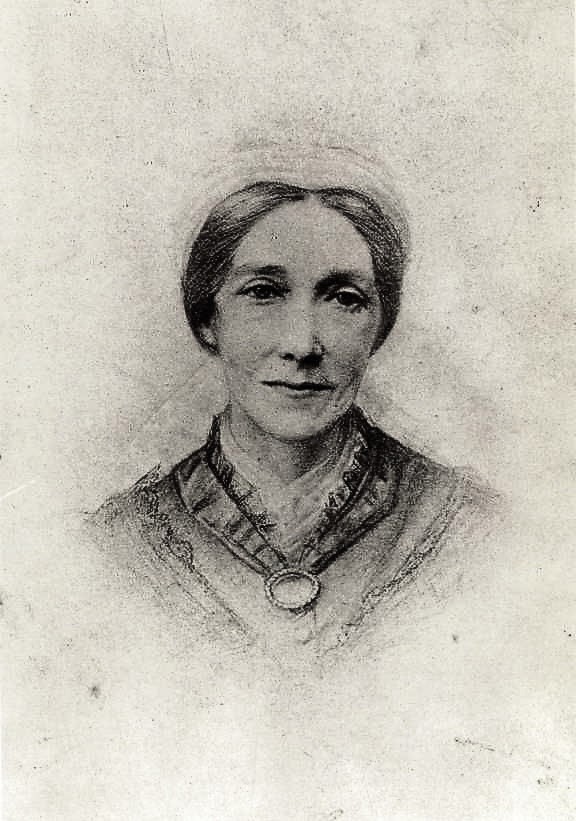
Margaret Ann Fish Neilson (original source unknown)

Moving in with her was son John Jr., a real estate agent, and her unmarried daughters.  (Nicholas Fish Neilson had died in 1855 at the age of 23.)  Julia married Robert Peabody Barry in the parlor in 1865, and Helen's wedding to Maitland Armstrong was held here on December 6 the following year.

The Armstrongs moved elsewhere, but Julia and her husband stayed on in the East 17th Street house.  Little by little the population of Margaret's home increased.  Herbert Barry was born in 1867, and Lewis Peabody came along the following year.  Sadly, the parlor where his parents were married was the scene of Lewis's funeral on August 14, 1870.  The little boy was just 14 months old.  Julia was pregnant at the time, and three months later a third child, John Neilson, was born.

Although she retained possession of it, Margaret and her family left the East 17th Street house around 1874.  It was being leased to a Mrs. Shook in 1875 as a high-end boarding house.  Among the tenants in 1878 were Philo E. Doolittle, a dry goods merchant, his wife, the former Elizabeth Marks, and his mother and step-father, Caroline D. and Charles Wilson.  It was not a peaceful coexistence.

On July 14, 1878, The New York Times reported, "A singular spectacle was witnessed yesterday in the Fifty-seventh-Street Police Court.  At the bar stood a very respectable-looking and well-dressed man, a septuagenarian, and close by him stood his wife, his step-son, and his step-daughter-in-law."  The elderly man was Charles Wilson and he faced charges of having threatened the life of Elizabeth Doolittle.  The article pointed out that all four lived in the same household, but Wilson, "has incurred the enmity of his family and relatives by his extraordinary rash conduct at times."  

Justice Kilbreth pointed to Elizabeth Doolittle and said to Wilson, "This lady says that you were about to strike her with a large iron poker when prevented by her husband, and that you also had in your possession a loaded cane.  What have you to say?"

Wilson said, "All I have to say is that if she says so she lies."

He then explained that on that morning his wife was in the rear yard and called for the servant girl, who was upstairs.  She did not respond.  Caroline Wilson called repeatedly, with no answer.  And so, Wilson stormed upstairs and berated the girl.  "You heard my wife call you, why did you not answer?"  Wilson continued, "She said nothing, and I told her that if she did not answer my wife the next time she was called I would jerk her liver out.  This woman here, Mrs. Doolittle, then interfered, but what she said about me threatening to take her life with a poker is an utter falsehood.  We had a few words but that is all."

Unfortunately for Wilson, his step-son, his wife, and the arresting officer all testified that he had had a poker.  He was sent to Blackwell's Island for six months.  Despite the tensions, the extended family was still here a year later.

Margaret Fish Neilson died on March 3, 1877 at the age of 70.  The East 17th Street house was inherited in equal parts by her children.   (In April 1882, Julia K. Barry, who now lived with her family in Warrentown, Virginia, sold her portion to her sister Margaret, for $5,500, about $150,000 in 2022.)  The siblings continued to lease the house, which was still being operated as a fashionable boarding house.

Among the residents in the mid-1880's were Lt. Butler Coles and his wife.  Born in 1831, he came from a military family.  His grandfather was General Nathaniel Coles, and his father was Major General Nathaniel Coles.  During the Civil War, Butler Coles had served three months at Harper's Ferry, and was later captured, spending seven months at Libby Prison.  There he contracted "infirmities from which he never fully recovered," according to the Huntington Long Islander.  He was now associated with Tweedy & Co., a hat manufacturing firm. 

Coloratura soprano Annie Louise Tanner lived here in 1891.  Her husband, Wells B. Tanner had died in 1885.  Said to have a vocal range of three octaves, she had been a member of the Ovide Musin Concert Company since 1888.  The Geneva Advertiser said possessed "so phenomenal a range for a soprano voice to be styled the 'American Nightingale.'"

Annie Louise Tanner-Musin (original source unknown)

The East 17th Street house was the scene of what The Geneva Advertiser called "a wedding of music" on October 7, 1891.  Annie Louise Tanner was married to her employer, violinist Ovide Musin.  The virtuoso groom had been awarded first prize for violin at the Royal Conservatory of Liège, Belgium when he was just 11 years old.  The couple would perform together for years, touring world-wide.

In April 1900, Margaret Neilson's heirs sold 237 East 17th Street.  Again a single-family residence, it became home to Lewis Henry Morgan and his wife, Camilla Leonard.  The couple had two children, Henry Carey, who was eight years old at the time, and Camilla, who was seven.  Shockingly, a year later on October 31, 1901, Morgan died in the house at the age of just 35.

Camilla briefly leased the house to former Nevada Senator John Percival Jones.  He and his wife, the former Georgina Frances Sullivan, had three daughters, Alice, Georgina Frances, and Marion.  

Marion had already made a name for herself outside of society teas and ballrooms.  An accomplished tennis player, she won the women's single's titles at the 1899 and 1902 U. S. Championships.  At the 1900 Summer Olympics, she became the first American woman to win an Olympic medal.

The Joneses announced Marion's engagement to architect and violinist Robert Farquhar in June 18, 1903.  Her wedding in Grace Church took place on September 29.  The Evening Telegram noted, "Several hundred guests were invited to the ceremony, which was followed by a reception at the residence of the bride's parents."

The family of banker and businessman William Fellowes Morgan, the brother of Lewis Henry Morgan, was in the East 17th Street house the following year.  Coincidentally, his wife, the former Emma Leavitt, was also a tennis champion, having won the Women's National Doubles Championship in 1891.  She was an accomplished golfer, as well, and "won many golf trophies," according to The New York Times later.

The couple had three children, Beatrice, William Jr., and Pauline (known as Polly).  The family moved into the house just in time for Beatrice's coming out.  Her debutante entertainments began with a reception at here on December 7, 1904.

Young men were slipped into adult society more quietly.  On the evening of April 7, 1905, the Morgans gave "an entertainment for young girls and boys...in honor of W. Fellowes Morgan Jr.," as reported by The New York Times.

The Morgans' social status was reflected in Beatrice's marriage to Frederick S. Pruyn in St. George's Church on February 4, 1907.  Calling her "the very attractive daughter of Mr. and Mrs. William Fellowes Morgan," The Argus said her wedding "will be a large and fashionable one, and the bridal procession should be one of the prettiest seen there in a long time, for Miss Morgan has chosen ten of the most charming young women of society for her bridesmaids, and her sister, Miss Pauline Morgan, as maid of honor."  The reception was held in the East 17th Street house.

Immense change came in October 1909 when St. Andrew's Convalescent Hospital for Women took title to the mansion.  Founded in June 1886 by the Sisters of St. John Baptist in a "pleasant house" opposite St. George's Church, it originally could accommodate 12 patients.  Since 1889 it had been operating from 213 East 17th Street, and in the 1890's expanded into 211 next door.

In 1908 the facility sought to expand again.  The 1919 History of Medicine in New York explained, "While the question was under consideration, the house, No. 237 East 17th street, on Stuyvesant Square, was offered to the hospital.  The house, a very desirable one, needing very little alteration, the trustees after somewhat protracted negotiation acquired for $47,500."  The renovations began in June 1911 with an elevator, fire escapes and a new "heating plant." 

The St. Andrew's Convalescent Hospital was a sort of recuperation or rehabilitation facility for patients deemed by the Sisters as being morally fit for care.  In 1915 the Directory of Social and Health Agencies described it saying,  "For women, girls, and children of good character, who need care, nursing, and rest, or who are recovering from acute illness, but not ill enough to be admitted to a regular hospital.  It receives promptly, with or without payment, all suitable cases."  The facility could accommodate 35 patients.

The Living Church Annual, 1928

St. Andrew's Convalescent Hospital depended greatly on donations.  Socialites often held benefit events, such as bridge parties, to raise funds.  It appears that by the early 1940's the facility no longer offered free accommodations.  An advertisement in The Living Church on January 14, 1942 noted private rooms cost $10 to $15.

After operating from the former mansion for four decades, in 1957 St. Andrew's Convalescent Hospital closed the East 17th Street facility.  The building was converted to the Gramercy Park Nursing Home that year.  It was most likely at this time that nearly all of the Italianate details were shaved off the facade and the brownstone was either removed or covered with a brick veneer. 

The proprietor of the Gramercy Park Nursing Home, Eugene Hollander, might have been a bit nervous when he received a summons from Congress that read in part:

You are hereby commanded to appear before the Special Committee on Aging of the Senate of the Unites State, on January 21, 1975, at 10 o'clock a.m. at 270 Broadway, New York, New York...The Committee requests your appearance along with all business records relating to the operation of the above named facility from 1969 to the present.

The Committee had good reason to suspect Hollander of misdoings.  On February 3, 1976, The New York Times reported, "Eugene Hollander, a major figure in the nursing-home industry here, pleaded guilty yesterday to state and Federal charges of bilking Medicaid of hundreds of thousands of dollars to pay for such personal items as paintings by Renoir, Utrillo and Mary Cassatt, and furnishing and decorating his apartment at 980 Fifth Avenue."

The scandal put an end to the Gramercy Park Nursing Home.  The following year the building was converted to apartments with doctors' offices in the basement level.


Sadly "modernized," the former Neilson mansion still shows hints of its former grandeur in the surviving stoop and balcony ironwork, and in the partial enframement of the entranceway.

photographs by the author
LaptrinhX.com has no authorization to reuse the content of this blog