Saturday, September 24, 2022

The 1860 John Russell House - 454 West 25th Street


photograph by the author

In 1860 a row of handsome Italianate style homes was erected on the south side of West 25th Street, between Ninth and Tenth Avenues.  The 20-foot wide brick-faced residences reflected the latest in domestic taste--with high stone stoops, substantial Italianate cast iron fencing, and paneled and bracketed cornices.  One house, 454 West 25th Street, stood out among the row with its oversized center window on the top floor.  It was apparently a specification of the purchaser during construction.

That buyer was 43-year-old John Russell, who owned a stonecutting business on West 30th Street near the Hudson River.  He and his wife Helen had nine children.  Despite what must have been somewhat tight conditions, they took in a boarder.  They would have to find a replacement in 1865 when C. P. Byron was drafted into the Union Army.

By 1865 the Russell's eldest daughter, Helen, was a teacher.  She divided her day between two relatively nearby schools--P.S. No. 55 on 20th Street between Sixth and Seventh Avenues, and P.S. No. 19 at 223 West 18th Street.

Around 1868 Russell moved his stone operation to the foot of West 51st Street and the Hudson River.  By now, the population of 454 West 20th Street had increased by one following Helen's marriage to Alexander Orr Hopkins, a boat pilot.

In 1876, Janet Russell, who was just five years old when the family moved into the West 25th Street house, became a teacher like her sister.  She taught in the primary department of Grammar School 546 on West 18th Street.  Her brothers, John Jr. and Robert, were both listed as masons, working in their father's business.

Sadly, that same year, on April 13, Helen died at the age of 31.  Her funeral was held in the parlor two days later.  Her husband moved out of the Russell house the following year.  The Russells once again took in a boarder.  Edwin Connor, who ran a coal business on West 29th Street, lived with the family in 1879 and 1880.

John Russell died in the house on March 20, 1881 at the age of 64.  His funeral was not held in the family residence, but rather far to the north, in the Church of Our Saviour on West 57th Street near Eighth Avenue.  His children inherited the West 25th Street house in equal portions.
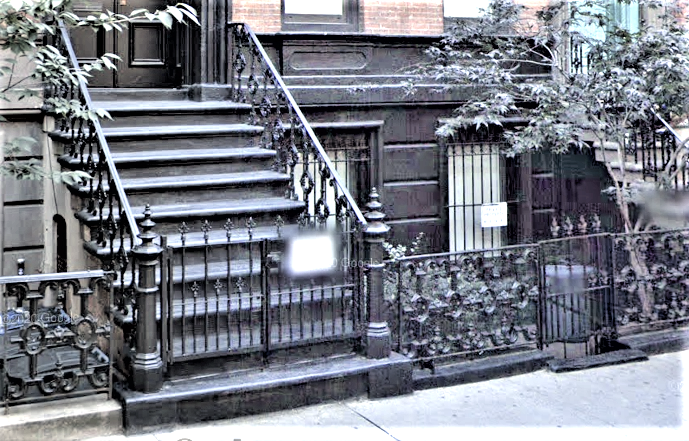
The ornate Italianate style ironwork survives along the row.  photograph by the author

Alice R. Russell, who had married James P. Clark, sold her interest in the house to John Russell Jr. in 1887 for the equivalent of $22,o00 today.  By the mid-1890's 454 West 25th Street was occupied by what appears to be a different Clark family.  Patrick J. Clark operated a "three-story brick hotel" nearby on the northeast corner of Ninth Avenue and 25th Street.

He and his wife, Sarah Coleman, had a daughter, Mary, and five sons, Joseph, James, Philip, Eugene, and John Joseph.  Joseph attended P.S. No. 17 on West 20th Street in 1901.  On June 27, the day before his graduation, the 11-year-old was running home from school when, as reported by The New York Times, "he fell in front of a horse car at Twenty-fifth Street and Ninth Avenue and was instantly killed.  The front wheel of the car passed over the boy's abdomen."

Joseph's brothers were significantly older.  In 1909 James P. Clark was made a commissioner of deeds, a civic position similar to today's notary public, and John Joseph Clark was the proprietor of Clark's CafĂ© on Columbus Avenue and 62nd Street.    John Joseph died at the age of 30 on January 5, 1915.

Not long afterward, 454 West 25th Street was being operated as a rooming house.  War was intensifying in Europe at the time and the conflict would deeply affect three families living here.

John J. Flood held a job which today would qualify him as an "essential worker" and which qualified him as except from the draft.  But on August 10, 1917, the New York Herald listed him on "the honor roll of the national army" after he waived him exemption.

Two other residents joined the army, Edward P. Lynch and Joseph E. Nash.   Lynch enlisted with the 69th Regiment and was sent to Europe in October 1917.  Joining around the same time were his cousins, with whom he had grown up.  Nine months later, his widowed mother, Mary Lynch, received the news every mother feared.  On July 15, 1918 Edward was killed in action.  The New-York Tribune noted, "The corporal was Mrs. Lynch's only son, but she has two nephews, the sons of her sister, whom she has raised and who are at the front."

Mary E. Nash also received frightening news from Government.  Lt. Joseph E. Nash was "wounded severely" in April 1919, but happily he survived to return home to 454 West 25th Street.  Over the next few years his name would appear in newspapers for less heroic reasons.

In 1921 Irish-American newspaper The New York Age reported on the trials in Belfast, Ireland, of court-martialed Irish soldiers.  Virginia-born Ed Cahill had been stopped while bicycling and searched.  "Four envelopes were found in his possession.  One was addressed to "Jos. Nash 454 West 25th street, New York, containing seditious matter re affairs of Ireland," said the article."  In Cahill's room were found the floorplans of a police barracks, the plans for blowing up a bridge, and a notebook about the Irish Republican Army.  Cahill was sentenced to "five years' penal servitude."

Nash was still rooming at 454 West 25th Street on June 19, 1922 when he was pulled over by Patrolman D. J. Mullen for "failing to observe the eight-foot law."  (The law required motorists to stop no closer than eight feet from a stopped street cars and buses.)  Because this was Nash's second offense, he was fined $25--a hefty $400 by today's standards.

The house continued to be operated as a rooming house for years.  Mary Ellen Laritz and her adult son lived here in 1943 when she witnessed a horrifying accident from her window on August 24.  Directly across the street was the U.S. Coast Guard Chelsea Encampment.  She later testified before a Congressional hearing that at 7:00 that evening, "I was looking out of my front-room window, which faces the property now occupied by the Coast Guard."  She said that several children were running up and down the sidewalk playing, and a Coast Guard supply truck was on the sidewalk, fueling trucks parked along the curb.  The truck moved slowly up the block from one truck to another.

Mary Laritz recalled, "I suddenly heard screams from these several children, and saw several of them running back along the sidewalk, but I did not see the little light-haired boy.  I saw coast guardsmen and others running toward this oil truck which was at a standstill on the sidewalk."  The reason Mary Laritz could no longer see five-year-old William Mooney was because the supply truck had run over his leg.  The driver of the truck said the children had made a game of riding on the running board of the truck, and Mooney had slipped under.  Mary said, however, "The injured boy was not in the roadway at any time I saw him and was not hitching on any truck at the time I saw him."  

William Mooney suffered a fracture of his right femur, multiple abrasions and a laceration of the groin.  He spent two months in St. Vincent's Hospital.  Mary testified on January 22, 1944, "This oil truck and others were always running along the sidewalk, but since this accident, they do not run on the sidewalk anymore."

photograph by Beyond My Ken

A renovation completed in 1965 resulted in five apartments within the house.  A subsequent remodeling in 1992 combined the parlor and second floor into a duplex.

LaptrinhX.com has no authorization to reuse the content of this blog

Friday, September 23, 2022

Frank Ayres Wright's 1911 112 East 23rd Street


In 1856 Rev. Augustus Valette Clarkson and his family moved into the 24-foot wide residence at 66 East 23rd Street (renumbered 112 in 1868).  Three stories tall above an English basement, the high-stooped house was typical of the elegant homes in the fashionable Union Square neighborhood.  Nearly half a century later, while business buildings crowded in around them, several of Rev. Clarkson's children still lived in the family home.  

Frederick Clarkson died in the house of pneumonia on February 5, 1901.  The New York Times called him, "a member of an old Colonial family and associated with many scientific and religious movements."  Three years later, on July 23, 1904, The Globe and Commercial Advertiser reported, "David Clarkson, one of the oldest residents of the lower park of the city, died Thursday at his home, 112 East Twenty-third street."  Clarkson was 83 years old.  The article noted, "Four brothers and a sister survive him."

One brother, Augustus L. Clarkson, stubbornly held onto the house for six more years.  In reporting that he had sold it to Oswald Oelschlaeger, "who will make extensive alterations," the Record & Guide noted, "The property has been owned by the Clarkson family for more than fifty years."  Oelschlaeger paid $125,000, nearly $3.7 million in today's money.

Oelschlaeger initially intended to substantially alter the house for business purposes.  His architect, Frank Ayres Wright, filed plans days that called for an extension to the rear, and new interior walls and windows.  But Oelschlaeger quickly changed his mind, and a week later Wright filed revised plans for an entirely new building.  It was described as a five-story brick and stone loft, to cost $20,000 to construct (about $590,000 today).

Wright's Arts and Crafts style facade was as much glass as it was it was brick.  A steel skeleton allowed for vast, grouped windows within a cast iron framework.  The entrance to the upper floors was set to the side of the storefront.  The most striking element of Wright's design was the deeply overhanging cornice, supported by alternating pairs of long and short brackets.


The greatly-changed personality of the neighborhood was reflected in the ground floor tenant, a saloon operated by Ralph Elsinger.  It played the pivotal role in a landmark New York Supreme Court Case in 1914.  Harlem resident Aldwin C. Babb dropped into the tavern for a drink, but Elsinger refused to serve him because he was Black.  In an early and unexpected move, Babb sued.  On April 14, the Supreme Court justices ruled in Babb's favor, saying "that a saloon was a place of public accommodation and therefore no discrimination was permitted."

In the meantime, the initial tenants of the upper floors included a Marine Corps Recruiting Office.  In December 1911, an advertisement looking for "Able-bodied men," offered monthly pay of "$15 to $69," plus "food, clothing, quarters and medical attendance free.

Another of the original tenants was Gabriel Weis, who ran a rare books store.  On April 7, 1912, The New York Times reported that Weid had obtained a "bejeweled copy of Edward Fitz-Gerald's 'Rubaiyat' of Omar Khayyam" at Sotheby's in London.  The newspaper said it "is said to be, for richness of design and beauty of decoration, the finest specimen of binding ever designed," and noted, "the outside covers and the doublures [are] lavishly inlaid, richly tooled and studded with 1,650 jewels set in gold."

Ironically, Weis had seen the book in London a year earlier and offered $4,000 for it--a significant $118,000 today.  The owners would not accept the offer.  When he saw that it was to be auctioned, he sent his agent to London, instructing him to bid $3,125 but "to go higher if necessary, as he wanted the book."  He was flabbergasted when his agent cabled to say he had won the book, valued at $5,000, for $2,025.  Sadly for Weis, the treasure was carefully packed and loaded onto the RMS Titanic for shipment to New York.  The New York Times would later remark simply, "it was lost at sea."

Gabriel Weis commissioned exquisite, one-of-a-kind volumes, as well.  Around the time of the Rubaiyat disaster, he commissioned a "a beautifully illuminated copy of 'Romeo and Juliet,'" according to The New York Times.  The illuminations were executed "by the famous Alberte Sangorski."  Upon its completion, the bookbinders, Riviere & Son, received a $6,000 offer for the book, "presumably from an agent of King Albert [of Belgium]," said the newspaper.   It is unknown if Weis would have accepted the offer, since, once again, circumstances out of his control foiled the unlucky Gabriel Weis.  

He had sent the volume to an exhibition in Leipzig, Germany, which is where King Albert saw it.  But World War I broke out in April 1914, and on November 22 The New York Times reported the book "is now in possession of the Germans at Leipsic."

A most colorful tenant was Captain O'Brien's Gymnasium, which occupied an upper floor by 1915.  He offered his services to aspiring recruits for city agencies, like the fire department.  After giving them an examination, he then prepared them with physical training.  An example was 21-year-old Hugh A. Halligan in 1916, a Fire Department hopeful.  The Evening Telegram reported his measurements when he "first entered the gymnasium of Captain O'Brien, at No. 113 East Twenty-third street," and after training.  He had gained 22 pounds, 1-1/2 inches in his biceps, lost two inches around his waist, and chest increased from 39 to 44 inches.

New York Irish American Advocate, 1915 (copyright expired)

Captain O'Brien was quick to adapt to changing times.  By the end of the war, he had expended his gymnasium to include a clerical school.  On May 29, 1918 he ran three advertisements in The New York Times that read:

Girls, Ladies, Attention!
Learn telephone switchboard operating, typewriting, stenography, filing, dictaphone bookkeeping, billing.  Capt. O'Brien, 112 East 23d

Attention--Filing Course
Filing course $10.  Why pay more?  Capt. O'Brien School, 112 East 23d.

Attention Ladies!
Learn elevator and telephone operating; fee reasonable.  O'Brien, 112 East 23d.

And on March 10, 1921 the Merchant Plumber and Fitter reported on Captain O'Brien's Civil Service School.  It noted that he coached prospects for the plumbing examinations, saying "His class in technical training and lead wiping has been large, and when appearing before the board of plumbing examiners, his students have been thoroughly grounded, making it easy for them to pass the examination."

Other spaces in the building at the time were leased to the Accurate Office Supply Co. and the Secor Manufacturing Co.  An unexpected tenant was the Committee of Fifty Friends of Conscientious Objectors, here in 1918.  The group was formed to support conscientious objectors who were imprisoned at Fort Levenworth, Kansas.  

On December 23, 1918 the committee met with the Secretary of War, Newton D. Baker, in Washington, presenting him with a petition containing 15,000 signatures.  Baker told them that "the future of the objectors now undergoing military discipline at Leavenworth for refusing to submit to military authority" was being considered.  The committee pointed out that many of the incarcerated were valuable to society.  A representative told the New-York Tribune, "We spoke of George Wiershausen, whose scientific skill effected a wonderful cure on a five-year-old boy crippled with infantile paralysis; of Evan Thomas, the brilliant young minister serving a twenty-five-year sentence; of Roderick Seidenburg, the gifted etcher, and many others."

The 1920's saw the Triangle Radio Supply Co., the Gramercy Radio Store, and the Hair Specialty Co. move into the building.  The ground floor became home to Joseph Habas's stationery store in 1924.

image from the NYC Dept of Records & Information Services

The Hair Specialty Co. would remain in the building for decades.  An advertisement in October 1955 promised, "Gray hairs need worry you no more," and said its hair colorer "will cover gray hair in 10 to 30 minutes so that you would not know it ever was gray."  The advertisement apparently did its job, because other than an updated model photograph, the text of an ad in Ebony magazine in March 1962 was verbatim.

In 1979 Neustro Teatro operated from the building.  In September that year it presented Neil Simon's Plaza Suite in Spanish.  Admission was $5.

The Institute for the Protection of Lesbian and Gay Youth leased the third floor in 1983.  The group would be responsible for the organization of the first high school in America specifically for LGBT youth, the Harvey Milk High School.  It remained in the space at least through 1988, when it was known as the Hetrick-Martin Institute.


Other than the starkly remodeled storefront, home to a Wendy's restaurant today, Frank Ayres Wright's handsome Arts & Crafts building is nearly unchanged since its opening in 1911.

photographs by the author
no permission to reuse the content of this blog has been granted to LaptrinhX.com

Thursday, September 22, 2022

The 1855 Samuel Joyce House - 219 East 17th Street


Benjamin Wise and Joseph Whitehead assuredly knew one another through the building trade.  Wise was a bricklayer and Whitehead a mason.  In 1855 Wise purchased two vacant lots on East 17th Street, half a block from Stuyvesant Square from Lewis Rutherford, and Whitehead acquired three adjoining plots, also from Rutherford.  The five houses were completed in 1856, the only telltale sign that they were built as separate projects being a gap in the otherwise continuous cornice between the two groups.


The easternmost of the row was one of Wise's two houses, 118 East 17th Street (renumbered 219 in 1866).  Like the others, it rose four stories.  The basement and parlor levels were faced in rusticated brownstone, and the upper floors in warm orange-red brick.  The stoop was slightly higher than the average Anglo-Italianate example, yet still shorter than those seen in high-stooped Italianate homes.  The fully round arches of the parlor floor gave way to flat-headed openings on the upper stories, their flat lintels topped with projecting molded caps.


Wise sold 118 East 17th Street in 1856 to Samuel Joyce, a merchant tailor.  Like top tier dressmakers of the period, merchant tailors were highly paid, their clientele coming from the top rungs of business and finance.  Joyce's customers would have come to him for their extensive wardrobes--business attire, formal wear, riding outfits and such. 

Joyce and his wife, Ellen, had two children, Charles Augustus, who was 12 years old when the family moved into the house, and Emily.  A third child, Arthur James, had died in 1851 at ten months old.  Also living in the house was Samuel's brother, James T., and their widowed mother, Isabella, who was 84 at the time.

The family had barely settled in when Joyce received chilling news.  His large shop was at 378 Broadway at the corner of White Street, where he employed several workers.  Among them was Bartholomew Burke, the porter, who had been with Joyce for a decade.  Burke had a room in the back of the shop where he lived.  Around 8:30 on the night of July 18, 1856, Joyce bade him goodnight and came home.

The following morning, at around 9:00, an employee appeared at the Joyce house with startling news.  When the clerks and tailors arrived for work that morning, the door was locked and they could get no response from within.  After the door was forced open, according to the New York Herald, "a large pool of blood was discovered on the floor."  A trail of blood led the men to a small anteroom.  The article said, "on opening the door they were horror stricken."  There was the nude body of Burke, his throat cut "almost from ear to ear" and his forehead smashed in, "evidently produced by a large pressing iron which was lying within a few feet of the corpse."  Burke's gold watch and his bankbook were missing.

Later that morning Joyce told investigators, "I then came down to the store and found the body lying on the right side of the inner room."  He said, "I don't know that the deceased had an enemy in the world."  He notified the bank not to give money to anyone producing Burke's bankbook, explaining what had happened.

Rather surprisingly, the investigation was closed just three days later.  The New York Herald reported, "not a single available clue could be obtained to the perpetrator of one of the most shocking murders ever committed within the premises of New York.  The mystery attending the barbarous proceeding still remains unsolved."

The year 1861 was one of upheaval and sorrow within the Joyce household.   Charles Augustus went off to war, where he rose to the rank of first sergeant with the 88th New York Volunteer Infantry, known as The Irish Brigade.  On June 12, James T. Joyce died at the age of 48, and his funeral was held in the house the following day.  Four months later the parlor would be the scene of a second funeral.  Samuel Joyce died on October 1 at the age of 50, and his funeral was held on October 3.

There would be one more Joyce funeral held here.  Having just buried her two sons, Isabella Joyce died on December 11, 1862 at the age of 90.  Her casket sat in the parlor until her funeral there two days later.

Samuel Joyce's thriving business continued.  In 1863 Emily and her brother, Charles, were running it, both listed as tailors in the city directories.

Although Ellen retained possession of the house, the family left in 1864.  She leased it to a series of tenants before selling it in 1873.  It became home to the Metz family in the late 1870's.  Charles D. and Henry F. Metz were attorneys, with an office at 23 Park Row.  They sold the house to Dr. Sylvester Straat Bogert around 1883.

Bogert was born in Rockland County, New York on September 23, 1844, and graduated from the College of Physicians and Surgeons in 1865.  He married Sara Kathrina Van Zandt (known as Kittie) on October 28, 1869.  They had two children, Helen Alberta and David Van Zandt.

When the family moved into 219 East 17th Street, in addition to his private practice Bogert was the House Physician of the Eastern Dispensary.  His close relationship with his patients was evidenced in the assumption by one of them who assumed Bogert would come to his financial aid on October 13, 1890.  The problem was, it seems, that the doctor had done so repeatedly already.

The New York Herald reported that "a tall young man wearing a blond mustache" had hired hackman James Hanley "to carry him to many Broadway cafes."  Two hours later and without the money to pay for the cab, "the young man told Hanley to drive him to No. 219 East Seventeenth street," said the article.  But when the cab arrived there, Dr. Bogert told Hanley "that he had paid all the cab fares for the young man that he proposed to pay."  Hanley then drove the young man (who refused to give up his name) to the West 13th Street police station "where he was deposited for all night."

After living in the house for nearly two decades, Bogert moved to Pearl River, New York where he set up his practice.  The house was sold to two wealthy, unmarried sisters, Katherine and Susan McGee.

In 1908 the sisters welcomed Edwin O. Kindberg into their home.  They had been close friends with him and his wife for nearly two decades.  Kindberg's wife had committed suicide on October 11, 1908 and within a week he moved into the East 17th Street house "pursuant to her express wish," according to court papers later.   "He occupied the best room in their house and paid generously for it," said the brief.

Kindberg had had a falling out with his brother, whom he claimed had scammed him out of property.  After moving into the East 17th Street house, he rewrote his will, leaving essentially his entire estate of around $90,000 (more than $2.6 million today) to the Presbyterian Hospital.  To his brother he bequeathed $100.  And to the Katherine McGee, he left the items he had brought to the house, "All my furniture, bric-a-brac, books, engravings, paintings, jewelry, piano and sundry personal effects...in recognition of her many kindnesses to my late wife."

The trauma of his wife's sudden death drove Kindberg to start drinking.  He was abetted in this, despite the McKee women's protests, by his lawyer August Reymert, who would take him drinking.  Katherine later told how Reymert would bring Kindberg home drunk, "although specifically warned by Miss McGee that Dr. Burke had said was dangerous to his health."

In February 1909 Kindberg became ill, to the point that he was unable to feed himself, take solid food, nor leave his bed.  The McGee sisters later testified that for two weeks "he rambled in his talk, was unable to carry on any connected conversation or hold his mind upon any subject."  While he was in this condition, on March 5, 1909, Reymert brought relatives of Kindberg to the McKee house and wrote a new will, dividing the estate among the Kindbergs and Reymert's daughters, leaving nothing to the hospital.

A series of suits to overturn the new will were launched, one by the Presbyterian Hospital, and another by Charles A. Kindberg, the brother who by the new will did not even get his $100.  Understandably, the McGee sisters were repeatedly called to the stand to testify.  The contest lasted until December 1910 when the Presbyterian Hospital won the case, and the second will was overturned.

On the afternoon of July 27, 1914, the 60 year old Katherine was crossing Fourth Avenue (later Park Avenue South) at 17th Street when she was struck by a streetcar and killed.  The New-York Tribune reported that her body "lay all last night in the Morgue, while police tried to discover, by means of addresses and papers in a handbag, who the victim was."  In the meantime, Susan was panicked when her sister did not return home.  The following morning she went to the East 22nd Street police station to file a report.  There she was shown jewelry which had been removed from the body, and identified it as Katherine's.

Susan's grief was augmented by a ghoulish crime.  When she collected her sister's effects from the morgue, a chamois bag containing diamond rings "worth about $2,000," according to The Evening World, was missing.  (The figure would be closer to $23,400 today.)  The newspaper noted, "Neither the Coroner's office nor the morgue records had any entry regarding them.  It was suggested the bag might have been caught in the underwork of the car and carried away."

Susan did not accept the unlikely explanation and pressed for an investigation.  And on August 8, The New York Times reported, "Thomas Carr and George Delassandro, employed at the Bellevue morgue...were locked up at Police Headquarters last night on the charge of stealing four diamond solitaire rings from the body of Miss Katherine McGee of 219 East Seventeenth Street."  The men admitted to stealing the jewelry, "but they said they thought the stones were imitations."

In fact, their story was true.  They men had gone to a saloon and, believing the rings to be worthless, gave three of them to friends to give to their wives, and sold the other to the bartender for $1 which they used to drink."  Detectives followed up, and found all four men.  The New York Times said, "All gave up the rings."

Around 1917, Susan sold 219 East 17th Street and it briefly became the Anna Levenberg Home for Immigrant Girls.  Mrs. Oscar Straus explained to a Congressional committee on immigration in 1920 that while the girls left their homelands with addresses of relatives, "These poor people move about a lot.  They had the wrong addresses, so that when they sent the telegrams and the relatives did not come to meet them, and then they are sent to us while they are looking up their relations."

In a macabre case of dĂ©jĂ  vu, on the night November 12, 1920 an occupant of the Anna Levenberg Home for Immigrant Girls, 30-year-old Kathleen O'Connor, attempted to cross Fourth Avenue and 17th Street--the exact spot there Katherine McGee had been struck and killed by the streetcar--when she was hit by an automobile.  The New York Times reported, "The machine stopped after striking the woman, and the driver, a man, assisted in placing her in the automobile of Berger W. Tonneson."  Tonneson headed to Bellevue Hospital and the driver of other car promised to follow.  But along the way he disappeared.  The article said, "Miss O'Connor died shortly after reaching the hospital."

It appears 219 East 17th Street was being operated as a rooming house during the Great Depression years.   One resident, Thomas Scheehy, was the victim of a now all-too-familiar accident on October 1, 1939.   At 2:35 that morning, as he was crossing Third Avenue at 36th Street, he was struck by a southbound streetcar.  Scheehy was not killed, but was hospitalized.

image via elliman.com

A renovation completed in 2002 resulted in an apartment in the basement and parlor levels, and a triplex on the top three floors.  From the exterior, almost nothing has changed since the house was completed in 1856.  It recently sold for just under $5.5 million.

photographs by the author
LaptrinhX.com has no authorization to reuse the content of this blog

Wednesday, September 21, 2022

Abingdon Court - 75 Bank Street


The Abingdon Square Hotel opened in 1892.  It engulfed the Bleecker Street blockfront from Abingdon Square to Bank Street.  (The block-long portions of Eighth Avenue and Hudson Street on either side of Abingdon Square were named for the park.)  The eight-story hotel offered rooms at "$2 and up."

The main entrance of the hotel faced the park, opening onto Abingdon Square.


In 1929 real estate operators Bing & Bing purchased the old hotel and several abutting houses as the site of a modern apartment building.  But, perhaps because of the onslaught of the Great Depression, after the structures were demolished, the project stalled.  

The corner sat vacant for nearly a decade when, in December 1938, A. A. Silberberg purchased the property from the Guaranty Trust Company.  His architect, Irving Margon, filed plans for a six-story, $200,000 apartment house.  Called the Abingdon Court, its construction was completed the following year in September.

Margon's Art Moderne design was executed entirely in brick.  Bold orange brick courses, belted with dark brown brick, stood out against the beige facade.  Streamlined fire escapes that closely matched the rooftop railings were designed as part of the architecture.  To make them less obtrusive and to provide dimension, on the Bleecker Street side Margon set the fire escapes within a recess, and dramatized the chamfered corners with faceted windows.


The entrance, on Bank Street, sat within a deep "garden court."  Above the door within a banded, black-veined stone frame was etched the name Abingdon Court.  

The entrance was featured on the cover of an 1939 brochure.  from the collection of the Columbia University Library.

The building offered 87 apartments of from two to four rooms.  Despite the Depression, on November 14, 1939, A. A. Silberberg told a reporter from The New York Sun, "It is not only completely occupied, it has a waiting list."  He added, "Incidentally, I think you will find the trees outside the building very attractive.  And our garden too."

A brochure published that year listed amenities like sunken living rooms, separate dressing rooms, Westinghouse refrigerators, "chromium fixtures," and "room size foyers."  Atop the building was a roof garden for residents.  

from the collection of Columbia University Library.

Rents for a two-room apartment started at $50, and for three-room apartments at $70--about $975 per month for the least expensive by 2022 terms.

In 1941 Natalie Bacal moved into Abingdon Court with her 17-year-old daughter, Betty Joan Perske.  Following her divorce from William Perske in 1929, Natalie had legally changed her surname to Bacal, a version of her birth name, Weinstein-Bacal.  Their move from Brooklyn may have been to make Betty Joan's studies at the American Academy of Dramatic Arts more convenient.

While studying at the American Academy of Dramatic Arts, she began dating a fellow student, Kirk Douglas.  She helped with household finances by working as an usher in the St. James Theatre, and as a model in department stores.  A year after moving into the building, she was crowned Miss Greenwich Village and the same year landed a walk-on part in the Broadway show Johnny 2 x 4, which opened at the Longacre Theatre on March 16.

Betty Joan's face appeared on the March 1943 cover of Harper's Bazaar.  It caught the attention of the wife of director Howard Hawks, who urged him to screen test the young model for his upcoming film To Have and Have Not.  Betty Joan boarded a train to California on April 3, 1943.  She not only got the part, but a seven-year contract with a weekly salary of $100 (about $1,570 today).  Hawks changed her first name to Lauren, and Betty Joan chose a variation of her mother's name, Bacall, as her stage surname.

Lauren wrote to her mother about the filming, telling her that her co-star, Humphrey Bogart "is very, very fond of me."  Natalie visited her daughter in California and was incensed to discover that the fondness had evolved into a relationship.  Bogart was not only married, but was 25 years older than Lauren.  

The 19-year-old Lauren Bacall in a scene from To Have and Have Not.  from the Sight and Sound Magazine archives.

Soon afterward, Natalie Bacal moved out of Abington Court and rented a small furnished apartment in Beverly Hills for herself and Lauren.  Her ongoing protests (and those of Howard Hawks) over the romantic affair were to no avail.  On May 21, 1945 the now-divorced Bogart and Bacall were married.

In the meantime, the Abingdon Court filled with financially-comfortable, albeit significantly less glamorous, families.  Among the Bacal's neighbors was the spinster former school teacher Ellen A. Leo.  A graduate of Hunter College, she had worked as a teacher in the public schools until her retirement at the age of 68 in 1936.

Nathan and Shirley Spitzer moved into Abingdon Court in the mid-1930's.  Nat, as he was known, had an easy commute to work.  He operated the St. Vincent's Chemists pharmacy at 2 Bank Street, at the corner of Greenwich Avenue.   Their son, Dr. Richard Alan Spitzer, who was born here in 1945, recalls, "The pharmacy was something of a neighborhood institution and my Dad highly regarded by the locals. Not infrequently he had customers who had appeared at the [Village] Vanguard, and once in a while Joe Gould would make an appearance."  Nathan Spitzer sold the pharmacy and the family moved to Queens around 1951.


The United State's entry into World War II caused changes in the lives of Americans, including residents of Abingdon Court.  Textile manufacturer Harry Rosenfeld was stopped by a Port Authority policeman on February 23, 1942 and was unable to provide his draft card.  The 41-year-old "said he had registered, but had left his card at home," reported The New York Sun.  Unfortunately for Rosenfeld, forgetting his card was not an acceptable excuse.  The article explained, "The law provides a maximum penalty of five years in jail and $10,000 fine for men of draft age who do not carry their cards."   Rosenfeld was jailed in lieu of $1,000 bail.

War restrictions affected American's vacation plans, as well.  Gas rationing meant that in order to use one's vehicle for leisure travel required a Government-issued "vacation permit."  The first to apply in the summer of 1943 was Abingdon Square resident Julius Lowenthal.  The Sun explained the certificates "will permit [holders] to use their A gasoline ration coupons to drive their cars on vacation trips."  Lowenthal's application was approved, allowing him "to use his car to get to Lake Kauneonga, N.Y, where he will stay from July 17 to August 1," said the article.

On March 24, 1946 resident C. R. Lehigh encountered a terrifying intruder in the building.  Having recently returned from four years of service in the Pacific during World War II, Lehigh was now the automobile and yachting editor of the Newark News.  Early that morning he returned to Abingdon Court.  The New York Sun reported, "As Lehigh entered a self-operated elevator he faced a man with a drawn revolver.  The thief ordered him to hand over his valuables, and Lehigh, looking into the muzzle of the unwavering gun, produced $41."  After the robber fled, a no-doubt shaken Lehigh called police.

When America entered the war, lawyer Harry H. Rifkin was appointed an official in the Office of Price Administration.  He first served as enforcement attorney, and then as director for the price agency for meat and poultry.  He returned to his private law practice following the war.  He lived in Abingdon Court with his wife, Shirley, where he wrote several short stories for various magazines about life during the Depression years in the 1960's.

Living in the building by 1970 was photographer Leo Stashin and his anatomist wife, Dr. Judith Hardy Stashin.  Leo's passion was the collecting of 19th century photographs and daguerreotypes.  The New York Times said his collection included "American statesmen, actors, inventors and businessmen."  In rummaging through a Greenwich Village art shop, he came across an 1849 daguerreotype "which he identified as one of Abraham Lincoln," said The New York Times.  (Experts tended to disagree.)  Confirmed images in his collection were of Presidents John Tyler, Zachary Taylor, Millard Fillmore and Franklin Pierce.  Stashin was working on a book about the Abraham Lincoln daguerreotype in 1973, when he died of cancer at the age of 54.


Irving Margon's confident Art Moderne building, sitting conspicuously at an intersection of three parks, is nearly unchanged in its more than eight decades.

photograph by the author
many thanks to reader Dr. Richard A. Spitzer for requesting this post
no permission to reuse the content of this blog has been granted to LaptrinhX.com

Tuesday, September 20, 2022

The 1892 Albert L. Johnson House - 354 West End Avenue


 Clarence F. True, the Upper West Side's most prolific architect in the late 19th century, designed a group of seven houses in 1891 for Francis M. Jenks.  Four faced West End Avenue, while the other three were on West 77th Street.  Completed the following year, they included 354 West End Avenue, an eclectic mix of French Renaissance Revival and Romanesque Revival styles.  

Like its neighbors, it was three-and-a-half stories tall above the English basement.  A full-height, three sided bay provided a balustraded balcony to the tiled mansard level.  Here a dramatic gable ornamented with a carved tympanum and topped by two shield-holding lions added architectural drama.  Often whimsical in his designs, True added a subtle difference to the three houses at 352 through 356.  Each had a carved decoration below a third floor window.  Next door at 352 was a spread-winged owl, while 354 received a somewhat shiver-inducing bat.


The 19-foot-wide house was sold to 33-year-old Albert Loftin Johnson and his wife Kate on January 9, 1893.   A fascinating figure, Albert was the son of a Confederate States Army colonel who moved his family north following the Civil War.  Albert and his brother, Tom, initially went into business in Ohio where, according to the New-York Tribune, they "started with a few mules in the street railroad business."  Tom later turned to politics, serving in the United States House of Representatives and in 1901 would be elected mayor of Cleveland.

The brothers' success garnered each a fortune, and before moving his family to New York City, Albert purchased the Cleveland baseball team of the Players' League, and in 1890 bought the Cincinnati Reds.  In New York, however, he focused much more on the street railroads.  When he moved his family into the West End Avenue house, he was president of the Allentown & Lehigh Valley Traction Co., the Nassau Electric Railroad Co., and the Yonkers Railroad Co.  He was vice-president of the New York State Street Railway Association and a director in three other street railroads.

Albert's wife, the former Kate Mitchell, was also a Southerner, and, like he, came from a Louisville, Kentucky family.  Their summer home on the Shore Road in Fort Hamilton was described by the New-York Tribune as "one of the handsomest on the Shore Road in Brooklyn.  The house overlooks New-York Bay and the Narrows, and is of unique architecture.  It combines many characteristics of Spanish and Roman types."

Albert L. Johnson.  New-York Tribune, March 27, 1901 (copyright expired)

Albert's fortunes increased when he and his brother sold the Brooklyn Rapid Transit system for "more than $4,000,000," according to the New-York Tribune.  Albert then came up with a plan to build a railroad tunnel below the East River to Brooklyn and under the Verrazano Narrows to Staten Island, which would create an unbroken route from Pennsylvania to Staten Island.  The New-York Tribune reported, "He offered to make the fare three cents for passengers in any part of greater New-York, and if the tunnel cost more than the $8,000,000 which it was decided could be spent on the Brooklyn extension of the Rapid Transit tunnel, Mr. Johnson offered to raise the capital himself."

The controller, the mayor, and other officials met to discuss Johnson's ambitious plan on March 26, 1901.  While Controller Bird Sim Coler said he was "in favor of the main features," and Mayor Robert Van Wyck was "impressed with the desirability of Mr. Johnson's plan," the Rapid Transit Commission's counsel, Albert B. Boardman was not convinced.  Asked if he would deposit $150,000 "as an evidence of good faith," according to the New-York Tribune, Johnson replied, "I'll put up $200,000.  I mean business.  I've got $1,000,000 and more, too."

Johnson would never see his sweeping proposal executed.  At the beginning of that summer, his brother Tom and his mother were spending time with the family at the Fort Hamilton house.  There, on July 2, 1901, Albert L. Johnson suffered a heart aneurism and died at the age of 40.  The Street Railway Journal wrote, "The death of Mr. Johnson will come as a surprise to his friends, as he was a man of powerful physique, who always led an outdoor life in his railway work, and never had any several illness."

At the time of Albert's death, he and Kate had four children, ranging from eight months to nine years.  Tom L. Johnson was named executor of the estate and he was extremely tight-lipped about the details.  On July 9 the New-York Tribune wrote, "He would not express any opinion as to the value of the estate, which was difficult to determine."  The newspaper made its own vague estimate of its being in the millions.  While reporters were told that everything was left to Johnson's family, even those details were kept secret.  "The mother would get more than the children, but as to the proportions of the division Mayor Johnson would not say."

Kate and the children left the West End Avenue house within the year.  It soon became home to Dr. Walter G. Douglass and his wife.  The affluence and pedigree of the dentist earned the couple a listing in Dau's Great New York Blue Book of society.  Douglass's personal fortune was increased in 1907 following the death of his mother, Amanda B. Douglass.  Of her large estate, he received the equivalent of over $1 million in today's money.

While other wealthy New Yorkers filled their spare time with raising thoroughbred horses or yachting, Walter Douglass preferred billiards and card playing.  On March 19, 1907, in reporting on an upcoming pinochle tournament, The Tammany Times noted that among the judges would be "Dr. Walter G. Douglass, who for years held the amateur billiard championship of the New York Athletic Club."

That summer Douglass's name appeared in the newspapers following a disturbing incident in Coney Island.  He and a group of friends had dined at Feltman's Restaurant there on July 13, 1907.  He later told police, "As a windup they ordered a round of drinks."  The group, it seems, had already had more than their fair share of cocktails, and when the drinks were brought to the table, the head waiter stepped in, directing that they not be served.

The Sun reported, "An altercation followed."  Indeed, it did.  Douglass and the head waiter engaged in a physical battle that ended with the water hitting Douglass over the head with a bottle, ending the fight.  The wealthy dentist was locked up on charges of disorderly conduct.  "Douglass's clothes were saturated with blood and his injuries were dressed in the Emergency Hospital," said the article.  While a friend bailed him out, he was required to return to Coney Island the next day to appear before a judge.

In December 1912, Mary Evelyn Manuel, who had been living in the upscale Hotel Gotham, leased 354 West End Avenue.  She had recently taken over the care of her two nieces, Horsinia and Jessie Muller, 15- and 13-years-old respectively.  They were the daughters of Mary's sister who had died on February 27, 1911.  The girls' father, Adrian H. Muller, who was vice-president of the General Railways Company, had  been separated from their mother, and now ceded their upbringing to Mary.

When Mary Manuel allowed Horsinia and Jessie, now 17- and 15-years old, to attend a dance in January 1914, she could never had imagined the repercussions.  There the girls met 21-year-old Herbert Huber and his 22-year-old cousin, Rex Jones.  One week later, Horsinia and Jessie left 254 West End Avenue, met their new boyfriends, and took a train to Maryland where they were married. 

When news of the elopements reached Adrian Muller, who to date had shown little interest in his daughters' upbringing, he was enraged.  The New-York Tribune explained on February 2, "Mr. Muller at first began to exercise his parental right to storm a bit."  Mary, Adrian, and the newlyweds discussed it all in the parlor of the West End Avenue house.  The New-York Tribune reported that since the two grooms "are well employed and connected with good families, Mr. Muller decided to make the best of it."  He agreed to allow his daughters to remain married, with the stipulation that they live apart from their husbands for one year.

The True-designed houses, to the left, harmonized architecturally with the southern half of the block, designed by Edward L. Angell.

Herbert and Horsinia, however, could not stand the wait.  Horsinia sneaked away and the couple rented an apartment.  Muller promptly had Herbert arrested for abduction.  In the meantime, Mary kept Jessie under lock and key.   On March 19, The Knickerbocker Press reported, "In order to prevent her from following the example of her sister and eloping with her husband, Mrs. Leslie Muller Jones, fifteen years old, has been locked up in her home by her aunt, Miss Mary Manuel, of 354 West End avenue."

In a clever move, on March 26, Horsinia requested that her husband be appointed her guardian, "in an attempt to prevent her father from trying to have the marriage annulled," according to The Sun.  She did not hold back in her testimony, saying, "My father has never shown the slightest regard for me and I have not lived with him or been supported by him for the last ten years.  I have been maintained by my aunt, Miss Mary Evelyn Manuel of 354 West End Avenue."  And she stressed that both hers and her sister's marriages were legal.  "The age of consent in Maryland is 14 years, and I want no action brought to annul my marriage by my father or anyone else."

Henry Huber was awarded guardianship of his wife, thwarting Muller's attempts at intervention.  The marriages of both girls were upheld by the courts.

In 1918 the house was leased to Charles H. Torrey.  Then, on June 3, 1920, it was sold to attorney Charles Adrian Brodek.  Born on January 20, 1872, he had earned his law degree from Columbia University in 1893.  Six years later he married Hortense Josephy and they would have three children, Edith Joyce, Catherine M. and Frances.

Just four months after moving into the house, Edith Joyce was married in the ballroom of the Hotel Gotham to Jack Marqusee.  Catherine was her attendant.  Little Frances was just 10 years old.

image via the NYC Dept of Records & Information Services

Wealthy New Yorkers closed their homes during the summer to spent the warm months at their country estates or fashionable resorts.  In 1922 Charles Brodek went to extreme lengths to safeguard the house.  The New York Herald reported, "The windows were barred, the doors protected with iron gratings, burglar chains were across the inside door and even the doorbells were boarded up.  A trusted watchman was on duty at night."

The Brodeks knew the watchman well, and had employed him to stay in the residence at nights during their absence for years.   But on June 23, 1922 Brodek returned from the country and as he entered through the basement door he realized it had been jimmied.  "Everything was in disorder," wrote the New York Herald.  "Coverings were torn from the furniture, bureau drawers had been opened and their contents thrown on the floor; the house was topsy-turvy.  Upstairs he found the thirty inch safe, where valuables were kept, open and empty."

A police investigation revealed that the burglars had made their way across the rooftops during broad daylight, forced open the scuttle on the roof of 354 West End Avenue, and ransacked the house.  "Working down stairs the thieves were forced to jimmy their way out," said the article.

The burglars got away with jewelry, silverware, imported rugs and clothing, including Hortense's Russian sable scarf.  The value of the haul in today's money would be about $130,000.

In 1912 George Weider was sent to prison for burglarizing the mansion of J. Pierpont Morgan.  He was sent to Sing Sing again in 1918 after robbing the home of D. W. Potter.  He was released in 1922 and picked up where he had left off.   In the three weeks after his release he burglarized no fewer than four homes, including the Brodek house on May 30.  This time the family was somewhat luckier.  While Weider made off with thousands of dollars in jewelry from some of his victims, he got only $300 in case from the Brodeks.

Charles Adrian Brodek sold 354 West End Avenue in 1926 to attorney Charles H. Herbst, a partner in the law firm of Herbst, Balaban & Weinstein.  In 1938 it became the home of Joseph Rountree and his wife, who had previously been the proprietors of the Rountree Hotel in Washington D.C.


Perhaps because of its narrow width, 354 West End Avenue remained a single family home until 1967, when a renovation resulted in two duplex apartments above the basement level.

photographs by the author
no permission to reuse the content of this blog has been granted to LaptrinhX.com