Showing posts sorted by date for query church of the incarnation. Sort by relevance Show all posts

Wednesday, April 15, 2026

The Wesson-Leland Mansion - 123 East 79th Street


Eufrasia Aguilar Leland and Emma Martha Leland were born in 1836 and 1844 respectively, two of the nine children born to Francis Smith Leland and Eufrasia Bernardina Aguilar Piriz.  Emma married Charles Howland Wesson, who died in 1873 when their only child (also named Eufrasia) was just three years old.

In 1906, the sisters purchased the two 20-foot-wide dwellings at 123 and 125 East 79th Street and hired the architectural firm of Foster, Gade & Graham to replace them with a double-wide mansion.  Simultaneously, Emma's daughter, Eufrasia, and her husband, artist Allen Tucker, commissioned Robins & Oakman to design a residence next door at 121 East 79th Street.  The two firms' neo-Georgian designs worked together in creating a harmonious effect.

Writing in The Architectural Record in November 1911, critic Montgomery Schuyler praised, "see how a big house and a little house may dwell together in amity on account of the employment of the same materials in both, when the designs of them have nothing in common beyond a loose and general agreement on 'style.'"

The Wesson-Leland mansion coexisted happily with its smaller neighbor.  The Architectural Record, November 1911 (copyright expired)

Faced in Flemish bond brick and trimmed in marble, the sisters' residence was three stories tall above a shallow basement.  Its Georgian inspired elements included fully-arched openings at the first floor, layered and splayed stone keystones at the second, and a dignified balustrade atop the cornice.

The women moved within society as a pair.  On July 7, 1918, for instance, the New York Herald reported, "Mrs. Charles Howland Wesson and her sister, Miss Eufrasia Leland of 123 East Seventy-ninth street, after a stay in Lenox, have gone to Poland Springs."

Eufrasia Aguilar Leland died in the East 79th Street mansion at the age of 88 on November 14, 1924.  Her funeral was held at the Church of the Incarnation on Madison Avenue three days later.  The following month, on Christmas Day, Emma died in the house.  Interestingly, her funeral on December 27 was held in the Church of the Resurrection on East 74th Street.

Dorothy May Jordan Robinson purchased the mansion.  Born in Boston in 1885, she was, according to The New York Times, "daughter of the late Eben D. Jordan, merchant of Boston and at one time a member of the famous dry goods firm of Jordan, Marsh & Co."  The newspaper said she "inherited a handsome fortune from her father."

Dorothy was estranged from her husband, Monroe Douglas Robinson, whom she married in 1916.  She had custody of their only daughter, Dorothy, who was eight years old in 1925.  Before moving in, Dorothy hired architect Mott Schmidt to add a fourth floor.  Set back from the roofline, the addition was greatly hidden behind the balustrade.

The new addition peeks above the balustrade in this 1940 photograph.  via the NYC Dept of Records & Information Services.

Dorothy Robinson would not be alone with her daughter and servants in the commodious home for long.  She obtained her divorce in December 1925, and on March 4, 1926, The New York Times reported that she and Elbridge Gerry Chadwick had been married in the house "in the presence of a few friends."

Chadwick, too, was born in Boston (he in 1881) and had lived in New York City since the turn of the century.  He was a partner in the real estate firm of Brown, Wheelock, Harris, Vought & Co.  "Mr. Chadwick and his bride left the city immediately after the ceremony," reported The New York Times, "and on their return they will make their home at 123 East Seventy-ninth Street."  The couple's country home was in Syosset, Long Island.

Both Dorothy and Elbridge sat on the board of the Philharmonic Symphony Society of New York, and entertainments in the mansion often centered around music.  In 1937, conductor Arthur Rodjinski of the Cleveland Orchestra was invited by the society as a guest conductor.  On February 19, The New York Post reported, "Mr. and Mrs. Elbridge Gerry Chadwick will be hosts at the reception in his honor to be held at their residence, 123 East Seventy-ninth Street."

On February 5, 1938, The New York Post reported, "One of the largest as well as most important weddings of the late season in town is that of Miss Dorothy Douglas Robinson, a grand-niece of President Roosevelt and cousin of Mrs. Roosevelt, to Randolph Appleton Kidder."  (Monroe Douglas Robinson, who came from Paris to give her daughter away, was the son of Corinne Roosevelt Robinson, sister of Theodore Roosevelt.)  The article said, "there will be a large reception at the residence of the bride's mother, Mrs. Elbridge Gerry Chadwick."

Elbridge Gerry Chadwick died in the East 79th Street mansion at the age of 63 on March 23, 1945.  Within a few years, Dorothy sold the house to Ronald and Marietta Endicott Peabody Tree.

The couple, who had recently divorced their spouses, were married on July 26, 1947.  They had one child, Penelope, born in 1949.  Marietta brought her daughter from her previous marriage, Frances Fitzgerald, into the marriage.

Ronald Tree from the collection of the U.K. National Portrait Gallery

Tree's name at birth was Arthur Ronald Lambert Field Tree.  He was born in England of American-born parents, Arthur Tree and Ethel Field, daughter of Marshall Field.  Ronald served as a Member of Parliament from 1933 to 1945.  The family also maintained a home in Barbados, "Heron Bay."

Marietta Tree was as much involved in politics as she was in society.  She became county Democratic chairperson and in 1952 was involved in the presidential election campaign of Adlai Stevenson.  

Stevenson, of course, was defeated in that election.  On January 21, 1953, The New York Times reported, "A half-hour before the inauguration of the man who defeated him at the polls, Adlai E. Stevenson left New York for Barbados."  The article said, "He will stay at Mr. and Mrs. Tree's home in St. James Parish, Barbados."  On the plane was Marietta Tree.  "Mr. Tree will join them Saturday," said the article.

Marietta Tree and Adlai Stevenson before boarding the airplane to Barbados.  The New York Times, January 21, 1953

In fact, Marietta and Stevenson were having a romantic affair, one reportedly acknowledged and accepted by Ronald Tree, who was bisexual.  The New York Times would later explain that Marietta "served as unofficial hostess at dinners Mr. Stevenson gave in his apartment in the Waldorf Towers."  

In 1954, Marietta was elected to the Democratic State Committee and on April 13, 1959, she was sworn in as a member of the New York City Intergroup Relations Commissions.  President John F. Kennedy appointed her to the United Nations Commission on Human Rights in 1961.  The New York Times said, "She arrived at the United States mission almost every day in a chauffeur-driven Rolls Royce."


Marietta Tree and Adlai Stevenson were together in England on July 14, 1965 when, as worded by The New York Times, Stevenson "dropped dead on a London street."  The article said, "She tried vainly to revive him with mouth to mouth respiration."  According to her biography by the Human Rights Commission, that evening she wrote in her diary, "Adlai is dead.  We were together."

Ronald Tree died on July 14, 1976 and Marietta moved to One Sutton Place South where she would remain until her death on August 15, 1991.  

No. 123 East 79th Street next became home to John S. Samuels III.  Born in Galveston, Texas in 1933, Samuels received his law degree in 1960.  He and two other investors borrowed $4.5 million in 1973 to buy the Leckie Smokeless Coal Company.  Within a year the firm's earnings were reported at $50 million and in February 1979, three years after moving into 123 East 79th Street, he appeared on Fortune magazine's list of America's wealthiest men.  It reported his personal fortune to be as much as $300 million (about $1.3 billion in 2026 terms).

A month before that article, on January 9, 1979, The New York Times headlined an article, "House Ransacked," and reported, "The town house of John S. Samuels 3d at 123 East 79th Street was ransacked over the weekend by burglars who took gold and silver flatware, trays and place settings, according to the police, who estimated the value of the items as $500,000."  (By the time of the heist, Samuels was, as well, the chairman of the New York City Opera Company and the City Center.)

The East 79th Street mansion was one of five residences owned by Samuels.  He had two country estates on Long Island, a townhouse in London, and a home in Galveston, Texas.  

In 1979, John Samuels and his wife, the former Ellen Richards separated.  (They had four children, including actor John Stockwell.)  At the time, he was already experiencing financial problems.  An article in The New York Times on March 26, 1981 explained, "A series of reverses, starting in the late 70's, forced him to liquidate many of his personal and corporate assets."  Just two months later, the newspaper reported, "The fine town house at 123 East 79th Street, formerly the home of Marietta Peabody Tree, a former member of the United States delegation to the Union Nations, and the home since 1976 of John S. Samuels 3d, has been bought at auction for $4.05 million by the Brazilian Government."


The article said that the mansion "will be the residence of Brazil's United Nations head of mission."  The Wesson-Leland house remains the property of the Government of Brazil.

photographs by the author

Monday, May 19, 2025

The Lost George W. Pell Mansion - 392 Fifth Avenue


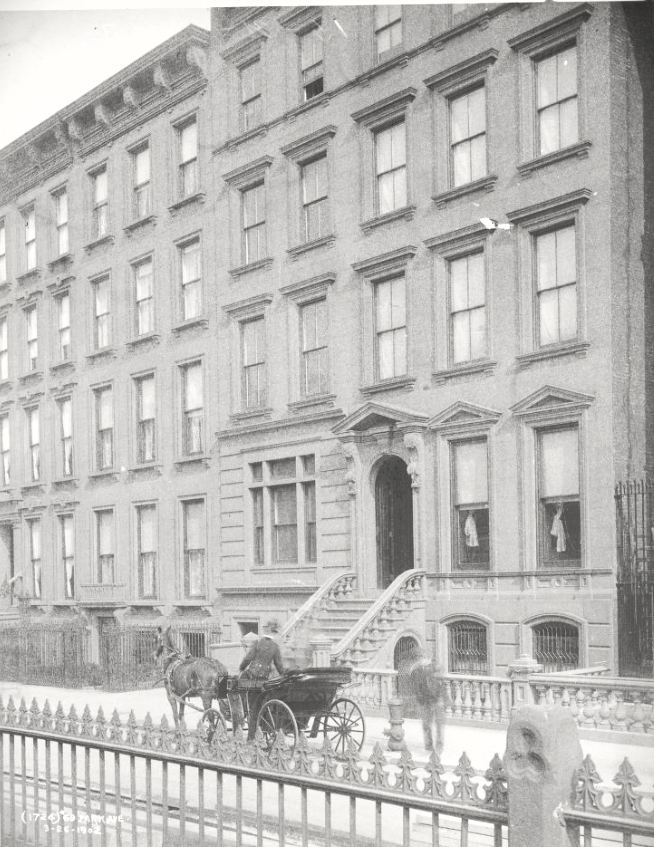
The family's private carriage house can be glimpsed behind the mansion, beyond the bay window.  from the collection of the Museum of the City of New York.

Born in 1820, George Washington Pell was described by The New York Times as "a member of one of the oldest New-York families."  His earliest paternal ancestor in America, John Pell, was the first lord of Pelham Manor.  His mother, Adelia Duane, was related to "the Livingstons, the Norths, the Bleecker-Millers, and the Duanes of Schenectady," said the newspaper.

In 1853, Pell married Mary Bruen.  The couple moved into the newly built brick-and-brownstone mansion at the northwest corner of Fifth Avenue and 36th Street.   They would have one son, Alfred Duane Pell.

The Pell's opulent home was four stories tall above an English basement.  Its Second Empire design included a classical pediment above the entrance.  Prominent cornices upheld by scrolled brackets graced the parlor openings.  A stone balcony fronted the floor-to-ceiling parlor windows on Fifth Avenue.  The fourth floor took the form of a slate-shingled mansard.  Its elaborate dormers were strikingly similar to those of the John Jacob Astor III mansion, erected a year earlier at Fifth Avenue and 33rd Street.

Although he held a degree from Columbia College, Pell's substantial inherited wealth precluded his needing a profession.  The New York Times would later mention that he "never engaged in business further than to manage his brother's estate and his own property interests."  He did involve himself in the community, specifically regarding issues within his elite neighborhood.  At the City Council meeting on December 9, 1862, for instance, Pell's "remonstrance to the proposed incumbrance of Thirty-fifth-street, by projecting the sidewalk out," was read.  And the following year, he joined neighbors to sign a letter to Albany expressing "surprise" of the state legislature's intention to install street railroads on every "avenue and street in the City of New-York."

In 1864, George and Mary Pell moved slightly northward to the southeast corner of Fifth Avenue and 39th Street.  No. 392 Fifth Avenue now became home to Emil and Virginia W. Justh. 

Born in Hungary in 1825, Justh was the head of the brokerage firm E. Justh & Co.  When he and Virginia moved into their new home, the Civil War was raging.  It appears Justh was nervous about the draft lottery, enacted the previous year.  The legislation provided a loophole by which the wealthy could pay for a substitute.  On September 4, 1864, The New York Times ran the sarcastically worded headline, "The Draft: Names of Patriotic Gentlemen who Have Furnished Substitutes in Advance of the Draft."  Among those listed was Emil Justh.

The wealthy couple apparently leased 392 Fifth Avenue from the Pells.  In 1866, they moved to 93 East 34th Street.  (Emil Justh survived an assassination attempt there on Christmas Eve, 1866.  In the middle of the night, he heard a noise in the hallway.  As he approached his bedroom door, "it was suddenly thrown open and a pistol fired directly at him," reported The New York Times.)

In 1868, Louis Thurston Hoyt purchased 392 Fifth Avenue for $129,000, according to The New York Times.  The price would translate to about $2.9 million today.  Born on April 9, 1834, Hoyt was a stockbroker.  Among his high-powered clients, according to The New York Times later, were "Commodore Vanderbilt, Leonard Jerome, A. W. Morse, E. H. Miller, John Trevor and Benjamin Nathan."  He married Marie Antoinette Bogert on January 27, 1857.  The couple had two daughters, Geraldine, born in 1859; and Aline born two years later.  The couple's country home was in New Brighton, Staten Island.

Marie Antoinette Hoyt died in the mansion on June 1, 1879.  Interestingly, her funeral was not held in the drawing room, as would be expected, but at the Church of the Incarnation on Madison Avenue.

Hoyt and his daughters were at the Staten Island estate during Thanksgiving week 1886.  While there, Geraldine died at the age of 27.  Her funeral was held in New Brighton on December 1.

Left with no family members other than her widowed father, Aline was now among the most prominent heiresses within Manhattan society.  The hostess of 392 Fifth Avenue, she appeared in society columns, like the mention in The New York Times on January 29, 1893, "To-morrow Miss Hoyt of 392 Fifth Avenue will entertain a party of ladies at luncheon."

from the collection of the New York Public Library

The innocuous article did not reflect the storm clouds forming inside the mansion.  Aline was engaged to John W. Woodfield, against her father's blessings.  The potential groom was British and, reportedly, Hoyt did not wish his daughter to marry anyone other than an American.  The tensions were perhaps behind the notice in the New-York Tribune on December 24, 1893, "The wedding of Miss Aline Hoyt, daughter of Louis T. Hoyt, and John Woodfield, which was set down for January 3, has been postponed on account of the illness of Miss Hoyt."

On January 18, 1894, the New-York Tribune reported, "It is authoritatively announced that the engagement of Miss Aline Hoyt...to John W. Woodfield, of England, has been broken."  While it appears that Louis Hoyt's will had prevailed, it was a temporary situation.  Four months later, the New-York Tribune wrote, "Miss Aline Hoyt a few months ago was married to John Woodfield, in St. Chrysostom's Church...without the knowledge of her father, who has since refused to receive either his daughter or her husband."

With Aline gone, Louis handled the social affairs within his house personally.  On May 8, 1894, The New York Times announced, "Miss Edith Cruger Sands and her fiancĂ©, T. J. Oakley Rhinelander, were the guests of honor at a handsome dinner given last evening by Louis T. Hoyt."  But the absence of a female in the Fifth Avenue mansion would be short-lived.  On May 18, 1894, the New-York Tribune reported, "The engagement has just been announced of Mrs. Richard M. Pell, of No. 436 Fifth-ave., to Louis T. Hoyt, of No. 392 Fifth-ave."  Louis and Frances Mary Jones Pell were married on June 11.  (Interestingly, Frances's former husband, who died in 1882, was the brother of George Washington Pell, the first owner of her new home.)

The newlyweds would see changes within their exclusive residential neighborhood.  A year earlier, William Waldorf Astor opened the Waldorf Hotel on the site of his father's mansion.  It would open the floodgates to commerce along the thoroughfare.

In the summer of 1901, Louis and Frances traveled to Europe.  Louis died in Bad Nauheim, Germany on August 2 at the age of 67.  His body was brought back to New York and buried in Greenwood Cemetery.  In reporting his death, The New York Times mentioned, "he had one daughter, Mrs. Woodfield, who lives in London."

At the turn of the last century, commerce had encroached into the neighborhood.  The Hoyt mansion can be glimpsed on the right, while a shop has been installed into the ground floor of the mansion to the left.  from the collection of the Museum of the City of New York.

On September 4, 1901, The New York Times reported that Frances "is to receive the bulk" of Hoyt's estate, noting, "She is to receive the residence 392 Madison [sic] Avenue, with the jewelry, furniture, and horses and carriages for life...Mrs. Hoyt is also to have the use of his country seat at Staten Island."  The Fifth Avenue property was assessed at $9 million in today's money.

It does not appear that Frances Hoyt was interested in the New Brighton estate.  Following her period of mourning, she rented "Mrs. Markoe's cottage" in Southampton for the summer of 1903, according to the New-York Tribune, and spent subsequent summers in other fashionable places and in Europe. 

By 1908, Frances Hoyt was the last of the holdouts in the neighborhood.  Other mansions had been converted for business purposes or replaced with commercial buildings.  She eventually relented.  On June 2, The Sun reported she "is the buyer of No. 726 Fifth Avenue, sold recently by Charles W. Morse."  Six months later, the New-York Tribune announced that Frances had hired McClellan & Beadel to design a replacement mansion on the site.  

With her new home completed, in February 1912 Frances Hoyt sold the brownstone mansion to The Martin Holding Co.  The Record & Guide reported, "The price paid was about $1,000,000."  The figure would translate to about $33.4 million today.  On February 4, The New York Times commented, "The old house has been occupied for many years by Mrs. Louis T. Hoyt, and it has attracted attention in view of the fact that it is the only dwelling in that locality which has thus far resisted the encroachment of business."  The article said, "it is believed that the residence will soon be torn down and improved for high-class commercial purposes."

That assumption proved to be true.  Just four months later, on June 16, The New York Times began an article saying, "In the recent demolition of the old Louis T. Hoyt house on the northwest corner of Fifth Avenue and Thirty-sixth Street, for an eleven-story commercial building...one of the few remaining residential landmarks in the shopping district around Thirty-fourth Street has been wiped out as a result of the all-devouring trade invasion."

The tall building in the center of the frame replaced the Hoyt mansion.  via the NYC Dept of Records & Information Services.

Monday, October 21, 2024

The Lost Charles Lanier House - 30 East 37th Street


photograph by Wurts Bros. from the collection of the Museum of the City of New York


James Franklin Doughty Lanier was born in North Carolina on November 22, 1800.  His earliest ancestor in America was Thomas Lanier, who arrived with his friend, John Washington, in Virginia in 1655.  (Washington's great-grandson, George, would become America's first President.)  

In 1849, James Franklin Doughty Lanier moved his family to New York City.  His first wife, Elizabeth Gardner, had died in 1846 and he married Mary McClure in 1848.  Lanier, who started out practicing law, turned to banking in the 1830s and became president of the Bank of Indiana in 1833.  The year he moved his family to New York, he co-founded the banking firm of Winslow, Lanier & Co. with Richard H. Winslow.

The Laniers moved into a fine residence at 16 West 10th Street.  Charles Lanier was 12 years old at the time.  Two years after he married Sarah E. Egleston on October 7, 1857, he was taken into his father's banking firm.  The newlyweds remained in the West 10th Street house, increasing the population with a son, James Frederick Doughty Lanier III, born in 1858; two daughters, Sarah Egleston, born in 1862; and Fannie who arrived two years later.

Sarah Egleston Lanier was pregnant again in 1870 when she and Charles left West 10th Street for their own opulent, double-wide mansion at 28-30 East 37th Street.  Elizabeth Gardner Lanier would be born there on October 29, 1870.

Charles Lanier later in life.  from the collection of the Library of Congress

The family's brownstone fronted, Italianate house rose four stories above an English basement.  The arched entrance sat within a Corinthian columned portico.  In a highly unusual move, the architect chamfered the western corner.  His doing so strongly suggests the Laniers' property extended a few feet into a narrow garden between the mansion and the carriage house of the former Isaac Newton Phelps mansion which was erected on the Madison Avenue corner in 1854.

The drawing room of the mansion was the scene of Sarah's marriage to Francis Cooper Lawrance, Jr. on the afternoon of December 14, 1881.  The choice of a house wedding rather than a more socially visible ceremony was, no doubt, because of James F. D. Lanier's death three months earlier.  The New York Times said, "The wedding was private, owing to recent deaths in the bride's family, and the guests were limited, therefore, to near relatives and most intimate friends."

The family's summer estate, Allen Winden, was in Lenox, Massachusetts.  Fannie married Francis R. Appleton in Trinity Church there on October 7, 1884.

The residence at Allen Winden was designed by Peabody & Stearns in 1882.  from Lenox, 1886 (copyright expired)

James F. D. Lanier III was the next to marry.  His wedding to Harriet Bishop in the West Presbyterian Church on West 42nd Street was a socially prominent affair.  On November 25, 1885, The New York Times reported, "In the rear of the church was a grouping of luxuriant tropical plants, palms and ferns stretching above the organ loft.  The pulpit was buried under a mass of roses."  Among the long list of socially elite guests at the wedding and reception were Mrs. Stuyvesant Fish, Mrs. Oliver Belmont, Mrs. Seward Webb, Mrs. Cornelius Vanderbilt, Mr. and Mrs. D. O. Mills and Ogden Mills.

As his father had done, James brought his bride to his parents' home.  Two sons would be born in the East 37th Street house--Charles Day in 1886, and Reginald Bishop in 1888.

Four months before James's and Harriet's wedding, Charles had hired builder G. Mulligan to install a bay window on the parlor floor.  The handsome alteration cost him the equivalent of $19,600 in 2024 terms.

The social spotlight finally landed on Elizabeth (known within the family as Lizzie) in 1889.  On December 13, the New-York Tribune reported, "Mrs. Charles Lanier, No. 30 East Thirty-seventh-st., gave a reception yesterday afternoon for her daughter, Miss Lizzie Lanier."  Among those assisting in receiving were Lizzie's sisters.  The article noted, "About 1,000 people were present."

Two years later, Lizzie married George Evans Turnure in  Trinity Church in Lenox.  The Springfield Daily Republican reported, "a large and fashionable company of guests were present," adding, "The wedding breakfast at the country house of Mr. and Mrs. Lanier was the scene of a delightful gathering immediately after the ceremony."  Astoundingly, the article said, "More than 1000 varieties of roses were used in decorating the entire lower level of the house."

James and Harriet still lived in the townhouse with Charles and Sarah.  In October 1891, they were looking for a governess for their eldest son.  Their ad read, "Wanted--German governess, able to give English lessons to a boy until he goes to school, and take entire charge of him; must have best references."  (The mention of taking "entire charge" of the boy before entering school suggests Charles Day Lanier would be going away to a high-end boarding school.)

Charles had the house updated in 1896, apparently modernizing the interiors.  On March 22, The New York Times reported that his alterations would cost $15,000.  The significant expense would translate to half a million in 2024 dollars.

Up-to-date dĂ©cor was necessary for the Laniers' extensive entertaining.  The 1895 America's Successful Men of Affairs mentioned, "His wife and he are hospitable entertainers and welcome in the most cultivated circles."  The article listed his exclusive club memberships, including the Union League, the Union, the Metropolitan, Knickerbocker, Century, Tuxedo, and Players' Clubs among others.

In February 1898, Sarah caught the flu and never recovered.  She died in the East 37th Street mansion on April 18 at the age of 61.  Somewhat surprisingly, her funeral was not held in the house, but at the Church of the Incarnation on Madison Avenue and 35th Street.

Equally surprising, ten months later James and Harriet left Charles, still in mourning, for an extended period.  On December 1, The Sun reported they, "will go abroad this month, to remain until the summer at least."  The article noted that earlier they had leased their country house, Sunridge Hall, at Westbury, Long Island, to Clarence H. Mackay and his wife for three years."

In April 1901, James and Harriet began construction of a sumptuous townhouse nearby at 123 East 35th Street.  Two months earlier, Charles had given the family a scare when he was injured in a serious accident.  On the evening of February 14, he and the housekeeper, Miss Bigelow, were being driven in the Lanier coupĂ© by coachman Christopher Hayer to visit Louisa Minturn at 22 Washington Square.  At the corner of Madison Avenue and 29th Street, the hose wagon of Engine Company No. 1 collided with the carriage.  The New-York Tribune reported, "Hayer attempted to get out of the way, but before he succeeded the pole of the hose wagon had pierced the side of the coupĂ©."

The speeding wagon pushed the carriage to the curb and both teams of horses fell to the pavement.  The two drivers were thrown from their seats.  The New-York Tribune reported, "Mr. Lanier was injured on the side and chest and Miss Bigelow suffered considerably from shock."  After being taken to the home of Vernon H. Brown at 95 Madison Avenue, the pair was brought home in a cab.  The newspaper noted, "The coupĂ© was badly wrecked, but none of the horses were injured."

James and Harriet moved into their new home in 1903.  The following year, Charles's grandchildren, Charles Lanier Lawrance and Katherine "Kitty" Lanier Lawrance moved into 30 East 37th Street.  They were 22 and 11 years old respectively.  Their mother, Sarah Lanier Lawrance, died in 1893, the year Kitty was born.  Their father married Susan Ridgway Willing the following year.  After his death in 1904, Susan surrendered the custody of her step-children to their grandfather and moved to Paris with the daughter she had with Francis Lawrance.

On September 21, 1915, Kitty was married to William Averell Harriman in Trinity Church in Lenox.  The reception was held at Allen Winden.  The New York Times said, "breakfast will be served on the porches and at small tables on the terraces...The villa and the grounds are most inviting."  Harriman would go on to become Governor of New York and Under Secretary of State for Political Affairs under Presidents John F. Kennedy and Lyndon B. Johnson.

The younger Charles Lanier had moved to a ranch in Omaha, Nebraska by the time of his sister's wedding.  He died there at the age of 32 on December 4, 1918.

On January 19, 1926, Charles gave "an informal reception" to celebrate his 89th birthday.  Less than two months later, on March 8, The Springfield Daily Republican reported, "News was received here this afternoon of the death at his home in New York city of Charles Lanier, 89, who has made Lenox his summer home for the past 60 years."  The newspaper mentioned that he was "a close friend of the late [J.] Pierpont Morgan and was a member of the little group, informally called the Corsair club, which met on Mr. Morgan's yacht."

The Lanier house became the Harvard Business Club.  While the club occupied the lower floors as its clubhouse, certain unmarried members lived in the upper floors.  It remained here until 1938 when the Dartmouth Club moved in.  In its March 1938 issue, the Dartmouth Alumni Magazine reported, "By the time this appears the ritzy Dartmouth Clubhouse at 30 East Thirty-seventh Street should be in use."  The article mentioned that the "extensive refurbishing was almost completed."

The Dartmouth Club was replaced by the Andrew Furuseth Club in 1942.  The Seafarers Log reported on October 1, "The most sumptuous quarters ever set aside for the exclusive use of the merchant seaman was dedicated today in a ceremony which included prominent speakers from all walks of American life."  The article said, "This entire structure is for the exclusive use of the merchant seamen.  They have only to show their discharges at the door and all facilities are at their disposal."

A postcard depicted activities in the Andrew Furuseth Club--a stark contrast from entertainments during the Lanier years.


The Andrew Furuseth Club would have to find new quarters in 1949.  The former Lanier mansion was demolished to make way for the Emery Roth & Sons designed Morgan Park apartment building, which survives.

no permission to reuse the content of this blog has been granted to LaptrinhX.com

Wednesday, January 31, 2024

The 1903 Le Grand L. Benedict Residence - 125 East 56th Street


Simon and Rosina Weil had lived in the three-story, high-stooped house at 125 East 56th Street since around 1877 when they sold it to Le Grand L. Benedict in September 1901.  By then its architecture was decidedly out of fashion.  

Benedict and his wife, the former Sarah C. Blaine, demolished the vintage house and hired architect J. H. de Sibour to design its replacement.  His plans, filed in April 1902, projected the construction cost of the "five story brick and stone dwelling" at $40,000 (about $1.4 million by 2024 terms).  Completed early in 1903, the 20-foot-wide house was faced in red brick above a rusticated limestone base.  Its Colonial Revival design invoked refined 18th century townhouses of Philadelphia or Boston.  French windows on the second floor, or piano nobile, were fronted by faux balconies with waist-high iron railings.  The splayed lintels of the third floor and layered keystones of the fourth carried on the colonial motif.  The top floor took the form of a tall, single-slated mansard with three pedimented dormers behind a stone balustrade. 

The Architectural Review April 1905 (copyright expired)

Born in 1855, Benedict (whose first name was sometimes spelled LeGrand) could claim an old American pedigree.  According to The New York Times, he was "a descendant of a family that came to New England in 1600."  He was the son of banker and railroad mogul James H. Benedict.  Le Grand and Sarah had two children, Margaret De Witt and Le Grand, Jr.  The family's summer home, The Nooke, was in Cedarhurst, Long Island.

The Benedicts' home was completed in time for Margaret's debut.  On December 22, 1903, The Sun reported, "Mrs. Le Grand Benedict of 125 East Fifty-sixth street, gave a tea yesterday afternoon at which she presented her daughter, Miss Margaret Benedict, to society...Afterward there was a dinner and the guests went together to Sherry's for the Gorham Bacon dance."  Notable among the three young ladies who assisted in the receiving line was Miss Uling Harper.

The Architectural Review April 1905 (copyright expired)

Uling Harper was the daughter of J. Henry Harper, a partner in the publishing house of Harper Brothers.  On March 12, 1905, The New York Times reported, "On Tuesday, Miss Urling Harper...will be married to Le Grand Benedict, Jr., the son of Mr. and Mrs. Le Grand Lockwood Benedict of 125 East Fifty-sixth Street."  The article noted that because the Harper family was in mourning, "the wedding will be quiet."  Following the ceremony in the Constable Chapel of the Church of Incarnation, the newlyweds made their home with the Benedicts.

In April 1907, the Benedicts sold 125 East 56th Street to Robert Curtis Ogden and his wife, the former Ellen Elizabeth Lewis.  Ogden was born in Philadelphia on June 20, 1836.  His father relocated the family to New York in 1852 and founded the clothing firm of Devlin & Co., of which Robert became a partner.  He and Ellen were married on March 1, 1860.

This portrait of Robert C Ogden was painted by Thomas Eakins.

The couple moved to Philadelphia in 1885 when Ogden became a partner of John Wanamaker.  Then, in 1896, he took charge of the Wanamaker Department Store's New York City branch.  

Robert and Ellen had two married daughters, Margaret and Julia Tredwell.  (A son, Robert G. Ogden, died in 1875 at the age of two.)  Margaret's husband was Alexander Purves, and they lived in Hampton, Virginia.  Julia and her husband, Dr. George Waldo Crary, lived in the East 56th Street house.  The Ogden country home was in Kennebunkport, Maine.

The Architectural Review April 1905 (copyright expired)

Robert Ogden had served in the Civil War, and had visited the South for Devlin & Co. in 1861.  His experience there left a lasting impression.  A good friend of Samuel C. Armstrong, who founded the Hampton Institute of Virginia, Ogden involved himself in education in the South, particularly for Blacks.  He headed the Southern Education Board and was president of the Conference for Education in the South.  Additionally, he provided significant funding to Booker T. Washington and sat on the Governing Board of the Tuskegee Institute.  An author, as well, among his works was Getting and Keeping a Business Position.

On November 19, 1909, Ellen became ill.  The New York Times remarked, "Before that, for some months, she had been in feeble health."  Her condition worsened into pneumonia, and on November 24, the newspaper said that her condition "was said last night to be so serious that she might not live until morning."  She lingered until December 3.  In reporting her death, the New York Observer noted, 

Mrs. Ogden took an active interest in her husband's work for education in the South.  She generally accompanied the annual parties of educators he has taken to that field every year since 1901, and was a familiar figure at the numerous educational conference and meetings in which Mr. Ogden has taken a conspicuous part in the later years of her life.

Robert Ogden's Philadelphia friend, George E. Tilge was returning home from Europe with his wife in December, 1910 when he fell ill on board the ocean liner.  The ship docked in New York on December 6, The New York Times reporting that Tilge "was in ill health when he left the ship, and went to Mr. Ogden's house."  The unexpected house guest died in the East 56th Street house two weeks later on December 18.

Robert Curtis Ogden was in Kennebunkport, Maine on August 6, 1913, when he died at the age of 77.  His estate was reported by The New York Times as being "more than $2,000,000."  (The figure would translate to about $61 million today.)  Margaret inherited both homes.  Interestingly, the will forbade the daughters to sell Ogden's horses.  It directed, "When they become unfit for use they are to be given to friends who will care for them in the country and provide them with a comfortable death."

The Architectural Review April 1905 (copyright expired)

Six years later, in March 1919, the Ogden estate sold 125 East 56th Street to Charles Kerkow, "who will use it for his own occupancy," according to the Record & Guide.  But despite Kerkow's assertion, he quickly converted the mansion to apartments.  Only six months later, on September 24, the New-York Tribune reported that Mrs. Mary E. Green had taken an apartment in the house.

The apartments were extremely high-end.  An advertisement for a duplex on December 24, 1922, described it as "unusually decorated and furnished; living room, with balconies, beamed ceiling, cathedral windows, log fire; adjoining a terraced library, 34 feet long, 18 feet high, opening into a sunken garden; breakfast room, bedroom, bath."

Among the residents in 1921 were broker Laurence Craufourd and his wife.  The couple's 27-year-old maid, Jeanne Cunningham, disappeared that year along with $5,000 in jewels.  As it turned out, the Craufourds were not the only victims of the young woman.  Following her arrest in July, she told a heart-breaking story.

A year earlier, Jeanne had met Charles B. Adams in Central Park and "after a flirtation," according to the New York Herald, he got her a job as a maid in his mother's home.  Mrs. Adams fired her after a few weeks.  Adams convinced Cunningham "on the promise that he would marry her" to steal from her employers.  She began a pattern of taking a job, pocketing valuables and leaving that position to repeat the crime at her next position.  She turned over more than $50,000 in loot to her lover.  Cunningham was crestfallen when she read in the newspapers that Adams had married a society girl.  She not only fingered the man who pushed her into criminal activity, but picked him out of a lineup.  She told him, "I know you double crossed me.  Sorry I had to do this, but I've made a clean breast of it."

Living here at the same time was Mrs. H. E. Aitken.   She was summering in Long Island in 1922, when she went to luncheon at the Glenwood Lodge near Roslyn with businessman H. D. Connick.  Afterward, she realized she had lost three rings worth $16,000.  The New York Herald reported on July 6, "Mrs. Aitken thought she left the rings in the wash room of the lodge.  The manager of the lodge said that perhaps a hundred women had been in the wash room between the departure of Mrs. Aiken and her escort after luncheon and their return two hours later."  It does not appear that the rings were ever recovered.


The apartments continued to be home to affluent residents throughout the World War II years.  In 1967 the lower three floors were converted to offices.  The two apartments per floor on the top two survived until 1996, when the building was renovated to office space throughout.  Today the Shanghai Commercial Bank occupies the former Benedict residence.  The house remains extraordinarily intact outwardly, an astounding remnant of the residential block in 1903.

photographs by the author 
many thanks to reader Doug Wheeler for suggesting this post
LaptrinhX.com has no authorization to reuse the content of this blog

Monday, December 11, 2023

The Lost George Harrison Byrd House - 69 Park Avenue


A landau awaits in front of the Byrd house on March 26, 1902.  from the collection of the New York Transit Museum

George Harrison Byrd was born in Brandon, Virginia on May 8, 1827.  He descended, according to the New-York Tribune, "from one of the oldest and most prominent families of Virginia."  Byrd's wife was the former Lucy Carter Wickham.  In January 1866, less than a year after before Robert E. Lee surrendered at 
Appomattox Court House, their second child, Alfred Henry, was born.  Perhaps unexpectedly, with Northerners' memories of the bloody conflict still raw, Byrd brought his family to New York City in 1867.

Byrd was a partner in the cotton firm of Wyman, Byrd & Co. and a director in the Bank of New York.  He and Lucy rented a new home at 69 Park Avenue in the fashionable Murray Hill neighborhood from Samuel G. Weyman.  Located on the east side of the avenue just north of 38th Street, the Italianate residence rose four stories above a rusticated English basement.  A wide, stone stoop led to the parlor floor, where the windows wore classical pediments that echoed that of the entrance.  A molded bandcourse that connected the sills of the fourth floor windows broke up the verticality of the design.

Alfred's sister Anne Harrison was seven years old when the family moved in.  Three more children would add to the population of 69 Park Avenue.  Lucy Carter, Francis Otway, and Edward Wickham would be born in the house.

George Harrison Byrd (original source unknown)

George Byrd retired in 1890 at the age of 63.  He would continue to rent the 24-foot-wide residence until, after nearly four decades in the house, he purchased it from Samuel Weyman's estate on March 1, 1900 for $81,000--about $2.9 million in 2023.  

The Byrds were among the "prominent and well known guests" of the Saranac Inn in the summer of 1900, according to the New-York Tribune.  The article hinted at the activities the family enjoyed.  "The golf course retains its popularity, and tennis and boating have their share of devotees.  The casino and billiard rooms always present a lively appearance during the evening."

But the family's attention would quickly turn to a serious threat to their townhouse.  The construction of a subway tunnel up the middle of the avenue was not merely an inconvenience, it was a danger.  On January 27, 1902, a massive explosion at Park Avenue and 41st Street rocked the neighborhood for blocks around, killing six persons and injuring hundreds more.  Damage to nearby structures like the Murray Hill Hotel was substantial.  

On March 3, 1902, Byrd and his neighbors, "driven to desperation by the series of tragic accidents which have occurred along Park avenue between Thirty-fourth and Forty-second streets," held what The World called "a desperation meeting" in the Manhattan Hotel.  "The residents feel that the occupancy of their homes at present is unsafe," said the article.

George and Lucy Byrd had good reason to be nervous.  At the time of the article, the row of houses directly across the avenue had been so badly undermined that they were being carefully demolished.  The World explained, "the front of three houses on the block had caved in and to laymen it seemed as if the other houses on the east side of the street would also cave in."

The houses opposite the Byrd mansion were shored up and being carefully dismantled on March 26, 1902 when this photograph was taken.  from the collection of the Museum of the City of New York

Then, on January 30, 1903, the New-York Tribune reported that inspectors and engineers of the Buildings Department had discovered that the Barney mansion next door "had settled," and that three others, including the Byrd house, had sunk "an inch."  The article said that a "large force of men" had been put to work installing "pushing braces to support the front walls" of the houses.  The braces, which were embedded into the sidewalk at a 45-degree angle, "do not prevent the houses from settling, but insure the walls from cracking while the settling is going on," said the New-York Tribune.  T. O. McGill, speaking for the Buildings Department assured owners that, while the houses might sink another two inches, "There is nothing alarming about this settling, and people should not be frightened because they see a large force of men bracing up some buildings."  Despite those assurances, three days later the newspaper reported that an inspection of the houses was being made every two hours.

Irate, George H. Byrd and his neighbors sued the Board of Rapid Transit Railroad Commissioners on September 7, 1905.  Byrd's claim covered damages caused by blasting, "damages generally," legal expenses, and other items.  It totaled $17,250.79 (nearly $600,000 today).  

In the meantime, life went on in the Park Avenue house.  On May 4, 1904 George and Lucy announced Lucy Carter's engagement to Dr. Ellsworth Elliot, Jr.  The couple was married in the Church of the Incarnation on June 15.  The New York Times noted, "A small reception for the relatives and intimate friends followed at the residence of the bride's parents."

George Harrison Byrd fell ill in June 1910, and died a few days later on June 10.  In reporting his death, the New-York Tribune pointed out, "Mr. Byrd's mother was before her marriage Miss Anne Harrison, whose family was equally prominent in Virginia as the Byrd family.  President Harrison was a distant relative."  Byrd's body was transported to the family cemetery in Berryville, Virginia for internment.  On August 6, The New York Times reported that he left an estate of $1,205,902, the equivalent of $38.3 million in 2023.

Lucy and Anne, who was still unmarried, re-entered the social circle following their period of mourning.  On February 27, 1912, for instance, The New York Times reported that a meeting of the Sewing Class in Aid of Seamen would be held "at the home of Miss Byrd, 69 Park Avenue," on March 27.  Lucy was involved in a sewing class, as well, one organized by the Colonial Dames.

When this photo was taken on April 19, 1920, the end of the line was near for this block of Park Avenue.  To the right of the Byrd house is the Charles Barney mansion.  It may have been the damage from the subway construction that resulted in 71 Park Avenue, on the other side, being demolished and replaced with the fine home we see here.  from the collection of the Museum of the City of New York

Anne Harrison Byrd never married.  She and her mother  lived on in the house with their staff of servants as Park Avenue changed from a quiet, mansion lined street to a busy thoroughfare.  Then, on April 19, 1923, The New York Times reported, "Mrs. Lucy Carter Wickham Byrd, the widow of George Harrison Byrd, died on Tuesday at her home, 69 Park Avenue."  As had been the case with her husband, her funeral was held in Virginia.

Before the end of the year, the Byrd house and its neighbor at 71 Park Avenue were demolished to make way for a 13-floor apartment building designed by Walker and Gillette.

LaptrinhX.com has no authorization to reuse the content of this blog