Showing posts with label west 125th street. Show all posts

Monday, April 20, 2026

The Lost West End Theatre - 362 West 125th Street


image by Wurts Bros. from the collection of the Museum of the City of New York

During the 1896 St. Louis Republican National Convention, 34-year-old Meyer R. Bimberg came up with the idea of printing pictures of the candidates on tin buttons.  Hearing that McKinley and Hobart would get the nomination, he had 100,000 buttons made—the first political campaign buttons in history.  Later, his buttons that read "Our Choice for Governor" for candidate Theodore Roosevelt sold "like hot cakes," according to The New York Times.  Bimberg became widely known as "Bim the Button Man."

In 1898, Bimberg invested in real estate, erecting a public hall on the Lower East Side.  He would eventually erect five theaters throughout the city.  In 1902, he turned his focus to the what was then known as the West End, where there was a dearth of theaters.  He acquired the vacant lots at 362 through 370 West 125th Street, just west of Eighth Avenue and hired the architectural firm of Neville & Bagge to design a theater on the site.

Designed in the Spanish Baroque style, the tripartite design included a striated brick-and-terra cotta base dominated by a wide cast-iron-and-glass marquee.  The second and third floors were faced in beige brick.  The openings of the midsection were filled with colorful stained-glass, with the three center windows arranged in a Palladian configuration and crowned with elaborate terra cotta ornaments.  The frieze below the bracketed cornice announced West End Theatre.  A handsome balustrade completed the design.

Meyer R. Bimberg personally opened the theater on November 3, 1902.  The New York Times said it contained, "all the most improved electrical devices, superb interior appointments, and safeguards against fire."  The article continued:

From an artistic standpoint the new theatre will be attractive to the eye, the decorators having made effective use of the color scheme, maroon and green, which has been carried throughout the entire building.  The large, roomy chairs are covered with green velour, and the carpets of a rich maroon blending in pleasing harmony with the other decorations.

On each tier were "reception rooms" and below the lobby was a smoking and lounging room for male patrons.

Tickets ranged from 25 cents to $1 (roughly $10 to $40 in 2026).  Actress Alice Fischer appeared in Mrs. Jack on the theater's opening night.

Bimberg soon ran afoul of the Penal Code that prohibited entertainments on Sunday other than singing and concerts.  The New York Times blatantly said, "A general vaudeville show is usually given here which lasts until half-past 11 o'clock.  There are sketches, burlesques, all sorts of variety acts, including singing and monologues."  But during the week of January 3, 1903, the police warned the management "to comply strictly with the law."

Patrons packed the theater on Sunday January 11, 1903 to see the regular Sunday offering.  Instead, one singer after another came on stage.  The New York Times reported, 

Then some of the people began hissing and catcalls followed, women joining in until the theatre was in an uproar.  "Rank!" "Stale!" "Say, this is New York!" and other cries of derision greeted the singers."

The manager came on stage and explained the situation, saying finally, "Please blame the police and not me."  The entire audience eventually walked out.

The following month, on February 10, 1903, The New York Times reported that Bimberg had sold the West End Theatre to Weber & Fields for $300,000.  The comedy team of Joe Weber and Lew Fields had recently added theater management to their resumes.  The article noted that this was "their third theatre."  The partners said they would "carry out the present engagements" through the current season, but refused to say what the next year's attractions would be.

In fact, Bimberg had partnered with the pair to form the Bin-Web Corporation.  Bimberg still owned a portion of the property, but gave up its management.

image by Byron Company, from the collection of the Museum of the City of New York.

A critic on the staff of The Theatre was pleased with the new management.  In its November 1903 issue, he said that under Weber & Fields the theater "is commodious and comfortable, handsomely furnished and decorated, and the attractions being among the best."  The plays, it said, "draws refined, intelligent audiences at Broadway prices."

Those refined and intelligent audiences were enjoying grand opera and concerts by the end of the year.  During the week of December 20, Weber & Fields presented a concert by the New-York Symphony Orchestra, and productions of Otello, La Traviata and Carmen in English.

New Yorkers were thrilled when Weber & Fields announced that Madame Adelina Patti would appear on November 27, 1903.  Arguably the most famous operatic soprano in the world, her appearance would guarantee a full house, but it would also take a huge chunk out of the ticket sales.

Fans waited an hour for the prima-donna to appear on stage.  While they waited, Patti "waited placidly in her apartments at the Savoy Hotel," reported The New York Times.  Her delay, said the article, "cost the audience a large share of its good temper."  The problem was a detail in the contract.  Adelina Patti insisted upon the payment of $5,000 "before she would budge one inch toward the stage of the West End Theatre," explained The Times.  But when the receipts were tallied, they totaled only $3,180.  The diva's agent told the manager, "Mme. Patti could not think of leaving the Savoy with only $3,180 in sight."  (The figure would translate to $117,000 today.)
Lew Fields was contacted and the $2,000 was sent to the theater.  

The concert went on, the audience was mollified, and Weber & Fields took a severe financial blow.  The next morning Adelina Patti headed off to San Francisco.  The New York Times said, "Mr. Fields was not to be seen, but sent out word that he was too overcome to speak."

In its May 1904 issue, The Theatre commented, "The West End Theatre is growing steadily in popularity, due to the astute policy which takes up to Harlem some of the best attractions seen on Broadway."  

Weber & Fields continued to mix grand opera and orchestral concerts with dramas and comedies.  On April 10, 1907, for instance, The New York Times announced that the Van den Berg Opera Company "will begin a Summer engagement at the West End Theatre on Monday, May 6, in grand and comic opera at popular prices."

The next year, Weber & Fields leased the theater to the Shubert brothers, Lee, Sam and Jacob.  They opened with John Mason in The Witching Hour on September 21, 1904.  The New-York Tribune noted, "It is the intention of the Messrs. Shubert to present here only first class productions, and they are to be varied."

Actress Marie Dressler opened here on February 24, 1913 with the Dressler's Players.  The audience might have been impressed with the 45-year-old woman's capabilities.  The playbill listed "The entertainment staged by Miss Dressler, curtains and decorations designed by Miss Dressler, costumes designed by Miss Dressler."  She also, of course, appeared in the troupe's production of Camille.  The New York Times remarked, "Miss Dressler proved that she had not forgotten how to hold an audience."

Renovations to a movie theater included a new marquee, blade sign, and the removal of the balustrade, seen here in 1929.  from the collection of the New York Public Library

On March 15, 1914, The Sun reported that the West End Theatre "will be dedicated from to-morrow on to the film plays."  The venture was short lived.  On February 11, 1915, International Music and Drama reported, "Taking heed of the signs of the times, and noticing that the craze for moving pictures is on the wane, and that there is a distinct interest in the revival of the stock company proposition, the management of the West End Theatre has decided to return to this policy."  The theater opened with Nobody's Widow.

In August 1919, the Real Estate Record & Builders' Guide reported that Bin-Web Corporation had leased the building to Marcus Loew.  As a nod to Meyer R. Bimberg, who died in 1908, he tweaked the named to Bim's West End Theatre.

On the night of November 6, 1921, manager Robert McNaab locked the theater and headed home with the evening's receipts.  The New York Times reported, "In a deserted district, McNaab said, someone struck him over the head."  Three men grabbed the package containing $1,500 and fled in an automobile.  The robbers were never found.

There were more than 800 patrons in the theater on the afternoon of June 20, 1940 watching The Shriek in the Night.  Suddenly, two large sections of the plaster ceiling 75 feet above them collapsed.  The New York Times said they "crashed atop of those in the front rows."  Six movie-goers were injured enough to be hospitalized.

By the early 1970s, the West End theater featured horror and action films.  New York Amsterdam News, September 16, 1972.

The West End movie theater closed in 1975.  It was acquired that year by the La Gree Baptist Church.  

The marquee and stained glass were gone when the church operated from the structure.  (photographer unknown)

Le Gree Baptist church remained in the building for four decades, selling it to a developer in July 2016.  On December that year, the Commercial Observer announced that Haim Nortman had filed plans for a commercial-residential structure on the site.

image via cityrealty.com

Tuesday, September 9, 2014

Blumstein's Dept Store -- No. 230 West 125th Street


  photo by Nicolas Lemery Nantel / salokin.com

When Louis Blumstein arrived in New York in 1885, the mansion of Dr. John Ferdinand stood in the Harlem area that would become West 125th Street.  Before the end of the century the neighborhood would become a high-end suburb and the doctor’s handsome home would be gone.

Blumstein established a dry goods store in 1886.  When he moved northward to West 125th Street between Seventh and Eighth Avenues two years later, the street already bustled with shoppers.  Blumstein’s Department Store was soon a fixture and was run as a family business.  According to Jonathan Gill in his book Harlem, “At a time when signs reading Keine Juden, und Keine Hunde (‘No Jews, and No Dogs’) could be seen in shop windows, Blumstein’s became a favorite of uptown’s German Jews.”

The management methods of the sometimes stern German Blumsteins, however, was not always appreciated.  Carolyn Stock worked in the store in March 1900 when Benjamin Blumstein asked her to show him a box of handkerchiefs.  By mistake she pulled down the wrong box.  Blumstein’s reaction was, perhaps, excessive.

Carolyn charged “he grasped the box and threw it at her, striking her on the side, and that later he threatened to kill her with a hammer, and struck her with his fist and threw her against a wall,” reported The New York Times.  She complained that the attacked resulted “in nervous prostration.”

Carolyn Stock sued Benjamin Blumstein personally for $2,000 damages.  The retailer’s lawyer insisted that “the handkerchief box fell on the floor, and that the proprietor walked away without doing anything.”  The jury deliberated for ten minutes and granted the salesgirl’s demands—about $54,000 today.

Blumstein’s was a rather upscale department store, offering Easter Dresses in 1911 for $18.50; more in the neighborhood of $450 today.  But Harlem was changing.  More and more black residents moved into Harlem hoping to escape the discriminatory practices of downtown landlords.  The Blumstein brothers resisted the change and it would later cause them problems.

On Sunday, January 25, 1920 Louis Blumstein died at the age of 56.  The family mourned, then got on with enlarging the business.  On July 3, 1921 The New York Times reported that Blumstein’s would begin tearing down five old buildings that week.  The old two-story department store would go, as would the buildings facing 124th Street.  “Plans were prepared several months ago by the architects, Robert D. Kohn and Charles Butler, for an eight-story building to cover the entire site,” said the newspaper.

Placing the cost at $1.25 million, The Times said “It will be the most ambitious structure erected in the Harlem area for many years.  In order to avoid disruption of business, the 124th Street section was constructed first.  Then the store was moved to that area and the original store demolished and rebuilt.

“Among the features of the new store will be high ceilings and a maximum of show window space of the type known as ‘island windows,’ which are much more common in the Middle West and on the Pacific Coast than in New York,” said the newspaper.  “A complete fresh air supply and exhaust system is designed to include air washers and cooling apparatus.”

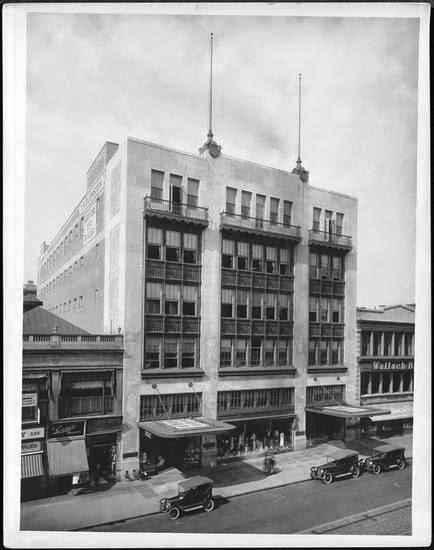
Costly automobiles park outside the newly-completed building -- photo by Wurts Bros. from the collection of the Museum of the City of New York http://collections.mcny.org/C.aspx?VP3=SearchResult_VPage&VBID=24UAYWW4JGPO&SMLS=1&RW=1366&RH=631

Among the conveniences for shoppers were five passenger elevators and a cafeteria in the basement.  On the top floor were “rest and recreation rooms for employes.”  The building was completed in 1923—an unexpected combination of the arriving Art Deco movement and the quickly-receding Art Nouveau.  Copper was more important than limestone in the architects’ novel design.  Above the three sets of grouped openings were unusual and eye-catching copper awnings.


Exquisitely worked copper, unnoticed from street level, and innovative awnings distinguished the design --   photo by Nicolas Lemery Nantel / salokin.com
Before the decade was up, black shoppers at Blumstein’s outnumbered whites.  But the employees were, with the exception of menial labor, all white.  It was a situation that did not go unnoticed by residents increasingly vocal about their civil rights.   

In 1934 The Citizens’ League For Fair Play plastered the streets with fliers that read “Refuse to Trade with L. M. Blumstein 230 West 125th Street” and “This firm, acknowledging its large proportion of Negro business, has refused to employ Negro Clerks.  Stay out of Blumstein’s!  Refuse to buy there!”

The League’s economic boycott was supported by more than 50 churches and groups.  Among those churches was the Abyssinian Baptist Church pastored by both Adam Clayton Powell, Sr. and Jr.  The boycott—the theme of which was “Don’t Buy Where You Can’t Work”—was successful.  Not only did the Blumsteins change their hiring practices; their department store was the first to use black mannequins and—no doubt a shock to some white shoppers—a black Santa Claus at Christmas time.

In 1937 20-year old Irving Barr had been working in the store as a sign painter and handyman for several years.  Surrounded by jewelry and other expensive items, the low-paid Barr hatched a plan.  On May 11 he hid in the store at closing time, waiting until everyone was gone.  He then stole two suitcases from the store’s stock and filled them with fountain pens, watches and other easily transportable costly items.

Suddenly Barr was discovered by the watchman, Joseph Geiger, described by The New York Times as “a frail 61-year old man.”  Knowing that Geiger recognized him, Barr panicked.  He hit the old man repeatedly with a hammer.

Barr rushed to the roof of Blumstein’s and tossed the two suitcases to the roof of a nearby apartment building.  Police said that he then “descended to the engine room and hit Geiger again.”  After what The Times called “intensive detective work,” Barr was arrested and charged with homicide.

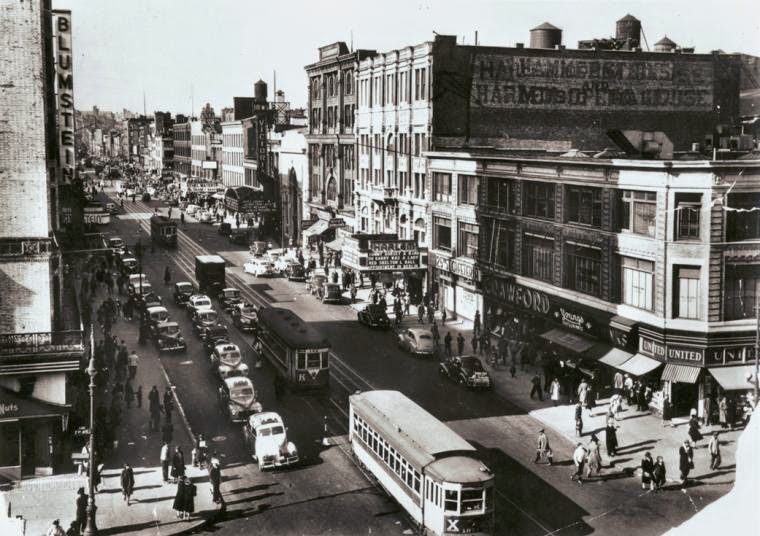
West 125th Street in 1943 bustled with taxicabs, streetcars and nicely-dressed shoppers.  Blumstein's can be seen at the far left -- from the collection of the New York Public Library

The store that had unintentionally been a flash point in the early civil rights movement welcomed Martin Luther King to the store for a book signing on September 20, 1958.  King sat behind a table autographing copies of his Stride Toward Freedom when Mrs. I. W. Curry approached.  The woman groped in her purse and pulled out a sharp stiletto-like letter opener which she plunged into the civil rights leader’s chest.

An elderly customer, Mrs. James Watson moved to remove the weapon; but another woman cautioned against it.  Dr. King lay on the floor assuring the gathering crowd “That’s all right! That’s all right.  Everything is going to be all right!”

When the ambulance arrived a few minutes later, the weapon was still protruding from King’s chest.  The customer’s prudent action, or lack of action, no doubt resulted in his survival.  King was rushed to Harlem Hospital where the wound was treated.  Mrs. Curry’s letter opener had grazed the aorta without piercing it.

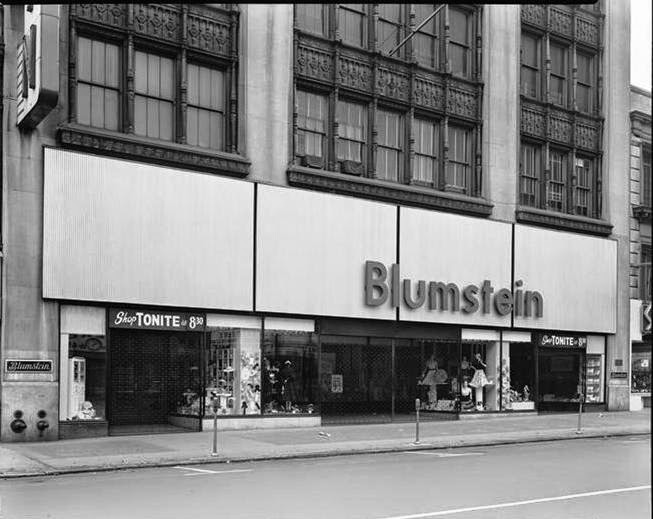
By March 21, 1954 when Wurts Bros. took this photograph, Blumstein's had been given a first floor make-over -- from the collection of the Museum of the City of New York http://collections.mcny.org/C.aspx?VP3=SearchResult_VPage&VBID=24UAYWW4JGPO&SMLS=1&RW=1366&RH=631

The succession of Blumsteins at the helm of the department store would continue for years.  On August 29, 1960 William Blumstein died, and Jack Blumstein took over as President.  By now the store that had once refused to accept change was an active participant in the community.  In June 1965 the National Council of Negro Women sponsored a showing of paintings by black artists here.  Five years later when Abraham & Straus and Macy’s department stores announced with self-applauding fanfare that they would include black Santas on their Christmas floors, The New York Times pointed out that “Blumstein Department Store at 230 West 125th Street in Harlem, however, has had a black Santa Claus for more than 20 years.”

By now the Blumstein building was suffering from old age.  When The Times described the proposed structure in 1921 it made note of the basement.  “A staircase immediately adjoining the entrances will lead to the basement store, which it is planned to make the best ventilated basement in the city.” 

Now, in 1971 the pet shop was in the basement and New York Magazine’s description was less glowing, saying it was located “down two slightly dingy flights of steps.”  Nevertheless, the store offered an amazing selection of animals, many of which would be illegal today.

“The pet shop is a squawky display of exotic plumage of some 50 varieties of birds,” said the magazine.  “The shop also shelters a pair of Capuchin (organ grinder) monkeys, many tanks of exotic fish and an assortment of fresh aquarium plants.”

Five years after the article was printed, the Blumstein family sold the building.  Before long a variety of small businesses filled the now-divided floors where women had shopped for Easter dresses and, later, civil rights history played out. In 2002 the last president of Blumstein’s Department Store, Kyver Blumstein, died at the age of 95.

Today Touro College has taken over much of the building as its college of medicine and college of pharmacy.  Distracting plastic retail signs plaster the lower levels so that only by glancing upward can a passerby appreciate the surviving remnant of an important part in Harlem’s development and the Civil Rights movement in America.

Tuesday, August 12, 2014

Loew's Victoria Theater -- 235 West 125th Street


The once-grand theater sits boarded-up awaiting its fate -- photograph by Nicolas Lemery Nantel / salokin.com

In the opening years of the 20th century nickelodeons and theaters offered New Yorkers a fascinating new form of entertainment—the silent movie.  By 1910 more than a dozen theaters offered motion pictures along East 14th Street alone.

Marcus Loew was born on the Lower East Side in 1870, the son of Jewish immigrants.  Starting out as a newsboy, he worked his way up to owning his own newspaper and selling furs.  When he met fellow furrier Adolph Zukor, his life would take a drastic turn.

The pair established the Automatic Vaudeville Company around the turn of the century and opened penny arcades with hand-cranked “motion picture” vignettes.  As motion picture technology improved, Loew began purchasing established theaters and renovating them into actual motion picture houses.

Loew’s fortunes soared and before long he was constructing his own buildings; and his motion picture palaces were intended to outshine the best of the legitimate theaters.  In 1907 Loew joined forces with architect Thomas White Lamb to design his theaters.  The arrangement would be mutually advantageous and by the end of his career Lamb would be responsible for the plans of more than 300 theaters in the United States, Australia, India, South Africa, England and Egypt (not all for Loew’s, of course).

In 1916 Loew acquired the properties at Nos. 235 and 237 West 125th Street occupied in part by the 12th Ward Savings Bank.  And now Lamb returned to his drafting board to design what would be Loew’s Victoria Theatre.

On May 13, 1916 Exhibitions World predicted “Loew’s Victoria will be the last word in the theater construction.”  The periodical said the theater would be “devoted to high class vaudeville and the very best of motion pictures.”

The Harlem area around the site was changing in 1917 from the all-white middle- to upper-class neighborhood of a generation ago.  Black New Yorkers, in an attempt to escape the prejudicial treatment of landlords downtown began moving north around the turn of the century.  Even here, however, the blacks were taken advantage of.  Later, in 1939, the WPA’s New York City Guide noted “Barred from most residential areas in the city, Negroes pay rents 50 per cent higher than those charged for comparable living quarters elsewhere.”

Yet it was still a vibrant neighborhood and motion picture theaters were cropping up along its avenues.  For the Victoria, Lamb melded an Italian Renaissance Classical facade with British 18th century Adams interiors.   Completed in September 1917, its exterior was clad in white terra cotta.  A grand, soaring colonnade, two stories tall, supported a dignified paneled parapet.  Inside were wall murals and in the 2,394-seat auditorium, a large and striking ceiling dome.  The boxes were set within triumphal arches.  The final construction cost was $250,000—a significant $4.25 million today.


Terra cotta rhytons stand at the ends of the deteriorating parapet.  photograph by Nicolas Lemery Nantel / salokin.com

With the new Victoria along West 125th Street were Hurtig & Seamon’s New Burlesque Theater (it would be renamed the Apollo Theater later in the century), the Alhambra Theater, Proctor’s, and the Hammerstein Opera House.  The strip would become popularly known as “Opera Row.”

photograph Architecture & Building, January 1918 (copyright expired)

Opening night was on October 3, 1917 and it was noteworthy.  On the bill that night were the silent films Barbary Sheep and Oh, Doctor!  The stars of both, Elsie Ferguson and Fatty Arbuckle, were present.  Vaudeville draws Raymond & Caverly, known as the Wizards of Joy, presented their new act “The Submarines,” and The Hirshcheff Troupe played in A Russian Wedding.  Also present was Loew’s good friend Irving Berlin.

photograph Architecture & Building, January 1918 (copyright expired)
The Victoria opened its doors every day at noon and ran continuously until 11 p.m.  Admission was 10 or 15 cents in the afternoon and 15 and 25 cents at night.  For the price audiences could see two live shows per day along with the movies.

The popularity of the theater is evidenced by the take in the armed hold-up on December 6, 1925.  Assistant Manager Irving Plumer and cashier Ada Maurice were counting the receipts from one of the ticket booths in the business office.  Suddenly the window to the alley suddenly burst.  They were faced with a revolver thrust through the broken glass as the thug ordered them to turn over the cash.

“The hold-up man, a well-dressed youth wearing a cap pulled over his eyes, ordered: ‘Give me that money.  Hurry up; give here quick!’” reported The New York Times the following day.  Plumer handed the two piles of bills to the thief who fled down the alley into the night.  The take was $351—a substantial amount considering the dime and quarter admission fees.

Although the Harlem neighborhood by 1927 was comprised of two-thirds of New York’s black population, there were still a significant number of Irish residents here.  Problems came to the Victoria in August that year when the motion picture The Callahans and the Murphys was screened.  The picture had already aroused protests in other theaters and so on August 26 there were two patrolmen stationed outside the Victoria.  But inside, when a scene depicting an Irish picnic started, two audience members initiated what The Times deemed a “row.”

Mrs. Alice Tennyson and Mrs. Katherine Tennyson shouted “Are you going to stand for this.  It’s a disgrace to the Irish!”  The New York Times reported “The shouts brought more cries, hisses and catcalls.”  Two other women, Mrs. Anna Skillan and Mrs. Mary Monahan joined in the disruption.  The two policemen rushed into the theater and when the women refused to desist, they were arrested for disorderly conduct.

But in 1927 it was not discrimination against the Irish that was most evident at Loew’s Victoria.  Black patrons were permitted only in the balcony.  African-American jazz musician Garvin Bushnell had moved to Europe in 1925 to escape discrimination and had established a successful career.  Now he was back in New York and according to James L. Conyers, Jr. in his African American Jazz and Rap, he set out on his own personal campaign against segregation.  He did so at Loew’s Victoria by “sitting down in the restricted section, wearing a Homburg hat, speaking with a British accent, and daring them to throw him out.”

Although live vaudeville came to an end at the Victoria in 1930, the Great Depression years brought another type of diversion—the talent contest.  On week nights the Victoria, along with most of the theaters on Opera Row, staged local talent contests.  It was the beginning of a tradition that created a national name for the nearby Apollo Theater.

As it had done on opening night of the Victoria, the Loew’s Corporation drew audiences with live appearances by stars on premiere night.  The choice of stars in August 1940 could be argued as either demographic marketing or inherent racism.  While Eddie Cantor appeared downtown at Loew’s Canal Theatre for the premiere of Forty Little Mothers; it was not Jack Benny, but Eddie Anderson--who played Rochester--who was sent to Loew’s Victoria for the opening of Buck Benny Rides Again.

From the late 1940s through the mid-1950s the Victoria was the scene of the Police Athletic League’s annual Christmas party for the underprivileged children of the neighborhood.  Each year thousands of youngsters would file into the theater for free screenings and gifts and candy from the PAL.

By the 1960s motion picture attendance nationwide dropped as families purchased television sets and stayed at home.  In response, the Loew’s chain initiated close-circuit large screen television viewings of live boxing matches.  In 1962 over 2,500 patrons—mostly black according to the New York Post’s writer Ted Poston who was there—paid $6.75 to see the Sonny Liston-Floyd Patterson fight in Chicago.  Poston described “hundreds of standees…scores of others crouching in the crowded aisles and…dozens of teen-agers who had slipped through a back door.”

The scene would be repeated for major bouts like that 1966 Clay-Williams fight and the 1973 Ali-Norton bout.

By now the Harlem neighborhood around the theater was impoverished and crime-ridden.  And so when the Dance Theatre of Harlem threw a “gala benefit” at Loew’s Victoria on November 13, 1972, wealthy New Yorkers were concerned about political correctness.  The following day The New York Times remarked “But after many a white liberal discussion about what one should or should not wear to Harlem in 1972 (let alone whether one should go or not), the partygoers finally got themselves together.”

People like Mrs. Alfred Gwynne Vanderbilt, Mayor Lindsay, Rod Steiger and Brock Peters were present that night and The Times said “When they arrived at the brightly lighted theater, Harlem was waiting for them behind police barriers.  Black children in bell bottoms, teen-agers in faded corduroys and adults in the worn cloth coats of the poor stood six rows deep to stare, whistle, cheer and comment as black and white women in minks, sables and even chinchilla climbed out in the middle of 125th Street.”

The newspaper added “If either black or white guests were afraid of what might happen to them on 125th Street, nobody, including Mrs. [Oscar] Hammerstein, admitted it.”  Mrs. Harold Reed told a reporter “Someone asked me, ‘Aren’t you afraid of muggers?,’ and I said, ‘Good heavens, No.’  I said, ‘I’m wearing my best fur coat and my best pearls.  Harlem is not a jungle.’”

The following year iconic French entertainer Josephine Baker held a benefit concert at Loew’s Victoria to aid the Police Athletic League.  When a New York Times reporter somewhat oddly asked her how she found Harlem, the chanteuse replied “Well it was night, and we have a saying in France, ‘Every cat looks black in the dark.’”
 
By the mid 1970s the Victoria could no longer command the first-run films being shown in midtown.  Instead it featured “mostly Kung Fu and action movies,” according to Philip Morrow, the director of development for the Harlem Urban Development Corporation a decade later.

Finally, in 1977, after six decades of screening motion pictures to the Harlem community, Loew’s Victoria shut its doors.  It was acquired that year by the Harlem Community Development Corporation.  After nearly a decade of mixed use the corporation issued an announcement in July 1985.  Harlem was on staging a come-back and Loew’s Victoria would be part of it.

The $2.6 million renovation resulted in Moviecenter 5--five theaters and a small restaurant.  Then, on November 27, 2007 the Harlem Community Development Corporation announced its latest idea.  “The plan calls for a 40,500-square-foot cultural arts condominium, a hotel with 170 to 200 rooms and 91 residential condominiums,” reported Cityrealty.  “The arts center will include a 199-seat theater to be used primarily by the Classical Theater of Harlem, a 99-seat theater for the primary use of the Harlem Arts Alliance, 10,150 square feet for the primary use of the Jazz Museum of Harlem, and 4,000 square feet of office space for the primary use of the Apollo Theater.”  Lamb’s façade would be salvaged.

The ambitious project ground to a halt in 2011 when an Environmental Impact Statement revealed that water seepage had led to “heavy mold growth, potential threats to the structural integrity of the building and other defects which…threaten to seriously undermine the long term viability of this historically significant structure.”

Lamb's magnificent interiors and wall murals were heavily damaged by water infiltration -- photos Library of Congress
A revised project plan in 2013 suggested that “certain historic preservation measures” would be taken.  These include “restoration of its original lobby, façade, marquee and blade sign.”  Behind the lobby Thomas Lamb’s Adams-style auditorium would be demolished for a hotel and condominium structure and mixed use cultural center.

photograph by Nicolas Lemery Nantel / salokin.com

In the meantime, Loew’s Victoria sits boarded up.  Its once animated auditorium is quiet.  And the theater awaits its fate.