Showing posts with label west 15th street. Show all posts

Thursday, May 4, 2023

The John H. Williams House - 344 West 15th Street


In 1845 John H. Williams and his family lived in the recently completed house at 214 West 15th Street (renumbered 344 West 15th Street in 1860).  It was one of a row of brick-faced, three story houses, each just under 18-feet-wide and reflected the transition from Greek Revival to Italianate style architecture.  The iron stoop and areaway railings were a blend of the two styles.  The window lintels, originally plain brownstone, reflected Greek Revival tastes; while the full-height third floors were Italianate.  The builder, again, blended the two styles in the cornices--their plain, substantial fascia boards reflecting Greek Revival, while the carved brackets drew from the Italianate style.

Williams was in the stove business at 246 Water Street.  His family would not remain in the West 15th Street house for especially long.  In 1851 it became home to Henry Allen, a shoe merchant on Water Street.  It appears he leased the house from Edward D. West.

Living with Allen and his wife were two grown children, Caroline D. and William H.  Caroline was married on June 1, 1853 to Silas Potter of Boston, Massachusetts.  The couple would have six children. 

By the time of his sister's wedding, William was working in his father's business.  He volunteered free time as a firefighter, or "laddie," with the Washington Hose Company, No. 12 on 13th Street near Eighth Avenue.

The Allen family is listed at 344 West 15th Street through 1862.  In 1864 and '65 Joseph Liebenau, a clerk with a business at 181 Duane Street, occupied the house. 

Following Edward D. West's death, his estate sold 344 West 15th Street at auction on April 26, 1865.   The advertisement reflected the "modern improvements," including lighting gas and a bathroom.  In 1865 many middle-class homes still had privies in the rear yard.

Around 1875 Frederick W. Seybel purchased the house.  Both he and his wife were from Alsace in France.  In 1849 he had "accompanied an expedition to California in quest of gold," according to The Illustrated Milliner years later, "but returned to New York the following year, and resumed his regular occupation as owner of a large notion store located at 8th Avenue and 15th Street."

Seybel immediate began updating the house, including adding the 1875 version of central heating.  On October 20 an advertisement appeared in the New York Herald column "Wanted to Purchase."  It read:

A Second Hand Portable furnace, in good order, to heat a house, 20 by 45, 3 stories, 7 registers.
                        F. W. Seybel, No. 344 West Fifteenth street.

It was most likely Seybel who updated the exterior of the house at this time, as well.  The outdated iron railings were replaced with swirling, French inspired examples.  Rather grandiose copper pediments were installed above the entrance and the parlor windows.  Those windows were also lengthened.  The windows of the floors received cast metal lintels.


Seybel sold 344 West 15th Street to Sophie L. McLintock on June 1, 1882.  The $10,000 price would be equivalent to just under a a quarter of a million in 2023 dollars.  She does not  seem to have ever lived here, but rented it.

It became home to Captain Charles N. Brackett and his wife.  Brackett had a colorful history.  Born in 1831, he was educated at Edge Hill School in Princeton, New Jersey, after which he went to Lima, Peru.  The New York Times recounted, "the death of his father recalled him to this city, and some time after his return he entered the police force."

After achieving the rank of captain within the New York City Police Department, he was appointed Fire Marshal.  Having fulfilling that position for a number of years, he was made Special Agent in the United States Custom House, eventually rising to chief of the special agents.

Snow began falling on the night of Sunday, March 11, 1888.  When Brackett left for work the next morning, several inches had accumulated in the streets.  In the decades before weather forecasting, no one could have known that the snow was not going to stop soon, nor that this would be remembered a century later as the Great Blizzard of 1888.

The storm intensified with winds of up to 80 miles per hour that knocked down power poles and created drifts as high as 50 feet.  At some point Brackett realized the danger and left his office, heading home on the Sixth Avenue elevated train.  But it stalled along the way, trapping him and the other passengers for hours without heat.  When he finally reached 344 West 15th Street he "was thoroughly chilled," according to The New York Times.  The cold he contracted worsened into pneumonia.  He died in the house on March 26.  His funeral was held in the Church of the Holy Communion on March 28.

By the mid-1890s 344 West 15th Street was apparently  being operated as a boarding house.  Living here in 1895 was Frank Smith, who was one of nearly 30 workmen employed by George W. Ritchie, a large printing establishment on West 14th Street.  The firm produced high-end, costly etchings.  During the last week of March 1894, according to The American Bookmaker, "Mr. Ritchie complained at Police Headquarters that valuable etchings were mysteriously disappearing from his establishment."

Undercover detectives were put on the case to watch the printers.  They followed one, Warren Rockwood, to the picture shop on Avenue A owned by Max Webber, where he handed Webber an etching from under his coat.  It was later valued at $2,330 in today's money.  Three other printers, including Frank Smith, were also seen entering Webber's store with etchings.  Faced with the irrefutable evidence, Warren Rockwood confessed, explaining that they would "enter Mr. Ritchie's shop after the closing hour by means of duplicate keys and take the etchings, choosing only valuable ones, such as proofs worth $125."  Ritchie was taken to Max Webber's store where he identified $1,000 worth of etchings stolen from his shop.  He estimated his total losses at $5,000--around $165,000 today.

By the second half of the 20th century, the immediate Chelsea neighborhood had turned gritty.  No. 344 West 15th Street was the scene of a drug deal on February 15, 1965 that put an end to one dealer's career, at least temporarily.  Undercover Detective Anthony Schiano, known on the street as Frank Solo, saw drug dealer Edward "Eddie" Henriquez" in front of the house and approached.  Henriquez asked if he was "copping" (a street term for "looking for drugs") and said he had "good fours," referring to $4 bags of heroine.  Schiano handed him $8, Henriquez went into the basement of 344 West 15th Street, and reemerged with a bag of white powder.

The pair walked together to Eighth Avenue, passing two other undercover narcotics officers.  They arranged to meet the following evening at Bickford's restaurant on 23rd Street for another transaction.  That gave the officers time to have the powder analyzed by the police lab.  The next night Henriquez sold Schiano two more $4 bags in the restaurant.  He was later arrested by detectives on Tenth Avenue and 27th Street.

But change to the immediate neighborhood was on the horizon.  In 2010 Google took over the massive Port Authority Building on Eighth Avenue and 15th Street, the old National Biscuit Company factory building at 15th Street and Ninth Avenue was converted to the trendy Chelsea Market, and the abandoned elevated train tracks were transformed into The High Line Park.  Joining the trend, 344 West 15th Street became the Chelsea Mews Guesthouse in the early 21st century.  A men-only establishment, journalist Steven McElroy remarked in The New York Times on March 16, 2012 that it "is definitely not for the prudish," referring in part to the inn's clothing-optional policy.


The unusual 1870's copper updates, mellowed by a century-and-a-quarter's green patina, and the unusual French railings make the otherwise unnoteworthy 344 West 15th Street worthy of note.

photograph by the author
LaptrinhX.com has no authorization to reuse the content of this blog

Saturday, December 10, 2022

The Jules Wile Sons & Co. Bldg - 62-64 Ninth Avenue


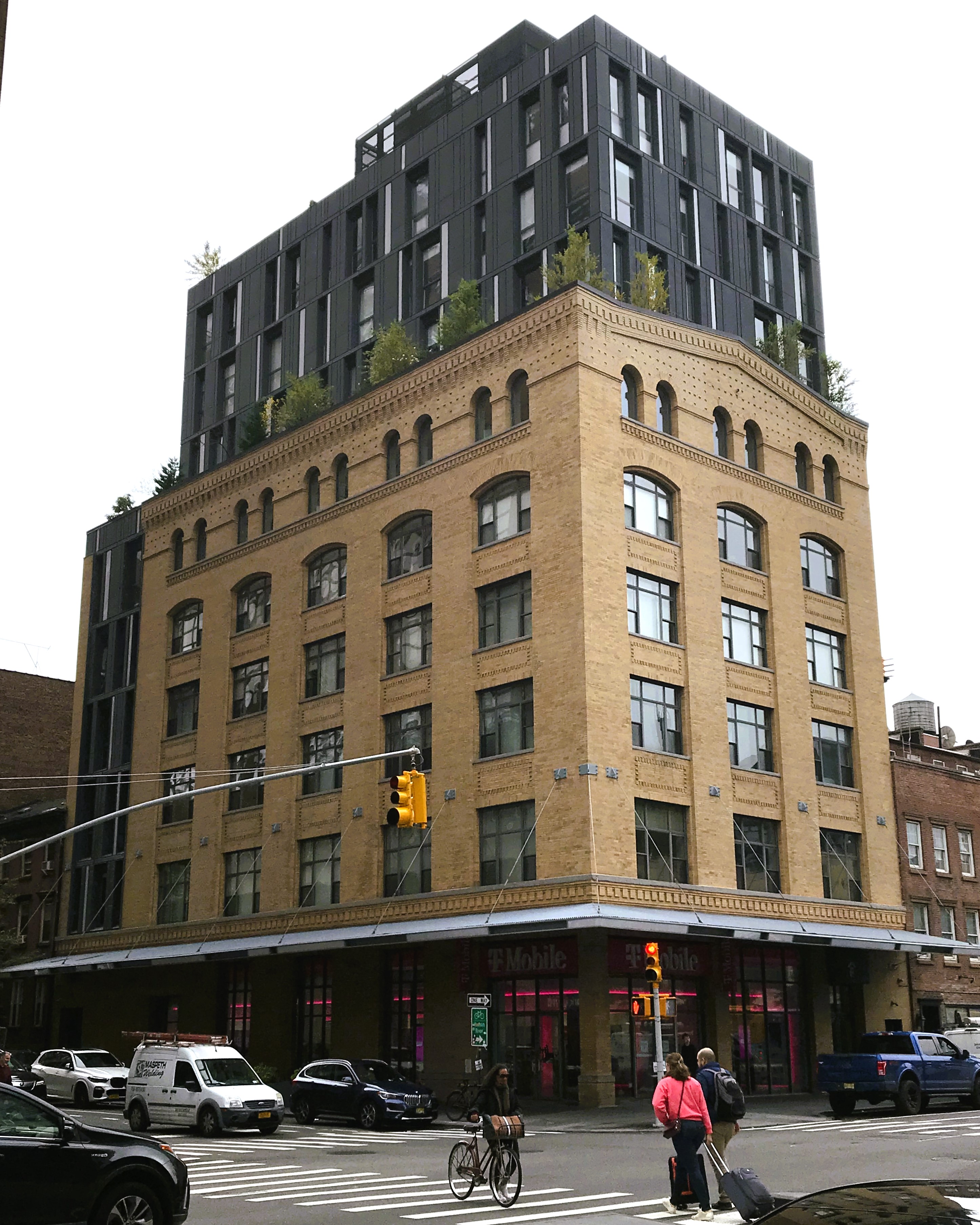
In November 1905, architect William A. Boring filed plans for a six-story brick and stone warehouse to be erected on the southeast corner of Ninth Avenue and 15th Street.  He had been hired by developer Mary A. Tuttle, who saw the potential in the site's location at the northern hem of the bustling Gansevoort Market area.  Completed in 1906, the structure was faced in yellow brick above the ground floor loading area.  A modern take on Romanesque Revival, the openings on the second through fifth floors were slightly recessed, creating the impression of four-story arches.  The decorations--paneled spandrels, a corbel table below the sixth floor, and complex dentiled cornice--were all executed in brick, a significant cost savings for Tuttle.  The paired windows of the sixth floor were arranged as an arcade, and the Ninth Avenue roofline rose in a gentle gable.

Mary A. Tuttle leased the building in May 1906 to German-born Julius Wile for a term of 20 years.  He was the principal in Julius Wile Sons & Co., importers of liquors and wines, which he founded in 1877.  Working with him were sons Alfons and Irwin.  

While the firm occupied most of the building, it sublet two floors in October that year to the Austrian Bent Wood Furniture Company.  In 1914, upon the expiration of that lease, the Eureka Pneumatic Spray Co. rented the third floor.   The firm manufactured what The Metal Industry described in July 1915 as "a complete spraying outfit consisting of compressor, air tanks, gauge,, safety valve, tank draincock, air filter, one sprayer and a length of hose."  The gadget retailed for $33, or just under $1,000 in 2022.

The Ninth Avenue elevated tracks ran in front of the building, which loomed above the 19th century structures around it.  The sign stretching the building's width above the first floor reads "Julius Wile Sons & Co."  photograph from the collection of the New-York Historical Society.

As America emerged from World War I, the Government turned its focus to an issue that would have enormous effect on Julius Wile Sons--Prohibition.  The 18th Amendment was ratified on January 16, 1919 and Prohibition was enacted on January 17 the following year.

The firm was permitted to carry on business on a limited basis.  A loophole in the National Prohibition Act allowed clergymen to use wine for sacramental services, food processors to use alcohol in preserved fruits, and doctors to prescribe liquor for medical reasons.  (For instance, when the future British Prime Minister, Winston Churchill, was in New York in 1932, Dr. Otto C. Pickhardt wrote a prescription, "This is to certify that the post-accident convalescence of the Hon. Winston S. Churchill necessitates the use of alcoholic spirits especially at meal times.  The quantity is naturally indefinite, but the minimum requirements would be 250 cubic centimeters.")

Liquor and wine firms like Julius Wile Sons & Co. were closely scrutinized, so when Daniel Murphy and Joseph Levine showed up in September 1920 with a permit to purchase 200 cases of whisky, the management was suspicious.  The New-York Tribune reported, "Weil's [sic] employees kept the men in the place and communicated with the authorities, who declared the permit a forgery."  The value of the liquor they attempted to buy would top $200,000 today.

The restricted amount of business in liquor and wine that Julius Wile Sons & Co. was permitted to conduct was not enough to sustain the business.  And so the firm adapted, forming a sideline, The Wile Corporation.  In 1921 The Index of Export Merchants listed it as dealing in "hosiery, underwear, hardware, iron, steel, textiles, groceries, cigars, cigarettes, general merchandise."

Unfortunately for Julius Wile Sons & Co., gangsters were as harmful to its business as was Prohibition.  On February 2, 1924, the New York Evening Post reported, "Four thousand cases of well aged Scotch were stowed in the Cunard-Anchor liner Cameronia when she sailed at noon to-day from Pier 56 and Chief Office A. H. Kesson submitted that carrying Scotch to Glasgow outdid the adage of carrying coals to Newcastle."  

The liquor was part of a 9,000 case order earlier imported by Julius Wile Sons & Co.  The remaining 5,000 cases were scheduled to ship on the next ship to Glasgow.  The article said, "They are sending it back because they cannot meet the competition in supplying druggists and hospitals, of bootleggers, who undersell them $21.75 a case."  Kesson told the reporter that the shipment was guarded by "a whole regiment" of security men on the way to the docks.

Julius Wile Sons & Co. now focused even more on alternative products.  The following year, on April 12, The New York Times reported that the California Crushed Fruit Corporation, "manufacturers of orange, grapefruit and lemon juices," had opened a New York office at 62 Ninth Avenue in cooperation with Julius Wile Sons & Co., "who will act as their New York representatives for ten years."

Just over a year later, on May 13, 1926, The New York Times announced, "Julius Wile Sons & Co., for many years in the liquor business at 62 Ninth Avenue, have taken a long term lease...on the building at 10 Hubert Street, northwest corner of Collister Street.  After improvements are made the new tenant will use the building for the sale and handling of fancy groceries."  

As an important side note, following the repeal of Prohibition, the resilient firm returned to importing wine and liquor and once again became a leader in the field.  For years, Julius Wile's grandson, also named Julius, would write the wine section of the Encyclopedia Britannica's Book of the Year, and in the 1970's would rewrite the 1941 book Encyclopedia of Wine.

Following Julius Wile Sons & Co.'s departure, the architectural firm of Maher & Ward made renovations to the building.  There was now an office and market on the ground floor, and warehouse and factory space above.

In the 1960's the Ruger Chemical Co., Inc. occupied the building.  By the mid-1970's a Chase Manhattan Branch occupied part of the ground floor.  It was the scene of a terrifying armed robbery on August 12, 1978.  That day Michael McClanahan, Wayne McClanahan and Rickard Mickens walked in with guns drawn.  They made off with $8,000.  The McClanahan brothers were captured before long, but Mickens remained on the lam until April 12.

Historian Jay Shockley, in writing the 2003 landmark designation report of the Gansevoort Market Historic District, said, "At the time of designation, this property was under construction, which entailed the alteration of and addition by architects Sharples Holden Pasquarelli to a 1905 wine warehouse.  Above the fourth story of the building, the new addition is cantilevered over No. 60 Ninth avenue."  


One wonders if Sharples Holden Pasquarelli's design would have been approved had the addition not been begun prior to the district's designation.  The sleek, black form that rises above Boring's warm brick warehouse makes no attempt at architectural continuity.

photographs by the author
no permission to reuse the content of this blog has been granted to LaptrinhX.com

Thursday, July 15, 2021

The Owen W. Brennan House - 156 West 15th Street


By 1855 broker Morris DeYoung and his wife lived in the comfortable brick-faced house at No. 120 West 15th Street (renumbered 156 in 1860).  Theirs was one of a row of Italianate houses completed a few years earlier on the south side of the block between Sixth and Seventh Avenues.  Each of the identical, 20-foot wide residences was three stories tall above an English basement.  The parlor floor windows extended to the floor, suggesting they originally opened onto a cast iron balcony.  Pretty foliate panels filled the spaces between the brackets of the pressed metal cornices.

While it was common for families to take in roomers or boarders, the DeYoungs 
seemed to have been nearly unusually desperate to do so.  Mrs. DeYoung placed an ad in the New York Herald on January 9, 1856 which read, "A lady, who occupies a house too large for her necessities, would like to dispose of some rooms to single gentlemen."  (Why she worded the ad to sound as if she were widowed or single is puzzling.)

The ad apparently did not produce results and a month later Mrs. DeYoung changed her strategy:

A lady of very superior education and capacity for imparting instruction, and who is permitted to refer to persons of the highest standing as to her worth and attainments, wishes to take into her family, a few young ladies, whose entire education she will superintend.

Another ad in May noted that in addition to an education, the young ladies would be surrounded "with home influences and comforts."

When the boarding school idea apparently did not work out, Morris placed a rather peculiar ad in the New York Herald on September 11, 1857:  "Board--A Lady Invalid can be accommodated with board and nursing, and every requisite attendance.  No other boarders or children...Address M. D., 120 West Fifteenth street, New York."

It seems that the DeYoungs were in financial straits.  Only a few weeks later, on November 1, they offered, essentially, the entire house for rent, other than space for themselves:  

To Let--Unfurnished, to a very small, quiet and unobtrusive family only, for $130, in advance for six months, the parlor, alcove and tea room (entire parlor floor), dormitory and ante room, on bathroom floor; rooms on upper floor, with privilege in kitchen, vault, &c.  Hot and cold water, bell and register in each room.  Occupant has no children or boarders.  A rare opportunity for a suitable party desiring the exclusiveness of an entire house.

The mention of  bells and registers referred to the servants' call bells, and the floor registers that allowed heat to rise throughout the house from the basement furnace.

The DeYoungs either soon sold their home or lost it in foreclosure.  By the following spring it was owned by D. S. Barnes who advertised it for rent in April, describing it as a "three story, high stoop, genteel modern house."

He found a tenant in a Dr. Dubois who ran the house as a sort of women's hospital.  An advertisement in April 1858 was entitled "Important To Females" and coaxed, "Diseases of females exclusively treated by Dr. Dubois."  For between $1 and $5 ($160 for the most expensive today) he guaranteed "remedies for Female Derangements."  Patients who traveled to the city were offered "board, nursing and exclusive attendance."  (The advertisements worrisomely hinted at abortions.)

The doctor's residency was short-lived.  By 1860 No. 156 West 15th Street was being operated as a boarding house.  Among the residents that year were Swedish immigrants G. Berggvist and his wife, Margaret.  Other boarders within the next few years included Isaac I. Lazarus, who dealt in "showcards;" Joseph Lyons, a commission agent; and physician Charles Salmon.

The boarders enjoyed upscale surroundings.  An inventory in 1866 showed a seven-octave piano in the parlor, oil paintings, and "elegant" parlor furniture.  

The list was compiled because the house was being sold that year.  It was purchased by Owen W. Brennan and his wife, the former Mary E. O'Connor, and, finally, there would be a long-term resident.

Mary was his second wife.  His first, Margaret Horn Brennan, had died in 1848, just months after the deaths of two of their sons, James Timothy and William Troutman, in 1847.

The 15th Street house would be tightly populated.  There were three sons, John, Winfield Scott, Charles M., and three daughters, Annie W., Isabel Hazel, and Louise.

Brennan was born on November 1, 1814.  His father, Timothy, had fought in the War of 1812.  Owen Brennan had started out his career in the liquor business, but turned to public service when Mayor Fernando Wood appointed him Captain of Police of the 6th Precinct.  His career soared.  Three years later he was elected Police Magistrate; in 1862 he resigned to run for City Controller and was elected; and in 1865 he was appointed a Commissioner of Charities and Correction.  

It was almost assuredly Brennan who updated and enlarged the house by adding a stylish mansard roof with arched dormers.  In addition to his other positions, he was an Officer of The Central Park, vice-president of the Guardian Savings Bank, a director in the North and East River Railroad Company, and a manager of the Roman Catholic Orphan Asylum.

The house was the scene of Annie's marriage to Charles O'Connor on January 5, 1869 with, according to the Evening Telegram, "a number of their friends and relatives being present."

When the Guardian Savings Bank failed in 1871 The New York Times placed the blame upon its directors.  The fact that the president was one of the newspaper's most scorned personages was likely a factor.  It began its article on January 13, 1872 saying:

Would it not be well for some eminent whitewasher to exercise his art on the northern wall of the late lamented Guardian Savings Bank, in Chatham-street?  All who come down the Bowery see the names of this swindling concern and its managers staring them in the face.  Why perpetuate, as on a monument of brass, the names of 'William M. Tweed, President, and Walter Roche and Owen W. Brennan, Vice-Presidents'?

As a matter of fact, Brennan was closely involved with the Tweed Ring.  The Guardian Savings Bank had been a sort of piggy bank for high ranking Tweed officials.  (When the bank failed Jeremiah Quinlan disappeared "to evade jail," according to The New York Times.)  For years Owen Brennan had been the president of the Blossom Club, a political and social club for Tweed politicians and citizens.

When Brennan stepped down as president of the Blossom Club on May 12, 1883 after 19 years, he was given a glittering reception.  The New York Times reported that he was presented with "a large crayon portrait of himself, handsomely framed and elaborately inscribed."  Among those honoring Brennan were Senator T. F. Grady, Congressman John J. Adams, two judges and a raft of high-ranking public officials and politicians.  The New York Times noted "The club-rooms were profusely decorated with flowers."

Brennan's giving up his position after nearly two decades may have had much to do with his health.  By now he had been retired for some time and was suffering from malaria.  On the afternoon of October 28, 1884, according to The New York Times, he was seized with a congestive chill and died in an hour."  He was 71 years old.

The newspaper went on to say "for many years Mr. Brennan has been out of politics, and has been living quietly at his home in Fifteenth-street."  His funeral was held in the parlor on October 31, followed by a mass at the nearby Church of St. Francis Xavier.

Mary and the unmarried children lived on in the house.  On November 7, 1888 Louise was married to H. S. Provost in the parlor, and on April 22, 1891 it was the scene of Isabel Hazel's marriage to Edgar S. Weed.  In reporting on Isabel's wedding, The World mentioned "The house was beautifully decorated with roses, lilies, tulips and palms."

Mary E. Brennan died on November, 13, 1895 at the age of 65.  None of the Brennan heirs moved into the family home and it sat vacant for a considerable time--eventually drawing the attention of crooks. 

On August 2, 1898 the New York Herald reported "Five burglars were caught at work in the vacant house No. 156 West Fifteenth street yesterday afternoon, and after a desperate fight with two policemen, during which three of the burglars escaped, two were taken to the West Thirtieth street station."  Neighbors had noticed men coming and going from the basement door throughout the afternoon and notified a patrolman.

He and another policeman entered the basement and ascended to the parlor floor where they "discovered five men sitting around a table, upon which was a can of beer and several cups from which they drank."  They had managed to do severe damage to the residence.  "The police found that all of the brasswork in the house, gas fixtures and lead pipe had been cut away and removed, and that the woodwork had been chopped into with an axe and badly damaged.  Apparently the wood was chopped up for fuel, as several bags of it had been removed."

The vandalism was apparently a wake up call for the Brennan family.  In June 1899 Charles, as executor of his mother's estate, sold the house to Emil Bachman for $15,600--just under a half a million in today's dollars.  Bachman did hasty reparations and within a month a Mrs. Kaftan was operating the residence as a rooming house.

Among her first tenants was 27 year old F. Taylor Maus.  He had barely moved in when he appeared in the Coney Island and Police Court on July 14, charging David Sloan with assault.  Sloan was the brother and trainer of well-known jockey Tod Sloan.  According to Maus, "in a row in a Coney Island saloon Sloan struck him in the mouth with a chair and knocked out several of his teeth."

Another resident, Frederick Manning, appeared in a Coney Island courtroom the following year.  The 30-year-old was arrested by an over-zealous cop involved in a a "roundup" of "pickpockets who have been reaping a rich harvest of watches and plethoric pocketbooks" among the crowds, according to The Evening Telegram on July 19, 1900.  Among those he arrested was the 30-year-old Manning who, "although he protested that he was a businessman of this city, he was locked up all night."  The policeman's mistake was revealed in court the next morning and Manning was released.

Agnes Reed was renting a room here in 1901.  Her mother, Mary O'Donnell, traveled from Chicago on March 21 with $6,000 alimony she had received from Agnes's former husband, and took a room next door to her daughter.   It was not long before Mary became concerned about a man, John Murray, who had been wooing Agnes.  The back alimony she had brought would equal about $186,000 today alone and she feared Murray was after the 26-year-old's money.

Three days after Mary arrived, Murray appeared at No. 156 West 15th Street and sent a note up to Agnes asking her to meet him on the corner "as soon as possible."  But it was intercepted by Mary, instead.  After he had waited for some time, Murray returned to the house and asked Mrs. Kaftan when Agnes would be down.

"You can go upstairs and see her mother," he was told.

"No, thank you," he answered, and hurried away.

Later another boarder, Mrs. Walters, walked into Agnes's room to visit.  The Morning Telegram reported she entered "just in time to catch the divorcee, who was about to leap out of the window.  The rescuer watched Mrs. Reed for the remainder of the day."

Agnes disappeared two days later.  On March 29 The Morning Telegram reported she was still missing after four days and detectives were searching for her.  The article said her mother "fears she will be induced to marry an ardent suitor while in an irresponsible condition."  She told a reporter "The poor girl is not in full possession of her senses and may fall a victim to a designing fortune seeker if not returned to my keeping speedily."

Another divorcee, Ida Guild, had moved into rooms with her two children a month before Agnes Reed's drama played out.   She and Charles S. Guide had been married in Boston 14 years earlier.  A magazine writer, he left his family and moved to Brooklyn where he remarried (before bothering with the technicalities of a divorce from Ida).  Ida came to Manhattan to attempt to obtain support for herself and the children, but ended up in court defending against Charles's attempts to gain custody over the children.  She, at least initially, was successful in retaining custody.

In 1906 attorney John Bird Quinton purchased the house.  He was the head of the American Law & Claim Investigating Agency and a commissioner of deeds.   He made substantial alterations to the house, transforming the basement level to a restaurant and café.  

Quinton took in a single boarder, Edward Thurston Hiscox, in 1907, who had graduated from Yale University three years earlier.  Like his landlord, Hiscox was an attorney and would remain with Quinton at least through 1919, by which time he was a member of the law firm Gray & Hiscox.

The stoop was gone by 1941.  The architect deftly copied the original lintels to create a window where the entrance had been.  via the NYC Dept. of Records & Information Services

At some point before 1940 the stoop was removed and the entrance moved to the basement level.  It was not until 1997 that a renovation resulted in official apartments--three on the former parlor level and two each on the upper floors.

The address received significant press coverage in 2018 when the city's Office of Special Enforcement sued Dr. Philip Baldeo and Miguel Guzman for "illegal hotel use."  The charges claimed the pair had rented six of the nine units to tourists over a three-year period.  


Although the Brennan house is in remarkable shape above the commercial space, a recent real estate listing suggested replacing it with a modern apartment building--even offering a proposed rendering.

photographs by the author
LaptrinhX.com has no authorization to reuse the content of this blog

Friday, April 16, 2021

The Nearly-Lost 1844 Twins at 362 and 364 West 15th Street


Around 1842-44 the mirror-image brick houses at Nos. 232 and 234 West 15th Street were completed.  (They would be renumbered 362 and 364 in 1860.)  Three stories tall and three bays wide, they were designed in the Greek Revival style.  An unusual feature was the double horse-walk between the two stoops.  Tunneling through the houses to the rear yard, it provided access to accessory structures--small stables, shops or possibly houses for rental income--and was large enough to accommodate a cart.

In 1847 No. 362 was home to James Vandenburgh and his family.  A builder, it was possibly he who was responsible for the construction.  Thomas K. Mills, an embroidery merchant, lived next door that year.

Theodore Lavielle and his wife, the former Amelie Gervaize, followed Vandenburgh in No. 362.  Lavielle died at the age of 81 on December 7, 1853.  It was soon purchased by attorney Matthew Campbell.

Like all financially comfortable New Yorkers, the Campbells spent their summers in the country.  The unoccupied townhouses provided tempting opportunities to burglars.  
The Campbells extended their stay through September in 1857--a decision that nearly cost them dearly.

While making their rounds at around 4:30 in the morning on September 28 police officers Tuorney and Fischer noticed three "suspicious-looking men coming out of a vacant lot," as reported by the New-York Daily Tribune.  They were carrying a large bundle of "costly wearing apparel, valued at about $400."  (That amount would exceed $12,000 today.)  Upon further investigation, the officers discovered that a door in the rear of the Campbell house had been forced open.  "The house had been thoroughly ransacked, and a large quantity of goods had been packed up for removal," said the article.

The Rev. Joseph R. Mann moved into No. 364 around that year and would remain through 1861 when the McQuoid family took possession.  Robert McQuoid was a partner with his brother, William McQuoid, Jr., in Hudson River Pottery, the business started by their father in 1838.  It was located on West 12th Street and Tenth Avenue.  The brothers' widowed mother, Martha, lived in the house as well.  She died in the house on January 19, 1865 at the age of 83.

Interestingly, around that time William changed the spelling of his surname to Macquoid.    The firm's name was changed to William A. Macquoid & Co. around 1868.  In her 1879 book, The Ceramic Art, Jennie Young called it "the oldest [pottery] establishment in New York."  She explained, 

The only products, until within a year ago, were store-ware and glazed earthen-ware.  At that time the demand by decorators for terra-cotta in the choicest antique forms led the firm to add it to their list of productions.  The experiment was successful.  The paste is fine and well worked.

Mary Killmer moved into No. 362 around 1866.  She was the widow of Abiram P. Killmer, a dentist, who had died in 1857.  Living with her was her son, William G., who was employed as a clerk in the stationery manufacturing firm of J. Q. Preble & Co.

Mary took in boarders to make ends meet.  From 1872 to at least 1876 Barbara Evans lived in the house.  She taught in the Primary Department of Grammar School No. 11 on West 17th Street.  A widow, Margaret Highet, was here by 1879, as was Albert Demarest, a "boatman."  Given the female population of the main house, it is possible that Demarest lived in the rear building.

For at least a decade, starting around 1876, William D. Duyckinck and his family lived next door at No. 364.  He owned the Duyckinck & Co. gentlemen's furnishings store at No. 707 Broadway.  Like Mary Killmer, the Duyckincks took in boarders.  In 1886 William Lupton, an importer, and Matilda M. Ogden, the widow of E. D. Ogden, were boarding with the family.

Two years later No. 364 was converted to Ferdinand J. White's School of Religious Music.  He boasted the "large and fine-toned organ" and a "complete library of liturgical and musical works."  The school offered instruction not only in "every branch of choir and church music work," but in the "ceremonies of the church, the relation of the choir to the altar, chanting, [and] the liturgy."

Sadlier's Catholic Director, 1888 (copyright expired)

It appeared that the twin houses would not survive past the first decade of the 20th century.  On March 2, 1910 the New York Produce Review reported that Conron Bros. had purchased the entire block on Ninth Avenue from 14th to 15th Street, extending east to No. 357 on West 14th Street, and 362 on West 15th Street.

But if Conron Bros. had envisioned a large commercial structure on the site, it did not come to pass.  The two houses were converted for business, with the stoops being removed and the entrances lowered to street level.  The Ireland & Nelson Paper Company operated from No. 362 and the Park Trucking Company, Inc. was in No. 364.  

The double horsewalk is protected by heavy doors today.

The upper floors were rented as apartments.  In 1915 Fitz McCorney, an elevator operator at the Hotel McAlpin, and Dr. James T. Manchester, live in No. 362, for instance.

Manchester found himself in legal trouble in the summer of 1916.  A terrifying epidemic of infantile paralysis, or polio, swept the city that year.  On August 23 The New York Times reported that the 70-year-old had been arrested "on the charge of selling a fake cure for infantile paralysis."  He sold his mixture of alcohol, capsicum and sassafras for $1 a bottle (about $25 today), promising that it was a "sure cure for infantile paralysis and various other diseases."

Living in No. 362 during the Depression years was the Rioz family.  They received a shock on July 28, 1935.  The New York Post reported, "A ten-day-old baby girl with blue eyes and blonde hair was found last night outside her door by Mrs. Guadalupe Rioz...Mrs. Rioz turned the baby over the the New York Foundling Hospital."


In the summer of 2020 the Landmarks Preservation Commission held a hearing regarding a proposed glass and steel tower which would replace all but the facades of the Greek Revival structures at 351-355 West 14th Street and along Ninth Avenue.  The discussion included the comment "a pair of non-landmarked Greek Revival houses at 362-364 West 15th Street would likely not survive."  The proposal to gut the historic structures and to demolish the 15th Street twins was declined.

photographs by the author

Wednesday, March 31, 2021

The Harrison P. Liscomb House - 210 West 15th Street


In 1856 the family of Harrison P. Liscomb moved into No. 130 West 15th Street, one of a long row of recently erected Italianate brick homes between Seventh and Eighth Avenues.  Liscomb purchased it from Margaret Christy, the widow of George Christy.

The Italianate style of the Liscombs' new house was the latest in domestic architectural fashion.  At three stories tall above an English basement and 25-feet wide, it spoke of the family's affluence.  The enframement of the elliptical arched double-doored entrance featured foliate brackets that upheld a triangular pediment--echoed in the pediments over the parlor windows.  Those were, in fact, French doors which opened onto a cast iron balcony.  The pretty cornice with brackets and rosette was identical to those of its neighbors.

Liscomb was the head of the coffee importing firm H. P. Liscomb & Co. at 64 Barclay Street.  He and his wife, Elizabeth M., had three children, Frances Jerusha, Emma Edgerly, and Charles G.  Their country home was in Belleville, New Jersey.

The house was the scene of Frances's wedding to Joseph Rudd, Jr. on September 19, 1865.  Joseph was a merchant, doing business at No. 147 Maiden Lane.  The newlyweds took up the lives together in the 15th Street house with France's parents and siblings.  The house became more populous when Charles's bride moved in.  Emma broke tradition when she married James H. Fullerton and moved out (possibly because her parents would not have Fullerton in their house--he was known to have "loose habits").

The renumbering of West 15th Street in 1868 gave the Liscomb house the new address of No. 210.  The following year, on February 20, 1869, Harrison P. Liscomb was in New Orleans where he died at the age of 55.  His body was brought back to New York and his funeral held in the parlor of No. 210 on March 14.

He bequeathed the house to Elizabeth, Charles, and Frances and her husband.  Interestingly, no mention of Emma nor James Fullerton was made; quit possibly because of Fullerton's already questionable reputation.  On May 8 Charles transferred his portion of the title to his mother.  The Rudds did the same, but were less generous, selling their one-third portion to Elizabeth for $5,318.66--just over $103,000 in today's money.

In 1870 Elizabeth took in a boarder, John A. Hillery, who was in the insurance business on Wall Street.  Money seems to have been getting tight by 1873, prompting Elizabeth listed the Belleville property for sale.  Then, on March 30, 1881, she sold No. 210 to Frances and Joseph Rudd for $7,000, not much more than they had sold their one-third interest to her 12 years earlier.  

Somewhat surprisingly, Emma and James H. Fullerton, who had not been listed at the address in decades, reappeared shortly afterwards.  James had been working as a "transfer clerk" for the Manhattan Beach Railway Company since 1880.  In that position he was responsible for transferring stock certificates to investors as well as handling the payroll of lesser employees like watchmen.

The reason that Harrison Liscomb had ignored his daughter and Fullerton in his will might have been explained by Fullerton's gambling addiction.  The Sun, which described him on March 13, 1884 as "of slight build, and quiet and courteous manners," said:

He was well known in certain resorts uptown, and so far as can be learned, spent the greater number of his evenings at card tables.  An acquaintance of his, in speaking of him last evening, said that he first met him about six years ago, when he was accustomed to play in a well-known sporting resort at a game of poker for $300 and $500 table takes.  He used to frequent a well-known gambling house on the west side of town, where he bucked the tiger as if possessed of unlimited resources.

Fullerton earned $1,200 per year with the railroad company--about $32,300 today.  But his gambling far exceeded his income.  One acquaintance said "Why, he apparently had more than that in his clothes every night."

It became evident where his gambling money was coming from on March 7, 1884.  An attorney for the Manhattan Beach Railway Company found discrepancies in the books that afternoon and brought it to Fullerton's attention.  Fullerton said that the account had not been completed and, according to the lawyer, "I told him he had no business to leave it that way, and to write the account up at once.  He said he would do so.  As soon as my back was turned he put on his hat and left the office, and we have not seen him since."

Fullerton went straight to the American Exchange National Bank and withdrew the $920 payroll (almost $25,000 today).  When he did not return to the office a more thorough examination of the ledgers was made.  Officials estimated he had obtained about $45,000 by forging and cashing out stock certificates--more than $1.2 million in today's money.

Fullerton never went home, either.  The Sun reported on March 13, "He lived at 210 West Fifteenth street.  Nothing was known of him at that number last night except that he had not been seen since Friday.  He leaves a wife and child."

Five years later the family's name appeared in the newspapers for a much less grave situation.  Charles's son Harry became a hero of sorts in December 1889 when he helped capture the male ringtail monkey that had caused havoc in the neighborhood for months.  It had all started that September when a servant girl in one of the houses on the block was "awakened one morning by two hands patting her cheeks," as reported by The World.  "She looked up, and by the morning light saw bending over her a strange and hideous face."

The girl jumped from her bed yelling "Murder!" and flew down the stairs.  The family checked her room and, finding nothing, assumed she had had a nightmare.  A few days later an upholsterer returned to his shop to find some of his tools gone, and then a boarding house landlady awoke to find her cupboard ransacked and several jars of preserves stolen.

Finally a woman walked into her rear yard to find the monkey perched on her board fence, eating from one of the stolen jars.  The monkey's vandalism and thefts from kitchens and bedrooms continued, but no one was able to catch it.

Harry Liscomb told reporters of the months-long episode.  "It was fun to see him crawling along the division fence with something that he had stolen in each of his front paws.  At times he would disappear for several days.  Where he would go no one knew; then back he would come hungrier than ever.  He soon learned to open doors of cupboards, and nothing was safe from him...Wash-day was his delight.  He would climb along the clothes-lines, pull the pins out and then sit on the fence and watch the clothes blow off the line."

But as the temperatures fell, the monkey spent more and more time indoors whenever he could find access.  Finally, one morning just before Christmas a servant of William Whiteman at No. 220 West 15th Street built a fire in the kitchen then went upstairs.  When she returned the monkey was sitting on the range, shivering.  Harry Liscomb and the Whiteman's son captured him.  Thinking back on the damages and thefts, Harry told a reporter, "If any one should appear and claim the monkey there will be some reckonings to be made before the monkey is taken away."

Joseph Rudd died in 1895 and Charles G. Liscomb died on April 8, 1903.  Frances moved to Utica around the same time.  She retained possession of the house, leasing it to a boardinghouse proprietor.  Among the boarders in 1906 was Arthur Johnson, who was a con man of sorts.

On November 7 that year silk merchant Julius Shapera temporarily left his wagon loaded with goods in front of his home on West 34th Street.  When he returned, a $300 bundle of silks was missing.  Just as he was about to drive off, Johnson appeared, identified himself as a private detective, and said he would recover the goods for a $100 fee.  Shapera agreed and later Johnson returned with $75 of the stolen goods.  Shapera gave him a check for $34 but later, suspecting foul play, cancelled payment.  When Johnson came to his home on January 21, 1907 to get a cash settlement, a detective was waiting to arrest him.

On November 18, 1921 Frances Rudd transferred title to No. 210 to Daisy B. Rudd.  Like Frances, Daisy lived upstate and continued to lease the house.  (Frances died two years later at the age of 78.)

In 1941 the cast iron balcony and the upper floor lintels survived.  via the NYC Dept of Records & Information Services.

By the Depression years the house had declined to a rooming house, operated by Anna Benhart.  It was the scene of tragedy early on the morning of June 30, 1939.  Madeline Kelly fell asleep with a lit cigarette in her hand.  Sometime later Mrs. Benhart was awakened by the barking of her dog.  Smelling smoke, she "yelled to give the alarm," according to The Daily Worker.

Three of the roomers rushed to the roof before the fire fighters arrived.  In the chaos and panic, one occupant collapsed from shock in the hallway.  The fire fighters extinguished the blaze, which was confined to Madeline's room, and raised a ladder to rescue the roomers on the roof.  A doctor from St. Vincent's Hospital treated Anna Benhart for shock.  Sadly, the 36-year old Madeline Kelly was found dead in her bed.

Although some of the detailing has been removed, the entrance is intact as are the cornice and Italianate ironwork.

Against all odds the Liscomb house was not converted to apartments until 1968.  The alterations resulted in a duplex in the basement and parlor floor, and one apartment each on the upper floors.  At some point after mid-century the cast iron balcony was removed and the pediments and lintels over the windows shaved flat.

photographs by the author

Thursday, February 18, 2021

The Patrick Brophy House - 138 West 15th Street


The noticeable change in brick color testifies to the alterations which raised the attic to a full floor.

By the mid-1850's the Vaneeten family lived in the comfortable brick-faced house at No. 102 West 15th Street (renumbered 138 in 1860).  Louis M. Vaneteen was the senior member of the brokerage firm Louis M. Vaneeten & Co. on William Street, and his son August worked as a clerk, quite possibly in his father's firm.  When the family moved out in 1860, an auction sale of their high-end furniture hinted on the elegant interiors of the residence.  Included were a rosewood piano manufactured by Horace Waters (who, incidentally, also wrote hymns and was a collaborator with Stephen Foster), Brussels carpets, and silver flatware and hollowware.  That the area was still developing was evidenced in another item being sold, a "milch cow."


The Greek Revival style Vaneeten house sat upon a high English basement and rose two-and-a-half stories.  The understated framing of the entrance featured "ears" just below its cornice, a motif common in Greek Revival houses, although their origins were actually Egyptian.  The parlor windows, which extended to the floor, were most likely fronted by a cast iron balcony.  Below an oval opening to the right of the entrance, at basement level, was an opening to a horsewalk which led to the rear yard (where that milk cow lived).

The house was purchased by Patrick Brophy and his wife, the former Isabella Ramsey.  Brophy operated a painting business on University Place.  The couple had four children, William J., John A., Mary Ann and Jeanette G.

The family had just moved into their new home when Mary Ann Brophy died just two months before her 17th birthday.  Her funeral was held in the parlor the following afternoon.

It is easy to think of all Irish immigrants as impoverished and living in squalor.  But like many others, the Brophys were well established and financially comfortable.  William eventually worked with his father, and John went into the dry goods business by 1864.

Isabella Brophy died at the age of 46 on August 30, 1865.  Her funeral was held in the house two days later, followed by a requiem mass at the nearby St. Francis Xavier's Church on West 16th Street.  The house was the scene of the funeral of Patrick's brother, Dennis, four years later on July 4, 1869.

At some point the attic of No. 138 West 15th Street was raised to a full floor.  The architect carefully copied the window treatments and either recycled or nearly copied the original Greek Revival cornice.

Following William's marriage he and his wife lived in the West 15th Street house with his father and unmarried sister.  Following Patrick's retirement William took over the business, renaming it W. J. Brophy & Son by late 1880's.

There would be two more funerals in the Brophy residence.  Jeannette, who had never married, died on July 20, 1889, and Patrick died at the age of 80 on April 5, 1893.

Exactly one year later William offered the 15th Street house for sale.  It was purchased by John Leslie, a well-to-do lumber merchant and respected member of the General Society of Mechanics & Tradesmen.  Born in Scotland in 1845, he had entered the lumber business in 1871 and by now operated two stores, one on Prince Street and the other on Thompson Street.  The New York Lumber Trade Journal later recalled, "John Leslie, who started this business, was a retired carpenter who, with an original idea, entered the lumber business simply that he might have something to occupy his mind."  

Soon after purchasing No. 138 Leslie initiated changes.  He erected a one-story wooden building in the rear in January 1895, and converted the basement level of the main house for his third lumber store.  He hired Andrew H. Dykes, the teen-aged son of a friend, to manage the new location.

Given Leslie's Scottish roots, it is perhaps surprising that when he looked for a servant in 1898, he specified a German girl.  He noted that she was needed for "general housework [and] to go in the country for summer."

His sharp understanding of business and human nature was evidenced in a help-wanted at in 1902:

Boy wanted for lumber mouldings; public school graduate, living with parents.  Address, in own handwriting, John Leslie, 138 West 15th st.

Leslie recognized that a boy living with his parents would be more responsible--simply because he would be answerable to his father.  And by requiring that the boy himself write the application letter, he could assess his literacy and attention to detail.

John Leslie died at the age of 72 in June 1917.  His estate retained ownership of the 15th Street house for years and the business was renamed the Dykes Lumber Co., co-operated by Andrew H. Dykes and Frank Leslie.  The business would remain in the house for decades, eventually becoming one of five locations throughout the city.

In 1941 the Dykes Lumber Company still operated from the basement level and rear yard.  via the NYC Dept of Records & Information Services.

In 1943 the lumber store was replaced by The Artists Associates.  It opened on June 20 with "an exhibition and sale of selected works in exchange for war bonds and stamps," according to The New York Times.  The space was known as the New Age Gallery by 1945.

In the meantime, the upper floors were leased to multiple tenants.  Among the residents in the early 1950's was artist Nova Hecht, the daughter of painter Zoltan Hecht.  Nova's father was known to the U.S. Government as "a leftist."  Federal officials' attention was focused on No. 138 West 15th Street in 1954 when Nova began a relationship with artist Frederick Taylor, who was a member of the Labour Progressive Party.

In his 2008 book Fred Taylor, Brother in the Shadows, John Virtue notes, "As soon as Fred started seeing Nova in the fall of 1954, FBI director J. Edgar Hoover ordered him placed under surveillance...The FBI staked out the Hecht home at 138 West 15th Street, in New York, noting Fred's comings and goings and mail addressed to him."


A renovation completed in 1990 resulted in one apartment per floor above the store.  It was most likely at this time that the horsewalk was converted to a second store.

photographs by the author