Showing posts with label grosvenor atterbury. Show all posts

Thursday, September 17, 2026

The Gluck-Zimbalist House - 225-227 East 49th Street

 
image via streeteasy.com

Alma Gluck was born Reba Feinsohn in Romania in 1884.  Her marriage to insurance agent Bernard Glick produced a daughter, Marcia.  By 1912, when Alma divorced Glick, she was an internationally-renowned operatic soprano.  That year she took a sabbatical from the stage to study in Europe.

In the meantime, Efrem Zimbalist, too, had earned fame in classical music.  Born in Russia in 1889, he was a violin prodigy.  He was first violin in his father's orchestra at the age of nine, and entered the Saint Petersburg Conservatory at the age of 12.  By 1910 he ranked as one of the world's greatest violinists.  He was, as well, a composer and conductor.

The two stars collided shortly after Alma's divorce and in 1914 they were married in London.  They would have two children, Maria Virginia and Efrem Jr. 

In 1926, Alma and Efrem purchased the two high-stooped brownstones at 225 and 227 East 49th Street.  They hired architect Grosvenor Atterbury to design a double mansion on the site--one residence for the Zimbalist family and the other as rental income.  

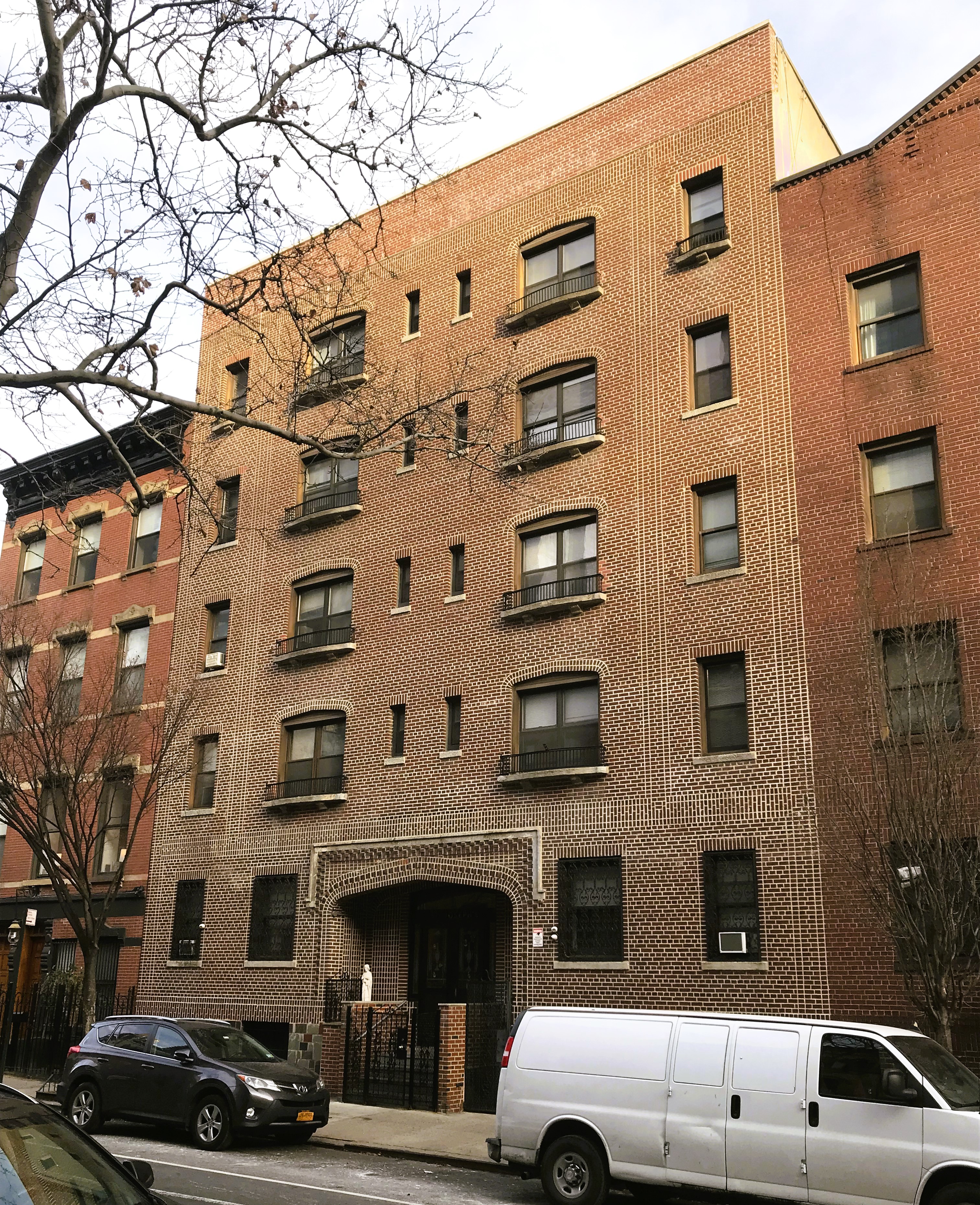
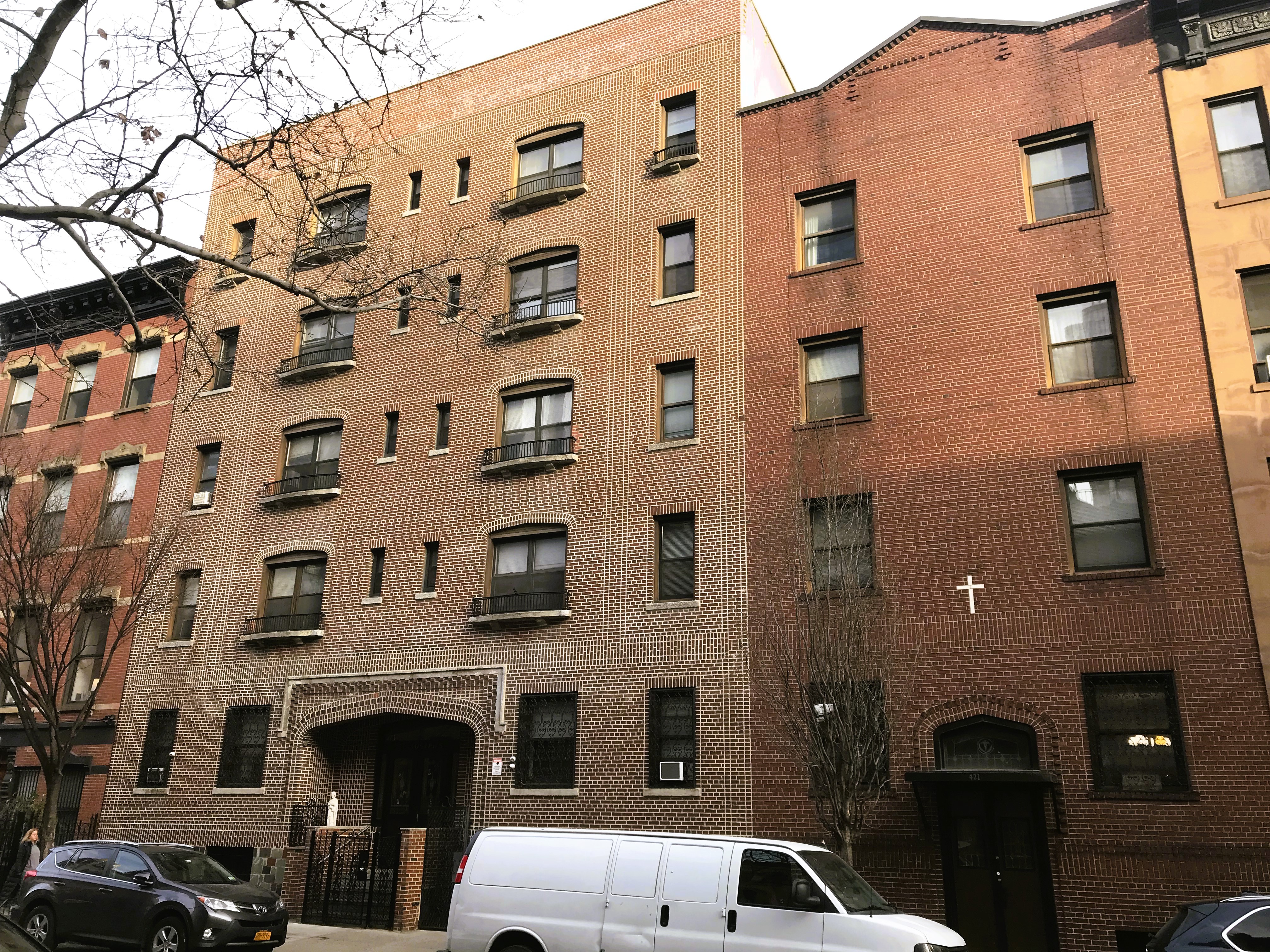
Completed in 1927, the charming neo-Tudor-style structure appeared outwardly as a single home.  Inside the main entrance, slightly below grade, occupants entered left or right into their respective homes.  The facade's irregular brick, which gave the appearance of age, was enhanced with Tudor-style half-timbering.  Within the intricately carved tympanum of the entrance, plaques directed visitors to the correct doorway inside.  Above the entrance is a slate-shingled hood crowned by a heraldic shield with a violin against a sheet of music.  Below it, Tudor-style lettering announces, "Erected In The Year 1926."

The Gluck-Zimbalist mansion replaced two houses similar to the existing homes on either side in this photo.  image via the NYC Dept of Records & Information Services. 

The vast grouping of multi-paned windows on the second and third floors carried on the Tudor motif, as did the three picturesque gables that pierced the slate shingled roof.

The Zimbalist family moved into 227 East 49th Street and rented No. 229 to Marie Corcoran Eustis Hofmann and her daughter, Josefa.  Alma and Efrem were well acquainted with Marie and they were keeping a well-kept secret.  Marie married the famous pianist Josef Hofmann in 1905.  The bride was ten years older than the groom.  Hofmann met 15-year-old piano student Betty Short in 1922.  Two years later the Hofmanns were secretly divorced.  Hofmann and Short had a child the following year.

According to Elizabeth Carr in her Josef Hofmann, The Piano's Forgotten Giant, the split was costly for Hofmann.  He was compelled to deposit $100,000 in trust for Josefa until she reached the age of 21.  "Marie Hofmann was awarded an annual sum of $12,500 dollars, payable in monthly installments for life or until her remarriage."  (Marie's annual alimony would equal about $236,000 in 2026.)

photograph by Wurts Bros. from the collection of the Museum of the City of New York.

The secret was finally made public in 1928 when Josef Hofmann and Betty Short were married.  The New York Times reported on April 3, "The first Mrs. Hofmann, who lives at 225 East Forty-ninth Street with the pianist's 21-year-old daughter, Josefa, refused to discuss stories of the divorce and remarriage."

Four months later, in August, Marie sublet the house to Henry Luce and his wife, the former Lila Ross Hotz.  Born in 1898, Luce was a co-founder and editor-in-chief of Time magazine.  The couple were married in 1923.  Luce would go on to found Life, Fortune and Sports Illustrated.  The 1930 census shows the couple living here with their five-year-old son, Henry Jr., 10-month-old son Peter, and six French-born servants.

Henry Luce, from the collection of the Library of Congress

Next door, the Zimbalist family started out in their new mansion with drama.  In July 1927, Alma visited famed diva Dame Nellie Melba in Melbourne, Australia.  Melba gave Alma a bulldog puppy named So-So.  (The New York Times later said it "got the name because it just about described his size.")  Alma had to sweet talk the captain of the S. S. Maruka to get her puppy home.  The New York Times explained, "under no circumstances were dogs allowed on board."

Alma confessed that when she returned to 227 East 49th Street, much of the welcome she expected from her children "was lavished on So-So."  The children were broken hearted on October 3, 1927 when someone left a door ajar and So-So ran away.  The crisis was reported by newspapers city-wide.

Happily, two days later The New York Sun reported, "So-so, the wander, So-so, the poor little rich dog has been returned to his house."  The article said he had made it "no father than the corner of Lexington avenue and Forty-ninth street."  It was no doubt the newspaper coverage that led the finder to the Zimbalists.  The New York Sun said that with So-So's adventure having been cut short, he had "resigned himself to the cushioned existence he seems fated to lead."

Marcia Gluck Clarke had moved into 225 East 49th Street with her mother and step-father.  She and Frank Delmas Clarke had divorced in 1926 and she was now on the editorial staff of The New Yorker.  The mansion was the scene of her wedding to author Russell Wheeler Davenport on May 13, 1929.  

Efrem and Alva Gluck Zimbalist.  from the collection of the Library of Congress

The Zimbalists had highly-visible houseguests in 1929 in architect Alfred Henry Bossom and his wife, the former Emily Bayne.  On November 10, The New York Times reported that the Bossoms "will give a musicale tonight at the home of Mr. and Mrs. Efrem Zimbalist."  And, indeed, they did.  The following day, the newspaper listed the names of the 108 guests.  Efrem Zimbalist was the principal performer that evening.  Among socially elite surnames on the guestlist like Brokaw, Bache, Guggenheim and Blumenthal were titled invitees like Count and Countess de Zellombrosa, Sir Harry and Lady Armstrong, and the Countess of Crawbrook.

Another glittering social event held here was the 20th anniversary celebration of Efrem's American debut on October 12, 1931.  Conductor and composer Walter Damrosch acted as master of ceremonies.  The New York Times reported, "Among those present were Josef Hofmann, Josef Lhevinne, Mischa Levitzki, John Erskine, Hermann Irion, Mme. Olga Samaroff, Yolanda Mëro, Reinald Werrenrath, Paul Kochanski and George Engles."

In 1932, Efrem made a concert tour of the Far East.  He was scheduled to appear in Manchuria, which was currently embroiled in a war with Japan.  According to The New York Times on November 26, "The two trains that preceded his were blown up, and he decided finally that the residents perhaps could get along without his musical contributions to happiness."  The violinist continued to tour and on April 5, 1934 The New York Times reported that he had "accepted an invitation of the Soviet Government to give recitals in all the large cities in Russia during the month of May."

Henry and Lila Luce were divorced in 1935 and Henry married author, politician playwright Ann Clare Boothe, who went by her middle name.  Henry gave up the lease on 225 East 49th Street.  The Zimbalists next tenant was William Morris Jr., president of the William Morris Agency, a talent agency founded by his father in 1898.

Maria Virginia Zimbalist was married to Ogden Goelet in the mansion on April 19, 1938.  The New York Sun reported, "Because of the illness of Mrs. Zimbalist, who is known on the concert stage as Alma Gluck, only members of the two families are witnessing the ceremony."

Six months later, on October 28, The Omaha World-Herald titled an article, "Alma Gluck Who Sacrificed Career for Family Dies After Long Illness."  It was one of hundreds of newspapers world-wide that reported on Alma's death.  The article said, "Millions who have never seen the interior of the Metropolitan opera house knew and loved Alma Gluck's voice, which reached homes throughout the world on phonograph records."

Efrem Zimbalist did not remain at 227 East 49th Street especially long.  In 1940, he leased it to Max Palm and the following year to Irving Wayland Bonbright Jr.  In 1941, Nathalia Collver signed "a long lease," according to The New York Times.  The educator was the wife of Clinton Collver, economist and author.  She converted 227 West 49th Street to the private Scudder-Collver School.

Music returned to 227 West 49th Street in the summer of 1943.  On June 26, 1943, The New York Post reported on the upcoming benefit concert of Elmo Russ.  The article said it "will be held at the Scudder-Collver School, 227 East 40th Street."

The school occupied the house until 1944, when it was relocated into the former Goodridge mansion at 122 East 78th Street.

Wurts Bros. took this photograph in 1927, the year the Zimbalists moved in.  from the collection of the Museum of the City of New York.

A drastic change came in 1957.  On February 31, The New York Times reported that the New York City Police Department had rented Nos. 225-227.  "The twenty-room structure, which has thirteen bathrooms, is actually two houses with one entrance," said the article.  Both sides were unoccupied at the time, however The New York Times said, "Twenty-five detectives and 194 uniformed policemen" would soon "move into the former Ease Side home of Efrem Zimbalist, the violinist, and his first wife, the late Alma Gluck."  The 17th Precinct station was slated for demolition.  The residences would serve as a temporary precinct house until the new building was completed.  The certificate of occupancy noted that despite alterations, "there shell be no detention rooms in the building."

Following the Department's removal, in 1965 the building was converted to apartments--four each on the first through third floors and two on the fourth.  Happily, despite the renovations, Grosvenor Atterbury's charming neo-Tudor exterior has survived.

Wednesday, September 3, 2025

The Music School Settlement (Maryhouse) - 51-55 East 3rd Street


Around 1835, Jonathan Wilt erected three two-and-a-half story, Federal-style homes at 51 through 55 Third Street (the "East" would come later).  Three bays wide and faced in brick, they would have had short stoops and their peaked roofs would have been pierced by dormers.  The paneled lintels (only one of which survives unscathed) were an added touch.

The original residents were middle class.  Peter R. Morgan, whose family occupied No. 51 in 1836, was a tinsmith.  His next-door neighbor by 1840 was Edward H. Arthur, a bank teller; and Theodore Banks lived at 55.  He listed his profession simply as "merchant."

Expectedly, the homes went through a series of ownerships over the coming decades.  In 1853, the Winterton family occupied No. 51.  William Winterton ran a coal business and William B. Winterton was an attorney.  Living next door were the Goodmans.  Max and Samuel Goodman were merchants, Samuel listing his business as "clothing."  The family was still here in 1863 when David H. Goodman suffered a horrible tragedy.  Without giving specifics (like the boy's name), The New York Times reported on August 19:

A son of Mr. David H. Goodman, of No. 53 Third-street, was accidentally run over, and instantly killed, last evening, in Third-street, by car No. 11 of the Second-avenue line.  The boy was 5 years of age.

Joseph and Elizabeth Demmer owned 51 East 3rd Street as early as 1876.  Demmer operated two "eatinghouses," one on Lispenard Street and the other on Canal.  The couple sold the house to Robert and Maria Bley in 1886 for $13,000 (about $447,000 in 2025 terms).  They hired architect Julius Kastner to built a piazza (or back porch) soon afterward.

It was about this time that the attics of all three houses were raised to a full story.

In the 19th century, a common method of disposing of inconvenient relatives was to have them committed to an asylum.  On July 6, 1889, Christian Grotrian, who lived at 53 East 3rd Street, committed his wife, Louise, to the Bloomingdale Insane Asylum.  He then moved Mrs. Mina Fischer into the house, allegedly as his housekeeper.

Christian Grotrian died in January 1892.  The World reported, "He was wealthy and owned $50,000 worth of real estate."  (The figure would translate to $1.78 million today.)  On October 12, the newspaper noted, "Mina Fischer lived at the Grotrian house.  She is in possession [of it] now."  Also in the East 3rd Street house was, presumably, Louise Grotrian's jewelry.  The World said her, "collection of diamonds was valued at $10,000."  And The Sun reported, "He left $20 a week for his wife's maintenance."

When a visitor called at the asylum, Louise asked her, according to The Sun, "where her dresses and diamonds were.  She said she had only old clothes at the asylum and that she didn't think her husband should have put Mrs. Fischer in charge of everything."  Another time, a visitor, Mary (known as Lulu) Schaffer, visited Louise accompanied by Mina Fischer.  Louise told Lulu, "Mrs. Fischer has my fur cape on."

In December, Louise Grotian, who was now 50 years old, pleaded to be released from the institution.  The Sun reported that Superintendent Lyons, "admitted that he had offered to release her last summer if some one would agree to care for her."  Apparently no one had come forward.  Louise appeared before Judge Pryor on December 16, 1892.  She was backed up by friends who "testified that she talked sensibly to them," according to The Sun.

Unfortunately for Louise, she became emotional in court.  She disrupted the proceedings by saying in part (in broken English), "I swore I would stay by [Grotrian] whenever there is hair on my head, and I declared his name ever since.  I will suffered for him when he married me for a true wife."  The Sun reported, "After a little more of this imperfect English, Judge Pryor said he thought they had heard enough."  Louise was deemed insane and returned to the asylum.

Immediately after Louise's removal from the courtroom, "a row occurred among the factions of each side in the case," reported The Sun.  Enraged that Lulu Schaefer had testified against her, "Mrs. Mina Fischer, sole executrix of the will of Grotrian, said, shaking her fist at Mrs. Lulu Schaefer: 'I've won, and I'll have my revenge on you."

In the meantime, No. 53 was being operated as The Jewish Mission by D. Landsmann.  Landsmann founded the mission on July 12, 1883.  In his 1896 Lutherans In All Lands, Rev. J. N. Lenker wrote that Landsmann worked "with great zeal among orthodox Jews, who had but recently arrived from Russia, Galicia, Poland, and Hungary."

The Jewish Mission ended here in 1903 when the house and 55 East 3rd Street were acquired by the Society of Music School Settlement.  Founded by Emilie Wagner in 1894, her goal was to provide music and culture to immigrant children.  Architect Grosvenor Atterbury was hired to convert the vintage houses to a single "three-story and basement brick and stone Settlement House," as described in his plans in June 1904.  The alterations were significant--entailing the refiguring of the interior walls, the removal of the stoops and eliminating the doorway of No. 55, and creating an arched, Colonial-inspired entrance at 53 East 3rd.

In its June 1904 issue, The New Era remarked that the settlement, "is soon to be quartered in the large and commodious building at Nos. 53-55 East Third Street, which is now being remodelled [sic]."

Within five years, the Music School Settlement had outgrown its new home.  In 1909, 51 East 3rd Street was acquired and the architectural firm of Bosworth & Holden was commissioned to integrate it into the complex.  At the same time, they added a floor to No. 55 and gave the buildings matching, projecting cornices.

Wreaths decorate the windows as students pose outside the building in the snow in 1917.  Musical America, February 24, 1917 (copyright expired)

In 1913, a piano tuning class for the blind was initiated here.  The Outlook for the Blind reported in autumn that year, "The first class started with eight pupils; the number has now increased to 40."

The Outlook, February 22, 1908 (copyright expired)

The 1916 Status and Value of Music in Education said that 800 children were enrolled here and explained, 

They are taught piano, violin and 'cello, sight reading, musical theory, ensemble playing and singing.  They pay twenty-five cents a lesson, and scholarships are given to those too poor to pay.  Success has been so great that thousands have been turned away.

The Outlook, February 22, 1908 (copyright expired)

The Music School Settlement orchestra gave an annual Spring Concert in Aeolian Hall.  On April 18, 1920, The Sun reported, "A hundred boys and girls of the cliff dwelling [i.e. tenement] section of New York called 'the lower East Side'...gave a sophisticated audience one of the surprises of the winter."  The article said that many of the society folk "went in a complacent sort of way because of the request of some friends, they had made out annual checks for a settlement house they had heard much about."  Expecting mediocrity, they were stunned.

The Outlook, February 22, 1908 (copyright expired)

The performances of the 6- to 14-year-old musicians were "an eye opener," said the article.  "It was a concert that satisfied a refined musical sense and amazed some persons in the audience who still regard the 'lower East Side' as a sort of foreign land."

The Junior Orchestra rehearsing in the Music School Settlement.  Musical America, February 24, 1917 (copyright expired)

In 1974, the Music School Settlement moved to East 11th Street.  The East 3rd Street property was acquired by the Catholic Worker Movement, which christened it Maryhouse.  It was founded in 1933 in part by journalist, social activist and  anarchist Dorothy Day.  Maryhouse offers shelter to the homeless.  

Writing in The Catholic Worker on March 1, 1981, David Beseda and Ruth Clements said, 

The overwhelming needs of the people in the street have exerted continuing pressure on our lives at Maryhouse as we try to keep our doors open to those in need.  Like other houses of hospitality, we rarely have an empty bed these days, and since we are trying to live together as a family there is always a tension between keeping a quality of life in the house that is peaceful and personal and, on the other hand, wanting to respond to everyone that comes to us.


Looking somewhat bedraggled today, Maryhouse continues to assist and house those in need.

photographs by the author

Friday, December 30, 2022

The 1914 Rogers Model Tenements (St. Joseph's Home) - 425 West 44th Street


Catherine Cossitt Dodge was wealthy in her own right when she married attorney John Shillito Rogers, the eldest son of Henry Pendleton Rogers, on April 18, 1906.  She was the granddaughter of millionaire William Earl Dodge Stokes.   Three years before the couple began construction on their opulent mansion at 53 East 79th Street, Catherine turned her attention to the less fortunate.

Grosvenor Atterbury had been the architect of the Sage Foundation Homes Corporation for several years, designing improved housing for low-income families.  In 1913 Catherine Rogers hired him to design a "model tenement" in the neighborhood just north of the notorious Hell's Kitchen district.  Completed the following year, it was highly praised as a "model" tenement building.

The Brickbuilder, May 1915 (copyright expired)

Atterbury's design drew on 16th century English architecture in the recessed entrance within a Tudor arch under a square-headed drip molding.  It was echoed in two arched windows per floor, each with cast iron faux balconies.  Atterbury forewent a cornice in favor of a brick Mission style parapet that protected the rooftop play area.

The Brickbuilder, May 1915 (copyright expired)

To reduce costs, the decorative elements were executed in "structural material," as worded by The Brickbuilder.  Creative brickwork formed the arches and moldings, and the sills were cast in concrete.  Nevertheless, beauty was not sacrificed for thrift.  The magazine noted that the front was of "dark red wire cut brick, laid in dark mortar, with almost black headers in patterns...All exposed faces of these concrete sections are of broken tile and crushed gravel, brushed with wire brushes."

It was Atterbury's interior design that drew attention, however.  In its May 1915 issue, The Brickbuilder noted, "The term 'model' is decidedly applicable to the arrangement of the rooms and the amount of light and air provided for each apartment."  The Independent, on April 13, 1914, wrote, 

Light and fresh air, play-space for the youngsters, and something to make neighbors out of co-tenants--all at a price that opens the door to families who are hard put to it to secure any of these advantages--these were the essentials in the planning of the Rogers dwellings in New York--the model of all model dwellings to date.

The Rogers Tenements were actually two buildings separated by courtyards, each with two apartments per floor.  The courtyards were 50-per-cent larger than the tenement law required.  The buildings were connected by a two-story structure, on the first floor of which were a common hallway and "perambulator room" for the storage of baby carriages.  

Large courtyards separated the two buildings, and a "common room" occupied the second floor of the link.  The Brickbuilder, May 1915, (copyright expired)

The second story of connecting section held a community room "for the use of all the tenants, for reading and chatting and just getting acquainted," explained The Independent.  "It is comfortably built, with large skylights and windows and big built-in seats and bookcases."

The communal room on the second floor of the linking structure.  The Independent, April 13, 1914 (copyright expired)

The tenants enjoyed other unexpected amenities.  In the "well lighted basement," as described by The Brickbuilder, each tenant had a storage area enclosed by wire fencing.   (On that level were also the "garbage burner" and the boiler that supplied hot water  and heat to the building.)  On the roof, paved with "promenade tile," were playgrounds for the children.

Children at play on the roof.  Note the glider to the left.  Technical World Magazine, July 1914 (copyright expired)

Technical World Magazine praised the Rogers Tenements, calling them "dwellings that provide real homes to New Yorkers who are having trouble in keeping the wolf from the door.  There is nothing cheap, nothing that smacks of charity about the model homes."  Rents for the two-bedroom apartments ranged from $20 to $22 per month (about $615 in 2022).  

Technical World Magazine said that while those rents would seem high to people in small towns throughout the country, in Manhattan "a comfortable flat of four rooms in a decent district" could not be found for that amount, and stressed that included in the rent was "steam heat, hot and cold water, and most of all, a common room supplied with magazines and some books, for social intercourse between all the tenants."

The larger windows were supplied with canvas awnings, an aid in keeping the apartments cool.  Record & Guide, July 31, 1915 (copyright expired)

An advertisement by one resident looking for work in September 1915 hints at the tenants.  "Useful man, single, Swede, middle age; experienced inside and outside work; private small family; city or country."

John L. Sutherland lived here in 1922.  He had served and was wounded in World War I while serving with the 105th Infantry.  Back at home, he saw another battle play out--the  Prohibitionists against the "wets."  It was a war that the Prohibitionists won, and Sutherland was not happy about it.  On March 20, 1922 he sent a terroristic letter to the State Superintendent of the Anti-Saloon League that threatened:

If your words and actions henceforth are not silent and if you do not take your place quietly in the great body of American citizenship we mean to kill you without the slightest compunction.

Sutherland was arrested and held on a massive $10,000 bail.  The magistrate explained the amount saying that he "believed Sutherland had a temporary aberration and he wanted to protect him from doing violence to Anderson," according to The New York Times.  On May 8, Sutherland avowed to three judges in Special Sessions that he had acted on "a silly impulse."  A probation officer testified that he had "suffered shell-shock" while serving in France.  Somewhat unexpectedly, while the judges found him guilty, they suspended his sentence.

Not long after the incident, the Rogers Tenements were purchased by the Catholic Charities of the Archdiocese of New York and converted to the St. Joseph's Home.  An extension that included a chapel was erected on the parcel at the east of the building, previously a play yard for the tenement children.

An addition was erected upon the building's conversion to the St. Joseph's Home.  image via the NYC Dept of Records & Information Services

The placid atmosphere of the St. Joseph's Home was shattered when Bridget Farry checked in against her will in April 1929.  Five months earlier Arnold Rothstein, known on the street as The Brain or The Big Bankroll, was found murdered in the Park Central Hotel.  Mrs. Farry was a chambermaid there and detectives were certain she could identify the murderer.  Bridget Farry was, perhaps, fearful about testifying against a mobster and was decidedly not cooperative.  She was held on bail for two days in the Jefferson Market Women's Prison, during which time according to The Standard Union Bureau, she had caused such an uproar that authorities "fixed it to have her boarded, instead, in St. Joseph's Roman Catholic Home, 425 West Forty-fourth street."  It did not go well.

"Mrs. Farry had a room there and the constant companionship of three policewomen who worked in eight-hour shifts to see that Mrs. Farry did not go away from there."  Finally, after two weeks, Bridget Farry determined to go home.  The Standard Union Bureau quoted the policewoman on duty as saying "Over my dead body," and commented, "Mrs. Farry thought that was all right, too."

"Books, lamps and other articles calculated to raise contusions and abrasions and lacerations began caroming off the policewoman.  Knuckles backed by two hundred and fifty pounds of indignant State's witness helped along."  When the police woman was relieved at 8:00, the she was "shattered and torn."  A third policewoman was summoned, and then a "husky male cop" was called.  He wasn't enough.  A second male officer was called.  It took all five officers to get Bridget Farry to the West 47th Street police station three blocks away.

The policemen there were crestfallen when a call later came from the District Attorney's office.  "Take Mrs. Farry back to St. Joseph's Home."  One after another, the officers--first female and then male--went to the back to retrieve their prisoner.  Each one reported back, "She says she won't go."

Patrolman Paul Kastner, who was not even on duty, but who had come in to get his paycheck, was one of three officers ordered to transport her back.  "Officer Kastner and the two policewomen went back to where Mrs. Farry was and appeared immediately," said the article.  "Not without the wagon," Kastner told the sergeant.

A crowd had formed outside the precinct house when the paddy wagon pulled up.  "The door of the station house opened and Mrs. Farry came out, a hysterical woman, her clothing almost torn off her."  The sergeant and three patrolmen brought her out.  Five male and three female officers guarded Bridget Farry on her trip back to St. Joseph's Home, where chaos reigned until the witness was finally called to testify.

A renovation completed in 1943 resulted in 16 single occupancy rooms per floor above the ground levels.  Run by the Daughters of Mary of the Immaculate Conception, in 1972 The New York Times described the facility as having "92 rooms and meals for transients as well as for women who want to stay longer."  Known today as the St. Joseph's Immigrant home, it affords housing to women "who are working in New York City and/or attending school or internship programs," according to the facility's website.  The site says the organization "helps solve the problems of New Yorkers in need, non-Catholics and Catholics alike."

At some point the Mission style personality of the parapet was eliminated.

St. Joseph's Immigrant Home got unwanted publicity in December 2014 when it initiated significant increases of room rates.  One tenant told a reporter her monthly rent jumped from $600 to $800.  Rather unexpectedly, about half of the 70 immigrant women went on rent strike, putting their funds into escrow after receiving eviction notices.  Periodicals were not kind to the organization, a Curbed New York headline accusing the nuns of having "Bad Habits" and Gothamist titling an article "Nuns Defy Stereotype To Raise Rent on Immigrant Tenants."  

St. Joseph's Immigrant Home continues to provide affordable housing to single women.

photographs by the author
many thanks to reader Doug Wheeler for prompting this post
no permission to reuse the content of this blog has been granted to LaptrinhX.com

Wednesday, November 27, 2019

The Frederic H. Betts Mansion - 22 East 65th Street


Attorney Frederic Henry Betts was a partner in the firm of Betts, Betts, Sheffield & Betts.  His wealth and social status were reflected in his memberships to some of New York's most exclusive clubs--the Metropolitan, Century, and Grolier Clubs among them.  He and his wife, the former Mary Louise Hollbrook (who went by her middle name), were well known among Manhattan society.  Their summer estate was at Ardsley-on-Hudson.  

In March 1897 Betts purchased the large property at the southwest corner of Madison Avenue from Archibald D. Russell for just under $1.8 million in today's money.  The Real Estate Record & Builders' Guide reported on March 13 that Betts "will build a residence for his own occupancy."

Betts commissioned society architect Grosvenor Atterbury to design the home.  His choice of architects is not surprising, since until three years earlier Charles Atterbury, Grosvenor's father, had been Betts's partner in Betts, Atterbury, Hyde & Betts.

The cost of construction brought his total outlay including land to the equivalent of just under $3 million today.  Construction progressed with lightning speed and the sumptuous residence was completed within the year.

Atterbury had produced a dignified neo-Georgian style mansion.  It was 25-feet wide on the avenue and stretched 95-feet along 65th Street.  The centered entrance sat within a portico below a grouping of three windows, fronted by a stone loggia.  Each of the second floor windows was enhanced with colorful stained glass transoms.  Atterbury used limestone for the quoins and bandcourses, which contrasted with the red brick, and faced the entire fifth floor in stone.

The couple had three children, Louis F. H., Mary E. (who was already married), and Wyllys Rossiter.  Louis and Wyllys moved into the mansion with their parents.  (Wyllys received his unusual name in honor of his ancestors, early Connecticut Governors George Wyllys and Samuel Wyllys.)

Louise resumed her social routine in the new home.  Every Monday morning during the winter season the Ladies' Singing Class met in the Betts residence.  Louise had organized it several years earlier and the New-York Daily Tribune deemed it "the oldest organization of its kind in New-York society."  On the evening of February 23, 1899 she showed off the group's accomplishments.

The Tribune reported "a very pleasant incident on Thursday evening was the informal reception given Mrs. Frederic L. Betts at her new home, No. 22 East Sixty-fifth-st."  Mary assisted her in receiving the guests, including some of the most recognized names in Manhattan society--like Mrs. Charles T. Barney, the William D. Sloanes, the Edward J. Berwinds, the Townsend Burdens, the Koernochans and the Schieffelins.  The article noted "The musical part of the entertainment was contributed by the members of the Ladies' Singing Class."

Three weeks later, on March 14, Louise experienced a frightful accident.  She was riding down Fifth Avenue in her brougham when a bicyclist, Michael Davay, lost control and ran into the pole of her carriage.  Louise's driver was able to control the frightened horse, but Davay suffered a fractured jaw.


The brougham Mary Betts was riding in was much like the one above.  Davay crashed into the pole at the side of the horse.  original source unknown
The following month, on April 6, 1899, Wyllys married Ada Godfrey.  When the newlyweds returned to New York Louise welcomed them back with a fete.  On December 7, 1899 the New-York Tribune reported "Mrs. Frederic W. Betts, who passed the summer in Europe, will give a reception at her home, No. 22 East Sixty-fifth-st., on Tuesday afternoon, December 19, in honor of her son and daughter-in-law."  The article noted that the couple "have established themselves for the winter in their new home, No. 63 East Seventy-fourth-st."

While Frederick and Louise sometimes summered in Europe, they most often spent the season at their Long Island estate, Mocomanto, in Southampton Village.  The house sat on Lake Agawam.  Louise had a gondola shipped from Venice in which she would be seen entertaining small groups of four or six on the lake.


Mary Louise Betts and friends in her Venetian gondola.  original source unknown
Louise was also highly involved in the Virginia Day Nursery, often holding its weekly meetings in the 65th Street house.  She opened the home for a sale for the benefit of the organization on Friday afternoon, December 13, 1902, as well.

On November 11, 1905 Frederic Betts died suddenly in the 65th Street house.  In reporting on his death, newspapers remarked on his illustrious career.  The Newburgh Register called him "one of the most prominent lawyers in New York," and said "He had been counsel in patent cases for the Western Union Company, American Bell Telephone Company, Edison Electric Light Company and many others."

Louise received the entire "big estate," as worded by the Brooklyn Daily Eagle, with the stipulation that she "is to care for the children."  Saying that Betts was "classed among the millionaire summer residents" of Southampton, the newspaper estimated the value of Mocomanto alone at $200,000--nearly $5.9 million today.

By 1908 Louise had moved into a Park Avenue apartment.  She leased the 65th Street house in August that year to banker James Cunningham Bishop and his wife, Abigail.

Like Mary Louise Betts, Abigail was interesting in honing musical talent.  She organized weekly classes for underprivileged children in the house.  In an unexpectedly democratic move, she included her four of her five daughters in the classes--three who played violin and one the piano.

On February 16, 1911 The New York Herald reported that she had sent out invitations to an upcoming Children's Orchestra concert in the ballroom of the Plaza Hotel.  "The concert will be out of the ordinary run of musical entertainments prepared for society," said the article, "as the performers will all be children, prodigies of Mrs. Bishop, and members of her own family."


The article went on "Many women in society provide for the children of the less fortunate tribes in the country in the summer, but in lieu of anything of this sort, Mrs. Bishop has made possible for children of talent whose means do not allow its cultivation a chance for the study of music and for several winters these children have met at her house, No. 22 East Sixty-fifth street and have been trained by Mr. Louis Cornau." 

To anyone who knew the Bishops, their married life seemed tranquil.  Their names repeatedly appeared in society columns for entertainments like the dinner party on October 15, 1912 for Abigail's niece, Laura Merriam and her fiancé, James Freeman Curtis, the Assistant Secretary of the Treasury.  Two months later a dinner and dance was held in the house for the Bishops' debutante daughters, Mary and Augusta.

But things had been rocky in the Bishop household for several years.  What the guests at the glittering debutante dinner and dance probably did not know was that James had moved out on November 9.  On January 8, 1913 Abigail sued for divorce, naming Mrs. Lelia Gaines Gwathmey as her husband's mistress.  Abigail had given a maid at the Astor Hotel a camera to capture evidence of the dalliance.

The drawn-out hearing was not a pleasant affair.  Bishop denied any misconduct and called his wife's charges "the phantoms of a disordered imagination, induced by the excessive us of alcoholic stimulants for the past several years."  Affidavits signed by three psychiatrists (known as alienists at the time) prompted an all-caps headline in The New York Herald on February 5, 1913:

ALIENISTS SAY MRS. BISHOP DRANK LIQUOR TO EXCESS

In what might be seen as a attempt to gain sympathy, Abigail filed for bankruptcy on March 8, 1913, claiming her husband refused to support her and the children.  She told the court that "the only assets she can actually lay her hands on are the furnishings of her house at 22 East Sixty-fifth street, which she estimates to be worth $1,000."

The Sun, however, pointed out that she owned outright $57,000 shares of stock in the Orchard Spring Water Company (about $1.5 million today), and would receive a $20,000 a year income when the divorce was finalized.  Abigail was immediately concerned, however, in the $28,351 she owed her dressmaker, milliner and lawyer.

Things turned physical on the evening of May 22, 1913.  James and his brother, Francis, visited Abigail that night.  The discussion apparently grew heated, for Abigail called her lawyer, James W. Osborne, and said "My husband and his brother are in my home and my husband has said he would kill you, Mr. Osborne."

Osborne and his nephew, also named James, jumped in a taxicab and arrived at the 65th Street house a few minutes later.   Just as they reached the door, Osborne and his brother were leaving.  Word were exchanged and Osborne's nephew and James Bishop began throwing punches.  The battled went from the porch to 65th Street, and "extended over a good part of the intersection of that street and Madison avenue," reported The New York Herald.


The colorful and complex stained glass transoms survive in the second floor windows.
"James C. Bishop and the younger Mr. Osborne were locked so tightly in each other's arms while they hammered with their fists as they rolled over the street that a policeman had difficulty in prying them apart."  Both men were taken away in a patrol wagon and both preferred charges against the other.  The newspaper said "the charges were withdrawn in the Men's Night Court in the presence of Mrs. Bishop, who was highly excited."

Abigail won her case on May 30.  She won custody of their seven-year old daughter, the other four being of the age to choose.  They chose their father.   The judge, Justice Hendrick, noted that Abigail would most likely have to leave her lavish home.

"It appears that this house is rented by the plaintiff at $10,000 a year...It is evident that if the plaintiff is to live in that house in such circumstances as she has been accustomed to it will be an expensive establishment to maintain."

He was apparently correct, for Abigail moved out within a year and a half.  In March 1915 Martina Downing signed a 20-year lease on the house.  The Record & Guide noted "Mrs. Downing will move her business to that location."

Madison Avenue had already become highly commercialized with high-end shops.  The location was perfect for Martina Downing's dress shop.  The designer had created a reputation among fashionable society women.  On August 7 The Record & Guide reported that architect Charles F. Peck had designed the renovations for a store in the Madison Avenue elevation.

Martina, her husband, Mortimer J. Downing, and their 19-year old son, Mortimer, Jr., moved into the house.  They were looking for a new houseman (a catch-all term for someone available to do general duties) in March 1920.  Their ad specified a "steady, reliable, Christian man, with first class references."

Mortimer and Martina worked together in the business, but it was Martina who ran it.  The Woman's Home Companion said in July 1923 that she "makes clothes for smart younger New York and may be trusted as an authority."


Martina Downing designed these summer dinner dresses in 1923.  Women's Home Companion, June 1923
In 1936 the house was purchased by the Oceanic Investing Corp.   Architect C. F. Rosbarg was commissioned to convert the upper floors to apartments.  In doing so, he removed the portico and the loggia.  The renovations, completed in 1937 resulted in three stores on the first floor and two apartments each in the upper stories.


Seams in the brickwork testify to the missing portico.
In 1960 a beauty salon was installed on the second floor for society hairdresser Monsieur Marc.  His high-end clientele was evidenced at a cocktail party he held in the salon on March 26, 1970.  The New York Times began its article saying "The Duchess of Windsor didn't make it--her ship was lake docking.  Neither did Mrs. William S. Paley nor her sister, Mrs. John Hay Whitney.  They were in the Bahamas.  However, their sister, Mrs. James W. Fosburgh, did.  So did young Mrs. Frederic Byers 3d, who is Mrs. Payley's stepdaugher.

"And so did Mrs. Winthrop Rockefeller, wife of the Governor of Arkansas, Mrs. Leland Hayward (who was once Winston Churchill's daughter-in-law), Mrs. Joseph A. Meehan, Mrs. Julien Chaqueneau, Mrs. Lawrence Copley Thaw, Countess Guy de Brantes, Mrs. Palmer Dixon and other regulars who have their hair done at the Monsieur Marc salon."

In 1985, Mimi Sheraton wrote an article in Harper's Bazaar about the society restaurant Le Cirque.  She mentioned "Nancy Reagan is likely to order the [lobster] salad, but when she is at her hairdresser's (Monsieur Marc, 22 East Sixty-fifth Street) and doesn't have time to make it to the restaurant, Sirio sends over a chicken-and-watercress salad."

In the meantime the ground floor shops housed upscale businesses.  Harbour Knits opened in 1982; The Green Thumb, a florist, was here the following year; and the gourmet shop Terra Mare by 1995.  In 2018 contemporary art gallery Kurimanzutto opened.


Although sadly missing its terminal cornice and its elegant entrance porch, the Betts mansion manages to remind the passerby of its elegant past.

photographs by the author