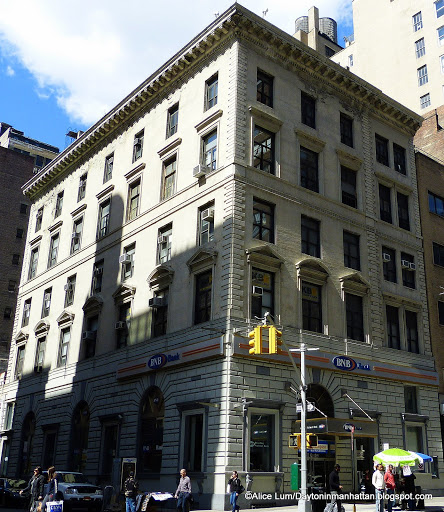
 |
| photo by Alice Lum |
On March 4, 1902 The New York Times reported “Every one was shocked yesterday at the news from California of the death of Mrs. Frederic Goodridge. Mrs. Goodridge died yesterday, and the news was telegraphed here immediately.”
The passing of Charlotte Matilda Grosvenor Goodridge was, as well, the passing of yet another of the last vestiges of old Fifth Avenue. A leading figure in Manhattan society, she was the widow of Frederic Goodridge, a millionaire importer who had died in 1897. Unlike most of her wealthy neighbors, she had remained in her great Fifth Avenue mansion, at the northwest corner of 28th Street, refusing to surrender to the tide of commerce.
The Times remarked about the mansion saying “It is one of the few residences now in that part of Fifth Avenue, and it is a splendid specimen of a New York Mansion.” Directly behind the house was “the magnificent stable occupying two lots in Twenty-eighth street.”
Almost immediately there was a question concerning the will. Mrs. Goodridge had bequeathed the house and its contents “known as No. 250 Fifth avenue” to her five children. Because the property was so specifically identified by the address, the question arose as to the disposition of the carriage house. If the sprawling building were considered a separate property by law, it would go to her grandchildren; if it were deemed part of the house property, it would pass on to their parents.
A “friendly suit at law” kept the estate tied up for several years while the courts decided the matter.
In the meantime, Mrs. Goodridge’s mansion was leased to the Gimpel-Wildenstein Galleries by the family. The firm dealt in fine art, selling European masterworks to Charlotte Goodridge’s former neighbors who were now living in lavish homes further north on the avenue.
All the while the Second National Bank had been doing business from the Fifth Avenue Hotel at the corner of 23rd Street for four decades. The bank catered to well-to-do depositors and its location in the fashionable hotel supported its high-end reputation. But by 1907, the same year that the Goodridge estate was settled, there was a problem. The Fifth Avenue Hotel was to be demolished.
On August 2, 1907 the real estate field took note when The New York Times reported that “The Goodridge estate has sold its holdings at the northwest corner of Fifth Avenue and Twenty-eighth Street” for the startling price of $1.1 million—nearly 18 times that much by today’s standards.
The purchaser was kept anonymous, to the frustration of real estate brokers. “It is understood, however,” said The Times, “that a modern store, office and loft structure will be erected on the site by the new owner.” Nearly a month later, on August 29, little more was known, but The Times provided a small update. “Gossip in Fifth Avenue real estate circles yesterday threw considerable light on the mystery which has surrounded the recent sale of the Goodridge estate’s property…According to reports, the property has been bought by a prominent financial institution which will erect a new building on the site.”
The “prominent financial institution,” of course, was the Second National Bank which sought out the services of the eminent architectural firm McKim, Mead & White to design a structure appropriate to the neighborhood. By now the firm was among the most prestigious in the country, responsible for important structures like Madison Square Garden, the Metropolitan Club, the Brooklyn Museum and the nearby Washington Arch. While the firm retained the name McKim, Mead & White, the great Stanford White was out of the picture, having been murdered a year earlier.
The Times remarked on the choice of the location and the changes in Fifth Avenue. “In selecting a Fifth Avenue site the Second National has only followed the tendency, which has already led nearly a dozen banks and trust companies to establish main offices of branches on that thoroughfare, and which promises to make the avenue’s financial importance second only to its prominence as a centre of retail trade.”
On October 18, 1907 the architects filed plans for a “five story and basement office and bank building.” The arcane description filed with Buildings Superintendent Murphy noted “facades of limestone at the first story and brick with trimmings of terra cotta above.” The projected cost was $140,000.
By December the Goodridge mansion and carriage house were gone and the foundation was being dug. Reports of the coming building were more concerned with the amenities than the architecture. “The basement story, which will be surrounded by an open area, will be faced with granite,” reported The Times. “Throughout the first story the facades will be of granite and above that of light colored face brick with trimmings of terra cotta.”
 |
| sketch from the collection of the Museum of the City of New York |
Accounts failed to mention the style. What would result was a five-story Italian Renaissance palazzo that would have been equally comfortable sitting among the mansions of upper Fifth Avenue as with the commercial buildings here. Arched entrances along 28th Street and on Fifth Avenue were edged with heavy stone voussoirs. The second floor windows were capped by alternating peaked and arched pediments and a stately bracketed cornice topped it all.
 |
| The altered mansion next door to the new bank building would soon be engulfed by an addition -- NYPL Collection |
Although the main entrance to the banking hall was on Fifth Avenue, ladies could bank unperturbed by using the 28th Street entrance. “At the rear on the Twenty-eight Street side will be special accommodations for the ladies’ department, a branch of its business to which the Second National has always paid special attention.”
The upper four floors were designed as offices and loft spaces for rental income to the bank.
 |
| The addition was both harmonious and extremely noticeable -- from the collection of the Museum of the City of New York |
In 1912 the bank purchased the adjoining 32-foot wide property at 252 Fifth Avenue. The Times reported that “the bank, it is understood, will alter the building using a portion of it for its own business, but later it may be improved with a new bank building.”
Indeed the directors “improved” the property by extending the bank in a harmonious if noticeable addition. October 26, 1913 The Sun reported that “Another bank improvement on Fifth Avenue is the small addition to the building of the Second National Bank.”
While the bank was busy extending to the north and to the rear (a somewhat odd-looking one-story addition was added along 28th Street), the upper floors buzzed with a variety of businesses. The Stewart Hartshorn Company, a window shade firm, was an early tenant. The manufacturer of “shade-rollers” would stay for nearly four decades.
 |
| The rear extension, humiliated with advertising awnings today, carried on the McKim, Mead & White design. photo by Alice Lum |
Small offices, like that of Paul Block, an advertising representative for newspapers like the St. Louis Times, coexisted with larger firms like the Start Shirt Company. Edward A. West ran his business from 250 Fifth Avenue in 1915 when he made it his civic duty to have Russian royalty arrested.
Prince Paul Troubletzkoy was an artist and sculptor whose best known work was the monumental equestrian statue of Tsar Alexander III in St. Petersburg. The political climate forced the prince to leave his homeland and on November 20, 1915, he was staying at the nearby Holland House Hotel. As he sped his motorcar that day up Fifth Avenue he provoked the ire of Edward West.
When the prince drove “his machine so rapidly around a corner at Fifth Avenue and Thirty-first Street,” said The Times, “West barely avoided being hit.”
The enraged West followed Troubletzkoy to the hotel “and remonstrated with him,” he later recounted. When his remonstrations brought no regrets from the Russian royal, West had him arrested.
In 1921 Charles E. Mitchall, President of National City Bank announced that the institution had taken over the Second National Bank. For the rest of the century the corner building would be home to National City Bank, later named CitiBank, N.A.
Throughout the 20th century apparel firms would take space here, including Kaahlonit Sweater Mills, Inc., and the important International Silk Guild which operated from the building for over a decade in the 1940s. The Guild was characteristic of several tenants who stayed on for extended periods.
 |
| photo by Alice Lum |
In 1950 Interscience moved in. Publishers of scientific periodicals and books it would be a familiar presence in the building for years. In 1967 the Singer Company took two full floors for its district sales and regional administrative offices.
1974 was not a particularly good year for the bank at least in terms of robberies. On June 26 at around 12:30 pm a 29-year old man handed a “threatening” note to a teller. The robber escaped with a bag containing $6,000. Four months later, on October 18, the bank was robbed again. This time the robber was less successful.
“A lone robber, armed with what the police described as a simulated gun, entered a branch of the First National City Bank at 250 Fifth Avenue and escaped with $250,” reported The New York Times. The take, about $900 today, would not be of much good to the thief. “The police said the money comprised marked $5 bills,” said the newspaper.
In 1986 a small bank opened nearby on Broadway near 27th Street. The Broadway National Bank was intended “to cater to the neighborhood’s business people,” according to Chairman Sam C. Chung. The business people Chung targeted were part of “the dramatic rise in the number of wholesale and import businesses on the avenue correspond[ing] to the mass immigration of Koreans and other Asians to the United States during the 1970’s.”
With the turn of the 21st century, BNB had grown, taking over the former CitiBank space at No. 250 Fifth Avenue. Then in 2012 a somewhat surprising announcement was made when building owners Quartz Associates LLC released its intentions to build a 23-story tower that would encompass the old McKim, Mead & White structure.
 |
| The proposed 23-story hotel caused concern with community groups -- http://www.citylandnyc.org/proposed-23-story-hotel-tower-at-fifth-avenue-and-west-28th-street-considered-by-landmarks/ |
Designed as a hotel, the tower would sit above the old rear addition to the bank building, sitting back 15 feet from the base structure. Issues were immediately raised by preservationist and neighborhood groups. But by October 2012, consensus on the design appeared near; and the site of Charlotte Goodridge’s “magnificent stable” seems destined for yet another remarkable change.


.png)


