Thursday, September 24, 2020

The Charles C. Stillman Mansion - 9 East 67th Street


Colonel Vernon King Stevenson purchased the newly-completed high-stoop brownstone row house at No. 9 East 67th Street in 1882.   It was one of six identical 25-foot wide homes designed by architects Thom & Wilson for real estate developers Spaulding, Breenan & Jones.

Stevenson was born in Kentucky in 1812.  He started out in business at the age of 16, initially involved in dry goods.  He founded the Nashville and Chattanooga Railway in 1848.   A portion of his service to the Confederate Army in the Civil War was the management of the railroads.  Following the war, he moved to New York and focused on real estate.  The Brooklyn Daily Eagle later commented that he "probably engaged in more real estate transactions than any other man who ever lived in New York City."  Two years before purchasing the 67th Street house he sold his railroads to August Belmont.

Stevenson's wife, the former Anna L. Eve, was his third wife.  The couple had three children, Vernon, Jr., Paul Eve, Maxwell, and Eloise.  

The millionaire would not enjoy his new home especially long.  On October 19, 1884 the Philadelphia newspaper The Times reported "Colonel Vernon K. Stevenson, the well-known Southern railroad man, died...on Thursday, in his seventy-second year."  Following his funeral Stevenson's body was taken to Nashville and placed in the family tomb.

On December 5, 1890 the New York Herald reported "Miss Eloise Stevenson was another bud who entered New York society yesterday afternoon.  A reception was given for her by her mother, Mrs. A. L. Stevenson, No. 9 East Sixty-seventh street."  

Once her daughter was properly introduced, a society mother's next focus was finding her an appropriate husband.  And it did not take long.  On November 10, 1891 The Sentinel reported "There was a quiet home wedding at the mother of the bride, Mrs. Stevenson, at No. 9 East Sixty seventh street, New York, last Thursday at noon, the parties being that keen young sportsman, Mr. James P. Kernochan and the graceful horsewoman, Miss Eloise Stevenson."  The article noted that Kernochan's father was building a "pretty cottage near Hempstead" for the couple "so that hunting with the Meadowbrook hounds, a sport which Mr. and Mrs. James P. Kernochan dote, lies at the very door."

Anna Stevenson sold No. 9 on April 15, 1893 to Charles and Gertrude Miller for $85,000--just under $2.5 million today.  The couple remained in the house five years, selling it to John Murray Mitchell on December 29, 1898.  

Mitchell was an anti-Tammany politician.  In 1894 he had been elected to Congress "having beaten Tammany Hall in one of its strongholds," said The Brooklyn Daily Eagle.  On April 16, 1896 he married Lillian Talmadge of Brooklyn and the newlyweds moved into a mansion on Washington Square.  The same year they moved into the 67th Street house a son was born, John Murray Mitchell, Jr.

The couple were members of the "Tuxedo set" and Mitchell was a prominent yachtsman.  "Few New Yorkers belonged to so many clubs as he did," said The Brooklyn Daily Eagle.

The Mitchells entertained lavishly in the 67th Street house.  On January 23, 1903, for instance, the New York Herald reported on the reception and musical they gave the previous evening.  "About one hundred and twenty-five persons were invited."  The article said this was the first of several concerts Lillian intended to give that season.  "The guests were seated in the large hallway, in which there is a magnificent organ, with manuals on one side and the pipes on the other.  This hall is filed with antique furniture, including a carved chapel seat of the sixteenth century and many beautiful tapestries."

In 1904 the Mitchells completed construction on their new Tuxedo Park country estate, Craghurst, which was reported to have cost $500,000, or about $14.8 million today.  But tragically the 47-year old Mitchell was battling cancer.  He died in the new summer home on May 31, 1905.

Lillian initially leased the house to Charles Chauncey Stillman and his wife, the former Mary Estelle Wight, in February 1907; but she would never return.  The couple purchased the house and in 1912 hired the architectural firm of Hiss & Weekes to completely remodel it into a modern up-to-date home.

The brownstone front was removed and replaced with a limestone facade in the neo-French Renaissance style.   The architects did not go so far as to move the entrance to street level, as was being done in most such renovations; but replaced the brownstone stoop with a limestone version.  A striking stone balcony with pierced railing ran the full width of the second floor and the slate-shingled mansard was dominated by three shoulder-to-shoulder stone dormers with elaborate pediments and finials.

The Stillmans' story was a romantic one.  Mary, who was born in Augusta, Maine, was a trained nurse.  She was working in a Boston hospital when Charles, a student at Harvard, was brought in seriously ill.  The New York Times later reported that Mary "nursed young Mr. Stillman back to health."  The couple was married in the fall of 1903.  They now had three children, Elizabeth Goodrich, born in 1905; Chauncey Devereux, born in 1907; and Eliot Wight, who arrived in 1909.

Stillman was a financier and son of millionaire banker James Jewett Stillman.  James J. Stillman died in 1918 leaving an estate of more than $40 million.  The New-York Tribune reported that Charles and his two brothers, James and Ernest, each inherited $9,694,561.  Charles's windfall would be the equivalent of about $165 million today.

The family maintained a large country estate, Kenridge, at Cornwall-on-Hudson.  Their Manhattan mansion was filled with choice artworks.  On September 23, 1921 the New-York Tribune reported that Stillman had placed on permanent loan to the Metropolitan Museum of Art 12 old masters, including Rembrandt's Portrait of Titus.

At the time of the generous loan Mary was confined to her bed.  She had suffered a debilitating stroke the year before.  She died on September 24, 1925 and Charles survived her by less than a year, dying on August 16, 1926.

Eliot Wight Stillman was killed in an automobile accident in Arizona in 1928.  His brother and sister remained in the 67th Street house and Kenridge.

Both were young adults now.  Elizabeth had received a privileged education, having attended the exclusive Miss Chapin's and Miss Walker's Schools.  She was a member of the Junior League and the Colony Club.  Chauncey Devereux Stillman announced her engagement to Langbourne Meade Williams, Jr. on April 17, 1930.   The wedding took place in St. John's Church in Cornwall, New York, on September 27 that year with Chauncey giving the bride away.  The reception was held in Kenridge.  The New York Times reported "The rooms were decorated with wild asters, orange chrysanthemums, and Autumn leaves."

Within a decade Chauncey sold the family home.  In 1945 the Douthitt Galleries operated from the ground floor and in 1949 a conversion resulted in three apartments in the basement through second floors, and two each on the third and fourth.  The stoop was removed at this time.

Living in one of the top floor apartments in 1975 was 51-year old Jan DeVroom and his 26-year old roommate.  DeVroom did not work, but lived off the income from investments.  At around 8:00 on the evening of November 14 the roommate discovered DeVroom dead on the kitchen floor, having been stabbed multiple times.  Henry Geoghegan was later arrested for the murder, which the prosecuting attorneys said "was part of a plot to embezzle money from Mr. DeVroom."

The house was owned by Janna Bullock in 2005 when she first attempted to sell it, asking as much as $35 million at one point.  But three years later it was still unsold.  But then she received permission from the Landmark Preservation Commission to recreate the limestone stoop and entrance.  As the restoration was nearing completion in November 2008 she found a buyer, who paid just under $25 million.  The New York Times remarked on January 16, 2009 "It has 10 fireplaces with carved stone mantels, a terrace and 13,000 square feet of space."
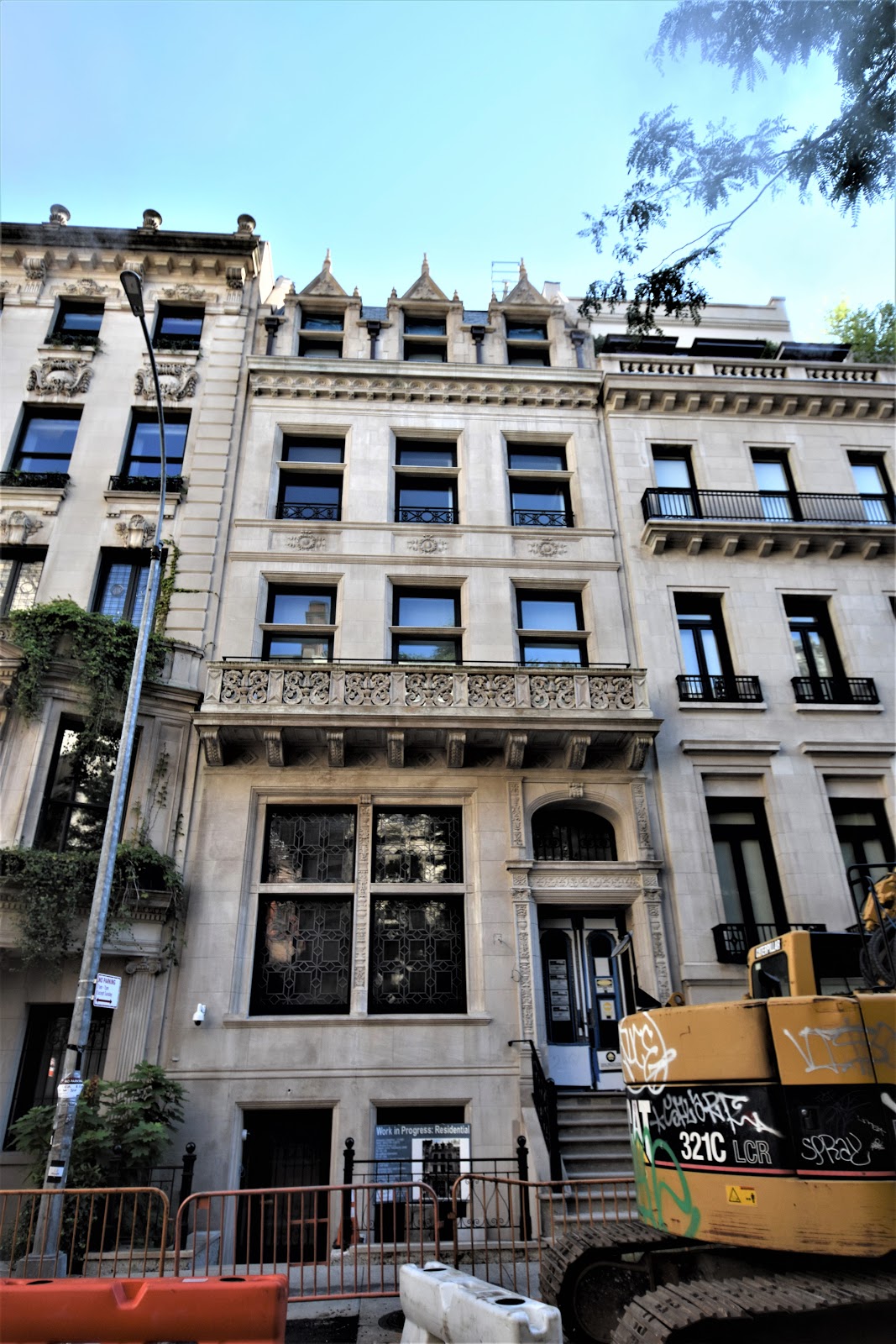
The 2008 renovation recreated the stone stoop and entrance.

The new buyer returned it to a single-family home.  But those ten fireplaces and carved stone mantels would not survive much longer.  Gary Shoemaker Architects was commissioned to do a gut renovation of the house.   Only the shell was preserved for what the engineering firm describes in its website as "the improved townhouse."

photographs by the author

Wednesday, September 23, 2020

The Henry E. Montgomery House - 115 East 30th Street


In 1859 Henry E. Montgomery and his family lived at No. 115 East 30th Street, one of a row of identical brownstone-fronted homes built a few years earlier.  Designed in the up-to-date Anglo-Italianate style, their owners did not have to navigate the high stone stoops so popular at the time.  Arched openings in the rusticated base contrasted with the elliptically arched windows of the upper floors.  Cast metal cornices with prominent arched pediments crowned the design.

Montgomery had been the rector the Church of the Incarnation on Madison Avenue at 35th Street since 1855.  he and his wife, the former Margaret Augusta Lynch, had three children, Sophia Elizabeth, Elizabeth Philips and John Howard Lynch.  John enrolled in New York City College in 1866.


Henry E. Montgomery, D. D. from a portrait by Julian Story, History of the Parish of the Incarnation, 1852-1912 (copyright expired

The New York Herald described Montgomery as "a small man, of very nervous temperament, an earnest Sunday school worker, and a vigorous preacher."  The writer's description of his oratory skills was only slightly complimentary.  "The Doctor's sermons are remarkable only for their simplicity and earnestness and practical application.  So simple, indeed, are they, that a little child may hear and understand them."

The Montgomery family remained in the house until May 1869 when it was sold to Dr. Joseph Worster.  On June 12 the Evening Telegram reported that although Dr. Worster's family "will spend part of the summer at Richfield Springs," the doctor would mostly remain in the city to attend to his patients.  

Worster had practiced medicine since around 1825 on 9th Street near Broadway.  The article explained "Many of Dr. Worster's patients being up town he has found his new and beautiful residence, 115 East Thirtieth street, a very convenient location."

Worster and his wife, Mary, had three daughters and a son, Dr. Willard Parker Worster, who practiced with his father.  Worster specialized in gynecology and obstetrics and, like almost all private physicians at the time, he and Willard practiced from the home.

In 1870 Flora McDonald came for treatment of a disorder.  The delicate, veiled terms used by the press to describe her condition suggest that she was experiencing problems caused by an abortion.  Embarrassed, she hid the facts from Worster.   When she died, rumors circulated that it was he who had performed the procedure that led to her death.

On November 21, 1870 newspapers across the city published an open letter signed by eight physicians.  They said that Worster's name "has been unjustly and with so much apparently malignity, connected with the death of the unfortunate woman Flora McDonald" and asserted that they were "fully convinced that the death was the result of causes in operation before she came into Dr. Worster's hands for treatment; that she concealed from him the fact that any serious trouble had existed--indeed, denied it when asked the question by the Doctor; and during her illness, the fatal result of which is not uncommon, she was skillfully, kindly and scientifically treated by him."

While her husband tended to his patients, Mary Worster involved herself in charitable causes.  Her favorite seems to have been the New-York Infant Asylum and annually she worked to organize the charity ball held at the Academy of Music.

In July 1877 Joseph Worster fell ill.  His condition worsened to pneumonia and he died in the 30th Street house on August 7 at the age of 75.  His funeral, which The New York Times said was "largely attended," was held in the rear parlor on the afternoon of August 11.  The article said that for hours before the service "the house was thronged with a continuous stream of visitors, most of them old friends and patients of the deceased."

Within four years No. 115 was home to Dr. Glover Crane Arnold.  Born in Charleston, South Carolina in 1849, he was brought to New York as a child.  Arnold, who came from a long line of doctors going back to his great-grandfather, was graduated from Bellevue Hospital Medical College in 1873.  He married Emily Spier, daughter of Superior Court Judge Gilbert M. Spier, in 1879.  The couple had three daughters.  

Arnold took on a case shrouded in mystery in the spring of 1895.  On Monday April 15 Deputy Chief Clerk Delamater of the Police Department brought Walter Hale to Arnold's office for treatment of various wounds.  The patient was an engineer from Massachusetts who had arrived in New York on his way to St. Paul, Minnesota two days earlier.

Having had his baggage transferred from the Grand Central Depot to the Pennsylvania Railroad Depot, he directed a cabbie to take him to the Debrosses Street Ferry.  The next thing he could remember is that he woke up in a place "which from his description must have been Koster & Bial's in Twenty-third street," said the New York Press.  It was now Saturday--twelve hours having elapsed since he hailed the cab.

"Hale claims to be a temperance man and says he has never been under the influence of liquor in his life, and cannot in any way account for his loss of memory...He remembers coming to himself in a concert hall and finding a crowd of men and women surrounding him.  His hat was gone, and when he put his hand to his head he found that he was bleeding from a deep scalp wound."  

When Hale saw the blood on his hand, he fainted.  The next time he regained consciousness he was in a bed "in a questionable resort."  The New York Press reported "He had never, so he says, been in a place of this character before, and did not know how he got there."  It was now Monday afternoon.

"When he searched his pockets he found that his money, some $125, and two watches he carried were gone."  The cash loss alone would amount to nearly $4,000 today.  Hale, "when he was sufficiently recovered," went to Police Headquarters where he told his wild story.

Dr. Arnold told reporters that "he has been unable to obtain any more information from Hale" than he gave the police.  The man's injuries, he said, were not serious.  The following day Hale's overcoat was found hanging in a closet in a saloon on Third Avenue.  The case went cold after that.

On the afternoon of January 6, 1900 Emily hosted a reception to introduced daughter Emily Julia to society.  

The house as it appeared around 1940 looked little different from today.  via the NYC Dept. of Records & Information Services
Within a few years Glover Arnold began experiencing symptoms of Bright's Disease, a kidney condition known today as chronic nephritis.  He died in the 30th Street house on November 29, 1906.  The Year Book of the Medical Association of the Great City of New York announced "He was buried with Masonic honors, an imposing ritual being celebrated at Greenwood Cemetery after the church service at Trinity Chapel."

Five months later, on April 2, 1907 Emily Julia married Glenn William White in the Church of the Transfiguration.  Her mother eventually moved to No. 10 West 53rd Street where she died in 1922.


Perhaps because of its narrow proportions, No. 115 was never converted to apartments.  In 1961 a renovation resulted in an office in the basement with two duplex residences above.

photographs by the author

Monday, September 21, 2020

The 1884 Dakota Apartments - 1 West 72nd Street


In 1992 nearly a century of black grime was removed from the building, exposing Hardenbergh's warm palette of brick and stone.  photo by Ajay Suresh

Although it was inventor and actor Isaac Merritt Singer who founded the Singer Sewing Machine Company; it was Edward Cabot Clark who made it a success.  Clark had been Singer's attorney since 1848 and the two became business partners.  A marketing genius, Clark's innovative ideas--like accepting trade-ins for newer models--made the Singer Company an enormous success and the partners millionaires. 

Edward Clark diversified into real estate development and quickly turned his attention to the rocky, mostly undeveloped Upper West Side.  He was outspoken in his intentions to make the West Side as affluent as the East.  He encouraged landowners to work together, mutually investing in property, and issuing restrictive covenants on construction.  

In 1880 Clark embarked on an ambitious project—the erection of a first-class apartment building that would engulf the blockfront of Eighth Avenue (later Central Park West) between 72nd and 73rd Streets.  His speculation was both aggressive and risky. Years later The New York Times would remind its readers that the area "was in the heart of a squatter's shanty district, where goats and pigs were more frequently encountered than carriages in the muddy streets." 

Architect Henry Janeway Hardenbergh’s plans, filed on October 1, 1880, called for an eight-story “Dorchester stone and brick Family Hotel” with an estimated cost of $1 million (more than 24 times that much in today’s dollars).   Clark christened his projected building The Dakota.  Manhattan lore is fond of saying that Clark’s friends chided him that it was so far away from the established city that it could be in the Dakota Territory.  But in fact, the name was almost assuredly merely a product of Clark’s fascination with the West. 

Clark was faced with the challenge of attracting moneyed residents to an apartment building at a time when multifamily living was considered middle-class at best.  And so, his apartments would offer everything found in an upscale private home.   The ceiling heights ranged from 15.5 feet on the first floor to 12 feet at the topmost.   No two of the scores of fireplaces were identical, and imposing scale was emphasized throughout the building.  Some drawing rooms were 20 by 40 feet, and the parlors, libraries and dining rooms were sumptuous.  Floors were inlaid with cherry, oak and mahogany.  The Manufacturer and Builder reported that the apartments would have “from five to twenty rooms in each; some are supplied with kitchens, and others have only dining-rooms.  On the main floor, at the Eighth avenue and Seventy-second street corner, is to be a large restaurant, including a dining hall and cafĂ©, with private dining-rooms connected.” 

Entrances are located on the four corners of the courtyard.  At the southeast corner were the restaurant, private dining rooms and cafe.  from the collection of the Library of Congress

The most lavish apartment was intended for Clark and his family.  Its drawing room was the size of a ballroom—24 by 49 feet—with two massive crystal chandeliers and fireplaces at either end.  It contained a total of 17 rooms and 17 fireplaces.  The expensive details included silver-plated doorknobs and hinges.

Clark would never see his apartment completed.  On October 14, 1882, Edward C. Clark died of malarial fever, two years before the end of construction.  But his project forged ahead without him.

To maximize floor space in the apartments, Clark and Hardenbergh had eliminated most of the servants’ rooms and relocated them to the top two floors, which they shared with the laundry and trunk storage rooms.  The second floor held apartments for out-of-town guests so the need for guest bedrooms in the apartments was unnecessary, as well.

Cast iron staircases with marble treads were deemed fireproof.  photo by Fred R. Conrad, The New York Times

In its May 1882 issue The Manufacturer and Builder reported on the progress.  “There will be seven hydraulic elevators, and the same number of stairways in iron and marble.  The woodwork will be elaborately carved.”  Hardenbergh assured residents their privacy by placing the entrances within a gated courtyard.  The main carriage gate--a 20-foot high arched entrance--opened onto 72nd Street.  On the opposite end of the courtyard was a smaller “tradesmen’s gate” where delivery wagons entered, trash and ashes were removed, and through which the servants came and went.  (In the 20th century the tradesmen’s gate received the romantic name “The Undertaker’s Gate,” despite that it was most likely never used for that purpose.)

The courtyard allowed residents to get in and out of their carriages in privacy.  The Daily Graphic, September 10, 1884 (copyright expired)

On October 21, 1882 The Record & Guide described the style as being “in the main, a reminiscence of French Renaissance.”  Architectural critics have argued the point for more than a century.   It has been described as German Renaissance, Chateauesque, Brewery Brick, and even “Victorian Kremlin.”  In fact, it is a melding of historic styles--Hardenbergh’s own hybrid. 

The Dakota, which the Record & Guide said was “the very earliest attempt on a large scale to attract fashion to the west side of the park,” was completed in 1884.  By then the cost had risen to “between $1,500,000 and $2,000,000,” according to the journal, which added on February 7, 1885, “the rents range from $1,000 to $5,600.”  

For that, however, residents enjoyed upscale amenities.  Maids arrived every day, as did porters who removed the ashes, and replaced coal and firewood for the stoves and fireplaces.  Laundry was taken away and returned freshly cleaned and ironed.  The main floor restaurant was in the style of an English baronial hall; but for those tenants who preferred to eat in, meals would be delivered and served by the restaurant staff.  On the roof was a promenade with gazebos and pergolas and canopied sunshades.  And for the more athletically inclined the adjoining lot to the side held private tennis courts for residents’ use. 


from The Sanitary Engineer, 1885 (copyright expired)

On October 27, 1884 the Daily Graphic entitled an article “A Description of One of the Most Perfect Apartment Houses in the World” and called The Dakota “the largest, most substantial, and most conveniently arranged apartment house of the sort in this country.” 

A glimpse of the rooftop promenade and a pergola can be seen in this 1965 photograph by the Historic American Buildings Survey.  from the collection of the Library of Congress


Among the early residents were the family of Theodor Steinway, of Steinway & Sons; music publisher Gustav Shirmer and his wife; John Browning, the founder of the Upper West Side’s exclusive Browning School for boys; and Edward Bascomb Harper, president and founder of the Mutual Reserve Fund Life Insurance Company.  Others included John D. Adams of the chewing gum firm; and engineer John B. McDonald who built the first subway. 

The completed building was surrounded by unpaved streets and vacant lots.  from the collection of the Library of Congress
The New York Sun found the extravagance of some residents inexcusable.  In an article in May 1890 it complained “A tenant with a five years’ lease in the Dakota flats has spent $5,000 in decorating the walls of his apartment.”  (It was a large amount, equal to nearly $150,000 today.)  But those who lived in The Dakota could well afford it.  

It was no coincidence that Frederick G. Bourne, president of the Singer Sewing Machine Company, had an apartment here.  He nearly lost his life on February 23, 1897 when he went for a ride in Central Park.  His relaxing jaunt turned terrifying when his saddle horse was spooked and began galloping down the Park Driveway.  Bourne was thrown to the pavement, breaking his arm.  The Tribune reported “he was taken to his home in the Dakota flats…in a carriage.” 

After the turn of the century the laundry was moved from the top floor to a large boiler room under the tennis courts.  On the afternoon of April 18, 1910 several employees were at work there, including 52-year old Ellen Cleary, who was working on a steam wringer.  Suddenly the massive boiler exploded.  The Evening Telegram reported “A huge piece of iron struck her in the leg and she fell to the floor unconscious.”  All the other employees ran from the room in panic; but when the danger seemed to have subsided, they rushed back. 

“James Williams, an employee of the place, saw the woman was badly injured and made a tourniquet of a sheet, which he placed above the wound to stop the flow of blood.”  An ambulance arrived to find that “the Cleary woman’s leg had been almost torn off and was hanging by shreds of flesh.  He immediately amputated the limb.”  The force of the explosion had broken out several of the lower floor windows. 

The tradition of the heads of the Singer Sewing Machine Company residing in The Dakota continued with Sir Douglas Alexander and his wife, the former Helen Hamilton Gillespie.  Alexander was the sixth president of the firm which he had joined as a clerk in his native Canada in 1891.   Upon his appointment to the Board of Directors in 1896 the couple moved to New York.  He was created a baronet of Edgehill, near Stamford, Connecticut, on July 2, 1921 by King George V.  Lady Alexander died in their Dakota apartment on March 19, 1923.

By 1959 the tenant list, while still highly affluent, had somewhat changed.  Nan Robertson, writing in The New York Times on September 7, 1959, grouped the residents into three categories: "the diplomatic corps, upper-echelon show business and publishing."  Included in the diplomatic contingent were the ambassadors to the United States of the Netherlands, Portugal, Finland and the former Ambassador from the Soviet Union.  "Theatrical tenants, to name a few," said the article, "are Boris Karloff, Eric Portman, Judy Holliday, Jose Ferrer and his wife, Rosemary Clooney, Zachary Scott and his wife, Ruth Ford, Jo Mielziner, the set designer, and Sidney Kingsley, the playwright."  C. D. Jackson, a top executive of Time, Inc. occupied the 17-room Edward C. Clark apartment on the sixth floor.

The Dakota still maintained a staff of 52, described by Robertson as "like wondrous fossils from the Age of Gracious Living."  And it was still owned by the Clark family.  One resident said "You never saw a building so superbly maintained.  The bronze is petted, the mahogany oiled, the brass rubbed, the floors waxed."  By now the former warren of servants' rooms on the eight and ninth floors were rented "to a chosen few tenants for $25 and $30 a month."

With motion picture stars inside, The Dakota became a film celebrity in its own right in 1968 with it served as the location of Roman Polanski's psychological horror film Rosemary's Baby.


photo by Half Sigma


In 1973 singer John Lennon and his wife, Yoko Ono, moved into an apartment, adding their names to those of other famous residents like Leonard Bernstein, Roberta Flack and Lauren Bacall.  Two years later, on January 26, 1975 a catty journalist suggested that the two had split up, writing in a Twin Falls, Idaho newspaper "Yoko still lives in their expensive New York City Dakota Apartment and drives around town in the Lennon limo.  John is hanging out with a swinging black dancer on Manhattan's West Side."

Seven years later the couple had acquired five apartments consisting of 26 rooms, plus a ground-floor office.  On the night of December 8, 1980, the Lennons left the building headed to a recording session.  A fan, Mark Chapman, approached John and asked him to autograph a copy of "Double Fantasy," Lennon's latest album.  He did so, writing "John Lennon, 1980."  Several hours later the Lennons returned home.  John stepped back through the gate to the crowd of fans to sign autographs.  Chapman was still there and he emptied his .38-calibre pistol into Lennon's back and left arm.  The former Beatle was pronounced dead upon arrival at the hospital.


Many of the 1884 interior details remain throughout.  photo via Brown Harris Stevens


Today The Dakota is regarded as America's second most famous address--the first being 1600 Pennsylvania Avenue.  While almost ever other Victorian apartment house fell from fashion or, more often, was demolished, The Dakota never lost its upscale reputation.  And, also unlike most, its interiors are for the most part secured.  Residents who wish to modernize their apartments are required to store any architectural elements--like mantels or woodwork--so they can be reinstalled later.


The Lost Bethel African Methodist Episcopal Church - 239 West 25th Street


from the collection of the New York Public Library
In 1865, only six years after the cornerstone was laid for its church on West 28th Street near Broadway, the Free Will Baptist Church sold it to the Disciples of Christ and moved west.  It erected a Gothic Revival structure on West 25th Street between Seventh and Eighth Avenues.  The facade was divided into three parts by buttresses that morphed into crocketed spires.  The Gothic arch of the main entrance was mimicked in the stained glass window directly above.  Two narrow Gothic windows graced the flanking sections.

Like all  19th century churches, the Free Will Baptist doubled as a meeting and lecture hall.   In 1871 the entire nation celebrated the 25th anniversary of the organization of the Grand Army of the Republic.  The New York Herald reported "This association of battle-scarred veterans of the war for the Union was born April 6, 1866, and its twenty-fifth birthday will be celebrated all over the land with banquets, speech-making, music and general rejoicing."

The article noted "James C. Rice Post No. 29 will appear in uniform at the Post and repair in a body to Rev. Waldo Messaroe's First Free Baptist Church, West Twenty-fifth street, where they will enjoy a vocal and instrumental concert, prayer by the chaplain, and an address by the Rev. Mr. Messaros."

In 1894 the congregation moved again.  It leased the 25th Street building to the Bethel African Methodist Episcopal Church.  On May 1 of the following year it sold the 80-foot wide church to its tenants for $67,500--more than $2 million today.

The church had been organized in 1819 by the Rev. Richard Allen, who went on to become the first Bishop of the African Methodist Episcopal Church.  It had worshiped on Sullivan Street in Greenwich Village until now.

Churches were, of course, racially segregated in the 19th century.  Large meetings in the church were now mostly concerned with the conditions of the poor in New York City, and more widely, conditions of Blacks throughout the country.  

On April 12, 1897 a meeting under the auspices of the White Rose Mission (an organization backed mostly by white socialites which focused on the plight of Black New Yorkers) was held here.  Among the speakers was the remarkable Lucy Seaman Bainbridge.  The wealthy widow who lived on Gramercy Park, had served in the Civil War as a nurse and helped organize the Women's Health Protective Association.

But an even more notable speaker that night was Booker T. Washington.  The New-York Tribune reported "He spoke of the work performed by the woman's branch in Tuskegee, and of the good emanating through its usefulness to kindred societies in Alabama."

In 1903 the Rev. R. D. Stinson addressed an assemblage here.  He had come north to raise funds for the expansion of the Morris Brown College in Atlanta.  The school's goal was to provide skills to Southern Blacks that would provide them a means to make a living.  He explained "The industrial department of the college, which is along the lines of Tuskegee, comprises dressmaking, cooking, housekeeping, laundering, nurse training, carpentry, harness making, shoemaking, printing, bricklaying, tailoring and art."

On the night of Stinson's address, Bishop W. B. Derrick of the New York diocese of the African Methodist Episcopal Church also spoke.  His topic was more political, insisting that the Congressional bill that proposed to give pensions to former slaves was "an insult."  Instead, he said, those funds should be directed towards institutions like  Morris Brown College.  "We do not ask the nation to pension us.  We ask the nation, though, to educate us so that we can support ourselves."

Racial tensions were at a heightened level at year.  After several lynchings in the Midwest, George White was lynched and his body burned in Wilmington, Delaware on June 2.

Even before that incident, which sparked nation-wide comment, the New York community considered its response.  On March 6, 1903 The Sun reported "There was a mass meeting of negroes at Bethel African Methodist Episcopal Church last night to consider 'the crisis through which the negroes of the United States are now passing."  Among the issues agreed upon was that President Theodore Roosevelt should have their further support.  The Rev. Dr. Proctor of Bay Shore, Long Island, noted that the "philanthropist, statesman and hero of the White House...is fighting the negro's second battle for his political rights."

Bishop Derrick was there, as well, who contrasted Roosevelt with Senator Benjamin Tillman, from South Carolina, an outspoken racist.  The bishop's blunt, uncensored verbiage did not pull any punches.  "The man's every utterance on a serious subject is an insult to his own race.  He speaks to a cultivated audience and his text is 'Nigger.'  His subject matter is 'Nigger' and his peroration is 'Nigger.'  His soul is full of 'Nigger' and if I were asked for a definition of the term I would say that the man's conduct has made a sure enough 'Nigger' of himself."

Booker T. Washington was back at the church on December 10, 1905 for the 100th birthday of William Lloyd Garrison.  The New-York Tribune reported that the church "was well filled yesterday afternoon...and with the negro worshippers at the church were several white persons, including a few women."

Garrison had worked tirelessly throughout his lifetime to abolish slavery.  His anti-slavery newspaper, The Liberator, was widely-read for three decades, until slavery was abolished.  In his address, Washington said in part "The celebration teaches the white man that the blacks are not ungrateful to or forgetful of those who have done good to them.   It teaches that Garrison did not work in vain, but there is no better way for us to show our gratitude than by our daily life, proving that we are a people worthy of the birthright of American citizenship."

In 1906 New York Republican candidate for governor, Charles E. Hughes, made a campaign stop in the church.  The New-York Tribune reported "The church, which is a large one with lots of balcony space, was jammed with negroes and a sprinkling of whites.  All received flags as they entered the church and the waving of them made a pretty sight when Mr. Hughes entered.

National conditions had not improved overall.  Earlier that year a Tennessee sheriff, Joseph F. Shipp, had allowed a mob to storm the jailhouse and remove and lynch a Black prisoner, Ed Johnson.  Hughes told the audience, that every offender should be punished.  "We don't want any lynch law in this country."

Hughes no doubt recognized the voting power in the Black community.  By now the congregation of Bethel A.M.E. Church had swelled to 2,000 members.

The high esteem in which the congregation held President Theodore Roosevelt crumbled after the incident that would become known as the Brownsville Affair.  The 25th Infantry Regiment, a segregated unit of Black soldiers called the Buffalo Soldiers, was stationed at Fort Brown, Texas.  Following the killing of a white bartender and police officer in 1906, townspeople accused members of the unit.  Although their commanders testified that they had all been in the barracks that night, evidence was planted against them.  President Roosevelt ordered the discharge without honors of the 167 soldiers.  It cost them their pensions and prevented them from ever serving in Federal civil service positions.

On June 5, 1908 the New-York Tribune reported "President Roosevelt and his treatment of the negro were attacked last night at a meeting of the Bethel Lyceum of the Bethel African Methodist Episcopal Church."  In the group were the editors of several Black-owned newspapers, including The New York Age, The New England Torchlight, and The Indianapolis Freeman.

Passions had not abated by election time.  On September 27 The New York Times reported on another meeting at the church.  The President had made recent comments that, according to the newspaper, had "stirred up anew the resentment of negro Republicans."  In his remarks that night the congregation's pastor, the Rev. Reverdy C. Ransom said in part "I wonder if the President, as he lies in his downy couch in the White House, does not hear the groans and cries of their widows and orphans."

from the collection of the New York Public Library


In 1911 Rev. Ransom headed what had become the largest Black congregation in the city.  Race relations across the country had not improved, lynchings were still going on, and discrimination was omnipresent.  On the Sunday following the murder of Zacharaiah Walker in August that year, the topic of Rev. Ransom's sermon was "Who Lynched Zacarahiah Walker Last Sunday at Coatesville, Pa?"  His answer was, in short, "Not the cold blooded mob of Coatesville, but American public opinion."

Ransom admitted he was losing faith that violence against Blacks could be stopped by pacifism.  "I am unwillingly but slowly coming to the conclusion that the only way for the Negro in particular and the dark skinned peoples in general to win and hold the respect of white people is to mete out to them a white man's measure in all the relations of life.  Pious professions and solemn proclamations have little weight when they come from a people whose character has been so clearly disclosed."

The minister felt that "Men would be slow to apply the match for the incineration of a living victim if it were probable that the answering torch would kindle a flame in their midst."  But he was by no means condoning lawlessness.  "But you stay inside the law.  No matter what happens you stay inside the law.  Then you can demand that the white man enforce this law.  The day the Negro becomes lawless he is doomed."

On March 22, 1913 the congregation sold its church property to Sol Brooks and Joseph Bichler, partners in the firm of S. Brooks & Co.  The Bethel A. M. E. Church moved northward to Harlem.  The new owners held the property only until December, when it was sold at auction.  The church with its colorful and important history was demolished the following year.

Its replacement building made way in 1962 for the six-story apartment building which occupies the site today.


Saturday, September 19, 2020

The James B. Thomson House - 203 West 14th Street


Like the other homes along 14th Street west of fashionable Union Square, the row of houses at the northwest corner of Seventh Avenue were upscale.  At 25-feet wide and five-stories high above an English basement, they were intended for well-to-do owners.  High brownstone stoops led to the parlor level where, most likely, a cast iron balcony fronted the windows.  The fish-scale singled mansards which sat upon bracketed cornices were the latest touch in domestic fashion.


The second house from the corner, No. 123 (renumbered 203 in 1868), was home to James B. Thomson by 1855.   A mathematician, he no doubt had a substantial study or library in the house, for he tirelessly produced a series of textbooks for academic use.  His Thomson's Arithmetical Analysis; Or, Higher Mental Arithmetic for Advanced Classes was published that year.  Publisher Ivison & Phinney touted "Teachers will find this work superior, in many respects, to anything of the kind ever before published."  He had previously written volumes like Mental Arithmetic, Slate and Blackboard Exercises, and Practical Arithmetic. 


Thomson remained in the house until 1868, when it was purchased by Captain Francis R. Baby and his wife, Hilda.   Born in 1825, when Baby was 13 years old he "began a sailor's life on the great lakes," according to The New York Times later.  The couple had relocated from the West Coast where Captain Baby had commanded steamers for the Pacific Mail Steamship Company since 1852.  On October 29, 1862 the Sacramento Daily Union reported that the "old hero of the Pacific and Neptune of the Atlantic, the courtly Captain F. R. Baby, [was appointed] the New York agent of the Pacific Mail Steamship Company, whose knowledge of his duties is alone excelled by his generosity."


Captain Baby's generosity noted in the article was reflected in a gift to the city.  In the New York Departments of Parks Annual Report in April 1872, the director noted "There have been many interesting additions to the collection" and listed the new exhibits, including: "A Japanese Deer, Cervus sika, presented by Captain F. R. Baby."


Surprisingly, Francis and Hilda embarked on a two-year renovation project in 1875.  The house was converted to an apartment house with one apartment of nine rooms per floor.  The stoop was removed and the former basement level converted to a commercial space.   Perhaps because the neighborhood was on the border of the Cuban community, it was given the name The Senora.  On September 15, 1877 an advertisement in the New York Daily Herald read:


The elegantly arranged apartment house, The Senora, No. 203 West 14th st., is now ready for occupancy; neighborhood and appointments unexceptionable; favorable leases given to select parties.  The basement admirably adapted for physician's office.


A separate ad noted the upscale amenities: "every improvement, marble halls; stairs, furnished; halls heated; private stairs; parlors frescoed; janitor in attendance." 


Captain Baby and his wife continued to live here with their white-collar tenants.  In 1879 they included the Phillips family (David was a physician and Waldorf H. Phillips was an attorney), Augustine Butler and Philip S. Hastings, both clerks, and lawyer James C. Hays.  The ground floor office was home to the Dr. Charles J. Sharretts.


It appears that Dr. David Phillips operated from his apartment.  In the early hours of January 26 he was awakened by a messenger boy who said he was needed on West 16th Street.   Augustus Phillips (no relation) had been living with a woman named Mary Hoopley in rooms on the third floor of No. 142 West 16th Street for six weeks.  They were known to the other roomers as Mr. and Mrs. Phillips.  The couple went to the theater with a friend on January 25.  The three returned to the apartment and the unnamed friend left around 2:30 in the morning.  The Buffalo Morning Express reported "Soon after his departure, the sound of an angry quarrel was heard throughout the house."


At 3:40 Mary wakened Dr. Quinlan, who lived on the first floor shouting "For God's sake come up stairs; Gus is shot."  When the doctor entered the room, Phillips said "Well, Doc, I've got it this time," to which Mary replied "Yes, indeed, and I only wish I'd finished you."


Dr. Phillips arrived and the two physicians worked on their patient until 9:00 when they left him alone with Mary, "partly quieted by morphine."  Astoundingly, the fight renewed.  Sounds of a fight were heard at 9:30 and neighbors rushed in.  "Phillips was found sitting in a chair weak from exertion.  His companion, bruised and beaten, lay on the floor."  Phillips claimed that Mary attacked him with a poker while he lay in bed; Mary insisted he had "jumped from the bed, felled her with blows with his fist, and then trampled upon her."  Both were removed to the hospital.


Dr. Phillips was again summoned by another physician in 1880.  This time Dr. John W. Gibbs found his wife, Mary, suffering from "narcotic poisoning."   She had been enduring an ongoing illness and small doses of morphine were given to her by her husband.  The two doctors were able to save the woman's life; and then an investigation was launched to discover how the overdose happened.   Mrs. Gibbs's morphine pills were found in the purse of a 22-year old Irish servant girl, Jane Rigney.   In court she denied having tried to poison Mrs. Gibbs, saying her only crime was theft.  The "only things I stole from the house were the gold watch, chain, and locket, and the silk dresses."


Augustine Butler, who listed himself as a clerk in 1879, branched out into the arts in 1881.   On January 8, 1881 The Sun reported "Mr. Augustine F. Butler, who resides at 203 West Fourteenth street, has written a new play, entitled "The Heir of Greylock," and it was produced last evening, with the aid of a gifted company, at the Union League Theatre."  The critic found Butler's detailed depiction of the British upper crust admirable.  "There is a touch of distinct vulgarity in the dialogue, which affords a pleasant proof of the author's unswerving fidelity to his chosen model, and shows, in a light and pleasant way, that such titled persons do not hesitate to use familiar English idioms when so minded."


By now Captain Baby was also president of the Board of Life-Saving Appliances.  The group examined new inventions to determine their possible use by the city.  On November 16, 1882, for instance, it saw a demonstration of "Mitchell's life-saving car."  Actually a type of lifeboat, The New York Times said it "consists of a boat of canvass in a frame of iron.  The bottom is of double, and the top of single, canvas, and an opening at the top admits the passengers.  It is claimed by the inventor that this car will ride the surf and land safely on any beach."


Captain Francis R. Baby died in the house on March 19, 1888 at the age of 64.   The New York Times noted that he "had been for many years prominent in maritime circles here and had many friends."  His funeral was held in the house two days later.


As the century drew to a close the ground floor space was home to Yee Sing's laundry.   In 1898 a rash of burglaries targeting Chinese laundries confounded the police.  Yee Sing left his business to make a delivery on the afternoon of November 20 and returned only to find his till had been emptied.  Later that night, according to The Sun, "Two excited men rushed up to Policeman Kahn...and told him that there was a Chinaman gone crazy in the laundry of Low Yen at 144 East Fifteenth street.  They based their assertion on the fact that they had seen him hacking at the money drawer with a hatchet."


As Officer Kahn entered the laundry, the man dropped his hatchet and disappeared through a rear door which he locked behind him.   The policeman gained entrance to the rear yards through the house next door, and "a pretty hurdle race ensued" as the burglar climbed fences followed closely behind by the cop.   The crook was slowed first when his shoe became caught on a fence nail.   He shook his foot loose of the shoe to escape, but was caught hiding behind a cistern in the yard.  During the struggle that followed he lost his other shoe.  "When Kahn conducted his barefooted captive to the East Twenty-second street station, he was followed by a crowd of fully 500 people."  


At the station house Captain Hasslacher said he felt Jim Sang was the perpetrator of the burglary of Low Yen's laundry, as well as so many others in the past three months.


The two corner houses still hint at their former appearance.

Among the residents of No. 203 at the time was a vaudeville entertainer,  Emma Francis, and her mother.  Emma was described by The Sunday Telegraph as "a limber soubrette."   She was appearing in an act "A Hot Old Time" at Keith's Theatre and the newspaper called her work "of dubious value," saying she did "some acrobatic work which would have been clever were it not for the stern fact that it wasn't."


In February 1899 William Johnston arrived in New York from England.  He was half of an acrobatic bicycle riding team which was also booked at Keith's.  Johnston became smitten with Emma and they began seeing one another.  The Sunday Telegraph reported on July 29, 1900 "he began making her presents, it being generally considered they were going to be married."  Emma, however, was less interested in marriage than in expensive gifts.


His gifts ranged from "diamonds, clothing, hats, stage dresses, foods liquids, [and] umbrellas," said the article.  He added "I would have bought her lingerie too, if she had told me she needed it."  When he proposed marriage, she lead him on, saying "he would have to wait on her for a year."  And so he did.


When the year had passed, he proposed again.  Her response was "that she wouldn't marry the finest Englishman that ever walked in shoe leather."  She had confided earlier to a cousin that she had never had any intention to marry him.  The Sunday Telegraph said "To say the least Mr. Johnston was miffed.  He promptly demanded that she return the things he had lent her."  When she refused the two paired off in court.  Johnston told the judge "It took me a whole year to find out that the limber soubrette handled me for a good thing."


The janitor of the building, John Bain, lived in a basement apartment with his family.  He and his wife, Helen, had two children in 1908, 7-year old Nora and 10-year old John.  Helen devised a nefarious way to add to the household income.


On September 20, 1908 The New York Times reported "The police say Mrs. Bain is a female Fagin."  On the evening before she and the children were arrested, "the woman charged with improper guardianship of the children, and John, the older child, charged with petit larceny."  Helen had taken the children into a Broadway department store that afternoon.  A store detective watched as she looked over the merchandise.  She would move a particular item to the edge of the counter, them move away, blocking the view of the clerks while John slipped the article into his shirt.  They repeated the operation from floor to floor, unaware that they were being trailed by the detective.


Whenever a clerk would notice what John was doing, Helen would "shake him soundly and replace the article, as though scolding the child for meddling."  And then they would resume the ruse.  On the sidewalk outside Helen was stopped by two house detectives.  In the boy's shirt were nearly ten stolen items.


"At the station house the woman blamed the whole affair on the boy, declaring that she did not know he was stealing...The boy, with many interpellations from his mother, told a similar story."  Helen was locked up and the children sent to the Children's Society awaiting an appearance in Children's Court.


An advertisement on March 30, 1916 described a "very desirable apartment, 8 rooms, 3 baths, size 25 x 100; steam heat, hot water, and electric light."  The $70 rent would equal about $1,680 today.  Among the residents the following year were architect William G. Boyd.  


The ground floor was home to a restaurant which became victim of an armed robbery that year.  On January 8, 1917 The Evening Telegram reported "With drawn revolvers, two men entered a restaurant in No. 203 West Fourteenth street, to-day, robbed the cash register of $44 and fled from the place after overpower one of the proprietors who attempted to grapple with them."  The robbers did not get far.  They were arrested outside the restaurant by an alert street cop.

The building, around 1941, still had its architrave window frames.  via the NYC Department of Records & Information Services


In 1921 the Andriano family lived here.  Anna Andriano was 18-years old that year and was suffering from a broken heart.  On October 6 she swallowed iodine in the women's lavatory in the Union Square subway station.  The Daily News reported "Thanks to the prompt administration of milk and eggs by Patrolman Behan, it was hoped in St. Vincent's Hospital yesterday that she will recover."  The newspaper said she had attempted suicide "owing, it is believed, to a love disappointment."

Astoundingly, 19th century interior elements, like this marble mantel and pier mirror, survive in some of the large apartments.  via trulia.com

Throughout the 20th century the once elegant home suffered abuse.  The front of the two-story commercial space was was remodeled repeatedly, not always attractively.  And although the Victorian details have mostly been lost on the upper facade, the cornice and shingled mansard survive along with the delicate cast iron cresting on the rooftop. 


photographs by the author
many thanks to reader Brendan Byrnes for requesting this post