Showing posts with label west 35th street. Show all posts

Wednesday, October 6, 2021

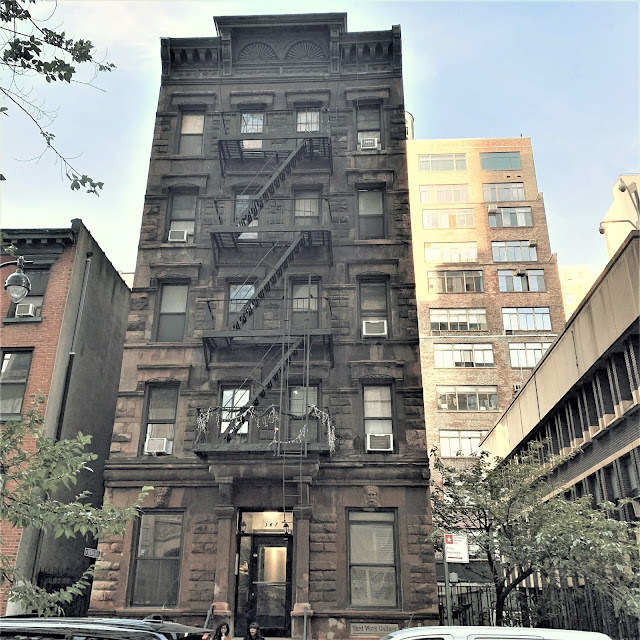
Ralph S. Townsend's 1890 367 West 35th Street


The brooding,  Halloween-ready appearance reflects the building's often dark history.   photo by Ted Leather

Life in the crime ridden Hell's Kitchen district was filled with dangers even for children.  On July 6, 1860 The New York Times reported, "Some wadding from a pistol which was fired by a lad whose name has not been ascertained lodged in the forehead of Albert Nicker, residing at No. 367 West thirty-fifth-street.  The sufferer, who is quite a little boy, was taken home."  

For many adults, the bleak neighborhood offered no hope.  Twenty years after little Albert's accident, Thomas M. Drew lived in the same house.  The 74-year-old gashed his throat with a razor and then hanged himself on Sunday night, April 13, 1880.  He left a letter to his son and another to a minister, explaining that his "sufferings" and "mental anguish" had become unbearable.  He was buried at city expense.

In May 1889 developers James H. Havens and Robert C. Winters bought the old three-story building.  They hired architect Ralph Samuel Townsend to design an apartment building on the site.  His plans, filed within days, called for a five-story "stone front flat" to cost $18,000--about $522,000 today.

Townsend's design drew from several currently popular styles--Romanesque Revival, neo-Grec, and Queen Anne.  A stoop rose above the basement level to the first floor, where the  decorations, like the portrait keystones and  the medieval-carved capitals of the pilasters flanking the entrance, were Romanesque Revival.  The chunky, undressed stone of all five floors also drew from the Romanesque.  

But, despite their foliate brackets and delicate carvings, the lintels of the upper floor windows were heavily influenced by neo-Grec.  The pressed metal Queen Anne style cornice, with its central parapet decorated with two large fans, might have been as comfortable on a commercial building.

Two stoic portraits grace the keystones of the first floor windows.

Among the first residents was Dr. J. H. Dewey, an author of Christian books and pamphlets.  Oddly, his works were not available in bookstores, but only by mail order sent directly from his apartment.

Perhaps expectedly, most residents appeared in newspapers for the wrong reasons.  Joseph C. Braman, the son of a well-known attorney, was also working as a lawyer in 1893.  But he was arrested on November 9 "on suspicion of burglary and forgery," according to The Press.  He was released when the complainants "refused to identify Braman as the man who uttered the checks."

Living here in 1895 was painter and paperhanger Charles H. Zimmerly.  The 27-year-old was apparently trying hard to improve himself.  He had earlier joined the Twelfth Regiment 
of the National Guard and was wounded during the Brooklyn trolley strike that winter.

Things looked up for Zimmerly when he met and fell in love.  He and the "certain young lady upon whom he had centred his affections," as worded by the New York Herald, planned a June wedding.  But then, in May he received orders to attend training camp Peekskill.  The newspaper said, "The struggle to follow the path of duty was severe, but the god of love triumphed over the fear of military injunctions.  Zimmerly was happily married and ignored the notice."

That was a mistake.  On October 28 a city marshal banged on the Zimmerlys' door and demanded payment of a $48 fine "for evading camp duty."  It was a crippling amount for the struggling newlyweds, slightly more than $1,500 today.  While his bride stalled the marshal, Zimmerly escaped out the rear window.  He managed to elude capture for two months, but on  January 8, 1896 the New York Herald reported that "the culprit was arrested in Ninth avenue.  He was placed in Ludlow Street Jail, and there his tearful young wife visited him."

The World captioned this sketch, "Recalcitrant Militiaman Zimmerly.  January 8, 1896 (copyright expired)

Eleven days after being incarcerated Zimmerly complained to a reporter that he could not pay his fine as long as he was locked up.  "Here I can do nothing.  If I was allowed liberty I could soon pay the money," he said.  In the meantime, Mrs. Zimmerly had money problems, too.  The Press reported, "His wife has been informed by their landlord that she will be dispossessed from her home if the rent is not paid by next Saturday."

Hell's Kitchen was home to treacherous gangs and William Engel, who lived in 367 West 35th Street, was a member.  Almost directly next door was the "Thirty-fifth Street Barracks," today known as the Midtown South Precinct station.  For whatever reason John Battigilso, alias "Bottles," was there on January 26, 1897.  When Lieutenant Cosgrove removed Battigilso from the premises, he was attacked "by a gang of roughs on the sidewalk in front of the barracks," according to The New York Press.

Captain Albert H. Endicott came to Cosgrove's assistance.  He was brutally assaulted.  The New York Press said he "was knocked down and kicked in the head and in the abdomen."  His injuries were so severe that two days later the New York Herald reported that he "was in such a critical condition yesterday in the New York Hospital that his friends were not permitted to see him.  Later last night his condition had not improved."

At midnight on January 27 detectives went to Engel's apartment and arrested him as one of the assailants.  It appears that he was slow in giving up information.  After he finally admitted that he was in the fight "and also gave the names of several others," The New York Press said, "Engel was taken to the hospital."

Frankie Bailey was a vaudeville entertainer living here in 1899.  According to The Morning Telegraph, her "curves have for a theatrical season past furnished the antidote for Weber and Fields' dialect and Peter Dailey's persiflage."  On June 6, the newspaper reported she had been "the victim of circumstances and a clever burglar."

The curvaceous Frankie Bailey graced a cabinet card around the time she lived here.

On June 3 Frankie and her across-the-hall neighbor, Bonnie McGinn, went to the races.  The Morning Telegraph said, "The girls had a good time and a subsequent good dinner, and returned to the humble little flat in West Thirty-fifth street at midnight with a bundle of honestly-won money sufficient to pay the rent and the gas bills for two months to come."

When Frankie turned her key, the lock was jammed.  "When she finally succeeded in getting the door open, she found the rooms she had left in perfect order in a chaotic state and the gas of every chandelier alight."  Fearful, she called Bonnie McGinn to search the apartment with her.  Burglars had been there, "and all the jewels, souvenirs of a hundred conquests, bric-a-brac and raiment that Miss Bailey prized most was missing."

Frankie had lost everything.  "They even took my silk tights, stage dresses and boots," she lamented to the police sergeant.  Ironically, nothing was truly valuable.  "I don't suppose the lot is worth more than $300," she said.

Too often domestic relations within Hell's Kitchen families involved violence.  Carl Schmidt worked as an electrician at the Pennsylvania Hotel in 1924.  He was 36 years old and his wife, Elsie, was 24.  The couple had a seven-year-old daughter, Clara.

Two weeks before Christmas, Schmidt came home to find that Elsie had left him, taking Clara with her.  Elsie found a job working in a delicatessen on Broadway on the Upper West Side, where Schmidt tracked her down.  On December 23 The New York Telegram and Evening Mail reported, "In the presence of more than a hundred stunned shoppers at 148th street and Broadway, Carl Smith [sic]...today stabbed to death his wife Elsie."  Elsie had almost made it to work.  She staggered into the deli and fell to the floor gasping, "He's knifed me."

Shocked witnesses chased Schmidt, overtaking him between Broadway and Riverside Drive.  He confessed to stabbing Elsie through the heart, explaining that a "quarrel arose when she refused to live with him."  On January 28, 1925 he was sentenced to from six to twenty years in Sing Sing prison.

photo by Ted Leather

By the third quarter of the century the Hell's Kitchen  block had tamed.  The building was significantly renovated in 1989, bringing modern amenities to the apartments that would have been unthinkable to tenants like Charles Zimmerly and his bride.  At the same time, any surviving interior 19th century charm was erased.  Ralph Townsend's forlorn façade, however, remains almost unchanged.

many thanks to reader Ted Leather for requesting this post
LaptrinhX.com has no authorization to reuse the content of this blog

Wednesday, October 30, 2019

The James Gordon Bennett Memorial - Herald Square


photo by Jim Henderson


The New York Herald was founded by James Gordon Bennett, Sr. in 1835.  Under his leadership it was the dominant newspaper in the city for most of the century.  Shortly after his death in 1866 James Gordon Bennet, Jr., who was raised in Paris, returned to New York to take the reins.

The junior Bennett brought with him the carefree lifestyle he had enjoyed in France, and his unorthodox behavior sometimes offended well-bred Victorian New Yorkers.  Such was the case in 1877 when he attended the New Year's Day party hosted by his fiancée's parents.  His engagement came to an abrupt end when he urinated in the fireplace.


James Gordon Bennett, Jr.  from the collection of the Library of Congress

In 1893 Bennett engaged the services of McKim, Mead & White to design a new printing plant and headquarters for The Herald far north of Printing House Square on the trapezoid-shaped plot of land facing West 35th Street, bounded by 6th Avenue and Broadway.   Completed in 1895 it was nothing short of a masterwork.

Sanford White based the design on the 1476 Palazzo del Consiglio in Verona, Italy.  But there was obvious influence from the publisher.  James Gordon Bennett, Jr. was obsessed with owls, which he made the symbol of The Herald.  Now 26 four-foot high bronze owls now perched along the cornice of the building.  Those at the corners, with spread wings, had illuminated green glass eyes which glowed eerily on and off with the striking of the two clocks embedded into the facade--one symbolic of Wisdom, the other of Industry.


The massive grouping dominated the roof line.  The two clock faces flank the central second story windows and bronze owls stand guard all along the cornice.  from the collection of the New York Public Library
The striking of that clock seemed to be accomplished by two massive figures in printers' aprons under the watchful eye of Minerva, goddess of wisdom, whose traditional attendant was an owl.  The massive bronze grouping was executed by French sculptor Antonin Jean Carlès, personally chosen by Bennett.  On the hour and the half-hour, the mechanized typesetters were set into action, swinging mallets against a large bronze bell atop which perched yet another owl.

At noon on March 21, 1895 the clock was first set into action.  The Editor & Publisher wrote that "thousands of persons cluttered up the neighborhood and gazed at the two figures."

The mechanical typesetters--given the names Guff and Stuff by New Yorkers--clanged out the hours for nearly three decades--during rain, snow and summer heat--as busy pedestrians scurried by below.   The colorful James Gordon Bennett, Jr. died in 1918 and three years later, on May 12, 1921 the New-York Tribune ran the headline: Old Herald Building Soon to Come Down.  It added "The heroic bronze smiths, known as Guff and Stuff, who had been striking out the hours night and day on the big bell on top of the southern façade of the building for the last twenty-eight years, and the goggling owls that had watched from their lofty perch on top of the building during those years were removed last month, for they were the property of the late Mr. Bennett." 

One calculation put the total number of mallet thumps by Guff and Stuff at 3,188,680.

Thankfully for posterity, Bennett's unnatural love for owls had prompted him to retain personal ownership of the bronzes as well as the sculptural clock grouping.  All of the statuary was carefully crated and stored.

Nearly two decades later a committee of businessmen in the Herald Square area was formed to erect a memorial to Bennett.  The men raised $10,000 (just under $180,000 today) and the well-known architect Aymar Embury II received the commission to design the structure.

As ground was broken on July 3, 1940 The New York Times reported "The proposed new forty-foot granite monument of modified Italian Renaissance design, with its double-faced clock and the two bronze owls, will serve as a background and base for the bronze group...The statue and bell will face south in front of a niche flanked by Corinthian pilasters, the upper part of which contains the clock and two of the owls of which the younger Bennett was so fond."


photo by the author
Although the monument included a lengthy inscription about Bennett and his contributions, The Times essentially ignored him when it reported on the unveiling on November 19 that year.  The newspaper referred to it as "Minerva and the Bell-ringers."  The article ended saying "The ceremonies will end at 6 P. M. with the striking of the clock, the ringing of the bells by 'Stuff' and 'Guff,' and the eyes of the owls blinking again for the first time in twenty years."


The spread-winged owls with their blinking green eyes were salvaged from the Herald Building's corners.  Both clock faces from the Herald facade survived, now back-to-back atop the monument.  photo by the author
The clock and its figures got a make-over in 1989 when Stuff began moving forward and actually making contact with the bell with his mallet, causing damage.  The clock, the granite and the figures were cleaned and conserved and, $200,000 later, emerged looking as they did in 1940.  Others of the reclaimed bronze owls perch on posts around the triangular park.


photo by the author

Monday, December 19, 2016

The Lost Great New York Aquarium - 1331 Broadway

A postcard depicted a crowd waiting to gain entrance to the exhibition.

Largely forgotten now, William Cameron Coup was among the foremost of American showmen--those brash impresarios who spoke in superlatives and offered audiences the biggest, the rarest and the most thrilling.  Born in 1837, he partnered with Dan Castello in 1869 and formed a "boat circus" which traveled the Great Lakes.  In 1870 they persuaded P. T. Barnum to merge his exhibition with their circus, resulting in "P. T. Barnum's Museum, Menagerie, Caravan and Hippodrome."

In 1876, Coup took on a new partner, Charles Reiche, for an ambitious and seemingly impossible project.  The latest European fad was public aquariums--essentially large museums of living fish.  The men acquired the northwest corner of Broadway and 35th Street where the Colosseum Theatre had recently been demolished.

Coup's two-story structure was faced in red brick and trimmed in limestone.  The unremarkable architecture of the exterior belied the engineering challenges inside.  The first floor contained the expansive exhibition hall and tanks, while below street level were the engine rooms and reservoirs.  The "naturalists' apartments" were on the second floor.

Maintaining environments for sea and fresh water animals required an intricate system of pumps, drains, and reservoirs of salt and fresh water.  The larger fish--ranging from six- to ten-feet in length--were kept in a darkened section lit by skylights.  The arrangement not only gave patrons a more naturalistic view and supposedly kept the fish from seeing the people, it reduced the amount of algae.

Frank Leslie's Sunday Magazine depicted the below-the-scenes engines and reservoirs.  (copyright expired)

Coup included an innovative marketing scheme in his building plans for the new venture.  "A very fine restaurant will be connected with the Aquarium, but it will differ from all others in the peculiarity that the fare it will offer will be only fish, which will be kept alive in a large tank where they may be viewed and selected by the hungry customer, who may enjoy the additional zest of catching his fish before eating it," wrote The New York Times.

In Barnum-like fashion, the showman knew that in order to draw visitors to his aquarium he needed something big, something sensational.  Nothing was bigger than a whale.  But keeping a confined whale alive in 1876 was problematic.  The Chicago Tribune held little optimism, saying the chances that a "whale will live long or not is somewhat doubtful.  His perils are five in number."  The newspaper listed the temperature of the water, the confinement, the "atmosphere of the aquarium," the purity of the water (2,400 gallons of sea water were pumped from the East River every 24 hours to refresh the tank), and keeping the mammal fed.  The article noted that a bushel and a half of live eels would be fed to the whale daily.  "As the animal is too epicurean in his tastes to like dead fish, each particular eel in his diurnal bushel and a half must be alive and squirming."

The tanks were constructed using English plate glass.  The half-inch thick sheets were considered the strongest of their type and able to withstand the pressure of hundreds of gallons of water.  But even this strong glass would be challenged by the immense whale tank--25-feet in diameter and about 6-1/2 feet deep.  The New York Times reported that it held "when full from 60,000 to 65,000 gallons."

To maintain suspense and mystery, the two whales which arrived during the first week of July 1876 were delivered under cover of night.  For two weeks the tank was only half-filled with water, just enough to keep the mammals alive.  Then, on June 24, the process of filling began.

Just before noon, when the water was about six inches from the top and orders were given to shut off the flow, the glass exploded.  The New York Times reported, "One of the workmen, who was in the act of turning off a waste-cock at the base of the wall where the break occurred, was struck with the fragments and thrown violently forward, receiving serious injuries."  Two other workmen were sent to the hospital and others were slightly hurt.  Both whales died.

A month later, The New York Times, in reporting that the Great New York Aquarium was nearly completed, advised, "A specially organized whaling expedition is now cruising off the coast of Labrador in search of whales to replace those that died at the aquarium recently, and Mr. Coup has offered $5,000 for the capture, alive, of the famous mammoth seal Ben Butler, which for years past has frequented the bay of San Francisco and the watering-places on the Pacific Coast."

The frustrating problem of the glass tanks continued.  On August 29 The New York Times reported, "At 7 o'clock yesterday morning, four more tanks bursted [sic] at the New-York Aquarium...These accidents are causing a delay in the opening of the Aquarium, but as a new glass of greater thickness will be used hereafter, it is hoped that no more delays will be caused."

That same day, in another section of the newspaper, a one-line article mentioned, "Three more young seals from the Bay of Biscay arrived yesterday, and are imprisoned in their respective tanks at the New-York Aquarium."

William Coup's replacement headliner arrived just in time for the Great New York Aquarium's opening.  On October 10, the New York Evening Post noted, "The expected whale has arrived at the Aquarium on Thirty-fifth street, after a week's journey from the St. Lawrence to Quebec by schooner, and thence to this city by rail.  He is white, frisky, and weighs 1,500 pounds."

The Great New York Aquarium opened the next day.  Frank Leslie's Sunday Magazine said it rivaled "in size and beauty any of its European contemporaries."  Coup's advertisement in The New York Herald called it, "the Finest Aquarium in the World!" and "A Place of Never-Ceasing Pleasure, Interest and Study."  The ad regaled: "The great living white whale devouring live eels, half a barrel per day! The thousand other divertissements! The Sharks! Sea Lion! Sturgeons! Seals! Sticklebacks! Sea Ravens! Winged Fishes of the Ocean!"  It reminded patrons, "while the visitors are examining the contents of the great iron and glass tanks Dodworth's popular orchestra discourses the most entertaining music."

Readers who snipped out that advertisement and sent it with 50 cents to W. C. Coup, would receive "a beautifully executed chromo-lithograph, size 30x40 inches, of the interior beauty and attractions."  It was a brilliant marketing ploy by Coup which not only helped him track the effectiveness of his advertising; but provided nearly free publicity when the posters were tacked up in homes and businesses.


For 50 cents this poster "in eleven colors, by Greyson, one of the best living chromo artists" could be had. Next to the whale tank can be seen the seal enclosure.  from the collection of the Museum of the City of New York

Biologist Frank Butler worked for the Aquarium, explaining in Popular Science magazine in July 1899, "I supervised fish culture, and when not otherwise engaged made collections of fishes and invertebrates in Bermuda and in other parts."  Butler revealed how Coup managed to keep a whale alive in such confinement.  He didn't.

"We had many white whales at different times, for the management would keep whales penned up on the St. Lawrence River to replace those which died, and would never show more than two at a time, claiming that they were rare animals and only to be had at 'enormous' expense...It would never do to have the public know that they were common during the summer in the St. Lawrence, and when one was getting weak another would be sent down, and the public supposed that the same pair was on exhibition all the time."

Some visitors to the Aquarium felt they were being duped by the former circus proprietor.  Butler remembered overhearing a tourist couple's conversation.

"Oh, I'm so glad we came here, and can tell the folks that we've seen a real live whale!"

"Lucy, this city if full of all kinds of cheats, an' I don't believe that thing is alive more'n Methuselah is; it's some indy-rubber contraption with clock-work in it that makes it go round and puff in that way."

Sadly, the whales were not clock-work and their life expectancy once delivered to the Aquarium was about three months.


Well-dressed patrons, having paid their admission of 50 cents, strolled through the exhibits.  Frank Leslie's Sunday Magazine 1876 (copyright expired)

In addition to the whale tank, there were three floor pools devoted to seals and alligators, and about 150 various-sized tanks.  The Great New York Aquarium was an instant hit and was brought in about $200 per day--more than $4,500 in today's terms.  "But," according to The Green Book Magazine in July 1914, "before long the novelty wore off and receipts fell even lower than expenses."  Theater historian Thomas Allston Brown, in his 1903 A History of the New York Stage, said that receipts dropped "to five dollars on at least one occasion." 

Coup was a businessman, not a scientist, and he scrambled to draw audiences.  A small stage was set up and live entertainments were presented.  On September 8, 1877, The New York Times reported, "There will be given on the afternoon and evening of Sunday next at the Aquarium the first of a series of grand sacred concerts with an orchestra of 20 pieces.  These concerts will be continued every Sunday."

Dr. H. Dorner took over when Coup withdrew from the struggling enterprise.  The respected Great New York Aquarium suffered the humiliation of becoming a sideshow to a vaudeville theater.  On December 30, 1878, Oscar's performing horses appeared and juggler Charles Seeley made his American debut.  A pigeon show opened on February 4, 1879 and Little Red Riding Hood was staged for children on February 10.  Other attractions that year included Angie Schott, the "female magician," a tribe of Native Americans in April, and Professor Parker's trained dogs.

The Great New York Aquarium limped along for two years, before Dorner finally gave up.  Forest and Stream magazine reported on May 5, 1881, "On the 26th of April the New York Aquarium presented a sorrowful spectacle to those who had know it in its days of grandeur.  The great tanks were torn down, and piles of brick and mortar only remained to mark their location."  That day an auctioneer sold off the contents.

The panes of plate glass from the disassembled tanks, about 1,000 square feet in total, were sold, along with decorations and fixtures.  "Next he offered a lot of statuary of life and heroic size, including the Venus of Milo, the Dancing Fawn and the Laccoon, which were bought by Mr. George Busnell, of museum fame.  A small Octopus, which had once been in alcohol, a big pile of chairs, a stuffed Sloth and the table-tanks went to as many different bidders, the dime museums getting their share."

The magazine lamented the loss of a quality institution.  "Farewell 'The Great New York Aquarium.'...The greed of present gain permitted all kinds of shows to invade it, and the class which once supported it in good style left it."

Thomas Allston Brown wrote, "During the fall of 1882 the Aquarium was used as an Indian camp, and entertainments were given.  The building was soon torn down."  In fact, only part of the structure was demolished.  

The front, 35th Street section was remodeled by architect John Sexton and converted to the New Park Theatre, which opened on October 15, 1883.  Most of the equipment--chairs, scenery, stage machinery, for example--came from Booth's Theatre on 23rd Street, which had closed in 1881.

The New Park Theatre used only the front-most section of the Aquarium building.  from the collection of the New York Public Library.

In 1894, architects Rose & Stone remodeled the building again for actor and producer Charles E. Evans who renamed it the Herald Square Theatre.  Much of the interior details were brought in from the former Booth's Theatre on West 23rd Street.  
It opened with the premiere American production of George Bernard Shaw's Arms and the Man.  The theater was taken over by the Shubert Brothers in 1900, and by 1907, when actor Lew Fields operated it, the building had been electrified.


The facade glowed in electric lights in 1907.  The New York Times, April 9, 1907 (copyright expired)

After being rebuilt after a fire in 1911, the Herald Square Theatre opened as reportedly Manhattan's first silent motion picture house.  Then, in 1914, it was demolished for an office building that survives.


many thanks to Paul Anater for suggesting this post