Showing posts with label san juan hill. Show all posts

Monday, May 30, 2022

The Lost High School of Commerce -- 155 West 65th Street


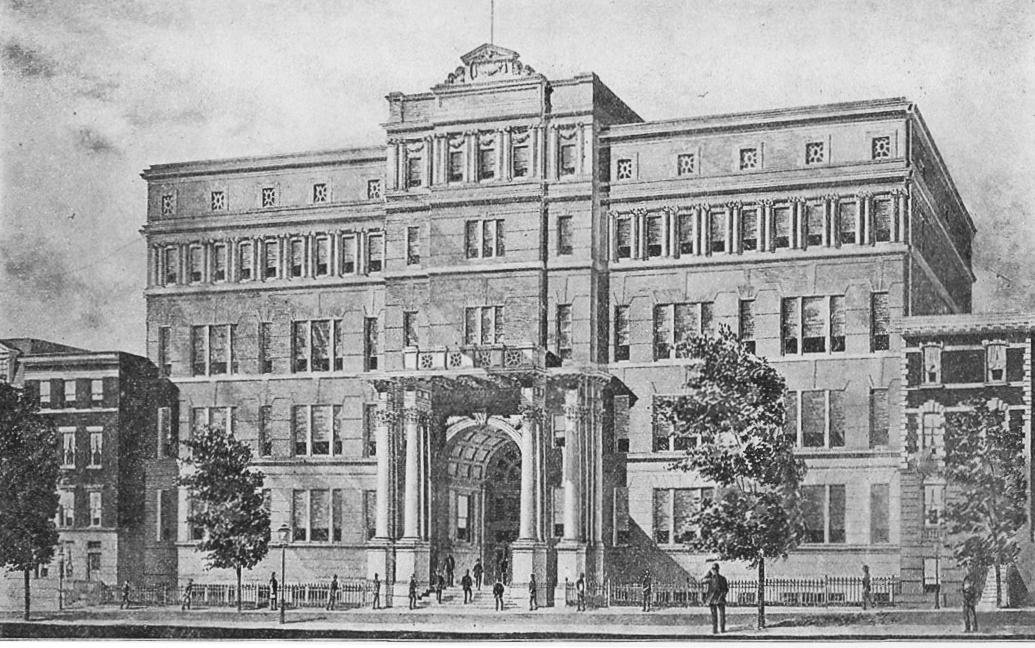
image from The School Review, September 1903 (copyright expired)

On July 1, 1890, 30-year-old Charles B. J. Snyder was appointed Superintendent of School Buildings of the Board of Education.   Among his responsibilities was the designing of the new buildings, and before his retirement in 1923 he would design more than 700 school structures within the five boroughs.  One of them, the High School of Commerce designed in 1900, was especially noteworthy--both for its architecture and its ground-breaking educational concept.
 
A few years earlier the Chamber of Commerce and Columbia University had conceived of a high school that would prepare boys for positions in commerce, a sort of trade school for businessmen.   At the cornerstone laying ceremony on December 14, 1901, Board of Education President Miles M. O’Brien said in part, “This school…is the pioneer high school of commerce in New-York, or in the country, and it owes its creation to the fact that the United States has become the leading commercial nation in the export of its products, even Britain now being second.”
 
The construction site stretched through the block from West 65th to West 66th Street, between Amsterdam Avenue and Broadway.  Snyder’s plans projected the construction costs at $302,640—more than $9.6 million today.  His striking brick-and-limestone clad structure would rise five stories above a basement level.  He lavished the generally Renaissance Revival design with grand neo-Classical elements—paired, engaged Corinthian columns at the fourth and fifth floors, pierced Roman-style openings on the fifth floor that matched the openwork railing of the third-floor balcony, and a temple-like parapet.  But most dazzling was the 65th Street entrance, designed like a grand triumphal arch recessed into the building.
 
The High School of Commerce was completed in 1902.  The five-year curriculum was “broad and liberal,” according to officials.  The courses required for freshmen, for example, were English; a choice of German, French or Spanish; Algebra; Biology (“with special reference to materials of commerce”); Greek and Roman History; Stenography; Drawing and Penmanship; Physical Training; and Music.  First year students were also required to have a least one hour of “exercises in voice-training and declamation” per week.


The first (top) and second floor plans.  The School Review, September 1903 (copyright expired)


A 16 year old student, Ralph Cooper, wrote a detailed description to induce other boys to enroll.  Published in the New-York Tribune on May 30, 1909, it read:
 
Dear Little Men and Little Women:  

I would like to tell you about the High School of Commerce, the school to which I go.  This school is situated at 65th street, between Broadway and Tenth avenue.  Only boys attend this school.

In the basement there is a swimming pool and a gymnasium.  The first floor contains several classrooms, an auditorium, seating 1,500 boys, and the principal’s office.  The other four stories are made up of classrooms and laboratories.

There are many boy organizations in “Commerce.”  Literary societies, chemistry and camera clubs and others.  Seventy teachers make up the faculty.

On Friday afternoons there are interesting assemblies, and often prominent men speak.  Sometimes plays and debates are given to interest the students.

Boys who wish to get a good business training should by all means go to the High School of Commerce.
 
Many graduates went on to impressive careers, like architect Lewis Ross.  He was employed by Ewing & Chappell in 1916 when he was awarded fourth price in The Sun’s Country Home Competition for “plans and a design of a dwelling that can be erected for a sum not to exceed $4,500.” 
 
Athletics played a major role in the lives of the students, and achievements in baseball, track, football, soccer, basketball, and other sports were widely followed in the newspapers.  One of its most active athletes in the post-World War I years was Henry Louis Gehrig, who was on the football, soccer, and baseball teams.  In 1920 the Commerce team traveled to Chicago for a national baseball championship game.  There former President William Howard Taft stopped by to wish the team well.  On June 26, in the ninth inning of the game in Wrigley Field, Gehrig hit a grand slam home run—only the 19th ever hit in the ballpark.
 
Students in the basement level swimming pool.  from the collection of the New York Public Library


Seven years later Lou Gehrig was a sports phenomenon.  On June 27, 1927, he was invited to award letters to the Commerce athletes and to referee the school track meet.  He had no idea what he was headed for.  The New York Times reported, “Lou Gehrig was rushed at Pelham Bay Park yesterday afternoon.  The star first baseman of the New York Yankees had this experience when 2,500 youngsters from the High School of Commerce rushed him at the annual field day of the school.”  The famous graduate somehow managed to perform his duties, as well to sign scores of autographs and baseballs.
 
A peculiar incident happened on January 17, 1929.  The New York Times began an article saying, “The lives of more than 1,000 pupils at the High School of Commerce…were endangered yesterday afternoon when three fires of incendiary origin started in different parts of the school within half an hour.”  At the time, midyear examinations were in progress.
 
The first blaze was discovered around 2:30 in the gymnasium on the fifth floor.  A physical education teacher, Samuel Prenn, walked into the room and found a container of wastepaper in the corner on fire.  He and an assistant custodian put it out with a fire extinguisher, then reported it to the principal.  Ten minutes later a janitor discovered a pile of trash on fire in a washroom on the first floor.  He, too, was able to put it out with a fire extinguisher.  Then, swimming instructor Hugh Jones noticed smoke coming through a transom of a ground floor classroom.  The New York Times said, “He broke open the door, found the room unoccupied, and the wastebasket under the teacher’s desk in the middle of the room in flames.”  While he was able to put it out, the desk was heavily burned and, had the fire not been discovered when it was, would have caused much damage.
 
The size of the school was double with an addition (left) in 1930.  from the collection of the New York Public Library

 
Lou Gehrig died of Amyotrophic Lateral Schlerosis, often referred to as Lou Gehrig’s disease, on June 2, 1941, just before his 38th birthday.  In tribute two years later in November 1943, the students of the High School of Commerce launched a fund-raising drive.  Within two months they had raised the equivalent of $30,000 today, with which to purchase an ambulance as a gift to the United States Army.
 
At a ceremony in the school auditorium on January 25, 1944, Lieutenant Marcella R. Meyer of the WACS, accepted the fully equipped army field ambulance called “The Spirit of Lou Gehrig.”  In her remarks, she said, “The gift of this ambulance is a manifestation of the spirit of a man who was loved by everybody.”  Gehrig’s widow then asked the assembled students to say a prayer “for the boys who will be transported in this ambulance.”
 
A substantial “annex” was erected in 1930 that essentially doubled the size of the facility.  Three decades later it looked as if the school would be enlarged again.  As much of the old San Juan Hill neighborhood was being demolished for the Lincoln Square redevelopment project, The New York Times reported on April 20, 1961 that only two tenement buildings still stood on the block with the school.  “The city wants to tear down the two remaining tenement buildings to extend the High School of Commerce,” said the article.
 
But the city changed its mind.  In 1964 demolition of the High School of Commerce was scheduled.  Ironically, a protest letter to the editor of The New York Times did not seek to preserve Charles B. J. Snyder’s magnificent Roman-inspired structure, but the more industrial 1930 addition.  “It is little more than thirty years old and with slight renovations would be in excellent shape,” said the writer.  “Why tear this wing down?”
 
photo by Ajay Suresh

In the end nothing was preserved.  Today The Julliard School occupies the block.

LaptrinhX.com has no authorization to reuse the content of this blog

Monday, September 7, 2015

The Lost 12th Regiment Armory -- Columbus Ave and 61st St.


Plans for James E. Ware's massive structure were published in Building on May 8, 1886 (copyright expired)

In the half-century before the Civil War the small militia force of State of New York protected the city again the threat of invasion, rioting, and other disorder.   When not seeing such action, the men of what would become the National Guard enjoyed their armories as more-or-less social clubs.

On June 21, 1847 the 11th Regiment was formed—later to be renamed the 12th.   While the 7th Regiment had earned the nickname of The Silk Stocking Regiment because many of its members came from the city’s wealthiest families; the 11th Regiment could boast blue blood as well.   Its first lieutenant colonel was John Jacob Astor.  He would proudly use his rank for the rest of his life.

Less than 24 hours after news of the bombardment of Fort Sumter reached New York in April 1861, the regiment “offered its services to President Lincoln," as reported in the New-York Daily Tribune later.  Under the command of then-Colonel Daniel Butterfield, the unit would see repeated action at the front lines; earning national commendation.

Just the regiment anticipated marching back to New York, after more than a year of action, General John E. Wool sent urgent word that “additional troops were needed, especially at Harper’s Ferry,” according to the Tribune.  The 12th Regiment was at present at the momentous surrender on September 15, 1862.

But there would be not much time to rest in success.  The 12th Regiment was brought back to New York to re-establish order when the bloody Draft Riots erupted in July 1863.  Following the war, the regiment saw duty in the Orange Riots in July 1871.  As the labor movement took form, strikes were often violent and bloody.  The 12th would be called to squelch the Railroad Riots of 1877, the switchmen’s strike in Buffalo in 1892 and the Brooklyn motormen’s strike in 1895.  

The 12th Regiment armory had been located on Longacre Square (later renamed Times Square), where Manhattan’s carriage-making industry was centered.  But by the early 1880s the rapidly-developing Upper West Side required an armory.   A plot encompassing 22 city lots on Ninth Avenue (now Columbus Avenue) from 61st to 62nd Streets was purchased and in April 1885 ground was broken.

City armories at the time were as much about architectural drama as they were military function.  Architect James E. Ware designed the rising structure as a medieval fortress replete with towers, loopholes, and a high tower “in which will be portholes commanding all the streets and avenues in the vicinity,” promised The New York Times.

Five months after construction began, the cornerstone was laid on September 19, 1885.  The Times reported “Military men in resplendent uniforms, gray-haired civilians, content with the badges worn in younger days; Freemasons behind their aprons, and Mr. Rollin M. Squire in a new silk hat and a pair of faultless trousers,” met at the site to participate in the ceremony.  The first speaker was, deservedly, Daniel Butterfield, now a General.

Ware’s plans included a 175 by 200 foot drill room with a glass and iron ceiling 45 feet above the floor.  There was a Board of Officers’ Room (called by the Tribune “one of the finest in the building), a meeting room, offices for the Colonel, Adjutant and Quartermaster, a “band room,” and 10 company “apartments.”  The single wood used throughout the interior would be ash.

Invading enemies would be well advised to steer clear of the 12th Regiment Armory.  The Times reported “Along the edge of the roof of the drill room will run a parapet walk guarded by a stone wall nine feet high.  Seventy portholes are to be built in this wall…This will be the only armory in the United States that will be practicably defensible from the inside.  The building will be of granite and brick, the former to be used only on the first floor.”

photo by Geo. P. Hall & Son, from the collection of the New-York Historical Society.

The $750,000 structure was completed in April 1887.  Before the 12th Regiment moved in, a glittering reception was held on April 21.   Unfortunately, the National Guard was better at fighting battles than at planning social events.  Invitations went out to far more people than could be accommodated. 

The following day the New-York Tribune was irate at the outrageous turn of events.  “The people who were asked to the 12th Regiment’s reception last night came near being invited to a riot.  Thousands of invitations were sent out, it is said, but after about 3000 people were admitted to the armory, the rest were kept out at the point of the bayonet.”


The Board of Officers' Room (above) and the room of Company B.  New-York Tribune December 29, 1901 (copyright expired)
While Victorian ladies and gentlemen in evening dress puzzled over their predicament, “Twice a corporal’s guard indicated a desire to charge on the eager guests, and would have done it, too, probably, if the guests had not had nerve enough to hold the dangerous playthings steady and harmless in the agitated militiamen’s hands.”  With thinly-veiled annoyance, the newspaper offered “Next time the regiment would do well to ask fewer people or such as are accustomed to being stuck with bayonets.”

The Regiment took the advice to heart and the following evening the armory was the scene of what the Tribune called “mild revelry."   This time only about 200 or 300 guests were present.  “The company first gave an exhibition of drill; then there was a dance, which was followed by a supper.  The regimental band gave a concert and played for the dancers.”

A week later, on April 29, 1887, the 12th Regiment marched up Broadway from its old headquarters, and took official possession of the Columbus Avenue armory.   The New-York Tribune noted that the Board of Officers’ Room “contains a fine collection of portraits” and “a collection of heavy oaken chairs in which the names of the officers who occupy then are inscribed.”

When the 12th Regiment was not engaged in putting down strikes or military campaigns—it would see action in Cuba during the Spanish-American War—the armory was the scene of sporting games and social activities.

On February 20, 1896 crowds watched the joint athletic games of the New West Side Athletic Club and Company F of the 12th Regiment.  Among the contests were the two-mile bicycle race, the one-mile walk (no one could understand why W. F. McLaughlin who finished second was disqualified), and basketball.  The Tribune reported that “Master Le Roy See gave a clever exhibition of trick riding on a bicycle.  After the games dancing was indulged in.”

Recruits for the Spanish-American War are sworn in.  Officers have stabilized the table, on casters, with magazines. photograph by Byron Company, from the collection of the Museum of the City of New York http://collections.mcny.org/C.aspx?VP3=SearchResult&VBID=24UAYWO0UPGN
In February of 1902 Columbia University’s intercollegiate, interscholastic and open track events were held here.  The university’s newspaper announced that “five hundred entries have been received” on February 28.

By 1905 the 20-year old armory showed needed maintenance.  Immediately after the election of Mayor George B. McClellan that year he was invited to review the 12th Regiment.  The Mayor arrived during a pouring rainstorm.  On February 5 the New-York Tribune reported “when the time came for the review the Mayor was led to a spot on the floor where the rain came through and sprinkled him.  He looked around to see if other people were in range of the shower, and saw that they were not.”

The following morning he understood the indignity.  “There came before him for signature a resolution of the Armory Board calling for an appropriation of about $40,000 for repairing the roof of the 12th Regiment Armory.”

At the time of the Mayor’s soaking, another millionaire, Cornelius Vanderbilt, was a Lieutenant in the 12th Regiment.   When Major General Charles F. Roe reviewed the unit in December 1905 Vanderbilt served as officer of the guard.  That same month the Tribune reported “Indoor baseball has become quite a pastime among the companies, and a competition is at present going on for the regimental championship.”

On March 27, 1909 the armory was visited by Baron Rosen, the Czar’s Ambassador to the United States.   With him were Colonel Baron Bode, the Military Attache to the Washington embassy, and Baron Schlippenbach, the Russian Consul General in New York.  The regimental band played the Russian National Anthem as the group arrived with Colonel Dyer.  After an exhibition of shooting and drill, the baron lavished the regiment with praise. 


The Russian baron reviewed the troops in the massive drill hall -- photo by Geo. P. Hall & Son, from the collection of the New-York Historical Society.
Russia was involved in violent revolution and political tensions throughout Europe were intensifying.  In response to his praise, someone remarked “But you are a man of peace.  As such, don’t you think this warlike display is to be deplored?”

The baron replied in part “I do not believe that my hope of peace is lessened in any way by reviewing the Twelfth Regiment.  More confident I am than ever of the fact that no nation will attempt to make war upon any other nation as well prepared as this would lead me to believe the United States is.” 

With an eerie sense of foreshadowing, in presenting the regiment an award, he said “Soldiers, you have shot well to earn this handsome trophy, and, although I am a man of peace, I hope that you will shoot as well in time of war as you have done in times of peace.”

As the United States paid careful attention to the developments overseas, the men of the 12th Regiment prepared for any eventuality.  On April 16, 1910 the detachment left the armory at 6:15 p.m. in a drill march.  They marched to Philadelphia, following the Pennsylvania Railroad tracks.  With only brief rest periods, the regiment continued for two and a half days, marching in with full equipment and ending back at the armory at 8:55 on April 19.  In his report, Captain F. C. Harriman noted that the men “finished in better physical condition than when they started, and with the exception of a few blisters on the feet owing to the very hard roads that we had to come over they would have been able to start and do the march over again.”  As it turned out, the march was, indeed, repeated several times over the next few years. 

In the meantime, the armory continued to be used for various exhibitions and meetings.  In 1912 it hosted the Exhibition of Aristocratic Canines, and a year later the United Catholic Works staged an exhibition and sale that included Native American works like Navajo rugs and Sioux and Chippewa bead work.

Especially noteworthy was the 10-day New York Emancipation Exposition held that same year.  The event honored the 50th anniversary of the signing of the Emancipation Proclamation.  The first staging of W. E. B. Du Bois’ pageant play The Star of Ethiopia with a cast of over 1,000 actors took place during the event on October 22, 1913.’’

When the Exposition closed, The Crisis called it “perhaps the largest single celebration which colored people have had in the North.  The total attendance was over 30,000; the order was perfect; not a single arrest was made and there were no serious accidents.”

Peace ended on April 2, 1917.  Dancing, games and dog shows gave way to war.   In September the year before, Base Hospital No. 1 had been organized as a military surgical team.  Now its home was the 12th Regiment armory.    As the Base Hospital temporarily remained, training for deployment, the 12th Regiment headed off to war.

Thanksgiving was bleak for soldiers that year.  The 12th Regiment armory became a gigantic dining room as it opened its doors to servicemen.  The New York Times called it “the largest dinner to be served in New York” and said those receiving Thanksgiving dinner here would be the enlisted men from Camp Mills on Long Island, consisting of “soldiers from Western and Pacific States.”  Those in charge of the dinner suggested that “former Westerners now living in New York to come to the dinner and join in the welcome extended to the men from the States from which the division now at Mineola has drawn its men.”

On February 26, 1918 Base Hospital No. 1 too left for war.  Upon arriving at Vichy it set up a hospital in nine hotels.  The first patients arrived on April 9—252 wounded Frenchmen.  Two days later 358 American soldiers arrived.

Among the medical team was Princeton graduate Frank L. Farrell.  Just prior to being shipped off to France, he wrote the Princeton Alumni Weekly, “I’m in a uniform.  It’s the somber, ill fitting uniform of a humble private, but still it’s Uncle Sam’s uniform.  It’s like this:  The Allies decided in view of the Italian and Russian situations that things were pretty serious.  So they decided to play their strongest card and I was mobilized at once…The thing I like most is rising at 6 a. m.”  He downplayed the danger of his deployment adding “Put my initials on one of the kegs you are sending to Berlin for our class reunion.”

Frank Farrell and the rest of Base Hospital No. 1 would remain in Vichy until March 5, 1919.  During that time it performed 8,142 surgeries and treated 7,481 other cases.  When the 12th Regiment, Base Hospital No. 1, and the city’s other regiments returned to New York City, hundreds of thousands of cheering civilians cheered as they marched up Fifth Avenue.

With the end of war the use of the great drill hall returned to its on-and-off use as an exhibition space.  It was highly favored as the venue for motor vehicle shows.  In January 1921 the Motor Truck Association of America held its Highway Transportation Show here.  Motor Truck magazine said “Demonstration of the possibilities of highway haulage with power vehicles is the keynote” of the event.

The event was repeated the following year; and in 1922 the Exposition of the Automobile Body Builders Association was held here.  The car and truck makers would have to find a new space by 1937 when the massive drill hall had been converted to a bowling alley.

On May 19, 1947 a two-day celebration of the centennial of the 12th Infantry Regiment was held.  The festivities ended “with a review and pageant in the regimental armory,” reported The New York Times on May 21.   The 350 people attending the dinner and dance at the Henry Hudson Hotel the first night could scarcely have imagined that within a decade later the massive stone and brick armory would be no more.

Robert Moses conceived of the “Lincoln Square Renewal Project”—a 16.3-acre urban renewal project that would stretch between Columbus and Amsterdam Avenues, from West 60th to 66th Streets.

On May 9, 1957 400 people attended a rally to protest the redevelopment project.  While the envisioned Lincoln Center would replace urban blight; it would also put more than 40,000 residents on the street.  The protesters, of course, failed and blocks of structures were razed—including the venerable 12th Regiment Armory.  Rather interestingly, little if any protest was raised about the demolition of the unofficial landmark.  

The site of the armory is now a parking lot and entrance to the garage beneath the Fordham University School of Law.
Tuesday, July 7, 2015

The Church of the Good Shepherd -- No. 152 West 66th Street


In 1887 development of the Upper West Side was picking up speed after the Panic of 1873 had brought construction nearly to a standstill.  Now, lured by improved transportation, new sewer lines, and street paving, developers rapidly filled blocks with rows of upscale and middle-class homes.

But not all of the Upper West Side was so comfortable.  The neighborhood that somehow acquired the nickname San Juan Hill stretched roughly from 59th Street to 65th, and from Amsterdam Avenue to 11th Avenue. While New York’s other grittiest neighborhoods--Hell’s Kitchen immediately to the south, Mulberry Bend and Five Points—were made up of a mix of ethnicities, San Juan Hill’s residents were almost exclusively black.    It was a district of gang violence, bloodshed, poverty and hopelessness.

With development came the need for stores, schools and churches.   The West Presbyterian Church on 42nd Street took a page from its Episcopalian and Roman Catholic counterparts and laid plans for a mission church. 

On January 6, 1884 a meeting was held in the church, led by its well-known pastor the Rev. Dr. John R. Paxton.  Frank Leslie’s Sunday Magazine described it as “a meeting in the interest of church extension in this city.”  The magazine noted that “The need of new churches on the east and west sides…was spoken of in detail.”

For the West Side the church chose the plot of land at No. 152 West 66th Street; on the eastern fringe of San Juan Hill.  And for its architect it selected J. C. Cady & Company.  Josiah Cleaveland Cady, who was known professionally as J. Cleaveland Cady, designed a wide variety of structures—from hotels and libraries to churches and synagogues.  In 1887 he put pencil to paper for the design of what would become the Church of the Good Shepherd.

It would be another six years before the church became a reality.  On February 4, 1893 The Evening World reported “The new Church of the Good Shepherd, on Sixty-sixth street, west of the Boulevard, will be dedicated at 11 o’clock to-morrow morning.”  It added “The church is a branch of Dr. Paxton’s West Presbyterian Church on Forty-second street.”

Costing $90,000 (in the neighborhood of $2.5 million today), it was capable of seating 750 worshipers.  Cady had produced a charming Italian Romanesque structure of light-colored brick.  The New-York Tribune called it “characteristic of many old Italian churches.”  Indeed, it shared many elements of country churches of the Southern Sicilian Romanesque style.

Within its first years the mission church seems to have done what it was intended to do—serve the underprivileged residents of San Juan Hill.  But that success came with a cost.  On May 16, 1900 the annual meeting of the congregation of the West Presbyterian Church was held.  Reports were read concerning the activities of the church’s various organizations.

The New-York Tribune reported on the following morning that “Mrs. Hannah’s report of the work in the Church of the Good Shepherd, a mission of the West Presbyterian Church was very gratifying.”  But, it admitted, in a not-so-Christian response to African American worshipers, many congregants had left.  “In reading a report of the pastor of the Church of the Good Shepherd, Dr. Evans said that the flood of colored population in the neighborhood of the church caused a falling off, and that 129 names had been stricken from the rolls.  Still, the church was prosperous.”

In 1926 pastor Rev. Dr. F. R. Clee was called upon to lead an unusual funeral service.  William Henry Johnson had died of pneumonia at the age of 84 in Bellevue Hospital.  His funeral was held at the Campbell’s Funeral Church nearby at 66th Street and Broadway, on April 28.

Better known as “Zip—What Is It?,” he was called by The New York Times “the famous freak, one of the first to be exhibited by P. T. Barnum back in the ‘60s.”  The newspaper’s account of the funeral was less reverential than sarcastic.

“Circus sideshow folk, giants, fat girls, sword swallowers, tattooed men and rubber-neck men filled the chapel, and their faces showed their sorrow.”  The article listed performers who had come from as far away as Chicago. “Then there was Alfonso, the human ostrich, who ate glass and other things for thirty-five years alongside of Zip at the sideshows of the circus and at Coney Island…Other circus freaks who attended were Lillian Maloney, the Albino girl; Carrie Holt, fat girl; Gus Birchman, the iron claw man; Frank Graef, tattooed man; Ajax, sword swallower; Joe Kramer, the rubber neck man, and Maharajah, the ‘This way, laydees and gentl-el-men’ lecturer of the Seaside circus sideshow of Coney Island, where Zip spent his Summers.”

Johnson’s funeral was, despite the description, conducted with dignity.  Organist and tenor Alexander Blander sang “Lead Kindly Light” and “Going Home,” from Anton Dvorak’s New World Symphony.

On November 13, 1932 the 45th anniversary of the Church of the Good Shepherd was celebrated.  In his sermon that morning, the Rev. William F. Wefer questioned whether things had really changed much in nearly half a century.

“A striking sameness may be noticed in the years 1887 and 1932.  About forty-five years ago we had sweeping Democratic victories just as we had this past week.  Charges of political corruption were hurled about then.

“The problems of that day were much the same as our own.  Fashions may change, but there is still the clamor over women’s dress.  Today we have gangsters, then we had gangs.  Today we have speakeasies, then we had ‘blind pigs.’  The ‘by-cycle-scorchers’ have given way to the reckless automobile drivers.”

Certainly one thing that had not changed was San Juan Hill.  The 1940 census indicated that the neighborhood was still exclusively black.  Residents still struggled and families were confronted with the problems of violence, gangs and crime.

Twelve-year old Martha Punt was one of the local girls who tried to better herself.  She regularly attended Sunday School at the Church of the Good Shepherd.  Martha lived with her mother, Elizabeth James, who was separated from her second husband.  The girl tried her best to survive in the squalid neighborhood.  In December 1943 a 63-year old street cleaner was accused of “trying to impair the child’s morals,” according to The New York Times.  The charge was dismissed on December 19.

Martha Punt would never make it to her teen years.

A month later, on the morning of January 20, 1943, her brutally battered body was found in the “poorly furnished” fourth floor apartment of two kitchen workers, at No. 513 West 59th Street.  She had been beaten about the head with a claw hammer and her throat cut.

The tragedy brought together at least some of the locals.   Three days later The New York Times reported “Martha Punt will not be buried in potter’s field, for the people of San Juan Hill yesterday were able to raise $138 to give the slain 12-year old schoolgirl a fitting funeral service and burial.

“Even strangers strolled into Abe Sable’s bar and grill at 2 Amsterdam Avenue to deposit dollar bills and coins in a beer container to help the family of the girl, who was brutally beaten to death in an apartment at 513 West Fifty-ninth Street Wednesday morning.”

The pastor of Good Shepherd, the Rev. Charles E. Souter, officiated at Martha’s funeral.

By now the name of the church had become Good Shepherd-Faith Presbyterian Church.  When Faith Chapel, another of West Presbyterian Church’s missions, gave up its building at No. 423 West 46th Street, the two congregations merged.

Around 1953 the Comic Opera Guild began giving presentations at Good Shepherd.  It was the beginning of a tradition of musical concerts and plays here.   But both concerts and religious services nearly came to an end when Robert Moses laid plans for his ambitious Lincoln Center project. 

Moses had been approached by Fordham University and the New York Philharmonic which were seeking venues in Mid-Manhattan.  His solution was to eradicate a slum and replace it with a fine arts complex.  He faced opposition by some groups—including the Lincoln Square Chamber of Commerce and the Good Shepherd-Faith Presbyterian Church.

On May 9, 1957 400 people attended at rally at the church to protest the redevelopment project.  While the envisioned Lincoln Center would replace urban blight; it would also put more than 40,000 residents on the street.

The local groups were defeated and the city began demolition of 16.3 acres of buildings—all except the Good Shepherd-Faith Presbyterian Church.  The stubborn little building managed to hold out as everything around it was bulldozed to rubble.

The church continues its role as a performance center—in the 1990s productions by the Seventh Sign Theater Company were staged here.  Ever changing with the neighborhood, it became home as well to the Korean Central Church and the Catholic Apostolic Parroquia del Espirit Santo y de Nuestra Senora de la Caridad.   The three Sunday services are performed--one each in English, Korean and Spanish.

The church is dwarfed by the 1980s structures that surround it.
The last vestige of San Juan Hill in the immediate Lincoln Center area, J. Cleaveland Cady’s remarkable Italian Romanesque mission church is a miraculous and stunning survivor.

photographs taken by the author