Showing posts with label nassau street. Show all posts

Monday, July 20, 2026

The Lost Clinton Hall - Beekman and Nassau Streets


A public pump sits opposite Clinton Hall.  The fence surrounds the churchyard of the Old Brick Church.  from the collection of the New York Public Library

Established in 1820 and opened on February 1821 at 49 Fulton Street, the Mercantile Library Association afforded a reading room and library for young clerks just beginning their business careers.  In 1829, its members established the Clinton Hall Association (named for beloved New York City Mayor and Governor DeWitt Clinton, who died the previous year) to erect a formidable new building.  The site chosen was formerly occupied by the 1761 theater in which Hamlet was first staged in the United States.  At the southwest corner of Beekman and Nassau Streets, it faced the 1767 Old Brick Church.  Scribner's Monthly would remark decades later, "Beekman street was pretty well up town in those days."

The association hired 26-year-old architect Alexander Jackson Davis to design the multi-use structure.  (Davis partnered with Ithiel Town, a respected and well-established architect, that same year.  Although it would make sense that Clinton Hall was a collaboration of the pair, only Davis is listed as its designer.)  

On July 21, 1829, The Evening Post reported on the cornerstone laying ceremony.  It began at noon with "a procession composed of the Trustees and the Clergymen, who were to officiate,...the subscribers, the Mercantile Library Association, and the members of other public Institutions" from City Hall to the site.  The stone was laid "in the midst of a large assembly of citizens" by Isaac Carow, vice president of the Chamber of Commerce, and Alexander Jackson Davis.

Dedicated on November 2, 1830, Davis's Greek Revival design successfully disguised the fact that the structure was, in fact, two separate buildings.  The New York Annual Register of 1831 explained, "The cost of the building was about $50,000, independent of Clinton Hotel, the property of Philip Hone, Esq. which is under the same roof, fronting on Beekman-street, and cost about the same as the Hall."  (Not coincidentally, Philip Hone was the chairman of the Mercantile Library Association.)  The combined construction cost would translate to about $3.5 million in 2026.  

The New-York Annual Register, 1831 (copyright expired)

The granite base was girded by a low flight of stone stairs.  It contained stores--six in the Clinton Hall portion and two in the hotel--that provided income.  The upper three floors were faced in brick "stuccoed in imitation of stone," said the New-York Annual Register.  Calling it a "noble and substantial edifice," the register said Clinton Hall was "dedicated to Literature, Science, and the Arts."  Within the upper floors were the Mercantile Library's large lecture room, library,  and reading room.  (The lecture room could be rented by outside groups.)

Philip Hone, who served as mayor from 1826 to 1827, hired Joseph M. Bispham to run his hotel.  On October 20, 1830, The Evening Post reported, "This elegant and commodious establishment is not completed...We understand Mr. Bispham is especially qualified to discharge the duties of the Host, and that his gentlemanly manners will render Clinton Hotel a place of fashionable resort and temporary residence."  The article added, "Its connexion [sic] with Clinton Hall will always preserve it as a conspicuous point in the public eye."

The Clinton Hall Bookstore was among the first of the commercial tenants.  The New-York Annual Register, 1831 (copyright expired)

In addition to housing the Mercantile Library, Clinton Hall was designed to accommodate long-term tenants.  Perhaps the first was the National Academy of Design, which moved in in 1830.  Frank Leslie's Popular Monthly said that starting in 1831, the academy's annual exhibitions "were held in much more commodious and altogether more suitable rooms, on the third floor of the Mercantile Library, in Clinton Hall."  The article reported that the National Academy of Design paid an annual rent of $500 (or $18,000 today) "for these apartments."

On November 11, 1831, The Evening Post noted that the National Academy would be opening its "school of the Antique," saying, "The instructors will be the gentlemen of the council."

from the collection of the New York Public Library

To pay for the building's construction, the directors sold Clinton Hall Stock.  But, "the sickness which shortly after prevailed in the city," as worded by The Evening Post, abruptly halted the fund-raising.  The city was ravaged by a cholera epidemic that took the lives of between 3,500 and 3,515 New Yorkers.  Roughly one third of the city's residents fled northward.  On January 9, 1832, The Evening Post reported, "Eighteen thousand dollars yet remain to be subscribed for, ere the Board of Trustees can proceed with vigor to the attainment of the magnificent ends aimed by this institution."

But at the time of the article, things were returning to normal.  On the same page was a notice that, "A course of lectures is to be commenced to-morrow evening, at Clinton Hall...The subject is Political Economy."

New York University's 1916 Annual Catalogue would recall its early years: "The work began with instruction in the Undergraduate College with special courses in Mathematics and Physical Science in the fall of 1832, the classes being held in Clinton Hall."

Although slavery was abolished in New York City in 1827, the city's economic dependence on the South placed its abolitionists overwhelmingly in the minority.  That was vividly shown in a passage in The American Metropolis:

To Tammany belongs the honor of the first victory over abolitionists in New York City.  In 1833 abolitionists attempted to hold their first meeting at Clinton Hall (Nassau and Beekman Streets).  It was prevented by a riotous crowd, which promptly celebrated its victory by adjourning to Tammany Hall and passing resolutions denouncing abolition.

Publisher Daniel Appleton established a bookstore in the Clinton Hotel side of the building.  It sold his own publications as well as books imported from England.   

James Gordon Bennett, the publisher of the New York Herald, rented offices in Clinton Hall as early as 1836.  That year the fiery publisher began a campaign "in favor of the great mass of the tenantry of New York, against the grasping landlords," in his words.  He was served an eviction notice in February 1837.

Bennett's editorial in the New York Herald on February 8 said that he had paid his quarterly rent in advance and that his eviction was "in consequence" of his campaign for renters.

I have every reason to believe that the Clinton Hall Association, a species of Real Estate Monopoly, composed as it is of speculators and fanatics, have determined to violate the implied engagements of their Agent with me, and to turn me out, as a punishment for my manifold transgressions towards the cause of the rich and powerful.

Upscale hotels were constant targets of burglars and the Clinton Hotel was no exception.  On November 23, 1843, the National Anti-Slavery Standard titled an article "Something New" and reported that two thieves, Richard Martin and George Fisher, had been arrested "for stealing wearing apparel from Clinton hotel."  They had an innovative burglary tool, "an instrument for turning a key outside, which has been turned by a person inside, and left in the door."

from the collection of the New York Public Library

By the mid-1840s, the Clinton Hotel was operated by Simon and Warren Leland.  (The brothers would later conceive of hotel chains.)  The problem of hotel thievery became personal to him in 1847.  On December 8 The Evening Post reported that William Seiler, an employee in the hotel, had been arrested for "stealing a frock coat from Warren Leland."  The young man had been hired four months earlier and during that time, "coats, &c. have been taken to the amount of $100."

In July 1848, The Institution for the Savings of Merchants' Clerks, a bank for young businessmen, opened on the ground floor.  The institution had been incorporated just three months earlier.  It would become the Union Square Savings Bank in 1905.

The Clinton Hotel hosted wealthy Americans and distinguished foreigners.  On June 21, 1851, for instance, The Evening Post reported that the entourage of "Count Villaneva, Intendent General of the Island of Cuba," were occupying rooms here.  Included were "Count Villanova, the Count's private Secretaries--Colonel Pinillas, General Carrillo--Colonel Pasejo and family, Post Captain Amero, Colonel Delango, and their servants."

At the time, the end of the line for the hotel and the Mercantile Library's occupancy in Clinton Hall was nearing.  On June 9, 1854, the New York Herald reported, "The Mercantile Library for several years past has been much cramped for room in its quarters in Beekman street, and after the urgent solicitations of its members, the Clinton Hall Association decided to purchase a more favorable site for the institution."  The association purchased the Astor Place Opera House on Astor Place.  The Mercantile Library Association's annual report in January 1855 said that the move from Clinton Hall was effected on June 8, 1854.

Two years later, in February 1856, a days-long auction of the furnishings of the Clinton Hotel began.  Hundreds of lots, including "a very large assortment of China and Glass Ware," mahogany dining tables and "several very large size Oil Paintings, very valuable," were sold.  The New York Times reported, "The Clinton Hotel property has been purchased by the Park Bank Company for $115,000."  The article said the bank would "fit up the old house temporarily."

The renovated Astor Place Opera House was renamed Clinton Hall.  Confusingly, the Beekman Street building retained the name, as well.  The downtown building was converted to offices, many of which were occupied by publishing firms.  Ironically, one of the new tenants was office of the Anti-Slavery Association.  

Other tenants in the 1860s were W. H. Bidwell, publisher of Bidwell's American Theological Review and W. H. Bidwell's Eclectic Magazine of Foreign Literature; the newspaper Independent, and Rev. John Marsh's Journal of the American Temperance Union.  One non-publishing tenant was financier and president of the Atlantic Telegraph Company, Cyrus Field, here as early as 1863. 

In 1881, banker Eugene Kelly purchased and demolished Clinton Hall.  On its site, he commissioned Silliman & Farnsworth to design a ten-story office building, the Temple Court Building.

King's Handbook of New York City, 1892 (copyright expired)


Monday, November 15, 2021

The Lost Hanover National Bank - 5-11 Nassau Street


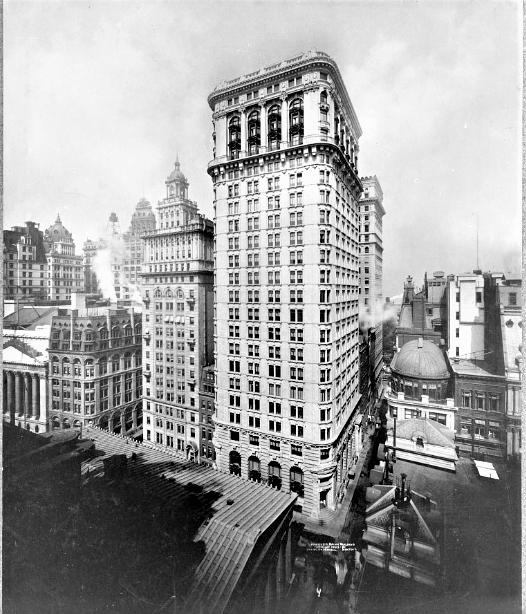
from the collection of the Library of Congress

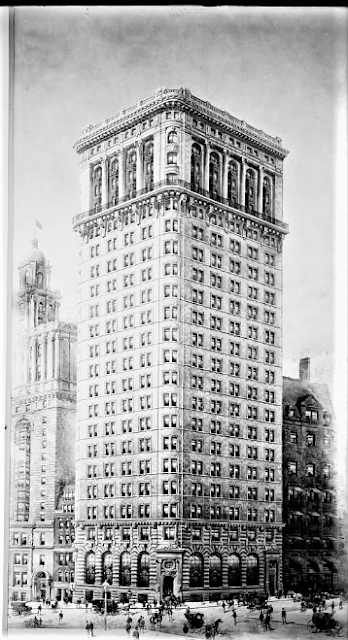
Established in 1851 as the Hanover Bank, the institution became the Hanover National Bank in 1865.  Its success continued until on July 13, 1901 the Real Estate Record & Guide reported that it intended to build a 22-story office building on the southwest corner of Nassau and Pine Streets "from plans by James B. Baker."  The Duncan Sherman & Co. building on the site, erected in 1857, would be a casualty of the coming construction.

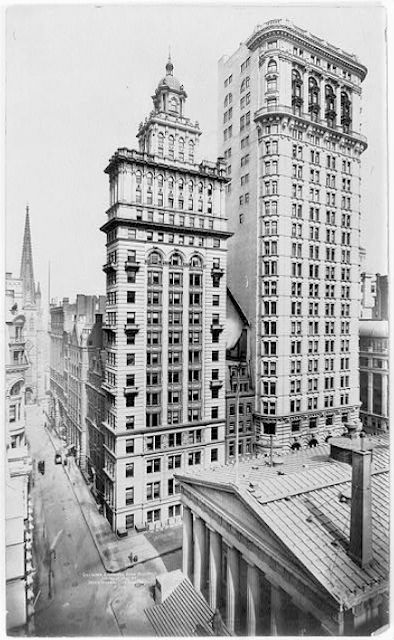
Completed in June 1903, the soaring structure had cost $1 million to erect--more than 30 times that much by today's terms.  Baker's neo-classical office building stood head and shoulders above its neighbors.  His tripartite design included a rusticated three-story base, a 15-story midsection, and a four-story upper segment embellished with engaged columns, pedimented metal window framing, and stone balconies.  A handsome stone balustrade crowned the elaborate terminal cornice.

James B. Baker's 1901 rendering included foot and carriage traffic on the busy intersection.  from the collection of the Library of Congress.

Three months before the building opened the Record & Guide noted, "The Hanover National Bank Building is not filling up as rapidly as some of the others, because the high rental, which is naturally demanded for space in a building so well situated."  The rental agents, however, told the reporter they were "fully satisfied with the demand for offices."

And indeed, the upper floors filled with tenants--mostly banking and brokerage firms.  Among the early occupants were the large stock exchange brokers Moffat & White, the American Finance & Securities Co., and Spitzer & Co., bankers.

To the left of the Hanover National Bank is the 1897 Gillender Building, and at lower right is the 1842 Federal Hall.  from the collection of the Library of Congress.

Two tenants unrelated to the finance industry were the New York and New Jersey Rapid Transit Company, which took space in May 1906; and the offices of the Lunacy Commissioners, which judged the sanity of certain individuals.  

The New York and New Jersey Rapid Transit Company was formed to operate commuter railroads between Manhattan and New Jersey.  Its general manager, Malcolm R. McAdoo, explained in a letter to The Paterson Morning Call on May 29, 1908, that the large railroads had told him that "the short-haul suburban business was so much less profitable" and that they "would gladly abandon it."

In the 19th century, having a wealthy or cumbersome relative declared insane was a convenient way to get one's hands on their money, or simply to put them out of the way.  The problem was such that in 1891 the Lunacy Law Reform League was established to prevent sane victims from being committed to asylums.

A peculiar case came before the Lunacy Commissioners here in November 1906.  Valeria F. Sands had been held for 15 years "as a lunatic in the Sanford Hill Asylum at Flushing, Long Island," according to The New York Times on November 17.  The newspaper said, "Miss Sands's delusion is that she has a right to the titles of Countess of Balmoral, Duchess of Kent, Duchess of Argyll, Duchess of Orleans, Countess de Rochefouchauld, Barone von Blanc, and Infanta of Spain."

Valeria's father had made a fortune in the East India trade and she had grown up in "one of the greatest mansions ever erected in Hong-kong," according to The New York Times.   Valeria's personal fortune was estimated at about $500,000--nearly $15 million today.

An only child, she had been committed by her cousins, Mattie Robinson and Margaret Clayton.  Now the two sisters wanted Valeria released for entirely different reasons.

Mattie Robinson declared that her sister wanted Valeria in her own custody to control her fortune, which was being administered by a court-appointed guardian.  The New York Times noted, "it has been increasing in value every year."  The accusations between the warring sisters erupted during the first session when they "fought with their fists."

After cooling off, the sisters reappeared on November 16.  Mattie Robinson told the commission, "She has been kept locked up all these years for no other than mercenary reasons."  Now, half of Valeria's fortune, which was held in Scotland, was in jeopardy.  Mattie testified that the $250,000 there would revert to the Crown in three years if Valeria did not appear to claim it.  "I am going to Scotland next Spring to look after some property of my own there, and Miss Sands wants to go with me and claim her property."

A third session was held on November 23.  Mattie Robinson declined to testify this time, telling a reporter, "I would have taken the stand but Mrs. Clayton was present, and I feared she would start a fight.  She would hit me with a chair at the slightest provocation."

The case dragged on until December 3 when neither sister got the result she had hoped for.  Valeria was deemed, "incapable of taking part in any other amusement than visits to the ladies' parlor" in the asylum, as reported in The New York Times.  Dr. Charles L. Dana, saying she was "unlikely to be cured," announced "she was better in the asylum."  Dr. Jared G. Baldwin, who had been the Sands' family physician, was given custody of her fortune, with no authority over "the spending of her money beyond approving the accounts submitted by the asylum."

from the collection of the New-York Historical Society

Broker George Wheeler Meacham was another early tenant.  He nearly lost his life in the summer of 1907 when he was carried unconscious from the burning Long Beach Hotel on July 29.  He recuperated in a private hospital near Central Park.  That paled, however, to the threat he encountered in his office two months later. 

Meacham was sitting at his desk on September 20 when James Macdonald stormed in, drew a revolver, and accused Meacham of being "attentive" to his wife.  The broker insisted he did not even know Macdonald's wife.  His earlier near-tragedy turned helpful when Macdonald mentioned dates that Meacham had supposedly carried on the indiscretion with his wife.

The New York Times reported, "To prove that Macdonald was wrong in his suspicions, Meacham brought forth his diary and asked him to compare it with the dates he said Mrs. Macdonald and Meacham had been together."  He had been hospitalized throughout the entire period.  Later Meacham testified, "He then forced me, at the point of his revolver, to sign a paper to the effect that I did not know his wife, and left, saying that if he ever returned it would be with the intention of blowing my brains out."

But the signed paper did not end the frightening affair.  On November 25, a Saturday, Macdonald showed up again.  Meacham explained to a judge a few days later, "Then I decided to put a stop to the business, as it was a little out of the usual routine in a New York office to have a man coming in with a loaded gun to interview one at unexpected moments."  He had Macdonald arrested at his home on December 3.  Macdonald professed that he had returned to Meacham's office merely to apologize for his first visit.  He was locked up.

Charles Edwin Ellis was the secretary, treasurer and director of the American Finance and Securities Company until the summer of 1912.  After going on a "prospecting trip" through the South, the Far West and Canada, he "became impressed with the insincerity of mankind," wrote The New York Times on August 19.  "He would have each man sincere with himself, and sincere with others."  

And so, to devote his entire time to the cause of sincerity, he resigned his position with the American Finance and Securities Company and two other concerns.  On August 18 he sent a 3,000-word platform for the Society of Sincerists to New York newspapers.  Although his plans for attacking the problem were, admittedly, still vague, Ellis could pinpoint the source of the country's problems.  "Then let us write across the sky in letters that the whole Nation may read, and spell out as the exact cause of this individual's culpability, the one word--insincerity!"  (Ellis's Society of Sincerists was not especially long lived.)

Banking and brokerage firms were often deceived by trusted employees.  Such was the case with Kean, Taylor & Co. in 1920.  Antonio di Gregario had been hired as a messenger boy five years earlier.  By now, the 19-year-old was the head messenger and, as such, was informed ahead of time when deliveries of bonds were expected.   

On November 30, 1920, messengers Irving Cohen and Austin Young were on their way to the office of Igoe Brothers with $466,666 worth of Liberty Bonds.  They were attacked by three men.  Young said later, "One of them pressed a gun to my side and demanded the bag."  When he did not release it, he was shot.  "I put up a fight and was struck over the head...I tried to hold to the bag, but they got it away from me."

Luckily, Young was not fatally injured.  Cohen told investigators, "It looks to me as though some one had tipped them off and they lay in wait for us."  It did not take police long to focus on Antonio di Gregario.  Pressured, he confessed and identified his brother, Joseph, who had a criminal record, and Antonio Vanilla, as the hold-up men.

Another tenant to fall victim to its own employee was the brokerage firm of Potter & Company.  Charles W. Reid was an auditor for the firm.  He got himself into serious trouble when he started an extramarital affair in 1923.  "Although I am married and have a daughter four years old, I fell in love with another woman," he explained to police two years later.

The other woman wanted more than to be a mistress.  She sued for $25,000 in damages for breach of promise.  Reid later said, "Fearing that my wife would hear of my misconduct, I did not contest the suit.  That was my mistake."

Things only worsened for Reid when friends of the woman threatened to tell his wife and his employer.  (Marital infidelity at the time was grounds for dismissal.)  In order to pay his blackmailers, Reid began to embezzle funds.  "I was trusted by my employers and it was easy for me to pad the payrolls and steal from $500 to $800 a month," he confessed.  He had skimmed $4,000 before being caught in 1927--nearly $60,000 in today's money.  He insisted "Every cent of this was spend on the young woman or given to the blackmailers."  As was so often the case with embezzlers, said The Times-Union, he "blamed his downfall on a woman."

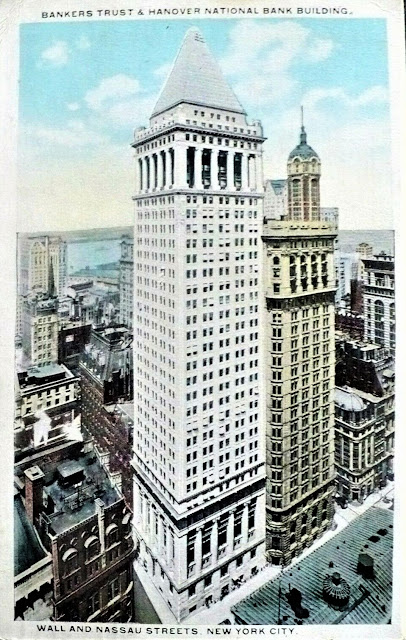
The Hanover National Bank building would fall victim to its taller next door neighbor, the Bankers Trust building.

By now the Hanover National Bank had been renamed the Central Hanover Bank.  On September 11, 1929 The New York Times reported that it had sold its Nassau Street building to the Bankers Trust Company.  "The purchase gives the Bankers Trust Company control of more than half the block," said the article.  Less than two years later, on June 19, 1931, the newspaper reported that the demolition of the 28-year-old Hanover National Bank building had begun "to make room for the new building of the Bankers Trust Company."

image via cbre.us.com

many thanks to reader Doug Wheeler for suggesting this post
LaptrinhX.com has no authorization to reuse the content of this blog

Monday, July 6, 2020

The Lost 1875 New-York Tribune Bldg - 150-154 Nassau Street


To the left of the soaring Tribune Building is the New York World building.  from the collection of the Library of Congress

In the 19th century the triangular plot of ground bound by Nassau Street, Spruce Street, and Park Row was known as Printing House Square because the city's newspaper publishers were closely packed into the neighborhood.  Certainly not the least of these was the New-York Tribune, founded in 1841 by Horace Greeley.  Upon Greely's death in November 1872 editor Whitelaw Reid purchased the newspaper.

Only seven months later, on June 13, 1873, architect Richard Morris Hunt filed plans for a replacement building for the Tribune.  Elisha Graves Otis had introduced the passenger elevator to the world in 1853, laying the groundwork for higher buildings.  Hunt's plans called for an 8-story structure to cost $400,000--about $8.82 million in today's dollars.  The 260-foot tall building would be the tallest in New York City, surpassed only by the spire of Trinity Church.


Richard Morris Hunt supplied this watercolor-tinted rendering.   The four-sided clock tower was described as a "Florentine campanile."  from the collection of the Library of Congress.
Almost from the beginning there were problems.  In March 1874 the New-York Sun newspaper sued in Supreme Court "to recover a large amount of damages for encroaching twenty-five inches on the property of the Sun in erecting their new building," as reported in The New York Times.  And a fatal accident occurred five months later when 30-year old construction worker John Murray plunged from the fifth floor on August 15, 1874.  

Completed in April 1875 the building was, in fact, ten stories rather than eight as originally planned.  Morris had created a vibrant neo-Grec style structure faced in bright red brick and trimmed in granite.   The New-York Tribune reported that the clock dials, "twelve feet in diameter," would be illuminated at night.


   from the collection of the Library of Congress

The main floor lobby was decorated in various colors of marble--black from Belgium, gray from Italy, and rouge griotte, or red marble, most likely from France.  The wood trims were of ash, cherry and apple, and bronze chandeliers dazzled the visitors.   Up-to-the-minute technologies included electricity for lighting (although gas lighting was prevalent), speaking tubes between floors, pneumatic tubes for sending messages, and "electric annuciators," early versions of the intercom.

Known popularly as "the Tall Tower," it drew criticism from near and the far.  An article in The British Architect called it "commonplace and unsatisfactory" and said it "was less pleasing in execution than in the illustration."  The Real Estate Record & Guide blamed the new challenge of designing a skyscraper for the building's "indecision and even formlessness."  Architectural critic Montgomery Schuyler said it was "a glaring collocation of red and white and black."  And The New York Times likened it to a "sugar refinery," and the type of architecture which children might appreciate.

In addition to the newspaper offices and plant the structure housed commercial tenants, including its architect,  Richard Morris Hunt.  

One tenant in particular, Koster & Bial, brought more unwanted press to the building with its "elegantly fitted up" basement saloon.  On August 20, 1875 The New York Times mocked the newspaper for leasing space to a saloon, quoting Horace Greeley's own words against intemperance (he called alcohol "poison").  The article said the Tribune had "added one more to the already large number of drinking saloons in this City...Perhaps not many drunkards will be allowed to loiter about the premises, but who can estimate the number who will therein develop the appetite which will inevitably end in inebrity and ruin?"

The other tenants of the New-York Tribune Building caused no unwanted ripples.  Among them was businessman and inventory Charles A. Cheever.   Undaunted by his disability (he was paralyzed from the waist down at an early age), he held more than 100 patents, ranging from electric rock drills to electric fire engines.  He became associated with Alexander Graham Bell and Thomas Edison and made dozens of improvements on their inventions.  He constructed the first telephone line in New York and formed the Telephone Company of New York.  The city's second phone line, installed in 1877, ran from Cheever's office in the Tribune Building to the the Law Telegraph Exchange at No. 140 Fulton Street 1877.  

The law firm of Brown, Hall & Vanderpoel was in the building at the time.  The New York Times described the office of partner A. Oakley Hall, former mayor of New York, on March 21, 1877.  "The offices of Mr. Hall comprise a suite of rooms handsomely furnished and decorated with pictures, statues, and other works of art many of which have some interesting incidents connected with their history."

The elevator had solved one of the problems of tall buildings, but fire remained a danger.  On April 1, 1888 a blaze broke out in the eighth floor offices of the Homer Lee Bank Note Company.  It quickly spread to the Tribune editorial rooms on the ninth floor.  The New York Times reported "Crowds...soon collected on The Times's corner, and strained their necks in their efforts to look at the tongues of flame that darted out from the windows so far above the street.  Ladders, of course, were of no avail to the firemen."

Firefighters climbed the nine flights of stairs with ropes which they lowered to the street.  Hoses were then hoisted up by that method while other firefighters dragged heavy hoses up the stairs.  Simultaneously, Tribune workers on the tenth floor had gotten the stand hose working which the firefighters took control of.

The fire was extinguished within 30 minutes; but the entire ninth floor was lost, including an old oil portrait of Horace Greeley.  Although the monetary loss to the New-York Tribune and its building was estimated at less than $2,000 (about $55,500 today), the loss of paperwork, the library, and original manuscripts "can hardly be estimated," according to the city night editor.


In 1900 the Tribune Building was by no means the tallest building in the neighborhood.  from the collection of the Library of Congress.

An annex to the Tribune Building was erected on Frankfort Street in 1881, but at the turn of the century yet more space was needed.  On August 22, 1903 The New York Times reported "The Tribune Association is to add a skyscraper to the Printing House Square neighborhood by increasing the height of its building from ten to nineteen stories."  The article said that the addition of 100 feet upwards would make the structure "visible within a radius of twenty-five miles from City Hall."  It would also be the only skyscraper without a steel skeleton.

Architects D'Oench, Yost & Thouvard had been hired to do the $350,000 in renovations ($10.5 million today).   They promised to "retain the architectural features of the present Tribune building, and its portico will suffer no change," although the steps would be removed to make the facade flush with the street.  The Times added "The tower, whose summit is 240 feet from the street, will be taken down with the clock and rebuilt so that its vane will be 340 feet above the sidewalk."

Plans were filed in November 1904, the Record & Guide noting that "the work calls for steel work, reinforcing the frame work." 

In an amazing feat of engineering and logistics, the clock tower was preserved.  On February 3, 1907 The New-York Tribune explained on February 3, 1907, "every stone [was] carefully taken and relaid on top of the twenty-story structure in exactly the same position.  The only difference between the Tribune tower to-day and that which stood for thirty years on the site is that the finial and weather vane of the present one are of copper and those of the former one were of iron."


The additional floors took the form of a massive mansard.  photo by Edwin Levick from the collection of the Museum of the City of New York
In 1915 the Tribune leased the corner, ground floor space to a drugstore.  The deal included the remodeling of the storefront and that presented a problem.  On June 13 The New York Times explained "An up-to-date American druggist cannot display the latest concoctions of ice cream and fruit flavors with a twenty-foot statue right where a show window ought to be."  John Quincy Adams Ward's imposing bronze statue of Horace Greeley reading an issue of the New-York Tribune had sat on the site since its unveiling on September 20, 1890.


from the collection of the New-York Historical Society
"So, Horace Greeley being in the way," said The Times, "decidedly persona non grata in front of the Tribune Building, may have to move on.  That is a tragedy."  The bronze monument was moved across the street into City Hall Park.

In the years following World War I the newspaper industry had moved northward and in 1921 the New-York Tribune followed the trend.  On December 24 The New York Times reported that after being located on the Nassau Street site for 80 years, the newspaper had purchase property on West 40th Street and sold its 20-story downtown building.  Saying that they had paid about $3 million (more than 40 times that amount today), the article added "The new owners have bought the property as an investment, and upon the removal of The Tribune, probably in May, 1923, they will renovate the structure and offer it in large suites to the ever-growing number of corporations seeking offices down town."


A postcard view showed the proximity of the Tribune Building to City Hall.   from the collection of the New York Public Library

In April 1922 demolition of the buildings on the 40th Street site got underway.  Six months later, on October 18, The New York Times reported that retired merchant Victor Weichman had leased the Tribune Building for 21 years for a total rental of $5 million (more than $76 million today).

The next three decades sat a number of legal firms as tenants, as well as banking and contracting companies.  Around 1935 the Catholic Board for Mission Work Among Colored People moved its offices into the building.

In 1944 the Tribune Building was sold to a syndicate which resold it the following year to Borrock, Steingart & Borrock.  It was again sold in July 1956 to a syndicate headed by Frederick W. Gehly, former vice president of the Chase National Bank.  The New York Times commented "The buyer plans to modernize and air-condition the structure."

That modernization was not enough to save what had become an unofficial landmark.  On May 20, 1966 The New York Times reported "The old Tribune Building at 150 Nassau Street, a relic of what was New York's 'Newspaper Row' at the turn of the century, is to be razed to make way for Pace College's $12-million campus center."  The article noted "The Tribune Building has been called New York's first 'skyscraper,' preceding the 21-story Flatiron Building."

Later The New York Times's columnist Christopher Gray would comment "The Tribune has vanished almost without a trace, and barely a whimper."


many thanks to reader Peter Alsen for suggesting this post

Monday, February 26, 2018

The Lost Tammany Hall - 170 Nassau Street


Valentine's Manual of the Corporation of New York for 1865 (copyright expired)

In the 17th century the land around what would become the intersection of Nassau and Frankfort Streets was part of the farm owned by Jacob Leisler.  His fate was sealed when he was temporarily put in control of city government at a time when tensions between the Dutch and English were high.  During an insurrection he and his son-in-law, Jacob Millbourne, were sentenced to death.  Their executions were gruesome--they were strangled to death on May 16, 1691 and buried in the Nassau-Frankfort Street site.  Later the bodies were reburied "with great celebration in the old Dutch Church yard," according to historian William S. Pelletreau in his 1900 book Early New York Houses.  

By 1810 there was a small house on the lot now -owned by Isaac Jones.  He sold it to the Society of Tammany or Columbian Order on May 4 that year for $10,050.  The society purchased the lot next door from Jacob Tyler on June 19, 1810 for $3,950--a total outlay of about $282,000 in today's dollars.

The Tammany Society was one of several social clubs by that name which arose in Philadelphia and other cities   The New York society elected its first officers in 1789, its members being mostly craftsmen and mechanics along with a few professionals like attorneys and merchants.  They dressed in Native American outfits, were known as braves, and were divided into tribes.  Originally non-partisan, by 1795 it was solely allied with the Democratic Party.  At the time it purchased the Nassau street property the group had been using the meeting room in Martling's Tavern on Chatham Street.

Martling's Tavern was known as Tammany's "first wig-wam." Early New York Houses 1900 (copyright expired)
The cornerstone of the new clubhouse was laid on May 13, 1811.   Half a century later the Society's history recalled "The members of the society wore the bucktail in their hats, as usual marched in Indian file, and appeared in aboriginal costume."   The building was completed within a year.  The Tammany historian noted "the hall was speedily finished and became the headquarters of the democracy about the time of the breaking out of war [of 1812]."

The society had erected a striking 57-foot wide clubhouse that mimicked the Georgian mansions of Broadway.  Feathery leaded fanlights above the ground floor doors, a tall Palladian window at the second floor fronted by a broad balcony, and splayed lintels gave the structure a dignified domestic appearance.  The stoop newels were surmounted by lanterns on high iron bases.

Once a social club, Tammany Hall soon became a center of political power.  It was the scene of impassioned meetings, and brilliant entertainments, such as the "grand banquet" held here in honor of Albert Gallatin, Henry Clay, and John Quincy Adams upon their return from Ghent in 1814.

In 1835 the out-of-style building was given a Greek Revival update and enlarged.  The peaked roof was replaced with a shallow attic, the arched openings were squared off and the upper floors were converted to the Tammany Hotel.  The New York Times noted that now its main feature was "the chief assembly or ball room opening upon the balcony  This would hold ten or twelve hundred people."

The elegant arched openings were lost in the modernization, and a full-width cast iron balcony was added. from the collection of the New York Public Library 
Meetings to nominate candidates, especially for high level offices like President and Vice President were conspicuous affairs.  On the day the group was to nominate Franklin Pierce for President and William R. King for Vice President, for instance, the building was hung with banners and was "brilliantly illuminated early in the evening," according to The New York Times on June 10, 1852.
The newspaper added "These attractions, together with the music of Shelton's Brass Band posted in the balcony and sundry loud calls in the shape of 100 guns, fired in front of the Park...drew together a considerable crowd; and soon after the doors were opened at 20 minutes past 8 o'clock the room in which the meeting was called was well filled."

The agenda of that meeting drifted briefly from the nominations to a subject that would dog Tammany Hall meetings for years--slavery.   The issue of the "immutability of the Fugitive Slave Law" was brought up "with hardly a mark of approval," said The Times.   Nevertheless at least one speaker voiced support of the slave-owners, saying "the man who aids the fugitive slave and helps him escape from his master is a thief and not to be trusted."

One month later Tammany Hall would be decorated in much more somber bunting.  Statesman and Senator Henry Clay died on June 29, 1852.  Buildings and houses along the funeral route were decorated with the trappings of mourning, along with busts and pictures of Clay.  The Times described "Here is Tammany Hall, clad in widow's weeds  Upon the balcony a large alcove has been constructed in which they have placed a bust of Henry Clay draped with crape [sic], the American flag on each side and the railing of the balcony is covered with the black and white, and on the arch of the alcove we read that 'A great man has fallen; our country mourns.'"

Later that year on December 3, an ugly incident took place in the "coal-hole" (the basement meeting room) which supplied Tammany Hall's detractors ammunition for months.  Several members had been drinking at the bar and their dissatisfaction with the vote taking place turned to violence.  The New York Post reported "Tammany Hall was again the theatre of one of those disgraceful scenes which have made the politics of this City a reproach to the cause of republicanism throughout the world."

The entrance at right led to the subterranean "coal-hole."  from the collection of the New York Public Library 
The protesters barged into the meeting room and "upset the tables, threw the chairs about indiscriminately, not appearing to know or care whom they hit or what damage they inflicted."  According to the article, the panicked committee members "rushed through every outlet from the room, even through the window sashes which they did not wait to open."

Several people were severely injured, the most seriously being August Schell, chairman of the Democratic General Committee, who was beaten on the head with a chair,  "The crazy wretch who wielded it was thrown back prostrate upon the floor when, fortunately for him the gas was put out and the fighting soon ceased."  For days newspapers reported that Schell would most likely die; although he did recover.

The six men arrested in what became known as the Tammany Hall Riot were found guilty for rioting.  The punishment was one year's imprisonment and a fine equal to $8,000 today.

While the sometimes boisterous political meetings went on in the lower floors, the Tammany Hotel was the scene of dinners and entertainments.  In March 1853, for instance The Republican Friends of Ireland announced it would celebrate St. Patrick's Day with a public dinner in the hotel.  "Several distinguished Patriots will be present as guests," it promised.

Newspapers were unapologetically partisan at the time.  When the Daily News reported on July 7 1855 that "A secret political society called the Columbian Order, celebrated the Fourth by a dollar dinner at the Tammany Hotel," it reminded readers of earlier disturbances by adding "We believe nothing unusual occurred."

The New York Times was vociferously biased in its reporting of Tammany affairs.  The newspaper did not bother to veil its contempt of the society when it reported on the nomination of James Buchanan as President in 1856.   Tammany traditionally celebrated with the burning of a tar barrel.  On June 7 The Times reported "Tammany and tar are (politically) as inseparable, as a pole-cat and its perfume.  Whenever anybody is nominated, out comes the vile-smelling, burning tar...The most probable explanation is...it is the only substance that could possibly make Democrats in office stick to the principles avowed before obtaining it."

Tammany Hall's anti-slavery platform was assailed by conservative newspapers like The New York Herald.  When Tammany threw its support behind abolitionist Mayor William Frederick Havemeyer in 1859 the newspaper unleashed a full-page attack.  It said that "the wealthy citizens of native birth who formerly belong to Tammany when it was the rendezvous of nationality in this city have also abandoned it...All classes are flying from Tammany; even rats desert a sinking ship."   It noted "The Journal of Commerce, one of the two anti-slavery organs of Havemeyer, congratulates its readers that the religious press is in favor of the candidate of the corrupt old harlot Tammany Hall, who sells her favors to the highest bidder."

In fact, Tammany Hall was experiencing problems with membership, having lost repeated political battles in recent years.  On April 14, 1859 The Times sounded gleeful when it reminded readers that following the French Revolution royal buildings were converted to public offices.  Now, it said "Tammany Hall is to be let or leased.  Nay, Tammany Hall is to be let or leased with all the fixtures!"

An advertisement in the Journal of Commerce read "The house, fixtures and furniture are up for a lease but the Democracy has a permanent foothold on the premises, and will probably stay there as long as the building lasts."

The celebrations of Tammany enemies were premature.  Instead of abandoning the building, the group merely leased out space.  The second floor became home to the Superior Court with  the city paying Tammany $500 per month rent.

The first trial in the space was held on June 7, 1860.  "It is the suit brought to recover for brandy sold, and alleged to have been of bad quality," reported The Times.  The newspaper commented "It was a matter of a good deal of humorous comment among practitioners at both the bars--the legal and the liquor selling--now in session in Tammany Hall that almost the first verdict recovered in that edifice should have been for brandy sold."

Following the attack on Fort Sumter which sparked the Civil War, Tammany Hall reconfirmed its loyalty to the Union and to its long-standing anti-slavery stance   On April 26 it issued resolutions which it later said presented "the whole subject of the war, its objects, duties, and claims, in a shape so patriotic and national, that they are accepted by all our citizens except those who are victims of unreasoning fanaticism, or a meaner treason, as a true utterance of the general voice."

Two years after the conflict ended, on the night of March 20, 1867, the members decided to "sell  Tammany Hall for what they could," get as worded by The Times.  "The old house has a famous history and at one time was the seat of the political power of the country."  The newspaper thought the sale was "a very proper move" given the value of the site for business purposes.

The building was sold within 24 hours for $150,000.  Included in the deal was the right to remove the cornerstone.  The New-York Tribune announced the sale venomously saying, "Tammany Hall has been sold out of sheer inanition and is, it is rumored, to be turned into a tavern or a second-hand clothes-shop."

The Sun was more objective; explaining that the buyers, Charles A. Dana, Frederick A. Conkling & Co. "are to establish a new newspaper in the building which they have just purchased."   The Express added "Tammany Hall was one of the oldest political landmarks of this city.  The leading men of the country delivered addresses from its rostrum on various occasions and it has been remarked that it made and unmade Presidents."

The Sun Building mimicked the proportions of its predecessor.  photograph by Wurts Bros, from the collection of the Museum of the City of New York
On the site rose the New York Sun Building, which survived until 1915.   The site is now part of Pace University and Pace Plaza.

Monday, December 8, 2014

The Lost Gillender Building -- No. 14 Wall Street

The Gillender Building sat on an improbably-small lot.  photo Library of Congress

On March 7, 1905 the New-York Daily Tribune reported that Augustus T. Gillender had, in the newspaper’s words,  gone “insane.”  The article contained a single line that infuriated one reader.  “He owned the Gillender Building, at Wall and Nassau sts.”

Three days later the following letter appeared in the newspaper:

To the Editor of The Tribune.

Sir:  In your issue of yesterday, under the heading of ‘A. T. Gillender Insane,’ you said that the Gillender Building, at Nassau and Wall sts., had been owned by Augustus T. Gillender.  This statement is not correct.  The land I inherited from my grandfather many years ago, and the building on it was constructed and owned by myself, and was named by me for my father, Eccles Gillender, and Mr. Augustus T. Gillender never has had, nor has he now, the slightest interest in the property.”

Helena L. Gillender Asinari

Admitting its mistake much later, the New-York Tribune would say “Mrs. Helena L. Gillender Asinari inherited the property from George Lovett, her grandfather, in 1849.”  Once again the newspaper had problems getting its facts straight.  

George Lovett, a wealthy lumber merchant and real estate investor, purchased the plot in 1849 for $55,000—an astonishing $1.73 million in today’s dollars.   Upon the settlement of his estate in 1873, the property passed to Helena. 

As the turn of the new century approached, steel-frame construction was making taller buildings possible.  Coupled with improved elevator engineering, New York real estate developers were getting the idea that, almost literally, the sky was the limit.

Along with the Manhattan fervor to construct ever-higher structures came the public’s concern that the streets would be left in a constant dusk.   New building regulations were tossed about to ensure that sunlight made its way to the pavement.  Unsure of what those restrictions would entail, Helen L. Gillender Asinari went into action in 1896, hoping to get ahead of the proposed laws.

At the time the narrow plot held the six-story Union Building.  Only 25-feet, 2 inches wide on Wall Street, it was the width of an upscale Fifth Avenue house.  The Nassau Street width was 73 feet, 5 inches.  In short it was a perfect sized plot for a six-story structure.

But having been bitten by the skyscraper bug, Helena hired architect Charles I. Berg to design a soaring office tower on the site.  Berg was challenged not only by the small plot; but by the spongy soil on which the building would sit.  In order to support a building of what Fireproof Magazine called “towering proportions,” caissons took the place of what normally would have been a sub-basement where storage rooms or income-producing vaults could be housed.

A turn-of-the-century postcard of Wall Street captured the Gillender Building with Trinity Church beyond.

The small rectangular footprint created a nightmare for Berg in laying out office space.   Common corridors, stairways and elevator shafts took up much of the usable interior space.  The several logistical and engineering drawbacks suggest that Helena L. Gillender Asinari most likely defiantly forged ahead against more sensible counsel.

Construction began in 1896 and was completed exactly ten months to the day afterward, prompting Fireproof Magazine to say “The Gillender office building has taken rank in the metropolis as one of the most rapidly completed structures as yet achieved anywhere in the United States.”

Journalists and architects disagreed about the number of floors.   The New York Times said it was 19 stories tall.   Technical World Magazine gave it credit for only 16 floors, ignoring the tower; while other publications counted the cupola as a floor, making a total of 20.  What everyone agreed upon was the height—306 feet from the curb to the tip of the tower’s pinnacle.  It was for a short time, according to The New York Times “the tallest office structure in the world” and “one of the wonders of the city.”

According to contractor Charles T. Wills, the cost of the completed granite-clad structure was $500,000.  It was a handsome structure when viewed squarely from the Nassau Street viewpoint.   When the skinny Wall Street side was taken into view, however, the Gillender Building took on the look of domino set on end, ready to topple at any moment.

Touted as “absolutely fireproof,” the steel framework of the skyscraper was encased in cement mortar.   No combustible materials were used inside, other than “unimportant details of trim,” according to Fireproof Magazine.  The magazine added, incidentally, “The interior decoration, finish and equipment are in perfect harmony with the general scheme of construction.”

Helena Gillender Asinari was fortunate in that a previous tenant in her Union Building, The Manhattan Trust Company, now took the three lower floors of the Gillender Building.   The small offices of the upper floors were taken by brokerage firms like Henry Allen & Co. and Patton & Cannon.

Being the tallest building in the neighborhood could have its disadvantages.  In July 1897, only months after the building opened, a storm blew in from the harbor.  The wooden flagpole atop the cupola was struck by lightning and was, according to The New York Times, “entirely wrecked.”

The flag pole atop the cupola was destroyed by lightning twice -- American Architect, June 15, 1901 (copyright expired)

Three years later on May 31, 1900, the replacement flag pole was struck again.  The New York Times reported “That lightning never strikes twice in the same place was proved a false theory yesterday afternoon, when a terrific stroke sent splinters flying in every direction from the flag pole on the Gillender Building at Nassau and Wall Streets.”

Wrapping the Gillender Building was the L-shaped Stevens Building.  In 1908 it was leased to the Bankers Trust Company which, like the Manufacturers Trust Company, was affiliated J. P. Morgan & Co. whose building was diagonally across Wall Street.   Then, on December 15, 1909, it was announced the Helena L. Gillender Asinari had sold the Gillender Building to her major tenant, the Manhattan Trust Company.     The bank met Helena’s purchase price of $1.5 million—almost $40 million by today’s standards.  “As the plot occupied by the structure comprises 1,825 square feet, about $825 a square floor was paid for the site,” said the New-York Tribune.  “That would be a new high record price for land on Manhattan Island.”

The newspaper figured the value of the property only in terms of the land, saying “the worth of the building on the plot did not figure largely in the sum which was obtained for the property.”

Much to the astonishment of many New Yorkers, The Sun reported that the Gillender Buildling—only 12 years old—was most likely doomed.  “Morgan interests are identified with both the Manhattan Trust Company and the Bankers Trust Company.  Negotiations are under way between the two companies which if successful will result in the demolition of both the old Stevens Building and the comparatively modern Gillender Building and the erection of a thirty-two story skyscraper on the combined plot.”

On New Year’s Day, just two weeks after the Manhattan Trust Company purchased the Gillender Building, the New-York Tribune reported that it had resold the property and “rented from the purchaser the ground floor and other space in the building for a term of eighty-four years.”

The 84-year lease would play out in an entirely new building.  The purchaser was Bankers Trust, which now controlled the large corner plot. 

In April 1910 “dismemberment” of the Gillender Building began, making way for Trowbridge & Livingston’s $3 million, 39-story Bankers Trust Company Building.  “This new building will be erected on the combined plot at the joint expense of the two trust companies and will be occupied jointly by them,” announced The Sun on May 1.

The New York Times wrote on April 10, 1910 “Here is a modern steel skyscraper in every respect, which was finished barely twelve years ago, and yet the purchasers of the property are going to sacrifice it as ruthlessly as though it were some ancient shack whose usefulness had long outlived the demands required from it by the immediate business vicinity.”

Adding to its boasts of having been the tallest building in the city, the most rapidly-constructed, and the highest price paid per square foot; the Gillender Building was now the first skyscraper ever to be demolished.  The term “dismembered,” used by a structural engineer, was aptly chosen.  

The structure was disassembled from the top down.  Jacob Volk, the contractor, explained to reporters that “A big shaft will be cut through the center of the building, and the material, as torn out, beginning at the top, will be dumped through it to the ground and the night force will cart it away.”  An enormous sidewalk bridge covered Nassau Street to “prevent possible accident from falling steel girders or blocks of granite,” said The New York Times on April 30.

The importance of dismantling a pioneer skyscraper was not lost on Professor Charles Baskerville, Director of the Department of Chemistry at the College of the City of New York.  He obtained permission from to examine and photograph the steel as it was exposed by the workers.  His purpose was to study corrosion, the condition of the beams and rivets and other structural elements.   The Gillender Building, in its early demise, provided important information to engineers and architects going forward.

In 1910 workers started at the top in demolishing the structure -- photo from the collection of the New York Public Library

Former Congressman Robert Baker of Brooklyn fired off a letter to Mayor Gaynor demanding that the demolition of the Gillender Building cease immediately.  “The demolition of the Gillender Building at Wall and Nassau Streets is rapidly producing a condition fraught with the direst possible consequences,” he wrote, “not alone to our citizens, but to the entire country.  This proceeding threatens to paralyze the financial activities of the Nation, as none of these millionaires can reach their offices without traversing air completely surcharged with pulverized stone, mortar, and brick, and thus filling their lungs, eyes, ears, nostrils, and clothes with this volcanic like material.”

An enormous sidewalk bridge covered the entire width of Nassau Street -- photo Library of Congress

Baker insisted that the Fire Department should direct a stream of water on the building during its removal in fear that the country’s economy would collapse.  “While ostensibly this appeal is made in the interest of a class, it is really induced by a desire to avert that stoppage of the wheels of industry of the Nation that would—we are assured—follow the temporary driving of our financial magnates from their field of operations, for the Nation has no right to demand that these men continue to run the affairs of the country under such conditions dangerous to their health.”

Despite the former congressman’s ardent plea, the mayor allowed the demolition to continue, J. P. Morgan and his peers continued to arrive at their offices, and the economy survived.

Trowbridge & Livingston's Bankers Trust Building still stands.  photo from the collection of the New York Public Library

The former Bankers Trust Company Building survives today—nearly ten times the lifespan of its predecessor, the unlikely Gillender Building.

many thanks to reader Peter Alsen for suggesting this post