Showing posts with label george fred pelham jr. Show all posts

Wednesday, April 3, 2024

George F. Pelham Jr.'s 1941 530 Park Avenue


image via composs.com

On January 18, 1940, The New York Times reported that George Fred Pelham Jr. had filed plans "for a nineteen-story apartment house at 530 Park Avenue, southwest corner of Sixty-first Street, to cost $1,100,000."  (That figure would translate to $22.9 million in 2024.)

Pelham's Art Moderne design included a two-story rusticated base.  As he had done a year earlier at 1150 Park Avenue, he sat the entrance within a full-height recessed bay.  But here, rather than chamfer the corners as he did in his previous design, he gently rounded them, giving 530 Park Avenue the streamlined look so crucial to the Art Moderne style.

Completed in 1941, the building filled with well-heeled residents.  Among the first to sign a lease was Josefita Arias, the Consul General of Panama.  On June 18, 1941, The New York Times mentioned she was " said to be the only woman to hold such rank in the United States."  Other initial residents were George A. Horton, vice president of Pagel, Horton & Co., Inc., dealers in crude rubber and wood pulp; and Charles P. Burr of the National Distillers Products Corporation.

photo by Wurts Bros. from the collection of the Museum of the City of New York

None of the early renters were more colorful than Dušan "Duško" Popov.  Born into a wealthy Serbian family, the well-educated attorney was practicing law in Dubrovnik when World War II broke out.  An ardent anti-Nazi, he joined Britain's MI6 (Military Intelligence, Section 6), then became a double-agent with the German Abwehr.  He handed over British-approved information to the Germans, while providing Britain with valuable intelligence.

(During a mission to Portugal in 1941, he met British Royal Naval Intelligence officer Ian Fleming.  It is generally agreed that Popov was the model for Fleming's later spy character James Bond.)

Dušan "Duško" Popov, from the National Archives and Record Administration.

Following the Portugal mission, Popov was sent by the Germans to New York, where he took an apartment at 530 Park Avenue.  FBI head J. Edgar Hoover was never comfortable with the double-spy and kept him under constant surveillance.  In his memoir Spy/Counterspy, Popov asserts that while living here, "If I bend over to smell a bowl of flowers, I scratch my nose on a microphone."

It may have been Hoover's distrust of Popov that resulted in disaster.  On August 12, 1941, Popov informed the FBI of plans to attack Pearl Harbor.  According to Rhodri Jeffreys-Jones in his 2007 FBI: A History, either Hoover did not report the intelligence, or his superiors took no action.

The Art Deco lobby could have been lifted from a 1940s movie set.  photo by Wurts Bros. from the collection of the Museum of the City of New York

Living here in the 1960s was Broadway producer Monty Shaff.  Among his productions were the 1955 The Boy Friend; Silk Stockings, which opened the same year; and the 1960 Cut of the Axe.  But in 1964, his name appeared in newspapers for less praiseworthy reasons.

On May 19, The New York Times reported that he had been indicted for accepting kickbacks.  "Mr. Shaff was accused of steering a $57,500 contract for scenery construction of the 1963 show, 'Tovarich,' to one stage builder for a $7,500 fee."  The 55-year-old pleaded guilty on October 19 and was given the choice of a $250 fine or 20 days in jail.  The New York Times reported, "Shaff paid the fine."

Attorney Harold H. Corbin and his wife, the former Helen Hazen Van Deuzen, lived here at the time.  The couple were married in 1913.  Corbin founded the firm of Corbin & Bennett in 1939, and was a founding fellow of the American College of Trial Lawyers.  

The New York Times said the defense lawyer "represented many figures of the underworld and public life."  And, indeed, his clients ranged from notorious bookmaker Frank Erickson to Joseph M. Schenck, chairman of the 20th Century-Fox Corporation.  In 1955, after socialite Ann Eden Crowell Woodward fatally shot her husband, millionaire William Woodward Jr.-- allegedly mistaking him for a prowler--Corbin was named special guardian for her children.

Helen Van Deuzen Corbin died in 1968.  Harold Corbin remained at 530 Park Avenue until his death two years later at the age of 80.

image via composs.com

Another colorful attorney was Joseph E. Brill, who lived here with his wife, the former Doris Foster-Wright Sutton.  Born in Warsaw, Poland in 1903, Brill's parents brought him to New York the following year.  Called by The New York Times, "one of the city's eminent criminal lawyers," he was known for his in-court wit and style.  The New York Times journalist Albin Krebs wrote on May 20, 1975,

An artful and tenacious lawyer, Mr. Brill was in great demand for a wide variety of cases.  In 1957 he won $3,000 for a woman who had broken a tooth on a luncheon roll in Peacock Alley at the Waldorf-Astoria Hotel.  He won an out-of-court divorce settlement of $2.5-million for the former Marjorie Steele, Huntington Hartford's second wife, in 1961, the same year he unsuccessfully defended Dr. Robert Soblen against charges of spying for the Soviet Union over a 20-year period.

In 1960 Mr. Brill so ably defended Norman Mailer, the writer, who was convicted of stabbing his wife, that the judge suspended Mr. Mailer's 3-year sentence.
 
Brill's convincing technique was such that after he described his racketeer client John "Johnny Dio" Dioguardi to the jury as being "pure as the driven snow," his prosecuting counterpart said, "He made an overcoat out of cobwebs."  

Among his clients was attorney Roy M. Cohn, later Donald J. Trump's lawyer, who was acquitted on charges of bribing a city appraiser and extorting stock in 1969.  Joseph E. Brill died  at the age of 71 on May 19, 1975.

Living here at the time were Morris J. Kasper and his wife, the former Eva Mayer.  Kasper was born in Poland and came to America at the age of 15, settling with his family on the Lower East Side.  He worked in the garment industry before founding his own firm, the Central Knitwear Company.

Kasper's passion was not women's sweaters and sportswear--it was chess.  Although considered "a good player," according to The New York Times, he did not participate in tournaments.  He, nevertheless, became a force in American chess.  A founder of the American Chess Foundation, he was a patron of the game for decades.  The New York Times said he "helped establish tournaments and other contests where aspiring youngsters could test their mettle.  Among those who came to him for help and confidence was Bobby Fischer."  The two, according to mutual friends, kept in constant touch with one another.

Judge Murray I. Gurfein and his wife, the former Eva Hadas also lived here in the 1970s.  Gurfein was described by The New York Times as "a tenacious Federal and state rackets fighter, a war crimes prosecutor at Nuremberg, a distinguished civil and criminal trial lawyer and...a Federal jurist on district and appeals court benches in Manhattan." 

In 1971, Gurfein was appointed to the United States District Court by President Richard M. Nixon.  The President may have rued his choice.  Only a few weeks later, Gurfein was called upon to made a decisive ruling.

In June that year, The New York Times had published three installments of a massive study about the American involvement in Vietnam called The Pentagon Papers.  The Nixon Administration sued to block further publication, saying it would endanger national security.  Judge Gurfein rejected its argument saying in part, 

A cantankerous press, an obstinate press, a ubiquitous press, must be suffered by those in authority in order to preserve the even greater values of freedom of expression and the right of the people to know.  These are troubled times.  There is no greater safety valve for discontent and cynicism about the affairs of government than freedom of expression in any form.

The most celebrated resident of 530 Park Avenue was Bianca Jagger, former actress, human rights advocate and divorced wife of Mick Jagger.  A high-profile battle broke out when she was evicted in 2007.  The landlord, Katz Park Avenue Corporation, contended that she was not legally entitled to her rent-stabilized apartment, saying, "she could not maintain a primary residence in the United States because she is a British citizen."

Jagger sued and won her case, but in October 2007 that  decision was overruled on appeal.  Undeterred, in August 2008, she sued again.  But, again she lost.  On October 23, The New York Times reported that the State Court of Appeals ruled that Jagger "who paid $4,614 a month for her 18th-floor apartment--was not, legally speaking, a New Yorker."

image via composs.com

In 2011, a renovation was undertaken by Handel Architects as the building prepared to convert its 119 apartments to condominiums.  George F. Pelham, Jr.'s overall design was preserved.  Aby Rosen, a spokesperson for RFR Holding said, "Prewar has its own charm, so you don't have to overdo it."

many thanks to reader Lowell Cochrane for suggesting this post
no permission to reuse the content of this blog has been granted to LaptrinhX.com

Friday, February 16, 2024

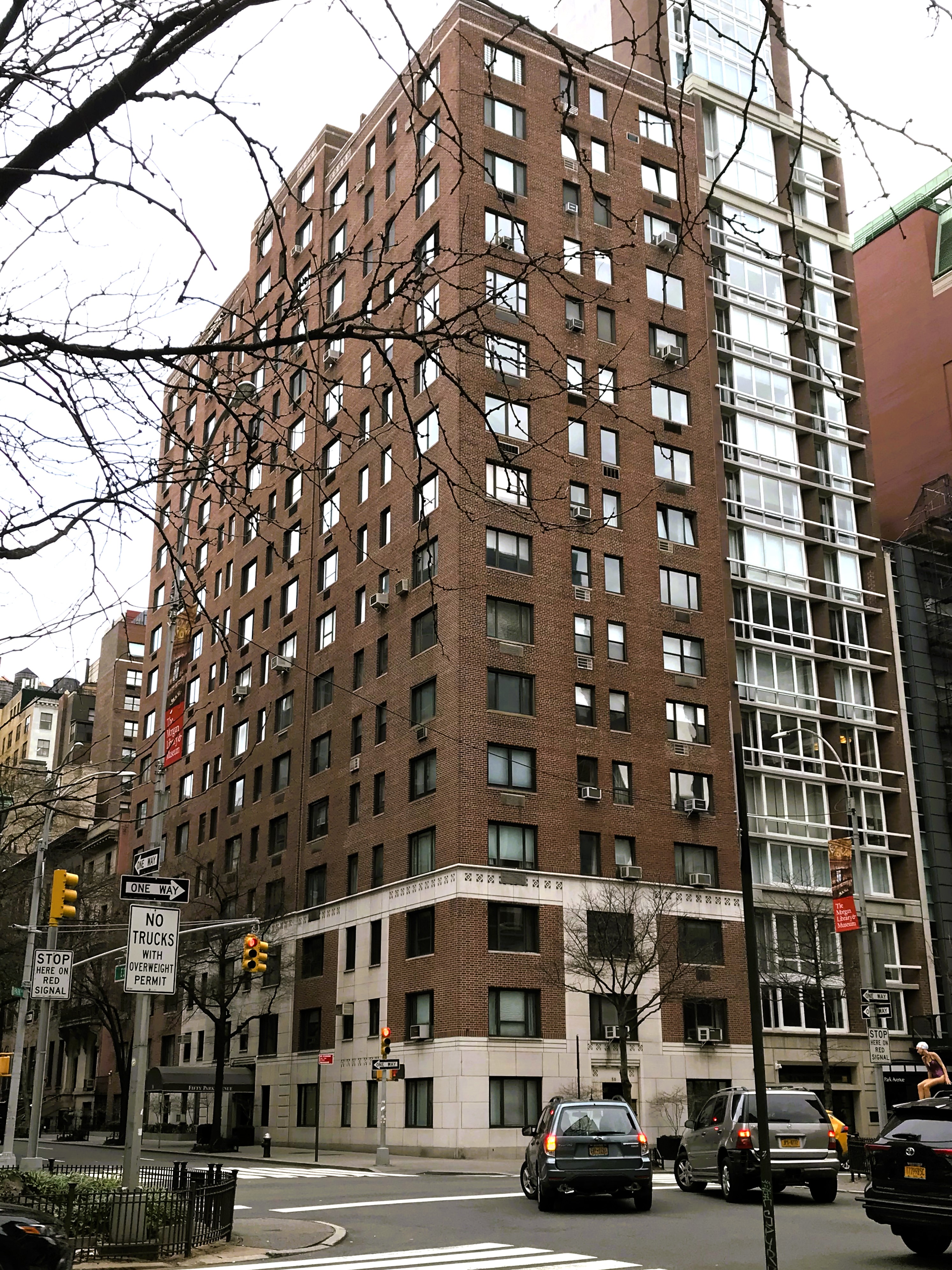
George Fred Pelham, Jr.'s 1940 50 Park Avenue


With the pall of the Great Depression slowly lifting, in 1939 developer Louis Cowan began construction of a 17-floor apartment building on the northwest corner of Park Avenue and 37th Street.  The thoroughfare south of Grand Central Terminal, which had been lined with elegant mansions only a generation earlier, was increasingly filling with multi-family buildings.

The persisting constraints of the Depression may have influenced Cowan's budget and, subsequently, architect George Fred Pelham Jr.'s materials and design.  Faced in red brick and trimmed in cast stone, Pelham's matter-of-fact plan relied on fluted pilasters beside the doorways, and scattered diamond designs along the base and third floor bandcourse.  Pelham used Chicago style windows to break up the monotony of the stoic facade.  

In April 1940, construction was nearing completion.  To the right, some of the Park Avenue mansions survived.  image from the collection of the New York Public Library


The building would have doctors' offices on the ground floor, eight apartments each on the second through sixteenth, and four apartments on the top floor.

On March 30, 1940, Marie DeLamater, wife of Brigadier General Walter A. DeLamater, died.  Less than three months later, on June 11, The New York Times reported, "A suite in the new apartment building under erection at 50 Park Avenue has been leased to Brig. Gen. Walter A. DeLamater, commander of the 87th Infantry Brigade of the New York State National Guard."  

DeLamater was one of several future residents to sign leases while the building was still under construction.  Others, said the article, were "W. W. Wister, W. R. Roberts, president [of] Guyon Mills, Inc.; Mrs. Alice Hunter Wells of the Deakman Wells Corporation; J. Edward MacDermott, president, Municipal Improvements Company; and Marie Michelle Gabrielle."  Another original tenant was drama critic Roland Field.

A fascinating figure, Walter A. DeLamater was well-known to New Yorkers.  Born on April 18, 1880, he descended from a settler of the Village of Rhinebeck, New York, founded in 1688.  Eighteen years before his birth, DeLamater's family, who owned the DeLamater Iron Works in Manhattan, constructed the iron-clad USS Monitor which would be engaged in the famous Monitor-Merrimac battle of the Civil War.

Walter DeLamater entered the army on March 2, 1900.  He served on the Mexican border in 1916, and fought in France during World War I.  Repeatedly decorated, at the end of the conflict, he held the rank of Brigadier General, and was soon promoted to Major General.  

Brig. General Walter A. DeLamater (original source unknown)

In 1934, Fiorello LaGuardia appointed DeLamater Civil Works Administrator.  He resigned seven months later to become director of the works division of the Public Welfare Department.  Simultaneously, he continued his military duties as commanding officer of the 71st Regiment of the New York National Guard.

Equally interesting were DeLamater's fraternal associations.  He was Master Mason and member of the Knights Templar.  He was elected Right Eminent Grand Commander of the State of New York in 1934.

Shortly after moving into 50 Park Avenue, DeLamater suffered a brain clot.  According to George L. Marshall, Jr., of the Knights Templar History Committee, he was paralyzed for two months and doctors diagnosed his case as hopeless.  Marshall wrote that DeLamater, while still anesthetized following an operation, related,

...that heavenly bodies, angels, admonished him that if he lived he must do some thing to heal the blind as Jesus had done when on earth and about his miraculous recovery from near death. He firmly believed that his recovery must have been for some divine purpose.

The experience did not leave him.  In 1946 at the Grand Conclave of the Knights Templar, DeLamater launched a campaign for Knights Templar Eye Hospitals throughout the United States.  His persistence resulted in founding of the Eye Foundation in 1952.

In the meantime, DeLamater had not remained single for long.  Soon after his miraculous recovery, on March 4, 1942 at the age of 62, he married Rosalind Gladys Huies.  The couple would have three daughters, Joanne, Claudette, and Dolores.

Judge Benjamin Altman and his wife, the former Bernice Berman, lived here by the early 1970s.  In 1974, he was appointed chairman of the Mayor Abraham Beame's  Criminal Justice Coordinating Council.  Altman was concerned with a pressing issue closer to home in the spring of 1974.

Park Avenue was, by now, a major thoroughfare, crowded with taxicabs and other vehicles.  And with traffic came noise.  Altman's frustration boiled over in April, prompting him to fire off a letter to Representative Edward I. Koch, State Senator Roy M. Goodman, Councilwoman Carol Greitzer, and Robert Low, the city's Environmental Protection Administrator.  Marked "personal and confidential," it read:

In the past several months I have asked each of you, jointly and separately, about a sign that says, "Don't Honk--$50 Fine."  Although I have gotten assurances from all of you, the horn-blowing is still very much unabated.  As a constituent and a New York resident, is it possible for me to get some real help?

Representative Koch was annoyed.  The New York Times reported on April 12, "In a 'Dear Ben' reply, Mr. Koch said he thought this note, 'particularly since it came from a public official,' was the kind of curt note that offends public officials."  He went on, "We have lots of problems in this town, and I am sure all of us will try to assist you in ameliorating the noise problem in your neighborhood.  But, let me tell you that it does not have the highest priority when compared to street crime."

Jerome and Julia Rosenberg lived here with their 17-year-old son Daniel in 1988 when they traveled to southern France.  At the same time, the Penson family of Sutton Place was vacationing there.  It was a trip that would change the lives of both families.

Alexandre Penson was 16 and attended the prestigious Horace Mann School with plans to become an attorney.  On July 30, 1988, the Rosenberg's gave Daniel permission to use their rental car.  Along with Alexandre Penson, there were two other teens in the car.  At one point Daniel swerved to avoid pedestrians and crashed into another car.  Penson, who was not wearing a seatbelt, suffered severe brain damage.  Physicians said he "will require someone to take care of him for the rest of his life," reported The New York Times.

The legal entanglement that followed would extend until August 3, 1992.  The French insurance company refused to accept financial liability, saying that Daniel Rosenberg was too young to drive in France, although he had a valid American driver's license.  State Supreme Court Justice Charles Ramos found the Rosenbergs liable for Alexandre Penson's past and future expenses on May 21, 1991.

The New York Times explained, "Following rules of the Hague Convention, Justice Ramos ruled that the law where the accident occurred should prevail.  Under French law, the judge ruled, a driver of a car is liable for the injuries suffered by any occupant, even if the driver is not at fault."

Three months later, State Supreme Court Justice Edward J. Greenfield presided over the award proceedings.  Now, he instructed the jury to follow New York law in deciding the damages, since both parties lived in Manhattan.  The jury's decision was stunning.  The New York Times reported, "the jury awarded [Penson] $1,260,000 million [i.e., $1.2 billion] for medical, rehabilitation and custodial care since the accident of July 30, 1988; $40 million for future care over 53.3 years; $10 million for loss of earnings over 45 years, and $7.5 million for pain and suffering."


A conversion to cooperatives was begun in 1981.  George Fred Pelham Jr.'s dignified and understated structure survives essentially unchanged.

many thanks to reader Lowell Cochran for suggesting this post
photographs by the author
LaptrinhX.com has no authorization to reuse the content of this blog

Thursday, February 1, 2024

George Fred Pelham Jr.'s 1940 1150 Park Avenue


photograph by Deansfa

George Fred Pelham, Jr. came from a line of architects.  His grandfather was George Brown Pelham, in whose office George's father learned the trade before opening his own office in 1890.  George Jr. joined that firm in 1910.  

Two years after his father's death, Pelham was hired by the 1150 Park Avenue Corporation to design an apartment house on the southwest corner of Park Avenue and 92nd Street.  The builders had acquired the site from the Brick Presbyterian Church two years earlier.  According to The New York Sun, the church corporation "reserved an easement for light and air over the southern ten feet of the site."  That worked out for both parties--assuring the proposed apartment building sustained views, ventilation and natural light.

Pelham filed the plans on July 17, 1939.  The New York Sun reported that construction of the "eighteen-story and penthouse apartment house" would cost $800,000--just under $17 million in 2024.  "There will be six suites on a floor from the second to ninth stories; five on each floor from the tenth to fifteenth; three each on the sixteenth to eighteenth floors, and two penthouse suites."  The first floor would house four doctors' offices and ten maids' rooms.

from the collection of the Columbia University Libraries New York Real Estate Brochure Collection 

Pelham's Art Moderne design relied on form rather than ornament.  Sitting on a granite base, the red brick structure rose to setbacks that provided terraces to certain upper-floor apartments.  Perhaps the most striking element of Pelham's design was the chamfered corners that allowed for dramatic, triptych windows.

The Great Depression was waning, but was by no means over.  Nonetheless, apartments in 1150 Park Avenue rented quickly.  With construction still ongoing, on May 19, 1940 The New York Times reported that more than four months before renting was to officially start, 60 percent of the apartments had been leased.

An advertisement on August 24, 1940 in The New York Sun called 1150 Park Avenue, "an outstanding example of modern apartment house construction."  Tempting potential residents with snob appeal, it said, "This latest addition to New York City's smartest avenue was designed to please 'particular' people who desire luxurious living...at moderate rentals."  Rents started at $1,400 for a three-bedroom suite--around $2,433 per month by today's conversion.

from the collection of the Columbia University Libraries New York Real Estate Brochure Collection 

The 1940 real estate brochure touted, "Each [apartment] comprises a complete home, whether it be a three room apartment or a five room unit with powder room off the foyer and two master bedrooms each with its private bath."  It concluded, "Altogether, 1150 Park Avenue may be said to express the Apartment Standards of the Future in one of the most perfect locations of To-Day."

Among those who signed leases during construction were Albert W. Barker, of the Transamerican Broadcasting & Television Corporation; and Maurice S. Diamond, curator of Near Eastern Art in the Metropolitan Museum of Art.

A year after the first tenants moved in, Japan attacked Pearl Harbor, Hawaii, drawing the country into World War II.  Phillip W. Haberman, Jr., a lawyer, left 1150 Park Avenue to serve in the Intelligence Division of the Eighth Air Force in England.  His wife Helen more than filled her time in his absence.  On March 7, 1943, NY P.M. said, "Mrs. Haberman is an account executive and copywriter for the William Douglas McAdams Advertising Agency, and also handles hotel reservations for the Times Square Service Men's Center."

An astounding "four-way exchange of apartments" took place in 1946.  On September 6, The New York Sun reported on an unbelievably complex coordination of leases and relocations.  Henry L. Harris was with Goldman, Sachs & Co.  He and his wife left their apartment here to move to 145 Central Park West.  That apartment had just been vacated by Jerome Tanenbaum, who moved to 1095 Park Avenue, the former apartment of Leon Spilo, executive vice-president of Clairol, Inc.  The Spilos were moving into the apartment vacated by Arthur Garson of the Lovable Brassiere Company, who had just signed a lease on the Harris apartment at 1150 Park Avenue.

Among the Garsons' new neighbors would be the Frederick Schuyler Krags.  A year before the dizzying exchange of apartments, the Krags' daughter, Joan Patricia, had married William A. Pond Phillips, Jr.  They had a short distance to go for the wedding.  On November 9, 1945, The Rye Chronical reported, "the ceremony was performed quietly Saturday afternoon at the [Brick] Presbyterian Church."  Joan had attended the Rye Country Day School and Penn Hall Junior College in Chambersburg, Pennsylvania.

Throughout the succeeding decades, 1150 Park Avenue would continue to be home to professionals.  Living here by the 1960s was trial lawyer Samuel J. Siegel and his wife Daisy.  Born in 1880, he graduated from City College and New York Law School.  Siegel practice law until his retirement in 1969 at the age of 88.

Another interesting resident at the time was Dr. Joseph Turner who lived here with his wife, the former Henrietta Bythiner.  Born in 1892, during World War I he had served as a captain in the army Medical Corps.  Upon returning to New York, in 1919 he was appointed superintendent of the Eagleville Sanitarium, a tuberculosis institution.  When the Second World War broke out, he served as a consultant on civilian defense.  The well-rounded Turner "had an extensive knowledge of art and often lectured on the subject," according to The New York Times on July 7, 1973.

Also living at 1150 Park Avenue at the time were George W. Phillips and his wife Margaret.  Phillips was a partner in the law firm of Cutting, Phillips & Hall.  Admitted to the bar in 1904, he initially represented several racing associations.  Only a year into his practice, according to The New York Times, he "represented August Belmont Sr. in acquiring the land that is now Belmont Park."


The building was converted to a cooperative in 1973.  

many thanks to reader Lowell Cochran for suggesting this post
no permission to reuse the content of this blog has been granted to LaptrinhX.com