Showing posts with label franklin baylies. Show all posts

Thursday, January 11, 2024

The Samuel Wilde's Sons & Co. Building--466 Greenwich Street


By the turn of the last century, the blocks of Greenwich Street directly below Canal Street were greatly populated by coffee, tea, and spice merchants.  Highly visible among them was Samuel Crooks who had founded Samuel Crooks & Company in 1890.  His success was such that two years later he erected a warehouse and roasting plant at 464 Greenwich Street.  He would add similarly-designed structures, each by a different architect, at 460 Greenwich Street in 1895, and 462 Greenwich Street in 1895.  Then, in 1899 Crooks commissioned architect Franklin Baylies to design the final structure in the assemblage.  Located at the southwest corner of Greenwich and Watts Streets, it would be slightly more imposing than its fraternal siblings.  The Railroad Gazette projected the construction costs at $24,000, or about $875,000 in 2024.

Baylies had been responsible for 460 Greenwich Street, and like S. W. McLeod who designed 462 Greenwich, he closely followed Charles S. Clark's original designs for 464 Greenwich Street.  He carried out the brick-and-stone motif in the lower five floors of 466 Greenwich Street, continuing the rough-cut keystones of the splayed lintels and extending the second floor intermediate cornice that ran along the row.  A sixth floor made 466 Greenwich Street stand taller than its neighbors.  A blend of Romanesque Revival and Renaissance Revival, its windows were fully arched, and the bracketed, terra cotta cornice was crowned with a brick parapet that added dignity to the design.

By 1906, Crooks had left and a new tenant, the New York Coffee Co., was operating from 466 Greenwich Street.  It was joined by the wine and liquor importing firm Kerin & Dunn, run by Daniel J. and Thomas A. Kerin and William G. Dunn, around 1908.  Kerin & Dunn would remain here until 1913 when the Record & Guide reported that the firm had leased five floors in 378 Washington Street.

The move was necessary since 466 Greenwich Street had been rented.  In its July 1913 issue, Simmons' Spice Mill reported, "On May 1 the old and well-known coffee, tea and spice house of Samuel Wilde's Sons Co. removed from Dutch St., New York, where they have been located since 1829, to 466 Greenwich St., corner Watts St., New York, where they occupy the entire building of six stories."  

Founded by James Wild (the "e" in the surname would come later) in 1814, Samuel Wilde's Sons Co. was considered to be one of the oldest (if not the oldest) coffee firms in New York City.  It had early on surpassed its competitors with modern equipment.  Coffee historian William H. Ukers explained in his 1922 All About Coffee, "The roasted coffee business in New York had grown to such proportions in 1833 and gave such promise, that James Wild considered it a good investment to bring over from England for his new coffee manufactory in New York a complete power machinery equipment for roasting and grinding coffee."  In 1851, Samuel Wilde brought his sons Joseph and Samuel Jr. into the business, creating Samuel Wilde's Sons & Co.

American Federationist July 1917 (copyright expired)

World War I depleted the male workforce in America.  Samuel Wilde's Sons devised an ingenious method of keeping up sales by recruiting everyday civilians to augment its sales department.  An advertisement in the New York Herald on September 29, 1918 explained:

Our roasting plant can turn out 10,000 pounds roasted coffee per day. The nation's call to duty has greatly reduced our selling force, but we must maintain our daily output, therefore we will pay to any man $3.00 cash for every genuine order for 100 pounds of roasted coffee @ 23c per pound.

$1.50 Cash for every genuine order for 50 pounds.  The Party sold must be a new customer on our books.

The ad boasted of the firm's sterling reputation, adding, "We sell grocers, restaurants, hotels, clubs, caterers to large industrial plants or any one who can use 50 to 100 pounds of roasted coffee."

The elevated train ran up Greenwich Street in 1941.  image via the NYC Dept of Records & Information Services.

Samuel Wilde's Sons & Co. remained in the building into the 1920s.  It was replaced by The Robert L. Albert Co., commission merchants, which served as the selling agent for firms like the Irish-based bakery W. & E. Jacobs, makers of Jacob's Cream Crackers.  An advertisement in October 1929 called them "the most famous biscuits in the world."

Subsequently, Le Beau Piping Corp., and then the importing business of Galvanoni & Nevy Brothers, Inc. occupied the building.  The latter firm, which would be here for decades, dealt in products like olive oil, parmesan cheese, wine vinegar, and other Italian commodities.

Galvanoni & Nevy Brothers distributed this 1966 advertising postcard touting "Toschi Cherries in Cherry Brandy," calling them "distinctive, ideal gift items in attractive re-usable containers."

Galvanoni & Nevy Brothers would have to move on in the last years of the 20th century as the Tribeca neighborhood was transformed to smart shops, art galleries, and residences.  A renovation to 466 Greenwich Street completed in 1996 resulted in one sprawling apartment per floor above the ground floor.  


In October 1998, Robin Allen and Andrea Zeman opened Olio in the commercial space.  Its slogan emblazoned on the show windows read "Furniture, Objects, Ideas."  Here customers could shop for everything from custom-upholstered furniture to jewelry and toiletries.  More recently Fabrics, a professional dry cleaning establishment, took over the space.

photographs by the author
no permission to reuse the content of this blog has been granted to LaptrinhX.com 

Saturday, October 12, 2019

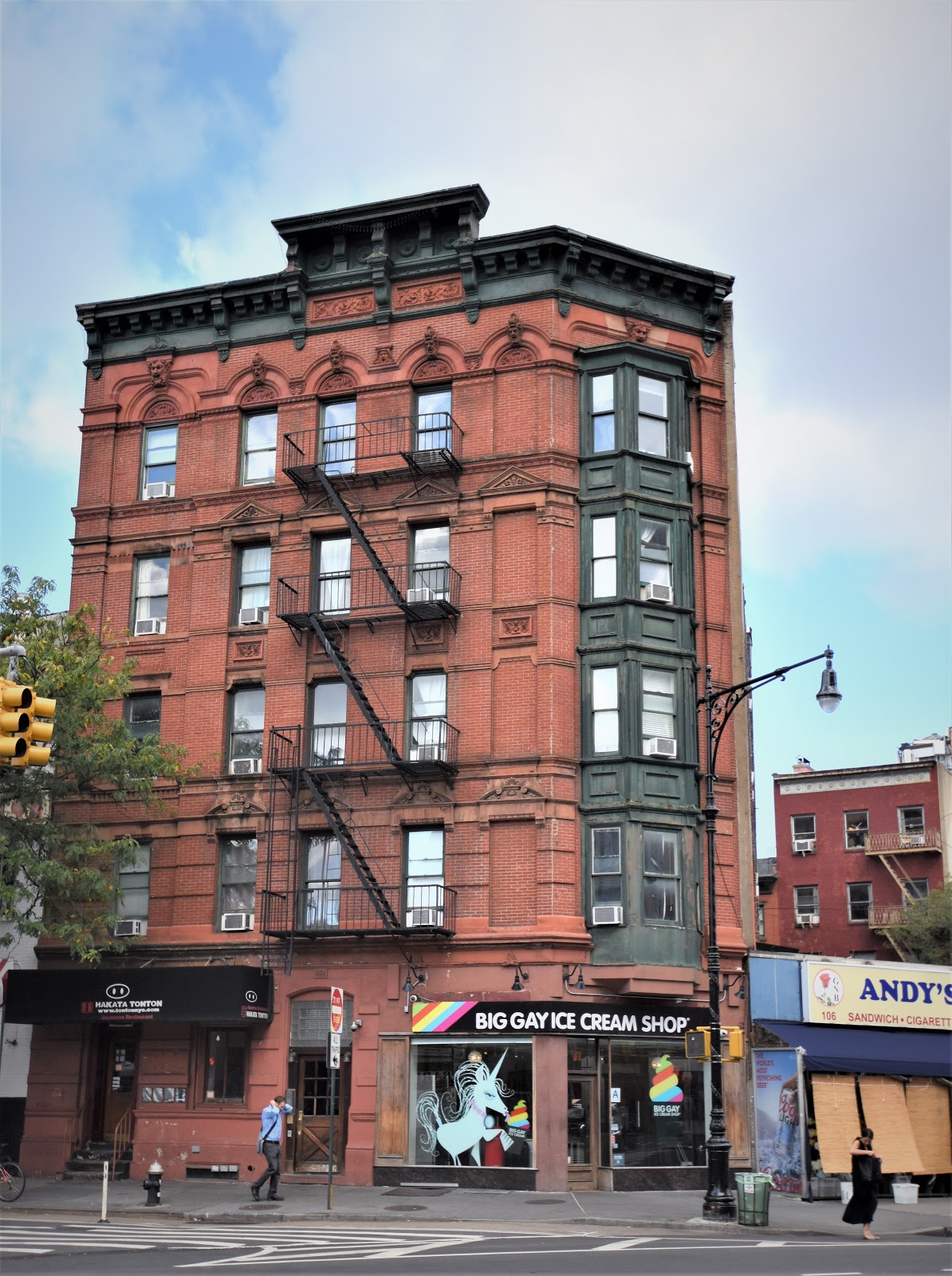
61 Grove Street and Its Remarkably Re-Built Corner


A seam running up the corner of the building testifies to the amazing plastic surgery performed in 1914.

In 1890 brothers John and Philip Goerlitz contracted architect Franklin Baylies to design a flat house on Grove Street in Greenwich Village between Bleecker and West 4th Streets.  The five story building would extend through the block, having entrances at both No. 61 Grove and No. 76 Christopher Street.  John Goerlitz was a contractor as well as a developer, so it is most likely that he was responsible for the construction.

Baylies's completed building was clad in red brick and trimmed in brownstone and terra cotta on the main, Grove Street elevation.  The openings of the top floor top floor were embellished with terra cotta tympana and fanciful carved portrait keystones.  Terra cotta panels were inserted within the ambitious tin cornice.  The Christopher Street side was similarly treated, although the brick here was beige--creating an even more striking color contrast between the materials.


The cost of construction was significant.  In April 1891 the brothers took out a $100,000 mortgage from The German Savings Bank--around $2.85 million today.

Tenants in the new building were a mixed bag--from blue collar workers like Edwin S. Payne, a seaman to professionals like Abraham Webb, an attorney. 

The fifteen families living at No. 61 were panicked on the evening of July 21, 1895 when a fire broke out in the basement.  The New York Herald explained "A match, thrown by some one into the front apartment of Janitor David Rinoler, had set some drapery ablaze and Rinoler, finding that he could not master the flames with buckets of water, caused an alarm to be turned in.  The tenants became frightened and rushed out on the fire escapes.  This caused some one in the vicinity to believe that the whole building was on fire and another alarm was sent in."  The fire was quickly extinguished and the damage was estimated at about $15,400 in today's dollars.


The Christopher Street elevation wears beige rather than red brick.
One resident at the turn of the century seems to have had a hard time retaining a job.  William T. Engesser placed a position wanted at in the New-York Tribune on December 30, 1900 for "Collector--Young man, 21, as collector with reliable firm; at present employed with jewelry house."  A month later he was looking for a position with a "reliable firm, with change for advancement; good penman, figurer, neat, quick, trustworthy."  No mention was made of his collector job.  And then on December 18, 1902 his advertisement read "Young Man, 22, at anything; neat, quick, trustworthy; business experience; references, bond; good education; no cavassing."  Possibly thinking his youth was working against him, his ad a month later added three years to his life and greatly broadened his background:  "Young Man, 25; neat appearance; good education and character...experienced selling and collection, shipping receiving and stock; trustworthy, a hustler."

An ugly feud between two families erupted around the time of Engesser's latest advertisement.  According to The Sun on March 1, 1905 "Social rivalry, it is alleged, had much to do with discord that prevailed."  It started when the Dugan family purchased a piano--an expensive item at the time--around 1903.  Their neighbors, the McCormicks responded by buying a piano too.

The Sun reported "The Dugans at first seemed to have rather the better of it.  Then the McCormicks added a fiddle to the family equipment and every one felt that they had gained a distinct lead."  But, said the article, "It was not for long."


"In May, 1904, the Dugans went to a concert in Tammany Hall.  They not only went to it; but Mrs. Dugan sang at it.  Further, there is the authority of Mrs. Dugan herself for saying that she frequently went to the theatre and that carriages drew up to take her there and in bringing her home.  But when the Dugans made a trip to Europe last summer—then it was, according to Mrs. Dugan, that the relations, already strained, snapped, and war in real earnest began."

In retaliation, according to the Dugans, the McCormicks "operated on their piano morning, noon and night" and "cooked fried liver and onions and boiled cabbage with their dumbwater shaft open."  The McCormicks retorted "that the Dugans caused small boys to ring their doorbell, and that an effort has been made to kidnap the family fiddle."

Edward Dugan was a special policeman and B. McCormick worked in a boiler factory.  Neither husband seemed much interested in their wives' feud until Dugan began receiving anonymous letters described as "very offensive in tone."  Mrs. Dugan had her neighbor arrested and the two women aired their grievances against one another in court.  The Sun noted "The husbands were there, too, but no one paid any attention to them."

Far more significant upheaval than piano music and fried liver was on the horizon.  At the time real estate agent Charles C. Hickok was lobbying to have Seventh Avenue, which began at 11th Street, extended south to Varick Street.  The project would necessitate the demolition of scores of buildings and portions of others.  Years of pressure paid off an in 1913 the extension began in concert with the construction of the 7th Avenue subway.  The project annihilated No. 63 Grove Street and shaved off a triangular corner section of No. 61.

When the dust had settled owner Jennie Messing hired architects Wortmann & Braun to fix the problem.   Their plans, filed in May 1914, were unexpectedly sensitive to the original designs.  In fact, during demolition the carved elements were salvaged to be incorporated into the rebuilding.  The result was seamless (other than the still-visible seam).   A three-sided bay included in the renovations projected over the new corner store.


In 1914 repairs were being made to the cut-off corner.  from the collection of the New-York Historical Society
Among the tenants in 1947 were Anthony Hintz, his wife Maisie, and their two-year-old son, Edward.  Hintz worked on the docks as a "boss stevedore."  The industry was controlled by the mob, making his job potentially dangerous if he stepped on the wrong toes.  And he did.

When Hintz answered his door on January 8, 1947 a barrage of shots rang out.  He fell to the hallway floor, struck by six bullets.  Neighbors, alerted by the gunshots, heard Maisie scream "Who shot you?" and Hintz answer "Johnny did it."

Despite the close-range wounds, Hintz lingered in the hospital for 25 days--more than long enough for him to make "death-bed declarations" against his attackers.  He identified John M. "Cockeye" Dunn as "the man who shot me," and Andrew Sheridan and Daniel Gentile as accomplices.

The individual trials went on for a year before all three were convicted of first degree murder and sentenced to the electric chair early in 1949.

Maisie remained in the Grove Street apartment, remarrying not too long afterward.  Around 3:00 on the afternoon of March 17, 1953 she went upstairs, leaving Edward, now eight years old, playing on the street.  In retrospect, it was a cavalier move, considering that she told investigators "she had received telephone calls threatening violence to her son."

The following day The New York Times reported that Edward "disappeared yesterday from the street in front of his home."  The article said Maisie "was near collapse when she reported his disappearance to detectives at 11:40 P. M."  A 13-state alarm was issued for the "chunky seventy-pound youngster" as described by The Times.

The terrifying situation had a happy ending--at least for Maisie.  The following morning just before 8:00 police found the boy sleeping in the cab of a truck around the corner.  "The boy said he had spent the night in the truck cab because he was afraid of being punished for staying out late," explained The New York Times.   It is more than possible that he was punished anyway.

For years during the second half of the century the corner store was Grove Drugs; and in 1974 the retail space on Christopher Street became home to Boots & Saddle, a gay bar.  


Around 1997 Taka, a "tiny sushi bar," opened at No. 61 Grove Street.  On November 21 that year The New York Times praised chef Taka Yoneyama's presentation.  "She will decorate tuna with leaves of edible gold, and stuff squid with spiced cod roe and cut it into pinwheels."

After decades on Christopher Street Boots and Saddle was replaced by Hakata Tonton, an Asian restaurant which stretched through to the Grove Street space formerly occupied by Taka.


Wortmann & Braun's 1914 rebuilding of the lost corner was so perfectly done that it fooled even the Landmarks Preservation Commission.  In its 1969 Greenwich Village Historic District Designation Report, the commission stated "The building was specifically designed for an oddly shaped corner lot."

photographs by the author

Wednesday, January 21, 2015

Franklin Baylies's No. 36-38 East 20th Street


As the turn of the last century approached, almost all of the brick and brownstone residences on East 20th Street between Broadway and Park Avenue had been converted for business or razed.  In 1899 two more, Nos. 36 and 38, would go.

The two 20-foot wide homes, both owned by the Remsen Estate, were being used by high-end dressmakers in the 1890s.  Additionally the Gramercy Laundry operated out of the basement level of No. 38 in 1895.  But with the millinery and apparel districts inching northward, the potential value of the real estate for commercial purposes far outweighed that of the old dwellings.  On January 27, 1899 The New York Times reported that the three-story houses had been sold to the real estate firm of Boehm & Coon.  Only days later, The Evening Post Record of Real Estate Sales noted that the firm had resold the properties “to a builder who will erect an eight-story building on the site.”

The “builder” was speculative developer John Walker.  He commissioned architect Franklin Baylies to design a modern loft and store structure on the site.   Plans were filed in March and the Real Estate Record & Builders’ Guide noted they called for “8-story brick, stone and terra cotta fireproof stores and lofts.”

Completed in 1900, the Beaux Arts-style building was as up to date as it was eye-catching.   A two-story base of rusticated limestone framed the first-floor retail space.  Its cast iron storefront featured a bowed show window and exuberant ornamentation of garlands, arabesques and cartouches.   The red brick of the upper floors was contrasted with white limestone courses, lintels, cornices and carvings.  Large, heavy cartouches below the fifth floor cornice matched those of the cast iron store front.  Baylies’s decoration of the topmost floors was controlled and yet sumptuous.

The attractive storefront featured the eyecatching, off-set protruding shop window.
The building quickly filled with apparel-related firms, like Simon Brothers, manufacturers and dealers in furs.   The firm was located on the fourth floor where flammable components like glues were stored.   After employees left for the night on July 8, 1904, something in the shop began slowly smoldering.  After several hours, around 7:00 in the morning, the pile burst into flames.

Fire fighters rushed to the scene, but the intense blaze took more than an hour to extinguish.  Officials estimated the damage to be around $10,000—nearly a quarter of a million dollars today.

Ladies’ hat makers Burras & Griffin moved into the building in 1906.  The semi-monthly journal Men’s Wear called it “a fine hat manufacturing establishment, making exclusive designs in shapes only.”   The company advertised its “high grade ladies’ and misses’ untrimmed hats.”

But not every tenant in the building at the time was an apparel firm.  That same year architect Charles Platt operated from here. 

J. Spencer Crosby & Co. was in the building in 1908.  Forest Leaves magazine, Spring 1908 (copyright expired)

In December 1909 the Cincinnati-based firm of P. R. Mitchell Company leased the store and basement “for a long term of years, at an aggregate rental of $45,000,” as reported in The New York Times.   While the store would cater mostly to women searching for bedding and pillows; the firm was also a wholesale dealer of upholstery stuffings.  Its listing in the American Trade Index the following year noted that it offered “Curled hair ‘Sterilized’ for all upholstering purposes, feathers and down for bedding purposes, turkey quills for duster and millinery purposes, bristles; tickings, denims, cretonnes, etc.; feather dusters; pillows and cushions.”

Housewives shopped for feather-stuffed pillows in the store in 1909 -- (copyright expired)
The building saw a surprisingly-quick turnover in ownership starting in 1913.  Five years earlier Julius Heimann had purchased it.  Now in July 1913 he sold it to the Salisbury Realty Company, which resold it in January 1914 to Minna M. Coester.   At the time the city assessed the property at $240,000.

Changes in ownership apparently did not negatively influence the building’s tenant list.  In May 1915 Pomeranze Bros., makers of cloaks and suits, moved in.  Prior to the move American Cloak and Suit Review made note of the increased space.   “While Pomeranz Bros. are now occupying extensive quarters, they have developed their business so successfully recently that they completely outgrew their accommodations and will have ample room to care for their increased business in their new home.”


The same year Tuttman Bros. & Rosen was organized to produce what The Corset and Underwear Review called “Attractive styles in infants’ and children’s dresses and children’s undermuslins.”  The journal said “They are featuring all white garments, which are being marketed as the ‘Daisy Brand’ line.”

Other tenants in the building in 1917 included P. J. Barash, who advertised “The Big 5 Skirt Line” saying “Come downtown and Save Money at Barash’s;” and Chas. Kafka & Co, manufacturers of dress skirts.  Kafka promised his buyers that year “The last thing I would think of would be to antagonize the buyers whose confidence and good will I value so highly and want you all to know that I am serving your  best interests by marking my skirts as low as possible.”

Eventually the garment district moved northward, past 34th Street.  As apparel firms moved out, vastly different companies moved in.  In 1933 the store became home to Samuel Wach and Samuel Berger, manufacturers of paper boxes.  Seven years later it was leased to the Chisolm Company, vendors of barber supplies.


Astoundingly, as the neighborhood and the tenant list changed, the exterior of Nos. 36-38 East 20th Street remained unchanged.  Today the ground floor retail space where P. R. Mitchell Company sold feather-filled comforters is home to a trendy restaurant.  Its wonderful bowed show window survives with little alteration, the cast metal store front is intact, and even the three sets of 1901 double doors remain.  And above, Franklin Baylies’s ebullient Edwardian façade deserves a craned the neck from across the street.

photographs by the author