Showing posts with label east 9th street. Show all posts

Thursday, January 29, 2026

345-347 East Ninth Street


In the 1850s, waves of European immigrants began changing the demographics and personality of the East Village.  To accommodate the exploding population, tenements and flat buildings replaced private homes.  As early as 1853, a four-story flat-and-store occupied 250-252 Ninth Street (renumbered 345-347 East 9th Street in 1868) just west of First Avenue.  An early example of Italianate design, the upper floors were faced in red brick.  At street level, t
he centered entrance was flanked by two wooden storefronts.  Cast sills and corniced-lintels decorated the upper openings (other than the smaller, hallway windows in the center).  The edifice was capped with an elaborate pressed metal cornice.  Its fascia was decorated with unusual, embossed imitation blocks; and a host of scrolled brackets crowded one another to uphold the cornice.

The building was a "double flat," meaning that there were apartments on either side of a centered hallway--two each, front and back, in this instance.  The professions of the tenants reflected their working class status.  In 1853, they included a marble cutter, a painter, two coachmen, an ostler (or stable hand), and an upholster.  The surnames of the residents in 1855 were mostly Irish, including Kelly, McCarthy, O'Brien, O'Reilly, and O'Shea.  Downstairs, one of the shops was occupied by James Mewkill, a "paperstainer," or maker of wallpapers.  He lived rather inconveniently far away at 234 West 27th Street.

Women and children worked to augment the families' income, as reflected in the "situations wanted" pages of local newspapers.  One, on March 12, 1856, read: "Wanted--A situation, by a young woman, as chambermaid and waiter, or to do general housework in a small private family.  Can be seen for two days, if not engaged, at 250 9th st., between 1st and 2d avenues, third floor, front room."  And the following year, on April 27, an ad in the New York Daily Herald said, "A most respectable young woman wishes a situation as chambermaid and waitress or [to] take care of children and do plain sewing."

Around 1862, Arthur Carey opened his boot and shoe making business in one of the shops and moved his family into an apartment upstairs.  Late on the night of May 18, 1866, two burglars broke into Carey's shop "by bursting in the front door," as reported by the New York Dispatch.  They gathered up $26 worth of goods and attempted to escape, but were seen by passersby who chased them.  The article said that the thieves, "dropped their plunder and fled."  Officer Callery, who had just gotten off duty and was on his way home, "joined the chase, and fired three shots at one of the thieves."  One shot hit George McGrath's hip, ending his flight.  

McGrath was taken to the 17th Street precinct station where a surgeon was sent for to treat his wound.  A search found a table knife hidden in one of his sleeves and a lock-pick in the other.  Had McGrath and his accomplices successfully made off with the shoes and boots, the value of their booty would translate to about $530 in 2026 terms.  Instead, McGrath, who was refused bail, faced serious consequences.  Two weeks later, on June 5, he faced a judge.  The New York Herald reported that he "pleaded guilty to an attempt and was sentenced to one year's imprisonment in the Penitentiary."

Arthur Carey remained in the space at least through 1870.  It was possible that two of his neighbors in the building worked for him.  Both Leonard Kantz and Charles Koener listed their professions as "shoemaker."  Other residents that year were George Johnson, a "seaman;" George Tugman, who drove a wagon; and James Shaw, a laborer.  Shaw was typical of the hard working residents.  Born in County Down, Ireland in 1830, he died on April 13, 1872 at just 42 years old.  His funeral was held in the family's apartment here.

In 1873, the stores were occupied by a fish and oyster market and a butcher shop.  The latter was operated by Abraham Altheimer, who moved his operation here from Avenue C.  That year the owner of the other store closed.  His advertisement in the New York Herald on November 4, 1873, read: "For Sale--Fish and oyster market, with a Horse and Wagon.  Inquire at 347 East Ninth street."

The space became home to D. C. Voss's jewelry store.  By 1876, Samuel C. Altheimer, possibly Abraham's son, had taken over the butcher shop.  He and his family lived nearby at 352 East 9th Street.  

As had been the case with Arthur Carey 12 years earlier, on the night of February 25, 1878, three thieves attempted to rob Voss's store.  And like that endeavor, they were unsuccessful.  They were hunted down and arrested a week later, on March 4, and held for trial.

The residents continued to be blue collar, listing commonplace professions like laborers and drivers.  One tenant in 1878, 16-year-old John Powers, however, had a much more unusual job.  That January, Elizabeth Cooley Ross, who was a dressmaker on Broadway, approached him with a proposition.  Her husband, Reuben Ross, operated a tea store at Third Avenue and 23rd Street.  Powers later explained that Elizabeth was jealous and suspected that her husband "was not true to his marriage vows."  She paid the teen (who looked "much older," according to The New York Times) to spy on Reuben Ross.  

Powers's covert surveillance went undetected by his quarry, but not by Joshua Davenport, who lived near the Ross tea shop.  Every time he left his home, reported The New York Times on February 1, 1878, he "noticed a strange young man standing in the doorway."  When Davenport came home for lunch on January 31, "he found as usual the stranger standing in the doorway, with his face muffled up in a woolen comforter with which he was trying to protect it from the fierce and raging storm."  Davenport had reached his breaking point.  Grabbing Powers by the collar, he demanded to know what his business was.

The New York Times reported, "The reply, which was not couched in very mild language, was to the effect that it did not concern in the least Mr. Davenport who he was or for what purpose he was there."  Davenport found Officer McKenna, who agreed that Powers was acting suspiciously and arrested him.  The next morning, Elizabeth and Reuben Ross were both summoned to court to testify about what they knew about the case.  Elizabeth admitted that the marital relations between her and Ross "were not the happiest kind," and that she had  been employing the teen for three weeks "to dog her husband's footsteps."  But before dismissing the case, Justice Smith gave the teenager some advice.  The Times said, "His Honor told him to be more careful hereafter, as his present business was not an enviable one, from the fact that he was liable to be 'thrashed' at any moment."

Two months later, the Wisenner family suffered horrific tragedy.  On May 3, 1878, the New York Herald reported, "Maggie Wisenner, two and a half years old, of No. 347 East Ninth street, was run over and instantly killed yesterday, at the corner of Eighth street and First avenue, by car No. 15 of the Crosstown line."

By 1881, a restaurant occupied one of the first floor spaces and the other was home to a cigar store.  Five years later, while the cigar store was still here, the restaurant had been supplanted by Lawrence H. Metzel's fish store.  A frightening incident happened on July 24, 1886, when an oil stove "exploded," as worded by the New-York Tribune in the fish store.  The article noted, "In putting out the flames Metzel burned his hands severely."

That year, Harrison M. Hayden arrived in New York from Chicago and took an apartment here.  His residency would be very short-lived.  On September 6, 1886, The New York Times reported that Hayden, "or Harry S. Smith," had been remanded at the Jefferson Market Police Court "to await the arrival of an officer from Chicago."  While boarding at the house of H. F. Liddell there, he stole $1,200 of property "by ransacking the house," according to the charges.  He had fled to Cleveland where he committed a similar crime.  The investigation of the Chicago police led him to New York "and it was found that the thief was Hayden."

An interesting tenant signed a lease in 1900.  On March 17, The New York Times reported, "The New York Checker Club will have a 'housewarming' in its new rooms, at 347 East Ninth Street, this evening."  That night the match for the "championship of Greater New York" would be played, said the article, "and $25 a side will be placed between the first and second prize winners."  (The price money would translate to about $950 today.)  A year later, the New-York Tribune reported on the preparations for the 1901 checker championship tournament to be held here.

The building received a significant updating in the spring of 1914 when indoor plumbing was installed.  A building inspector, T. J. Donaghue, certified that a "peppermint test" had been done on the work, that included a first floor bathroom, and water closets upstairs.

The modifications were part of necessary repairs caused by a two-alarm fire on February 24.  At the time, the ground floor spaces held a saloon and a restaurant.  Describing the building  now as a "rooming house" by the New-York Tribune, the upper floors were operated by John and Edith Lemminn.  

A two-alarm fire had broken out in the building that night.  The New-York Tribune said, "There were two thrilling rescues," including three men trapped on the roof who "were hauled to safety on a clothesline."  Edith Lemminn saved her son, seven-year-old John, by carrying him out of the second floor window and carefully navigating across the sills.  Tragically, two kitchen workers in the restaurant, Ernest Schick and Adolph Erumo, were fatally burned.

The residents of 345-347 East 9th Street were predominantly honest and hard-working.  An exception was Nicholas W. Raditsky, who lived here at the time.  On September 9, 1914, he was arrested for stealing $1,462 from his employer, Gregory Kunashezsky, a steamship broker.  The New York Times explained, "The money was the price of seven steamship tickets sold on August 23, to seven German reservists."  When arrested, Radisky had the exact amount in his pocket.

Criminals would be less uncommon in the building by the Depression years.  Joseph Schmidt was 35 years old and living here when, at 10:50 on the night of May 28, 1930, he and Andrew Fidorko assaulted and robbed Harry Roman of $175 in Jamaica, Queens.  Roman telephoned a detailed description of the gunmen to police.  It triggered a cops-and-robbers type standoff only a few minutes later.  The New York Times reported,

After sixty policemen armed with machine guns, rifles and tear gas bombs had spent several hours last night maintaining a cordon around a residential block in Jamaica in an effort to trap a gunman who fired at detectives, the fugitive turned up at his East Side home at 1:45 o'clock this morning and was caught, following a chase of several blocks, during which the police fired twenty shots.  One took effect.

Joseph Smidt was hit in the back and was taken to Bellevue Hospital where his condition was deemed "not serious."

The hallway windows can be seen in this 1941 photograph and the wooden storefronts were intact.  via the NYC Dept of Records & Information Services.

Another resident who ended up behind bars was Henry Fourens.  He and Jacob Goldfarb were charged with grand larceny on January 17, 1934 after they broke into about 60 parked automobiles.  In reporting the arrest, The New York Times mentioned, "A bottle of germs valued medically at $10,000, was thrown away recently as worthless by two automobile burglars who found it in a physician's car, according to detectives."

A renovation completed in 1970 resulted in just two apartments per floor and the combining of the stores.  It was most likely at this time that the former hallway windows were closed off.  In the late 1980s, the ground floor was home to The Gold Bar, described by New York Magazine on May 4, 1987 as an "intimate bar, with no sign and sparse decor."


Today a modern storefront and replacement windows testify to the late 20th century renovations.  An unattractive fire escape, installed after the fatal fire of 1914, distracts from the early flat building's design.

photographs by the author

Saturday, November 29, 2025

The Former Christodora House - 310 East 9th Street


As early as 1867, Elias Koch and his family occupied 215 East 9th Street (renumbered 310 in 1868).  The recently built, Italianate-style house was the latest in domestic fashion.  Three bays wide and four stories tall, the brownstone-faced home was intended for a merchant class family.  The double-doored entrance was flanked by paneled pilasters that upheld elaborate scrolled brackets and an arched pediment.  

Elias Koch's "satchels" or bag business was located at 155 Chambers Street.  His family remained in the house until 1870 when it became a boarding house.  An unusual advertisement in the New York Herald on October 20 that year read, "A few mechanics can obtain good board at $5 per week, with a comfortable home, at 310 East 9th st., second floor; day boarders also."  (The weekly rent, including meals, would equal $125 in 2025.)

Why the ad specified mechanics is puzzling.  But the tenant list that year was much more varied.  Among the boarders were John Bunell, a clerk; Hamilton Cole and Payson Merrill, both lawyers; and Frederick Bonnele, who worked in a loft building far downtown.  On April 1, 1870, The New York Times reported, "Frederick Bonnele, of No. 310 East Ninth-street, received a severe wound yesterday by being struck on the head by a chain which fell through the hatchway from an upper floor at No. 92 Broad-street."

The proprietor of the 310 East 9th Street relinquished the lease in the spring of 1873.  By then, many of the upper rooms had been divided.  On April 28, an ad in the New York Herald read, "To Let--House 310 East Ninth Street, near Second avenue, well suited for a boarding house, having 26 rooms."  The rent was $2,400 a year, or about $5,400 per month today.

The tenants continued to be varied and increasingly their surnames were German.  Among the boarders in 1877 were John Horgan, a builder; violinmaker August Gemunder; Henry Casperfeld, a jeweler, and the Schlatter family--Charles was a clerk and John was in the trimmings business.

While living here in 1878, George W. Hammill, sexton of St. Mark's Church, became involved in a shocking abduction case.  Millionaire Alexander Turney Stewart died on April 10, 1876 and his body was interred in St. Mark's churchyard.  Hammill explained to officials,

About eight A. M. Francis Parker, who is the deputy sexton of the church of which I am the sexton, came to my house at No. 210 East Ninth street, and in an excited manner said, "The body is gone."  I asked him what body.  He said, "Stewart's."
 
Hammill followed Parker to the churchyard.  The dirt had been shoveled away from the grave and the slab over the vault had been removed.  By using a rope, said Hammill, "I then descended into the vault and noticed that the body had been carried away."  The ghoulish kidnapping of Alexander T. Stewart's body and subsequent ransom demands became national news and the crime was never fully solved.

Otto F. and Mathilda Burkhardt operated the boarding house by 1886.  In April 1889, she appeared in court against her next door neighbor, Emily S. Rollwagen, who owned and operated the boarding house at 312 East 9th Street.  She complained that Rollwagen was incapable of "properly managing this property," and its neglected condition was damaging her business.

Mathilda's husband, Otto F. Burkhardt, appeared in court two years later.  He sued broker John E. Ireland for fraud.  Rather insultingly, on January 9, 1891, The Press reported, "Burkhardt declares that Ireland has swindled him out of more than $7,000 by a series of fairy tales that reflect somewhat upon the complainant's intelligence."  

According to Burkhardt's complaint, in 1889 Ireland told him that he could get him appointed on the Board of Appraisers of Lands that was connected to the Aqueduct Commissioners.  The salary, said Ireland, was $3,500 per year.  But, he needed $1,000 "so as to entertain some big men who would recommend him."  Burkhardt handed over the cash and then, "discovered that no such office existed."

Later that year, in December, Ireland told Burkhardt "that he has raised $21,000 toward buying a patent to purify milk, for which $25,000 was asked."  He said if Burkhard provided the balance, he "could get into a good thing on the ground floor."  Burkhardt invested $3,500 then found out that there was no such company.  Five months later, in May 1890, as reported by The Press, "Burkhard says Ireland got up a story about having to take up a note on a New York city bank.  Burkhardt let him have $525 and then discovered that there was no such note."  

Before the time Burkhardt realized that his "friend" was a fraudster, he had lost nearly $7,000.

The Italianate stoop railings and newels were intact in 1903 when artist E. Pallme, who lived here according to the inscription on the back of the photo, snapped this shot.  from the collection of the Museum of the City of New York. 

In 1909, Christodora House acquired the residence.  One of the early settlement houses in New York City, Christodora House was founded in 1897 by Sara Carson and Christine MacColl.  At the time of the purchase, the facility was located on Avenue B.

Christodora House provided services to the immigrant community that had engulfed the district.  Dr. H. Hallarman was on staff here for years to provide medical treatment.  The group offered classes and clubs, like its Poets' Guild of the Christodora House.

Nearly two decades later, on December 18, 1927, The New York Times reported, "The old Christodora House, 310 East Ninth Street, proving inadequate, ground has been broken for a new house, Ninth Street and Avenue B, facing Tompkins Square."  The proposed 16-story structure would include "a swimming pool, gymnasium, classrooms for the music school, club and game rooms," said the article.

While construction of that edifice proceeded, Christodora House continued here.  On May 7, 1929, the Barnard Bulletin announced, "The Poets' Guild of the Christadora [sic] House at 310 East 9th Street is planning a series of national evenings to which they will very gladly welcome any American student who wish to come."  The series started with "a Roumanian Poetry Night," on May 6.

At the time of the series, Christodora House was preparing its move into the new building.  No. 310 East 9th Street was purchased by Dr. Michael Steiner and his wife, Byrdie.  Steiner established his practice in the basement level while he and his wife lived upstairs.

The Italianate areaway railing survived in 1941.  via the NYC Dept of Records & Information Services.

Three decades later, Steiner was still practicing here.  He experienced an unusual incident on the afternoon of April 2, 1960.  Just as he was preparing to close his office at 2:10 that afternoon, a 23-year-old man walked in complaining about a sore foot.  He told Dr. Steiner that "he had a note from his mother," according to The New York Times.  Instead of producing a note, he pulled out a revolver.

"This is a stick-up," he announced, while pulling out a pair of handcuffs.  The Times said, "The hold-up man snapped one cuff around Dr. Steiner's wrist and the other around a steel bar on an operating table."  The young man removed Steiner's $50 wristwatch and rifled the doctor's coat, taking out $90 in cash.  The article said, "Next he asked the physician where he kept his narcotics.  Dr. Steiner said he had none."  

Twenty minutes after the robber fled, Byrdie arrived to find her husband handcuffed to the table.  She called the police, which summoned the Emergency Squad.  They cut the handcuffs with a hacksaw.  In all, said The New York Times, "Dr. Steiner had been handcuffed to the table forty-five minutes."


A renovation completed in 1985 resulted in a duplex apartment in the basement and parlor level, one apartment on the second, and another duplex on the third and fourth.  Rather remarkably, other than the replaced stoop ironwork and windows, the vintage house retains much of its 1860s appearance.

photographs by the author

Saturday, November 15, 2025

George B. Post's 1886 Livingstone - 206-208 East 9th Street


In 1885, seven years after he designed the magnificent Cornelius Vanderbilt II mansion at Fifth Avenue and 57th Street, George Browne Post filed plans for a much different project--a "flat" building for James Thomson at 206-208 East 9th Street, next to the diagonally-running Stuyvesant Street.  Completed in 1886, Post's Renaissance Revival design was splashed with elements of the popular Queen Anne style.  Six bays wide and five stories tall, Post trimmed the red brick facade with nearly matching terra cotta.  Molded terra cotta bands between the windows suggested capitals to the brick piers.  Each opening was crowned with an arch, its tympanum filled with ornate Renaissance decoration.  The corbel table of the complex terra cotta cornice took the form of shells.


Most striking, perhaps, is the bold entranceway.  To maintain symmetry, Post balanced the double-doored entrance with a window separated by an elaborate Renaissance Revival, terra cotta pilaster and connected it all with a large terra cotta arch filled with delicate, leafy decorations.  A Queen Anne-style scroll announces the address (the gold paint was added relatively recently).

There were ten apartments of seven rooms in the building, two per floor.  Rents ranged from $1,160 to $1,290 per month by today's conversions.  An advertisement in the New York Herald read, "The Livingstone, 206 and 208 East 9th St.--Very desirable Apartments at low rents; all improvements."  

Residents were middle- to upper-middle class.  An erudite resident, who signed her advertisement in the New-York Tribune on February 26, 1891 as "R. M.," wrote, "Educated lady has some hours disengaged, mornings or afternoons from 2 till 4; German, English, French, art, needlework, music, grown children or to a lady."


The apartments were spacious enough that some residents used them both for living and working.  An advertisement in The World on October 16, 1892 read:

Art Classes, painting, drawing, illustrating, designing, home decorations, all branches; lessons daily and evenings; eminent European teachers, Prof. and Mrs. Champney, principals Rembrandt Art School, 206 and 208 East 9th st.

Another resident who operated from his apartment was John F. Victory.  He published The Postal Record here starting around 1892, and the following year was secretary of the National Association of Letter Carriers, which listed its official address at 206 East 9th Street.  In 1893, he and his wife, the former Alice Dauphin, welcomed a son, John F. Victory, Jr.

Geo. P. Rowell & Co's American Newspaper Directory, 1893 (copyright expired)

The younger Victory joined the U. S. Patent Office as a clerk in 1908.  A friend of Wilbur and Orville Wright, when the National Advisory Committee for Aeronautics (NACA) was organized in 1915, he was its first employee.  He would become its secretary in 1921 and executive secretary in 1948.  

John F. Victory, Jr. on January 1, 1922, Great Images in NASA

When NASA was organized in 1958, Victory would serve as special assistant to administrator T. Keith Glennan.

Born in Puerto Rico, Antonio Velez Alvarado moved to New York City in 1888.  He lived here in 1898 when the Spanish-American War ended and America claimed the island of Puerto Rico as a territory on October 18.  Three days later, Alvarado attempted to register to vote.  The New York Journal & Advertiser reported that he "was denied the right to do so" when the official insisted on seeing his naturalization papers.  The newspaper explained that Alvarado:

...argued that he needed neither to show nor to have naturalization papers and that it was only necessary for him to satisfy the conditions of the ballot law as to the length of residence here--at least a year in the State, four months in the county and thirty days in the election district--which conditions he could meet.

He said he became an American "last Tuesday, October 18, when the American flag was raised over the palace and other public buildings in San Juan, signifying the completed occupation of the island by this country."  Alvarado turned to Tammany Hall, pleading his case to the Law Committee.  Impressed with his argument, attorney Rollin M. Morgan escorted him downtown to Corporation Counsel Whalen.  The two attorneys consulted "history, constitutions and law books for several hours."  Then a telegram was sent to the Secretary of State at Albany.

Antonio Velez Alvardo, New York Journal & Advertiser, October 22, 1898 (copyright expired)

As he waited for an answer, Alvarado asserted to a reporter from The New York Journal & Advertiser, "If I am not a citizen of Spain, and I certainly am not, I must certainly be an American."  The newly-minted citizen won his battle.  The next day, Congressman William Sulzer told the newspaper, "Porto Ricans were made Americans by the act of war.  They can vote here next month."  The Alvarado case had established an important legal precedent.

At the time, Henry Peck and Heinrich Trautman shared an apartment.  Luckily for Trautman, the roommate arrangement saved his life.  On December 18, 1899, the New York Journal & Advertiser reported succinctly, "If Henry Peck had been five minutes late in arriving at his room, at No. 206 East Ninth street, yesterday, Heinrich Trautman would have been suffocated.  The gas had been turned on by accident."


Interestingly, 206-208 East 9th Street (the name Livingstone was dropped a few years after its opening) was racially integrated as early as the World War I years.  When Alexander Dujat was tried for bigamy on October 28, 1918, the Brooklyn Standard Union reported, "The first witness to-day was the Rev. Matthew M. Wilson, colored, of 206 East Ninth street, Manhattan."

Residents of 206-208 East 9th Street rarely prompted negative press, but that was not the case in the summer of 1924 when Albert Blumberg faced serious charges: vehicular homicide.  On August 26, the New York Telegram and Evening Mail reported that he was held, "for further examination in connection with [an] automobile killing."  He had fatally hit six-year-old Alexander Chambers.


As was the case in 1886, there are ten apartments in the building.  Its exterior appearance is remarkably intact, but without landmark protection, the continued preservation of this striking example of one of New York's most important 19th century architects is uncertain.

photographs by the author  

Wednesday, November 12, 2025

The John R. Stuyvesant Stable - 231 East 9th Street


John Reade Stuyvesant was born on June 10, 1798 to Nicholas William and Catherine Livingston Reade Stuyvesant.  He and his wife, the former Catherine Ackerley, maintained a country home in Hyde Park, New York.  He inherited Manhattan property
--once part of the Peter Stuyvesant farms--from his parents.  By the 1850s, a two-story brick stable sat on his land at 231 East 9th Street.  

Stuyvesant died in 1853 and by the early 1870s, his heirs were leasing the structure.  George Williams operated his business here in 1874, possibly repairing wagons.  On May 25, 1874, The Evening Telegram reported that Richard Cary had been arrested "on a charge of burglariously entering the premises, No. 231 East Ninth street, and stealing $50 worth of carpenters' tools."  William's tools--worth $1,470 in 2025 money--were recovered.

As early as 1881, Frederick A. Palmer leased the building.  His  advertisements described his Palmer & Co. as "woven wire mattress weavers."

The Stuyvesant heirs sold the building on February 5, 1891 to Morris Rosendorff for $11,000, or about $391,000 today.  While Rosendorff continued to lease the structure to Palmer, it seems that he overextended himself, and he lost it in foreclosure in June 1894.  It passed through two owners' hands before long-time tenant Frederick A. Palmer purchased 231 East 9th Street in 1897.

Around the turn of the century, Palmer renamed his firm the Palmer Galvanic Bed Co.  It now manufactured "wire bed springs."

On November 21, 1927, The New York Sun reported that Frederick A. Palmer had sold 231 East 9th Street to the Standard Metal Ceiling Company.  "At the age of 89 years he decided to sell the property," said the article, adding, "Mr. Palmer was a bed spring inventor and manufactured his springs in the Ninth street structure for forty years, first as tenant and after 1897 as owner."  

If the ceiling firm occupied the building at all, it was a short venture.  In 1928, the Proletarian Laboratory leased it and converted it to what The New York Times called an "improvised play-house," called the Prolab Theatre.

The Daily Worker, February 16, 1929

On January 7, 1929, The Daily Worker reported, "The Prolab (Proletarian Laboratory) Theatre has begun operations of the season at its headquarters--231 East 9th St.  Rehearsals have already begun on three one-act plays to be presented some time in February."  The article noted, "There will also be a monthly program of plays and dancing at the theatre headquarters."

The very-off Broadway venue did not survive for long.  By the late 1930s, the ground floor of 231 East 9th Street housed an automobile repair garage and an apartment was on the second floor.

image via the NYC Dept of Records & Information Services.

Sculptor Charles Salerno occupied the apartment in 1953.  Born in 1916, he worked mostly in marble and was known for abstract figurative sculptures.  He taught art in Washington Irving High School and the National Academy of Design.

Charles Salerno, from the collection of the National Academy of Design

In 1959, the ground floor space was converted to a burlap bag repair shop.  Then in 1976, it became home to Montana Palace, a bakery-catering business.   It was replaced in 1990 by Col Legno, an "no-frills Italian spot," as described by New York Magazine's Liz Logan on July 16, 1990.

image via the NYC Dept of Records & Information Services.

Col Legno remained in the space until 2008, followed by the Japanese restaurant, Sakagura, owned by Robataya NY.  The name was changed to Robataya around 2015.


The venerable little building with its incredible history still has one apartment on the second floor.  A Japanese cafe, Hi Collar occupies the ground floor.

photographs by the author

Thursday, August 14, 2025

The Charles L. Carpenter House - 210 East 9th Street


As early as 1845, stable owner Phillip Clary and his family occupied the newly built brick-faced house at 181 Ninth Street (renumbered 210 East 9th Street in 1867).  Typical of the Greek Revival style, its brownstone details included understated sills and lintels, heavy doorway pilasters and entablature, and a simple cornice.

About a block way was St. Mark's Church on the Bowery, erected in 1795-99.  Its sexton, Charles L. Carpenter, moved his family into the Ninth Street house in 1851.  Born in 1810, Carpenter, apparently a widow, shared the house with his four sons--Leonard J., who was in real estate; Dennis M., a lawyer; Samuel, a deputy sheriff; and Merritt, who was a carman--and two daughters, Mary J. and Theresa W.

What must have been snug conditions within the house became slightly less so when Theresa was married in St. Mark's Church to Epheram Chamberlain on September 13, 1860.

On the evening of March 7, 1863, a brazen burglar entered the house, going as far as the hall tree just inside the door.  Three days later, an advertisement appeared in the New York Herald:

$15 Reward--Taken from the hallway of No. 181 Ninth street, on the evening of the 7th instant, two Overcoats and a Silk Umbrella; any person returning the same to L. J. Carpenter, 24 Third avenue, will receive the above reward and no questions asked.

The reward would translate to about $385 in 2025.

In 1865, Charles L. Carpenter moved his family to 228 East 11th Street where he died at the age of 61 on March 15, 1869.  The East 9th Street house became home to the Andrew Campbell family.  Andrew and Margaret Campbell had three children: Andrew McKenzie, who entered the College of the City of New York in 1866; John; and Margaret Ann.  

The house was the scene of eight-year-old Margaret Ann's funeral on July 23, 1866.  The Campbells had another daughter, Jane Graham, shortly afterward, but she, too, died in childhood.  Her funeral was held in the parlor on November 25, 1869.

John Campbell was old enough to start a career at the time.  He was listed the following year as running a saloon at 68 Broome Street.

Following the Campbell family, two other St. Mark's Church sextons occupied 210 East 9th Street.  William Fair moved into the house in 1872 and remained through 1875, followed by George W. Hammill.  He listed his profession as "Sexton of St. Mark's Church and general furnishings undertaker, receiving vaults for Greenwood and other cemeteries."

The East 9th Street dwelling became a boarding house, run by Anna Steen, in 1879.  She leased it from C. Battenhauser and it was most likely he who gave the exterior a pseudo-modern makeover.  Pressed metal sills and cornices were applied to the openings and an ambitious terminal cornice with brackets, swags and a triangular pediment (more expected in a commercial building) were installed.

By 1891 a Mrs. Thomas Miller ran the boarding house, which The New York Press on April 21 that year said, "has been the source of considerable gossip in that neighborhood."  

In October 1890, Paul Behrend, a German-born pianist took a room.  Mrs. Miller described the 25-year-old to a reporter from The Evening World as, "well educated and...an accomplished musician, having several piano pupils in various parts of this city."  She said he came from a "good German family," and The Evening World discovered, "in 1889 Behrend was forced to leave his home in Germany because his father had disgraced the family by forging a check and was sent to prison.  At that time the young man was studying law and he felt the disgrace keenly and came to this country."

In February 1891, 22-year-old Elsa Dannheimer took a room.  Mrs. Miller said that no one in the house "ever suspected any particular attachment between the handsome, blond young pianist and the dark-haired Elsa."  But soon after Elsa's arrival, there was an attachment.

The reason that The New York Press mentioned that 210 East 9th Street was "the source of considerable gossip," was revealed in a article in The New York Sun.  On April 21, 1891, it said that Behrend "came here from Germany less than a year ago and began playing [piano] in a house of ill repute...kept by Mrs. Thomas Miller."  The article said, "he was general utility man as well as pianist, and was frequently seen carrying pitchers of beer and whiskey from neighboring saloons to the house."

At 10:00 on the morning of April 19, 1891, Behrend and Elsa Dannheimer checked into the Grand Union Hotel as "P. Behrend and wife."  Around 8:30 that night, a hallman smelled gas and looked into the transom over the door of their room.  "The young man and woman were dead upon the bed in their night dresses, wrapped in each others' arms," reported the New York Sun.  The couple left two letters, one for Mrs. Miller and the other for Paul's cousin, Fred Behrend.

In Mrs. Miller's envelope was a latch key and a note that read:

My Dear Mrs. Miller:  I herewith send to you notice that both of us are tired of life, and both have come to the conclusion to proceed to end it.  Elsie's trunk should go to the Coroner, who will dispose of the effects to pay for our funeral.  We thank you and Mrs. Albert for kindnesses you have shown us.
                                Paul Behrend.

A reporter from The New York Press rang the bell at 210 East 9th Street.  Understandably, Mrs. Miller attempted to distance herself.  

"Well, all I have to say is this: I met those people some time ago, here in the city, in a casual way.  They are no particular friends of mine; simply acquaintances."  

The reporter added editorially, "It was plainly evident from Mrs. Miller's general actions that she knows more about the people than she wishes to divulge.  While she was talking to the reporter at the door three very well dressed couples passed into the house."

If the "gossip" about 210 East 9th Street abated after the incident, it was renewed in 1893 when hearings concerning corruption within the police department were held.  On December 22, The World reported that Captain Doherty had been ordered to "make a correct list of every disreputable place, including gambling-houses and houses of ill-fame, in the Fourteenth Precinct."  Included on the list was "the place at No. 210 East Ninth street."

The negative publicity most likely resulted in a change of proprietors.  L. Baumann took over the lease in 1897.  

Among the roomers living here in 1911 was Tillie Chesman.  At the time, the East Village was the center of the Socialist and Communist communities, and its blue collar residents were fighting valiantly for fair labor conditions and wages.

On January 30, 1911, The New York Times reported, "Nearly 2,000 Anarchists marched down Broadway yesterday afternoon singing 'The Marseillaise.'"  As police attempted to disperse the crowd and arrest those who resisted, Tillie Chesman lost control.  The Times reported:

Tillie Chesman, a young girl of 210 East Ninth Street, threw herself on the policeman, scratching and kicking while she shouted to the others to follow her lead.  She was more than a match for the policeman who tried to arrest her, and it took three men finally to pinion her arms and get her into a patrol wagon.

When architect Louis A. Sheinart made interior renovations to the house in 1923, the Department of Buildings described it as a "tenement."  The term generally referred to any multi-family structure; however, it suggests that the occupants were short-term roomers.

The basement level was converted to business in 1984.  It became home to Hasaki, a sushi restaurant that remains today.  There are five apartments within the upper floors.

photograph by the author

Monday, May 29, 2023

The Lost Frederick's Photographic Portrait Gallery - 770 Broadway


Renovations in 1885 resulted in a striking make-over.  from Illustrated New York City and Surrounds 1889 (copyright expired)

George Parker was born in Boston on March 2, 1793.  After graduating from Harvard College, he added his middle name Phillips, and entered the counting room of his father, John Parker.  In 1844 he moved his family to New York City and into the recently completed mansion at the southeast corner of Broadway and 9th Street, in the exclusive Bond Street neighborhood.

The Italianate style house was faced in brownstone, its entrance accessed by a high stone stoop.  The Parkers would have as their neighbors some of the wealthiest families in New York, with names like Jones, Mason, and Astor.

Parker and his wife, the former Anna Mitchell Moore, had a daughter, Mary Trapman Parker.  Parker's daughter from his marriage to Harriet Walker, Harriette Lydia Boardman, was married to Oliver Wendell Holmes, Sr. 

By now George Phillips Parker was nationally known for his passionate stance against alcohol.  Upon the formation of the United Brothers of Temperance of New York on May 17, 1844, he was appointed vice president, with publisher and mayor James Harper as president.  Five months later, on October 7, the New York Herald reported:

We are happy to learn that active and efficient measures have been adopted for the establishment of a fund in this city for the relief of reformed drunkards.  This benevolent and much wanted movement has been originated by George Phillips Parker, Esq., a wealthy gentleman, formerly of Boston, but now a resident of this city, and who has for a considerable time devoted his personal labor and abundant means to the promotion of the great temperance cause.

Sadly for Parker, in 1845 he was expelled  from the United Brothers of Temperance for divulging the "private business of the order" to a newspaper reporter.  Undaunted, Parker forged on with his temperance work on his own.

An 1844 silhouette by Auguste Edouart depicts Parker (right) handing the United Brothers of Temperance pledge to Dr. David Osgood.  from the collection of the National Portrait Gallery, Smithsonian Institution.

George Phillips Parker died at the age of 63 on January 19, 1856.  His funeral was held in the Broadway house two days later.  In reporting his death, the Necrology of Alumni of Harvard College recalled his temperance work, saying he "contributed liberally from his ample means to promote its objects."

By the outbreak of Civil War, the Bond Street neighborhood was experiencing the incursion of commerce.  It is unclear how long Anna Parker remained at 770 Broadway, but in 1863 the basement was converted to a store, and she rented the house proper.  In the April 23, 1864 issue of The Round Table, book publisher Anson D. F. Randolph announced, "Will remove about the 1st of May from No. 660 to No. 770 Broadway, corner of Ninth street, east side."

Randolph published and sold "religious, standard, miscellaneous and juvenile books in a great variety," as worded in an advertisement that year.  Shortly after moving into the former Parker mansion, he turned his attention to the Civil War.  He was instrumental in the formation of the Soldiers' Free Library at the Battery Barracks.  

The following year he lent his support to the family of Union Army Sergeant Humiston, killed on the first day of the Battle of Gettysburg.  So mutilated was his body that he was initially unidentifiable and buried among the unknown.  Then, as reported by The New York Times, "In his hand, however, was grasped a photograph of three little children, and this picture months afterward, let to his identification."  Now, to benefit his wife and children, Randolph sold copies of that photograph.

In 1876 the Parker family did not renew the lease of the upper floors.  An auction was held on June 21 of the furnishings which the auctioneer deemed "all strictly first class work and well worth the attention of purchasers."  The Parker estate then hired architect W. N. Griswold to install a storefront and make other alterations.  The new tenants were Fredericks & O'Neil, photographers; and publisher, Richard Worthington, who replaced Randolph.

Like Randolph, Richard Worthington dealt in a wide variety of books.  Among his many offerings in 1882 were the American Portrait Gallery, History of the American Fauna, Lavater's Essays on Physiognomy, Charles Dickens's Complete Works, and Thackeray's Complete Works.

R. Worthington published Baby's Picture Primer in 1880.

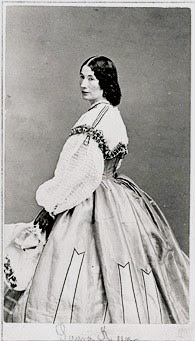
Charles DeForest Fredericks' photographic career was already firmly established.  In 1853 he had moved to Paris where he became the world's first photographer to create life-sized bust portraits, which were then hand-colored.  Returning to New York the following year, his studio at 585 Broadway was popular for its cartes de visites, or cabinet card photographs.  Among those he photographed were Civil War generals Philip Henry Sheridan and George B. McClellan, and the President's son, Tad Lincoln.  Ironically, actress Laura Keene who would be on stage when the President was assassinated, was photographed by Fredericks, as was actor John Wilkes Booth, who fired the fatal shot.

Charles D. Fredericks's portrait of Laura Keene, from the collection of the National Portrait Gallery, Smithsonian Institution.

On November 23, 1882 the New-York Tribune reported that R. Worthington "intends to close his retail department and to confine his attention to his own publications."  A month later an announcement in the newspaper was entitled "Closing Out" and offered "fine, standard and illustrated books" at sale prices.

Charles D. Fredericks now expanded into most of the building.  Mary J. Parker hired architect Jonathan B. Franklin to make renovations, including the removal of the stoop and a new storefront.

In January 1885 Richard Worthington declared bankruptcy.  Charles Fredericks now took over the entire building and in May that year brought Franklin back to make massive changes.  The architect's plans called for "raising attic to full story, new flat roof, also internal alterations, new beams, &c."  The changes would cost Fredericks the equivalent of $145,000 in 2023.

Charles DeForest Fredericks, from Anthony's Photographic Bulletin, January 1, 1894 (copyright expired)

Jonathan B. Franklin's renovations resulted in a fashionable Second Empire building.  The new, elegant cast iron storefront featured stained glass transoms that announced the firm's name and an elaborate entablature with a cast iron banner that read "Photographic Portrait & Art Gallery."  Decorative panels and frothy lintels embellished the second and third floors, and the new fourth floor took the form of a stylish mansard capped with ornate cresting.

On February 8, 1893, The Evening World commented on Fredericks's esteemed career.   "He has been taking pictures for fifty years [and] is the oldest photographer in New York...He has taken the pictures of most of our recent Presidents, including Harrison and Cleveland."  Only a year later, on May 25, 1894, Charles DeForest Fredericks died at the age of 71.

At the time of his death, the massive A. T. Stewart & Co. store covered the Broadway block from 9th to 10th Street.  In November 1896 Philadelphia retailer John Wanamaker moved his department store into the building.  Almost immediately he began buying up the properties on the block to the south, and by 1902 had successfully acquired the entire parcel, including 770 Broadway.  The buildings were demolished to make way for the Wanamaker Annex, which survives.


LaptrinhX.com has no authorization to reuse the content of this blog