Showing posts with label east 31st street. Show all posts

Friday, June 5, 2026

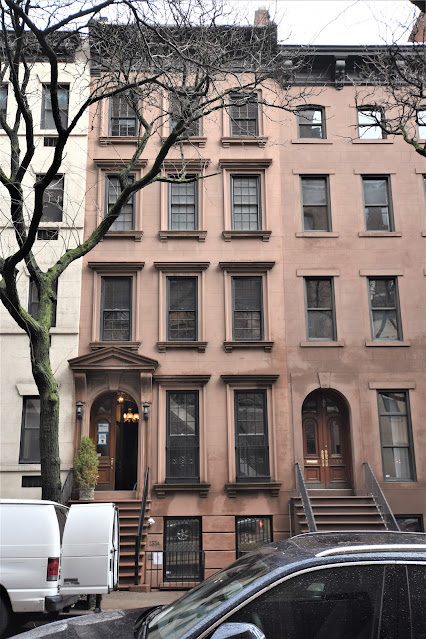
The Arthur and Anna Eisemann House - 212 East 31st Street


photograph by the author

A long row of modest houses on the south side of East 31st Street between Second and Third Avenues was completed around 1867.  Above rusticated brownstone basements, their upper three stories were faced in red brick.  At 20-feet wide, their stripped-down take on the popular Italianate style included a surprising vermiculated band below the parlor level (an unnecessary cost to the builder), floor-to-ceiling parlor windows, and individual bracketed cornices.

No. 212 East 31st Street was apparently leased, initially.  Adolphus Sinsheimer, an "agent," and his family lived here from 1868 to 1869, followed by Abraham Levy.  The clothier had two shops on the Bowery.  He and his family remained through 1874.

The residence next became a boarding house.  The small number of tenants reflected its high-end status.  Living here in 1876 were Edward S. Dex, Bartholomew and Felix Smith, and Catharine A. McLean, none of whom listed professions.  Catharine was the widow of Laughlin McLean, and it was possibly she who placed an advertisement in the New York Herald in March that year:

A young lady will give instruction on piano for $10 per quarter, with privilege of practice daily.  212 East 31st st.

The advertisements appeared routinely through 1879.  Bartholomew and Felix Smith were listed at the address through 1880.

Alice J. Bolmer, a widow, purchased 212 East 31st Street in August 1882, but she did not retain possession for long.  She placed an advertisement in the New York Herald on July 8, 1885:

A great sacrifice will be made if sold at once; must be sold, as the owner is going West; three story high stoop, all improvements, 20x45x100, 212 East 31st st.; this house is the most perfect home in the city; do not fail to examine at once.

Alice Bolmer sold the house to Jacob and Margaret Sauter for $13,000--about $438,000 in 2026.  It appears that the couple operated it again as a boarding house.  Among their boarders in 1886 was Mary Leonard, who abruptly moved out in September.  Soon afterward, men arrived at 212 East 31st Street to repossess a large amount of furniture.

Calling her "quite a business woman," the New York Herald explained on November 22, 1886 that Mary Leonard "at various times called herself Fanny Walsh, Duane, Stanley, Kelly and Lee, and that a large number of furniture dealers have made her acquaintance at considerable loss to themselves."

Mary Leonard had gone to several furniture dealers, telling them "she was honest, and had to have furniture because she was trying to support her four fatherless children by starting a boarding house."  She managed to purchase $190 worth of furniture from Thoesen & Uhl, a piano worth the same amount from Samuel Parsons, and $200 worth of furniture from George Reubel.  She had placed small amounts of money on credit and had the goods shipped to 212 East 31st Street.  She then waited on the sidewalk and when the deliverymen arrived, redirected them to an alternate address.  She was long gone before the dealers began looking for the unpaid goods.

Jacob Sauter died in 1887 and Margaret tried to hold on to the property, taking out a second mortgage in 1888.  She was not successful and the house was sold at auction on June 20, 1890 for $12,650.  It was sold again in 1892 to Lisette and Adolph Starke, who resold it in 1897 to Mary J. Mitchell.

The house finally returned to a single-family home in May 1903 when Martin L. Campbell purchased it from Mary Mitchell.  Campbell was a civil servant, working as a "tapper" in the Department of Water Supply, Gas and Electricity.  

In the spring of 1909, a proposal was bandied about to change the title of "assistant tapper" to simply "tapper."  Campbell was not entirely on board with the move, and in April he and Thomas F. McCormick sent a letter to the department.  It pointed out that they were "the only persons registered as Tappers in the Boroughs of Manhattan and The Bronx," and, while they did not oppose the change, "they would like to be protected in their higher position by a title such as Superintendent, Supervising or Foreman Topper, etc."  (It is unclear whether the proposal was accepted.)

In 1940, the rustication of the basement and its vermiculated band, along with the original floor-to-ceiling parlor windows survived.  via the NYC Dept of Records & Information Services.

Campbell remained at 212 East 31st Street until 1912, when he sold the house that December to Anna and Arthur Eisemann.  A graduate of Cooper Union, Arthur was an architect and independent contractor.  He and Anna had two daughters, Alma and Bertha.

His work drew important clients.  On September 17, 1921, for instance, the Real Estate Record & Builders' Guide reported that John D. Rockefeller, Jr. had commissioned him to make "alterations" to the four-story residence at 24 West 54th Street.  Eisemann was, as well, the president of the Society of Painting and Decorative Trades.

Anna Eisemann died on May 27, 1927.  Arthur moved permanently to Elmhurst, New York and the East 31st Street house was rented by Anna's estate.  Her will directed, "Income from the property at 212 East Thirty-first street, Manhattan, is to be divided among the children equally."

The house was converted to apartments in 1946.  A subsequent renovation completed in 1959 resulted in a duplex in the basement and parlor level, one apartment on the second floor and two on the third.  During one of those renovations, the rustication and vermiculated band of the basement were erased and the parlor windows shortened.

Wednesday, April 29, 2026

The Henry H. Keeler House - 128 East 31st Street


On November 11, 1856, Henry H. Keeler was married to Rachel C. Crane in "the Lafayette-place Church," as reported by the New-York Tribune.  Keeler was a partner with Julius A. Candee and Cornelius C. Demarest in the lime business Candee, Keeler & Co.  The newlyweds moved into the new three-story-and-basement house at 74 East 31st Street (renumbered 128 in 1867).  

The 16-foot-wide, brownstone-faced residence had been completed around December 1855.  Its cutting-edge, French Second Empire design included an arched pediment supported by foliate brackets over the doorway, and a projecting, three-sided parlor oriel.  The upper floor openings sat within robust architraves with molded cornices.  The leafy entrance brackets were echoed in the cast metal cornice.

Keeler was drawn into the mysterious case of Jane Augusta Blankman's death in 1860.  He and five other businessmen were impaneled as the coroner's jury to investigate the woman's "sudden demise, burial, and subsequent exhumation."  Jane Blankman's body had been exhumed "on the supposition that her decease was occasioned by sinister means," explained The New York Times on October 22.  After hearing lengthy testimonies, Keeler and his peers ruled that the 35-year-old had died from a stroke.

By 1864, the Keelers had moved to West 26th Street.  Merchant John Johnson and his family occupied the 31st Street house, while broker Conrad Phillip Bruns lived on Staten Island.

Bruns married 22-year-old Charlotte Emilie Switzer on December 16, 1863.  Interestingly, both of them went by their middle names.  Around 1866, they moved into the former Keeler house.

Born in Bremen, Germany on February 23, 1837, Bruns emigrated to the United States in 1858.  He found a job as a clerk in a brokerage house and rose within the firm.  The young man arrived at a propitious time.  In 1859, Edwin Drake successfully struck oil in Pennsylvania.  It triggered a frenzy of trading in "paper oil" and oil certificates.  The Evening World would later comment that Bruns, "made a fortune in the early days of oil speculation."

Not long after the couple moved into the East 31st Street house, twin boys--Philipp and William Ferdinand--were born on January 6, 1867.  Sadly, Philipp died five months later on June 24.  Another son, Edwin George, arrived on March 3, 1870.

Charlotte Emilie Bruns died at the age of 30 on April 23, 1872.  Her funeral was held in the parlor at 2:00 on the afternoon of the 25th.

Emilie had had domestic help, of course, but now servants were even more essential in the all-male household.  On April 25, 1873, an advertisement in the New York Herald sought: "Wanted--A cook; one who has lived in a German family preferred; also a chambermaid to assist in washing.  Apply, with reference, at 128 East 31st street."

Phil Bruns (as he was known familiarly) was "noted for his open-handed generosity," according to The Evening World.  His son seemed to have inherited the trait.  The 1888 Annual Report of The New York Society for the Prevention of Cruelty to Children noted that William F. Bruns had donated "25 books for reception-rooms" to the facility.

Known to his friends as Willie, William Ferdinand Bruns died in the house on July 25, 1889 at the age of 22.  His funeral was held in the parlor two days later.

By then, Philip Bruns was well-known and well respected in Wall Street circles.  He had purchased his seat in the New York Stock Exchange in 1869 and now he and his surviving son were partners in the firm of Edwin G. Bruns & Co.  

At some point Philip Bruns had begun a romance with Madge M. Gurney.  It is possible that the two never married because Madge was "a victim of an incurable disease," according to The Evening World.

Conrad Philip "Phil" Bruns (original source unknown)

On the evening of August 4, 1893, Bruns met Henry G. Hilton to have dinner at the Casino in Central Park.  They rode in Hilton's surrey and, as reported by the New-York Tribune, "In turning the corner at Fifty-eighth-st. and Seventh-ave. the vehicle went around so quickly that Mr. Bruns was thrown out and he fell heavily on the pavement."  Hilton rushed back to his friend, "who was bleeding profusely."  Bruns was taken back to 128 East 31st Street where Dr. Henry Forbes said he was suffering with a broken nose and two fractures of the collar bone.  "The most serious injury, however, was the cutting of the artery under the right eye, which had caused a great loss of blood," said the article.

The next day Bruns was described as "delirious" and "in an exceedingly critical condition."  That evening, Madge Gurney visited him and "remained with him for sometime," according to The Evening World.  

Phil Bruns lingered for nearly two weeks, dying in the East 31st Street house at 6:15 p.m. on August 15 at the age of 56.  The Evening World commented, "The death of Philip Bruns removes from Wall street one of its most familiar and well-known personages."

On August 19, The Evening World reported that when Madge Gurney heard of Bruns's death, "she appeared to be greatly dejected."  The newspaper announced, "at 6:15 P. M. the next day she died at her rooms in the Milburn apartment house."  The article said they died 24 hours apart to the minute.

Perhaps because of the anticipated large attendance, Conrad Philip Bruns's funeral was not held in the house, but in the Church of the Transfiguration.  On August 17, The Evening World reported, "The casket was almost buried in flowers."

Before the turn of the century, George Bruns sold 128 East 31st Street to George Florence Scannell and his wife, the former Elizabeth Rafferty (known as Lizzie).  The couple had three sons: Frank Joseph, John Jay, George Jr.; and a daughter, Marie F.

Born on February 22, 1860, Scannell was highly involved in Tammany politics.  He worked as a clerk in the Surrogate's office and was the leader of the 25th Democratic District and the chairman of the Seneca Club.  

In the fall of 1900, the family received a horrific scare.  John, who was 15 years old, attended the College of St. Francis Xavier on West 15th Street.  He and a number of other boys were "playing leap-frog" in the gymnasium, according to the New York Herald on October 10.  The New-York Tribune explained that John, "had succeeded in jumping over two boys, and was trying to jump over three, when he fell, striking his head on the floor."  The New York Herald reported that he was taken to St. Vincent's Hospital unconscious and diagnosed with a "concussion of the brain."  The New-York Tribune's report was more dire, saying that the teen had sustained a skull fracture.  At the hospital that evening, his father was told "that his son would probably recover," said the New York Herald.  Happily, John Jay Scannell did recover.

On January 1, 1904, Manhattan Borough President John F. Ahearn informed the Municipal Civil Service Commission that George F. Scannell had been appointed Superintendent of Highways.  He replaced James G. Collins, whom The New York Times said had been "ousted" by Ahearn.  The position came with a salary of $5,000 (about $175,000 in 2026).

In 1905, a woman who said her name was Mary Scannell, began appearing at the stoop of 128 East 31st Street and at Scannell's office on Park Row.  She said she was the daughter of Scannell's brother, Thomas, and when he died, when she was five years old, she was sent to a convent.  She tracked down George Scannell, she said, through the New York Foundling Asylum.  Now she insisted that he support her.

The major flaw in Mary Scannell's story was that George never had a brother named Thomas.  She was, nevertheless, persistent.  Two years after she first rang the bell of 128 East 31st Street, George Scannell's patience was exhausted.  When she showed up at his office again on August 17, 1907, he had her arrested.  The New York Times reported, "She was sent to Bellevue Hospital for observation as to her sanity."

George Scannell's promotion to Superintendent of Highways in 1904 turned into a nightmare for the family.  James G. Collins had not gone quietly after being fired.  He sued the city and Scannell.  The New York Times reported, "To safeguard the city in case Collins should win the suit Scannell had to furnish a $10,000 bond to guarantee that he would turn back his salary to Collins.  His own house, which stood in his wife's name, was put up as security."

In December 1909, James G. Collins "bodily took possession of Scannell's office," reported The New York Times.  He barricaded himself inside and "held the fort for a number of days."  Astoundingly, Collins's ploy worked.  The newspaper said that Mayor William Jay Gaynor's "revocation of the office of Commissioner of Highways" finally "induced Collins to surrender his stronghold."  The article concluded, "Thus Scannell lost his job."

Not only did Scannell lose his job, Collins continued to sue him personally for his back wages of about $30,000, or about $1 million today.  In the meantime, Scannell was appointed the Superintendent of Records in the Surrogates' Office--the same position in which he had started.

George F. Scannell fell ill in May 1912.  On September 19, The New York Times headlined an article, "George F. Scannell Dead From Worry."  The 52-year-old had died in the 31st Street house the previous evening.  The Times reported, "It was the prospect of losing everything in the world, Mr. Scannell's friends said last night, which had suddenly made such a noted change in the man."

The original 1850s detailing was intact in this 1940 photograph.  image via the NYC Dept of Records & Information Services.

On January 3, 1913, The New York Times printed a one-line story:  "Frank J. Scannell, son of George F. Scannell, has been appointed to his father's place as Superintendent of Records of the Surrogates' office."

The Scannell family finally received welcomed news in June 1916.  A court ruled that James G. Collins was entitled only to $3,000.  Elizabeth Scannell's tenuous hold on her home was restored.

Two months later, on August 22, George was married to Elizabeth O'Brien in the Church of St. John the Evangelist on East 55th Street.  Marie (who would never marry) attended the bride and John J. Scannell was his brother's best man.  

Frank was still living here with his mother and Marie as late as 1920, when he was appointed a commissioner of deeds.  Elizabeth sold 128 East 31st Street in September 1924 to the 5 Gramercy Park, Inc.

The firm operated the property as a rooming house and it continued to be such for decades.  When Mary Macfayden and her husband, Frank Netter, purchased the house in 1960, it was described as being vacant.  It was resold in 1964 when the couple began divorce proceedings.

A renovation completed in 1969 resulted in a photography studio in the basement.  It was most likely during this time that the Victorian details were removed from the doorway and windows.  

Shocking publicity came in 1981 when, on January 15, The New York Times reported that four men had been arrested for "operating houses of prostitution," one of which was 128 East 31st Street.


Renovations done in 2009 returned 128 East 31st Street to a single family home.  Despite the loss of most of the Italianate details, the Keeler house manages to retain its architectural charm.

photographs by the author

Saturday, April 26, 2025

George F. Pelham's 1931 121 East 31st Street


After learning his trade in the architectural office of his father, George Brown Pelham, George Fred Pelham opened his own office in 1890.  Having earned a solid reputation as a designer of apartment buildings and hotels, in 1930 developers Psaty & Fuhrman commissioned him to design an apartment building at 119 through 125 East 31st Street.

Pelham routinely drew from historic styles and for 121 East 31st Street he turned to the English Regency period.  Completed in 1931, the 12-story-and-penthouse structure was faced in red brick, its setbacks starting at the tenth floor perfectly symmetrical.  Pelham was perhaps inspired by the elegant 18th century designs of Robert Adam in the tracery above the doorway, the double-height fluted pilasters with lotus capitals that flanked it, and the delicate swagged frieze above the second floor.

George Fred Pelham released this rendering in 1930.  The New York Sun, May 3, 1930.

Among the initial residents were Dr. Harrison I. Cook, who leased the penthouse on March 22, 1931, and Marcus Meltzer.  Cook graduated from Bellevue Medical College in 1911 and Meltzer was the chief statistician of the National Bureau of Casualty and Surety Underwriters.

Born in 1883, Meltzer was born in Russia and was brought to America by his parents at the age of eight.  The New York Times said, "He was widely known for his work, not only in his field but among societies and associations, and was a writer and lecturer on his subject."  Meltzer's passion for statistical work spilled into his private life.  While other male residents in the building may have been members of social, political or athletic organizations, he belonged to the American Statistical Association, the Casualty Actuarial Society and the Association of Casualty and Surety Accountants and Statisticians.  He was one of the founders and the secretary of the latter society.

Meltzer was a bachelor and apparently shared his apartment with a roommate.  His enjoyment of his new home would be extremely brief.  He left his office on March 17, 1931 at around 8:00 "in apparently good health," according to The New York Times.  A doctor was called to the apartment around 2 a.m., presumably by Meltzer's roommate, who found the 48-year-old dead.  He had suffered a fatal heart attack.

photograph by Lowell Cochrane

Crawford Blagden and his wife, the former Mary Hopkins, were also initial residents.  The couple was married on October 7, 1911 and had one son, Crawford, Jr., who was born in 1912.  For some reason, the younger Blagden went to live with his father's brother, Francis Meredith Blagden, and his wife, the former Lydia Lawrence Mason Jones, at Sloatsburg, New York shortly after the family moved into 121 East 31st Street.

Francis and Lydia were married on August 22, 1917.  Lydia was previously married to Francis's and Crawford's older brother, Albert Campbell Blagden, who died in 1915.  Crawford Jr. was living with them when his engagement to Mary Kernochan, daughter of Chief Justice Frederic Kernochan was announced on April 18, 1933.

Benjamin S. and Carolyn Pulitzer moved into the building that year.  Pulitzer was president of Mayfair Cravats, Inc. a men's neckwear company.  Apparently the couple over-indulged on the night of April 28 that year.  At 8:30 the following evening, she went to the office of Dr. Frank H. Russell, her regular physician, "suffering from the after-effects of intoxication," according to The New York Times.  

Russell administered what the newspaper described as "an overdose of morphine."  Carolyn Pulitzer fell unconscious and the next morning, at 4:30, Dr. Russell took her home in a cab.  Carolyn later testified that "a hallboy in the apartment house had helped the doctor get her to her apartment."  She said Russell tipped the hallboy from change from her purse.  That was not the only thing the doctor slipped from her bag.  

When Carolyn awoke later, she discovered $12,000 worth of Mayfair Cravats, Inc. stock was missing.  In court, Russell admitted he took the stock, "but was holding it until she completed payment for treatments."  Carolyn Pulitzer, "said she thought she owed about $40 or $50, but that he maintained the bill was $200."  (None of those amounts would necessitate a $12,000 guarantee.)  The startling case was dismissed when Carolyn, somewhat surprisingly, agreed to drop charges if Russell returned the stocks upon her paying his bill.

William Russell and Walter Kaufman shared an apartment here in the summer of 1937.  They, along with Augusta Merten, took the train to Silver Point at East Rockaway on July 28 to enjoy the beach.  They had dinner later, then "decided to go bathing again," reported The Rockaway News.  Augusta was a few yards ahead of Russell and Kaufman in the water when she was swept up by the undertow and carried out.  As Russell and Kaufman swam to rescue her, an off-duty patrolman Joseph Lynch, "who was bathing nearby," joined the effort.

Lynch and Kaufman were able to pull the woman to the beach, but quickly realized that Russell was missing.  The Rockaway News reported, "Life Guard Roy Bower of Woodmere found Russell's body floating in the water a few hundred feet from where he had gone down."  Surprisingly, the 48-year-old had not drowned--an autopsy showed no water in his lungs.  The doctor deemed his death, "from a heart attack resulting from the excitement of attempting to rescue Mrs. Merten."

Dr. Harrison I. Cook was still living here on November 6, 1941 when he hosted a glittering dinner party in the Trianon Room of the Ambassador Hotel in honor of the engagement of Mildred L. Martens and Lt. George De Metropolis of the U.S. Navy.  Among the 40 guests listed in The New York Times, understandably, were several military officers and their wives.

Living here at the time were Lewis E. and Florence G. Birdseye, born in 1873 and 1874 respectively.  Until 1931, when Lewis was appointed the general agent for the St. John's Guild, a charitable institution established in the 1890s, he was superintendent of the Jewish Hospital in Brooklyn.  Lewis was at his desk in his office at 1 East 42nd Street on the afternoon of Christmas Eve, 1942, when he collapsed with a fatal heart attack.

A month later, another resident, Marc MacCollum, laid plans to find a weekend retreat.  His ad in The Rhinebeck Gazette on January 28, 1943, read: "Wanted--I would like to hear from someone who would like to have a paying guest over weekends.  I have simple but clean tastes and like to saw wood."

Ray W. Thompson and his wife did not need to rely on someone else's country home for respite.  On October 5, at the end of the summer social season of 1950, The East Hampton Star announced, "Mr. and Mrs. Ray W. Thompson have left Amagansett for their New York home, 121 East 31st Street."

An interesting resident was Dr. Tibor Eckhardt.  His wife, the former Judy Dwyer, died in 1966.  Born in Makó, Hungary in 1888, he studied at the Universities of Budapest, Paris and Berlin, earning a Doctor of Jurisprudence degree.  He served in the Hungarian Ministry of the Interior, the Hungarian Ministry of Foreign Affairs, and in 1920 served in the Premier's office.  He was elected to the Hungarian Parliament in 1922.

Dr. Tibor Eckhardt in 1931.  (original source unknown)

At the time, Hungary was experiencing what was known as the "White Terror"--a period when leftist intellectuals, especially Jews, were being purged.  In 1923, Eckhart joined the Smallholders Party, the leading faction of the Hungarian Opposition. He became its president in 1934 and was Hungary's chief delegate to the League of Nations in 1935.  

That year he joined the Democratic Opposition, which was fighting against the growing Nazi movement.  When Hungary sided with Germany during the war, Eckhardt escaped to the United States in 1941.

Here he initiated a movement for the restoration of Hungarian independence that would spread world-wide.  He helped organize the Hungarian National Council in 1948 and was a member of its executive committee.  He sat on the Assembly of Captive European Nations in 1954.  While living here in 1972, he published, From Yalta to Potsdam.

In 1975 the residents of 121 East 31st Street lost what some might have seen as a nostalgic reminder of the 1931 era--the elevator operator.  On March 30, The New York Times reported that the new owners, Teitelbaum Holdings, "plans to automate the elevators in the 96-unit apartment house, but not to make other major changes."

photograph by Lowell Cochrane

Outwardly, George Fred Pelham's dignified design survives essentially intact.

many thanks to reader Lowell Cochrane for suggesting this post

Wednesday, May 24, 2023

The Altered Charles H. Haswell House - 111 East 31st Street


photo by Ted Leather

In 1851 Charles Haynes Haswell and his family lived in the recently completed house at 59 East 31st Street.  (The address would be renumbered twice, to 61 East 31st Street in 1855, and to 111 East 31st Street in 1868.)  The high-stooped Italianate style house reflected the affluence of its owners.  The floor-to-ceiling parlor windows were, most likely, fronted by an ornate cast iron balcony.  The arched entrance was crowned by a prominent cornice upheld by foliate brackets, and the house was crowned with a handsome bracketed cornice.

Born on May 22, 1809 to a prominent family (his father, Charles Haswell, was a member of the British foreign service and his mother Dorothea Haynes was born on her family's plantation in Barbados), he began the study of engineering at the age of 19.  In 1846 he wrote the Engineers' and Mechanics' Pocket Book, which would have at least 17 printings throughout the 19th century.  In 1851, while living here, he was appointed Chief Engineer of the United States Navy, the first in its history, a newly formed position.

Charles Haynes Haswell in later years.  (original source unknown)

Haswell had married Ann Elizabeth Burns in 1829.  The couple had six children who survived into adulthood, Sarah, Edmund, Frances Roe, Gouverneur Kemble, Charles, and Lillie Bulwer.  

Living with the family was Haswell's widowed mother, Dorothea.  She died on November 21, 1854 at the age of 76.  Her funeral in the parlor was most likely the first in the 31st Street house, but it was by no means the last.

Almost immediately afterward, Haswell sold the house to James Theophylact Bache and his family.  It appears that the two families were well acquainted.  A stockbroker, Bache had married Rosabella Trueman (sometimes spelled Truman) on February 22, 1833.  The couple had seven children, two of whom died in infancy.

James T. Bache's business partner was Wallace Truman, possibly Rosabella's brother or father.  A year earlier, Bache suffered embarrassment when he was arrested on April 28, 1853, for running a "lottery policy."  According to George S. Meshural's complaint, Bache ran a side gambling operation from his brokerage office at 174 Broadway.  A gambling addict, Meshural claimed he went there every day for eight months and, according to The Sunday Dispatch, "frequently during that time he has paid him as much as $300 per day."  According to Meshural, said the article, "the sum total of his purchases of policies from the accused...is about $8000."  (It was a substantial amount, equaling nearly $290,000 in 2023.)

Despite the humiliation, Bache seems to have continued his illegal sideline.  On October 22 the following year, the New-York Dispatch reported, "James T. Bache and Wallace Truman, keeping an office in Broadway, near Maiden-lane, were on Friday arrested by Officer Rose...charged with selling lottery policies to Warren Matton."

In 1855 the Baches' eldest son, John Henry, was 19 years old and entered the leather business.  Within three years he would join his father in the brokerage office.  In the meantime, the close relationship between the Haswell and Bache families resulted in a romance.  On May 18, 1859 John Henry Bache and Francis Roe Haswell were married in the nearby St. John the Baptist Church.   The newlyweds moved into the 31st Street house that Francis had once called home.

The Bache family's affluence was evidenced in James's stable of thoroughbred racing horses and his yacht, the Mallory.  In 1859 Bache was elected the commodore of the Hoboken Yacht Club.

On August 11, 1861 John Henry and Francis had a baby boy, James Henry Bache.  Their joy turned to grief three months later when the infant died on November 18.  His funeral was held in the house on November 20.

The following year, on August 9, 1862, James Theophylact Bache died, "after a lingering illness," according to the New-York Daily Tribune.  Once again there was a funeral held in the house.

Almost immediately, Bache's son and executor, James Phillips Bache, began selling his father's racehorses.   An advertisement on November 9 listed "three valuable horses," Morgan Jackson, Nonpareil, and Lady Irving, with their pedigrees and details.  The following year, in October, he advertised a pair of trotters:

For Sale--A cross match team of mares, a black and a gray, beautifully formed, long tails, 15 hands high; can trot in three minutes together; also one light Phaeton, with top, Harness, Blankets, Whips, &c.; will be sold as the owner has no use for them.

The family that had experienced so much pain over the past few years had something to celebrate when Charlotte Barclay Bache married William H. Crossman in the Church of St. John the Baptist on June 16, 1863.

With all his father's horses and racing vehicles sold, James offered the private stable for rent in April 1866.  His ad read, "To Let--The stall and yard 63 East Thirty-first street; accommodation for seven horses and all conveniences."

Rosebella and her unmarried children remained in 111 East 31st Street until 1870.  To liquidate her husband's estate, it and seven other Manhattan properties were sold at auction on March 15, 1870.

The new owner briefly leased 111 East 31st Street to Dr. Wilson Peterson.  Born in 1831 he had graduated from the Hahnemann Medical College in Philadelphia in 1858.  During the Civil War he served at the hospital at Annapolis.  While living here he worked at the city hospitals on Ward's and Blackwell's Islands.

In 1873 111 East 31st Street became home to the family of attorney Stephen Henry Olin.  Born on April 22, 1847, he had graduated from Wesleyan University in 1866 and two years later began his law practice in New York City with Olin, Rives & Montgomery.  His wife Alice Wadsworth Barlow came from a socially prominent family, the daughter of Samuel Latham Mitchill Barlow and Alice Cornell Townsend.  The couple had two daughters, Alice and Julia.

The ancestral Olin country estate, Glenburn, was just outside of Rhinebeck, New York.  The family also maintained a summer home in Glen Cove, New York.

A turn of the century postcard depicted Glenburn.

Stephen Olin narrowly escaped death on June 28, 1880 when he boarded the steamboat Seawanhaka, which ferried passengers to and from Long Island.  The vessel was near Wards Island when a boiler exploded, setting fire to the boat.  The New York Times reported that among the wealthy passengers, "near a score of them were consigned to a horrible death, while many more received painful injuries."  

Olin escaped without harm and, somewhat coldly, seemed to blame the deaths and injuries on the victims' actions.  "Few of the passengers behaved quietly," he told a reporter from The Sun.  "Some were crying out and appeared panic stricken.  Those who were cool escaped."

Alice Barlow Olin died in the Glen Cove residence on November 7, 1882 at the age of 29.  Stephen sold the East 31st Street house to banker Charles B. Henderson not long afterward.  (Stephen H. Olin would marry Emeline Harriman, the widow of William Earl Dodge and sister of Anne Harriman Vanderbilt, in 1903.)

Henderson and his wife, Jeanie North, had two daughters, Frances Beatrix and Janet Louise.  Living with them was Janie's widowed mother. 

Like the families before them in the house, the Hendersons moved among the highest levels of society.  Their social position was reflected in The New York Times report of Frances's wedding to Nathaniel Thayer Robb in St. Bartholomew's Church on November 27, 1895.  (The Robb mansion at 23 Park Avenue, incidentally, was a showplace.)  The article said the church was crowded "with people prominent in society in this city, Boston, and Philadelphia."  After the ceremony, a reception was held at 111 East 31st Street.

This portrait of Frances Henderson Robb was painted in 1899.  from the collection of the New-York Historical Society.

Exactly two years later to the day, Janet Louise was introduced to society.  On November 27, 1897 The New York Times reported that Jeanie "gave a coming-out reception for her second daughter," noting, "Sixteen young society women, several of them buds of last season, helped the debutante and her mother receive."  Their names came from the highest echelons of Manhattan society, including Schieffelin, Iselin, Delafield, Alexander, Howland, and Biddle.

As the turn of the century approached, the once exclusive residential neighborhood was seeing the incursion of commerce.  In 1899 Henderson sold 111 East 31st Street to Charles L. Hesselbach and his wife, the former Henrietta Scheuplein.  Hesselbach installed his upholstery shop in the basement level.  He and Henrietta moved into residence proper.

In 1907 Hesselbach branched out, buying two acres of land in Newark, New Jersey.  On June 6 that year, The Iron Age reported that he was "purchasing machinery for a structural iron plant to be erected" on the site.  The article noted, "While Mr. Hesselbach has an office at the New York address, he is spending much of his time in Newark at the site of the proposed plant."  The Calmuet Iron Works was completed that year.

Henrietta Hesselbach died in the East 31st Street house on June 2, 1910.  Her funeral, on June 4, would be the last to be held in the residence.

In 1941 the stoop and Victorian detailing survived.  The shop that had been home to Hesselbach's upholstery business is below curb level.  image via the NYC Dept of Records & Information Services.

Charles V. Hesselbach continued to live and run his upholstery store in the building at least through 1924.  In 1955 a renovation resulted in the removal of the stoop and the shaving off of the Victorian details, leaving only a hint of the once elegant mansion.  There were now an office on the first floor and two apartments each above.   

many thanks to reader Ted Leather for suggesting this post
no permission to reuse the content of this blog has been granted to LaptrinhX.com

Saturday, April 30, 2022

The William H. Newschafer House - 227 East 31st Street


In 1857 attorney William H. Newschafer lived in the newly built house at 139 East 31st Street (renumbered 227 in 1868).  One of four identical 17-foot-wide homes, it was designed in the emerging Ango-Italianate style.  Short stone stoops led to the single-doored entrances.  The eye-catching cast iron lintels of the second floor windows set the design apart.  Their frothy French-inspired brackets and keystones reflected the domestic tastes of the 1850's.  Newschafer would be the first of a long string of occupants through the decades.  

By 1863 John F. Kellers, a grocer, lived here, followed the next year by Captain William H. Russell, a seaman.  In July 1865, The New York Times published a list of the notable "illuminations," or decorations, for Independence Day.  The 31st Street neighbors apparently got together to make their block especially patriotic and seven homes were chosen by the police department for listing.  Among them was the residence of "Capt. Russell, No. 139 East Thirty-first street."

By the late 1860's, Charles K. Hyde and his family lived in the house.  He was an inspector for the Department of Buildings.  The Hydes would remain until 1872 when they leased it, and then advertised it for sale in 1873.  The ad mentioned, "ten rooms; all modern improvements."


William H. Fisher, the proprietor of an eatinghouse, purchased 227 East 31st Street, and would remain at least through 1879.  By the early 1890's it was home to Margaret Meredith, whose son, Edward, had been sent to Sing Sing prison on December 20, 1888 for shooting Phil Daly, known by the press as "the gambler king."

Edward J. Meredith had "received a classical education, is an excellent bookkeeper, and one of the most expert penmen in the country," said to The New York Journal.  His clerical abilities were valuable in the prison office, but the warden discovered that he was taking detailed, and potentially damaging notes.  The New York Times expounded, "while in Sing Sing Meredith was a bookkeeper in Warden Brown's office, and soon after he had made some reflections on the management of the office he was sent to the State Asylum for the Insane at Matteawan."  Meredith arrived at the asylum on September 11, 1891.

Margaret "made strenuous efforts to secure his release from the asylum, declaring that he is not insane," wrote The New York Times on August 9, 1893, "and she finally secured the writ of habeas corpus."  Judge Barnard in the Poughkeepsie Supreme Court had deemed her son sane.

With "his mother promising to look after him," according to The Sun, Meredith was released October 18, 1894 at the expiration of his term.  At the time of his release the superintendent of the asylum, Dr. Allison, was not in total agreement with Judge Barnard's ruling:

We do not concede that he is not insane, nor that he is cured of his hallucination; but his mother and his friends seem positive that if he is given a chance he will lead a new life.  His mania is not dangerous in any event.

Edward returned to 227 East 31st Street and two months later his sanity would be weighed one more time.  On December 24 a commission was assembled to rejudge his mental stability.  The Sun reported, "It was said that the purpose of the commission is to care for his property, which is worth $5,000."  That property was in the form of an exposé book about Sing Sing--his compiled notes that he had somehow carefully guarded and spirited out with him.  

Meredith leaked portions of his manuscript that appeared in an article in The New York Times in November 1894.  In it he said he that when had found a deficiency of over $80,000 in the prison accounts, the warden told him to "fix the books."  It was when he refused, according to Meredith, that "he was persecuted by the prison officials, who conspired to have him removed to the Matteawan Asylum."  

Prison officials were quick to respond to the serious allegations.  Principal Keeper Connaughton called the accusations "pure inventions," and Warden O. V. Sage insisted, "The books show a good, clean record."

Things did not turn out well for Edward Meredith.  His book, for one thing, was not published.  Then, on February 9, 1897, the New York Journal reported, "The man who was arrested Sunday night for attempting to blackmail ex-Corporation Counsel Almet F. Jenks of Brooklyn, is the same man who once shot Phil Daly, the noted sporting man."  The article noted, "When arrested the prisoner said that his name was Edward J. Russell.  But to Mr. Daly, the New York police, to the officials of Sing Sing Prison and to the authorities at Matteawan Insane Asylum he was always known as Edward Meredith."

The New York Journal, February 9, 1897 (copyright expired)

Meredith was convicted of blackmail and sentenced to ten years hard labor at Sing Sing.  In November 1904, the New York Attorney General, John Cunneen, wrote that Meredith, aka Russell, "is still an insane convict and properly confined in the Dannemora State Hospital for Insane Convicts."

By then the East 31st Street house was being operated as a rooming house, home to hard-working Swedish immigrants.  On January 28, 1897, an advertisement in The New York Times read, "Gardener, &c.--By young Swede as gardener on gentleman's place; understands good care of horses; many years' experience; best references.  Gardener, 227 East 31st St."  And on April 19, 1899, another position-wanted ad read, "Nurse and Valet for insane or sick gentleman; experience and reference good.  Hundgren (Swede)."  That year another Swedish resident named Lindstrom sought work as "Second or Third Man to family or clubhouse."  (The second and third men assisted the butler in his duties.)

Charles E. Coan took a room in the house following the end of World War I.  He was enraged and humiliated when he found that his name was included on the War Department's list of draft deserters.  The administrative error was straightened out on August 31, 1921 when Secretary of War Weeks announced that his military records and those of two other "deserters" had been found.  Charles E. Coan, who served in the army during the war, had been listed as Ernest Coan.

The exact nature of the relationship between two roomers, Joseph Bonsiglio and Mrs. Mary Reed, in 1938 is unclear, but in any case it was not good.  On September 19 Bonsiglio was walking along East 23rd Street at 2:30 in the morning when, according to him, he "felt a sting and found he had been wounded."  He had been shot in the back.

Minutes later, according to the New York Post, "an excited taxicab driver" hailed two policeman in their patrol car, saying "I just saw a woman shoot a guy up the street."  The cruiser drove up Third Avenue and saw Mary Reed.  "As they stopped to question her she reached for a pistol which she was holding under her left arm, but the policemen disarmed her."  Despite having shot Bonsiglio in the back, at the station house Mary professed self defense.  "I had to shoot him or I would have been in the morgue myself," she said.

The house was painted barn red in the early 2000's.  photo via apartments.com

The house continued to be operated as a rooming house until 1968 when a renovation was completed that resulted in a duplex in the basement and first floor, and one apartment each on the upper stories.  Then, in 2008, it was reconverted to a single family house.

photographs by the author
no permission to reuse the content of this blog has been granted to LaptrinhX.com

Friday, February 25, 2022

The William H. Wood House - 233 East 31th Street


In 1861 the family of William H. Wood lived in the newly-built brownstone house at 128 East 31st Street (renumbered 233 in 1868).  The 20-foot-wide, four-story house was designed in the popular Italianate style.  Above the high stone stoop, the arched entrance was crowned with a classical pediment.  Floor-to-ceiling windows added drama as well as light and ventilation into the parlor.  The openings of the second and third floors, sitting upon bracketed sills, wore pronounced molded cornices, while the simpler architrave frames of the top floor windows were gently arched.

On June 19, 1865, the Woods' eldest daughter, Annie A., was married to Alexander Pollock.  Almost a year to the day later, on June 14, 1866, the parlor was the scene of Josephine's wedding to James William Boyle.

The 21-year-old groom was an oyster dealer, but would go on to greater things.  He would eventually become one of the largest oyster dealers in the country and a force within Tammany Hall.

Two years after Josephine's wedding the Woods sold the house to Joseph A Monheimer, an alderman and contractor, and his wife Emma.  Monheimer enjoyed large civic contracts, such as the one signed on May 15, 1870 for "the paving of Seventh avenue, from Fourteenth to Fifty-ninth street, with the Stafford pavement."

It is possible that Joseph Monheimer's position as alderman contributed to his city contracts.  And whether it did or not, the situation would certainly be called out as a conflict of interest today.  At the time of the paving job, Monheimer was earning $4,000 per year as alderman.  In September 1873 he received an astounding 50% raise to $6,000--about $135,000 in today's money.

Like all affluent families, the Monheimers spent at least part of the summer season away from the city.  In 1874 their trip nearly ended very badly.  On August 17 the New York Herald reported, "Alderman Joseph A. Monheimer is reported lying very low of fever on the coast of Maine, whither he had gone fishing in the early part of the summer season."


A glimpse into the stair hall reveals remarkably surviving elements--an etched glass door and electrified gas chandelier.

The Monheimers remained at 223 East 31st Street until March 1880, when they sold it to Emeline and John O'Byrne for $15,000 (about $392,000 today).   O'Byrne was an attorney with offices in the Stewart Building on Broadway, having entered practice in 1862.

O'Byrne took on a major client in January 1889, the Oyster Dealers' Association, represented by, coincidentally, James William Boyle, who had been married in the 31st Street house 23 years earlier.  O'Byrne was retained to obtain rights from the State for the usage of the water front on the Hudson River from West 10th to West 11th Street, at the time known as the Oyster Basin.

Boyle's involvement with Tammany Hall may have been a major factor in the transaction being closely scrutinized by the city's Commissioners of Accounts.  In July O'Byrne received $13,000 payment for his services--more than $375,000 today.  The Commissioners of Accounts wanted to question him about the massive fee (especially since the oystermen had already been using the water front in question before he was hired).

On November 20, The World reported that John Redmond attempted to serve a subpoena at 233 East 31st Street, but "was met by Mrs. O'Byrne, who said that her husband was ill in bed and could not attend the dock investigation today.  She promised to send to the Corporation Counsel a doctor's certificate."

Indeed, Dr. T. F. Joyce sent a note which said in part that O'Byrne was "suffering great pain from a severe attack of sciatica; that said John O'Byrne is now confined to his bed and room and is utterly unable, and will be for a few days, to leave his house."  The World said, "The genial Colonel was out with Mrs. O'Bryne yesterday evening and did not return till late, so an employe[e] of the Corporation Counsel's office says.  He was stricken, however, about that time."  Finally, on November 29, a warrant for O'Byrne's arrest was issued.

O'Byrne weathered the legal storm and the couple remained at 233 East 31st Street until 1898 when it was purchased by Robert Loercher.  Loercher was president of A. Haug & Co., an importer of ornamental papers used in bookbinding.

The Loerchers, whose son, Walter, was attending the City University of New York in 1901, took in a boarder.   Annie C. Ackerly was no retiring widow.  In 1895 she had been hired by the New York Custom House as an inspector, attached to the Special Agent's Office.  She still held the position on the evening of January 11, 1907 when she died "suddenly" in the East 31st Street house.  Her funeral was held in the parlor the following Monday morning.

The Loerchers' boarders continued to be city employees.  Their next boarder was James J. Lynch, a "keeper" with the Department of Corrections.  In 1909 Michael J. Deviney lived with the family.  The bachelor had been a clerk in the County Clerk's office since the 1880's.

When World War I broke out, the Loerchers had three boarders.  One, Frank P. Young, was declared exempt from military service because of his position as cashier in the New York County Sheriff's Office.  Eugene M. Masterson, who lived here with his wife, the former Winnifred M. Young, was not so lucky.  He was killed in action on September 29, 1918.  His body was returned to New York and his funeral was held in the nearby St. Stephen's Church on November 21.


The house remained a single family residence until 1970 when a renovation resulted in two duplexes.  The configuration was altered eight years later when each floor from the basement through third now held one apartment, and a duplex in the fourth and new penthouse level (unseen from the street) were created.  

photographs by the author
many thanks to reader Ted Leather for prompting this post
no permission to reuse the content of this blog has been granted to LaptrinhX.com