 |
| Above the vandalized street level, the groom's quarters and studios survive -- photo by Alice Lum |
By 1888, the Midtown area around 55th Street was
well developed as the mansions of New York’s wealthiest families moved up Fifth
Avenue. The residents of the
neighborhood required carriage houses for their several vehicles and
horses. Specific blocks along the side
streets that were not filled with upper class row houses were designated as
stable blocks—like West 44th Street between Fifth and Sixth Avenues. Here were both private carriage
houses and livery stables.
Already financier Charles T. Barney had constructed a row of
stables between 6th and 7th Avenues on 55th
Street, far enough away from Fifth Avenue that the noises and smells
were unobtrusive; yet near enough to prevent a long wait for one’s
carriage.
The wealthy Barney was a collector of European art ranging
from the 12th through the 15th centuries. Like most Victorian millionaires, his attitude
towards the works of the upstart American artists was unsympathetic at
best. Yet sculptor Jonathan Scott
Hartley was able to sway him—not through Barney’s appreciation for American art, but
through the added income the artists could provide.
Hartley was a member of the National Academy of Design and
had already completed an important work, a statue of the Puritan Miles Morgan
for the town of Springfield, Massachusetts. Focusing
mostly on portrait busts, he would go on to sculpt works for the Library of
Congress in Washington D.C., and the Appellate Court House in Manhattan. Despite Barney’s initial apprehensions, the
artist convinced him to convert the unused upper levels of the stables into
artist studios.
Before long painters who would become among the foremost
names in American art were renting space from Barney—society portrait painter John
Singer Sargent, landscape artist George Inness and impressionist Childe Hassam
among them. Buoyed by the financial
success of the project, Barney constructed another stable on the opposite side of the
street in 1888. This one was designed
specifically for artist space on the upper floor and would be known as the
Holbein Studio.
Designed by Bassett Jones, the handsome, three-story Romanesque Revival style building at 154 West 55th Street was clad in brick. The asymmetrical design
included grouped, arched windows at the second floor—one set of three and
another of two—unified by a decorative band of terra cotta. A long and narrow arched window to the side
of the steep mansard spilled light into the stair hall.
Jones treated the first floor like the second in running the
terra cotta molding along the arches of the double carriage doors and two
flanking side entrances. Oversized iron
hinges and attractive, segmented fanlights decorated the wooden side doors—one of which
led to the grooms quarters above the ground floor and the other to the studios. Over the entrance to the studios an ornate
terra cotta shield announced “Studio.”
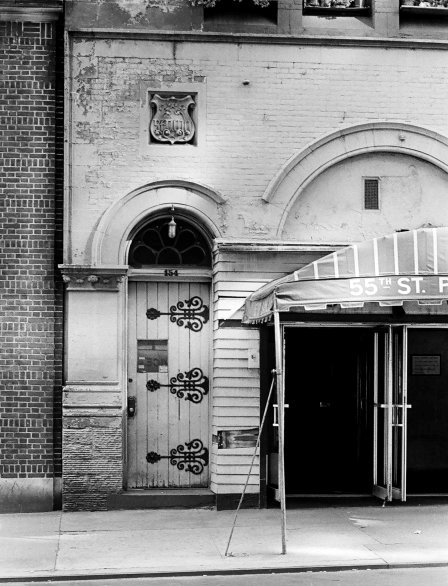 |
| In 1976 the side door to the studios survived with its marvelous over-sized hinges. The terra cotta shield announcing "STUDIO" is snugly fitted into the brickwork. None of it would last much longer. -- photo by Roy Colmer for his "Doors NYC" project; NYPL Collection |
Above it all, the artists’ studios on the top floor were
flooded with natural light through large skylights.
The carriage house portion was apparently leased to banker William
C. Whitney, Barney’s brother-in-law, who was just ending his term as Secretary of the Navy. Upstairs, struggling and not-so-struggling
artists rented the studios.
E. Leon Durand painted his The Little Missionary here. It was exhibited at the Art Institute
of Chicago’s Spring Exhibition of Water Colors in 1892. Painter Bruce Crane had his studio here at
the turn of the century as his work was shown at the Exhibition of Fine Arts at
the Buffalo Pan-American Exposition in 1901.
J. Mortimer Lichtenhauer would stay on for years at 154 West 55th Street. He painted a variety of
subjects, but recognized that society portraits were a sure source of
income. In 1908 he was commissioned to
paint Mrs. Walter Scheftel as well as “Master Joseph Rothschild.” That year he had a one-man show of a dozen
paintings at the prestigious Knoedler’s Gallery on Fifth Avenue. The critic from The New York Times found that his “combination
of portraiture with decoration is remarkably well managed,” but he cautioned
that Lichtenauer’s sense of color “tends, perhaps, towards heaviness.”
 |
| Lichtenauer created the above panel in 1904 in his studio in the Holbein -- Yearbook of the Architectural League of New York (copyright expired) |
At the time Edward Dufner was here, and that same year he was included in the
Biennial Exhibition of Contemporary American Painting at Washington D.C,’s Corcoran
Gallery of Art. He also exhibited at
the New York Water Color Club in 1908, resulting in a tepid assessment by the
critic of the New York Tribune.
“Mr. Edward Dufner in his 'Springtime, Taormina,' does not
seem quite to have achieved the effect sought, but it is interesting to observe
the direction he is taking. The figure
pieces are of slight import, but one or two of them are at least clever.”
A year later, The Sun would be kinder. “His suave touch, harmonious tonalities and
graceful composition are soothing to the eye.”
Dufner had studied under Jean Paul Laurens and James McNeill
Whistler. His awards included First
Wanamaker Prize at the Paris-American Art Association show in 1899, a bronze
medal at the Pan-American Exposition in Buffalo, and a silver medal at the St
Louis Universal Exposition of 1904.
Dufner would stay on at No. 154 through, at least, 1914.
By the middle of the 1920's, carriages and horses were essentially a thing of the past. So too
were the grand homes in the neighborhood.
In 1927 (or 1928, depending on the source) the carriage house was
converted to a movie theater. The owner
went right to the top in deciding on his architect.
In May 1923, the 26 year old Maurice Fatio had been voted the
most popular architect in New York. He
joined in partnership with William A. Treanor and designed lavish homes in New
York and Palm Beach. Fatio’s
Mediterranean-style mansions in Florida were already iconic.
Treanor & Fatio paused to convert the stable to a
theater. The 55th Street
Playhouse was, for years, an art theater. The first European film with subtitles
screened in the United States was shown here.
As the 1930's dawned, there were only three other art theaters in
Manhattan—the Fifth Avenue Playhouse, the Little Carnegie Playhouse and the
Plaza. The theater gained a reputation
as a venue for top-shelf, art films. Here were the premiers of important films like Orson
Welles’s The Spanish Earth, narrated by Ernest Hemingway; Jean Cocteau’s
Orpheus and Abel Gance’s Napoleon.
But avant garde films, as the managers of the 55th
Street Playhouse discovered, could also be trouble. In June 1970 the theater began screening the
new film Censorship in Denmark: A New Approach. The motion picture was ostensibly a documentary study
of pornography. Assistant District
Attorney Richard Beckler, however, did not agree with that description.
On September 30 theater manager Chung Louis was arrested on the
charge of promoting and distributing obscene material. The film was ordered seized by Criminal Court
Judge Jack Rosenberg. The judge ruled “This
court finds for the purposes of issuance of a warrant of seizer that ‘Censorship
in Denmark,’ taken as a whole, has as its dominant theme appeals to a prurient interest
in sex.” He added “It is patently offensive to most Americans because
it affronts contemporary community standards relating to the description or
representation of sexual matters.”
 |
| In 1976 the exterior was a bit worse for the wear. Clapboards, added to modernize the facade, are peeling off and the terra cotta molding is broken -- photo by Roy Colmer for his "Doors NYC" project; NYPL Collection |
In the meantime, office and apartment buildings were quickly
replacing the older structures on the block.
Residential renters now lived in the upper
floors of the Holbein Studios. In 1979
the Landmarks Preservation Commission included 154 West 55th
Street on its list of structures for possible consideration. It
had not gotten around to that consideration in 1987 when William Zeckendorf
began construction of the London NYC Hotel on 54th Street, directly
behind the old studios. The developer
announced that, while he would not raze the carriage house, it would be
converted to a freight entrance for the 58-story hotel.
One tenant, Gerald Intrator, rebuffed the new owner’s
attempts to remove him. Although offers
were made, reportedly, of half a million dollars to leave; Intrator
stayed. He implored the Landmarks
Preservation Commission to move on designating the structure.
Despite the tenant’s valiant efforts, the hotel owner got
his way. The Holbein Studios was not
designated and the handsome ground floor of the structure was obliterated for a
truck entrance. But above the
desecration of the street level, the façade survives; including the broad
expanse of skylight that once shed sunlight onto the creations of early 20th
Century American artists.
UPDATE: The structure was demolished in 2019.
no permission to reuse the content of this blog has been granted to LaptrinhX.com


.png)


