Showing posts with label barrow street. Show all posts

Thursday, February 8, 2024

The 1847 David Bignall House - 97 Barrow Street


In 1847, Jeremiah Lambert erected two identical, three-story houses at 95 and 97 Barrow Street between Hudson and Greenwich Streets.  Their Greek Revival design featured handsome stoop and areaway ironwork, plain brownstone lintels, and understated cornices with plain fascia boards.  Lambert leased 97 Barrow Street for decades, his first tenant seemingly being the David Bignall family, here by 1851.

Bignall was a broker with offices at 188 Greenwich Street.  He was also highly involved in politics.  On the evening of October 15, 1851, he hosted a meeting of the Whig Seventh Assembly District here, during which a Convention of Delegates was elected to select a candidate for the State Assembly.

Living with the family by 1853 was Samuel A. McGregor, a clerk, who may have been related to the Bignalls.  When his 31-year-old brother-in-law Alexander Henry died on August 2 that year, his funeral was held in the Barrow Street house.

Within two years, the Vanriper family occupied 97 Barrow Street.  Peter H. Vanriper was a partner in Rexford & Vanriper, a commission merchant firm at 29 Moore Street.  He and his wife, the former Sarah Dunham Stanford, had four children, Benjamin Franklin, Sadie Fowler, Cornelius H. S., and Peter Edward.

The parlor was the scene of Benjamin's funeral on July 27, 1855.  The boy was about 13 years old.

Three years later, the Vanripers sub-let the house.  Their advertisement on August 17, 1858, read, "To Let--A three story brick house with all the modern improvements.  Rent $450 per year.  Apply on premises or No. 29 Moore street."

It appears the family never returned.  They had moved to New Jersey by 1860 when Thomas H. Borden, a clerk, and his family occupied the house.  He and his wife, the former Imogen West, were newly-arrived in New York City.  They were married in Sacramento County, California in 1854.  On September 3, 1856, their son Spencer West was born.  Tragically, the parlor would be the scene of another child's funeral shortly after they moved in.  Spencer died at the age of 3 on February 4, 1860.

By 1864 Samuel Vanburen (sometimes spelled Van Buren), a provisions dealer, leased 97 Barrow Street.  His wife, the former Julia Ann Requa, came from an old New York family.  The French surname was originally Equerie.  Her earliest American ancestor was Claude Equerie, who arrived alone at the age of 12 in 1682.  Both his parents had died on the voyage.  Members of the Requa family distinguished themselves during the Revolutionary War.  The Vanburens had two children, Julia Frances, born in 1831, and Dow, born in 1846.

The middle-class status of the family was evidenced in Samuel's income taxes in 1865.  His reported income was $1,824 and he owed $41.20 in taxes.  (His modest earnings in 1864 would translate to about $33,800 in 2023.)

Another funeral would be held at 97 Barrow Street on December 7, 1873.  Dow Vanburen had died "suddenly," as reported by the New York Herald, two days earlier at the age of 27.

Although the Vanburens had leased 97 Barrow Street for a decade, when Jeremiah Lambert's heirs sold the house on April 27, 1874, the family moved to 43 Charles Street rather than buy it.  Mitchell Halliday paid the Lambert estate $10,900 for the house, or about $289,000 today.

Halliday ran a large-scale roofing business.  Not long after buying 97 Barrow Street, his firm received the contract to roof the renovated Thompkins Market.  Getting paid for the extensive work, however, was a challenge.  Halliday sued Mayor William H. Wickham personally for his $4,865.16 fee and won his case on February 9, 1876.

Mitchell Halliday provided the roofing for the renovated Thompkins Market on Third Avenue.  from the collection of the Cooper Union.

It was around this time that Halliday updated his home with fashionable neo-Grec elements.  Elaborate cast metal cornices were installed above the openings, and the windows were given bracketed sills.  The entrance cornice was crowned with a dramatic pediment that mimicked the Eastlake style dressers or sideboard that might have been found inside.  The ambitious bracketed cornice and fascia required the height of the building to be slightly raised.

Like all middle- and upper-middle class families, the Hallidays had a servant.  On May 29, 1889, an advertisement in The New York World read, "Housework--Wanted, a neat girl for general housework in small American family, 97 Barrow st."

On April 23, 1892, Architecture and Building reported on the progress of the Grant Monument Association.  At a meeting at the Building Trades Club, committees were formed to organize the various aspects of the construction.  Mitchell Halliday was elected to head the Slate and Metal Roofers committee.

At the time of the appointment, the Halliday family's residency at 97 Barrow Street was drawing to a close.  On January 7, 1893, Halliday sold the house to D. Edwin O'Neill for $10,000 (about $336,000 today).

The house saw a variety of occupants over the succeeding years.  Thomas H. McGowan, a clerk, lived here in 1895; and milk dealer Charles S. Bates occupied the house two years later.

It appears that 97 Barrow Street was operated as rented rooms through much of the 20th century.  Then in December 2001 it was purchased for $2.55 million by actress Edie Falco, who returned it to a single family house.  

Edie Falco  photograph by David Shankbone

The 38-year-old Falco had landed her best-known role as Carmela Soprano in the television series The Sopranos two years earlier.  She had already appeared on Broadway, in motion pictures and on television.  In 2003 she was awarded a Golden Globe, an Emmy, and a SAG Award.

image via avianvillagerealty.com

Falco listed 97 Barrow Street for sale on May 14, 2004 for $3.75 million.  It was recently resold for $5.5 million.  Through it all, Mitchell Halliday's striking remodeling of the exterior has been preserved.


photographs by the author
no permission to reuse the content of this blog has been granted to LaptrinhX.com

Thursday, December 21, 2023

James N. Wells's 1827 96 Barrow Street

 
The original appearance of the window lintels can be seen over the doorway.  The sheetmetal cornices were added in the 19th century.

In 1714 Queen Anne bestowed on Trinity Church a vast section of land stretching along the Hudson River from Duane Street to what would become Christopher Street to the north in the Village of Greenwich.  The large tract of land was familiarly known as the “Trinity Farm” or the “Church Farm.”  On November 6, 1820, the parish of St. Luke's was organized.

Construction of St. Luke's Chapel began in 1820, under the supervision of local carpenter-builder James N. Wells.  When the chapel was completed, Wells turned his attention to other Trinity-owned land.  He leased the rest of the  Hudson Street block from Barrow to Christopher, as well as a tract of land on Grove Street and, starting in 1825, filled the plots with charming Federal homes.  (His work apparently impressed the senior warden of St. Luke's Chapel, Clement Clarke Moore.  Wells would nearly single-handedly begin transforming Moore's estate Chelsea, north of Greenwich Village into a residential neighborhood in the 1830s.)

In 1827 Wells completed the four houses at 90 through 96 Barrow Street.  Like its identical neighbors, 96 Barrow Street was two-and-a-half stories tall above an English basement.  Paneled brownstone lintels contrasted with the Flemish bond red brick, and two pedimented dormers punctured the peaked roof.

In the mid-1830s, Barent Fraser and his family lived here.  He was a "combmaker" on Maiden lane.  The Frasers remained until 1839, when the Mourning Courier and New-York Enquirer reported the house and lot had sold for $3,275 (about $106,000 in 2023 terms).   It became a boardinghouse run by Elizabeth Conkin, who, it appears, accepted only a small number of boarders at any time.

By the mid 1850s Cornelius B. Smith occupied 96 Barrow Street.  He and his wife took in two boarders in 1856--John Read, who was an engraver; and Garrett Yerance, a carpenter.  Their boarders the following year suffered a tragedy.  Henry and Antoinette Morrow went to the country that summer, and on July 28, 1857, the New-York Tribune reported that while they were at Mamaroneck, New York their two-and-a-half-year-old daughter Henrietta died.  The article noted that her funeral would be held that afternoon "from the residence of Cornelius B. Smith."

The Morrows left soon afterward, and on April 29, 1858 an advertisement offered:

To Let--The lower part of a two story and attic brick house, 96 Barrow street, between Hudson and Greenwich streets, consisting of front and back parlors, two bedrooms and basement with vault, cellar, wash house, and other offices in separate buildings.  Rent $260, will be put in complete order.

That yearly rent would translate to about $795 per month today.

In 1859 William J. Black and his wife Sarah J. moved into 96 Barrow Street.  He was the principal in William J. Black & Co., a vegetable business in the Washington Market.  That year Sarah advertised for "A German girl; she must be a good cook, washer and ironer, and willing to make herself generally useful; but two in a family."

The mention that there were just two in the family was technically true, however, like the Smiths, the Blacks took in a boarder.  In 1860 and '61 it was John McFarlane, who worked as a clerk.  Chester Norton was boarding here on August 19, 1863 when he was drafted into the Union Army.  The following year, Chester N. Penoyer rented the room.  He listed his profession as a tallyman, someone who sold goods that were paid for in installments.

In 1868 David B. Johnston and his wife listed their address with the Blacks.  Johnston was in the piano business on East 9th Street.  He was still here in March 1869 when Sarah J. Black died.  Her funeral was held in the parlor on March 27.

It seems that William J. Black and David B. Johnston made a deal on the property following Sarah's death.  Black no longer appears at the address after 1869, while Johnston continued living here for years.  Like their former landlords, the Johnstons took in a boarder.  In 1871 it was policeman Cleveland A. Connor.

David B. Johnston (who changed his profession to "clerk" by 1879) remained at 96 Barrow Street at least through 1892.  The German Knierin family had boarded here since at least 1888.  Louis Knierin was a butcher and his son, Louis Jr., was a policeman.  As had happened in 1869, the boarder became the principal resident around 1893 when the leasehold was in the name of Isabella Knierin.

In 1897, 96 Barrow Street was again being operated as a boarding house, run by a "Mrs. Donnelly."  It was nothing like the respectable operation that Elizabeth Conkin had operated in 1840.  A female Fagin, Mrs. Donnelly headed a ring of young burglars and rented rooms to female accomplices.  It all came crashing down in the spring of 1897.  On March 27, the New York Herald ran the headline, "GIRLS LIVED IN DEN OF THIEVES / Betrayed Three Burglars and the Woman Keeper of a "Fence" in Barrow Street."

The article began:

Two girls, barely more than sixteen years old, were taken to Police Headquarters yesterday to tell what they knew of the band of alleged burglars with whom they had lived in a dingy Barrow street house, which, it is said, was a "fence" for thieves.

Detectives had arrested three men, all of them younger than 25 years old, shortly after they burglarized the home of Mary Ryan at 300 West Houston Street.  All of them had aliases, had served prison terms, and "had pictures in the Rogues' Gallery."  It was discovered that Maud Wilson was the "companion" of one of them, Charles Walker, alias Charles Stewart.  She was arrested at 96 Barrow Street.

At police headquarters, Maud did not hold back.  Calling her "a girl with a pretty but characterless face," on March 27, 1897 the New York Herald said she told "the story of the operations of this band," and "seemed to regard the life she had lived as nothing more than was to be expected."  The article continued, "the girl told the detectives of the life she had been leading, and informed them that Mrs. Donnelly, at whose house she had a furnished room, had many trunks full of booty she had bought from the three burglars."

Detectives went back to 96 Barrow Street, arrested Mrs. Donnelly, and search the house.  "Fur cloaks, overcoats, silver ware and bric-a-brac were dragged from chests and drawers. More than $2,000 worth of goods were taken to Police Headquarters," said the article.  The police estimated the booty was only about half of what had been stolen, since the ashes of pawn tickets were found in the kitchen stove.

Detectives also found Nellie McGinley, another accomplice.  "She had been concealed in the Barrow street house when the police visited," said the article.

In the meantime, Maud Wilson continued with her story.  She was the daughter of a printer.  Her downfall began, she said, when she left home.  The New York Herald recounted, "'I suppose,' she said, 'my father will kill me if he finds this out, and I suppose he will.  I was not happy. I started out to make my own living.  I got work in a factory and hired a furnished room at Mrs. Donnelly's house."  She said she met a man named William Wilson who wanted to marry her.  "Mrs. Donnelly said that would be a splendid thing to do.  'You can marry him,' she said, 'get hold of all his money and leave him.'"  The couple was married and separated after two months.

Maud laid out in detail the numerous burglaries, and Mrs. Donnelly's procedure of paying the gang members and disposing of the merchandise.  The New York Herald mentioned, "The house in Barrow street is an old-fashioned, brick structure such as the men of Greenwich village built fifty or sixty years ago.  It is a two story and basement affair, with dormer windows.  It was once the abode of staid respectability."

The entire group appeared in the Jefferson Market Police Court on March 27, 1897.  Also there was Nellie McGinley's father, who had promised the police he would press charges against Mrs. Donnelly "for abducting his daughter.  He says she was kept in the Barrow street house against her will."

Following the scandal, the house was once again a respectable boarding house.  Among the tenants in 1903 were David R. Eckert, his wife, the former Dellyetta McKellop, and their adult son Edward H.  The Eckerts had a long American history, originally coming from Holland and settling in Manhattan.  Dellyetta Eckert died on July 7, 1906.  Her funeral was held in the house on July 10.

There would be a second funeral in the parlor a month later.  Katherine A. Donshea was the widow of Isaac Donshea.  She died here on August 27 and her funeral was held two days later.

By then, the house was owned by Patrick and Albina (known as Abbie) Coyle.  Patrick was a fruit and vegetable dealer.  In January 1906, they took in Albina's invalid mother, Albina Lucey.  A native of County Cork, Ireland, she was the widow of John Lucey.  A neighbor, Charles F. Doushea, later explained, "She lived with Mr. and Mrs. Coyle, she occupied the back parlor."  

Albina was later described by another neighbor, Mary Dwyer, as "very old, bent over and lame."  She testified in 1913, "I heard an accident caused her lameness.  The condition of her feet that caused her to be lame was that she hadn't any toes on either of her feet."  (Additionally, Albina had lost the sight in one eye.)  

The reason Mary Dwyer appeared in court was that Albina Lucey had died on June 17, 1911 and now Abby Coyle was suing for her mother's estate because of the care she had given her.  Patrick Coyle testified that despite his mother-in-law's infirmities, she was "a woman with a fair appetite; she could eat well."  He said his wife "cooked and washed and ironed for Mrs. Lucey."

Patrick Coyle said that "there were at least a dozen conversations in my presence" when his wife confronted her mother about her estate.  "Mrs. Coyle said, 'I am entitled to it, I think I ought to get it, being that none of the other children seem to care for you, only coming to see you once in a while, when they need money, they do not seem to care for you otherwise.'"

After a lengthy hearing, Abby Coyle was awarded her mother's estate.  It is unclear how long the Coyles continued to live and run their boarding house, although rooms were rented in the house throughout most of the 20th century.  

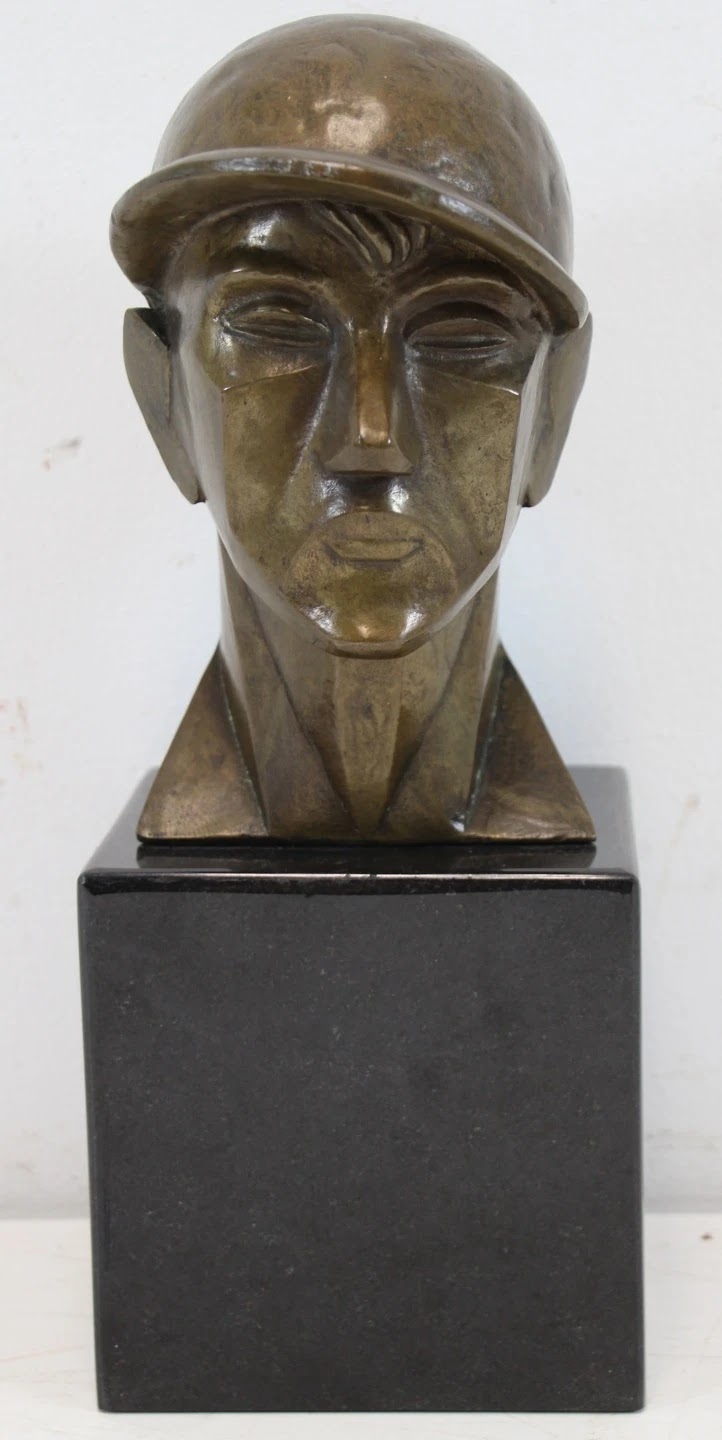
Among the residents in 1952 was sculptor Helena Simkhovitch.  Born in New York City, she studied at Columbia University's School of Architecture.  She lived in Paris from 1926 through 1940.  She was a member of the Sculptors Guild, the Federation of Modern Painters and Sculptors, the New York Six, and the Artists Equity.  

Helena Simkhovitch's The Jockey

While living here, she exhibited regularly at the Whitney Museum of Art, and in 1955 she was the only American artist represented in the Museum of Modern Art's traveling exhibition of modern portraiture.


A single family home, 96 Barrow Street was never divided into apartments.  In the 19th century, the paneled brownstone lintels were covered with sheetmetal cornices, and more recently the Federal dormers were given a glaringly modern metal cladding.  Otherwise, the charming, two-century-old dwelling is nearly unchanged externally.

photographs by the author
LaptrinhX.com has no authorization to reuse the content of this blog

Wednesday, February 21, 2018

The 1845 63 Barrow Street


In 1845 Catherine Cruger erected two houses, Nos. 61 and 63 Barrow Street, behind her store at the southeast corner of Bedford Street.  Unlike the earlier, Federal style homes along the block, they reflected the newer Greek Revival style.  Rather than a dormered attic, they had a full-height third floor.  While intended for a middle-class family, they boasted the floor-to-ceiling parlor windows expected in the residences of more affluent homeowners.  Nevertheless, the modest personality of the homes were expressed in its simple brownstone lintels and sills.

In the 1850's No. 63 was being leased by the Taft family.  Catharine A. Taft was a teacher in the Girls' Department of Primary School No. 18 on Waverley Place near Bank Street.  And by the early 1860's the William Henry Baldwin family lived at No. 63 Barrow Street.  Born on New Year's Eve 1824, Baldwin was married to the former Mary S. Stevenson.  The couple had seven children.

At the time the Baldwins moved into the Barrow Street house, the East Coast was plagued with a deadly disease, scarlatina, better known as scarlet fever.  The epidemic was so widespread that on April 1, 1868 Dr. Shrady, editor of the New York Medical Record, noted that the Metropolitan Health Board's latest report did not even bother to count the cases.  "Nothing is said of the great number of cases of scarlet fever, as it is so common a thing that nothing is thought of it."

In the spring of 1864 the Baldwins' three year old son, Harry Lincoln, contracted the disease.  It became complicated with diphtheria and he died in the house on May 8.   Perhaps due to the infectious nature of the disease, his funeral was rapidly held the next day, just past noon, in the parlor.

The Civil War had already been raging for three years at the time.  On March 3, 1863 Congress had enacted The Enrollment Act, sometimes called the Draft Act.   All male citizens eligible for military service were required to enroll.  Their names then were included in the highly unpopular draft lotteries.  On March 17, 1865 William H. Baldwin, Jr.'s name was one of those drawn to fight in the South.

By the time the Baldwin's youngest daughter, Emily Frances, died on June 29, 1869, they had moved to No. 291 West 4th Street.  Two years earlier, the owner (possibly still Catherine Cruger) sold all three of the properties.  An advertisement in The New York Herald on February 12, 1867 offered:

For Sale--Two Three Story Basement Cellar Philadelphia brick Houses, 61 and 63 Barrow street; $5000 each.  Corner store adjoining, $7,500--less if sold together.  Terms easy.

The price for the houses would be equivalent to about $82,600 today.  The new owners of No. 63 Barrow Street rented rooms, but stopped short of operating a boarding house.  An advertisement in The New York Herald on December 10, 1871 offered "Furnished rooms, for housekeeping, for gentleman and wife; also small Room, for one or two gentlemen, at $2.50 per week."


The difference in accommodations were reflected in the rent.  The $2.50 per week for that small room would be around $50 today.  But an apparently more spartan "furnished sleeping room" was available for a bargain $8 per month in 1873.  The advertisements through the years were nearly identical, with only the prices slightly changing.  A bedroom and adjoining room was offered "to gentlemen or for light housekeeping" in 1874 and "also a Room to a gentleman for $2 per week."  That advertisement noted that gas was included in the rent.

As the century drew to a close, No. 63 was home to a career woman, Elizabeth A. Lahey.  She had taken a job in John Van Orden's ladies' undergarment firm in 1882 at the age of just 14 years old.  In 1890 when the forewoman, Miss Hemme, was married, Elizabeth was promoted to assistant forewoman and "special fitter."  She was promoted again in 1893 when her employer's wife, Margaret, became too ill to work.

Elizabeth was dragged into the especially ugly divorce proceedings between the Van Ordens in 1896. and was called to the stand on May 16.  Her testimony made it unclear which of the two was more at fault.

She said in part that Margaret "never had anything but bad to say about him, stating he abused her, and very often she expressed herself as though she hated him, [and] his brother Jim she called a dirty loafer.  One Monday morning she came to me and said that Mr. Van Orden had been to a vile place the night before and on disreputable business; she expressed this in a very shameful way and too low for me to repeat."

"She would come down to the workroom and talk to me by the hour about Mr. Van Orden and sometimes would tell me the most indecent things about him...While she was around I have never heard Mr. Van Orden speak to or about Mrs. Van Orden in any but a respectful manner, and invariably considerate of others."

On December 1, 1909 Elizabeth transferred title to No. 63 Barrow Street to Fanny H. von Schmid.   Fanny's purchase was an investment and she immediately leased the house to Margaret Demuth.  Fanny retained possession for nearly two decades, selling it in July 1921 to artist Estella Case.

Case was followed in the house by Edward J. Condlon and his wife, the former Rosalie M. Freeman.  A financial reporter for The New York Times since 1927, he had started his career with the New York Commercial, later working for The Boston Evening Transcript, the Chicago Journal of Commerce and The United Press.

Condlon was not all business.  He was a member of the board of governors of the New York Financial Writers Association and, according to The Times, "He was one of the leading performers in the association's annual theatrical productions in 1938, 1939 1940 and 1941."

In July 1944 Condlon became ill and he died in the New York Hospital on August 5.  It is not clear how long Rosalie Condlon remained in the house; but it as sold to Mr. and Mrs. J. F. Bagster-Collins "of Cornwall, Connecticut" in December 1959.  In reporting on the sale The New York Times noted "They will occupy it."


The intimate proportions of the house--just 17 feet wide--are possibly what saved the charming brick house from being divided into apartments.  Still a single-family home, its brownstone trim has been painted white and understated ironwork replaces the original railings and fencing.  Nevertheless, Catherine Cruger's investment property looks much as it did nearly 175 years ago.

photographs by the author

Friday, November 17, 2017

The 1828 Jacob Bogert House - 39 Barrow Street


photograph by the author

Charles Oakley was busy constructing houses along Reason Street (named in honor of Thomas Paine's 1794 The Age of Reason) in the mid 1820s.  In 1826 he completed Nos. 47 and 49 and in 1828 added Nos. 39 through 45.  Already locals had corrupted Reason to Raisin Street and that same year Reason Street was renamed Barrow Street.  Artist Thomas Barrow, who had depicted Trinity Church in 1807, received the honors.

It appears that Oakley made deals with craftsmen; for apparently they either invested in the project, or they received discounted prices on the houses in exchange for work.  As a result the new buildings became home to masons, carpenters and stone cutters--like carpenter Jacob Bogert who moved into No. 39.  (The stone cutter Abraham Bogert who also worked on the houses was most likely a relative.)

Three bays wide, his house was two and a half stories tall above a shallow basement level.  A brownstone stoop let to the narrow entrance, adorned only by a small transom.  The Flemish bond red brick was trimmed in plain brownstone lintels and sills.  The peaked roof would have been pierced by one or two dormers.

On November 3, 1854 Joseph G. Warner moved into No. 39 Barrow Street.  His timing was bad in terms of the State and City elections that year.  Exactly one week later he walked to the polls to vote.  The inspectors told him he was ineligible to vote, because he had just moved into the district.

Warner was not pleased.  The New York Times reported that he "remonstrated" with the inspector and insisted that his lawyer had assured him he "had a perfect right to vote," because he had lived in the state for a year and in the county for four months.  "The appeals of Mr. Warner made no impression upon the Inspectors," said the newspaper.

Furious, Warner headed to the Second District Police Office and complained to Justice Meech.  Warner had presented an interesting conundrum.  While, on one hand, he had just moved into the Fourth District; on the other the law declared it "a misdemeanor for Inspectors of Election to refuse the deposit of a legal ballot from a legal voter."

Because of Warner's complain, three inspectors were arrested.  On November 11, 1854 The Times noted they were awaiting a hearing.  "The punishment for this offence is left at the discretion of the Court; being imprisonment for one year, or a fine of not less than $250."  It was the first case of its kind and the newspaper was sure that the "inquiry will probably excite considerable interest among politicians and citizens generally."

The fiery Joseph G. Warner was gone from Barrow Street by 1861 when David Groesbeck was living here.  He worked in the Hall of Records as the First Auditor in the Metropolitan Police Department's Board of Finance.  In December 1863 he received a raise, bringing his salary up to $2,000 per year (just under $39,500 today).  But he was disgruntled about the back pay the city still owed him.

Since 1859 he had been performing "extra services," apparently what would be termed overtime today.   He had petitioned the Board of Aldermen for his back pay in February 1863, but that petition "was referred to the Committee on Finance."    Finally, on December 13 he received $2,460 which represented the "extra services rendered in the Auditing Bureau" during the years 1859 through 1862.

It may have been that sizable windfall--equal to more than a year's pay--that prompted Groesbeck to move.  Only four months later he sold everything in the house.  His advertisement on April 28, 1864 offered "Beds, bedding crockery, table linen, towels, looking glasses, pictures, mantel ornaments, &c., for sale cheap, in good order.  Second hand dealers need not apply."

It was most likely James D. McClelland, a lawyer, who raised the attic to a full third floor within the next few years.  The renovation was done prior to July 29, 1870 when an advertisement in The New York Herald offered "A second or third floor to let--unfurnished, in a private house, where there are no children."

On March 13, 1873 McClelland sold the house to Amos Jean and his wife, Rosina.  They paid $4,100 (or about $84,800 in today's dollars).  The couple took out a $3,000 mortgage to buy the property.  They continued to rent rooms, and on May 8, 1874 offered "furnished--large front room and pantry in a quiet house...also a small room; excellent neighborhood."

The designation of a "front room" was important to potential renters.  Unlike a "hall room," it would have a window and therefore light and ventilation.

When the Jeans sold No. 39 in January 1891, the buyer was, somewhat surprisingly, James D. McClelland, who now lived just two houses away at No. 43. He spent $6,500 to regain the house, which he leased to John F. Neilson, a City Marshal.  Just two months later a fire broke out in the house; but the damage was minor and Neilson continued to live here.

Neilson was involved with Tammany Hall politics, a fact that tainted his reputation in the eyes of some journalists.  After City Marshal Henry J. Spink was killed in a train accident in Sheepshead Bay in June 1893, Neilson was appointed to replace him.  The Evening World commented "Neilson held the same office before.  He is one of Police Justice 'Barney' Martin's henchmen in the Eighth District...Neilson will be attached to the Third District Civil Court, in the Jefferson Market building."

'Barney' Martin, was, incidentally, Justice Bernard F. Martin.  He had been partners with "Red" Leary and his wife, Kate, in a saloon, described by Abram C. Bernheim as "the resort of the most disreputable classes in the community."   And Tammany Biographies published by The New York Evening Post in 1894 added "'Red' Leary was the most notorious burglar in the country, and Kate probably the most famous pickpocket in the world."  The trio had lived together above the saloon.

Later that year, in November, Martin advertised "hall rooms, nicely furnished, $1.50."  The weekly rent would be equal to about $43 today.  Among those living here in 1896 was William McClelland, apparently the son of Neilson's landlord.  It is most likely no coincidence that the young McClelland landed a job as a clerk in the Third Judicial District Court--the same location where John F. Neilson served as City Marshall.

It is unclear when Neilson left the Barrow Street house.  On July 1, 1910 James D. McClelland (still living at No. 43 Barrow) sold the house to Bridget McDonald.   At least twice she leased the house--in August 1919 to Jane Herder, and in November 1921 to Catherine McCabe.

It was purchased by Marie Louise and Julius Goebel in 1936.  Immediately Marie Louise involved herself in neighborhood activities.  She opened what one newspaper described as her "100-year-old house and garden" for the Greenwich House Garden Tour in 1937, arranged by Mrs. J. G. Phelps Stokes.  She participated in the event every year until 1940.  In 1939 she installed a "studio for sculpturing" in the rear.

The following year Julius Goebel died.  A few months later, in April 1941, Marie Louise leased the house to Bertha Brainard; then sold it in 1945 to Ruth Neinson.

No. 39 has remained a single-family residence.  It sits on a block emblematic of Greenwich Village charm, perhaps best described by the Landmarks Preservation Commission in 1969 when it said "The warm quality of brick creates an atmosphere for this street."

photograph by the author

Wednesday, May 17, 2017

The 1826 Nack-Ballantine House - 47 Barrow Street


The bucolic nature of Greenwich Village would be upset after New York City doctors, in 1825, recognized the first signs of a terrifying disease--cholera.  Only two years earlier citizens had endured an epidemic of yellow fever.  At that time many residents with the means to do so fled north to Greenwich Village.  Now an even greater threat loomed.

Speculators rushed to erect housing for the fugitives.  The New York Evening Post described the hysteria saying "The roads, in all directions, were lined with well-filled stagecoaches, livery coaches, private vehicles and equestrians, all panic-struck, fleeing the city, as we may suppose the inhabitant of Pompeii fled when the red lava showered down upon their houses."

Reason Street, which ran roughly east-west from Washington Place to the Hudson River, had been named in honor of Thomas Paine and his The Age of Reason, first published in 1794.  Here, between Bleecker and Bedford Streets, Charles Oakley built three brick houses in 1826 (47 through 51).  He would add four more along the block in 1828.

No. 47 Reason Street, like its neighbors, was two and a half stories tall with a brick front.  A single dormer punched through the pitched roof.   The Flemish bond brickwork and simple fascia board below the cornice were expected in the late Federal style house.  But its 21-foot width, handsome iron railings and fencing, and elegant entrance marked it as the home of a financially-comfortable family.

The first residents of the row had all participated in their construction.  No. 47 became home to mason Jacob Naugle.  Exactly how long he remained here in unclear.

By the time the house was completed, the name of Reason Street had been widely bastardized to Raisin Street.  But it was not this unflattering usage that prompted Trinity Church to lobby hard for a name change.  Thomas Paine's challenges to the Bible and his promotion of deism in favor of Christianity in The Age of Reason was rebuked by the church.  (Even Theodore Roosevelt, more than a century later, would call Paine a "filthy little atheist.")

Trinity Church had a new name in mind:  Barrow Street.  Thomas Barrow, who died in 1825, had been a wealthy vestryman.  An artist, he created an engraving of the ruins of Trinity Church following its destruction by fire in 1776.   In 1828 Reason Street became Barrow Street.

As Jacob Naugle and his neighbors (who included Charles Oakley) came and went, they were somewhat impeded by the old public well and pump that had been in place long before the houses.  The problem was that it sat directly in the middle of the road.  Oakley corrected the situation by petitioning the Common Council in May 1829 "to remove the Pump from the Well now standing in the Centre of the carriage way of Barrow (late Reason Street) and which was placed there before the Street was ceded to this Corporation."  The Council agreed, saying "the Well in its present location is an Obstruction to the Street and a Public Nuisance."


By the early 1850s the family of James Nack had moved from 229 Church Street to 47 Barrow.   Nack worked in the County Clerk's Office as a "First Searcher," earning $700 a year in 1853 (about $23,000 today).  But his civil service job was not what he was noted for.

In 1829 Samuel Kettell had written of Nack, "His poetry is quite respectable, but the most remarkable fact concerning it, is that the author is deaf and dumb.  He lost the faculty of speech and hearing, by disease at an early age.  His writings show that he has as nice a perception of the harmonies of verse, as those in whom the senses are perfect."

Nack was, in fact, the first deaf author to be published in the United States.  His first volume, The Legend of the Rocks and Other Poems, was published when he was 18, in 1827.   He married in 1838 and the couple had three daughters.  The youngest, Anna Virginia, tragically died of a "concussion of the brain," on June 14, 1845.

Nack was a widower by the time he and his two daughters, Mary Janette and Evelina, moved into the Barrow Street house.  They were joined by Nack's two spinster sisters, Sarah and Elizabeth, who would have been in charge of running the household.

On the night of Saturday, February 14, 1857 Elizabeth died five days after her 66th birthday.  Her funeral was held in the house on the morning of the 17th.   Four years later, on October 4, 1861, Sarah died.  Her funeral, too, was held in the parlor.

A little over a month later the family had a more joyous event.  On November 7 Evelina was married to William A. Ballantine.  A lawyer, the groom was a member of Morris & Ballantine with offices nearby at 52 Grove Street.

James Nack may have given 47 Barrow Street to the newlyweds.  They moved in, while Nack and Mary Janette moved to 38 Grove Street.  Tragedy continued to follow the poet and after what was described as a "long illness," Mary Janette died there on February 27, 1864 at the age of 21.

The Ballantines, too, suffered heartbreak.  On August 7, 1862 their first child, William Frederick, was born.  The following year the family was summering in Highland Mills, New York.  There, just three days before his first birthday, little William died.  He was brought back to Manhattan where, once again, a funeral was held in the Barrow Street house.

Around six years later another child, Evelyn, was born.  The family left by the last decade of the 19th century, but retained possession of the house.  Before then they had updated it by raising the attic level to a full third floor and adding fashionable cornices above the window lintels.

In 1891 Wright Holcomb was leasing 47 Barrow Street.  A lawyer with offices at 49-51 Chambers Street, he was better known as a Tammany Democrat.  That year the 48-year old was elected to the State Assembly.


Wright Holcomb in 1893.  The University Magazine, December 1893 (copyright expired)

The University Magazine lavished the politician with praise.  "His law office in this city is, as might be supposed, a bee hive of industry and activity.  He comes of the best American stock, being directly descended, on his maternal side, from Gov. Wm. Bradford, of Plymouth Colony and on the paternal side from English stock which emigrated from Old to New England early in the 18th century."

The Evening World agreed, saying on January 21, 1891 "Mr. Holcomb is an earnest, fluent speaker, who will add greatly to the strength in debate of the majority."

A block to the east, at 15 Barrow Street, lived Alderman Mead.  Following a meeting in Webster Hall that ran late into the early morning hours of June 17, 1891, Mead arrived home to find a stranger standing in front of his house.  The Sun reported "He took a good look at the man, who didn't seem to be at all put out by it, and then entered the house.  As he entered the hallway he saw another man half way up the stairs with a bundle in his arms."

Surprised, the burglar dropped the bundle and hit the floor with one leap.  Although Mead attempted to get out of his way, the "man ran plump at him, struck him in the chest, and then slipped out into the street and escaped."   Mead found another bundle on the second floor.  Both of them contained articles of his clothing.

Two days earlier, on Sunday morning, while Holcomb was in Washington, a burglar had broken into his house and taken a suit of clothes.  Caught following the Mead break-in, the thief, who turned out to be a homeless man, was captured.  "In his pocket were a lot of letters and railroad passes, and also a pocketbook with Mr. Holomb's name on it," said the newspaper.

Redmond Porter explained he had gained entrance to 47 Barrow by breaking a window in a vacant house on Commerce Street, going into the backyard, climbing over a shed, then opening a window to Holcomb's bedroom.

Over the next two decades William and Evelina Ballantine leased the house to a series of tenants--Catherine Burch after Wright Holcomb, Harry J. Quinn in 1908, Allen D. Orr in 1910, M. H. Franey in 1915, and in November 1918 to artist Ruth Murchison.

Murchison was know for her portrayals of peasant and servant women--often wearing traditional Dutch costumes.  In describing her "several versions of a peculiarly unbeautiful Vollendamer maid" at the Goupil Galleries in January 1916 an art critic for The International Studio was a bit unkind.  "In spite of a somewhat postery appearance, the canvases are distinctly interesting in colour and design, even if somewhat crude."

Ruth Murchison created this November 18, 1914 cover for Punch magazine
and this one for Treasures magazine (copyrights expired)

Ruth also ran a charming Greenwich Village store she called The Little Shop Around the Corner.  Here she sold homemade decorative goods.

Following William Ballantine's death, Evelina transferred the title to 47 Barrow Street to Evelyn.  Around 75 years after her poet grandfather purchased it, Evelyn sold the house in 1920 to Florence Hemsley Wood, the widow of prominent architect William Halsey Wood.

Florence had been born into a well-to-do Pennsylvania family and was educated in private schools.  In 1889 she married Wood, who was well known for his ecclesiastical architecture.  The couple had three children, including Emily, who still lived with her mother.  In 1915 the Woman's Who's Who of America had noted that Florence was "interested and active in societies and activities of [the] Protestant Episcopal Church.  Favors woman suffrage."

A year after purchasing the house, Florence made what was perhaps a surprising revelation.  "Mrs. William Halsey Wood of 47 Barrow street yesterday announced the marriage of her daughter, Miss Emily Hemsley Wood, to Mr. Wilson Ashley Burrows," reported The New York Herald on May 9, 1921.  The groom had served as Sergeant-Major under Major Fiorello H. La Guardia during the war.

Florence's lack of public fuss over the engagement and wedding may have been due to the splashy announcement of Emily's first engagement, on June 21, 1914.  Her marriage to Robert William Harris never came to be.

Florence Wood sold the house in 1927 to "an investor," who resold it in 1933 to "a Mr. Prout," according to The New York Times.  Although Prout announced his intentions to live in the house, he leased it to John Howard Lawson in 1935.

Throughout the rest of the 20th century until today, the picturesque structure has remained a single-family home.  Except for the renovations of the 1880s and the later addition of exterior shutters, it is a well-preserved reminder of a time when carriages had to circumvent a public well in the middle of the street.


photographs by the author

Thursday, March 20, 2014

The 1889 Livery Stable at No. 56 Barrow Street


In 1888, undertaken John F. Asmussen lived at 355 Bleecker Street between West 10th and Charles Streets.  A respected member of the Greenwich Village community, he served as Sexton in the nearby St. John’s Church on Christopher Street.  Within the year he would embark on a real estate project that involved demolishing the old house at 56 Barrow Street.

The block of Barrow Street between Bedford and Bleecker Streets was lined with quaint brick homes of the 1830s along with later Victorian structures.  The house at 56 Barrow Street had become a rooming house by 1855 when carpenter Harvey Depew and Charles Miller, who made his living as a hatter, lived here.  Both men volunteered as members of the Howard Engine Company No. 34 at the corner of Christopher and Hudson Streets.  Resident W. Johnson received what was likely unsettling news on March 17, 1865 when his name was pulled in the draft lottery to serve in the Civil War.
Now, in 1889, the house was pulled down to be replaced by John F. Asmussen’s livery stable and carriage house.  Designed by the architectural firm of Jordan & Giller, the brick-faced structure quietly melded into the streetscape with little ornamentation other than the fine dentil-molded brick cornice.  Two stories tall, its windows and carriage opening featured flat brownstone lintels.
Asmussen's livery stable also housed his own business horses and vehicles, as well.  He owned at least one wagon, which he was driving on July 6, 1901 along Central Park West near 68th Street.  When a streetcar operated by the Metropolitan Street Railway Company collided with Asmussen’s horse-drawn wagon, a near tragedy occurred.
Asmussen was thrown out of the smashed vehicle, resulting in both of his arms being broken.  He subsequently marched into the law office of William C. Timm and filed suit against the streetcar company, asserting that along with his broken arms he: 
...was bruised and wounded in various parts of his body, and was, and still is, suffering great pain, and was, and still is, prevented from going on with and attending to his business, and is, as he believes, permanently injured so that he will never be as strong or able to carry on said business as efficiently as before.
Asmussen’s lawyer detailed his injuries in the complaint papers:  "left arm broken in three places; right arm broken in one place, left side of head bruised and contused; one rib bent and chest contused; both legs bruised; both big toes bruised, right eye blackened.”
In addition to his “great pain and suffering” Asmussen had to pay $60 to repair his wagon, including repainting it—a not-insignificant $1,500 today.  Both William C. Timm and his client felt that $30,060 dollars would be sufficient to settle the case.  Not surprisingly, the Metropolitan Street Railway Company disagreed.  After a lengthy court battle, the jury awarded John Asmussen $5,431.50, or about $150,000 in 2014 dollars.

The carriage door bay has been altered as a residential entrance.  From an upstairs window in 1919 a tenant nearly witnessed murder.

Intrigue visited 56 Barrow Street in 1919 when Mrs. Florence Chris was living upstairs.  Each morning around 11:00 she would sit in the window with her invalid son for an hour or so, watching the comings and goings of people on the street below.
A vacant saloon occupied the ground floor of 80 Bedford, on the corner Barrow Street.  The building was owned by 71-year-old Charles A. Knapp.  The old man, who lived in Montclair, New Jersey, was a retired insurance man. Described by The Sun as a, “little old fashioned realty owner,” he was a familiar figure in the neighborhood and was well-known for often wearing a modest ruby stick pin with two pearls in his tie.
Since John Lawrence had closed his barroom, Knapp had visited what The Sun called a “gloomy structure” to feed the two cats Lawrence had left behind, and to arrange for the dismantling of the saloon.  The Knapp family had owned the three-story building for over a century and Mrs. Chris later told detectives, “I have noticed Mr. Knapp going to the place almost every day.”
And so it was on Wednesday January 8, 1919.  An auction of the saloon fixtures had been held a few days before and Knapp was in the process of having them removed and repairs done to the old building.  That morning, as Mrs. Chris and her son watched, Charles Knapp unlocked the side door and entered with a man wearing a blue workman’s jumper.  The mysterious man, she said, “held a small paper parcel for Mr. Knapp while the old gentleman was unlocking the padlock on the door.  They entered and I did not see either of them come out, although I remained at the window until shortly before 12 o’clock.”
An hour later, a glazier arrived for a 1:00 appointment with Knapp.  The side door was unlocked and inside he found the old man dead on the floor.  The murderer had shot him in the back of the head and cut his tie below the knot, making off with his stick pin.  Police wondered if the murder could be the result of a disgruntled tenant evicted from one of the Knapp buildings, since $60 in cash and a check for $116 was left on the body.  They ruled out the local gang members.  “Inspector Cray said last night that he doubted whether the shooting was the work of ordinary gangsters and he was inclined to absolve the Hudson Dusters from suspicion," said The Sun.
In the meantime, 56 Barrow Street and Mrs. Florence Chris received much attention and press coverage as the mysterious slaying was investigated.
As the excitement prompted by the tragic murder eventually abated, the little brick building remained out of the spotlight for years.  When Thomas M. Bevans purchased up six buildings on the corner of Bedford and Barrow, including No. 56, residents may have wondered about the fate of the structure.  But it survived and by the 1970s was a gritty, neglected building where tenants upstairs coped with falling plaster and vermin.
On August 8, 1973, a 28-year-old advertising copyrighter for Macy’s Department Store headed home to her Hudson Street apartment building for lunch.  As she reached the street door, Roberta Herbert was attacked by Hosie S. Turner, a 39-year-old heroin addict.  As he plunged a knife into the woman, she screamed, “Somebody help me!”  Construction workers who heard the cries pursued the fleeing felon.
Police took up the chase as Turner disappeared somewhere along Barrow Street.  Before long he was discovered by Police Officer William Whitaker hiding behind the boiler in the basement of No. 56.  In his pocket was the $7 he had stolen from the young woman he had left dead on the sidewalk.
In 2005, Margaret Streicker Porres owned 56 Barrow Street.  The New York Times said she “has built a business out of buying, managing and restoring run-down landmarked buildings populated with rent-regulated tenants.”  The newspaper said she “sees herself as preserving and rebuilding New York’s older buildings for future generations.”
Despite all of that, she sought a demolition permit for No. 56 Barrow in 2005.  The permit never came to be and on April 17, 2007, writing in The New York Times, James Barron disclosed some of the tenants’ frustrations.  “Their long list of complaints includes hallways that were without lights for several weeks last summer, fireplaces that can no longer be used and apartments where mice are regular visitors.”
Resident Nestor Palacios said he and his 6-year-old daughter slept in their coats and he hesitated to turn the lights out at night because the mice would come out.  “I have a hard time falling asleep, waiting for them to crawl over me,” he told Barron.
The turn-around came in 2009 when the building was renovated into three spacious apartments.  The former carriage bay is now the main entrance and while the alterations to the street-level openings are noticeable, they are sympathetically done.  James Asmussen’s livery stable survives as a charming relic on a quaint Greenwich Village street.


photographs taken by the author

Wednesday, March 13, 2013

The 1853 No. 81 Barrow Street


James Vandenberg was a well-respected builder and developer in Greenwich Village in the decades prior to the Civil War.  As the sleepy hamlet awoke with the building and population boom that in late 1820s, the opportunity to provide respectable housing for the new population was widespread.  Vandenberg took full advantage, building comfortable homes in the area for years.  Yet his greatest source of pride came on June 3, 1841.

On that day a box was deposited in the cornerstone of the new Trinity Church far to the south on Broadway.  On one side of the box were inscribed the names of the Building Committee.  Below that impressive list were the names of the four men who were responsible for the church’s construction.  Just under the name of  the esteemed architect Richard Upjohn was the inscription “James Vanderberg, Master Mason.”

While Vanderberg was busy with Trinity Church, winding Barrow Street in Greenwich Village was a mixture of homes and small shops.  No. 81 Barrow Street in 1835 was the working class home of Thomas Cox.  Two years later mason Samuel Conover lived here.

The land—familiarly known as “Trinity Farm” or the “Church Farm”--belonged to Trinity Church.  The expansive tract of land had been bestowed on Trinity Episcopal Church by Queen Anne in 1714.   It stretched along the Hudson River from Duane Street in the city north to what, by now, was Christopher Street.  Around 1825 Trinity Church began developing the land into building lots and soon many of the streets were lined with two-and-a-half story Federal-style homes.

In 1852 James Vandenberg turned his attention to the block of Barrow Street, just east of Hudson Street.  In place of the older homes, including No. 81, he built three impressive brick houses in the latest Italianate style.  Vandenberg’s new residences (he would keep No. 79 for his own use) were completed in 1853.

The builder managed to blend sophistication and mid-Victorian decoration with propriety and reserve.  Like its neighbors, 81 Barrow Street boasted a broad brownstone stoop with stylish Italianate iron railings and newels.  The three-story red brick house sat high above a brownstone English basement and the parlor floor lintels were gracefully scrolled and foliate carved.

Elegant carvings embellish the graceful lintels.

Unlike the Italianate style mansions of St. Luke’s place a few blocks south, Vanderberg’s homes were intended for the comfortable merchant class rather than the very wealthy.  In the early 1880s, Alice B. Keys lived in No. 81.  She was a school teacher in the Girls’ Department of the nearby Grammar School No. 41 on Greenwich Avenue.

John Mappis was living in the house in 1907 when he climbed aboard the Sixth Avenue elevated train on the morning of November 11.  Around 11:00 the train approached 34th Street across from Macy’s Department Store that had opened five years earlier.  Mappis, along with the other passengers, were badly jolted when the train and another collided.

“The two trains were moving slowly at the time of the accident, otherwise, it is believed, there would have been a long list of fatalities,” reported the New-York Tribune.  John Mappis was taken to Bellevue Hospital with head and face cuts.  One employee from each train was arrested for assault and held on $2,500 bail.

At the time, Mary Britton Miller was living in Italy.  Born into what she called a “good family” in New London, Connecticut.  Miller’s family life, however, would be a tragic one.  When she and her twin sister, Grace, were four years old her father, New York lawyer Charles P. Miller, and mother, the former Grace Rumrill, died within an hour of one another.  When Mary was just 14 years old her sister drowned.

The privileged girl was reared by a grandmother and, later, an aunt and governess.  She attended exclusive boarding schools and traveled throughout Europe.  An aspiring writer, in her late 20s she spent three years abroad, then in 1911 returned to the States to make New York her home.

Writing under her real name, she achieved little success.  In 1928 she published her first book of poetry, Songs of Infancy.  Three other volumes of poems followed.

Then in 1946 she reinvented herself.  Mary Britton Miller took the pseudonym Isabel Bolton.  By the middle of the century she was living at 81 Barrow Street and was what The New York Times deemed a “prominent literary figure.”


The poet-author had passed her 60th birthday and was unable to see clearly enough to write.  She dictated her books and poems in the house on Barrow Street.  In 1943 she published a novel, In the Days of Thy Youth, and in 1946 the book Do I Wake or Sleep.  

Edmund Wilson was the American Critic for The New Yorker.  Gore Vidal said that Wilson’s praise “or even attention” meant “earthly glory for a writer.”  Wilson read Do I Wake or Sleep and deemed it worthy of Henry James.  He wrote “the device of the sensitive observer who stands at the center of the action and through the filter of whose consciousness alone the happenings of the story reach us…a voice that combines in a peculiar way, the lyric with the dry; and is exquisitely perfect in accent; every syllable falls as it should.”

Later Vidal himself would say that through a “great act of will” the author had replaced “the mediocre Mary Britton Miller with a magically alive writer whom she chose to call Isabel Bolton, for our delight.”

In 1952 Isabel Bolton had achieved literary acclaim and on October 16 was the guest speaker at New York University’s Washington Square College Book Club.  The nearly sightless author had by now completed The Christmas Tree and Many Mansions.

On April 3, 1975, the 91-year-old Mary Britton Miller died after an extended illness.  By now 81 Barrow Street was the last remaining house on the block; an out-of-place slice of the 19th century sitting among commercial and apartment buildings.

Original details like the marble mantel and window framing survive -- photo www.elliman.com

In 2007, the remarkably preserved house was converted to two upscale apartments.  A severe renovation brought the interiors into the 21st century, while retaining some of the original detailing.  Then, in 2010, Brooklyn-based real estate developer Jeff Levine purchased the house for his own use for $12.75 million.

The last remnant of a pre-Civil War residential block, the house is almost completely unknown for its important place in American literary history.


non-credited photos taken by the author