Showing posts with label Morton Street. Show all posts

Thursday, January 18, 2024

Caleb Brush, Jr.'s 1858 31 Morton Street


The Brush family owned at least four vacant lots on Morton Street in 1858--the side-by-side properties at 31 and 33, and those at 41 and 43.  Caleb Brush, Jr. erected a three-story and basement house at 31 in 1858, possibly at the same time he built his own residence at 33 Morton Street.  He intended No. 31 to be a rental property.  Above its rusticated brownstone basement level, the red brick facade was trimmed in brownstone.  Its floor-to-ceiling parlor windows and bracketed cornice were typical of the style.

Brush intially rented 33 Morton Street to Daniel J. Dusenbury, Jr., a carriagemaker.  The Dusenbury & Arthur factory was on Laurens Street (today's West Broadway).

The American Advertiser, 1859 (copyright expired)

In 1863 the Dusenbury family moved to 31 Grove Street, and 31 Morton Street became home to Samuel Hall, a machinist.  At least two other families would occupy the house before Jay F. Moore signed a lease in 1874.

That year the New-York Tribune described Moore as "a young man, 31 years of age, married, and [living] with his family at No. 31 Morton-st., in apparently easy circumstances."  He was a bookkeeper at the Hotel Royal, at the corner of 41st Street and Sixth Avenue, opposite Bryant Park

Moore was "fully trusted by his employers," said the New-York Tribune.  But towards the end of 1874, the hotel management noticed missing funds.  By January 1875, "the loss amounted to several thousand dollars, and they received evidence...which left no doubt in their minds that Moore was the guilty person."

At 10:00 on the night of January 13, Moore was still at his desk and there were several guests and employees in the vicinity when police walked up to arrest him.  The New-York Tribune reported that he became "greatly agitated" when he was told that he would spend the night in the 13th Street Station House.  Moore turned to a closet behind his desk to retrieve his overcoat.  Immediately upon opening the door, he thrust his hand into the coat pocket, pulled out a Smith & Wesson pistol, and shot himself in the left ear.

The newspaper said, "The loungers in the hall gathered about him and tried to render him assistance, but it was seen that...the shot was sure to prove fatal.  The proprietors appeared and expressed the utmost sorrow that he should have been drive to such an extremity."

Around 1879, the family of Peter T. Vanderbilt moved into 31 Morton Street.  Peter and his wife, Henrietta K., had two children, Carrie J. and Morris S. Vanderbilt.  Vanderbilt was superintendent of the wine importing firm Acker, Merrill & Condit.  If there was any familial connection to the wealthier and more famous Vanderbilt family, it was remote--although the country home of Peter and his family was in Tarrytown, not especially far from Hyde Park, where Frederick W. Vanderbilt would erect his magnificent summer home.

Carrie J. Vanderbilt was just 24 years old in 1886 when she died on May 4.  Her funeral was held in the parlor two days later.  Her family moved to Brooklyn in 1890.  Morris married Annie Read there on May 20, 1895.  Following Peter's death in 1899, Henrietta moved permanently to the Tarrytown house, where she died in 1901.

No. 31 Morton Street became a boarding house, run by Eliza Hague, a widow.  Among her tenants in 1891 was retired policeman Russell Myers, who lived on a $600 pension.  

Eliza Hague became acquainted with Catherine Schleider, who lived in "utter destitution" in a small house in the rear yard of 36 Morton Street, across the street.  Her husband died in September 1892, leaving her struggling to feed her children.  When a reporter wrote of her plight, Eliza Hague and other New Yorkers took notice.  On September 29, 1892, the newspaper reported:

Foremost among the poor widow's active sympathizers is Mrs. Eliza Hague, a widow living at No. 31 Morton street.  Through her influence, assisted by Supt. Blake, of Charities and Correction, the remains of the widow's husband will be taken from Potter's Field, where they were buried last Monday, and given a decent resting place in the Lutheran Cemetery.

Less upstanding was Emil Blauth, who lived here in 1896.  In January, the 19-year-old was recognized "two of four burglars who, about a month ago entered a restaurant at Morton and Prince Streets," according to The Sun on February 10.  The article said Blauth "escaped conviction by giving State's evidence."

A month later, at 2:00 on the morning of February 10, policeman Henry Mallon discovered the side door of August Lundemann's saloon at 174 Mercer Street ajar.  He blew his whistle for assistance, and attempted to enter the side door when someone "shut it in his face," according to The Sun.  The article continued, "by the time [Mallon] pushed it open several other policemen had arrived in answer to his call for assistance.  Two men were found in the saloon."  At the station house, they were identified as Emil Blauth and his 17-year-old accomplice, John Welling.  This time Blauth would not escape conviction.

Agnes Blauth, presumably Emil's mother, was living at 31 Morton Street on March 5, 1899 when she went shopping on West Fourteenth Street.  Before she got there, Louise Elliot, who was an undercover detective in a Sixth Avenue department store, had recognized two known pickpockets as they entered that store.  The New York World reported, "The detective followed them for two hours" during which time she saw "both women make various attempts to pick pockets."  Unsuccessful, they left, but the dogged Louise Elliot followed them.

By now Agnes Blauth was casually shopping in a 14th Street store.  As she browsed, Louise Elliot witnessed Elizabeth Bianchi "put her hand in Mrs. Blauth's pocket."  When she was arrested, "the pickpocket threw Mrs. Blauth's pocketbook away in the store, where it was recovered."  Elizabeth Bianchi and Angela Primavesi were arrested.

In 1902, 31 Morton Street was advertised for rent.  The ad described "nine rooms, bath' modern plumbing."  Interestingly, the Brush family was charging by the month for the house.  The $30 rent would translate to about $1,750 in 2024.

Nearly half a century after its construction, the house that had been home to upper-middle-class families saw tenants like construction worker Frank Rollatio.  The 18-year-old was working on the Williamsburg Bridge on January 17, 1904 when he lost his footing and fell.  He landed on the "sidewalk foot of Pike street," according to The Evening World, and suffered a fractured skull.

Mary Burke boarded here in 1908.  When a friend had romantic problems that year, Mary somehow became involved.  On March 17, The New York Times reported that Joseph Kingsley "blamed Miss Mary Burke of 31 Morton Street for a quarrel he had with his sweetheart."  Angered, Kingsley slipped into the Morton Street house, found Mary's room, and stabbed her in her sleep.  "He was arrested, pleaded guilty, and was held for the Grand Jury," said the newspaper.

The Brush estate sold 31, 41 and 43 Morton Street in 1909 (the former Caleb Brush, Jr. house at 33 had been sold years earlier).  No. 31 continued to be operated as a boarding house, home to residents deeply involved in civic and charitable causes.

Living here at least by 1911 was Bertha D. Fuller, who was involved with Neighborhood House, a settlement house on Sullivan Street.  The unmarried woman would remain at least through 1913.  

Seen here in 1941, the horsewalk, which provided access to the rear yards, survives.  image via the NYC Dept of Records & Information Services.

Another resident, William Spinney, headed The Social Centre, organized in 1914 in Public School 95 on Hudson Street.  On December 7 that year, the New-York Tribune explained it would hold "classes in dancing and debating and Red Cross work and many other things when school is not in session."  Equally active was Mrs. Roger Hawson, who lived here that same year.  Affiliated with the Woman Suffrage Party, she was a Manhattan Borough Assembly District Leader.

In the post-World War I years, 31 Morton Street was again a private home.  Its owners took in a roomer in 1921, the advertisement on September 25, 1921 reading:

Ideal, charming home of taste offered gentleman of refinement; room, alcove, private bath and phone, fireplace; no other guests.

The Depression years were apparently difficult for the owners.  The house was sold at foreclosure auction in December 1934.  Although it was assessed at $8,500, May Paidoff spent only $5,000 for the property.  She hired architect J. D. Burlinger to convert the basement level to a separate apartment.


That configuration survives today.  A wisteria vine planted sometime after 1941 trails over much of the facade.  The charming house remains greatly intact since the Dusenbury family moved into the house in 1858.

photographs by the author
no permission to reuse the content of this blog has been granted to LaptrinhX.com

Saturday, December 16, 2023

The 1848 Samuel W. Baker House - 60 Morton Street


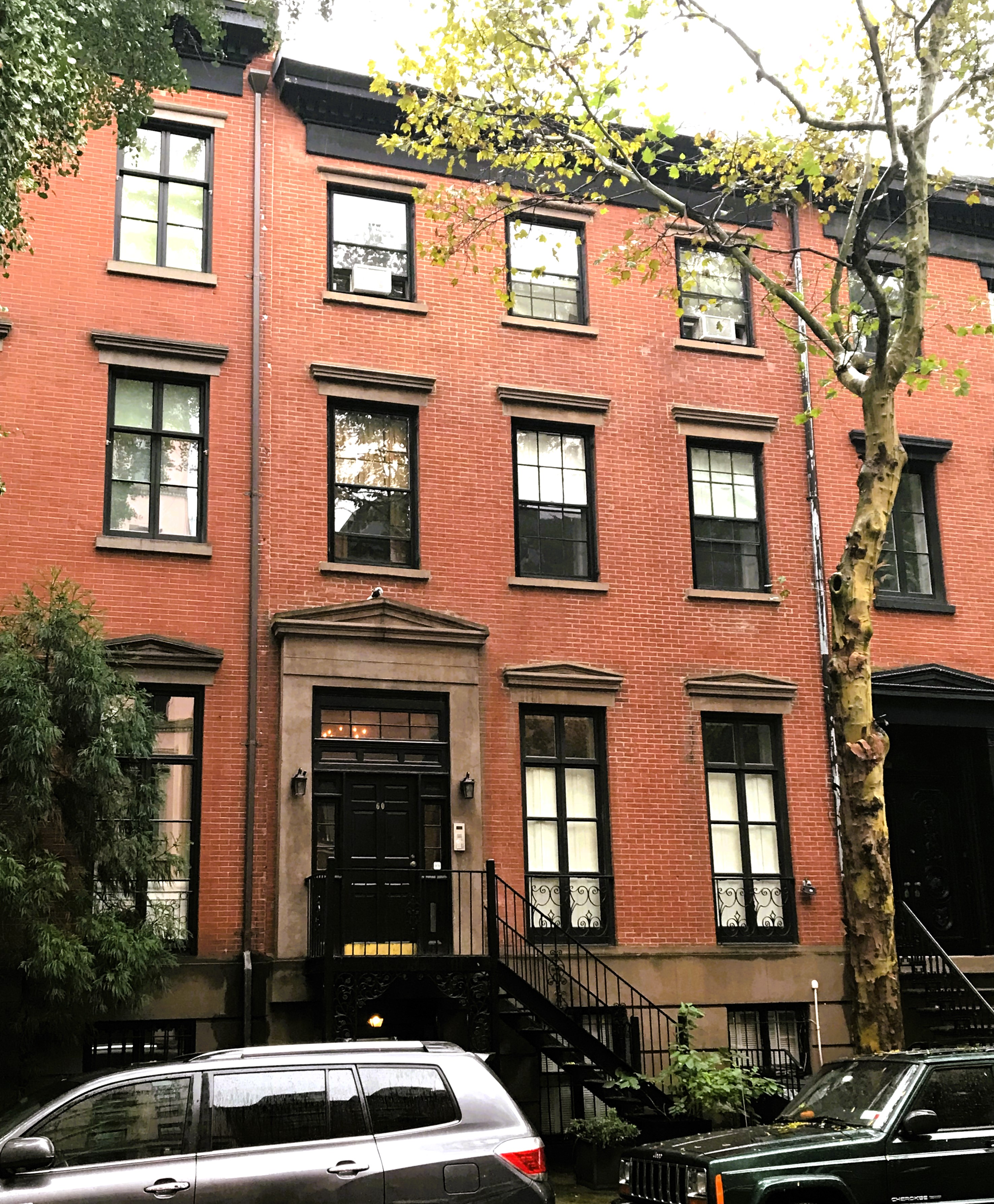
In 1847, clothier John D. Scott and lumber merchant Helmus H. Wells erected two high-end, speculative houses at 60 and 62 Morton Street, respectively.  The well-to-do businessmen were intimately familiar with the block, Scott living at 56 Morton Street and Wells next door at 58.

Completed in 1848, 60 Morton Street, like its identical neighbor, was three stories tall above a rusticated brownstone basement level.  Greek Revival style homes normally presented staid countenances, but here the architect embellished the parlor floor with triangular pediments over the openings, and elaborate Corinthian pilasters on either side of the entrances.

Helmus H. Wells was a partner in the lumber firm of Wells, Bontecou & Co.  He was no doubt highly involved in John D. Scott's selling 60 Morton Street to one of Wells's partners, Samuel W. Baker.  (Their other partner, Francis Bontecou, lived directly behind their homes, at 13 St. Luke's Place.)

The men's lumber business was highly successful and, resultantly, each was wealthy.  Wells, Bontecou & Co. operated from two locations--one at 344 West Street and the other on Third Avenue at the corner of East 130th Street.

Although he remained active in the business, in 1870 Samuel W. Baker moved his family to Troy, New York.  Francis Bontecou now moved from St. Luke's Place to 60 Morton Street.  A descendant of Pierre Bontecou, a Hugenot refugee from France, Francis was born in Coeymanus, New York in 1819.  He married Clarissa Maria Landon on June 25, 1844, about the same time he entered into the lumber trade.

Despite the family's surname, when Clarissa was looking for help in May 1873, she did not seek a French maid.  Her ad read, "Wanted--A German girl to do general housework, must be a good washer and ironer."

The family worshiped at the nearby Bedford Street Methodist Episcopal Church, the pastor of which was the Rev. Dr. J. P. Newman.  Newman left to become Chaplain of the United States Senate and "spiritual advisor to the [Ulysses S. Grant] Administration," according to the New York Daily Observer.  His close relationship with Francis Bontecou would cause suspicion to fall on the family in 1875.

The New York Daily Observer (which did not attempt to disguise its apparent contempt for the cleric), accused Newman of side-stepping the payment of customs duty, saying "his name is the open sesame for bringing dutiable merchandise into port without the payment of duty to the Government."  On December 11, 1875, the newspaper reported:

For eighteen months the ex-moral purveyor of Washington has been traveling over Europe and Asia with a commission from ex-Secretary of the Treasury Richardson to inspect the United States Consulates.  He has had all his expenses paid by the Government.  The last that was heard from him was from China.

Law required that incoming goods be "sent to a general order store, and from there to the public stores to be examined and appraised preparatory to the payment of duty."  But when the bark Kate Kearney arrived in New York from Hong Kong on December 4, eight crates circumvented the process.  Inside were "Chinese fancy wood boxes and curiosities, collected in the Holy Land, on which there is a duty of twenty-five per cent.  The curiosities are intended for presents for personal friends of Dr. Newman."  The New York Daily Observer said they were addressed to "Col. T. B. Thorpe, for Bontigu [sic] 60 Morton street, New York."

Surprisingly, in 1876 Francis and Clarissa Bontecou relocated to Toronto, Kansas where Francis became "engaged in farming and stock-raising," according to a family historian.  (They eventually returned to New York City, where Francis died at the home of their daughter on July 8, 1914 at the age of 95.

When the Bontecous left Morton Street, they leased No. 60 to Helmus V. Wells, who had grown up next door at No. 58.  Like his landlord and Samuel W. Baker before him, Wells was now a member of  the lumber firm co-founded by his father.  

Francis and Clarissa Bontecou were still living in Kanas in February 1883 when they sold 60 Morton Street to Evert Bergen, who lived in Brooklyn.  Bergen leased it to a proprietor who operated it as a boarding house.

The affluence of the residents was evidenced when Annie Pulver's "plush seal wrap" was stolen from the house in April 1889.  Police were on the lookout for anyone trying to sell the distinctive garment.  Then, on April 19, John Wilson, who was described by The New York Times as "an old man," was arrested while "endeavoring to dispose" of it.  Things got worse for him at the station house when police searched him and found "a number of letters and documents" bearing the name of Moses Schlessinger.  When questioned, Schlessinger identified them as papers that were in the pocket of his overcoat that was stolen from the hallway of his home on April 17.  The elderly thief was jailed awaiting trial.

In 1905, 51-year-old insurance agent Andrew La Croix took rooms here after separating from his wife.  She and the couple's 6-year-old daughter, Margaret, boarded a little over a block away at 7 Leroy Street.  As Christmas neared on December 19 that year, La Croix waited outside St. Vincent de Paul's Parochial School on West Fourth Street and when little Margaret came out, he took her.

Two nights later, La Croix was attending a prayer meeting on Hudson Street when authorities entered and arrested him for abducting his daughter.  The Brooklyn Daily Eagle reported on December 22 that the girl was "restored to her mother" and that La Croix was being held on $1,000 bail (a significant $34,000 by 2023 terms).

Enormous change came to 60 Morton Street with America's entrance into World War I.  The house was acquired by the Knights of Columbus, which converted it to the Veronica Council Service Station.  The facility offered recreation and temporary housing for servicemen.  On April 22, 1919, the New-York Tribune reported that a dance would be held that evening, and on November 28 that year, The Sun announced that "entertainment, dance, and refreshments" would commence at 8:00 that night, noting, "men in uniform invited."

After the war the Knights of Columbus switched its focus from servicemen to the underprivileged.  On December 24, 1921, the New York Herald reported, "The Knights of Columbus will distribute more than 2,000 Christmas baskets from Veronica Council clubhouse, 60 Morton street."

A renovation to apartments in 1926 significantly altered the appearance of 60 Morton Street.  The stoop was removed and replaced with a bunker-like entrance at the basement level.  The former doorway was converted to French windows that suggested their original use.

The dentiled pediment and Corinthian pilasters of the entrance survived the rather brutal remodeling in 1926.  image via the NYC Dept of Records & Information Services.

Among the first residents were singer-actress Norma Millay and her husband, Charles Ellis.  Norma's sister, poet Edna St. Vincent Millay, lived nearby at 75-1/2 Bedford Street.  In 1926, the New York Evening Post noted that Norma had "played the Ingenue role in 'Not Herbert' this past season, and has played in 'Me' and 'Fashion" and other productions."  The article added, "Norma, like Edna, chooses to keep her maiden name, although she, too, is married.  Her husband, Charles Ellis, is well known in the Provincetown Playhouse group."

By 1956 artist Leslie Powell lived in an apartment here.  He advertised in Art News that year, "Will take limited number of pupils.  Private instruction."  Born in Minneapolis in 1906, his watercolors would eventually hang in esteemed venues like the Smithsonian American Art Museum.

Leslie Powell's Coal Breaker was painted in 1939.  from the collection of the Smithsonian American Art Museum.

In April 19, 1966, Nick Davis advised classmates in the Princeton Alumni Weekly that they "can write me at 60 Morton Street, NYC.  60 Morton St., incidentally, is a Greek Revival brownstone (ca 1840) we just restored."  Nick and Linda Davis's renovations included the reopening of the parlor floor doorway and the installation of a metal, sidewise stoop.  A duplex apartment now engulfed the basement and parlor levels, and there was one apartment each on the upper stories.

In 1980, the duplex was home to comedian, actor and musician John Belushi and his wife, Judith Jacklin.  The couple had married in 1976.  In his 1984 book Wired: The Short Life and Fast Times of John Belushi, Bob Woodward wrote, "On the first floor, which was really the basement level, John and Judy had their bedroom.  Next to it John had a room he called the vault, a large music room with sophisticated stereo equipment and soundproofing on the walls and door."


Despite the abuse it has suffered, the Samuel W. Baker house still suggests the elegant lifestyles of its wealthy Victorian residents.

photographs by the author
no permission to reuse the content of this blog has been granted to LaptrinhX.com

Thursday, November 9, 2023

The Much-Altered 1836 Johnson Bakery - 6 Morton Street


Although Charles Oakley was educated as an attorney, he listed his occupation as "merchant" in 1810 when he married Margaret Roome.  But it was his real estate dealings for which he would be remembered.  By the 1830's Oakley had become, perhaps, the most prolific developer in Greenwich Village.  In 1836 he completed construction of a Federal style store-and-house at 6 Morton Street, just west of Bleecker Street.  It would originally have had a peaked roof with one or two dormers.  In the rear yard, as was common, was a smaller structure, used as a workshop.

That year the building became home to John Johnson's bakery.  Presumably, his family lived in the upper section.  The bakery initially saw a quick succession of proprietors.  By 1840 it was being operated by Nicholas Beekman, and the following year an advertisement in the New-York Tribune read, "To let or lease--The bakery and work-shops No. 6 Morton-st. near Bleecker, separate if wanted."  The lease was taken over by Samuel Decou.

Patrons woke up to startling news on September 30, 1846, when they read in the New York Mourning Courier, "On Sunday afternoon, at 3 o'clock, the bakery of Mr. Decoes [sic], No. 6 Morton street, near Bleecker, was destroyed by fire."  Happily, however, the journalist was a bit dramatic in his reporting.  

The Evening Post was more detailed and accurate, saying, "About 9 o'clock last evening the bells sounded the alarm of fire, and the firemen were soon at No. 6 Morton street, from whence the alarm proceeded."  The fire fighters discovered that a hand-held glass lamp, called a spirit gas lamp, had exploded.  "It appears that a young girl had the lamp in her hands doing something to it when it bursted," said the article, "and the spirit gas was thrown over her hands and arms which were severely burnt."  The fire was extinguished by the firemen, who deemed the damage "trifling."

Also listed at the address in 1849 was Franklin G. Bragg, presumably a boarder.  Bragg was arrested on May 14 that year on extremely serious charges.

William Backhouse Astor, the son of John Jacob Astor I, had received several letters at his home at 32 Lafayette Place, demanding $50,000 in cash.  They warned "that if he failed to meet the demand, they would carry out their determination of sacrificing his property and life."  The letters explained that the "sacrificing" of his property meant the burning of various Astor buildings.  The demanded ransom would translate to about $1.97 million in 2023.

The letters had been written by Bragg and Isaac A. Biggs, who lived nearby at 31 Morton Street.  Working with police, Astor filled a package with "spurious bills," then waited for it to be retrieved.  On the morning of May 13, Franklin G. Bragg knocked on the door of the Astor residence and received the package.  He was followed by undercover officers who later arrested both extortionists.

In 1853, the bakery was run by Louis Cantel, but by 1858 it had been converted to a butcher shop, run by Louis Hart.  He would remain in the space through 1862.  Ann M. Hill, the widow of Cornelius Hill, operated the upper floors as a boarding house.  Living here in 1858 were Henry Bradley, a gasfitter on Canal Street; and broker Joseph Harker.  Harker would continue to rent a room through 1862.

In the meantime, the property was offered for sale in February 1860, for $2,800 (about $102,000 today).  It was purchased by the Herz family.  Moses Herz ran a butcher store at 60 Barrow Street, but Lewis Herz (presumably a son) would not open his butcher shop and grocery at 6 Morton Street until Hart's lease ran out in 1863.

It appears that the Herzes converted the workshop in the rear to a residence.  In 1863 Samuel Darry, a waiter, and Levin Polk, a "carpetshaker," lived there.  Both were listed in city directories as "colored."

Although the family still owned the property, in 1867 the Herz butcher shop closed.  An ad in the New York Herald on March 13 offered, "For Sale--$250, a small grocery in the Ninth ward, near Bleecker street, Stock and Fixtures or Fixtures alone; Store to let; rooms back of store; low rent."

Eliza Janet Vanamringe, the widow of James L. Vanamringe, took over the operation of the upper floors.  She was, as well, a dressmaker.  Eliza had one listed boarder in 1867, William F. Williams, who was a machinist.

It appears Eliza Vanamringe depended mostly on her dressmaking skills for her livelihood.  An advertisement in December 1868 read, "6 Morton St.--A dressmaker, having ten years' experience in the city, desires a few more customers by the day or week."  Two years later she advertised, "6 Morton St., near Bleecker--An experienced dressmaker, many years in private families in the city, desires a few more engagements by the day; does first class fitting and trimming."

In 1877, Lewis Herz's widow, Kretchen, sold 6 Morton Street to Morris Herz, presumably a relative, for $4,000 (about $115,000 in 2023).  The shop continued as a butcher shop, run by John Collins.  In 1878 there were eight roomers in the upper floors and rear building.

The name of one resident, Alexander Davidson, appeared in newspapers for the wrong reasons in 1884.  It began on April 24, 1884 when the New York Herald reported he had been the victim of Daniel McDonald, who passed a "worthless check for $25" to Davidson.  But eight months later, Davidson was not the victim, but the perpetrator.  On December 12, the New York Daily Graphic reported the shocking news, "Caroline Richter, a Bavarian emigrant girl, was taken to a house of prostitution and offered for sale for $6 by a wretch named Alexander Davidson of No. 6 Morton street."

In 1889 Morris Herz sold the property to William Eisenberg, who modernized the building and raised the third floor to a full floor.  He sold the remodeled structure in 1890 to Patrick Sullivan.

One of Sullivan's sons, Eugene, was an "expressman," or delivery driver.  On November 8, 1899, The World reported that a man had attempted suicide in Central Park "at the east drive and Sixty-fifth street" by drinking carbolic acid.  He was taken to the Presbyterian Hospital, but he died there in an hour."  In his pocket was found a notebook with the name of Eugene Sullivan.  "The book was full of musical terms and the names of popular airs," said the article.

Police went to 6 Morton Street to notify the family of Eugene's death.  To their astonishment, Eugene "was found very much alive."  The article noted, "He was surprised when told that a notebook bearing his name was found on the body of the suicide."

Another son, Steve, learned a trade in the garment industry.  On January 27, 1904, he was looking for a job, advertising, "Bias cutter, at anything; best references.  Steve Sullivan, 6 Morton-st."

When The New York Times reported that Patrick Sullivan had sold 6 Morton Street to James L. Van Sant on January 19, 1923, it gave a colorful and inaccurate history.  The article said the house "was formerly owned by Aaron Burr, former Vice-President of the United States, who operated extensively in old Greenwich Village.  This is the first sale of property in 33 years."  (Technically, Burr had owned the property as part of his summer estate Richmond Hill, but never the existing building.)

Only a month later, Louise A. Cobb purchased the "business and dwelling apartment house," as described by The New York Times from Van Sant.  The article said she "intends to make extensive alterations and improvements and will hold the property for investment purposes."  It would be five years before the "alterations and improvements were made."  In 1928 the building, now owned by Alphonsus A. Brugnoli, was described as a store and residence for one family.

The building had been given what one architectural historian calls a Utilitarian style facade.  The decorative elements of its tan brick facade were executed in brick--red brick bandcourses, a faux cornice with brick corbels, and a stepped parapet ornamented with creative brick designs.

A large show window engulfed the ground floor space in 1941.  image via the NYC Dept of Records & Information Services.

In the third quarter of the 20th century, the store was home to the Leather & Suede Doc, where jackets, belts and handbags were repaired.  It was supplanted by 1979 by Fantasies, a vintage clothing store that touted, "Fine antique apparels."

The Villager, December 23, 1976

Major change came in 2013 when C-Three Architecture & Design converted the building to a single-family dwelling.  The store window has been replaced with a glass-block opening.


photographs by the author
LaptrinhX.com has no authorization to reuse the content of this blog

Wednesday, October 25, 2023

The 1852 Nassau Swinsen House - 66 Morton Street


In 1714, Queen Anne bestowed Trinity Church with an expansive tract of land.  Known as the Trinity Farm, it stretched north along the Hudson River from Duane Street in the city to what would become Christopher Street in Greenwich Village.  Around 1825 Trinity Church began developing the land into building lots. 

In 1852, the Trustees of Trinity Church erected a handsome, Italianate style residence at 66 Morton Street.  To take advantage of the breezes from the nearby Hudson River, its architect created an unusual, full-height faceted bay.  Its windows opened to the east and west, affording refreshing airflow.  Faced in red brick, the house rose four stories above a brownstone clad English basement.  The openings originally wore molded brownstone architrave frames.

The house was leased to Nassau Swinsen, who operated it as a boarding house.  An advertisement in September 1853 offered:

Boarding--Gentlemen and their wives can obtain rooms with board at six and eight dollars per week, or single gentlemen at the same price with two in a room by applying at No. 66 Morton street, corner of Hudson, in a very quiet place, and with an American family.  Cars and stages pass every five minutes.

The posted rents would translate to between $117 and $313 in 2023.  

At the time, Eliza Swinsen, presumably a relative, ran another high-end boarding house steps away on Hudson Street.  In 1856, she took over the operation of 66 Morton Street.  Also moving into the house was her daughter, Eliza J.  She became a teacher around 1858, and would work at Primary School No. 24 on Horatio Street for years.

A few of Eliza Swinsen's boarders would stay for years.  The Hodgson family, for instance, moved in around 1856 and would remain at least a decade.  William P. Hodgson ran a coal business at 368 West Street.  

In 1863, Congress passed a conscription act, creating the first war-time draft in United States history.  It provided a loophole for the well-to-do in that exemptions could be purchased for $300--about $7,000 today--or they could pay for a substitute.  The Hodgsons chose not to risk sending their son off to the battlefront.  On September 4, 1864, The New York Times published a list of the "names of Patriotic Gentlemen who have furnished substitutes in advance of the draft."  Included was Thomas Hodgson, who did not supply a profession.

Around 1873, Charles H. Webb took over the lease of 66 Morton Street.  The family lived here for about a year, then sub-let the house to Sarah A. Taylor, the widow of Isaac Taylor.  Living with her were her two adult sons.  Isaac was a clerk, and Hugh M. Taylor was a plumber.  As was common, Sarah took in one boarder at a time.

On July 12, 1887, the Webb estate sold the leasehold of 66 Morton Street to Francis Caragher and his wife Mary for $15,000 (about $475,000 in 2023 terms).  A "truckman," Francis was the head of Francis Caragher's Sons, which specialized in transporting goods for produce merchants.  The firm operated from 49-51 Downing Street, a building Caragher had erected in 1879.  It was one of several Greenwich Village properties he owned.

Francis Caragher died in 1893, but the Caragher family would remain in the house for decades and, like Sarah Taylor, they took in a boarder.

Living with the family in 1909 was Dr. Edwin Zimmerman.  Five years earlier, real estate agent Charles C. Hickok had begun lobbying to have Seventh Avenue, which began at 11th Street, extended south to Varick Street.  The proposal would include the extension of the Seventh Avenue subway.  Among Hickok's vocal supporters was Dr. Zimmerman, who was also president of the Greenwich Village Public Committee.  On June 26, 1909, The New York Times reported on a "meeting at 66 Morton Street, called by Dr. Edwin Zimmerman...at which [City Controller Metz] was the principal speaker."  It noted that the meeting "was held for the purpose of rallying forces for the fight for the Subway extension."

A less upstanding tenant was Louis Bernstein, who lived here by 1921.  On January 28, 1922, the 22-year-old was sentenced for shoplifting.  He did not perform the crime himself, however.  The Evening World reported he had been running a Fagin-like operation, and was "convicted of receiving during the last six months articles valued at $8,000 from a gang of boys he employed to steal from the stores."

In 1923 the Caragher estate leased the property to Elin Heins "for rooming purposes," according to The Sun and The Globe.  Within the next decade, the exterior was modernized.  The stoop was removed and the entrance lowered to the basement, and the Victorian detailing of the openings were shaved flat.

The house in 1941 had lost its stoop and carved details.  image via the NYC Dept of Records & Information Services.

In 1957, the 28-year-old fledgling poet Maurice Kenny moved into 66 Morton Street.  In his 2018 autobiography Angry Rain, he describes his room as "not much larger than six by ten feet," and says, "I was a tenacious young poet with a head start on success."  Before long, while going through the incoming mail on the hall table, he discovered that another tenant was author Willard Motley.  His 1947 novel Knock on Any Door had won critical acclaim and was made into the 1949 motion picture of the same title.  The two became close friends.  Kenny writes, "Within two years of our meeting, I was living and working in his house on the outskirts of Mexico City, while he tried to write his fourth novel."  Maurice Kenny would go on to be inducted into the New York Writers Hall of Fame in 2014, and Motley was inducted into the Chicago Literary Hall of Fame.

In 1969 Mary Kaplan purchased 66 Morton Street, returning it to a private residence.  She had the stoop and entranceway meticulously refabricated.  Astoundingly, given the vandalism that had occurred to the outside, much of the 1852 interior detailing had survived.

Sumptuously-carved marble mantles and rope molding are among the surviving interior details.  image via 6sqft.com

While Kaplan owned it, the unusual house became a favorite for Hollywood location scouts.  It was the home of Harrison Ford's character in the 1988 Working Girl, the residence of Matthew Broderick's character in the 1998 The Night We Never Met, and in 2000 was the home of Winona Ryder's character in Autumn in New York.


In 2015 Kaplan sold 66 Morton Street to jewelry designer David Yurman and his wife Sybil for $17 million.  His ownership would be short-lived, and he put it back on the market in 2017, selling it in August the following year.

many thanks to reader and blogger Jason Kessler for suggesting this post
photographs by the author
LaptrinhX.com has no authorization to reuse the content of this blog

Saturday, February 6, 2021

The 1854 Russell Thatcher Trall House - 52 Morton Street


In 1853 businessman and inventor Thaddeus Hyatt purchased a parcel of land from Trinity Church on the south side of Morton Street, between Hudson and Bedford Streets.  The following year he completed construction on four especially handsome brick and brownstone homes stretching from No. 46 through 52.   

Their Anglo-Italianate design forewent the tall brownstone stoops seen throughout the city.  Instead, the entrances were within a brownstone base.  The second, or parlor floors, boasted elegant French windows fronted by cast iron balconettes and classical stone pediments.  The openings of the upper floors wore bracketed cornices, while the sills sat upon unusual paired corbels.  Hyatt advertised the "first class basement Houses" for sale with $3,000 down and "the balance on favorable terms." 

No. 52 was purchased by Dr. Russell Thatcher Trall.  Born in Connecticut in 1812, he had earned his medical degree from Albany Medical College in 1844.  By now he was well known as the head of the Hydropathic and Hygienic Institute at No. 15 Laight Street--a combination hospital, medical school and "water-cure" establishment, and as the founder and president of the New-York Vegetarian Society.

His water-cure theories were based on the fact that the human  body is composed mostly of water.  Patients immersed in the various cold water treatments--"plunging baths," "sitting baths," and "head baths" among them--would have impurities flushed out of their bodies.

Trall apparently purchased the Morton Street house as an investment, for he continued using the Laight Street address as his residence.  He first leased No. 52 to William J. Wilcox, whose lard business, William J. Wilcox & Co., had two locations on West Street.  He was, as well, secretary of the Knickerbocker Ice Company.  He and his wife, Mary, had a daughter, Rena.

When the Wilcox family left in 1857 Trall considered selling the property.  He placed an advertisement in the New-York Daily Tribune that read:

To Let--House No. 52 Morton-st., near Hudson; well arranged for a select private Boarding House; partly furnished; will be sold at a bargain.  Inquire of Dr. Trall, No. 15 Laight-st.

Interestingly, he leased it to an associate, Charles H. Shepard.  Born on September 28, 1825, Shepard was a member of the firm of Fowler & Wells, which had published Trall's cookbook.   He opened the New-York Kinesipathic Institute in the Morton Street house, which like Trall's facility, offered water cures.

Shepard used Russell Trall's name as a reference in his advertisements. The Water-Cure Journal, May 1859 (copyright expired) 

Shepard and his wife had six sons and one daughter.  Later The Phrenological Journal said "He traveled abroad extensively to familiarize himself with the working of the Turkish Bath in other countries, and made it his life work to demonstrate to his countrymen the advantages of the Turkish Bath in America."

Dr. Charles H. Shepard The Phrenological Journal, December 1910 (copyright expired)

Shepard's wife was highly involved in the operation.  An advertisement in the New-York Daily Tribune on May 16, 1860 read:

At this establishment Invalids can have the advantage of Kinesipathy, or Swedish Movement Cure, combined with all necessary Water-Cure appliances.  Mrs. C. H. Shepard, M.D., assists in the treatment of ladies.  Our success during the past year has been highly gratifying.

It may be that the house became too confining for Shepard's growing business, or, possibly, the neighbors within the upscale homes along the block protested against the presence of the institute.  For whichever reason Shepard moved his Kinesipathic Institute to Brooklyn Heights in September 1861.  His announcement explained "Dr. Shepard hopes by his enlarged facilities for the treatment of disease, and the superior location, to give ample satisfaction."

The Shepards remained in the house for another year, and then, somewhat surprisingly, Dr. Russell T. Trall moved in in 1863.    He and his wife took in two boarders that year, John S. Stryker, a clerk, and policeman John E. Fitzgerald.

This photograph of Dr. Trall was taken around the time he moved into the Morton Street house.  original source unknown

It was a short-term arrangement and in 1864 the family of William G. Robinson was living in the house.  Robinson's dry goods business was on Broadway.  Henry Robinson was in the flour business on Whitehall Street, and William, Jr. was a clerk.

Maintaining an upscale household with several adult family members required a domestic staff.  In the spring of 1868 Mrs. Robinson was looking for "A girl as chambermaid and waitress, and to assist in the washing and ironing; must be neat and tide and come well recommended."

The Robinsons remained in the house until 1870 when the family of broker William E. Heiley moved in.  Heiley's wife was apparently more comfortable speaking in her native language than English, for an advertisement in the New York Herald on September 7, 1872 read "Two German Girls wanted--One to cook and assist with washing; the other for chamberwork."

In 1888 No. 52 was purchased by William J. Broderick for $13,000--about $360,000 in today's money.  Living with him were his widowed mother, Catherine, and his sister Celia Ann.  Following Celia's marriage to Patrick Corbett, the newlyweds lived on in the house.

Broderick was a partner with James F. Nearey in the hatters' supply firm of Broderick & Nearey, and the printing firm of Amity Printing Co.  Proud of his native roots, he was an active member of the American-Irish Historical Society.

Catherine Broderick died in the house on February 7, 1895 at the age of 73.  There would be another death in the house eight years later.  Celia died on July 15, 1903 and her funeral was held in St. Joseph's Church on Sixth Avenue three days later.

Although he retained possession of the house, William Broderick left No. 52 in 1911.  He first leased it to A. J. Wallick, and then to Edward Kearney and his wife, Catherine, in 1914.  The Kearney's remained here for several years.

52 Morton is at the far right of the row.

By the late 1920's the house held unofficial apartments.  In 1931 Allard Valentine lived on the third floor.  He and his wife, freelance writer Anita Valentine, were separated but remained close friends.  She often stopped by to clean his apartment for him, and since she was preparing to go to Cape Cod on Saturday June 6, she made certain to "tidy up" the place on Friday.  She arrived at around noon and remained for several hours.   

The rear garden of the house backed up to that of No. 12 St. Luke's Place.  That once-refined home was now broken into apartments as well.  Among the tenants there were entrepreneur and inventory Stanley Faithfull and his wife, the former Helen Wyman.  Helen's daughter by a former marriage, Helen Starr Faithful (who went by her middle name) lived with them.   Starr Faithfull had had a trouble past.  She had been repeatedly sexually abused by a relative, Andrew James Peters when she was 11-years old and had shown signs of emotional disturbance as a teen.

via the NYC Dept of Records & Information Services.

Helen's mother did not learn of the abuse until 1927 at which time she engaged an attorney who negotiated a $20,000 settlement in return for keeping the scandal a secret.  It appears, however, that the Faithfulls continued to extort money from Peters and some accounts estimate the total payouts at $80,000.

Starr Faithfull, in the meantime, led an unflattering life.  She habituated speakeasies and cruise ships, where she carried on numerous sexual flings with ship officers.   On at least one occasion she was discovered drunk, naked and beaten in a hotel room.

Between 3:00 and 4:00 on that June afternoon Anita Valentine heard screams from the St. Luke's Place house.  They were coming from the Faithfull's apartment.  She later testified she heard a woman's voice saying "She mustn't do that.  She must stop it."  The shrieks, she said, ended as abruptly as they started, but another woman could be heard talking in a loud voice.  She looked out at the open windows of the Faithfull apartment, but could see nothing.  Nevertheless, the incident so affected her that she made note of it in her diary.

Anita went on with her vacation and it was some time before she read in the newspapers that Starr Faithfull's body had been discovered on a beach on Long Island on Monday morning, June 8.  She was interviewed several times in regard to the matter.  The mystery of Starr Faithfull's death was never solved.  It sparked several novels, including John O'Hara's Butterfield 8.

Noted dancer, teacher, author and spiritualist Joseph Gifford lived here by the mid-1950's.  Born in 1920 in Niagara Falls, he began his career as a member of the Doris Humphrey and Charles Weidman Dance Company.  By now he had formed his own company, the Joseph Gifford Dance Theater, headquartered in his apartment.   He performed within the group, as well.  On April 9, 1959 The Villager reported "The Joseph Gifford Dance Theater, 52 Morton St., appeared on Sunday in a production of Igor Stravinsky's 'L'Histoire Du Soldat' at the Kaufmann Concert Hall, 92nd St. and Lexington Ave...Mr. Gifford himself played the part of the devil."

Joseph Gifford as he appeared at the time he lived in the Morton Street house.  from the collection of the University of Washington Library


In May 1960 the house was purchased by Jeanne Denny.  In reporting on the sale The Villager noted it contained eight "non-housekeeping apartments."  The term meant that the apartments had no kitchens.  The article added, "The new owner plans to do extensive rehabilitation by making Class 'A' apartments and a duplex for her occupancy."

That finally came to pass in 1982 when a renovation resulted in a duplex apartment in the basement and first floor level, and one apartment each on the upper floors.  That configuration changed in 1996 when the third and fourth floors were combined to a duplex residence.


Externally, the Trall house is almost entirely unchanged after more than 165 years.

photographs by the author