Showing posts with label west 71st street. Show all posts

Tuesday, February 13, 2024

The 1884 David C. Montgomery House - 126 West 71st Street


In 1883, the architectural firm of Thom & Wilson designed a row of five 20-foot-wide, brownstone-faced rowhouses for George W. Hamilton on the south side of West 71st Street between Columbus Avenue and Broadway.  Designed as two models in an A-B-A-B-A configuration, the A designs were Renaissance Revival in style, while the B's were a more playful Queen Anne.  

Completed in 1884, 126 West 71st Street (one of the A models) rose four stories above a high English basement.  Its parlor level was decorated with elaborately carved Renaissance style panels.  Here the openings were fully arched, and the windows sat above shell-carved half bowls.  A three-sided bay dominated the second floor.  Thom & Wilson added a delightful detail at this level by designing the side window as a faux Juliette balcony.


The house became home to Samuel Dalsimer and his wife, the former Zettie Wellman.  The couple was highly active in Jewish philanthropies, and Samuel was a member of the Jewish Publication Society, The Home for Aged and Infirm Hebrews, and the United Hebrew Charities of the City of New York.  He was, as well, as a patron of the Hebrew Orphan Asylum. 

Well-to-do New Yorkers spent the warm months away from the city.  The Dalsimers did not own a summer home, but patronized fashionable resort hotels.  On April 1, 1900, for instance, the New-York Tribune reported that they had checked into the Seaside House in "balmy Atlantic City."

On November 14, 1908, The New York Times titled an article, "David Montgomery Buys a House."  It began, "David Montgomery of Montgomery & Stone, now playing in 'The Red Mill,' has joined the group of theatrical people who maintain permanent residences in this city."  The entertainer had purchased the Dalsimer house and The New York Clipper noted, "The comedian will reside there with his mother and sister."

At the time, it was common for well-heeled families to sell everything in their former homes and start fresh in their new one.  The following week, an announcement of a two-day auction appeared in The New York Times.  The sale, it said, was "By order of Samuel Dalsimer, Esq., who recently sold his residence to David C. Montgomery, the well known comedian."

The auction was held "at the beautifully appointed residence," and included "the rich modern cabinet made furniture throughout, together with the magnificent collection of European art objects, including valuable Limoges enamels, paintings, porcelains, bronzes, statuary, etc."  The announcement said the items reflected "a refined and comfortable home," and suggested that those "in quest of furniture and works of art of the better class" should attend.

David Craig Montgomery, from the collection of the New York Public Library

Born on March 21, 1870, David Craig Montgomery was the partner of Fred Stone in the comic duo Montgomery and Stone.  He had been on stage since the age of 17 when he played a role in the concert beer hall Streakbiner's Garden in St. Joseph, Missouri.  By practicing in his backyard, he taught himself to dance.  When he was adept enough, he presented his song and dance routine at local venues in St. Joseph and Kansas City.

He met Fred Stone in Galveston, Texas in 1895 while playing with J. H. Haverly's minstrel company.  They formed a song and dance act together, first appearing as a duo in New Orleans with the Haverly company.  Montgomery and Stone appeared in vaudeville theaters across the country.  They performed on Broadway in 1901 in The Girl From Up There.  The duo's great break came in 1903 when they were hired to play the Tinman and Scarecrow in Victor Herbert's stage adaptation of L. Frank Baum's 1900 book The Wizard of Oz at the Majestic Theatre.  Montgomery brought his trademark humor to the Tinman with the character's rusty movements, and Stone's "boneless" dancing as the Scarecrow drew rave reviews.

Never married, when Montgomery purchased 126 West 71st Street, he and Stone were appearing in another Victor Herbert production, The Red Mill.  They played two down-on-their-luck vaudevillians, Con Kidder and Kid Conner, stranded in a small hostelry in the Netherlands.  Their routines from the play were made into two short films by the Winthrop Moving Picture Company.  

David Montgomery (left) and his partner, Fred Stone.  from the collection of the New York Public Library

David Montgomery's success afforded him a comfortable lifestyle.  On August 8, 1910, as the opening of the theater season neared, The New York Times ran the headline, "Players Back From Europe."  The article ended saying, "Dave Montgomery, who spent the Summer as the guest of Danny Maher, the jockey, in England, will open in 'In the Old Town' in Chicago on Aug. 15."

He and Stone were back in New York City in 1914 to open in Chin-Chin at the Globe Theatre.  Produced by Charles Dillingham, it may have been inspired by the success of Victor Herbert's smash hit Babes in Toyland.  Set in a toy bazaar, a tea shop, and similar venues, its characters were painted dolls and tin soldiers that come to life.  It was the top hit of the 1914-15 Broadway season.

David Montgomery's brother, Harry, was also an entertainer, whose stage name was Scamp Montgomery.  He died on July 9, 1911 and his funeral was held in the West 71st Street house.

On March 18, 1895, The New York Times began an article saying, "Twenty years ago tonight Fred Stone and Dave Montgomery made their first appearance together as a team of comedians in a vaudeville theatre in New Orleans."  Fred Stone explained the duo's successful formula for staying together:

During the twenty years Dave and I have been together, we have shared the same dressing room.  We have been together morning, noon and night for all the playing months of the year, and in all that time we haven't had as many quarrels as the average man and wife have in a week.  We believe in the separation cure.  As soon as our season is over we pack our grips and set out in opposite directions.  When Dave and I meet after our separation we are better friends than ever.

Fred Stone as the Scarecrow and David Montgomery as the Tin Man in The Wizard of Oz.  from the collection of the New York Public Library

In 1917, Charles Dillingham took Chin Chin on the road with, of course, Montgomery and Stone in the roles they created on Broadway.  In March, the company was in St. Joseph, Missouri--where it had all started for David Montgomery--when he was taken ill.  An understudy took over his role.  Montgomery initially went to Chicago "for an examination," as worded by The New York Times, which then reported, "He entered the Presbyterian Hospital for a major operation on March 20."

The procedure seemed to have gone well, but then, on April 10, 1917, The New York Times reported, "Dave Montgomery, the comedian, who was operated on two weeks ago, is in critical condition, it was reported today.  He has been unconscious for a week."

By then, Chin Chin was playing in Canada.  The New York Times reported, "Fred Stone...left the company at Montreal and went to Chicago to be at the bedside of his comrade."  Stone's wife, actress Eileen Crater, also rushed to Chicago.   

After having been unconscious for 11 days, at 3:00 on the afternoon of April 20 David Montgomery regained consciousness.  Hospital employees recounted his interaction with Stone, who "had reproached himself for not ending his tour so as to remain with his friend," wrote The New York Times.  Montgomery was reported to reply:

Fred, you've sacrificed enough for me in recent years.  I know that you've been the whole show for a long time--that people want to see you, and I've simply been paid as part owner of the old trademark.  I know that you've refused offers from other managers that would have given you for yourself my income as well as your own and that you turned them down to be loyal to your old pal.

An hour after he regained consciousness, David C. Montgomery died.  At his bedside, along with Stone, were Eileen Crater; Dillingham's general manager Bruce Edwards;  and Montgomery's sister, Mrs. R. O. Lawhead.  Fred Stone told a reporter from The New York Times, "I've seen the gamest little fellow I know fight to the finish for life's biggest stake--life."

In reporting his death, The New York Times said, "The team of Montgomery and Stone was one of the last of the famous teams of comedians."  On April 22, the newspaper wrote, "Fred Stone planned today to accompany the body of his dead partner, David Montgomery, the comedian, to New York, where it will be buried in Woodlawn Cemetery beside that of 'Scamp' Montgomery, the dead jester's brother, who was also an actor."

Two days later, The New York Times reported, "Not since the funeral of Charles Frohman have so many men and women of the theatre gathered to honor the memory of one of their number as assembled yesterday for the funeral of David Montgomery."  A Who's Who of the American theater gathered at the chapel of Frank S. Campbell on Broadway at 67th Street.  The article said, "many who could not find room within stood outside."

In 1919, Montgomery's sister filed an accounting of his estate.  The New York Sun noted, "Montgomery also owned a house at 126 West Seventy-first Street" which was valued at $25,000 (just under $425,000 in 2024 terms).   On August 16, the Record & Guide reported that the house had been sold, adding,  "The purchaser will alter the dwelling into small apartments."

The renovations, completed in 1920, resulted in "bachelor apartments."  The stoop was removed and a handsome, if period inappropriate, Greek Revival style entrance created at the basement level.  It was most likely at this time that the out-of-fashion stained glass transoms over the parlor windows were removed.  The Department of Buildings cautioned, "cooking in more than two of the apartments will render this building liable to immediate vacation by the Tenement House Department."

The term "bachelor apartment" was a holdover from the 19th century when apartments were designed without kitchens in buildings erected specifically for unmarried men.  The term no longer meant that only men were welcomed, and among those signing leases in 1921 were several unmarried women.  (The thought of an unattached female living alone would have been shocking a generation earlier.)

Among the tenants in 1926 was concert basso Sigurd Nilssen, who used his apartment as his studio for giving vocal lessons.   Born in Norway in 1895, he would dramatically change courses before long, turning to acting.  He most notably appeared in the 1940 motion picture Flash Gordon Conquers the Universe.

Signurd Nilssen (right) in Flash Gordon Conquers the Universe.  image via imdb.com

A renovation completed in 1974 resulted in two apartments per floor.  


photographs by the author
LaptrinhX.com has no authorization to reuse the content of this blog

Tuesday, August 8, 2023

The Myron Oppenheim House - 118 West 71 Street


Heavy Italianate stone railings originally guarded the stoop, and the beefy newels were capped with decorative finials.

In 1883 the architectural firm of Thom & Wilson designed a row of five 19-foot-wide, brownstone-faced rowhouses for George W. Hamilton on the south side of West 71st Street between Columbus Avenue and Broadway.  Designed as two models in an A-B-A-B-A configuration, the A designs were Renaissance Revival in style, while the B's were a more playful Queen Anne.  

Completed in 1884, 118 West 71st Street (one of the A models) rose four stories above a high English basement.  Its parlor level was decorated with elaborately carved Renaissance style panels.  Here the openings were fully arched, and the windows sat above shell-carved half bowls.  A three-sided bay dominated the second floor.  Thom & Wilson added a delightful detail at this level by giving the side window a faux Juliette balcony.

Stained glass fills the transoms of the parlor windows.

After leasing the houses for three years, Hamilton sold the entire row in August 1887 to operators Frederick Beck and Charles E. Runk for $171,000.  Their advertisement for 118 West 71st Street in February 1888 reflected its high-end details:

Handsome 4-story high-stoop basement and cellar brown-stone private dwelling, with extension, elaborately finished and in perfect order, and adjacent to Central Park entrance at 72d st. and 8th ave.

It may have been the mention of the proximity to the Central Park entrance that caught the eye of Myron Henry Oppenheim and his wife, the former Jennie May Toplitz.  Both were accomplished equestrians.  The couple purchased 118 West 71st Street for $36,000 (about $1.14 million in 2023).  As was common, title to the property was put in Jennie's name.

Myron H. Oppenheim on his gelding Johnny Jones on the bridal path of Central Park.  Show Horse Chronicle, May 2, 1917 (copyright expired)

Born in Albany, New York in 1859, Oppenheim had graduated from Columbia College in 1881.  A partner in the law firm of Oppenheim & Severance, Show Horse Chronical called him "the well-known corporation lawyer and capitalist."  The couple had a one-year-old daughter Dorothy.  Their summer home, Castle Wall, was in Elberon, New Jersey.

A postcard pictured the Oppenheim's country home.  image via historiclongbranch.org.

The couple had barely settled into the West 71st Street house when Oppenheim found himself in court, charged with usury.  Silas J. McGinnis, a real estate operator, charged that in 1885 he borrowed $600 from Oppenheim.  He was to repay $1,000 within six months--making the interest nearly 60 percent of the principle.  Furthermore, as security McGinnis transferred title to a house in Brooklyn valued at $4,250.  When it came time for him to repay the loan, he discovered the Oppenheim had sold the property for $1,000.  

Little Dorothy was a precocious girl, at least by the account of the Albany newspaper The Times-Union on July 5, 1893.  The article said in part:

Miss Dorothy, though but six years of age, is quite a linguist, speaking French, German and English fluently.  She dances prettily and quite enchants those who are fortunate enough to be in her set.

Jennie (who went by Jane) Oppenheim was as skilled in the saddle as was her husband.  On October 15, 1916, The New York Times reported on the "keen competition between the owners of the high steppers" at the Westchester Horse Show.  It reported, "Mrs. Myron H. Oppenheim won the first prize of $50 and a blue ribbon" in the class of a saddle horse "ridden by a lady on a side saddle."

By then, the Oppenheims had been gone from West 71st Street for several years.  Their former home was purchased by Dr. Samuel W. Hassell in November 1902.  (Four years later, the Oppenheims would acquire the sumptuous Shadow Lawn estate in West Long Branch, New Jersey, a 52-room showplace.)

Hassell was an odontologist, a scientist who focused on the study of teeth.  His academic writings regularly appeared in medical journals.  His wife, the former May O'Brien, was the daughter of the well-known artist and "distinguished literateur," as described by the Express Gazette in 1895, Matthew V. O'Brien, who signed his works "Matt O'B."

In April 1908, Dr. Hassell's duties were increased when he was appointed to the Local School Board for a period of five years.  It appears that the well-to-do couple made a significant decision in 1911--to give up their horse-drawn vehicles in favor of an automobile.  On April 26, Hassell's advertisement appeared in The New York Times:  "A fine team of road horses; very gentle and good looking; both used in saddle.  Owner, 118 West 71st st."

In 1941, the muscular stone stoop railings and newel finials survived.  image via the NYC Dept of Records & Information Services

Following World War I, 118 West 71st Street was acquired by the 71 Property Corp., which rented the house.  It sold it to the Wallan Holding Company, Inc. in 1928.  The new owners continued to lease it to well-heeled tenants.  Living here in 1929 was the family of William Conlans.  He and his wife had two sons, Harry and Alfred Baxter.  Alfred was married to Dorothy Helen Brey in June that year.

James H. Cruikshank purchased 118 West 71st Street in April 1937.  In reporting the sale, The New York Sun noted, "It contains sixteen rooms and seven baths."  Living with him and his wife, Florence B., were their three sons, James Jr., John E., and Robert W., their daughter, Carol Alice, and a servant.


Throughout the 1940s, the house was home to broker John J. O'Rourke and his family.  It was not converted to a multiple family residence until 1972, when a renovation resulted in an apartment in the basement plus half of a duplex that extended into the parlor floor.  The upper levels now had one apartment each.  It may have been at this time that the stoop was remodeled and a regrettable coat of white paint applied to the brownstone.  

photographs by the author
no permission to reuse the content of this blog has been granted to LaptrinhX.com

Tuesday, July 11, 2023

The James Baldwin Apartment - 137 West 71st Street


John T. Farley was a significant player in real estate development on the Upper West Side in the late 19th century.  In 1890 he and his wife Marie T. Farley partnered on a project--four 21-foot-wide rowhouses on West 71st Street between Broadway and Columbus Avenue.  Designed by the equally-prolific architectural firm of Thom & Wilson, the four-story-and-basement homes featured high stoops, fully-framed openings through the third floor, and unassuming cornices.

An advertisement in the New York Herald on February 4, 1891 warned potential buyers that 137 West 71st Street was "the only one left in the row," and noted it was "finished in the same elegant manner which characterizes all our work.  The trim is hard wood throughout."

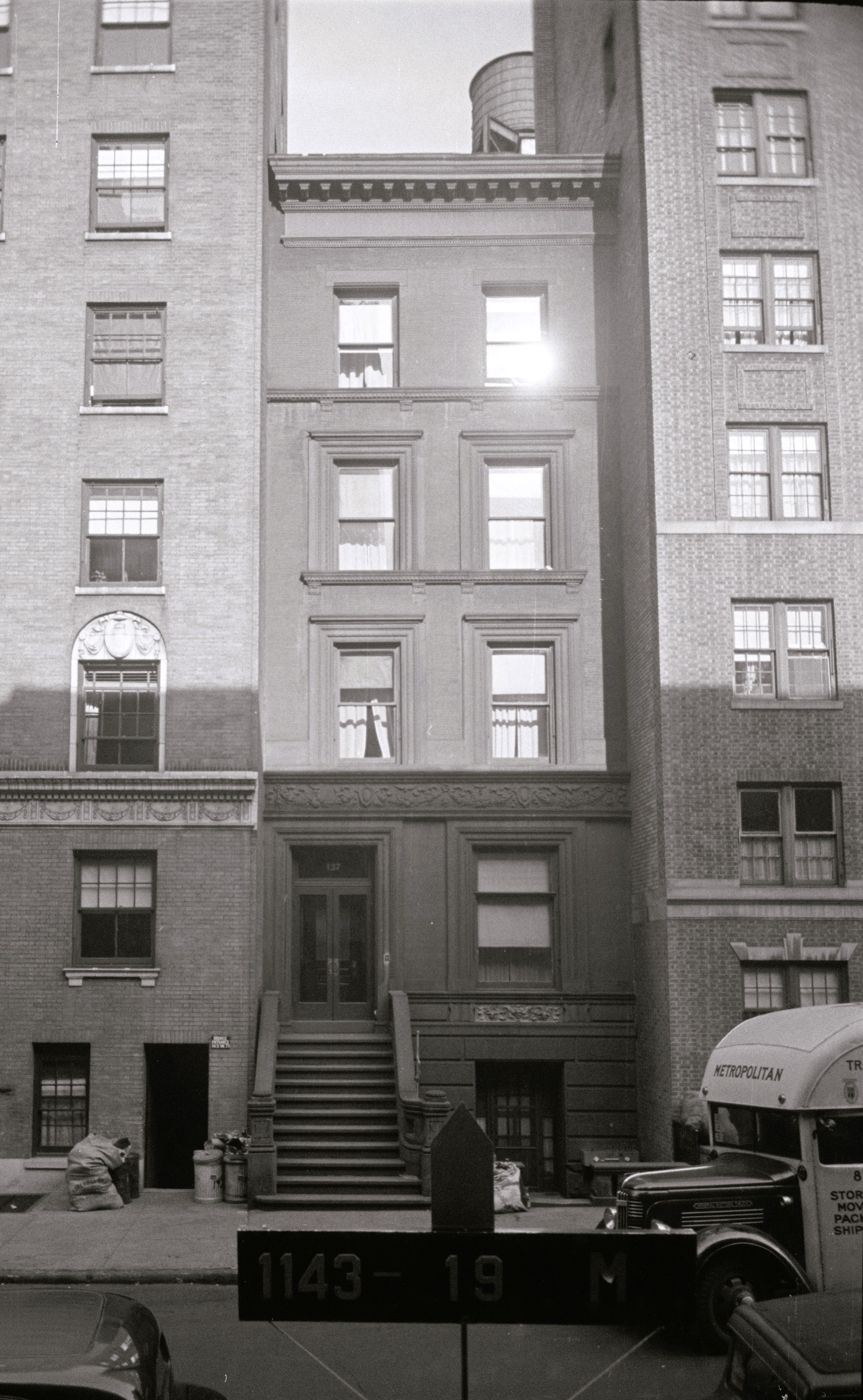
When this photograph was taken in 1941, 137 West 71st Street was the last of the 1890 row to survive.  image via the NYC Dept of Records & Information Services.

Within three weeks Spencer D. Schuyler purchased 137 West 71st Street for $40,000--around $1.23 million in 2023.  A widower, he put the title in the name of his adult daughter, Estelle L. Schuyler.  Spencer Schuyler was president of the Pneumatic Dynamite Gun Company, director of the Maxim Powder and Torpedo Co. and of the Underground Railroad Company, and a member of several exclusive clubs.

Schuyler's Pneumatic Dynamite Gun Company produced the Zalinski Dynamite Gun, invented by D. M. Medford.  The artillery pieces were intended for warships and used compressed air to fire dynamite-filled shells, sometimes called "aerial torpedoes."  The USS Vesuvius, armed with three 15-inch Zalinski dynamite guns, saw action in the Spanish-American War.

The Schuylers did not remain at 137 West 71st Street especially long.  In May 1895, Cora L. Dutton "entered into a contract with Miss Schuyler to purchase the house for $52,500," reported the New York Herald.  The Duttons' stay would be even shorter.

Cora and her husband Stephen A. Dutton paid Estelle the first installment of $3,125 and moved in.  Living with them was Dutton's younger brother and business partner, Simeon.  Stephen Dutton was president of the Scott Ice and Coal Company and a real estate operator.  Lily Alys Godfrey, a potential client, said "he invited me to call upon him at his home, No. 137 West Seventy-first Street.  He had the most exquisite place in New York, he said.  He had paid $70,000 to have it furnished."

It was not long before Estelle Schuyler realized she had been taken.  On November 24, 1896, the New York Herald reported that the first payment was the only one she received from the Duttons.  "Owing to Miss Schuyler's absence in Europe they have been allowed to occupy the house undisturbed.  On her return next month, however, proceedings to eject them will be begun."

Eviction was the least of the Duttons' worries.  On November 24, 1896, the New York Herald ran the headline, "Dutton, Prince of Swindlers," and reported on his ongoing trial on charges of selling worthless investments and properties that did not belong to him.  He was found guilty and sentenced to Sing Sing prison.  On December 28, Simeon Dutton arrived at the Tombs prison downtown to say goodbye.  He never returned to the West 71st Street house, however.

As he started to leave, he ran into Detective Cuff who said, "Why, I've been hunting all around town for you, and here I find you where you weren't expected.  I have a warrant for your arrest.  You have been indicted by the Grand Jury for swindling a Brooklyn woman out of some real estate."

With the Duttons finally gone, Estelle Schuyler sold the house to millionaire Albert Tilt for $40,000.  Tilt had made his fortune in the silk industry.  He was the head of the Phoenix Silk Manufacturing Company founded by his father, Benjamin B. Tilt.  He and his wife, the former Adelaide V. Raynor, had three grown children, Benjamin B., Albert Jr., and Adelaide Estelle.  Living with Albert and Adelaide Tilt were their daughter and her husband, lawyer Frederick Adams Acer.  The Tilts' country estate, Mount Arlington, was in Morris County, New Jersey where, according to the New-York Tribune, they had a "delightful summer home" and "a fine stable of driving and saddle horses."

The Tilts soon relocated to a mansion at 5 East 67th Street, while the Acers remained in the West 71st Street house with their two children and two live-in servants.  Albert Tilt died on May 2, 1900 at the age of 59.  He left a substantial fortune and an odd codicil to his will that suggests there was a strain in the relationship between him and either his daughter, or her husband, or both.  He left the title to 137 West 71st Street in trust with The Fifth Avenue Trust Company to be used by "my said daughter and her family" for as long as they desired.  But they were required to pay rent.  Whenever they chose to leave, the house was to be sold.

It was not long before more drama erupted.  Early in 1902 Acer sued Adelaide for divorce, saying she had been unfaithful with "a man prominent in club circles."  Adelaide accused Frederick of dalliances with "a woman well known in theatrical circles."  It was a high profile battle.  The New York Herald noted, "Mrs. Acer belongs to a family of great wealth...Mr. Acer is a lawyer of considerable promise."

When the domestic problems began, Acer sent their two children, a four-year-old boy and a six-year-old girl, to Buffalo where his mother lived.  Adelaide, according to the New York Herald, "was told that she could never see them again."  And so, in March 1902, Adelaide and two maids went to Buffalo, took rooms near the Acer house, and surveilled the situation. On March 14 they waited in a carriage and when the children took a stroll with a maid, Adelaide "picked them up and, putting them in a carriage that was waiting, drove with them across the Canadian line."  Acer now added kidnapping to the charges against his wife.

Rather surprisingly, given a history of club men, theatrical women, and a kidnapping, the Acers reconciled, returned to 137 West 71st Street, and had at least two more children.  They were still living here on October 17, 1923 when daughters Charlotte Peck and Adelaide Estelle were married in a double ceremony at the Plaza Hotel.

Three years later architect Carl B. Cali was hired to alter the former sumptuous Acer residence into a rooming house.  The certificate of occupancy noted, "not more than 15 sleeping rooms in the building."

The configuration lasted until 1961 when Jack Mandel and Elias Gold commissioned architect H. Russell Kenyon to completely remodel the house into an apartment building.  The stoop was removed, the front pulled forward to the property line, and a Modern-style white brick façade applied.  There were two apartments per floor.

The attractive but unexceptional building would have drawn no attention were it not for its buyer on February 4, 1965.  The El-Rhon Corporation had been incorporated less than five months earlier by the Baldwin family.  Its CEO was Gloria E. K. Smart, the sister of writer and civil rights activist James Baldwin.  The building would serve as much as a family residence as an investment property.

Baldwin took the rear ground floor apartment that opened onto the back yard.  His mother, Emma Berdis Jones, lived directly above him in Apartment 1-B, and his sister Gloria (who acted as Baldwin's secretary) took 4-A.  Sister Paula Whaley also moved into one of the upper floor apartments, while the remaining units had rent-controlled tenants.

Allan Warren took this photograph of James Baldwin in 1969.  (image placed in the public domain by the photographer)

When the family acquired 137 West 71st Street, Baldwin was in London.  Just over two weeks later, on February 12, Malcolm X was assassinated at the Audubon Ballroom on Broadway.  The writer rushed home to attend the funeral on February 27.

Gloria was indispensable as her brother's secretary since he was away traveling more than he was here.  At least one historian has called 137 West 71st Street his pied-à-terre, although it was his official address until his death.  In 2019, the United States Department of the Interior noted, "The address was used as a permanent locale to which documents of import, books to review, and a myriad of requests could be forwarded and assured to reach him, regardless of whether he was currently residing in the city or not."

On May 12, 1972, syndicated columnist Jack Anderson wrote an article titled "FBI Abounds with Informers," and noted somewhat sarcastically, "For information on black author James Baldwin, the sleuths called on 'Joseph Brusco (apartment) Superintendent, 137 West 71st St., New York City' to learn that 'Baldwin had returned from his trip to Turkey.' This hot little item was stamped 'Secret--No Foreign Dissemination.'"

The FBI concerned itself with Baldwin not because of his brilliant novels, of course, but because of his activism within the civil rights movement.  He took part in the 1963 March on Washington for Jobs and Freedom and in the voting rights march from Selma to Montgomery in 1965.  He was, as well, outspoken on his sexual orientation and spoke publicly on topics like racism within the LGBT community, homosexuality, and homophobia within the media.

When he was in town, his apartment saw a stream of well-known Black civil rights leaders, and musical and literary figures come and go.  Celebrated writer Toni Morrison briefly lived in the building during Baldwin's residency.

Baldwin died of stomach cancer at the age of 63 on December 1, 1987.  His funeral in the Cathedral Church of St. John the Divine was attended by thousands.  Among those who paid tribute were Toni Morrison, Amiri Baraka, and Maya Angelou.


No. 137 West 71st Street is the most important building associated with the final stages of James Baldwin's career as a literary giant, and a Black civil rights and LGBT civil rights activist.  It was  added to the National Register of Historic Places in July 2019, and designated an individual New York City landmark in June 2019.

photographs by the author
LaptrinhX.com has no authorization to reuse the content of this blog

Tuesday, February 22, 2022

The Isabella Merritt Hawley House - 49 West 71st Street


In January 1885, architect John Sexton filed plans for seven four-story brownstone houses on the north side of West 71st Street, between Columbus Avenue and Central Park West.  The 19-foot-wide homes would cost the developer, Owen Donahue, $12,000 each to construct (about $329,000 today).  Donahue may have run into financial problems, because before the project was completed his builders, George and Andrew Crawford, held title to the properties.

Although the row was completed in 1886, the Crawfords retained possession of 49 West 71st Street until October 23, 1890 when it was sold to Louis Stix for $34,500--just over $1 million today.  The Real Estate Record & Guide noted, "This is the last house of the row built by Mr. Crawford on 71st street."

The house was identical to the other six along the row.  Designed in the neo-Grec style, its openings sat within architrave frames, each having a molded cornice and bracketed sills.  Identical pressed metal cornices graced each house along the row.

49 West 71st Street is easily identified along the row of once-identical homes by its 1909 French makeover.

Louis Stix purchased the property as an investment.  (He and his family resided in another of George Crawford's houses on the block, 35 West 71st Street, just steps away.)  He leased it  to Isabella Meritt Hawley.

Isabella was born in St. John's, New Brunswick, where she received a private education before attending the Troy Female Seminary in Troy, New York, and then Mrs. Mears' Boarding and Day School in New York City.  She was the widow of Peter Radcliffe Hawley, an officer of the U. S. Coast Survey, a Government-run scientific organization.  They were married in 1856 and had five children.  

Isabella Merritt Hawley was no  hapless widow.   An accomplished dancer and musician, the 1898 Emma Willard and Her Pupils noted that she was, as well, a "contributor to the daily newspapers on current topics, and has translated from both French and German."  That same year, on December 9, The Argus reported that she had incorporated the stock brokerage firm, I. M. Hawley Company with her sons Alan and William.  The New-York Tribune commented that she spoke "fluently French, Italian and German and was especially interested in Oriental philanthropy and religion."

One of Isabella's two daughters was Wilhemina Douglas Hawley, born in 1860.  Like her mother, she showed early artistic talent and in 1879 enrolled in the Cooper Union Women's Art School, and the following year she entered the Art Students League--eventually becoming its first female vice president.

When her mother moved into 40 West 71st Street, Wilhemina was in Paris, studying at the Academie Julian.  She would never return, settling permanently in Europe where she pursued her career as an artist.

Equally noteworthy was Isabella's son, Alan Hawley.  His interest in stocks and bonds paled to his passion for flight.  Born in 1869, he attended the prestigious Trinity School in New York City.  He would become a balloonist and early aviator.  In 1910 he entered and won the Gordon Bennett International Balloon Race, and in 1916 was first passenger to fly in an airplane from New York City to Washington D.C.

In the meantime, Isabella carried on the expected routine of a wealthy socialite.  On June 28, 1898, The Evening Telegram announced she "has leased a cottage at Seabright, N.J. for the season."

The house was sold to George Potts in 1901, triggering a rapid succession of owners and occupants.  Potts resold it the following year to Irving I. Kempner.  In 1903 it was purchased by Lewis C. Marshall, who sold it to Elizabeth E. Mack in April 1909.

As Louis Stix had done, Elizabeth purchased the property as an investment.  A professional lecturer and speech instructor, she had studied under Sarah Bernhardt.  The unmarried speaker gave lectures and dramatic readings on subjects like "Current Events of the New York Theatres" and "Modern Poets."

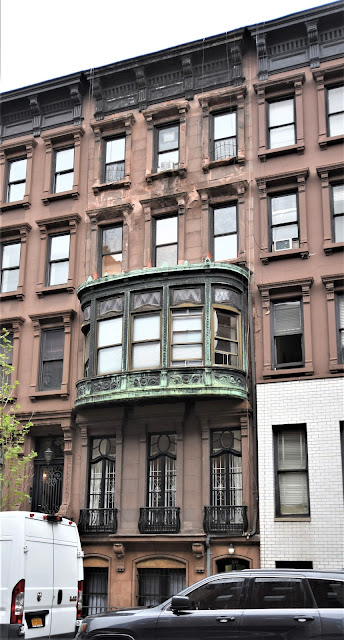
Before leasing the house, Mack hired the architectural firm of Herts & Tallant to modernize it.  A three-story addition was constructed in the rear, the stoop was removed and the entrance lowered to the basement level, and a striking copper oriel was added to the second floor.  The former parlor level was given French windows fronted by bulbous faux balconies.

The glass of the original oriel window panes would have been curved to follow the shape of the bay.

Mack's first long-term tenant came in 1917 when Nelson W. Greenhut and his wife, the former Cecile Erstein, moved in.  Greenhut was a partner in the private banking firm of Greenhut & Co., founded by his father, Joseph B. Greenhut.  (Joseph Greenhut had distinguished himself in the battle of Gettysburg, earning a special commendation from Secretary of War, Henry L. Stimson.)

Jacob H. Scheuer purchased the house in 1924.  After the Scheuer family sold it two years later, it was operated as an unofficial apartment house, home to professionals like attorney Joseph Ankus throughout the Depression years.

In 1947 a renovation resulted in two apartments per floor.  During the Cold War years of the 1960's it was owned by Lino Quirko, who installed a Federally registered fall-out shelter in the cellar level.

A resident in the summer of 1969, Karen Sue McKee, led police in several counties on a nearly year-long search for her.  The News-Review reported on March 5, 1970, "Police say she went on a shopping spree last July in Suffolk [county] stores, concentrating on Riverhead, Patchogue, and other Brookhaven communities, writing forged checks ranging from $180 to $220, and purchasing small articles."  The total value of her buying binge was more than $2,000--nearly seven times that much in today's dollars.

The 29-year-0ld was arrested in November 1969 in Rhode Island, "but jumped $2,000 bail on Nov. 13," said The News-Review.  It all ended without drama when McKee surrendered to County Police at Hauppage, New York on March 3, 1970.

The appearance of the original stoop can be seen next door at 51 West 71st Street.

Outwardly, 49 West 71st Street is little changed since Elizabeth E. Mack gave it an architectural split personality in 1909.

photographs by the author
no permission to reuse the content of this blog has been granted to LaptrinhX.com

Tuesday, August 10, 2021

The 1889 Albert J. Elias House - 18 West 71st Street


The row of four brownstone houses that Gilbert A. Schellenger designed for John Ruddell in 1889 was intended for well-heeled families.  Each would cost the equivalent of about $573,000 today to construct.  Four stories high above an English basement, the Renaissance Revival style residences had prominent cornices above the entrances, decorative carved courses below the third and fourth floors, and substantial stone stoop railings and newels.

In May 1890 Ruddell sold 18 West 71st Street to Albert J. and Rebecca Lyon Elias for $36,000, just over $1 million in today's money.

Born in New York City in 1853, Elias was by now a busy man.  He was the head of the brokerage firm Albert J. Elias & Co. and was highly involved in a number of street railroads.  He was president of the Dry Dock, East Broadway and Battery Railroad Company; the Forty-Second Street, Manhatanville and St. Nicholas Av. Railroad; the Third Avenue Railroad Company; and the Kingsbridge Railway Co.  He was, as well, a director in the Southern Boulevard Railway and a former School Commissioner.

Albert and Rebecca had three children.  When they moved into their new home Henry H. was seven-years old, Elizabeth Lyon was four, and baby Josephine was just one-year old.  

On the night of March 17, 1895 a servant saw a man sneak out of the basement door.  The World reported, "She screamed and ran to the district telegraph call and summoned a messenger."  At around 10:45 a boy ran into the 68th Street police station and told Sergeant Ryan "that burglars were in the house of ex-School Commissioner Albert J. Elias."   As responding officers ran down West 71st Street toward the house, neighbors quickly threw on their coats and followed.  The World said, "A crowd of fifty people gathered in front of the house when they saw the police running."

As it turned out, it was a love-struck servant girl and her clandestine beaux who had caused the uproar.  A thorough search found no intruder and nothing missing.    "It is the opinion of the police that one of the domestics had been entertaining a male visitor," said The World.

Around the turn of the century the Eliases modernized their home with decided French touches.  Ornately grilled entrance doors were installed and a full-width copper-clad oriel was added to the second floor.


In 1898 Joseph Reinheimer was fired from his job as a street car conductor for "agitating his fellow workmen."  (He was most likely lobbying them to union.)  The New York Times reported that "he declared that Mr. Elias was the cause of the discharge."  In response, Reinheimer sent a threatening letter to Rebecca.  Police Captain Donohue concluded that the best way to calm things down was to find a job for Reinheimer.  The New York Times said, "that was done.  Nothing more was heard from Reinheimer."

But Reinheimer would be heard from again four years later.  The family went to the Atlantic Highlands in New Jersey for the summer season of 1904.  Albert's father, Jacob Elias, who lived nearby on West 69th Street, agreed to stop by the house now and then to check on things.  

When Jacob went to the 71st Street house on the morning of July 21, he discovered a man lurking in the basement areaway--it was Reinheimer.  According to Elias, "Reinheimer pulled a revolver and said, 'It's a ----- good thing you're here and not your son.  I'd soon fix him with this.'" 

Upon the family's return, two officers were detailed to watch the house.  On the evening of August 7 Detective Sergeant Downing arrested Reinheimer at his home.  Upon seeing the officer, Reinheimer muttered, "I know what you want me for."  The New York Times reported, "The detective said that Mr. Elias told him he had nothing to do with the discharge of Reinheimer."

Street Railway Journal, 1892, (copyright expired)

The Elias family would live on in the 71st Street house for decades.  It appears they traveled to Europe for the summer of 1910.  Rebecca hoped to find a position for one of her servants in their absence.  Her advertisement read, "Lady wishes position for her first class chambermaid; will assist with waiting."  ("Waiting" was the term for serving in the dining room or at tea or receptions.)

In 1928 Dr. Moses Lobsenz, who owned 16 West 71st Street, purchased the Elias house.  In reporting the sale on May 25 The New York Times noted, "this was its first transfer of ownership in thirty-eight years."  It appeared that the end of the line for both houses was on the near horizon.  The newspaper reported, "A builder who plans to erect a nine-story apartment house is negotiating for the plot."

The deal never came to pass, however, and 18 West 71st Street became home, next, to the Fitch family.  They were followed by Gustav Neuzkirk who leased the residence from the 18 West Seventy-first Street Corp. in 1932 and '33.  In 1933 part of the house was used by the Miss Dorothy Studios, which offered "modern and stage dance" lessons.

It appears that 18 West 71st Street was being operated as a rooming house in the 1940's.  Among the residents in 1944 were Michael E. Scharf and his bride Ellen.   But trouble soon upset the newlyweds' happy home.  In order to marry Michael, Ellen had had to get a divorce from her former husband, Gosta Ljungdahl.  She did so in May 1943 and, according to the Suffolk County News, "as soon as she had obtained her liberty, married Michael M. Scharf."

But Gosta Ljungdahl did not disappear from their lives.  He protested the divorce on the grounds of fraud.  Two of Ellen's witnesses, Walter Christman and Richard Wilens, were arrested for perjury for falsely testifying that they had found Ljungdahl in a hotel with a woman in a negligee.  It was all too much for Michael Scharf who left Ellen in February 1944.  Ellen was back in court in May, facing charges of obtaining a divorce by fraud.

Pfc. Irving Fink lived here in 1945.  The soldier was an accomplished violinist, formerly with the Cleveland Symphony Orchestra.  He was now a member of the 39th Army Air Force Orchestra.  Following a performance on the night of February 17 he and 30 other orchestra members stopped in a cafeteria at 50th Street and Sixth Avenue.  Fink had his violin with him--but it was not just a violin.

The New York Sun explained, "The violin [is] said to be 250 years old."  Crafted by master violin maker Giavonni Paolo Maggini, it was valued at about $28,500 in today's money.

Suddenly Fink realized his violin was gone and the entire group of soldiers headed out of the cafeteria to catch the culprit.  The New York Sun reported, "Police said the soldier musicians caught up with [Samuel] Goldman on a subway platform, recovered the instrument, and meted out a swift going over to the Bostonian."


A renovation completed in 2010 resulted in a total of three apartments.  

photographs by the author
LaptrinhX.com has no authorization to reuse the content of this blog

Tuesday, June 1, 2021

The 1886 Max Weil House - 51 West 71st Street


In January 1885 architect John Sexton filed plans for seven four-story brownstone houses on the north side of West 71st Street, between Columbus Avenue and Central Park West.  The 19-foot-wide homes would cost the developer, Owen Donahue, $12,000 each to construct (about $329,000 today).  Donahue may have run into financial problems, because before the project was completed his builders, George and Andrew Crawford, had title to the properties.

Although the row was completed in 1886, the Crawfords retained possession of 51 West 71st Street until August 1890 when they sold it to George E. Stedman the equivalent of $1.1 million today.

The house was identical to the other six along the row.  Designed in the neo-Grec style, its openings sat within architrave frames, each having a molded cornice and bracketed sills.  Identical pressed metal cornices graced each house along the row.  If Stedman lived in the house at all, it was only for a short period.  By the mid-1890's it was home to the Maximillian Weil family.

Born in 1843, Max Weil and his wife, the former Gertrude (known as Gertie) Williams, had three children, Hilda, Minnie B., and Max Sanford.

The year 1897 began with the family making plans for Hilda's upcoming wedding.  The focus turned to Minnie, however, as she fell seriously ill.  The 25-year-old died in her bedroom on February 2 and her funeral was held in the drawing room three days later.

Rather shockingly, Hilda's wedding plans went on and she was married to John Taussig in that same room two months later, on April 7.  The New-York Daily Tribune remarked, "Because of a recent death in the bride's family, only relatives and personal friends were present to witness the ceremony."  Afterward a "wedding dinner" was served to those present.

Young Max graduated from New York University in 1903 where he had been on the varsity tennis team.  The family remained at 51 West 71st Street for just three more years, selling it to Thomas J. McLaughlin in May 1906.  

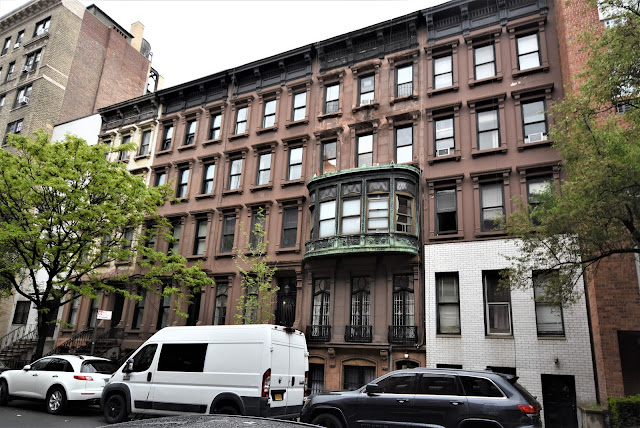
McLaughlin most likely gave them an offer they could not refuse.  He simultaneously purchased 49 and 47 West 71st Street and hired architect C. B. Brun to remodel the three adjoining homes.  The middle house of the trio was made the true centerpiece with a spectacular copper-clad oriel at the second floor


As with the other two, Brun replaced the parlor windows of 51 West 71st Street with full-length French windows that opened onto Juliette balconies.  The entrance was given an ornate French grilled door.  His renovations completed, McClaughlin advertised the house on February 23, 1907:

Ready for occupancy, four story Dwelling; thoroughly renovated; entire new plumbing system; three bathrooms, electric light; hardwood floors; chandeliers and attractively decorated.

Only five days later the New-York Tribune announced that McLaughlin had sold 51 West 71st Street.  "This completed the sale of the three adjoining houses bought and extensively remodelled by Mr. McLaughlin," it added.

The new owners were the Reverend John Henry Watson and his wife, the former Susan Matilda Hoffman.  Born in Boston, Watson was a Harvard graduate and received his divinity degree at the Berkeley Divinity School in Middleton, Connecticut.  Susan had significant religious ties, as well.  Her father was Rev. Eugene Augustus Hoffman, the dean of the General Theological Seminary.  (When Dean Hoffman died in 1902 he left an estate to about $460 million in today's money, the bulk of which was divided among his widow and four children.)

The Watsons had two sons and a daughter.  By the time they moved into the 71st Street house Watson had given up his parish work to devote all his time to missions in the city.

On September 30, 1913 Watson suffered a fatal heart attack in the house at the age of 68.  The following year, in November, the house was opened for inspection prior to the auction of the  house and its contents.  The two day auction was handled in part by Silo's Fifth Avenue Art Galleries who took charge of "the art collections and period furniture," according to the New York Herald on November 13.

By the early 1920's 51 West 71st Street was home to the Louis Krohnberg family.  A partner in the Eureka Dress Company, Krohnberg also made money in a less upstanding way--poker.  It resulted in a well-publicized law suit in January 1920 when the Commissioner of Charities, Bird S. Coler, charged Krohnberg with cheating.

Coler claimed he and others had lost a total of $350,000 during poker games--an astounding $4.47 million today--to Krohnberg.  Alleging that Krohnberg "used markers," he sued for $1.75 million, five times the amount lost, promising to turn it all over to charity.

Louis's wife appeared in newspapers for more respectable reasons.  On May 26, 1922, for instance, The New York Times reported, "Mrs. Louis Krohnberg entertained at a luncheon at her home, 51 West Seventy-first Street, yesterday for her niece, Miss Florence Krohnberg, who is to be married at the Astor Hotel on June 20.

In 1941 the house was renovated to apartments and furnished rooms.  A subsequent remodeling, completed seven years later, resulted in a total of nine apartments; and a final renovation in 2009 joined the basement and parlor floors into a duplex.


Of the three homes Thomas J. McLaughlin remodeled in 1906, 51 West 71st Street has fared the best, retaining its stoop and crisp neo-Grec details.

photographs by the author
no permission to reuse the content of this blog has been granted to LaptrinhX.com