Showing posts with label west 22nd street. Show all posts

Saturday, January 27, 2024

The 1856 Geagan-Reed House - 419 West 22nd Street


In 1856 William H. Smith, Daniel Townsend, and John Lane partnered to erect three matching houses at 295 through 299 West 22nd Street, between Ninth and Tenth Avenues.  Smith listed his profession as a builder, and his partners identified themselves as masons.  They would more likely be termed contractors today.  

The speculative homes were completed within the year.  Each of the 16-feet, 8-inch wide residences was intended for upper-middle-class families.  Their Anglo-Italianate design placed the impressive, arched entrances above short stoops.  Above the rusticated brownstone basement and first floors were three stories of red brick.  Each house had its own unpretentious bracketed cornice.

It is unclear who originally occupied 295 West 22nd Street (renumbered 419 in 1864), since "name refused" accompanied the address in city directories until 1859.  That year William Y. Clark and his family lived here.  He been appointed a public notary by the state governor in 1840, a position he still held.

Like many families, the Clarks took in a boarder.  Living with them in 1865 was Jonathan Waters.  The young man's residency would be cut short when his name was pulled in the Civil War draft lottery on March 17, 1865.

John Cowles, a clothing merchant, moved his family into the house in 1871.  They, too, accepted boarders.  Their advertisement on January 10, 1875 read:

A private family, living in own house, having more room than required, will let, to gentlemen and wives or single gentlemen, handsomely furnished rooms, with all conveniences and first class board.

That the Cowles did not accept unmarried women testified to the respectability of the household.  The morals of single women living on their own were highly suspect.

John Cowles sold 419 West 22nd Street to Dr. William H. Scott in February 1878.  The family moved into the house three months later.

Born in 1801 in Philadelphia, Scott had originally been in the wholesale "small wares" business there, selling "buttons, needles, pins, tapes" and similar items.  He sold the business in 1837 to pursue a career in medicine.  Scott graduated from the Jefferson Medical College in 1841, but four years later was induced by his brother-in-law to become a partner in his importing business, James A. Stewart & Co. in New York.  He retired from the business the year he purchased 419 West 22nd Street.

Dr. William H. Scott died at the age of 82 on November 6, 1883.  His funeral was held in the parlor three days later.

The following year, in February, William Scott, Jr. sold the 22nd Street house to Charles H. and Adelaide L. Butler for $14,500 (about $415,000 in 2024 money).  

Apparently renting a room from the Butlers in 1884 was 19-year-old Victor Dayton.  He and two others broke into the house of Joseph Farrington at 19 West 11th Street early on the morning of March 7, 1884.  When family members were awakened, two of the burglars escaped but Dayton found himself trapped.  The New-York Daily Tribune reported that he "was found curled up under the bed of an old blind man in an upper chamber."  The teen was held on $1,500 bail awaiting trial.

It seems the Butlers made renovations to the house, but soon lost it in foreclosure.  It was sold at auction on May 5, 1885.  The announcement described it as being "well built" and containing "modern improvements...having been recently thoroughly overhauled."

The property was purchased by Lansing Zabriskie, who resold it in March 1887 to John Geagan and his wife Mary for $15,000.  Geagan was a builder and owned several Manhattan properties.  Within weeks of receiving title to the house, he filed plans for installing a new dumbwaiter, listing himself as both contractor and architect.  (It may have been at this time that the exquisite stained glass fanlight was placed over the entrance doors.)

The Geagans entertained sumptuously.  On May 15, 1888, for instance, The Evening Telegram reported, "Mrs. Gegan [sic], No. 419 West Twenty-second street, gave a reception last evening.  One hundred guests were present.  Mazzetti served."  (Louis F. Mazzetti was a society caterer, called by The New York Times "a master of the mysteries of the cuisine.")

John Geagan died at the age of 62 in the West 22nd Street house on September 7, 1893.  Somewhat surprisingly, his funeral was not held in the parlor, but at the Church of St. Paul the Apostle on 59th Street and Columbus Avenue.

Mary E. Geagan sold 419 West 22nd Street in 1895 to Mary A. and William W. McLaughlin.  They quickly resold it to Julia Gwinea in December for $20,000 (about $720,000 in 2024 terms).  The new owner operated it as a boarding house.

Living here in June 1902 were Thomas F. Crawford and his bride.  He was the shipping clerk of the wholesale grocery firm Francis H. Leggett & Co.  It may have been his newly-married position that prompted him to make a rash decision.  On June 17, he and two of the company's drivers were arrested.  The New York Sun reported, "Crawford, without entering on his books barrels of sugar that were received, turned them over to the drivers, who in turn gave them to Jacob Fried of 60 Hester street, also arrested."

That night, said the article, "a pretty young woman went into the Leonard street station and asked Sergt. Holse to be allowed to speak with Crawford.  When she was told that this was impossible, she broke down and began to cry.  She said that Crawford had married her fourteen days ago."

In a somewhat bizarre turn of events, around 1905 William J. A. and Mary E. Reed took title to 419 West 22nd Street.  William was in the printing business.  The couple, who had a son William N. P. Reed, were apparently somehow related to Mary E. Geagan, who now returned to her old home.  In 1909 Mary E. Reed issued a $1.00 "life lease" to Mary E. Geagan.

Boarding with the family in 1909 was Irish immigrant Mollie O'Connell.  She applied to the city for a job as Hospital Clerk that year, but was rejected "for non-citizenship."

After living in the West 22nd Street house for more than three decades, Mary E. Geagan died in 1920.  

Boarding with the Reeds at the time was Adele Mortimer Woodward.  Born in 1866 in Rutherford Park, New Jersey, she had taught French at the Wadleigh High School since 1897.  During the St. Louis Exposition in 1904 she sat on the international jury on awards for both the French and Italian Governments.   Never married, she died here at the age 55 on June 11, 1921.

Following Mary E. Reed's death, William J. A. Reed and his son continued to live in the 22nd Street house.  Unwilling to retire, Reed was known in the printing industry as "The Deacon."  

In February 1941, the "Big Six" Typographical Union held a dinner in honor of printers who had been members of the union for more than half a century.  The American Labor World reported, "'The Deacon,' was the oldest working printer present."   Within months of the dinner Reed was dead.


The house was soon foreclosed upon and sold by the bank in 1943 to Charles Farrugla.  It was converted in 1951 to apartments and furnished rooms and a fifth floor, nearly unseen from the street, was added.  In an effort to modernize the vintage structure, the lintels were shaved off, the brick painted, and the rustication of the first floor covered over and painted white.


That configuration lasted until a renovation completed in 1978 resulted in one apartment per floor in the first through third, with a duplex in the fourth and fifth.   More recently, the facade has been restored.  The paint was carefully removed, the lintels refabricated, and the first floor returned to its 1856 appearance.


photographs by the author
no permission to reuse the content of this blog has been granted to LaptrinhX.com

Saturday, July 8, 2023

The 1855 Samuel and Mary A. French House - 433 West 22nd Street


In 1855 two matching houses were erected on the north side of West 22nd Street, between Ninth and Tenth Avenues for upholsterer William S. and Mary Fogg, and Charles and Mary A. French.  Their architect eschewed the American basement style seen elsewhere along the quickly developing block for the more familiar, high-stooped English basement plan.  His Italianate-style design included double-doored, arched entrances under substantial classical pediments, elliptically-arched windows with graceful lintels, and individual foliate-bracketed cornices.

The Frenches moved into 297 West 22nd Street (renumbered 299 shortly afterward, and finally 433 in 1864).  The wealthy Samuel French operated a printing and publishing house at 18 Ann Street, a bookstore at 122 Nassau Street, and a shoe factory at 69 Murray Street.  His publishing business focused mostly on dramatic works and educational books.
On November 30, 1856, the New York Herald reported on the newly released book, Massey's Exhibition Reciter and Drawing-Room Entertainments.  The article said in part:

Mr. Samuel French, the well known publisher of the American Drama and John Brougham's Dramatic Works, has supplied a want of the community in publishing this elegant and unique "Reciter."  School "Readers" and "Speakers" are numerous; but hitherto no work has appeared so well calculated to supply a want felt by all who delight in the popular, entertaining and improving practice of recitation.

Samuel and Mary French remained in the house through 1866.  The following year it was home to the family of Isidor H. Lichtenhein.  He was a partner in the apparel firm of I. & G. Lichtenhein at 43 Chambers Street.  His partner, George H. Lichtenhein (presumably a brother), lived nearby at 254 West 23rd Street.  

The family's residency would be extremely short.  After having gone to the expense of having custom furniture manufactured, in the spring of 1869 they left for Europe--either for an extended or permanent stay.  An auction of the household goods was held on April 12, the announcement of which promised, "This furniture will be found well worthy the attention of those in want of really fine goods, having been all made to order within a year, and is in splendid order."

The luxurious surroundings in which the Lichtenhein family lived were evidenced in the auctioneer's inventory, which read in part:

The parlors contain rich medallion Carpets, massive French plate Pier and Mantel Mirrors, superb ebony gilt medallion Parlor Suits in green satin, made by Kimbel & Cabus; elegant 7-1/2 octave rosewood Piano, superb French Clocks, Bronzes, Vases, Ornaments, Oil Paintings, rich, heavy Lace Curtains, artistic bronze Chandeliers, &c.

Potential bidders were provided catalogues and permits were required to attend the high-end auction.

The residence was next home to the Ebenezer C. and Fannie Jackson and their two small sons, William E. and Frederick Howard.  Jackson was a partner with his brother William H. Jackson, and John H. Hankinson in William H. Jackson & Co.  The firm manufactured and sold "grates, fenders, and other hardware."

Only weeks after the Jacksons moved in, their house was the scene of a somber gathering.  Frederick Howard Jackson, Ebenezer and Fannie's youngest son, died of scarlet fever on May 30, 1869 at the age of two-and-a-half.  Family members and friends assembled in the parlor the following afternoon for the toddler's funeral.

By the early 1880's Jackson's widowed mother, Sarah, lived with the family.  Another funeral was held in the house following her death at the age of 76 on February 28, 1884.

After living at 233 West 22nd Street for more than two decades, in September 1890 the Jacksons sold the house to George Vassar and his wife, the former Helen Williamson Price.  The couple had six children, George Jr., Annie, William J., Walter Wicks, Florence, and Natalie.  Despite what must have been snug conditions (considering the Vassars would have had at least one live-in servant), George's spinster aunt Mary Vassar also lived with the family.

Born in December 1852, George was an architect and builder, like his father had been.  He was the principal in George Vassar's Son & Co. and was a member of the National Academy of Design.  He was responsible for the construction of several impressive Manhattan structures, including the massive Ansonia Hotel on Broadway.  

Mary Vassar died at the age of 73 on December 29, 1896.  The parlor was the scene of her funeral at 8:00 on New Year's Eve.

It would, of course, not be the last of the funerals held in the house.  On July 10, 1910, the Vassars' youngest son, Walter Wicks, died; and seven years later, on January 16, 1917, his father's funeral was held in the parlor.

George Vassar's death may have dealt a heavy emotional toll on his wife.  Only three months later, on April 28, Helen Williamson Price Vassar died.  Her funeral was held in the house on April 30.

The several-million-dollar Vassar estate, which included several parcels of Manhattan real estate, (including the family home), was divided in equal parts among the children.  George Jr. was the executor of his parents' estate, and his father's will gave him "sole control of all the real estate of George Vassar, Sr."  It would cause significant tensions.

Tensions among the siblings seem to have appeared early on.  Although Florence and Natalie Vassar did not marry, they left 433 West 22nd Street around the time of World War I.  It was a highly unorthodox move for unmarried women at the time.  Now only George Vassar, Jr., also unmarried, was left in the family home.

The familial problems came to a head in May 1921 when George's siblings took him to court, charging him with refusing "to distribute rents, income and profits of the real property of the estate of George Vassar, Sr, and for alleged failure to alter, sell or improve the real estate."  

Another point of contention was the house at 433 West 22nd Street.  George's brothers and sisters bristled at his charging the salary of his housekeeper, as well as the expenses of "having the house cleaned, heated and partially lighted" to the estate, while not paying rent.  They pressured him to alter the residence into income-producing apartments.

At trial, real estate broker Vince C. Pepe testified for the defense, saying "it would not be advisable to alter the house, No. 433 West 22nd Street into small apartments."  He explained that the expense of renovation "would be very large and that the neighborhood in which the house is situated has not yet become a center for that sort of renting and that the changing of houses into small apartments...may be a great loss when the housing shortage ends and apartments are erected with all the modern improvements."

But in the end, George lost the battle.  In 1923, the architectural firm of Polhemus & Coffin was hired to remodel the house into apartments.  It was not an especially upscale change.  The Certificate of Occupancy, granted in 1924, demanded "not more than 15 sleeping rooms throughout."  It was apparently during his renovation that the stoop was removed and the entrance lowered to the basement level.

Although the stoop was gone in 1941, the preponderance of the 1855 architectural details were intact.  image via the NYC Dept of Records & Information Services.

Among the tenants were artist John J. A. Murphy and his wife, the former Cecil Buller, who arrived by 1926.  Murphy had studied at the Boston Museum of Fine Arts and at the Art Students League.  He moved to London as chief assistant to painter Frank Bragnwyn until World War I pulled him into military work.  He served in the camouflage section of the Army Corps of Engineers in France, and illustrated war posters.

Murphy's woodcut Leapfrog is in the permanent collection of the Victoria & Albert Museum in London.

By the time the he and his wife moved to 433 West 22nd Street, he was best known for his woodcuts and had been exhibited at the Leicester Gallery in London.  His works would eventually be in the permanent collections of the Smithsonian American Art Museum, the British Museum, The Art Institute of Chicago, and the Metropolitan Museum of Art, among others.

Unexpectedly, 433 West 22nd Street served briefly as the Consul General of the Kingdom of Serbs, Croats and Slovenes beginning in 1927.


A renovation completed in 1971 resulted in a duplex apartment in the basement and former parlor level, and two apartments each on the upper floors.  It was apparently during this remodeling that the early Victorian details were vandalized, leaving a mutilated facade.

photographs by the author
no permission to reuse the content of this blog has been granted to LaptrinhX.com

Wednesday, September 14, 2022

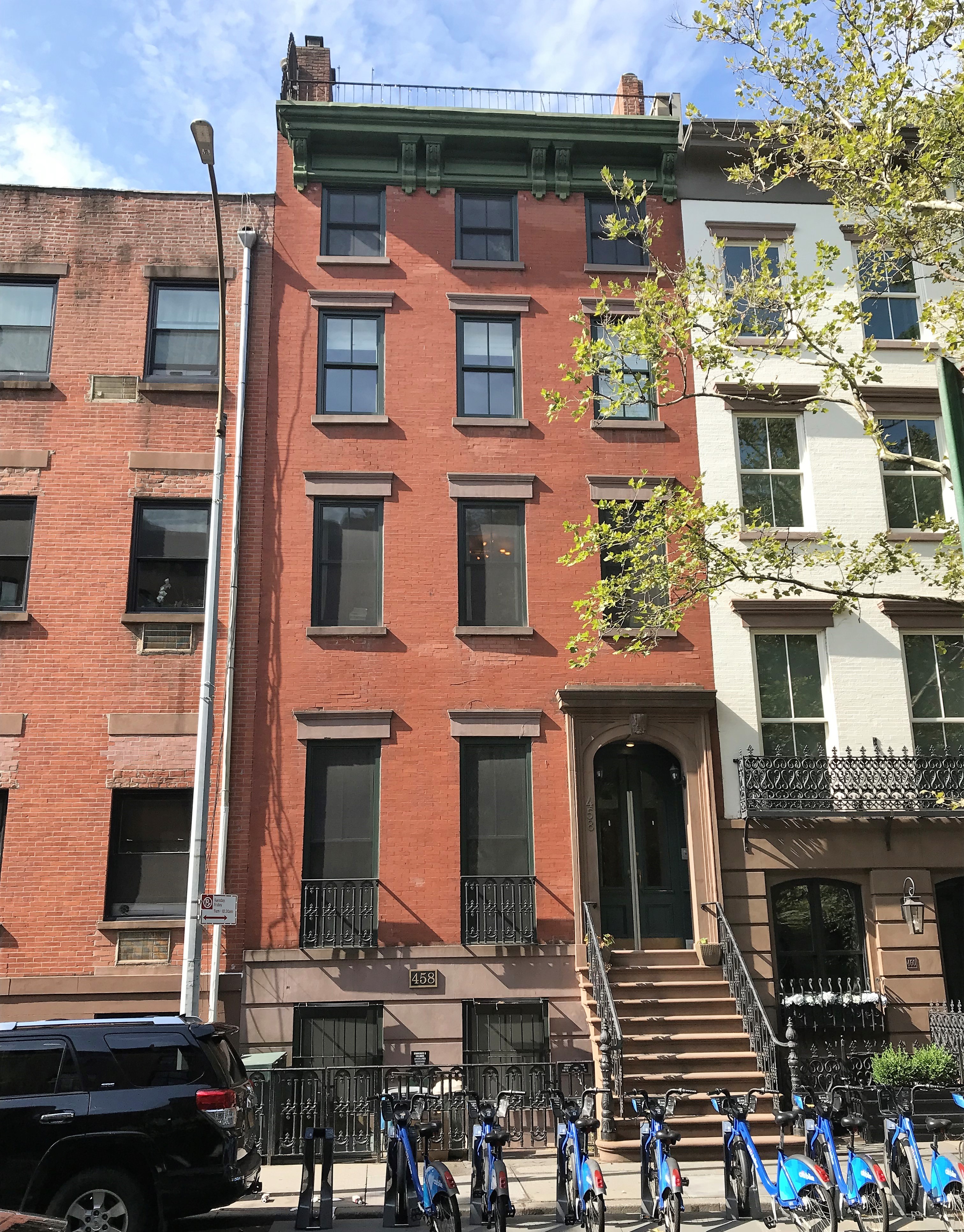
The Judge Joseph S. Bosworth House - 458 West 22nd Street


Born in Cortland, New York on March 27, 1807, Joseph Sollace Bosworth was the valedictorian of his 1827 Hamilton College class.  In 1833, three years after he was admitted to the bar, he married Francis Eliza Pumpelly.  The couple relocated to New York City in 1836.  His career skyrocketed.  In 1844 he was elected a member of the State Assembly, and in 1851 elected judge of the New York City Superior Court.

The Bosworths erected a home in the Chelsea district in 1854.  Faced in orange-red brick, the Italianate style residence rose four stories above a brownstone basement level.  The double-doored entrance was fully framed in stone and capped by a molded cornice.  The floor-to-ceiling parlor windows very likely were fronted by a cast iron balcony.  A pressed metal cornice with paired brackets crowned the three-bay wide home.

Joseph and Francis had 11 children, ranging in age from Annie, who was 17, to Frances Howard, how was one year old when the house was completed.  (A twelfth child, Frances A., was born in 1834, but died in infancy.)

Judge Joseph S. Bosworth.  image via the Century Association Archives Foundation

Judge Bosworth's civic activities went beyond the bench.  He was one of the Executive Committee that erected the Free Academy Building, selected the faculty, and organized the institution; was on the Board of Managers of the Magdalen Benevolent Society, a home for indigent women; and was a member of the Board of Education.

In 1858 Bosworth was made Chief Justice of the New York City Supreme Court.  His responsibilities were increased in 1864 when he was made a Police Commissioner, and in 1868 made president of the board of the Police Department.

Several of the Bosworth sons attended Columbia Law School.  Both Frederick and Frances were enrolled in 1871, Frederick as a senior and his brother a sophomore.  Tragedy struck the family that year.

On July 30, 1871 the New York Dispatch reported that Frederick's funeral had taken place in the West 22nd Street house the previous day.  The article called him "a remarkably brilliant young man," saying, "He had nearly completed the study of the law."

When servants decided to leave on amicable terms in the 19th century, it was common for the family to allow them to have prospective employers interview them at the house (in the basement level, of course) at prescribed times and, most often, for only one or two days.  The practice proved disastrous for the Bosworths in one instance.  The New York Herald reported on November 27, 1874, that Bridget, one of the Bosworth's maids, "having determined to leave, advertised for a place.  The day the notice appeared a man called at the Judge's house to see the girl, and having agreed to take her requested that she would go up stairs and get a certificate of character from some of the ladies of the house."

Bridget did so, but when she returned to the basement with Frances's recommendation, the man, who had identified himself as Frederick Nichol, was gone.  And so was $600 worth of silver.  It was a significant haul, worth around $14,700 today's money.  

Bridget gave a detailed description to the police.  Two weeks later Detective Henry Avery noticed a man in Washington Square who fit the description.  "On arresting him and taking him to headquarters he was found to have on a suit of clothes stolen from a Mr. Fox, of No. 94 East Ninth Street," said the New York Herald.  The man's name was Frederick Nichol.  Although the thief was caught, the Bosworth silver was no doubt long gone.

The Bosworth's daughter Josephine had married Brigadier General Charles Yates, who had distinguished himself in the Civil War.  Following his death in September 1870, Josephine returned to the West 22nd Street house, bringing her two daughters, Stella and Frances along.

Bosworth stepped down from the bench in 1872, continuing his private law practice.  When Frances Pumpelly Bosworth died in 1879, Joseph Jr. and Francis were attorneys working in their father's law firm.  Both were still living at 458 West 22nd Street, as well.

The esteem with which former Judge Bosworth was held was evidenced in a surprise party for his 76th birthday on March 28, 1883.  The event was worthy of a booklet titled, "Account of a Surprise Party Which Called on Ex-Judge Joseph S. Bosworth At His House, in the City of New York, on the Evening of March 28, 1883."  The scheme, concocted by Assistant United States Treasurer Thomas C. Acton and attorney Aaron J. Vanderpoel, relied on co-conspirators within the Bosworth household.  A "son and daughter," the latter presumably Francis, arranged to sneak a society caterer, food for a banquet, and staff into the basement, and to distract their father in his upstairs study.

The distinguished gentlemen arrived "in omnibuses and carriages...taking care to stop a few doors short, that his suspicions might not be aroused," said the booklet.  Quietly they filled the parlors, and when Bosworth "was induced, by stratagem, to come down from his sitting-room above, his amazement was complete."  The New York Times remarked that the parlor level was filled with "distinguished judges, lawyers, bankers, doctors and other citizens."

The following year, on May 14, Bosworth presided at a meeting of the New York Bar "held to take cognizance of the death of Charles O'Connor," as reported by the Hamilton Literary Monthly.  He caught a cold that evening, and was unable to go to his office the next morning.  The following day, according to The New York Times, "pneumonia developed, and Mr. Bosworth was too old to rally against the attack."  He died on May 21 at the age of 77.   Possibly because of the large number of attendees expected, the funeral was not held in the 22nd Street house, but at the Madison Square Presbyterian Church.

Of his 12 children, four sons and two daughters survived him.  Still living in the West 22nd Street household were Josephine and her daughters; Stella Louise, her husband George Carlton Lee, and their two daughters, Adelia M. and Josephine Bosworth Lee; and George B. Bosworth.

The bulk of Bosworth's estate was divided among his children.  Francis and Joseph Jr. received his law library, and daughter Mary, the widow of John G. Saxe inherited the family piano.  The New York Times reported that "the testator directs that his daughters, Mrs. Josephine B. Yates and Mrs. Stella Lee, be permitted to retain the use of the family residence and furniture."

Josephine's daughter, Stella Yates, was married to Guert Gansevoort Jackson in Calvary Episcopal Church on October 20, 1886.  The "wedding supper" served by society caterer Clark was held in the 22nd Street house afterward.  The New York Times noted, "Only the family were present."

Josephine Yates died at 458 West 22nd Street on May 3, 1902 at the age of 63.   Just five months later, on October 23, an advertisement appeared in The New York Times that read:

Big Bargain--$16,500 will purchase 4-story private dwelling.  Premises 458 West 23d St.

The price would equal about $536,000 today.

It was sold that month to Michael A. C. Levy, who quickly resold it in March 1903 to Sarah H. Thomas.  She leased it to various private families for years.  Then, on July 30, 1918 The Sun reported that she had leased it to Frank Earle, "who intends to make extensive alterations."  The changes were on the interior, and likely included updated plumbing and electricity.

By 1920 rooms were being let in the house.  And not all the tenants were upstanding.  On November 13, 1920 20-year-old Peter Clover was arrested after he and two other men broke into Schwartz Bros. fur shop on West 29th Street.  And on August 17, 1928, Joseph Southard and two accomplices held up Maloney's restaurant on Eighth Avenue.  The 22-year-old explained in court, "I'm in love with a sweet little girl, and I thought I'd just pull one stick-up so I could furnish a flat."  Touching as his love story was, Magistrate Macreary was unmoved.  He was held without bail.


A renovation completed in 1949 resulted in three furnished rooms in the basement, one apartment and two furnished rooms on the parlor floor, and four furnished rooms on each of the upper stories.  That configuration lasted until 1979, when a remodeling resulted in two duplexes and an apartment.

photographs by the author
LaptrinhX.com has no authorization to reuse the content of this blog

Thursday, May 19, 2022

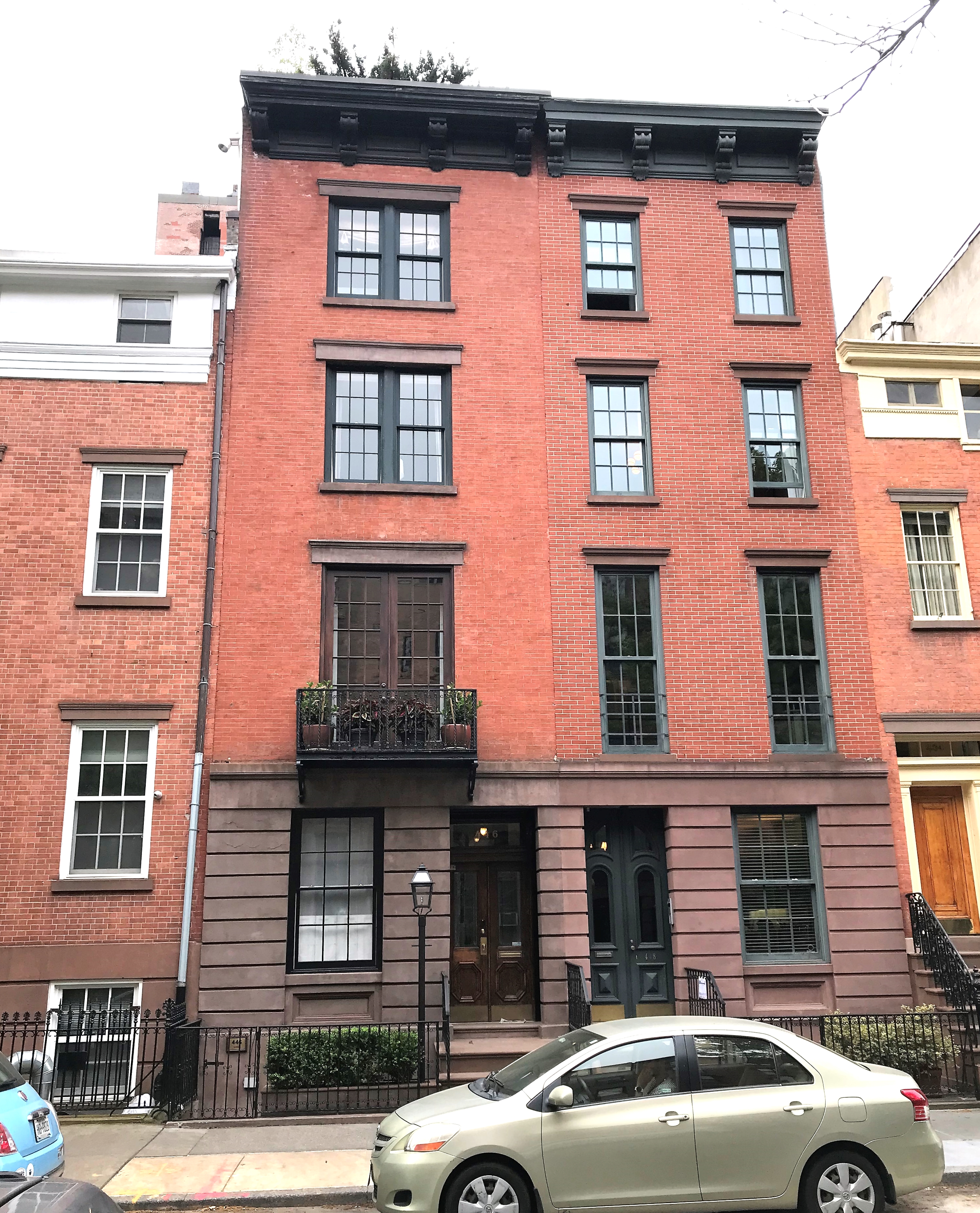
The 1854 Former Twins at 446 and 448 West 22nd Street


In 1854 developer William Berrian's vacant, 32-foot-wide parcel on the south side of West 22nd Street between Ninth and Tenth Avenues provided him with an option.  He could erect one mansion or two skinny houses, each just over 15 feet wide.  He chose the latter.

Completed within the year, the mirror-image homes were designed in the Anglo-Italianate style.  Short stoops, three steps high, led to the double-doored entrances within a rusticated brownstone base.  The three upper floors were clad in warm red brick and trimmed in brownstone.  The full-height windows at the second floor may have been fronted by cast iron balconies.

The Swift family moved into 306 West 22nd Street (renumbered 446 in 1868).  Charles Swift was a carriage maker whose business was at 44 Mercer Street.  There is little doubt that his son, Charles, Jr., learned his trade from him, but for some reason the two did not initially work together.  Charles Swift, Jr. was listed in directories in 1860 as "coachmaker" with a business address of 372 Broome Street.  They would join forces by 1867, however, operating as Charles Swift & Son at the Mercer Street location.

By then the Swifts had been gone from West 22nd Street for three years.  The house was now home to Eliza Milne Chandler, whose husband, Adoniram Chandler, had died in 1854.  Widows often took in boarders for extra income, but that was not the case with Eliza, who lived here alone with her small staff of servants.  Her husband had apparently left her a sufficient estate upon which to live.

Eliza's husband, Adoniram Chandler, died ten years before she moved into the West 22nd Street house.  from the collection of the Museum of the City of New York

Adoniram had been highly involved in politics and was a Whig candidate for State Assembly at least once.  He was a Legal Collector of Arrears of Taxes for the city, with an office in the Old Alms House.

In the meantime, the house next door was initially home to Hamilton R. Searles, who listed his occupation as "mirrors" at 57 White Street in 1859.  By the following year he had opened a second store at 62 West 13th Street, and had expanded into "frames."

John C. Brampton and his wife moved into that house in 1864.  He was a real estate agent and it appears his wife helped out in the business, as well.  An advertisement in the New York Herald on April 28, 1866, for instance, read:

Country board can be obtained at the house on Greenwich Point, Long Island Sound, near the water; fine salt water bathing; healthy location; adults preferred; steamboat and cars; stable for horses...for further information call on Mrs. Brampton, at 308 West Twenty-second street.

Martin Fox purchased the Brampton house (now renumbered 448 West 22nd Street) in 1871.  He ran a store at the corner of 37th Street and Ninth Avenue until 1877, when it appears he retired.  He remained in the house until June 1885, when he sold it to Ernestena C. Unger for $12,500, just under $350,000 today.

Around 1895 Dr. C. Kierstedt and his family moved into 446 West 22nd Street.  He came from a long tradition of physicians, the first Dr. Kierstedt arriving in New Amsterdam in the 17th century.  The Kiersteds' daughter was a member of the Children of the Holland Dames of the New Netherlands and the house was several times the scene of the group's meetings.

The grade school aged members had serious business to attend to.  At a meeting here on April 4, 1898, for instance, the children addressed the on-going Spanish-American War.  Nine-year-old Sarah Bancker Trafton entrusted a letter to a reporter from The World to be sent abroad.  The succinct and straight-forward message read:

To Alfonso XIII, King of Spain:

Please have this war stopped at once.  I don't like it.

    Sarah Bancker Trafton
    Regent of children of Holland Dames of the New Netherlands.

And after the agenda points had been taken care of at the meeting a month later, Sarah asked, "Any new business?"  Mai Moore stood up and said, "I move that we look after the war correspondents.  They're just as much heroes as soldiers are."

Asked what they could possibly do, Mai answered, "Why, if they get sick and need things in hospitals, or clothes, they could just let us know.  And if they were in prison, maybe we could help them out.  I prayed for the two that were shut up in Havana, and now they're out."  The group voted to adopt the "looking out for poor war correspondents" as a priority.

The Kierstedt family remained in the house at least through the first months of 1902, after which it appears to have been operated as a boarding house.  Among the initial tenants was Orrin J. Ford, whose business was on West 29th Street.  Drinking during business hours was not a problem for Ford, but it nearly cost him his life on August 23, 1902.

The 64-year-old placed his whisky bottle on a window sill, and shortly afterward, someone placed a bottle of muriatic acid next to it.  The Brooklyn Daily Eagle said, "The two bottles looked alike and Ford took up the wrong one."  He drank a mouthful of the acid, spilling part of the bottle over his chin and beard, and collapsed on the floor.  The newspaper said "his cries of agony attracted the attention of his son, William Ford, who ran to his assistance."  A policeman ran to a nearby grocery store and returned with two quarts of milk, which he "poured down the man's throat."  Ford was taken to the New York Hospital where it was deemed the prompt administration of the milk saved his life.

Among the boarders in 446 West 22nd in 1908 was Helen V. McCourt.  That year she passed the civil service test for the position of telephone operator.

Living next door at 448 was the family of Charles Bryant Overton, who had moved in around 1892.   Overton and his wife, the former Carolina Augusta Unger, had five grown daughters, Caroline, Katherine Louise, Carrie H., Elizabeth, and Edith May.  

Caroline, Katherine Louise, and Edith May were unmarried and lived their their parents.  Both Katherine Louise and Edith May were teachers.  Caroline seems to have been a bit more progressive.  In 1905 she was the corresponding secretary of the Daughters of the Lafayette Post.  He father, who was now 67 years old, was a veteran of the Civil War.  The purpose of Caroline's group was "to perpetuate the memory of their fathers who fought in the Civil War."

Caroline's modern bent was much more apparent when The American Stationer reported on December 19, 1914 that the "stationary and bookstore of Caroline H. Overton, at 450 Bedford avenue, Brooklyn...will be opened on January 1."

On April 4, 1920 an advertisement appeared in the New York Herald offering 446 West 22nd Street for sale at $12,500 (about $161,000 in today's money).   It was sold within the month and on May 16 the New-York Tribune reported, "The purchaser will make extensive improvements."

Those improvements included removing the upper floor openings and replacing them with centered, paired windows.  The architect gingerly attempted to match the original brownstone lintels and sills seen next door.  A cast iron balcony fronted the French doors of the second floor.

Author and journalist Marguerite L. Glentworth purchased 446 West 22nd Street in 1926.  It was the setting of meetings and social events for women writers, such as the reception for the League of American Pen Women on April 22, 1926.  Marguerite Glentworth was a member of the New York Woman's Press Club, as well.

Equally interesting was Marguerite's spiritual side.  She claimed to have a "sixth sense" and could foretell coming events or the contents of sealed letters.  She told a journalist from The Forum that she had had "several manifestations of persons who have been out of the world many years--and seen them so clearly that I described peculiarities of their expression and articles of jewelry I had never seen or heard about."  Among those spirts were her great-grandmother and the deceased father of a close friend.


In 1945 446 West 22nd Street was converted to a two-family home with duplexes on the first and second, and the third and fourth floors.  An identical conversion happened next door in 1948.  A subsequent renovation to 446, completed in 2006, resulted in an apartment on the first floor and a single family residence on the floors above.

photographs by the author
LaptrinhX.com has no authorization to reuse the content of this blog

Thursday, March 24, 2022

The Mark J. King House - 50 West 22nd Street


An outdoor dining shed currently obscures the extant stoop of 50 West 22nd Street.

In 1850, two decades after Henry Brevoort, Jr. erected the first mansion on Fifth Avenue, grand homes had spread northward as far as 23rd Street.   The development of the retail shopping district along Sixth Avenue, known as the Ladies’ Mile, would not be in full swing for years.  And so, the blocks between Fifth and Sixth Avenues took on an elegant residential nature.

That year developer John Latson erected a row of carbon copy brownstone-fronted residences on the south side of West 22nd Street.  Each twenty-three feet wide and three stories tall above a English basements, their Italianate elements included handsome stone entrances with carved pilasters and dentiled cornices, heavy iron stoop railings and fencing, and unassuming bracketed cornices.

Among the row was 50 West 22nd Street, described in an advertisement in February 1855 as "The medium sized three story stone front House...containing all the modern improvements and conveniences."  Among those conveniences was indoor running water, made possible by the opening of mains from the Croton Reservoir in 1842.

The house became home to the Mark J. King family in 1861.  King was the principal in Mark J. King & Co., a retail furrier at 62 Broadway.  He and his wife, Sarah, had two sons.  Initially living with the family was Mrs. Ella Hall.

They had barely gotten settled when youthful burglars broke in.  On the night of February 23, 1861, Police Officer O'Connor saw "three lads, named Patrick Farrell, Michael Farrell and Patrick McDonnell," carrying a mantel clock.  The New York Times reported, "believing they had stolen it, he arrested them."  The boys languished in jail for three days until Mrs. Hall appeared to report the burglary.  They had not only stolen the mantel clock, but "sawed off the water-pipes and did other damage."

The three Irish boys confessed to the crime, "stating that they had entered the building by sliding down the coal-hole, not to steal but merely to have a slide for the fun of it."  Once in the coal cellar, they could not escape without going upstairs.  "Then they found the clock and took it away," they explained.

The King boys were teenagers when the Civil War broke out.  On July 11, 1863 the nation’s first attempt at a military draft played out in New York with a lottery, but newspapers explained "Isaac M. King and H. King were disposed from the draft as being under age."  In fact, few sons of wealthy families were inducted, their parents having bought exemptions or used their political power to circumvent the draft.  It resulted in the infamous Draft Riots, a three-day reign of terror and carnage unlike anything seen in the country before.  That the King boys were truly ineligible for the draft is questionable, given that shortly afterward King changed the name of his firm to Mark J. King & Sons.

King had renamed the firm and moved further up Broadway by 1866.  New York Dispatch, December 30, 1866.

Mark J. King died in 1866.  Sarah and Isaac lived on in the house until 1869.  Isaac had decided not to continue in the fur business, and in 1868 was listed as Dr. Isaac M. King.  

Another physician, Josiah Clark Nott, next occupied 50 West 22nd Street.  Born in 1804 in South Carolina, he was the son of politician and judge, Abraham Nott.  After receiving his medical degree from the University of Pennsylvania in 1827, he further studied medicine in Paris.  A esteemed surgeon, Nott is listed at the address in 1869.  He is best remembered for his studies into the origins of malaria and yellow fever (he was the first to suggest the mosquito was responsible for spreading the diseases), and for his racist theories.  A slave owner prior to the end of the Civil War, he wrote in 1847 that "the negro achieves his greatest perfection, physical and moral, and also greatest longevity, in a state of slavery."

Dr. Josiah Clarke Nott, from the collection of the Alabama Department of Archives and History

Nott was still listed at the West 22nd Street address when he died on March 31, 1873.  His body was returned to Mobile, Alabama.

The house was next home to Rev. James Mulchaney, a minister with St. Paul's Episcopal Chapel on Broadway at Fulton Street.  Mulchaney was a prolific author whose works include The Inspiration of History, The Witness of the Church to Christian Faith, and Christianity in the Daily Conduct of Life.

The Mulchahey's son, John Henshaw Mulchaney graduated from Columbia University in 1879 and the following year the family left 50 West 22nd Street.  By then the commercial tone of Sixth Avenue had begun spilling over to the side street.

In 1888 Ella Hoyt purchased the house and opened Miss Hoyt's Dance School.  Her advertisement that year promised "Strictly private lessons daily; classes for adults and children's private classes; special terms; all dances carefully taught."  It was most likely Ella Hoyt who converted the basement and parlor level for commercial purposes by installing storefronts.

Andrew J. Graham was the inventor of Graham's Standard Phonography, a method of shorthand writing based on sound.  He was, as well, the editor and publisher of The Student's Journal, affiliated with his process.  In its November 1890 issue Graham wrote:

We have opened at 50 West 22nd Street...a school of Standard Phonography and typewriting, where we can accommodate a large number of pupils...The school is on the first floor, and is thoroughly lighted and ventilated with windows and a large skylight.  The location is one of the finest in the city, and being so accessible, must be a popular one for all pupils, especially ladies.

St. Nicholas magazine, June 1891 (copyright expired)

The former residence would have a wide variety of commercial tenants.  In 1891 Emily M. Coe operated the American Kindergarten Normal School, here, and the millinery store of Sunderland & Son, importers of ladies hats was in the building.

By the end of 1899, Higgens & Seiter occupied space in 50 West 22nd, as well as in 52 and 54.  The firm dealt in "fine china [and] rich cut glass."  The company was joined in the building by G. F. Conlon, "practical furrier," the following year, and by the furniture store of Cowperthwait & Co. in 1901.  G. F. Conlon advertised, "the repairing and altering of seal garments and fine furs a specialty."

A surprising tenant in 1902 was the Koch Lung Institute, run by Drs. Edward Koch and Frank A. Bigelow.  The facility promised to cure asthma and consumption (the then-common term for pulmonary tuberculosis) through "The Koch Lung Inhalations."  The public may have first become suspicious when Bigelow was sued in July 1903 by the widow of Thomas H. Collie.  On July 22 the New-York Tribune reported, "Mrs. Collie told the magistrate that her husband began taking the Koch lung cure on March 1, and had been paying for medicine and treatment, which, she said, did him no good.  She also told the court that Dr. Bigelow had not been near her husband for a month before he died."

Higgins & Seiter, described by Recreation magazine in 1903 as offering "the most complete and extensive stock of fine cut glass and china ware in the world," remained at 50 West 22nd Street through 1912.  Most of the interior remnants of the once-refined residence were erased in 1917 when owner Henry Stein made renovations.  Upon completion, the Department of Building noted the structure was to be "occupied as tenant factory with not more than 22 persons employed above the first story at any one time."

The post-World War I years saw tenants like F. J. Bernard & Co., jewelers, the International Trimming Co., and King & Reissman, Inc. dealers in sewing machines.

Woolen & Worsted Piece Goods Houses, 1920 (copyright expired)

The building was sold in 1941, described as having "a double store on the street floor with lofts above."  By 1945, the Metropolitan Mechanical Display Co. was in the building.  The firm manufactured the motorized department store figures especially in demand at Christmas.  It would remain in the building at least through 1964.

The New York PM Daily labeled this drawing of the Metropolitan Mechanical Display Company's shop "Santa and satellites in the making" in December 1945.

The owner of the building in the 1950's was Jacques Gadiel.  Born in Germany in 1906, his dramatic, years-long escape from the Nazi regime had culminated with his arrival in New York in April 1941.  Gadiel established Cameo Novelty which originally manufactured large plastic buttons and shoulder padding, then transitioned to making the brass fastenings for women's handbags.

Gadiel's son, Peter, recently recalled his visits to the building in the 1950's:

The stoop on the east side of the building front led to the main entrance door, behind which was a small vestibule with stairs straight ahead that led up to the main floor.  At the top of the stairs was a statuary niche...Behind the offices and separated from them by a wooden wall were large power metal stamping presses producing the brass parts used in the handbag “turnlocks.”  On the floor above were smaller foot powered presses used in assembly. Other than the wall enclosing the offices there were no other interior walls. 

Change in the neighborhood was evident in the last decade of the 20th century.  In 1990 the Swiss Sun Tanning Salon, one of four in the city, occupied space; and in 1995 the upper portion of the building was converted to apartments--one each per floor.


A subsequent renovation, completed in 2008, resulted in an eating and drinking establishment in the basement level.  It is home today to BXL Zoute, a Belgian pub.  (BXL is the airport code for Brussels, and Zoute is a high-end neighborhood on the North Sea.)  On June 12, 2018 The New York Times called BXL Zoute "a home base during major [soccer] tournaments for fans of all stripes, not just those of the Red Devils."

photos by the author
many thanks to Peter Gadiel for suggesting this post
no permission to reuse the content of this blog has been granted to LaptrinhX.com


Friday, March 18, 2022

The 1926 Frank G. Shattuck (Schrafft's) Building - 43-49 West 22nd Street


In 1898, Frank Garrett Shattuck opened an ice cream and candy store on Broadway, opposite the New York Herald Building.  The candies were made by W. Schraftt & Sons of Boston.  He opened a store in Syracuse, New York in 1906, and another at Broadway and 34th Street.  The same year he joined forces with George and William Schrafft, sons of the candy firm's founder, and Shattuck incorporated the Frank G. Shattuck Company to exclusively handle the Schrafft operation.


The business expanded from ice cream and candy into the restaurant business.  The New York Times later said "Remembering the neatness and cleanliness of his mother's farm kitchen and also some of the bad meals he had eaten in restaurants while a traveling man, [Shattuck] insisted upon cleanliness and quality as cardinal virtues in his organization.  The Schraftt stores prospered and others were opened in rapid succession." 

Frank G. Shattuck, The Brooklyn Daily Eagle, June 10, 1925

The Schrafft's bakery and confectionery shop was located on West 22nd Street, steps away from Sixth Avenue.  On August 2, 1919 the Real Estate Record & Guide wrote that the expansion of the shopping district was reflected in "the purchase by Schraffts' of property abutting their present home at 47 and 49 West 22nd street."  And yet only six years later, the firm's continued growth demanded a larger, modern structure.

On June 27, 1925, The Sun reported that Schrafft's had announced plans to "erect a thirteen story factory building" at 43-49 West 22nd Street.  Technically, the firm was the Frank G. Shattuck Company, which, explained by the Brooklyn Daily Eagle, "operates the chain restaurants and candy stores in New York, Boston and Syracuse under the name of 'Schrafft's.'"

The proposed building would house the Schrafft's bakery and candy making operations.  It was designed in the Art Deco style by Russell G. Cory, senior partner in the architectural firm of Cory & Cory.  Known for his use of colorful tiles, the Frank G. Shattuck building would not disappoint.  Between the second and third floors, boldly colored tile decorations adorn the full-height piers.  At the same level, mossy green tiles stand in for an intermediate cornice in separating the building's base from the central section.


As the building rose, The Brooklyn Daily Eagle explained the scale of the work to be done here.  "That the company is a success is evidenced by the fact that it serves 60,000 men and women daily at breakfast, luncheon, afternoon tea and dinner.  It served 18,780,000 meals last year."  The article went on to say that in 1924 the company used 4 million eggs, 1.5 million pounds of chicken, 200,000 pounds of ham, 650,000 heads of lettuce. 10.6 million quarts of milk, and so on.

Construction was completed in 1926, and the Frank G. Shattuck Company listing statement of New York Stock Exchange in 1927 noted that it "is now in full operation.  In addition to the manufacture of candy and ice cream, the Company maintains at this location a large bakery, commissary department and laundry."

Although all the Shattuck properties had been operated under the trade name of Schrafft's, it was not until 1929 that the two organizations finally merged.  The New York Times reported, "Mr. Shattuck relinquished the presidency of the company bearing his name and became chairman of the board of directors."  

Frank G. Shattuck died of pneumonia on March 13, 1937, three weeks before his 77th birthday.  The company continued to flourish and in 1954-56 a 10-story annex to the bakery building was erected at 48-54 West 23rd Street, designed by Walter Monroe Cory, younger brother of the original architect.

The firm survived in the building for two decades.  In 1972 architect Herbert Tannenbaum filed plans for interior alterations, and a new entrance and lobby.  Among the tenants here by 1984 was Photographics Unlimited.


The following decade architect Beverly Willis was commissioned to give the building another major interior remodeling of the second and third floors for the Manhattan Village Academy, which remains in the building today.  But despite the several changes, Russell Cory's striking Art Deco design "make the building particularly notable," in the opinion of the Landmarks Preservation Commission.

uncredited photographs by the author
LaptrinhX.com has no authorization to reuse the content of this blog