Showing posts with label thomas hastings. Show all posts

Wednesday, September 24, 2025

Fort Washington Presbyterian Church - 21 Wadsworth Avenue


photo by Beyond My Ken

In 1883, two years after Reverend Thomas Samuel Hastings stepped down as its pastor, the West Presbyterian Church moved from 42nd Street to West End Avenue and 84th Street.  Now known as West-Park Presbyterian, in April 1912 the trustees purchased the vacant lot at the northeast corner of 174th Street and Wadsworth Avenue as the site of a "daughter church."

Given that his father had been the congregation's pastor for nearly a quarter of a century, it was perhaps not surprising that on August 24, 1912 the Record & Guide announced that Thomas S. Hastings had been selected to design the church.  It would be one of Hastings's first solo commissions.  His partner in Carrère & Hastings, John Merven Carrère, had died in a car crash the previous year.

Interestingly, while the trustees had the process of constructing a church building well in hand, they had no congregation to fill it.  On November 4, 1912, the New-York Tribune reported, "Many signatures were obtained at the services yesterday to a petition to be sent to the New York Presbytery asking that a congregation be organized for the new church."  The article said the projected building "will cost $200,000, the money being furnished by the West-Park Presbyterian Church...which is one of the richest in the city."

Just over a year later, construction was completed.  On December 15, 1913, the New-York Tribune reported, "The new Fort Washington Presbyterian Church, at 174th street and Wadsworth avenue, was formally opened yesterday morning with a congregation that filled every available seat in the edifice."

The cost had surpassed the initial budget.  "The edifice cost $321,000," said the article.  (The figure would translate to about $10.5 million in 2025.)  The journalist added, "The architecture is a combination of the English Georgian Renaissance and the American Colonial periods.  White and gray is the interior color scheme."

Hasting's plans vividly reflect the Georgian detailing he lavished on the design.  The American Architect, June 13, 1917 (copyright expired)

Hastings harkened to 18th century prototypes, particularly the churches designed by British architect James Gibbs.  Four monumental Doric columns upheld a classic entrance portico.  Rising above was a striking bell tower, the center section of which included free-standing Corinthian columns and matching pilasters that flanked Georgian-style arches. 

When this photo was taken, the clock had not yet been installed in the belfry.  The Brickbuilder, December 1913 (copyright expired)

Hastings carried the Georgian motif inside.  The barrel-vaulted ceiling was decorated with large coffers and plaster rosettes.  The dignified details included Corinthian pilasters and a half-domed sanctuary.

 The Brickbuilder, December 1913, (copyright expired)


Dr. Daniel Hoffman Martin took the pulpit.  Born in 1859, he was a graduate of the College of the City of New York and the Union Theological Seminary.  Outspoken and opinionated, he quickly increased the congregation.  In reporting on his second anniversary as pastor here, on October 9, 1915, The Evening Post reported, "It has been a continuous revival at the Fort Washington Presbyterian Church...Starting with sixty-nine members, the roll now numbers six hundred."

Martin strongly espoused his views from the pulpit.  And there seems to have been no lack of issues upon which he did not have an opinion.  In his sermon on August 4, 1914, he called liquor "the most sinister influence in American politics;" and on March 26, 1916, he railed against prize fights.  Referring to the recent Willard-Moran bout, he said, "It was not an exhibition of manhood at its best, but it was a good exhibition of doghood, because to fight is the best a dog can do."  And when Europe became embroiled in World War I, on February 18, 1917, Martin declared, "if it was necessary for the United States to make a sacrifice, it should make a sacrifice of its pride by avoiding war, and not lives in a war in which nothing would be gained."

When America did join the conflict two months later, the Fort Washington Presbyterian Church declared its patriotism and helped in relief.  On May 13, 1917, a large American flag, donated by Dr. Charles V. Paterno, was unfurled on the 35-foot flag pole in front of the church.  The New York Times reported that about 1,200 persons were there to see the ceremony.

On September 30, 1918, The New York Times announced that contributions of clothing "for the destitute French and Belgians" were being accepted on behalf of the American Red Cross at the church.

photograph by Beyond My Ken

On October 2, 1919, Rev. Daniel H. Martin was crossing 168th Street and Broadway when he was struck by an automobile.  The Evening Post reported, "His hip was dislocated and he received lacerations of the jaw."  Martin's injuries were much more serious than the initial reports.  The 61-year-old was taken to St. Lawrence Hospital, then to the Radium Sanitarium.  He remained there until mid-December when he was sent home.  Martin died three weeks later from internal injuries.  

The funeral was held in the church on January 4, 1920 with seven clergymen officiating.  Later that year, on December 19, a bronze and marble memorial tablet was unveiled in Martin's honor.

Martin was succeeded by the Rev. Dr. John McNeill, "known as the 'Scottish Spurgeon," according to The New York Times. (The term referred to English Particular Baptist preacher Charles Spurgeon.)  Born in Scotland in 1854, the newspaper said he "has preached in practically every part of the world" and was "best known as an evangelist."  Martin's salary had been $6,000, but some trustees, said the article, "wish to raise it to $7,000."  (The increased figure would equal about $110,000 today.)

McNeill's pastorage was short.  He was replaced in 1925 by Rev. Dr. Wesley MeGaw, a native of Belfast, Ireland.  "Dr. MeGaw will receive a salary of $7,500," reported The Times.  "He has a wife and two children," said the article, adding, "He is between 40 and 45 years old."

By 1941, MeGaw's sons, Ellison and Robert, were of college age.  Ellison was studying divinity at Princeton University and Robert Neill E. MeGaw (who was called by the family as Neill), was at Duke University.  On November 2, 1941, the 20-year-old Robert walked out of his dorm room and disappeared.  Rev. MeGaw received a letter from his son that said he was going to end his life because he "had an incurable form of cancer."  Similar letters were left for Robert's roommate, a girl at the university, and for Ellison.

The family's desperation climaxed with Rev. MeGaw's appearing on the Columbia Broadcasting System's nationwide weekly radio show, We the People.  He gave a "dramatic appeal" for Robert to come home.  During the broadcast, MeGaw said, "The most terrible part of it all is, I know Neill hasn't cancer."  He said that an earlier physical required by the university had showed no sign of cancer.

After a nation-wide search, on December 28 FBI agents found Robert working as a book salesman in Jacksonville, Florida.  The next day Rev. MeGaw and his wife flew to Florida and brought the wayward young man back to New York.  On January 3, The New York Times reported that he "is confined to his bed at home."

With his son found, MeGaw turned to global issues.  In his sermon on August 30, 1942, he declared that all Christians throughout the world want the "utter destruction of Hitlerism."  He stressed that if Hitler wins, Christianity "will be wiped from the face of the earth."

Forty years after taking the pulpit of Fort Washington Presbyterian Church, the Rev. Dr. Wesley MeGaw retired.

In 1982, the congregation of the Fort Washington Presbyterian Church transferred the property to the Primera Iglesia Espaňola de Washington Heights.  The Hispanic congregation was formed in 1948.  The name of the church was changed to Iglesia Presbitereriana Fort Washington Heights (Fort Washington Heights Presbyterian Church).

photograph by Beyond My Ken

The church continues in Hasting's dignified neo-Georgian-style structure today, ministering to its Spanish-speaking congregation.

many thanks to reader Doug Wheeler for prompting this post

Thursday, February 29, 2024

The 1926 Ritz Tower - 465 Park Avenue


photo by the author

In 1920, newspaper columnist and editor Arthur Brisbane purchased his first property on Park Avenue near 57th Street.  Little by little over the next four years, he quietly bought up former mansions, assembling a significant corner site.  Brisbane had worked for William Randolph Hearst since 1897.  The publishing mogul had been developing Manhattan real estate for years, and now Brisbane followed his lead.  In 1925, he broke ground for a high-class residential hotel, The Ritz Tower, designed by architect Emery Roth.  (Roth brought in Thomas Hastings, formerly of Carrère and Hastings, to collaborate after his preliminary designs were completed.)

Construction had barely started when Brisbane began marketing his building.  An advertisement in The Spur on September 1, 1925 said in part:

The Ritz Tower, when it is completed in the Summer of 1926, will be forty stories in height, containing four hundred rooms.  It will embody the last word in architecture, in construction and in appointments.

The ad predicted The Ritz Tower would be "The largest and most perfectly appointed Apartment Hotel in the world."

On November 17, 1926, The New York Times reported, "The Ritz Tower, the new forty-story apartment hotel at Park Avenue and Fifty-seventh Street, was formally opened last night with a dinner.  The hotel is under the management of the Ritz-Carlton Restaurant and Hotel Company, and with the exception of two floors which will be reserved for transient guests, the building is devoted to apartments which are leased for extended periods."

photo by Wurts Bros. from the collection of the Museum of the City of New York

Brisbane had created what The Edison Monthly called "the tallest apartment house in the world."  Costing him $6 million to construct (closer to $100 million in 2024), its Italian Renaissance design included a three-story limestone base designed by Hastings.  The beige brick-clad upper floors were almost entirely Roth's design.  The slender profile with subtle setbacks was described by Arthur T. North, writing in The Western Architect, as "skypuncture" architecture.

Critic Fiske Kimball approved of the silhouette, writing, "The Ritz Tower shoots upward like a slender arrow.  On one of the most valuable sites in the world, its area has been voluntarily constructed immediately above the ground stories with a preference for going high rather than spreading out."  Writing in Buildings and Building Management on June 21, 1926, Emery Roth noted, "In the design, the rather narrow plot one way was utilized to advantage architecturally in producing a distinct tower effect in sixteenth century period architecture."

While most critics applauded the design, one was notably less impressed.  Arthur T. North felt the tower "approaches the stage of painful attenuation."  He diplomatically added, "Perhaps the architect is not altogether at fault; the owner might have had ideas of his own.  We are told that the owner, Arthur Brisbane, whose writings we religiously avoid reading, has ideas and opinion on every subject and thing in the Universe."  He compared the obelisks on the setbacks to gravestones, adding, "What do gravestones think of being hoisted heavenward and placed on parapet and crest?"

The Edison Monthly explained, "On the ground floor, besides the bank space and several shops, are the main entrance halls, a tea room and a restaurant.  The promenade from Park Avenue is handsomely finished in French walnut, with a roman travertine floor and a ceiling of ornamental plaster in Italian Renaissance design."  A second "promenade" from 57th Street was "Pompeiian" in design, with bronze and crystal chandeliers.

The Edison Monthly, March 1927 

Because The Ritz Tower was a residential hotel, there were no kitchens in the suites.  Tenants could take their meals in the residents' dining room, or have them delivered via heated dumb waiters to the service pantries (which were "connected with automatic refrigeration," according to Roth).

Roth described the residents' dining room as "high-ceilinged--a formal room, executed in the French period, with soft tints of burnished gold.  The room has large wall mirrors and rare tapestry.  Large crystal fixtures add to the air of formal elegance which forms the dominating note."

Residents dined within a decidedly French atmosphere.  photo by Wurts Bros. from the collection of the Museum of the City of New York

There were also a tea room on the ground floor and a grill room in the basement level.

The Tea Room, photo by Wurts Bros. from the collection of the Museum of the City of New York

The Grill, The Edison Monthly, March 1927 

Emery Roth wrote that the "living rooms, libraries, dining rooms, chambers and halls in the suites have parquet floors, laid in fire-proofed red oak." 

Arthur Brisbane had reserved the 19th and 20th floors for his own 18-room duplex apartment.  Unlike the other apartments in the building, this one had a full kitchen and servants' rooms.  (Because The Ritz Tower was a residential hotel, the other residents did not need staff.)  He enjoyed three terraces, a leaded glass solarium and Renaissance palazzo décor.

Not long after opening, The Ritz Tower had unwanted publicity.  Among the initial residents was Captain Alfred Graham Miles.  He was recently divorced from Clover Louise Boldt, whose father had owned the Waldorf-Astoria.  On November 5, 1927, Miles returned home to find the locks had been changed on his apartment.  The New York Times reported, "He asked the manager why this had been done and was told that he was no longer wanted as a tenant."  (Further investigation by the newspaper revealed that he owed $759 in back rent and "was responsible for numerous unpleasant and disagreeable incidents about the hotel.")

Buildings and Building Management, June 21, 1926

Miles convinced his next-door neighbor to allow him to use his apartment to access the window ledge.  He then crawled along the ledge and into his own suite.  Certain that if he left his apartment he would never be allowed to return, he barricaded himself inside.  Eleven days later, The New York Times reported that his attorney, Aaron H. Kaufman, "has been acting as the Captain's Quartermaster Corps, bringing apples, sandwiches and other food to the beleaguered garrison."  In the meantime, Kaufman had initiated a $250,000 suit for damages for his client.

The hotel's attorney told The New York Times, "At all times he has been at liberty to leave, and the hotel has been willing to have him leave.  In fact, so eager is the hotel in the latter respect that it would gladly waive any indebtedness that may be charged against him."  Miles was unmoved.  On November 23, the newspaper titled an article "Siege Still On, Says Miles / Ritz Tower 'Prisoner' Says He Will Stay and Press Damage Suit."

Miles finally left on November 25, but the incident would not be over for years.  On August 3, 1929, The Ritz Tower, Inc. answered his suit--now for $50,000--which asserted "the manager of the hotel insulted him in the presence of guests," and cut off his mail and telephone delivery.  The Ritz's attorneys countered that his services were discontinued because he had not paid his rent and was no longer a tenant.

In the meantime, an impressive list of residents took apartments.  On May 29, 1928, for instance, The New York Times reported that Will H. Hays, president of the Motion Picture Producers and Distributors of America, Inc., had leased the 37th floor.  "The apartment consists of four rooms and occupies the entire floor," said the article.

Hays was not the only tenant involved in the entertainment industry.  Actress Greta Garbo was an early resident, followed by Paulette Goddard, Deborah Kerr, and Kitty Carlisle.  

Unfortunately for Arthur Brisbane, his $4 million mortgage proved impossible to manage and on January 17, 1928 The New York Times reported that he had sold The Ritz Tower to his close friend and employer, William Randolph Hearst.  Taking an apartment in the building now owned by his father was George Hearst and his wife, the former Blanche Wilbur.

By now, William Randolph Hearst and his wife, Millicent, were living separately.  (Hearst was carrying on an open affair with motion picture actress Marion Davies.)  Nevertheless, Millicent occasionally took advantage of her husband's property.  On April 16, 1931, for instance, The New York Times reported, "Mrs. William Randolph Hearst gave a supper-party last night at the Ritz Tower for the Duke and Duchess of Sutherland, who are on a brief visit here.  The rooms given over to the entertainment were decorated with Spring flowers."  Included on the extensive guests lists were society names like the Vincent Astors and Hermann Oelrichs, along with titled guests like Countess di Zoppola, Countess de Malroy, and Prince Serge Obolensky.

On the morning of August 1, 1932, a fire broke out in the basement.  About 30 fire fighters were "groping through the smoke-filled subcellar," as reported by The New York Times, when paint fumes in the cellar ignited, resulting in an immense explosion.  Two fire fighters were killed instantly.  "As survivors, shaken and bewildered, choked by the fumes and with blood streaming from cut hands and faces, tried to drag the dead and dying up stairways and ladders to the street, a second blast occurred," said the article.

The brick walls of the sub-basement were blown apart, the hotel switchboard was "wrecked," as worded by The New York Times, and electricity in the building was knocked out.  On the ground floor were the Double-Day Doran bookshop and the Thomas Kirkpatrick, Inc. jewelry store.  When the blast occurred, the plate glass window of Thomas Kirkpatrick was blown out, spewing $100,000 worth of jewelry onto the sidewalk and street.  The only customer in the Double-Day Doran bookshop fell behind a heavy chair, which prevented a portion of the ceiling that collapsed from injuring her.

Chaos reigned outside the blast area.  The New York Times, August 2, 1932

Pedestrians were thrown into the street or knocked to the sidewalk.  Residents on the upper floors, whose apartments had been rocked by the explosion, were trapped with no elevator nor telephone service.

Although the three clerks in the jewelry store were cut and bruised, they rushed to the street to gather up the jewelry (including a $65,000 emerald ring),  Passersby assisted them in sorting through the rubble.  All the items were recovered and taken to the bank across the street.  The blast initially killed seven fire fighters, and injured dozens of civilians and fire fighters.  An eighth firefighter, Edward R. Maloney, died at Bellevue Hospital on August 18.

The marriage of George and Blanche Hearst ended in divorce, with Blanche retaining the Ritz Tower apartment.  On the afternoon of March 31, 1934, it was the scene of Blanche's marriage to Cortlandt T. Hill.

The Ritz Tower continued to attract well-heeled tenants.  In November 1942, Benjamin F. Fairless, president of the United State Steel Corporation took an apartment, for instance.  And James Seligman of the famous banking family lived here at the time.

  photo by Wurts Bros. from the collection of the Museum of the City of New York

Living here in 1949 were Mr. and Mrs. Barry Thomson.  Mrs. Thomson was better known as the stage and screen actress Ruth Chatterton.  The celebrity broke the hotel's rules by sneaking in a hotplate and cooking in her apartment.  The aromas caught the attention of another resident, Wallace C. Strauss, who sued in March that year.  His complaint was not about the threat of fire, but of the "noxious odors."

On March 18, The New York Times said, "The odors that proved so noxious to the guests of the Ritz Towers Hotel have ceased and Ruth Chatterton, former star of 'Come Out the Kitchen,' who caused all the fuss, will come out the kitchen and stay out the kitchen."

In December 1955, The Ritz Tower was converted to cooperative apartments.  The hotel amenities, however, were retained.  Three decades later, on August 28, 1985, The New York Times noted, "When the Ritz Tower opened in 1956 [as co-ops], it provided room service and maids who changed the sheets and put out soap daily, and it still does."

Actor, director and producer Martin Gable and his actress wife Arlene Francis moved in around 1959.  They left their former Manhattan apartment, according to Francis, after "she was thrown out of her own kitchen by her cook."  The New York Times reported, "Mr. Gabel happily went along with the suggestion to try hotel life."

Tragedy occurred on June 23, 1960.  The Gabels were not home that afternoon when a dumbbell that had been propping open a window fell from their eighth floor apartment.  Alvin Rodecker, a visitor from Detroit, had been celebrating his 60th birthday with his wife in the Le Pavillon restaurant on the ground floor.  As they stepped out of the restaurant, the dumbbell fatally hit Rodecker on the head.  The Gabels later paid $185,000 in damages.

Among the Gabels neighbors in the building were radio personalities Goodman and Jane Ace.  During the 1930s and '40s their radio program Easy Aces kept audiences howling at Jane's famous malapropisms like "you could have knocked me down with a fender," and "The Ten Amendments."  

Among the Aces' visitors was playwright Neal Simon, who, after his visit, reportedly vowed to live in The Ritz Tower someday.  In the 1980s, he and his wife Marsha Mason moved in.  Other celebrated tenants have been fashion designer Valentino, author Elinor Glyn, and socialite Amalie Baruch Banks.

photo by Epicgenius

On September 16, 1984, The New York Times architecture critic Paul Goldberger countered Arthur T. North's assessment of the upper portion's "painful attenuation."  He described the "rich, rusticated limestone base on which was set a gracious and elegant tower, its setback profile a lively element on the skyline."

no permission to reuse the content of this blog has been granted to LaptrinhX.com

Monday, December 12, 2022

The Lost C. Ledyard Blair Mansion - 2 East 70th Street


Architecture magazine, January 1917 (copyright expired)

Following Martha Fiske's death in the Shepheard's Hotel in Cairo on January 23, 1908, her impressive mansion at the southeast corner of Fifth Avenue and 70th Street sat shuttered for four years.  It was sold in April 1912, at a time when the purchasers of significant real estate parcels often preferred to remain, at least initially, anonymous.  And so it was not until September 19, 1914, that the Record & Guide reported, "C. Ledyard Blair proves to be the buyer of the plot 33.5x175 on the south corner of 5th av and 70th st."  

Clinton Ledyard Blair was born on July 16, 1867, the grandson of one of 19th century America's wealthiest men, John Insley Blair.  A graduate of Princeton, Clinton was a partner in the banking firm founded by his grandfather, Blair & Company.  He and his wife, the former Florence Osborne Jennings, had four daughters, Marjory Bruce, Florence Ledyard, Edith Dodd and Marie Louise.

Clinton Ledyard Blair, from the collection of the Library of Congress.

Blair commissioned the architectural firm of Carrere & Hastings to replace the Fiske house with a modern mansion.  The firm had been responsible for designing the Blairs' 1903 country home, Blairsden in Peapack-Gladstone, New Jersey.  Both the Record & Guide and Architecture magazine would give Thomas Hastings sole credit for the design of the New York townhouse.

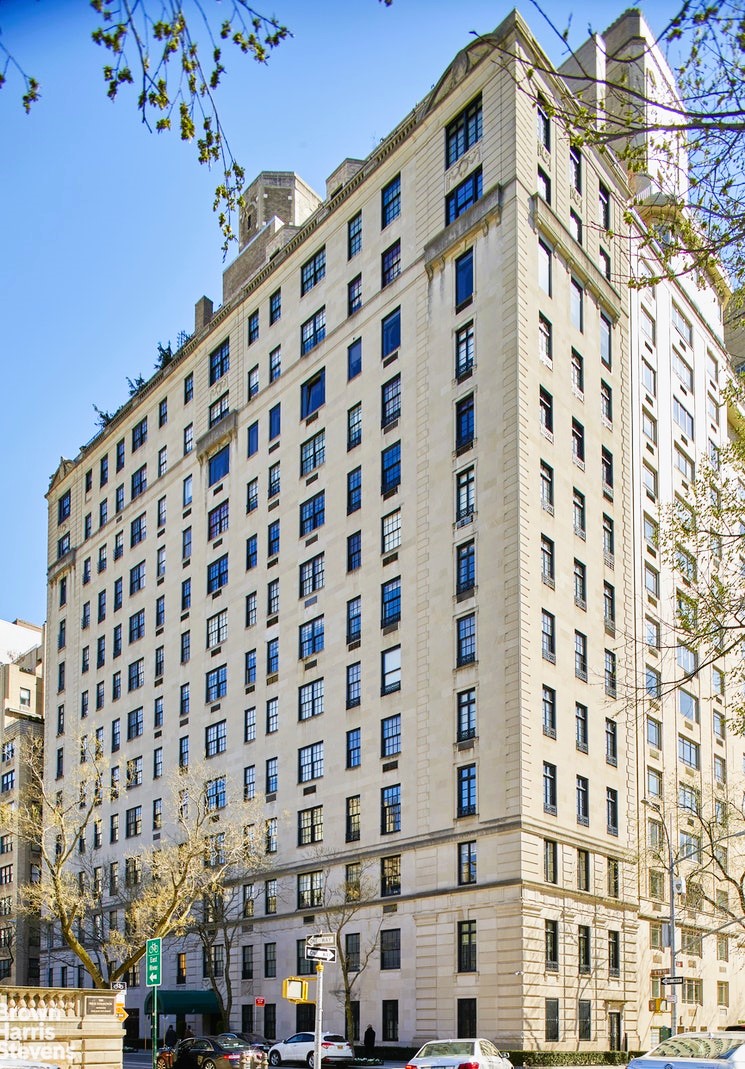
Completed in 1917, the 66-room Regency Revival mansion was faced in limestone.  Four stories tall, its entrance was centered within the rusticated base.  The wide 70th Street elevation was divided into three horizonal portions, the end sections marked by double-height, fluted Corinthian pilasters.  The top floor sat atop a stone cornice.  Here the central section sat slightly back to provide a stone balustraded balcony.

As the house was rising, on November 21, 1915 The New York Times had reported on the several mansions being built in the neighborhood.  It noted, "the one that stands out with prominence is C. Ledyard Blair's big house on the south corner of Seventieth Street.  With the new Frick house on the block to the north and the splendid homes lately completed on the old Lenox block, the Blair house takes an important place."  The article continued:

Of a simple but dignified Colonial architecture type, with its great limestone front relieved with low iron balconies at the second-floor windows, a grass plot on the Fifth Avenue side in which have been planted two plane trees, the Blair residence is an excellent example of good architectural taste combined with the luxuries and comforts of a Fifth Avenue home.

The Real Estate Record & Guide (which, incidentally, described the mansion as "a four-story marble structure"), placed the construction costs at "between $150,000 and $200,000.  That would translate to about $5.5 million on the higher end in 2022.

In addition to Blairsden, the family maintained a Newport cottage, Honeysuckle Lodge (which, coincidentally, had also been the home of Martha Fiske), and a home in Bermuda, named Deepdene.  Florence and her unmarried daughters often spent weeks during the cold months there, arriving on Blair's sumptuous yacht, the Diana, described by The New York Times as "one of the largest of the yachts of the New York Yacht Club...She is 254 feet over all and was a waterline of 216 feet."

If the Blairs had hoped to have their townhouse completed in time for the weddings of their daughters, they were disappointed.  Marjory was married to William Clark in "a Grecian temple" on the lower terrace of Blairsden on September 20, 1913.  Six hundred guests rode to the estate on a six-car special train.  The boys choir of the Cathedral of St. John the Divine led the procession from the mansion.

An early postcard depicted Blairsden.

Blairsden would be the scene of another wedding reception on June 16, 1916.  Florence was married to H. Rivington Pyne in St. John's Chapel in nearby Bernardsville, New Jersey.  The New York Times reported, "Blairsden was lavishly decorated for the reception with flowers from the conservatories on the grounds.  The house is one of the largest country homes in New Jersey, set in the midst of a magnificent estate."

Prior to the completion of his townhouse, Blair's already significant personal fortune was enormously increased.  On June 17, 1915, The New York Times reported, "To C. Ledyard Blair and J. Insley Blair is left the bulk of the estate of their father, De Witt Clinton Blair...who died recently.  The estate is valued at $50,000,000."  (The total estate would be closer to $1.39 billion today.)

Although the lavish townhouse was completed in the summer of 1917, Edith's wedding to Richard Van Nest Gambrill took place at Blairsden on June 21.  Once again, guests road to the estate in a private train.

The last of the daughters to wed was Marie Louise.  Society columns normally highlighted the bride in reporting engagements and marriages, but the social and historic prominence of the groom, in this case, supplanted tradition.  The New York Times reported on September 12, 1919, "The wedding of Pierpont Morgan Hamilton, the older son of Mr. and Mrs. William Pierson Hamilton and a grandson of the late J. Pierpont Morgan, and Miss Marie Louise Blair...was solemnized at 4:30 o'clock in St. John's Chapel-on-the-Mountain, near Bernardsville, N. J."  The article added that the groom "is a great-great-grandson of the famous Alexander Hamilton."

It is unclear whether the Pynes moved into the 70th Street mansion, or if Florence (as was common) simply came here during the last stages of her pregnancy.  Either way, in October 1917, the New-York Tribune announced, "Congratulations are being extended to Mr. and Mrs. H. Rivington Pyne on the birth of a son at the home of her parents, Mr. and Mrs. C. Ledyard Blair, No. 2 East Seventieth street."

Six months earlier, the country had entered World War I.  Blair turned the Diana over to the Government as his donation to the war effort. 

Like most socialites, Florence became involved in relief efforts.  On March 30, 1919, the New-York Tribune reported, "An American Memorial Hospital in the city of Rheims is to be established by the American Fund for French Wounded."  The project had been established at a meeting of the National Executive Council of the American Fund for French Wounded the day before in the Blair mansion.  During that meeting, $100,000 was pledged toward the construction of the hospital.

C. Ledyard and Florence Blair spent nine winter social seasons at 2 East 70th Street.  In January 1926, they sold the magnificent limestone palace to real estate developer Anthony Campagna for $1.25 million.  He replaced it with a 14-story apartment building, designed by Rosario Candela, which survives.

image via bhsusa.com

many thanks to reader Doug Wheeler for prompting this post
LaptrinhX.com has no authorization to reuse the content of this blog

Monday, November 21, 2022

The Lost Altar to Liberty - Madison Square


On the face of the central part of the monument was a map of the Western Front.  Architecture magazine, November 1918 (copyright expired)

American patriotism exploded following the country's entry into World War I on April 6. 1917.   Within three months, the stretch of Fifth Avenue from Madison Square to 59th Street was branded "The Avenue of the Allies," and three temporary monuments--The Altar of Liberty in Madison Square, the Arch of Victory at 24th Street, and the Arch of Jewels at the northern end--were being planned.

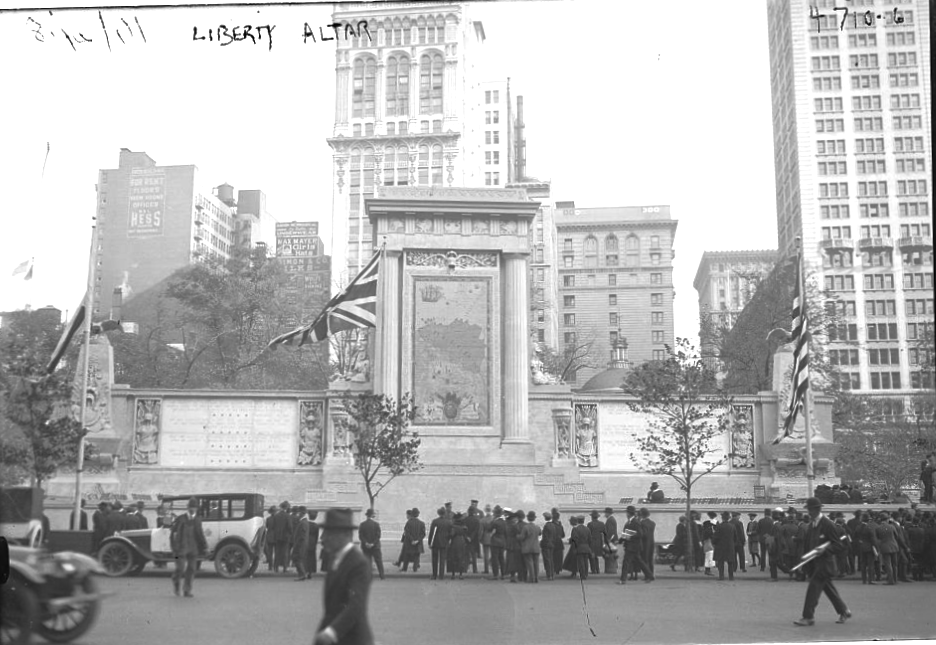
The Altar of Liberty, which would edge up to the sidewalk facing Fifth Avenue, was designed by Thomas Hastings, of Carrere & Hastings.  He incorporated quotations from statemen like Lloyd George, Woodrow Wilson, and Georges Clemenceau into the design.  Hastings explained the neo-Classical structure in Greater New York magazine one year later.  Interestingly, he stressed that his focus was not merely on World War I, but on civilization's fight for freedom in general, including slavery.  He said in part:

On either side of the Altar the chain armor, the shields, helmets and chains symbolize the early spirit of asceticism, mediaeval feudalism and finally slavery in our own time and country overcome by the continuous progress of civilization.  The Altar in its ensemble and in the selected quotations from men who think and men in authority, shown in the large panels at either side, is intended to signify and uphold the real moral issue that this is a war upon the very institution of war itself, to conquer and overthrow militarism in order to establish, with limited armament, reason and justice in all intercourse between nations.

The altar was dedicated by Vice-President Thomas R. Marshall on September 28, 1918.  Several thousand people crammed Fifth Avenue, and the New-York Tribune reported, "the great mass of citizens reacted to the stimulus of great events and lofty utterances by signing their names to orders for bonds--in quietly mobilizing their savings for service in the war."  It was the first instance of a series of Liberty Bond drives to take place at the Altar of Liberty.

The flags of the Allied nations fly during the dedication ceremonies on September 28, 1918.  image via the Granger Collection

There would also be specific days dedicated to each of the Allied nations along The Avenue of Allies and at the Altar of Liberty.  On October 10, 1918, The Christian Advocate explained, "Each avenue block is decorated with the flags of one of the Allied countries, and each day at noon a representative of a different nation is escorted to the altar, where he lays upon it a floral offering and makes an address, which ends with an exhortation to buy bonds."

General Gvosdenovitch speaking at the Altar of Liberty on Montenegrin Day on October 11, 1918.  from the archives of the Department of War, Washington D. C.

In 1920, Valentine's Manual of Old New York described the Avenue of the Allies and the Altar of Liberty:

The Altar of Liberty at Madison Square--an extraordinarily beautiful work of art--was the center of attraction for the crowds who came out to boost the Liberty Loan.  Fifth Avenue was decorated gorgeously.  Such richness and beauty of color was never seen before.  Each block was decorated with the colors of one particular nation of the Allies, and the avenue for the time became known as the Avenue of the Allies.

The Commonwealth, November 26, 1918 (copyright expired)

The flag-lined thoroughfare was memorialized in Childe Hassam's famous series of paintings, known as the Flag Series, in 1918.

World War I came to an end on Armistice Day, November 11, 1918.  That same day the National Sculpture Society met "to discuss ways and means to embody the Altar of Liberty into a permanent 'Victory Arch' that will remain, for all time, as a monument to America's part in the war," reported The Evening World.  The proposed rendering featured an arch of victory, atop which was a grouping of soldiers and a bi-plane, a colonnade, and a fountain and large reflecting pond complete with a submarine. 

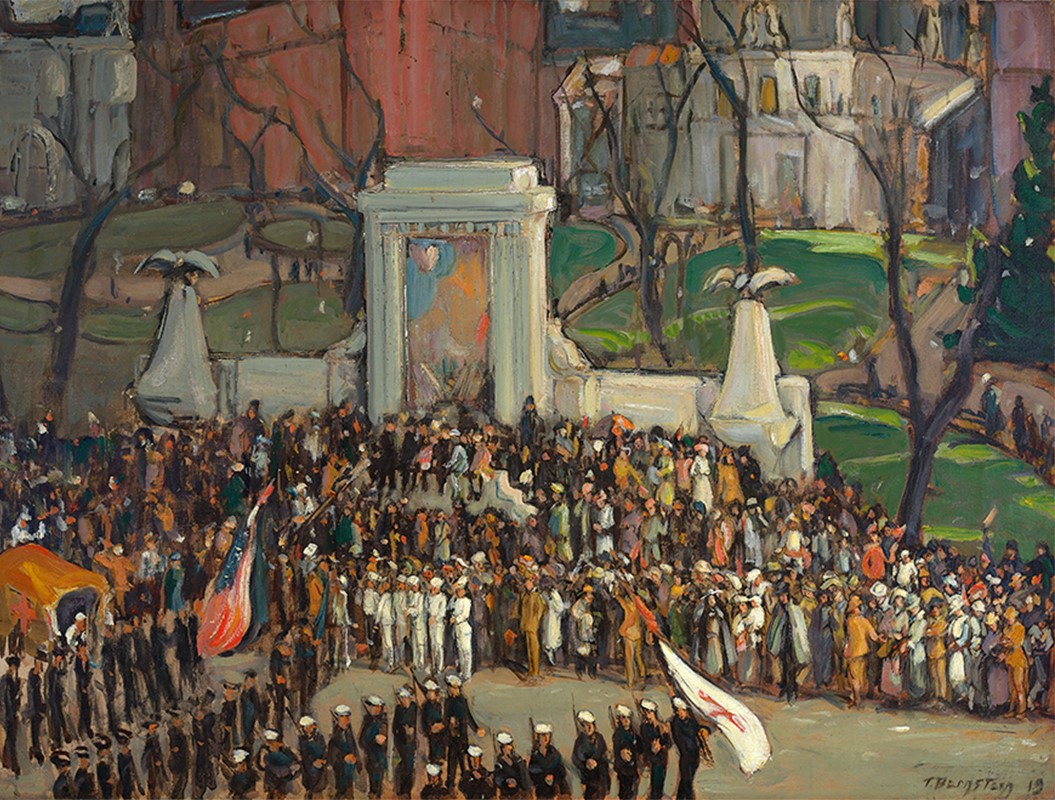
Theresa Ferber Bernstein painted Armistice Day Parade: The Altar of Liberty in 1919.  from the collection of Smith College

Plans for demolishing the Altar of Liberty proceeded quickly.  Robert Davis, a colonel with the Field Artillery in Germany, sent a plea to delay the razing through a letter to The New York Times on December 12, 1918:

I speak for a large number of us to whom has fallen the lot of garrisoning captured areas in Germany during the coming dreary Winter when I ask that you use your influence to prevent the removal of the much-read-of 'Altar of Liberty' from New York until such time as the army shall have been returned to the States.

We feel that we are as anxious to see what you have done in the States as you are to inspect the work accomplished by us here.

Davis got his wish.  As the returning American troops marched up Fifth Avenue, they paused at the Altar of Liberty.  One officer, Colonel William Hayward, echoed Thomas Hastings's thoughts on freedom to the crowd on May 2, 1919.  Hayward was the commander of the "colored" New York 15th Regiment."  Segregated from white troops, the Black regiments were always commanded by white officers.  Standing at the Altar of Liberty at noon that day, he announced, "If there is any one here who does not approve of the principles for which my men fought let them clear out of the country and don't let them buy any Victory notes.  Let those who approve those principles have the privilege of buying."

from the collection of the Library of Congress

Four months later, two million spectators lined five miles of Fifth Avenue to welcome General John J. Pershing and the famous First Division.  The Chattanooga Daily Times wrote, "It was the last great review of the war for New York and it was a fitting climax to a long series of military spectacles."  The article noted, "Perhaps the most impressive moment of the parade was when the soldiers reached the altar of liberty at Twenty-third street, where drums were muffled, colors 'dipped' and officers saluted in memory of the nation's heroic dead."

Shortly afterward, the Altar of Liberty was scrapped.  Proposals to replace it with a permanent structure were discussed for two more years.  After that, the memory of Thomas Hastings "extraordinarily beautiful work of art" faded from memory.

Many thanks to reader Doug Wheeler for prompting this post
LaptrinhX.com has no authorization to reuse the content of this blog

Saturday, September 4, 2021

The Eternal Light Flagstaff - Madison Square.


Nearly two years after the end of World War I, New York Legislative Documents noted, "No progress has been made during the past year toward a conclusion as to the form of New York City's great war memorial."  The two favored ideas being considered were a "Liberty Bridge" over the Hudson River, and the conversion of Madison Square Garden into Liberty Hall, proposed "to become the largest convention hall in the world, with a seating capacity of 20,000 people, containing a sacred Gothic Chapel and an organ that should be the greatest yet built."  The document added, "As a third alternative they recommended a Liberty Arch in the heart of the city."

As it turned out, none of those ideas would earn the approval of millionaire department store mogul Rodman Wanamaker, Chairman of the Mayor John Francis Hyland's Committee on Permanent Memorial.  (Wanamaker almost undoubtedly achieved the position through his former employee, Grover Whalen, who had been appointed Commissioner of Plants and Structures in 1918.)

Wanamaker felt strongly that the monument "should stand out by its simplicity"--the very antithesis of the three popular ideas.  It may have been that conflict that resulted in his personally footing the $25,000 bill for the project--more than $360,000 today.

Wanamaker's committee eventually approved the design submitted by Thomas Hastings, of the esteemed architectural firm Carrere and Hastings.  The Eternal Light Monument would take the form of a 125-foot tall wooden flagstaff formed from a century-old tree cut in "the virgin forests of Oregon and transported over the Rocky Mountains," according to The NYC Department of Parks.  Hastings designed a monumental pink granite pedestal that upheld the grand bronze pole base.  Paul Wayland Bartlett, who had studied under Auguste Rodin, executed the sculptural elements.


Atop the flagpole was a seven-pointed electrified star.  It was  first illuminated on Armistice Day, November 11, 1923, and the m0nument was formally dedicated on June 7, 1924.  The names of significant French battles were engraved on the east and west faces.  On the north was carved, "In memory of those who have made the supreme sacrifice for the triumph of the free peoples of the world," and on the south, in part, "Erected to commemorate the first homecoming of the victorious Army and Navy of these United States."

The Eternal Light Monument was the terminus of the annual Armistice Day parades, when tens of thousands of veterans marched from City Hall to Madison Square.  (Armistice Day marked the day and hour World War I ended--the 11th hour of the 11th day of the 11 month in 1918.)

photo via the NYC Dept of Records & Information Services

The monument was also used by the city to honor distinguished guests.   In June 1927 the Broadway motorcade of Charles Lindbergh stopped so the famous flier could lay a wreath at its base.   And a month later, on July 18, The Daily Worker reported, "Clarence Chamberlin, Richard E. Byrd and the three men who flew with Byrd to Paris came back to New York yesterday...The fliers were met at the City Hall by Mayor Walker and received the city's medals of valor.  At the eternal light in Madison Square, William H. Woodin welcomed them to the state in the absence of Governor Smith."

The Eternal Light Monument turned political around 1930, when socialists adopted it as their own symbol.  It may have started with the May Day observations in Union Square that year.  Army veterans planned a counter-protest.  The Socialist newspaper The Daily Worker wrote, "If the Veterans of Foreign Wars can scrape together enough sluggers, boss-bellycrawlers and thugs they will start their march from the Eternal Light in Madison Square."

Members of the Women's Overseas Service League pose before the monument around 1924.  from the collection of the New-York Historical Society

In 1932 veterans marched on Washington D.C. to demand government promised pension money.  Two of them, Eric Carlson and William Hushka were shot dead by D.C. police.  The deaths enraged Socialists, who organized "Huska-Carlson Day" the following year.  On July 27, 1933 protestors assembled at Rutgers Square.  The Daily Worker advised, "From there, a parade will leave for Madison Square (23rd St.) at the Eternal Light."

Every year the antithetical groups would use the monument for their widely disparate purposes.  The annual Armistice Day  parades and subsequent ceremonies went on in November, while the Socialists embraced the memorial in the spring months.  On March 6, 1934 The Daily Worker announced, "The youth section of the American League Against War and Fascism will hold an anti-war parade starting at the Eternal Light in Madison Square, where a wreath will be laid."  The banner on that wreath read, "We Will Not Support the Government In Any War It May Undertake."


Ernst Thaelmann, the leader of the Communist Party of Germany, was arrested by the German Government in 1933.  Reaction in the form of rallies and protests among the Socialist and Communist communities in America was swift.  On the night of June 13, 1934 Jack Corrigan shimmied to the top of the Eternal Light flagpole and hung a massive red banner demanding "FREE ERNST THAELMANN."  He and his comrades assured that it would remain there as long as possible by greasing the pole upon his descent and cutting the pole ropes.  On June 15 The Daily Worker reported, "While crowds gathered to watch the sight, police squads desperately tried to get up the pole, but it was greased too well for them."

In 1965 the participants in the annual ceremonies--originally composed of thousands--had greatly diminished.  photo via the NYC Dept of Records & Information Services

In 1954 Armistice Day was changed by Congress to Veterans Day, in order to honor the deceased veterans of all wars.  

In 1976 the wooden flagpole was replaced with a metal version.  By then the once massive Veterans Day ceremonies had greatly diminished.  On November 13, 1979 Judith Cummings, writing in The New York Times, said "Few New Yorkers marched in the annual Veterans Day parade yesterday on Fifth Avenue and almost as few bothered to watch it, deciding instead to take advantage of department store sales."  She went on, "Ceremonies at the parade's terminus at Madison Square Park drew several dozen onlookers, who stood quietly in chill wind to hear the speakers in front of the graffiti-scarred Eternal Light monument near 24th Street."

Part of the meager turnout was blamed on anti-Vietnam War sentiments.  But numbers grew in 1981 when national patriotism swelled with the return of American hostages from Iran.  Mayor Edward Koch announced, "Now we must not rest until they [the Vietnam MIA's] are likewise returned."

The Veterans Day ceremonies saw another increase of numbers in 1983.  Gannett Westchester Newspapers wrote on November 12, "About 2,000 present and former servicemen marched under cloudy skies in New York City's Veterans Day parade to pay tribute to America's fallen heroes, especially those killed recently in Lebanon and Grenada.  They stepped smartly down Fifth Avenue to the Eternal Light Monument in Madison Square where 32 wreaths were placed in memory of the fighting men and women of the United States."

But the numbers had waned again in 1986, when The New York Times reported "The sparse crowds at recent Veterans Day parades in Manhattan were generous compared with the smattering that turned out yesterday."  It was, nevertheless, a groundbreaking event.  The article noted, "for the first time, homosexual veterans joined the march under their own banner."  It was not entirely a welcomed change.  The article noted, "As the Gay Veterans entered the parade from 39th Street, a man slashed the banner with a knife and fled."


The luminaire, or lighted star, at the top of the flagstaff was refurbished in 2017.  Thomas Hastings's magnificent base, described in 1979 as "graffiti-scarred," has been restored.  And the Eternal Light monument continues to be the site of the annual Veterans Day ceremonies after nearly a century.

photographs by the author
no permission to reuse the content of this blog has been granted to LaptrinhX.com