Showing posts with label richard w. buckley. Show all posts

Thursday, October 21, 2021

The Frederick M. Davies House - 20 East 82nd Street


In the 1870's Richard W. Buckley was deemed by the Real Estate Record & Builders' Guide to be a "rising young architect."  In 1880 he formed a partnership with developer Robert McCafferty.  Initially McCafferty & Buckley designed and erected rows of middle-class brownstone homes.  But in the 1890's they aimed at a more moneyed customer base.

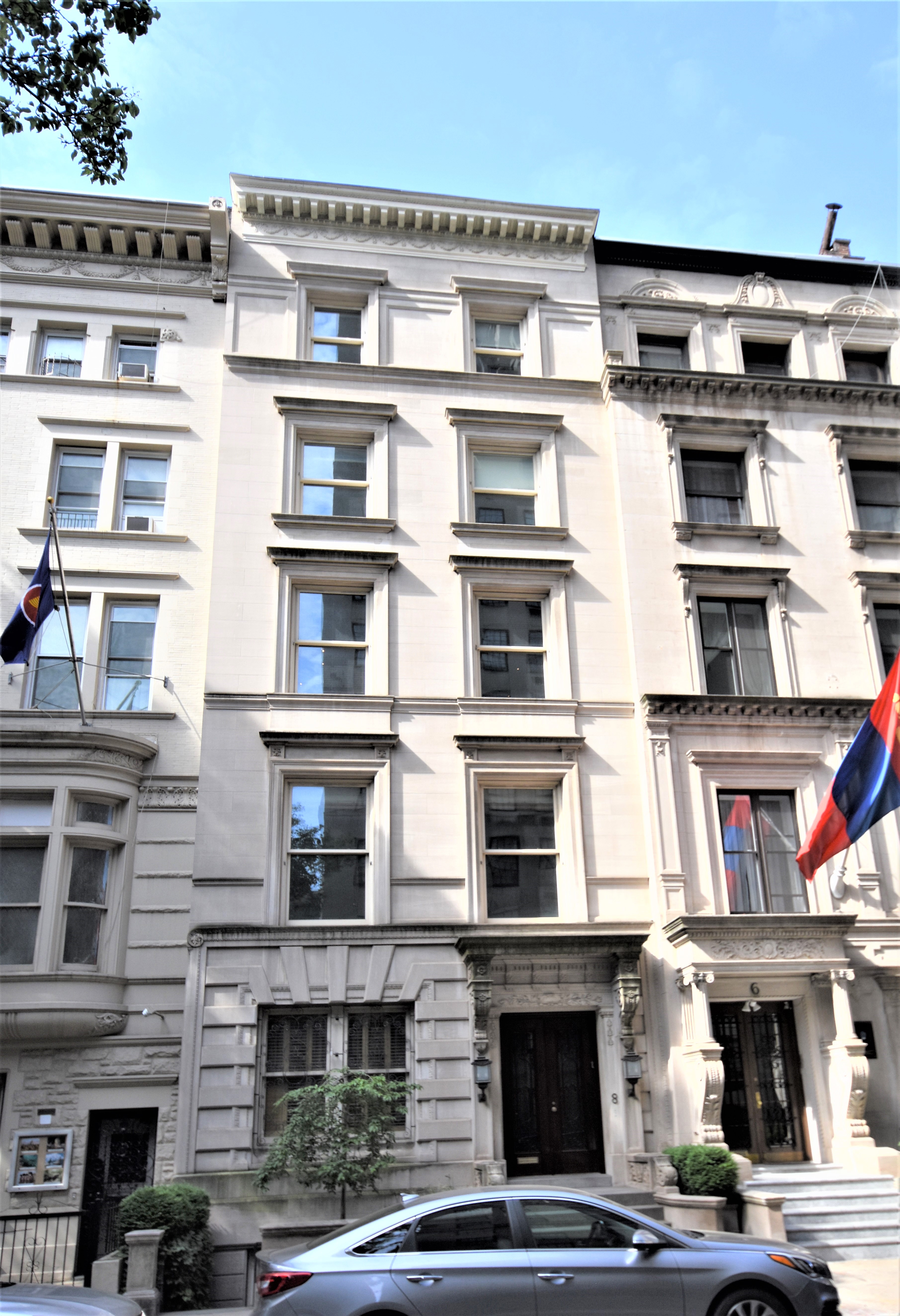
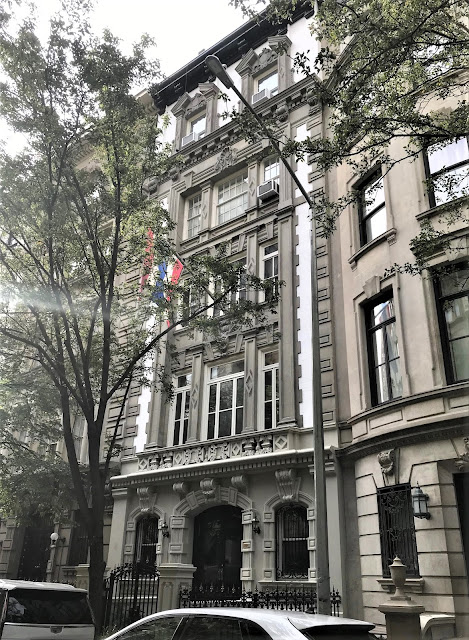
In 1900 they began construction on a row of sumptuous mansions at 18 through 26 East 82nd Street.  Completed the following year, the Beaux Arts style houses were harmoniously, yet individually, designed.  Like the others, 20 East 82nd Street was intended for a wealthy buyer.  Five stories tall and 26-feet wide, it sat behind elegant areaway fencing with paneled stone gateposts.  Heavy Gibbs surrounds framed the entrance and first floor windows.  A carved stone balcony introduced the three-story midsection.  The fifth floor openings, which sat atop the bracketed intermediate cornice, wore impressive broken pediments.

Robert McCafferty's health began to fail around the time the houses were completed in 1901.  The sale of these and many other properties was held up.  After what was termed “a lingering illness,” he died in his Park Avenue home on February 11, 1905.  Two years later the McCafferty holdings finally began being liquidated.  The New York Times remarked “The sale of the real estate owned by the late Robert McCafferty is an event of unusual interest to the older generation of real estate men in New York, among whom he was for many years a leader.”
On April 16, 1907 Richard W. Buckley "as surviving partner" sold 20 East 82nd Street to Eugene Murrough O'Neill.  Born in Clonroche, Ireland in 1850, he had emigrated to Pittsburgh, Pennsylvania as a youth, "following his brother Daniel," according to The Recorder, Bulletin of the American Irish Historical Society later.  He became the editor and publisher of The Pittsburgh Dispatch and then increased his significant fortune in Pittsburgh real estate.
Eugene's brother had married Emily Martha Seely in 1867.  They had three children.  Daniel died in 1877 and two years later Eugene and Emily were married.
Eugene M. O'Neill had retired in 1902.  The purchase of 20 East 82nd Street was, presumably, a gift to Emily O'Neill, his step-daughter, who had married Frederick Martin Davies in 1901.  Nevertheless, he listed his New York address here with the Davies family.
Born in 1877, Frederick Martin Davies had graduated from Yale University in 1899.  He went into the railroad business for two years and then turned to banking.  When he and Emily moved into their new home, he was a partner in Alexander, Thomas & Davies.  The couple had a four-year-old daughter, Emily O'Neill and a one year old son, Frederick Martin, at the time.  A second daughter, Audrey, would arrive in 1912.
In 1914 Frederick "was stricken with a cold, which did not improve," according to the New York Herald.  Hoping that a change of climate would help, he went to Santa Barbara, California.  There he developed pneumonia and his condition was so precarious that his closest friend since childhood, Alfred Gwynne Vanderbilt, "obtained a special train in order to get quickly to his bedside."  
Frederick rallied and the New York Herald said, "Later Mr. Davies went to Palm Beach, Fla., and then took a yachting trip, but neither of these served to improve his health."  On May 2, 1915, Frederick Davies died in the 82nd Street mansion at just 38 years old.  Calling him a "prominent horseman and clubman," The New York Times listed his many memberships in exclusive clubs:  the Metropolitan, Union, Knickerbocker, New York Yacht, Piping Rock, University, Colony, Down Town and The Brook Clubs.
The bulk of Frederick's extensive estate went to Emily.  The will directed her to set aside $50,000, "the income to be paid to Frederick Martin Davies, Jr., until he is 25 years old, or until he shall be graduated from the Naval Academy at Annapolis.  Then he is to receive the principal."  Frederick Jr.'s father was obviously intent that his son would attend the Academy.  "Should the boy not choose to enter the academy or fail to finish his course there, the fund is to revert to the residuary estate."  His $50,000 (about $1.3 million today) inheritance would then be divided among him and his sisters.
The will also directed Emily to choose "some articles of jewelry" for Alfred Gwynne Vanderbilt as a "personal remembrance."  Tragically, on the day before Frederick's death, Vanderbilt had boarded the RMS Lusitania headed for England.  He was among the victims when the ship was torpedoed by a German U-boat on May 7.
Among other bequests was $5,000 to Burton Leopold Powley, "man servant of my father-in-law, Eugene M. O'Neill."  An Englishman, Powley was O'Neill's valet.  The position, like that of a lady's maid, resulted in close, personal relations--despite its being an employer-employee situation.
The family had always summered in Newport.  Now, in November (despite still being in mourning), Emily hired the architectural firm of Mann & MacNeille to design a summer home in Southampton, Long Island.  Upon its completion the Daily News called it "one of the show places in fashionable Southampton."
During World War I, New York socialites threw their support behind the various causes.  Emily showed her support for the troops abroad in what might seem a surprising way.  On January 15, 1918, The Sun reported, "Mrs. F. M. Davies, 20 East Eighty-second street, has generously provided some 67,000 smokes for our soldiers in France."  
Eugene O'Neill's valued manservant, Burton Powley, registered for the draft in September that year.  It may have been his age--he was 41 years old at the time--that kept him from service.  His registration form listed his address at 20 East 82nd Street.
But, ironically, being drafted might have saved his life.  Ten months later, on July 14, 1919, Powley was headed from Manhattan to the Davies country home in Southampton on a motorcycle.  Riding with him was Dora Harding.  They were about two miles from the Davies estate when the motorcycle was hit by an automobile.  Miss Harding was killed instantly and Powley died at the Southampton Hospital a few hours later.
On February 8, 1923, Emily gave a dinner party in honor of William Henry Vanderbilt III, the son of Alfred Gwynne Vanderbilt.  There was more to her tribute to the 22-year-old than the close relationship between his father and Emily's deceased husband.  Later that year, on November 1, her daughter Emily O'Neill Davies and William Henry were married in Grace Church.
The New York Times reported, "A Vanderbilt wedding naturally attracted a large crowd, but the police kept the curious well in hand, although there was a crush of women around the entrance awning."  Eugene O'Neill walked his granddaughter to the altar.  Audrey, who was now 11 years old, was the bride's maid of altar.  
Following the ceremony, the millionaire guests filed into 20 East 82nd Street for the reception.  The New York Times said the house "was simply decorated with large jars of russet oak leaves, dark chrysanthemums and small palms with white and palm hued autumnal flowers in the drawing room, where the bride and bridegroom received congratulations."
In September 1926 Eugene M. O'Neill contracted pneumonia.  He died at St. Luke's Hospital on November 26 at the age of 72.
The marriage of Emily and William H. Vanderbilt was not going well at the time.  That year rumors of trouble circulated when Emily went to Paris while William vacationed in California.  Although William told reporters upon his return to New York that "there was nothing to the reports," Emily returned to Paris that fall.  Friends said she told them "she was through with married life."
In May 1928 Emily sued for divorce.  Gossip said she was having an affair with theater producer Sigourney Thayer.  The rumors proved true when the couple was married in the East 82nd Street mansion on December 7 that year.  The New York Times reported, "The marriage comes as a complete surprise to the friends of the couple, as no preview announcement of the engagement had been made."  Not surprisingly, only immediate family members were present at the ceremony.
Arthur Mefford, writing in the Daily News, was less sympathetic in its reporting of the wedding.  He wrote, "Mrs. Emily Davies Vanderbilt, harum-scarum daughter of Mrs. Frederick Martin Davies, 20 East 82d st., and divorced wife of William H. Vanderbilt 3d, eloped yesterday with Sigourney Thayer, jack of all trades and a rival of the famed Joe Cook as a 'one man show.'"
This marriage did not work out, either.  A year later the couple divorced.  Emily Vanderbilt Thayer spent much of her time in Paris, surrounding herself with literary figures like Gertrude Stein and Alice B. Toklas.  She reputedly had a two-month affair with poet E. E. Cummings.  
The colorful and tragic Emily Davies Vanderbilt Thayer Whitfield.  from the collection of the Library of Congress.

When in America, of course, she was either at the Southampton estate or 20 East 82nd Street.  On April 20, 1930 Cholly Knickerbocker, the pseudonym of a group of society columnists, reported in the Times-Union, "Recently Mrs. Thayer has been making her headquarters with her mother, Mrs. Frederick Martin Davies, at 20 East Eighty-second street."  The writer had caught sight of her at the Madison Square Garden circus, proving "that Emily is decidedly more human than most of the ladies who have been in a position to sign themselves' Mrs. Vanderbilt.'"
Emily's place in the spotlight was briefly taken by her mother that year.  On July 19, 1930 The New York Times reported, "Cables were received by relatives here announcing the marriage in Paris yesterday of Mrs. Emily O'Neill Davies, widow of Frederick Martin Davies, to Horace Chase Stebbins...It took place very quietly in the Hotel Crillon."
There would be no time for an extensive honeymoon.  One month later, on August 21, 600 guests were invited to a ball at the Alexander Hamilton Rice mansion, Miramar, in Newport to celebrate the betrothal of the Rice's granddaughter, Diana Dodge, to Frederick M. Davies, Jr.
The wedding on December 6, 1930 in St. Thomas' Church on Fifth Avenue took up nearly a full page of the Daily News.  The article said, "It was a Social Occasion (capitals, please), with every one conscious of the fact that the Dodge-Davies nuptials were bound to be an Event.  Because of the prominence of the two families...Philadelphia, Pittsburgh and Newport were as interested in the wedding as Manhattan and sent their highest hats to attend."
Emily Davies Vanderbilt Thayer married again in 1933.  Her husband this time was mystery writer Raoul Whitfield.  This marriage would end in what could have been a chapter from one of his books.  Following her long-established trend, Emily started divorce proceedings in 1935.   The couple had purchased a ranch in Las Vegas, New Mexico called Dead Horse.  At around 7:30 on the morning of May 24 an employee entered Emily's bedroom there to light a fire.  He found her shot dead through the heart.
The Daily News wrote, "Society knew Emily Davies Vanderbilt Thayer Whitfield as either a Scott Fitzgerald flapper born too late or a member of the Lost Generation.  Born to the purple, she inclined toward the mauve."  A coroner's jury deemed the death a suicide, despite the fact that the wound was on her left side and she was right-handed, making it nearly impossible to have been self-inflicted.  Years later Lillian Hellman flatly said, "she was murdered...and neither the mystery story expert nor the police ever found the murderer."
Things had not gone well with Frederick's marriage, either.  In June 1936, Diana Dodge Davies obtained a Nevada divorce and on the day after Christmas she married George Ryan.  The Daily News described the newlyweds as "two of fortune's as well as Society's darlings."  In reporting the marriage, the newspaper recalled, "Her Park Avenue wedding to Frederick Davies, the son of Mrs. Horace Chase Stebbins...was one of the grandest at which the Best People of New York, Newport and Philadelphia have hobnobbed."
In the meantime, Horace Stebbins had adopted Audrey.  He died in Roosevelt Hospital at the age of 73 on June 2, 1947.  Eleven years later, after suffering what The New York Times called "a long illness," Emily died at the age of 82 on October 3, 1958.

The following year 20 East 82nd Street was made Thailand's Permanent Mission to the United Nations.
photographs by the author
LaptrinhX.com has no authorization to reuse the content of this blog

Saturday, July 17, 2021

The Joseph H. Hoadley Mansion - 18 East 82nd Street


In the 1870's Richard W. Buckley was deemed by the Real Estate Record & Builders' Guide to be a "rising young architect."  In 1880 he formed a partnership with developer Robert McCafferty.  Initially McCafferty & Buckley designed and erected rows of middle-class brownstone homes.  But in the 1890's they aimed at a more moneyed customer base.

In 1900 they began construction on a row of sumptuous mansions at 18 through 26 East 82nd Street.  Completed the following year, the Beaux Arts style houses were harmoniously, yet individually, designed.  Like the others, 18 East 82nd Street was intended for a wealthy buyer.  Five stories tall and 26-feet wide, its four-story bowed bay was crowned with a stone balustrade. 

McCafferty & Buckley sold the mansion in December 1901 to William E. and Clara Tranter Reis.   Reis was president of the Shenango Valley Steel Company.  He and Clara moved to New York City in 1899 upon the organization of the National Steel Company, of which he was also president.

The family did not remain in the mansion especially long.  They sold it on May 18, 1908 to Fannie C. Hoadley and provided the mortgage.  It was a transaction the Reises would regret.

The former Fannie Curtis was the wife of Joseph H. Hoadley, described by the Times Union as "reputed to be worth $15,000,000."  (That amount would be closer to $430 million today.)  Hoadley was the president of the International Power Co. and the Hoadley-Knight Coal Mining Machine Company.  The couple had a daughter, Grace.

They had barely moved in when Hoadley found himself in court, sued by Elizabeth C. Prall, widow of William E. Prall.  Hoadley had been associated with Prall in the Prall Engine and Power Company, and Elizabeth accused him of illegally using trademarked engine designs.

Despite the Hoadleys' reputed fortune, they were slow at best at paying their mortgage.  On November 12, 1910 the Real Estate Record & Guide reported that William E. Reis had filed a foreclosure suit against Fannie C. Hoadley.  In what must have seemed an impertinent move, Fannie purchased the mansion at the foreclosure auction.

And it was not the last time.  On February 20, 1913 The Sun reported, "Mrs. Fannie Curtis Hoadley yesterday bought in foreclosure her house at 18 East Eighty-second street for the fourth time in a year."  The Reises had managed to transfer the $105,000 mortgage to the New York Life Insurance Company, so they were free from the battle.  

The article explained that at a foreclosure sale a year earlier, "Mrs. Hoadley bought the house, paying 10 percent of the purchase price.  She defaulted on the rest.  This necessitated a resale and Mrs. Hoadley was again the buyer.  She paid 10 percent, as before, and once more she failed to make further payment."  The foreclosures and purchases went on, each time Fannie putting down 10 percent.  "If the sales continue and she continues to be the buyer, the amount the mortgage calls for will be eventually reached and she will hold a clear title to the property," The Sun jested.

On September 25, 1913, The New York Times reported "Grace Hoadley Weds In Haste."  The article said that she and Joseph Wade had obtained a marriage license two days earlier and were married on the same day in St. Ignatius Loyola Church on Park Avenue and 84th Street.

It appeared that there was tension surrounding the union.  The article said "Mr. Hoadley declared last night that his daughter had married Mr. Wade with parental approval, and that he had been unable to attend the wedding ceremony on account of illness...The bridegroom's parents were also unable to be present, as they had left the day previous for Detroit, Mich."

Hoadley explained the abruptness of the wedding by saying that Grace "had made up her mind to marry suddenly as she did not care to have a large and formal wedding later in the season."  A more likely explanation was the fact that Wade was a Roman Catholic and Grace was Protestant.  She had been received into the Catholic faith shortly before the wedding.   The New York Times noted, "According to one of the guests at the wedding, there had been some objection on the part of the bride's parents to her becoming a Catholic."  But apparently the parties buried their problems and the newlyweds moved in with the Hoadleys.

Hoadley was sued by Richardson, Hill & Co. in 1914 and ordered to pay $24,653.  He professed to the courts that he did not have the money.  On October 15 the New-York Tribune wrote, "Hoadley lives at 18 East 82d st.  He said he did not know who owned the house, as he paid no rent...The furniture in his home belongs to his wife, said Hoadley, and he has not given her any money in several years."  He further stated that he had no bank account, and paid all his bills in cash.  As president of the International Power Company, he received no salary, he claimed.

Notwithstanding his alleged poverty, the Hoadley's maintained an elegant yacht, the Alabama.  When the mortgage company discovered the fact in 1916, it obtained a summons "directing Mrs. Hoadley to show cause why she should not be held in contempt of court for failure to pay the judgment in that she was the owner of a $9,000 yacht."  Hoadley countered that "he had used the yacht in the company's business--entertaining customers."

This photograph of Hoadley was taken in 1905, three years before the family moved into 18 East 82nd Street.  from the collection of the Library of Congress

The couple could not scam the system forever.  In March 1916 they had, for the eighth time, purchased the house in a foreclosure sale, paying 10 percent of the purchase price.  But the Mutual Life Insurance Company, which held the mortgage, was losing patience.  

Deputy Sheriff Katzenstein gained entrance to the house by telling the butler he had a letter for Hoadley, and then putting his foot between the open door and the jam so it could not be closed.  He "gradually forced [in] despite the struggles of the servants," said The New York Times.

Katzenstein later reported "the house has two elevators, but only one of them can be seen on entering the main hall.  A smaller elevator is concealed behind a specially built wall, which can be reached only by a person pressing a button and causing a panel in the wall to slide back."  He said that the servants, "had tried to get him into this private car, when they found he had located it, for the purpose of imprisoning him by stopping the car between floors."

In November 1916 deputies and a private detective staked out the house for days, waiting for one of the Hoadleys to appear.  The New York Times reported, "They saw Mrs. Hoadley at an upper window.  Friends and acquaintances of the Hoadleys called in motor cars and entered and departed, but the officers could get no nearer to either the host or the hostess."  Despite the 24-hour surveillance, Joseph and Fannie slipped away.

"Then word reached the waiting officers that Mr. and Mrs. Hoadley had gone, leaving their fine home in possession of their daughter, Mrs. Wade," reported The New York Times on November 15.  Recalling the hidden elevator, Deputy Sheriff Katzenstein suggested there was a secret tunnel, as well.  "I'm sure the dignified Mrs. Hoadley would not have climbed a rear fence to a neighbor's yard and departed in that way," he said.

However they escaped, officials were certain they had "reached the safe asylum of their yacht Alabama, anchored somewhere near Rye Beach, or perhaps were on the way by sea to Florida."

Eventually, the Hoadleys returned to the East 82nd Street mansion, but the pressure on them did not let up.  On the night of April 13, 1919, according to Hoadley, he and Fannie were up late.  Around 1 a.m. Fannie went to bed and Joseph continued reading a book.  The following morning Fannie was found dead in a maid's room.

The Times Union reported, "the room was filled with gas from two open jets in the chandelier."  The newspaper deflected the idea of suicide by saying, "It is believed that in attempting to turn them off when she was about to retire, she accidentally opened the cocks."  It also put a positive spin on the couple's recent history.  "Mrs. Hoadley, who was 42 years old, together with her husband had lived a life of real adventure...Other promoters and financiers, together with investors, have frequently been hot upon his trail.  Mrs. Hoadley was a loyal and resourceful wife, and as such, could seldom escape the role of heroine."

An investigation proved the theory of accidental death wrong.  On April 18, 1919 The Record of Hackensack, New Jersey quoted Dr. Benjamin Schwartz, acting chief medical examiner as saying, "I think there can be no question that Mrs. Hoadley committed suicide."

Fannie's sudden death may have been enough to distract Joseph from another foreclosure sale less than a month later, on May 15.  The house was purchased by Arthur B. Westervelt who immediately started eviction proceedings.   In court Hoadley asserted that Westervelt, "became the owner at the request of Mrs. Hoadley in order that the property might fall into friendly hands."  The New York Times reported on June 5, "Hoadley said it was understood that his family would pay no rent."  The ruse did not work.

After having lived in opulence nearly cost-free for a decade, on June 11, 1919 The Evening World reported that Joseph H. Hoadley "was formally dispossessed to-day of the residence at No. 18 East 82d Street."  City Marshall Peter J. Gaffney served Hoadley the warrant as the trucks of the Encumbrance Division "drew up at the curbing" to empty the house.

Westervelt quickly sold the mansion to Ogden Haggerty Hammond, who did interior renovations in 1921.  Born in Louisville, Kentucky in 1869, his brother, John Henry Hammond, Jr., was married to Emily Vanderbilt Sloane. 

He and his first wife, the former Mary Picton Stevens, had three children, Mary Stevens, Millicent Vernon, and Ogden Haggerty, Jr.  Despite warnings about transatlantic travel because of the war in Europe, Mary Hammond was intent on helping victims and assisting the Red Cross overseas.  On May 1, 1915 she and Ogden boarded the RMS Lusitania headed to Liverpool.  Six days later the luxury liner was torpedoed by a German submarine.  While Ogden survived the sinking, Mary was lost.

Three years before buying the 82nd Street residence, he married Marguerite McClure Howland (known familiarly as Daisy), the widow of Dulany Howland.   Hammond adopted her 11-year-old son, McClure.

Hammond had begun his career in real estate, but had become increasingly involved in civic administration.  From 1918 to 1920 he had served as chairman of the New Jersey State Board of Charities and Correction.  He would be treasurer of the Friends of Greece, Inc., the Bonnie Brae Farm for Boys, and the National Civil Service Reform League.

In 1925 President Calvin Coolidge appointed Hammond to be United States Ambassador to Spain.  With the family abroad, 18 East 82nd Street was closed until their return in 1929.

Ogden Haggerty Hammond from the collection of the Library of Congress

Upon returning to New York, Hammond became vice president and a director in the First National Bank of Jersey City.  The family maintained a summer home in Newport, Rhode Island.

In 1931, shortly after the family returned to New York, Millicent married Hugh McLeod Fenwick.  (She would go on to follow in her father's diplomatic footsteps.  She served as a United States Representative from 1975 to 1983, and was appointed by Ronald Reagan as U.S. Ambassador to the United Nations Agencies for Food and Agriculture in 1983.)

Ogden Hammond retired in 1950, possibly because of his failing health.  The 87-year-old died in the 81st Street mansion on October 29, 1956.

Marguerite left East 81st Street not long afterward.  In 1960 it was converted to apartments.  There were now a doctor's office and maid's room on the ground floor, and two duplexes above.  It was apparently at this time that the balustrade atop the bowed bay was removed.  The bay was extended upward with a new, glaring brick bowed facade.

The ground floor space intended as a doctor's office was the Allan Stone Gallery by 1962.  A collector and dealer, Stone was described by a colleague who said, "If not quite infallible, his eye allowed him to hone in on the best object in the room, whether an artist's studio, an antiques shop, or a thrift store."

In 2008 a renovation was initiated to return the mansion to a single-family home.  The exterior was meticulously restored by CTA Architects P.C., a project which included removing the brick top floor addition and refabricating the balustrade and fifth floor architectural elements based on historic photos.  The interior was not so gently treated, the architects in charge of that part of the project announcing a "gut renovation."


The exterior restoration earned CTA Architects P.C. the 2013 Residential Architect Design Award and the Restoration/Preservation Merit Award.

photographs by the author
LaptrinhX.com has no authorization to reuse the content of this blog

Thursday, July 8, 2021

The Mary T. Penniman House - 8 East 77th Street


Not only was Richard W. Buckley a partner with Robert McCafferty in the development firm of  McCafferty & Buckley, he was the firm’s architect—a significant cost savings.  In 1895 the partners started construction of seven high-end homes at 4 through 16 East 77th Street.  Unlike the nearly identical high-stoop brownstones erected a generation earlier, each of Buckley’s handsome neo-Renaissance style residences, completed in 1897, was given its own personality.  Perhaps to compensate for the sloop of the street, the two eastern-most houses were designed on the English basement plan, which provided them with high stone stoops.  


8 East 77th Street is the third from right.  Record & Guide, April 11, 1896 (copyright expired)

Like its neighbors, 8 East 77th Street was 25-feet wide and rose five stories.  An American basement house, its entrance sat above a short stoop.  The restrained ornamentation depended almost entirely on the banded facade of the first floor, Renaissance-inspired carvings around the upper part of the doorway, and a neo-Classical frieze below the cornice.

The house was sold in 1897 to Mary Talcott Penniman, the widow of Samuel Judd Penniman.   Born on January 8, 1841 to Edmund and Harriet Strong Knower, Mary traced her lineage on her mothers side to the Mayflower, and was listed as the "eighth in descent from William Bradford."   

Mary had met Samuel J. Penniman on a transatlantic crossing with her mother in 1859.  During that same voyage she and her mother met with the English novelist Anthony Trollope.  The chance meetings would result in her marriage to Penniman and a life-long friendship with the famous author.

Penniman, who was a widower, was an oil merchant and the principal in the Judd Linseed Oil Company.  The newlyweds moved into a house at 44 East 22nd Street.  He died in 1876 at the age of 43, leaving his 36-year-old widow a significant fortune.

Mary lived quietly in the 77th Street house, her name appearing in print most often for her charitable contributions.  Shortly before moving in, for instance, she donated $5,000 to the New York Cancer Hospital "to endow a bed in memory of Samuel J. Penniman and Mrs. Knower," according to The Evening Post.  The value of the gift would be around $157,000 today.

The house was the scene of a socially important wedding on January 15, 1901, when Mary's cousin, Elisa Strong, was married to William V. B. Kip.  The New York Times reported, "The house was beautifully decorated with palms and flowers, pink roses being used in all the rooms save the drawing room on the second floor, where the wedding took place, there the decorations were Bride roses and ferns and palms."  The article hinted at the layout of the Mary's home:

The suite of rooms on the second floor were thrown together and the bridal party, which formed in the library, passed through an aisle formed of broad satin ribbons to the drawing room to a bower of green and white, where the ceremony was performed.

The long list of guests included some of the most prominent families in New York society, like Rhinelander, Livingston, Rutherford, Schieffelin, Kingsland, Rockefeller, Goodrich and de Peyster.

Mary spent her summers in the White Mountains, New Hampshire.  She preferred to stay at fashionable resort hotels rather than to rent or own a cottage.  On July 17, 1921, for instance, the New-York Tribune notified its society page readers that she "is summering at the Profile House."

The aging widow lived quietly on in the house with her servants as the decades passed.  She died on February 13, 1931 at the age of 90 and her funeral was held in the house three days later.

Mary left an estate valued at $1.11 million, according to the Daily News (nearly $21 million in today's money).   Much of it was bequeathed to charitable institutions, but her will was very generous to her servants, as well.  Her personal maid, Hila Dahlgren, for instance, received $25,000 "and personal effects."  It was a Depression Era windfall equal to about $420,000 in today's money.

The 77th Street mansion was sold in 1940 and the new owners announced plans to alter it to apartments.  The completed renovations resulted in two apartments per floor.  

Living on the fourth floor in the mid-1950's was Leo Castelli.  Although not an artist, he was a member of the Club, a group founded in 1949 that included William de Kooning, Franz Klein, and Robert Rauschenberg.  Castelli's first venture into art dealing came in 1951, and in 1957 he opened the Leo Castelli Gallery in his apartment here.  According to the Wall Street Journal's Daniel Grant in 2011, through the 1960's and '70's the gallery was the most prominent commercial venue for art in the world.

Living here in the late 1960's was the family of Dr. Guillermo Salazar.  A psychiatrist, he had fled Cuba after having served as Fidel Castro's former Ambassador to Switzerland.  He and his wife, Caroline, had one child, Isabel, who attended the private Miss Hewitt's School.  

Now associated with Gracie Square Hospital, Salazar specialized in the treatment of narcotic addicts.  In a tragically ironic twist, Isabel was an addict.  In 1970 Salazar explained she had been introduced to drugs by acquaintances in Central Park when she was just 11. 

Not long afterward Isabel dropped out of school "because of her serious drug habit," according to The New York Times.  Her parents understandably panicked when the 12-year-old disappeared on Monday, January 26, 1970.  

At the same time police were conducting a citywide search for a man believed to control "teams" of underage narcotic dealers.  The arrest of three heroin peddlers on January 28--one merely 11-years-old--led police to a search of an Upper West Side apartment building.  There, reported The New York Times, Isabel "was found dazed in a hallway."

Caroline Salazar blamed her daughter's addiction on the United States.  "Now Isabel and I are leaving the country forever," she told reporters.  "This is a jungle, this country.  It's going down the drain faster than anyone realizes."  She saw a brighter future for her daughter in Hong Kong.


General contractor Steve Mark purchased the 10,000-square-foot mansion in 1999.  Upon the expiration of his tenants' leases he initiated a renovation to return it to a single-family dwelling for his family of six.   The project was officially completed in 2009.

photographs by the author
LaptrinhX.com has no authorization to reuse the content of this blog

Thursday, May 9, 2019

The Charlotte M. Tytus House - 10 East 77th Street


Not only was Richard W. Buckley a partner with Robert McCafferty in the development firm of  McCafferty & Buckley; he was the firm’s architect—a significant cost savings.  In 1895 the partners started construction of seven high-end homes at Nos. 4 through 16 East 77th Street.  Unlike the nearly identical high-stoop brownstones erected a generation earlier; McCafferty & each of Buckley’s handsome neo-Renaissance style residences, completed in 1897, was given its own personality.  Perhaps to compensate for the sloop of the street, the two eastern-most houses were designed on the English basement plan, which provided them with high stone stoops.  

Like its neighbors, the central house, No. 10, was 25-feet wide and rose five stories.  An American basement dwelling, its entrance was just two steps above sidewalk level.  The ground floor was clad in a seemingly random arrangement of small, rough-cut blocks.  The understated entrance and the service doorway flanked a window.  Directly above a wide, curved oriel all but engulfed the second floor where planar-faced limestone was interrupted by bands of undressed stone.  The upper three floors were faced in sandy-colored Roman brick and trimmed in limestone.  A pretty frieze of bows and swags ran below a band of egg-and-dart molding under the bracketed cornice.

No. 10 is the centerpiece of the odd-numbered row.  Record & Guide, April 11, 1896 (copyright expired)

In 1897 McCafferty & Buckley sold the house to Charlotte Mathilda Tytus, widow of Edward Jefferson Tytus who had died in 1881 at the age of 35.  Tytus had been a partner in the wholesale paper business Tytus, Van Buren & Company.  Moving into the new house with Charlotte was her 20-year-old son, Robb de Peyster Tytus, who graduated from Yale that same year.

It was not long before Charlotte addressed what she apparently felt was a lack of light within the house.  On November 18, 1898 architect W. H. Whittal filed plans for a "new glass and iron skylight."  It was no small project, costing Charlotte the equivalent of more than $28,000 today.

An accomplished artist, Robb's sketches appeared in magazines.  Many of them depicted scenes he captured while traveling abroad with his mother.  He became fascinated with Egypt and, subsequently, archaeology. Before long the Tytuses visited that country annually.  The Washington Times mentioned in 1903 that Robb "is not connected in business in any way in Egypt, but has a dahabieh, on which he and his mother take their winter excursion up the Nile."

The year 1903 was momentous for Robb de Peyster Titus.  The New-York Tribune reported that Yale University "gave him a degree of A. M. for research work in Egypt" and on May 19 he was married to Grace Seeley Henop in Grace Church.  The New Haven, Connecticut newspaper The Daily Morning Journal and Courier called it "one of the largest church weddings of the season."  The New-York Tribune chimed in saying "The church was crowded with friends and acquaintances, among whom the old Knickerbocker element was largely represented."  Indeed, among the families mentioned were Livingstons, Barnes, Stokes, Schieffelin, Gallatin, Duncan, and Potter.

Newspapers nationwide picked up on a detail of Grace's wardrobe.  The South Carolina paper The County Record noted "The buckles on the bride's shoes were of rhine stones, the same worn by Dolly Madison at her wedding."  The New-York Tribune reported "A part of the honeymoon will be spent at the bridegroom's camp in the Adirondacks, and afterward the couple will visit China and Japan, proceeding by way of India and the Red Sea to Egypt for a trip up the Nile next winter."

Robb de Peyster Tytus would go on to have a celebrated, if relatively brief career.  With an English archaeologist he made several excavations in Egypt.  The New York Times later recalled "he obtained from the Khedive of Egypt a concession to make explorations at Luxor, where he found, among other things, that King Amenhotep had built eight bathrooms of cement, with tubs twelve feet long, six feet wide and eighteen inches deep, for the use of the royal family."  In 1907 he was elected to the Massachusetts Legislature.  He and Grace purchased a 1,500-acre estate in Tyringham, Massachusetts where he built a country villa costing more than $2.5 in today's dollars.  He died of tuberculosis of the throat in August 1913.

In the meantime, with her son gone, Charlotte left the East 77th Street house, selling it to J. Horace Harding in March the following year.  In reporting on the sale on April 2, 1904 the Real Estate Record & Guide noted "One of the fixtures of the house is a large pipe organ."

Born in Philadelphia, Harding had entered the banking profession at the age of 20.  In 1898 he married Dorothea Barney, and was taken into her father's banking firm, Charles D. Barney & Co. (it would later become Smith-Barney).  By the time the couple moved into the 77th Street house he was a partner with J. P. Morgan, the chairman of the board of the American Express Company, and a director in two dozen others.

He and Dorothea had four children, Charles, Catherine, Laura, and William Barclay.  The couple were close friends with Henry Clay Frick and his wife and traveled with them to Europe on art-buying trips.  The 77th Street house was filled with irreplaceable masterpieces and antique objets d'art.  

Harding was an early automobile enthusiast.  On March 24, 1905 The Sun reported on a shocking turn of events--the Morris Park raceway, long a haunt of the fashionable horse set, would be the scene of an automobile race.  "In the wake of the horse comes the motor car," the article said.  "The tracks of the famous ground where thousands have watched the thoroughbreds is to become a new home for automobile racing this summer."

Highly involved in the revolution was Harding, who had helped form the Morris Park Motor Club earlier that year.  The Sun reported "J. Horace Harding, the Wall Street broker, and J. S. Bunting, both members of the Automobile Club of America, will be vice-president and treasurer, respectively."

His love of mechanized transportation had gotten him in trouble for speeding earlier that year.  On February 20 The Sun reported "Bicycle Policeman Rensselaer saw a machine in which J. Horace Harding, the banker, and a chauffeur were riding.  After a short chase they were overtaken and Mr. Harding went to the station and bailed out the driver, George Sailor."

It would appear that Harding had always intended his family's stay at No. 10 to be temporary.  On November 15, 1905 The Evening Post had reported that construction had begun on a six-story mansion on Fifth Avenue designed by C. H P. Gilbert.  Now, on March 7, 1908 the Record & Guide reported that Harding had sold No. 10.  "He moves around the corner to 953 5th av, a beautiful modern residence."  As an interesting side note, the couple escaped almost certain death by a caprice of fate four years later.  Having toured Egypt with the Fricks, J. Horace and Dorothea took the parlor suite on the new R. M. S. Titanic after J. P. Morgan, who had initially booked the massive space--Suite B 52/54/56--changed his plans.  But nearly at the last minute J. Horace was able to book an earlier ship.  Their suite was then given to the White Star's director, J. Bruce Ismay.

In the meantime, stock broker Edmund Q. Trowbridge, senior member of Trowbridge & Co., was the buyer of the 77th Street house, title to which was put in his wife's name.  He and his wife, the former Gertrude Harrison, had been married in London on July 1, 1901.  Edmund had graduated from Yale University two years earlier. They had two daughters, Nancy and Barbara Harrison Trowbridge.  The family maintained a summer house in Guilford, Connecticut.

The Trowbridges would remain at No. 10 for years.  Barbara attended the exclusive Foxcroft School and was introduced to society in the fall of 1923 at the Colony Club.  On May 15, 1925 her mother hosted a luncheon during which her engagement to Joseph Potter Murphy was announced.  The wedding was held in the 77th Street house on November 4, 1925 with Nancy acting as her sister's maid of honor.  The New York Times noted "Autumn foliage, palms and chrysanthemums decorated the house."

On July 8, 1927 The New York Sun reported that Gertrude had sold the house.  The purchaser was John Howie Wright, president of the Dry Goods Credit Adjustment Corporation and editor of the magazine Postage.  The family's summer home was Seaside Cottage at East Hampton, Long Island.

The Wright's daughter, Anne, enjoyed a privileged upbringing.  On August 26, 1932 The East Hampton Star reported "Forty young summer residents were the guests of Miss Anne Wright on Saturday, at a party arranged by Mrs. John Howie Wright at the Devon Yacht Club, in celebration of her daughter's 12th birthday."

The house was the scene of a society wedding on September 4, 1937.  The Mount Vernon, New York newspaper The Daily Argus reported that Betty Devine, Mrs. Wright's niece, would was married to George Byron Smith, 2nd, here.  Both of their families lived in Pelham.  Anne was a bridesmaid.  

As Anne grew the social spotlight turned to her.  Her coming out was celebrated in the fall of 1938.  On November 14, 1938 The New York Sun reported, "Miss Anne Wright, debutante daughter of Mr. and Mrs. John H. Wright of 10 East Seventy-seventh street...will participate in the cavalcade of dances to be staged by Ned Wayburn as the feature of the Miami-Biltmore fashion show and ball to be held on December 16 at the Waldorf-Astoria as a benefit for the Goddard Neighborhood Center."

And a month later, on December 6, the newspaper wrote, "Miss Anne Wright, member of the junior committee for the Caucasian Allaverdy Ball to be held at the Plaza on December 9, agave a tea yesterday at her home, 10 East Seventy-seventh street, for the other members of the committee."

The Wrights sold No. 10 in July 1943, and in 1950 it was purchased by Daniel Saidenberg and his wife, Eleanor Block.  Although Saidenberg's career had been as a cellist and conductor, and Eleanor had been a professional dancer in Chicago, they were now focused on modern European art.  Eleanor had been working as a private art dealer since soon after moving to New York in 1943.  Now the ground floor of No. 10 became the Saidenberg Gallery.

Theirs was a significant venue.  In December 1955 they opened a Picasso exhibition, and they showed the works of artists like Paul Klee and George Braque.  On November 10, 1959 The New York Times' John Canaday wrote "Picasso is with us again, this time in an exhibition called 'Faces and Figures' at the Saidenberg Gallery, 10 East Seventy-seventh Street.  For some reason the master's social aplomb is more apparent than usual.  The seventeen paintigs are dominated by half a dozen of such witty elegance that the charging bull of modern art appears to have been caught in a moment of atypical amiability."

Among the Picasso paintings in the 1959 exhibition was the 1909 Portrait of Manuel Pallares (from the collection of the Detroit Institute of Arts)

The Saidenbergs sold No. 10 in January 1964 to the Government of the Union of Burma for use as its Permanent Mission to the United Nations.  The New York Times reported the $300,000 price was paid in cash.  Now the Permanent Mission of Myanmar, it continues to own the property.

Thursday, September 1, 2016

The Chas. Marshall Mansion -- No. 6 East 77th Street


Not only were Richard W. Buckley and Robert McCafferty developers, operating as McCafferty & Buckley; Buckley acted as the firm’s architect—a significant cost savings.  In 1895 the partners started construction of seven high-end homes at Nos. 4 through 16 East 77th Street.

Unlike the nearly identical high-stoop brownstones erected a generation earlier; McCafferty & Buckley’s handsome residences, completed in 1897, were limestone-faced, neo-Renaissance mansions; each with its own personality.

No. 6, was, like its neighbors, four stories high over a basement level.  The most eye-catching feature was the entrance portico above a wide flight of five stone steps.  Hefty consoles, looking like over-sized scrolled brackets, supported two short, fluted Ionic columns which, in turn, upheld the heavy stone entablature. The understated ornamentation of the façade included shallow, paneled pilasters, and handsome architrave-type frames of the openings.

McCafferty & Buckley did not have to wait long for a buyer.  On September 1, 1897 The New York Times reported that they had sold the 25-foot wide mansion for “something over $100,000.”  That price would translate to nearly $3 million in 2016.  “The buyer’s name could not be learned,” said the article.

The mystery would not last long.  Charles H. Marshall soon moved in with his wife, the former Josephine Banks and their two young adult children, Evelyn and Charles, Jr.

Marshall was the principal in the shipping company Charles H. Marshall & Co.   His father, Captain Charles H. Marshall, had risen from a seaman to the principal owner of the famous Black Ball Line of packet ships.  The younger Marshall was also appointed Dock Commissioner by Mayor Abraham Hewitt and had extensive holdings in transatlantic steamship companies and in the Liverpool, London and Globe Insurance Company.

Like most millionaires, Marshall had assembled a fine art collection.  In addition to his paintings and sculptures, he also owned several valuable Sevres vases, along with miniatures and watches.  The 77th Street house was filled with antique furnishings.  And while all moneyed New Yorkers had country estates; the Marshall family maintained a home in Paris.

Ten years after purchasing the house, Marshall brought back Richard W. Buckley to design a harmonious penthouse floor. Buckley successfully melded the addition to his original design.  Only the now upset proportions and the non-matching cornice hint at the renovation.

Charles Marshall died at No. 6 East 77th Street in 1912 at the age of 75.   Although he bequeathed small amounts to several charities; the bulk of his nearly $5 million estate went to his immediate family.  Josephine was given “the use” of the 77th Street mansion.  It was appraised at $140,000.  Marshall’s will instructed “that his collections of works of art, books and antiques be kept intact in his home.”

There were certain valuable objects, especially family pieces, which Marshall specifically tagged for his children.  To his son he left the portrait of his father by Charles Crowell Ingham, “an ivory miniature of his father, an oil painting of his father, [and] by Pennington, a marble bust of his father by Launt Thompson.

The will broke up the pair of matching Sevres vases given to him by by the French Government in 1874.   Charles and Evelyn each received one.  Evelyn also received “the miniature of her grandmother, by Pennington; his collection of watches and miniatures, and an equal share of his collection of books and bric-a-brac.”

Marshall’s will, perhaps, hinted at a strained relationship with his two sisters, Mary and Helen.  While he bequeathed $2,000 each to his nieces, Charlotte Appleton and Fidelia M. Hoffman; his sisters each received $100.

On December 21, 1914 25-year old Evelyn Marshall gave a dinner dance in the family mansion.   Following the formal dinner, about 150 additional guests arrived for the dancing.  Society affairs were late night events and The New York Times commented that “a seated supper was served about 1 o’clock.”  Among the long list of guests were two young Chicago heirs, Lester Armour and Marshall Field.   Those reading the account of the party the next morning most likely had little clue to the significance of their appearance.

Earlier that year Evelyn was returning home from Europe.  The 21-year old Marshall Field III, who was in line to inherit a massive fortune of $200 million--three-fifths of the Marshall Field estate--was on the same ship.  The Evening World explained “He has lived abroad since boyhood with his widowed mother, who recently married a British nobleman.  Young Field has been brought up in the English fashion, and is a graduate of Eton and Oxford.”

A romance had blossomed aboard ship; and five days after Evelyn’s dinner party—on the day after Christmas--the couple went to City Hall to obtain a marriage license.   Newspaper reporters routinely camped out at City Hall in hopes of catching just such new stories.  This time they were frustrated.  The Evening World reported “They hurried away, refusing to tell the reporters when the wedding was to be.”

New York and Chicago society were abuzz with rumors.  Field left Chicago in January, having given his farewell bachelor dinner at the Blackstone Hotel, and headed to New York.  Stanley Field’s departure soon after “precipitated a premature announcement of the wedding day,” reported the Chicago Tribune.  “Following the denial of that day as the correct day by Miss Marshall’s family, February 4 was rumored as the day for the event.”

Socially-proper eyebrows in both cities were most likely raised when the groom-to-be did not head to the St. Regis Hotel as he normally did when in New York.  “This time he and his uncle, Stanley Field, went to the home of Mrs. And Miss Marshall,” reported The Evening World.

While the arrangement was convenient, it turned out to be problematic when both Evelyn and Marshall contracted a severe case of the flu.  On February 5 The Evening World reported that the wedding was postponed.  “He and she are ill with the grip [sic] at the home of Mrs. Marshall, but both are improving and may be well enough for the wedding in a few days.”

Much to the surprise of everyone, the couple was married in the Marshall mansion the next day.  Bishop Patrick J. Hayes, of St. Patrick’s Cathedral, performed the ceremony.  The low key service included only a few family members—Mrs. Marshall Field, grandmother of the groom; Mrs. James Lenox Banks, grandmother of the bride; and Evelyn’s mother and brother.  Stanley Field, Marshall’s cousin, was best man.

If socialites in both cities had expected a lavish ceremony, they were both surprised and disappointed.  Evelyn did not even have a bridal gown.  The Chicago Tribune noted “Miss Marshall wore a dress of dark blue silk and chiffon.  Her head was bare.”

As the newlyweds headed south for their honeymoon (the Chicago Tribune reported that following a stay in Hot Springs, Virginia, they “will go to Florida and pass much of their time on the houseboat Everglades”), Josephine Marshall resumed her social involvements.  She arranged an “afternoon of French music” two weeks later, on the afternoon of February 24, in the massive mansion of former Senator William Clark, directly across the street.

The event was for the benefit of the Villa Moliere, the French military hospital auxiliary in Paris.  The New-York Tribune noted that this was the first time the Clark mansion had been open to the public.  “The organ will be used, and M. Andre Tourret, violinist, from the Conservatoire in Paris, has aided in arranging the programme,” said the newspaper.

Evelyn and Marshall were back in the 77th Street house the following year for the birth of their son.  Little Marshall Field IV was born in the mansion on June 17, 1916.   It was the last important event Josephine Marshall would witness in the house.   A month later she sold it for $150,000 to a “prominent New Yorker,” Edmund Coffin.  In reporting on the sale, The Sun noted “Reginald Vanderbilt recently purchased the house at 14 East Seventy-seventh street, just a few doors east on the same block.”

Coffin did not hold the property long.  He resold it in March 1917 to William Chapman Potter and his wife the former Caroline Morton.  The Real Estate Record & Builders’ Guide, on March 24, reported that buyer “is one of the members of the Guggenheim Exploration Company.  Mr. Potter intends to use this house for his own occupancy, and will make extensive alterations.”

Caroline Potter was the daughter of financier Paul Morton.  William was a member in Guggenheim Bros., president of the Intercontinental Rubber Company, and a former vice-president of the Guaranty Trust Company.  He had heavy interests in copper mines both in the West and in Chile.  The couple had two daughters, Jean and Charlotte.

With the entry of the United States into World War I, Potter focused his expertise to military aid.   While the family spent much time in Washington DC as he worked with the Army, they leased the New York mansion to Rufus L. Patterson.  

Patterson and his wife and daughter, Lucy, summered in Southampton and took the 77th Street house for the winter season.  Like the Potters, their lives were heavily affected by the war.  On May 11, 1919 The Sun reported “The marriage of Miss Luncy Lathrop Patterson, daughter of Mr. and Mrs. Rufus L. Patterson of 6 East Seventy-seventh street, to Lieut. Casimir de Rham, U. S. A., will not take place until next autumn.”  Lt. de Rham was serving with the American Expeditionary Forces.


Later that year William C. Potter was awarded the Congressional Distinguished Service Medal “for exceptionally meritorious and distinguished services.”  The Office of the Adjutant General of the Army explained “He reorganized the Equipment Division of the Signal Corps and organized and developed the Bureau of Aircraft Production.”

But if the Potters anticipated returning to East 77th Street directly after the war, they would have to delay it one more season.  In 1920 the house was leased to Professor and Mrs. John Dyneley Prince for the winter.  The couple entertained lavishly during their stay.

The Potters returned to New York just in time for William’s change of jobs.  In January 1921 he stepped down from his partnership with Guggenheim Bros. and accepted the position of Chairman of the Board of the Guaranty Trust Company.   Potter’s decision to leave Guggenheim Bros. may have been more domestic than professional.

In October 1922 Caroline obtained a divorce in Paris.  She told the court “that for fifteen years after their marriage they were very happy together, but that more recently he had allowed his business to crowd his family out of his thoughts.”  That was, it seems, not the only reason for the break up.   Less than four months later Caroline married Harry F. Guggenheim, of her former husband’s firm.

Caroline kept the house until 1925, when it was sold to 50-year old George Arents, Jr.   He was the son of the treasurer of the American Tobacco Company and a member of the New York Stock Exchange.  In 1900 he co-founded the American Machine and Foundry Company, one of the largest recreational equipment companies in the United States.  The AMF logo is still recognized in bowling alley equipment throughout the nation.  He later founded the International Cigar Machinery Company, and in 1918 patented the cigar-making machine by which most American cigars are still made today.

Arents and his wife, the former Lena Blake Richardson, moved into the 77th Street house with Dorothy, Lena’s daughter from her previous marriage; and their son George Jr.  (Arents had adopted Dorothy following his marriage to her mother.)

The family traveled extensively; but entertainments in the New York mansion were exceptional.  On January 20, 1928, for instance, they hosted a “cabaret” dinner and dance in the house.  The New York Times reported “An orchestra played for dancing, which was general, being interrupted at midnight for supper, during which Rubini entertained the guests with card tricks and mental telepathy.  The other artists were Barth Bartholomew Doyle, Scotch and Irish monologues; Peggy Zane, songs, and William Dick, guitarist.”  The guest list totaled approximately 130.

The family maintained a summer estate, Hillbrook, in Westchester County.  It was there on May 31, 1930 that Dorothy was married to Julius de Konkoly-Thege whom The New York Times described as “an engineer, who belongs to the old Hungarian nobility.”  Following their brief honeymoon, the newlyweds arrived in Budapest on June 18.  On July 6 the 23-year old bride was found unconscious and was taken to a sanatorium where she died without regaining consciousness.

A telegram to The Times reported that her death was the “result of swallowing poison.  It is uncertain whether the case was suicide or an accident.”

Lena and George Arents traveled to Europe where they persuaded their grieving son-in-law to accompany them to Scandinavia.  The tragedy continued when, on August 11, Julius committed suicide.  The Arents accompanied his body back to Budapest where he was buried alongside Dorothy.

Three years after the tragic incident, the 77th Street house was the scene of a much happier event.  Amelia Earhart was being applauded world-wide for being the first woman to make a solo flight across the Atlantic.  On the evening of January 5, 1933 the Arents hosted a reception for the aviator, during which she was awarded the gold medal of the Society of Women Geographers.

George Arents died on December 13, 1960 in the 77th Street house at the age of 85.  His philanthropies had included the 21-bell carillon in St. Thomas Protestant Episcopal Church on Fifth Avenue, as well as a new organ in 1956 in memory of Lena.  In the 1940s he had began donating first editions to the New York Public Library until finally a special room was established to handle them.  At Syracuse University he had installed the Lena R. Arents Rare Book Room.

His estate was estimated at around $50 million; millions of which went to institutions like the New York Public Library and Syracuse University.

Within the year No. 6 East 77th Street—to date always a private home—was sold to the Mongolian People’s Republic.  Today it remains that government’s consulate to the United Nations.  Outwardly, essentially nothing has changed to the limestone mansion since the original owner added a penthouse in 1907.

photographs by the author