Showing posts with label oscar lowinson. Show all posts

Tuesday, January 29, 2019

A Mutilated Marvel - The Jones Speedometer Bldg 2160 Broadway


Nearly nothing is left to remind us of Oscar Lowinson's Art Nouveau design.

Joseph W. Jones took a summer job in the 1890's with a phonograph inventor, Emile Berliner.  Quick to learn, he developed his own ideas for improving the device.  He received a patent for his process of creating disc records, which he sold for $25,000 to Columbia Graphophone.  It was the beginning of a long string of inventions from the young man.

Like the popular gramophone, the automobile provided a fertile field for innovation.  In rapid-fire fashion Jones invented taximeters, speedometers, and spring motors.  He established a factory in Rochester, New York, and in 1906 laid plans for a new Manhattan showroom, offices and garage (for installing the instruments in buyers' cars).

(original source unknown)
At the time the long stretch of Broadway above Times Square was known as Automobile Row.  The offices of automobile makers and sellers, as well as tire companies and other related firms lined the thoroughfare for blocks.  Now Jones would join the trend.

On September 15, 1906 The Real Estate Record & Builders' Guide reported that Oscar Lowinson "has been commissioned to design plans for the Jones Speedometer Co...to be erected on a plot at the northeast corner of Broadway and 76th st."  No one could have anticipated the remarkable structure that emerged from Lowinson's drafting table.

Six years earlier the Exposition Universelle had opened in Paris.  It thrust the Art Nouveau style onto the world stage, in the form of textiles, home decorative articles and jewelry, and in architecture.   The style was so identified with the World's Fair that when Lowinson released his renderings for the Jones Speedometer project, The Record & Guide said "The building is designed in the Exposition type."  But Lowinson did not rely solely on the sinuous French model; he melded other regional takes within the Jones Speedometer Building design.

"The Art Noveau [sic] style being particularly fitted for this type of work, Mr. Lowinson availed himself of the experiences of the expositions held in France, Germany and Italy during the past five years to design a structure that would be both an exposition and an advertising building."

Lowinson's office released this rendering.   Record & Guide February 9, 1907 (copyright expired)
On February 9, 1907 The Record & Guide said that the  building "promises to be the finest sample of architectural ensemble devoted to the automobile business in Manhattan.  Mr. Oscar Lowinson, the architect, has spared no pains in making this the finest building of its kind."  

Four stories tall, it used a steel-frame construction to enable vast planes of glass.  Lowinson then decorated the facade with striking Art Nouveau elements of copper, bronze and iron.  Above the ground floor showroom was what the Record & Guide termed "an elaborate cornice extending some distance from the building, supported on ornamental brackets with ornamental grill work over the entrances."  The electric lamps on the piers were giant imitations of the Jones Speedometers, the lettering of the instruments etched into the glass faces.

The upper cornice was spectacular, taking the form of a gently-arched hood on the Broadway elevation.  A large frieze below was decorated with gilded discs.  Corner piers upheld two other lamps over Broadway, "set in allegorical casings representing 'flight.'"

The interiors, too, were in the Art Nouveau style.  The Record & Guide wrote "The second floor has been laid out in the Art Noveau [sic] and contains the various offices, including the private office of Mr. Jones, the inventor, which has been built in oak wainscot treated characteristically."  The basement was used for shipping, and contained the stockrooms, lathes and machinery for testing and fitting the instruments.  The ground floor was an automobile showroom; and the top floor was divided into laboratories and offices.

The Jones Speedometer Building was completed in August 1907 at a cost of $500,000--in the neighborhood of $13.5 million today.  On September 5 the press and other guests were invited to tour the building which Automobile Topics called "a model of completeness and commodiousness."

The Real Estate Record & Guide went further.  "Mr. Lowinson prides himself on having constructed the most characteristic building in the automobile district to-day."  It was, in fact, among the most distinctive structures in any part of the city.

Real Estate Record & Guide, April 18, 1908 (copyright expired)

Automobile Topics noted "Few men of thirty can point to such achievements as stand to the credit of Joseph W. Jones who has become famous in connection with the speed recording instrument bearing his name.  Five years ago he came from Syracuse without a dollar in his pockets, and his energy and inventive genius have in that short time made his name and his product known over the civilized world.

The Automobile focused more on the reporters' lack of manners.  "New York's long and constantly increasing line of automobiling establishments that are daily going up further north along Broadway received a notable addition with the recent formal opening of the Jones Speedometer building...in which ceremony the newspaper scribes duly assisted by punishing the buffet luncheon."


The street-level lamps were oversize copies of the Jones Speedometers seen in this ad. The Motor World March 6, 1912 (copyright expired)

Jones Speedometer initially leased the showroom space to United Manufacturers.  The wholesaler handled not only Jones products (like its speedometer and Jones Electric Horn), but auto accessories of a few other makers.  In May 1910 it moved to No. 239 West 54th Street when it and the tenant there, the Touring Club of America swapped spaces.  The club took not only the first, but the third floors in the Jones Speedometer Building.  Another tenant, The Automobile Blue Book Publishing Company was in the building by 1913.  It was a sign of Joseph Jones's gradual withdrawal from the automotive business.

We are accustomed today to celebrities branding their names onto apparel, sneakers and cosmetics.  In 1915 stage actress Lillian Russell was ahead of the game.  She incorporated Lillian Russell's Own Toilet Preparations, Inc. and moved into the Jones Speedometer Building.

Always on the cutting edge of inventions, Joseph W. Jones was focusing more and more on radio.  In October 1924 he opened a new factory in the Bronx to manufacture his radios and eventually gave up the Broadway headquarters.

The building became home to Friedner & Ebstein, Inc., which listed itself as selling "furniture, interior decorations, works of art."  The firm updated the ground floor, stripping off Lowinson's Art Nouveau cornice and inventive lighting fixtures and replacing the facade with a sleek black-and-chrome Art Deco surface.


Friedner & Ebstein, Inc. remodeled the ground floor.  When this photograph was taken around 1940 the lamp  and decorations of one of the rooftop piers had been lost.  NYC Department of Records
As mid-century approached Gala Record Co. was in the building.  No. 2160 Broadway received four alterations--in 1950, 1953, 1957 and 1968--after which almost no trace of Oscar Lowinson's singular Art Nouveau design--a rarity in Manhattan--survived.

In the last quarter of the 20th century the ground floor was home to Kinsley's restaurant (the service of which New York Times food critic Mimi Sheraton deemed "well-meaning").  It was the beginning of a long tradition of eateries in the space.

The 1980's saw four restaurants come and go; followed by Bertha's Mexican restaurant in 1993, Xando Coffee and Bar in 1997, and Cosi in 2005.  

In the meantime, the Jeff Martin Studio provided aerobics classes on the second floor to "housewives and Broadway dancers; [and] at night, three-piece-suit lawyers and Wall Street number-crunchers," according to director Dianne Feeney in an interview with Times journalist Joanne Kaufman on October 5, 1990.  It closed in 1994, prompting The Times's Beth Landman to recall that it "dominated the 1980's fitness scene in New York with driving aerobic dance."

It was replaced by Crafts on Broadway where children learned sand-art, how to decorate a t-shirt or paint plastic figurines.


Today the building is occupied by a bank; its stark, denuded facade an architectural tragedy.

Thursday, April 26, 2018

Oscar Lowinson's 1909 830 Sixth Avenue


In 1890 the old brick-faced houses at Nos. 476 and 478 Sixth Avenue had long since been converted for commercial purposes.  Four business operated from No. 478--Mary Laconture's dress making shop, Abraham Brothers's paint and oils store, James D. Keeley's plumbing business, and James W. Westerfield's "stove and range" operation.  Next door was the real estate office of E. J. Lemon & Son, run by Emanuel E. Lemon and his son, Joseph.

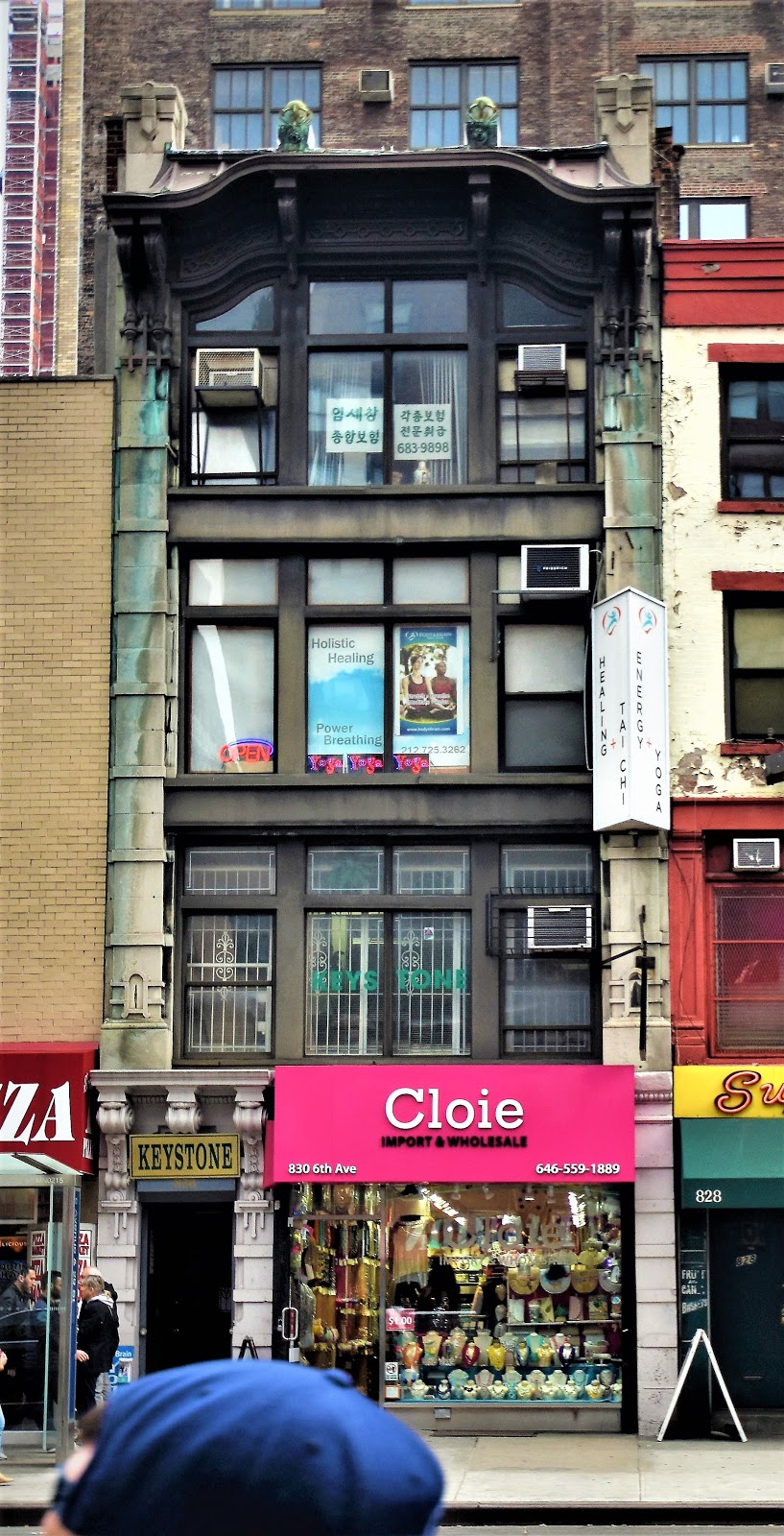
Following Emanuel Lemon's retirement the firm became J. E. Lemon & Co.  In November 1906 Joseph purchased No. 478 and relocated the office into the building.   Two years later he set architect Oscar Lowinson to work to remodel the former house.  On December 15, 1908 the New-York Tribune reported "Plans have been filed...for making over the old-fashioned four story and basement dwelling house, with store, at No. 478 Sixth avenue into a modern loft and store building, rebuilding the front in ornamental pattern of iron, with brownstone trimmings and large glass windows."

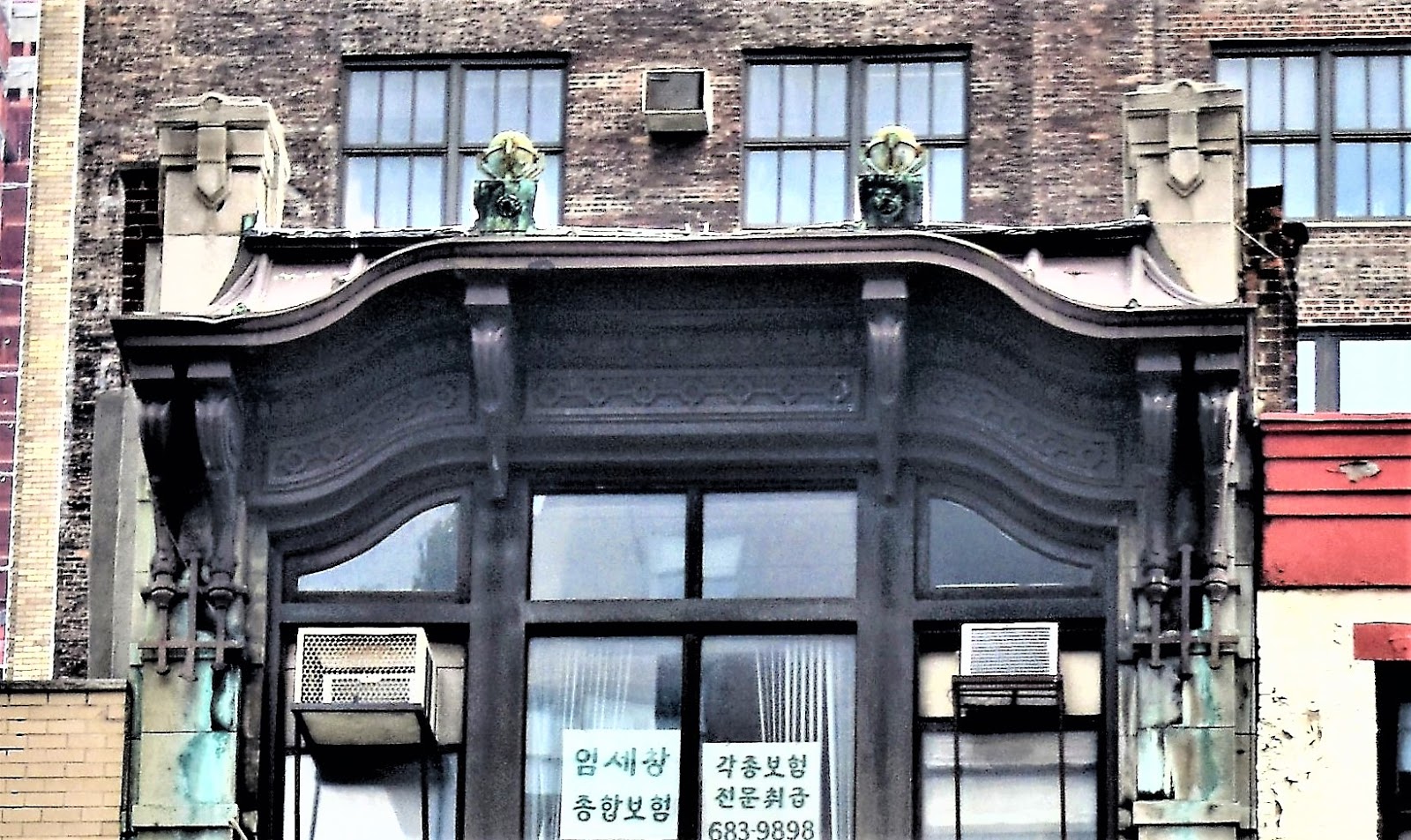
The $8,000 in renovations resulted in a stylish mixture of the Art Nouveau and Beaux Arts styles.  Most eye-catching was the sinuous cast metal cornice which followed the scalloped shape of the French-inspired openings below.  Perched above were unusual finials--nested stone orbs on copper pedestals.  If Lowinson had in fact originally contemplated using brownstone, he changed his mind.  While the limestone he used for the base and piers was more expensive, it was a more appropriate choice for the architectural style.

Quite possibly matching finials graced the corners of the cornice as well.
Furriers Semmel & Meisler operated from the second floor by 1911.   Early in October that year a suspicious-looking man wearing a raincoat with his hat pulled down entered.  Saying he represented a burglary insurance company, he said he was there to inspect the wiring of the workrooms and storerooms.  When Psachje Semmel asked him for credentials, the visitor could only produce a few blank application forms.  He was told to leave.

It appears that the "inspector" was, in fact, casing the shop.  Semmel & Meisler did have a burglar alarm and it proved its worth about two weeks later.  Policeman Fitzgerald was doing his rounds early on the morning of October 28 when he heard the clanging from within the building.  He called for assistance by rapping his baton on the pavement, drawing the attention of Policemen Murphy and Gorman and Detective Bauerschmidt.

While the two patrolmen stood guard in front of the building, Fitzgerald and Bauerschmidt went to the rear where they found the drop ladder of the fire escape pulled down.  The pair climbed to the top floor where the iron shutter of the Roth Embroidery Company had been forced open.  The entered.

The lock on the company's hallway door had been broken.  On the third floor the officers found the door of the Brilliant Sign Company forced open.  Like Roth Embroidery Company, it had no burglar alarm.  Inside Fitzgeralnd and Bauerschmidt found a two-foot hole which the crooks had chopped in the cement floor.  A rope dangled down into the Semmel & Meisler space.  The two cops shimmied down the rope into the darkness.  What they found was astounding.

The Evening World reported "On the floor at the bottom of the hole lay a saw, a brace and two bits and a heavy pair of scissors for cutting metal.  Near by was a bottle of bromo seltzer, some sandwiches and some grapes, and all over the floor were bundles of furs that the thieves had evidently prepared to be taken when one of them accidentally touched the burglar alarm and they were compelled to flee, leaving their plunder."

The food was evidence that the thieves had intended to take their time in picking out their booty.  They had chosen only "the choicest skins" and had carefully wrapped enough packages to fill a wagon.  Police surmised that "the thieves planned to carry the bundles up to the fourth floor and down the fire-escape to the ear, where a wagon would have met them to haul away the plunder."

It was assumed that this was the same gang who had pulled of a nearly identical heist a few nights earlier.  In that case a hole was dig through a cement floor to get into Samuel Saxe's fur shop at No. 24 West 24th Street.  The made off with 1,000 mink pelts.

The ground floor store was home to the West Side Loan Office, a pawn shop.  On September 7, 1912 a young woman entered with a bracelet which she pawned for $4.  Twelve days later she returned, this time with a diamond ring for which she was given $10.   Pawning her precious jewelry was a hint of problems in the woman's life.

Wilhemina M. Hadlow was about 27 years old and for a little over a year had lived in a furnished room at No. 64 West 91st Street.  She had been a clothing designer (of women's waists) but for some time had been out of a job.

Part of the money from her pawned jewelry was spent on September 21 for a $3 stateroom ticket on the Hudson River steamboat Adirondack to Albany.  Before she left her 91st Street room she filled a trunk with her clothes and had it shipped to Mabel Peterson in Thompson, Connecticut.  She then left New York City for good.

On board the Adirondack Bert Dewey noticed her crying.  He managed to engage her in conversation and she told him she was "suffering mental anguish which she could not withstand."  He later told authorities she said "she would never reach Albany."  She handed him a letter and asked him to mail it when the boat docked.  "Dewey counseled her to keep the letter until she arrived and mail it herself," reported The New York Times.  "He also obtained from her a promise that she would take breakfast with him in Albany."

Concerned, he went to her cabin door that night.  Hearing her moving around, he assumed she was alright.  But when the steamer reached Albany, there was no sign of Wilhemina.  The letter she had asked Dewey to mail was found torn up in her stateroom.  Another letter, addressed to Mabel Peterson, was found in the steamer's letter box.  It stated she was sending her "some clothes.  I won't want them any more, and thought you would like them."  Investigators surmised she had jumped overboard somewhere between Catskill and Hudson, New York.

In 1918 Joseph Lemon received orders from the City to make extensive safety improvements in the building.  He and Oscar Lowinson had continued to work on projects together, and he consulted the architect on this expensive and, most likely, unexpected renovation.  The City demanded a new rear fire escape, an interior fire staircase enclosed in fire-resistant materials, replacement of the inward-opening street level door with one that opened outward (to facilitate escape in case of fire), and double fire doors to the interior staircase.  A separate violation required the installation of a fire alarm system.

Lowinson filed a request with the Board of Standards and Appeals requesting a "variation of the requirements" that would relieve Lemon of the renovations.   The Board ruled on February 28, 1918 on both counts:  "denied."

The building continued to attract furriers into the 1920's.  Fur Trade Review, April 1922 (copyright expired)

In 1925 Sixth Avenue was renumbered, giving No. 478 the new address of No. 830.

As the fur district moved north of 34th Street, No. 830 drew a variety of new tenants.  The ground floor store was home to the Gem Luggage Shop by 1928.  On the afternoon of January 31 that year Joseph Vernazza was the only employee on duty, but he was more than enough to thwart an armed robbery.

The New York Times reported "A hold-up man dashed out of the Gem Luggage Shop, 830 Sixth Avenue, at 2:30 o'clock yesterday afternoon, leaving his pistol on the floor and probably happy to be able to run."  When he decided to go up against Vernazza, the newspaper said he "had picked a tartar."

The man had come in asking to see a bag.  When Vernazza turned, the supposed customer struck him over the head with his gun.  Instead of knocking Vernazza out or dazing him, the blow merely angered him.  He wrested the weapon out of the man's grasp and the would-be robber ran.

Vernazza told the reporter "I'm sorry he got away.  It would give me pleasure to kill such a man.  I could kill him with my bare hands," and simulated the motion it would take to do so.  The pistol had made a gash on his head, which was covered by a bandage.

"It's nothing to what I could do to that fellow if I could catch him," he seethed.

For more than a decade, beginning around 1939 the Atlas Personal Finance Corporation was in the building.  The Sixth Avenue neighborhood had increasingly grown as the center of Manhattan's Flower Wholesale District, and by 1958 DeMarco & Vlachos, Inc., wholesale florists was operating from No. 830.

By 1977 more flowers were sold in Manhattan than any city in the world except Amsterdam.  But as the 21st century neared, developers increasingly eyed the Flower District for new apartment buildings, hotels and office buildings.   Little by little the flower merchants were forced out until today there are only a handful of holdouts.

The upper portion of the building next door--the original location of E. J. Lemon & Son--retains the residential appearance of the original houses.
The striking 1909 facade is surprisingly intact, including the stone entrance with its heavy scrolled brackets and the banded piers that frame the modern show window.  The oxidized copper cornice has stained the white stone blue.  The building is unprotected by landmark status, so its continued survival is solely in the hands of any future owner or tenant.

photographs by the author