Showing posts with label neo-italian renaissance. Show all posts

Tuesday, December 7, 2021

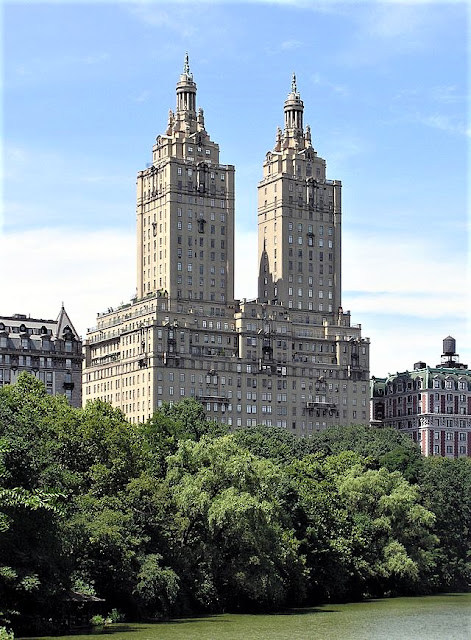
Emery Roth's 1930 San Remo Apartments - 145-146 Central Park West


photo by Bilby

The once magnificent San Remo Hotel on Central Park West and 75th Street, opened in 1891, was decidedly out of fashion by the 1920's, when modern Art Deco buildings were luring residents.  And so it was not especially surprising when The New York Evening Post reported on November 28, 1928, "An apartment house representing an investment of about $7,000,000 is to replace the San Remo apartments, on Central Park West, and adjoining dwellings on Seventy-fourth and Seventy-fifth Streets."  

Senator Henry W. Pollock had assembled a syndicate for the massive project.  A year later, on October 24, the Stock Market crashed.  With construction of the luxury structure well underway, the investors must have been nervous at best.

On September 13, 1930, The Sun reported, "the San Remo, the twenty-six-story, twin-towered apartment building, overlooking Central Park West...is scheduled for occupancy October 1.  The building, which commands striking views, is an example of the modern trend of architectural treatment as applied to finer apartment construction."  The article said the suites would range from six to sixteen rooms, "with simplex tower apartments of six rooms, one apartment to a floor, and duplex tower apartments of fifteen rooms, each occupying two tower floors."  There would also be a maisonette--a street level two-bedroom, two-bath apartment with a private entrance.

The syndicate had hired Emery Roth to design the San Remo.  Born in Hungary in 1871, he was responsible for several medium height apartment buildings before designing the 41-story Ritz Tower with Thomas Hastings in 1926.  When hired for the San Remo, he was at work on the Eldorado Apartments and Beresford Apartments, also on Central Park West.

For the San Remo, Roth turned to the Late Italian Renaissance.  Writing in the New Yorker, architectural critic George S. Chappell said, "the Italian baroque [is] skillfully adapted to modern conditions...The proportions are well-studied and the warm light brick used above the limestone substructure give a delightful effect."  Chappell was taken with the treatment of the towers, topped by Corinthian temples and 22-foot-high copper lanterns.

An advertisement in The New York Times touted:

Every detail of these sumptuous apartments has been carefully planned to make living in them the last word in luxury.  Only private homes have ceilings as lofty as these and rooms as spacious.  Every chamber [i.e., bedroom] has its own colored tile bathroom and is well-supplied with deep closets.  Many have dressing rooms too.  The long galleries and living rooms with fireplaces offer splendid decorative possibilities....Up in the towers are apartments such as New York has never before seen with windows on all four sides and views of Central Park, the Hudson, and Westchester.

The Sun noted that the interior garden had been designed by horticulturist Lou R. Strauss, Jr., and the lobby by decorating firm Theodore Hofstatter & Co.

photo by Wurtz Brothers, from the collection of the New York Public Library

Among the initial residents were Herbert Sondheim, owner of the upscale clothing company that bore his name, and his fashion designer wife, the former Etta Janet Fox.  The year they moved into the San Remo, a baby boy was born, Stephen Joshua Sondheim, who would become the world's most renowned composer-lyricist of the 20th century.
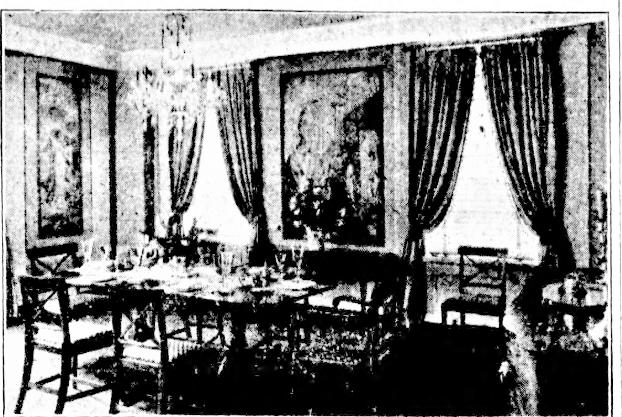
A grainy photograph shows the Sonheim dining room, "decorated by Thedlow with Hepplewhite and Sheraton furniture."  The New York Sun, March 7, 1931

The family of Sol Brill were also initial residents.  Brill was the owner of fifteen motion picture theaters and president of the Meserole Securities Company.  Sharing the apartment were his wife, Sadie, and their daughters Hortense and Lillian.  When he died on January 26, 1932, his estate was estimated at around $16.8 million in today's dollars.

Also living here at the time was Sara Shubert Davidow, the widow of theatrical manager Edward Davidow.  Sara came from a theatrical family, her famous brothers being Lee, Jacob (J. J.), and Sam S. Shubert.

Rival motion picture executives Jack Cohn and Joseph R. Vogel lived in the San Remo by 1935.  Cohn was a vice president of Columbia Pictures and Vogel was vice president of Lowe's Theaters.  Vogel's sister, Adele, was also a resident (in a separate apartment).  She was described by The New York Sun as "one of the few women stock brokers in Wall Street."

Perhaps the first celebrity to sign a lease was Jack Dempsey, former boxing champion and, now, restauranteur.   He and his wife, Broadway singer Hannah Williams, moved into an 11-room apartment in May 1936.  Hannah was the pugilists' third wife.  They would have two children while living in the San Remo.

Dempsey nearly lost his life on June 29, 1939.  He had been too sick to attend a boxing match a few days earlier, but it did not seem serious.  But that night, while he and two friends were playing cards in the apartment, Dempsey collapsed.  He was taken to Polyclinic Hospital suffering from gangrenous appendicitis.  The following day doctors told reporters he was "still in a critical condition."  Dempsey's personal representative, Billy Taub, said that "Dr. Brennan told him shortly after the operation that Dempsey escaped death by an hour."

In the meantime, things were often rocky within the Dempsey household.  Hannah later related her husband's alleged abuse.  She recounted a time when he complained that the food bills were too high and called the cook and a maid in.  "Don't take orders from Mrs. Dempsey," he told them, "she's crazy half the time."  

And on one occasion, when she returned home after being out with her sister and two female friends, he accused her of adultery.  "He pushed me down on the bed and held his fist up, and started to bring it down," she told a judge.  She pleaded for him not to strike her, but he punched her face, giving her a black eye.  "He said he was going to kick me downstairs and out of the house," she recounted.  The couple divorced in 1943.

In January 1939 world famous actor John Barrymore and his wife, Elaine, signed a lease.  It came at an inconvenient time, since 60 San Remo employees--elevator operators, maintenance men and attendants--had walked out on October 28, 1938.  Pickets were marching outside the San Remo when the Barrymores moved in.  Nevertheless, services were being carried out by replacements, denounced by the Building Employees' Industrial Union as "scabs."

photo by Clement Bardot

Labor negotiations in the 1920's and '30's often involved violence.  In February 1939, the problems at the San Remo nearly was tragic for one resident family.  The sympathies of wealthy attorney Harry Bijur and his wife, the former Madeline Ryan (daughter of multi-millionaire Thomas Fortune Ryan), were on the side of the workers.  For three months Madeline had been providing monetary assistance and food for 23 San Remo striking employees.  By now, she and her husband had donated around $4,000--nearly $75,000 in today's money--to the men and their families.  Their charitable and political stand did not sit well with the union that supplied the replacement workers.

On February 3 Madeline received a phone call saying, "Mrs. Bijur, get that picket line off the street.  I'll break your neck and throw you and your boys into the furnace."  One of the couple's sons, 15-year-old Ryan, was away at the Cheshire Academy in Cheshire, Connecticut.  The following day he received a telegram telling him his mother had been killed and his father injured.  It directed him to take a specific train to the city.

The school's headmaster, however, was suspicious, and called State Troopers to accompany the boy.  The delay caused Ryan to take a later train.  Later in the afternoon, an automobile carrying three men pulled up in front of Ryan's dormitory, but left suddenly when the headmaster, Arthur N. Sheriff, came out to investigate.  The failed kidnapping did not intimidate the feisty Madeline Bijur.  She sent Ryan "to a hideaway in Connecticut with a bodyguard of detectives," according to the New York Post on February 6, and told reporters, "If by this scare they think they have me licked, they are all wrong.  I'm going out on the picket line myself."

The long list of celebrity residents continued with former vaudeville and Broadway entertainer Eddie Cantor.  Following mid-century, well-known groundbreaking photographer Diane Arbus lived here as did actors Tony Randall, Dustin Hoffman and Mary Tyler Moore.  The widely talented Carl Van Vechten was a resident by the first years of the 1960's.  His impressive resume included critic, author, portrait photographer, and "discoverer of young or overlooked talent," according to The New York Times.

The San Remo was converted to co-ops in 1972.  The affluence of the owners was evidenced on June 15, 1973 when thieves made off with $200,000 worth of jewelry from the apartment of Eugenia Gladstone.  (That figure would top $1 million today.)

Following the conversion, The New York Times noted that Madonna had been rejected by the board, but "boldface residents," like Dianne Keaton and Steven Spielberg had been accepted.

The long list of famous names in the San Remo continued.  Motion picture star Rita Hayworth lived here until her death in 1987.  Her apartment was bequeathed to her daughter, Princess Yasmin Aga Khan.  Apple Computer founder Steve Jobs purchased a tower duplex in 1982, but never moved in.  After spending years renovating it, he sold it to singer Bono.  In 1986, following his marriage to actress Victoria Tennant, Steve Martin purchased and joined two apartments.  (Following their divorce in 1994 he had them separated and soundproofed.)  At one point, Barry Manilow sublet his apartment to actress Raquel Welch.

In 1986, motion picture producer Robert Stigwood put his 28th floor, 14-room apartment on the market.  Designer Calvin Klein and his wife Kelly hoped to purchase it, but were rejected by the co-op board "because The San Remo was afraid they'd throw wild parties," according to Klein's biographer Steven Gaines.  Instead, Stigwood sold it to actor Bruce Willis and his wife, Demi Moore.  (Around that same time, the couple purchased the maisonette, apparently for investment purposes.)  The couple did major interior renovations, eliminating almost all of Emery Roth's detailing in favor of "Southwestern Mission."
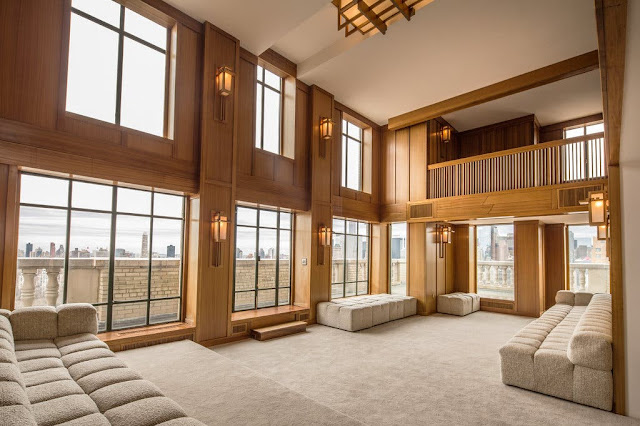
The Willis-Moore renovations went as far as replacing the windows.  photo by Tony Cenicola/The New York Times, May 5, 2017

Over the years the San Remo has been home to a seemingly endless list of celebrities--Donna Karan, Zero Mostel, Peter Allen, Aaron Spelling and Hedy Lamarr among them.  Emery Roth's twin-towered structure earned individual landmark status in March 1987.

photo by Downtowngal

LaptrinhX.com has no authorization to reuse the content of this blog

Friday, October 12, 2018

The Gertrude and Michael Gavin Mansion - 12 East 65th Street


In June 1906 Minnesota railroad magnate James J. Hill purchased the sumptuous mansion at No. 8 East 65th Street.  The New York Times remarked that he was the "second of the Western railroad magnates to reach the decision recently that he spends enough time in New York to justify his buying a house here."  Another member of the Hill family would, too, be moving to the block before long.

On September 21 that same year a Minnesota newspaper reported "The engagement of Miss Gertrude Hill, daughter of James J. Hill, to Michael Gavin, a lawyer of New York, was announced last evening at a dinner given at the home of Mr. and Mrs. Theron Slade."  Noting that Gertrude had made her debut two years earlier, the article added that she "is musical in her tastes."

Gertrude Hill Gavin on her wedding day.  from the collection of the Minnesota Historical Society 
The wedding took place in St. Paul later that year.  The couple received a handsome wedding gift from James J. Hill; a Manhattan mansion.

Next door to the Hills' New York home, at No. 12 East 65th Street, was the 22-foot wide brownstone residence of Judge Charles H. Truax, built in 1876.  The Traux family had lived in the house since the mid 1890's.  In 1907 the judge sold the now out-of-fashion brownstone to Hill.

The architecturally outdated Traux house, left, contrasted with the ebullient Beaux Arts mansions of James J. Hill and William Bliss.  from the collection of the Minnesota Historical Society
The title to the property was put in Gertrude's name.  When the couple returned from their honeymoon trip, they set about planning their new home.  On August 29, 1908 the Real Estate Record & Builders' Guide reported that architect Walter B. Chambers had been hired to design a five- and six-story brick and stone dwelling.  The projected cost was placed at just over $1 million today.

The New York Times explained the "five- and six-story" issue.  "The design is unusual, the house being five stories high in front and six stories in the centre, and three at the rear.  It will have a mansard and a second-story balcony, and be finished with a central stair hall and foyer."

Chambers carefully melded the new house to its neighbors to the west.  He matched the rusticated base, and lined up the second floor balconies and cornices.  A quieter presence, the design was nonetheless harmonious and elegant.

Although educated in law, Gavin was a junior partner in the investment banking firm of Moore & Schley when the couple moved in.  In 1915 he joined the brokerage firm of Montgomery & Company; and before long became a full partner in the financial firm Montgomery, Clothier and Tyler.

The Gavins were highly visible in society, traveling to Europe regularly and entertaining both in the Manhattan home and their Bernardsville, New Jersey estate.  On August 19, 1910 The New York Times advised "Mr. and Mrs. Michael Gavin will sail on the Adriatic next week for France, where they expect to visit friends and spend considerable time motoring.  They will return to New York in October."

Gertrude was highly active in charities and activities related to the Roman Catholic Church.  In 1920 she was elected the first president of the National Council of Catholic Women.  She was awarded the papal medal Pro Ecclesia and pontifical diploma in 1924.  Her religious interests spilled over into the entertainments in the 65th Street house.  On January 16, 1923, for instance, she hosted a lecture by Father Clifford, Professor of Scholastic Philosophy at Columbia University, on "faith, faith cures and the doctrine of the miraculous."

In 1920 the Gavins gave up the Bernardsville summer home after Graenan, their French Renaissance-style mansion designed by John Russell Pope, was completed on their 50-acre Oyster Bay, Long Island estate.  In 1926 Gertrude had Chapelle de St. Martin de Sayssuel, a medieval chapel in the French village of Chasse, dismantled and shipped to the Oyster Bay estate.  John Russell Pope was brought back to oversee the careful reconstruction on the grounds.   The project sparked the legend that Graenan, too, had been imported stone-by-stone from France; a rumor that survives.

The charming chapel was removed to Marquette University in Wisconsin, in 1966 following the destruction of Graenan by fire.  photo by Sulfur
In the meantime, Gertrude may have surprised some when she announced in November 1924 that she would be stepping down from the presidency of the National Council of Catholic Women.  She had been selected by Cardinal Patrick Joseph Hayes to "work among Catholic immigrants landing at New York."

Quoted in The New York Times on November 10, she explained "Many of these Italians as well as Catholic immigrants from other countries become confused in the struggle for existence in the new country and from lack of information sometimes make mistakes."

Michael Gavin retired in 1928.  His time was not idle.  The Gavins traveled almost every year to the Saint John River where Gertrude loved salmon fishing.  Along with the Hills, they were members of the exclusive Jekyll Island Club.  They eventually acquired a third home in Boca Grande, Florida.

Wealthy socialites gave their assistance during World War II to relief work and to military support--like the Soldiers' and Sailors' Clubhouse.  Gertrude did her part by helping to organize and run the Cathedral Canteen of New York.  Both the Departments of the Army and the Navy awarded her certificates of appreciation following the war.

In 1949 the Gavins sold the 65th Street house to the Dominion of Pakistan.  They moved to an apartment at No. 760 Park Avenue where, within six months of one another, the couple died in 1960.


The Republic of Pakistan purchased the James Hill mansion in 1951 and today still owns both properties.

photographs by the author

Saturday, September 23, 2017

The 1914 Church of St. Jean Baptiste - Lexington Avenue and 76th Street

An early postcard of the magnificent new building could have been set in Italy.

The parish of Saint Jean Baptiste was founded in 1882 to serve the Yorkville ndistrict's growing French-speaking population.  The congregation soon built what The New York Times later called "the little red brick French Church of St. Jean Baptiste" on 76th Street.   In 1900 the church was chosen to house a relic of Saint Anne, formerly located in Canada.   But the modest structure was hardly proper, prompting Archbishop Michael Corrigan to comment at the inauguration of the Solemn Exposition in December that year "Evidently this church is too small and not imposing enough for the requirements of perpetual adoration."

Despite its elaborate interiors the 76th Street church (seen here in 1908) was deemed "not imposing enough."  photo by Byron Company, from the collection of the Museum of the City of New York
Thomas Fortune Ryan was among New York's wealthiest and most philanthropic citizens.   According to church legend, he often attended mass at St. Jean Baptiste, preferring it to the more pretentious society churches.   The story goes that he arrived late for mass and was disgruntled to find standing room only.  During the announcements a plea for donations for a new structure was made.

Afterwards, unaccustomed to standing and having no intentions to do so again, he approached Father Letellier, asking how much a new church would cost.   The priest threw out a figure from the top of his head.  "$300,000.00," he said.  Ryan told him to proceed with the plans.


Land was acquired at the southeast corner of Lexington Avenue and 76th Street.   Construction began in 1911 and about a year later, on April 28, 1912, the cornerstone was laid  An orchestra played as the choir sang before a crowd of 8,000 onlookers.  Cardinal John Murphy Farley smoothed the mortar with a silver trowel and the stone was set in place.  Inside was a copper box containing a medal from Pope Pius, a copy of that morning's newspaper, and a parchment bearing the names of the Fathers of the Blessed Sacrament connected with the church. 

While some might have expected such an important architectural commission to go to one of Manhattan's more famous architectural firms, it had been awarded to Nicholas Seirracino.  Primarily a designer of ecclesiastical structures, he had just completed the Roman Catholic St. Clare's Church on West 36th Street a year earlier.

His monumental design drew inspiration from several Italian Renaissance churches.  A classical portico upheld by free-standing Corinthian columns sat above a wide staircase.  Just below and on either side of the twin bell towers stood trumpeting angels.  Completing the Renaissance design was the 172-foot tall dome.
Serracino's rendering won the Gold Medal at the International Exposition at Turin.  Real Estate Record & Builders' Guide, February 18, 1911 (copyright expired)

As construction continued, The New York Times reported on November 3, 1912, that Ryan's gift had significantly increased from the original $300,000 estimate.  "It will be one of the largest and most imposing Roman Catholic churches in America," it said, "accommodating 7,500 persons.  The cost will be about $1,000,000."  The newspaper noted that Ryan had "determined to build for the fathers a church of cathedral-like proportions and of the highest artistic beauty."  The completed Church of St. Jean Baptiste was dedicated on January 6, 1914.


The quiet devotions of worshipers were dramatically upset on the evening of November 30, 1918.   There were a few women in the church that night when two blocks away a gun-wielding man named Charles Georges ordered Dr. Richard Kovacs out of his automobile and then drove off with it.  The doctor hailed police who joined him in chasing the car.

When Georges ditched the car near the subway entrance at Lexington Avenue and 76th Street, the police began firing.  The thief shot back then rushed up the stone steps of the Church of St. Jean Baptiste.  The New York Times reported "The chase continued up the central isle and shooting went on as Georges climbed the stairs leading to the choir."  When Georges ran out of ammunition, he was subdued and arrested.

The newspaper added "After he had left with the police some of the women who had not become hysterical continued their prayers.  No one was injured."


Almost a year to the day later another disturbing incident took plate.  French-born Cecilia Simon was 33 years and worked as a maid in the home of William Geenough on East 56th Street.   She was said to be devout and attended mass every morning.

On Sunday November 23, 1919 Cecilia dropped her envelope into the collection plate.  Later when the envelopes were opened, hers did not contain cash, but a note saying she objected to certain items being placed on the altar.   She apparently kept watch, but none of her perceived offenses were corrected.

The following Saturday she left the Greenough house, telling another maid that she was "going out to do some good work; to smash some statuary."   A funeral service had just completed when Cecilia walked into the church and approached the altar.  Before anyone could stop her she "swept several costly pieces of statuary and candelabra from the altar to the floor," according to newspaper reports.  The damage amounted to about $3,000 (nearly $42,000 today).  She was arrested and taken to Bellevue Hospital for observation.


On May 29, 1921 the New-York Tribune reported stunning news.   Archbishop Patrick J. Hayes had returned from Rome, where he had petitioned the Holy See with an unlikely request--one which was granted.  At 4:00 that afternoon, said the article, St. Jean Baptiste would become a Major Basilica--the first in the United States.  As a matter of fact, it went on, only "three other churches, all of them in Rome, have been raised to the dignity of Major Basilica."

When the annual Novena to St. Ann opened on July 17, 1921 more than 5,000 persons were in attendance.  The New York Times reported that they "had the supposed relic, a bone of St. Ann, applied to their afflicted parts.  Some had only a headache, but others suffered from cancer, lameness, blindness and epilepsy."

The faithful related their miraculous stories of a year earlier.  "A boy of 8 appeared walking naturally before Father Pauzet and told him that he had been lame in one knee and had come to the shrine on crutches.  He had been instantly cured, he said.  A woman said that last year she had been cured of a growth; that all signs of this had since disappeared and now she had com again to give thanks.  Another woman said she had been instantly relieve a year ago of a bad sore throat."

With the new honor came a new altar--the costliest and second largest in the United States.  On October 30, 1921 the New-York Tribune reported that the $100,000 altar ($1.34 million in today's dollars) was set to be installed.

"The altar will be forty-seven feet high, twenty-eight feet wide, and twenty-six feet deep.  It is of Italian Renaissance design, the altar proper being approached by a flight of five steps of marble."   It was constructed in the United States by Gorham & Co., although the carvings were executed in Italy.   The central panel depicted a marble depiction of Di Vinci's "The Lord's Supper."  On either side were panels of St. Matthew and St. John. 

The massive altar was the most expensive in the U.S.  photo by James Primosh, via https://jamesprimosch.com/tag/church-of-st-jean-baptiste/


"Another base course is of Botticino marble, ornamented with mosaic panels containing ecclesiastic symbols, and the door of the Tabernacle is of bronze studded with precious and semi-precious stones.  The throne for the Monstrance is of bronze and is surmounted by adoring angels."  Above the altar rose the baldachino, supported by 12 red marble columns.  Mosaics of saints decorated the interior, and the canopy over the altar was made of velvet and ermine.

Over the years the magnificent church was the scene of elaborate funerals and fashionable weddings, but one of the most memorable and subdued was that of Thomas Fortune Ryan on November 26, 1928.  The tycoon had left an estate estimated at around $300 million, but he requested the simplest service that the church could perform.  The Times reported "A single priest officiated.  There was no eulogy, no honorary pallbearers, no flowers, except for a handful of red roses on the candlelit altar."

Millionaires and commoners crowded the church for Thomas Ryan's funeral.  photo from the collection of the Library of Congress

The church was packed--from titans of industry to servants from the Ryan household.  Among the mourners were J. P. Morgan, Otto H. Kahn, Charles M. Schwab, Elihu Root, Bernard Baruch, and Clarence H. Mackay.  There were politicians, like Senator Royal S. Copeland and James W. Gerard, former Ambassador to Germany.  Yet the entire service lasted only 25 minutes.

The congregation that had been formed to serve French speaking immigrants, most from Canada, had changed.   By the time of Ryan's funeral the membership included society leaders like Helena Woolworth McCann, the wife of millionaire attorney Charles E. F. McCann and daughter of Frank W. Woolworth.  Her funeral on March 18, 1938, was much less muted than Ryan's had been.  A solemn high mass of requiem was celebrated and floral tributes included two 8-foot crosses composed of lilies.

Cardinal Francis Joseph Spellman presided at the pontifical mass to celebrate the Church of St. Jean Baptiste's 75th anniversary on October 27, 1957.  The service included several monsignors and two auxiliary bishops.   The New York Times reminded its readers of the stark differences that had occurred since the church's beginnings.  "The parish's first mass was said above a still-existing stable at 202 East Seventy-seventh Street on Washington's Birthday in 1882."

It was not only the parish, but the neighborhood which had changed.  Following Vatican II masses in French were discontinued.  By now the rowhouses of Lexington Avenue had been replaced by the sprawling Lenox Hill Hospital complex or converted to shops and apartments.  It remained, nonetheless, an upscale neighborhood.  So it was surprising when a worshiper was attacked within the church on October 28, 1970.

Anna King, a 63-year old widow, attended mass every morning.   That day she visited the St. Anne Shrine in the lower chapel just after 8:30.  As she made her way back up the spiral staircase to the church proper, she was attacked by three teens who tried to wrest her purse from her.   She steadfastly refused to let go of the purse and the youths fled, but not before stabbing her four times in the back.

In 1989, after limestone chunks fell to the Lexington Avenue sidewalk, a $6 million restoration was initiated headed by the architectural firm of Hardy Holzman Pfeiffer Associates.  The magnificent building was designated a landmark in 1969 by the recently-formed Landmarks Preservation Commission.