 |
| Easily cleaned away, a century of grime currently obscures the contrast of red brick and brownstone trim. |
As the city recovered from the Financial Panic of 1873, development on the Upper East Side began in earnest. The burgeoning popular required additional police stations, schools and fire stations. The city scrambled to keep up, as did Napoleon Le Brun, who had become the official architect of the New York City Fire Department in 1879.
On November 17 that year the city paid Israel Caspar and his wife, Henrietta, $3,500 (around $91,000 today) for the 25-foot wide midblock lot at No. 121 East 76th Street, between Second and Third Avenues. By September 17, 1880, when plans were filed for a new firehouse, Le Brun's son Pierre had joined him in the business, creating N. Le Brun & Son. The plans were vague, calling for a "three-story brick engine house." Construction was projected to cost $15,000; bringing the total cost to about $471,000 in today's dollars.
While some of N. Le Brun & Son's later firehouses would border on the opulent, this would be more outwardly utilitarian (quite possibly because of the architects' astounding workload at the time). The firm followed the typical firehouse pattern--the cast iron base was dominated by the centered, two-door truck bay flanked by a doorway and window. The upper floors were clad in red brick and trimmed in brownstone. A wide opening at the second floor allowed hay and other supplies to be hoisted up. A handsome pressed copper cornice crowned the structure.
It was almost assuredly the number of station houses the firm was tasked with designing that led N. Le Brun & Son to essentially recycle this design the following year. Engine Company 27, at No. 173 Franklin Street, and Engine Company 13 at No. 99 Wooster Street, completed in 1881, were near twins; and their cast iron bases and copper cornices were identical.
 |
| Engine Company 27 (above) and Engine Company 13 completed a year later, were near copies of No. 44. |
The station house became home to the newly-formed Engine Company 44. Its members would deal with fires caused by circumstances common to the period and the district--gas lighting, open flames, wooden structures, and poorly designed tenement buildings.
But the cause of the fire that broke out on the day before Independence Day in 1884 was unique. At around noon Captain Rodger B. Hamblett heard "a loud report, followed by a rattle as of the discharge of small arms," as described by the New York Herald. Just down the street was Public School No. 70 and the children of the primary department who had just been released for the day filled the sidewalks.
Hamblett rushed out of the firehouse to discover that the fireworks display in the show window of Helen Masterson's variety store directly next door were exploding, sparking a fire. The engine was brought out and the flames extinguished. The school children seem to have delighted in the show, unaware of the danger. They "were pouring out of the school doors, but fortunately they did not take flight and therefore there was no panic among them," said the New York Herald. The article presumed that the fireworks were detonated by "the focusing of the sun's rays by the plate glass windows of the store."
The company responded to a much more perilous call on May 11, 1900. The five-story tenement house at No. 176 East 78th Street caught fire when escaping gas from equipment in the basement, used for pumping water to the upper floors, exploded. The basement level was filled with toxic gas and smoke and one by one the firefighters who went down were overwhelmed.
The New-York Tribune reported "Nearly ever member of Engine Company No. 44 was overcome." It began when the first three, Lieutenant Taylor and Firemen Jeremiah Driscoll and Jeremiah Blazzine lost consciousness. They were carried out, but their rescuers then collapsed. Although some of the men were unconscious for up to ten minutes, each rushed back into the fire as they recovered.
"Fire Chaplain Johnson was kept busy working over the men and bringing them back to consciousness," said the article. Three men, Firemen Connolley and Morie and Captain Hicks "were repeatedly overcome and left the cellar many times, but returned as soon as they revived." Although Hicks was in serious condition, according to the newspaper, he refused to be taken to the hospital until the blaze was extinguished.
The iconic mascot of fire companies was the Dalmatian. And Engine Company 44 adopted theirs, Fritz, in 1903. Four years later, in June 1907, a reporter from the New-York Tribune visited the station house to learn about the activities of the fire dog.
Fireman Ehrhardt explained, "You'd be surprised how clever that dog is. He's right on hand the minute the alarm sounds, and he never stays away from a fire, not he! And he goes right into the burning buildings, too, with the men, into the basements and the cellars, right into the hot steam. He's got a burn on his foot now from the steam."
Ehrhardt claimed that no matter how many horses and men were at a fire, "it may be a third alarm or a fourth alarm fire," Fritz never was confused, always recognizing his own firefighters and horses.
 |
| Photographed in 1930, Engine Company 44 (to the right) sat on a bustling street. P.S. 70 is in the foreground. None of the structures in the photograph, other than the fire station, survive. photograph from the collection of the New York Public Library |
The article recalled "During his career as a fire dog he had his feet blistered on hot roofs, his coat marred by hot cinders and sparks. No fire was too hot to deter Fritz from entering a building with the firemen." The body of the Dalmatian was laid in state in the firehouse, wearing "a fireman's full dress coat and a service helmet." The Evening World said "hundreds of school children visited the place and took a last look at the firehouse mascot." The following morning his casket was interred in the dog cemetery in Scarsdale. "Later a monument will be erected over the grave," said the article.
His replacement, Fritz III, soon arrived. (Fritz II, a foundling pup, was a temporary tenant during Fritz's lifetime. He had been given to another firehouse.) The Evening World called the new mascot "a fine Dalmatian dog." But on January 26, 1914 that newspaper began an article saying "The firemen of Engine Company No. 44 at No. 221 East Seventy-fifth street are sad to-day." When the fire alarm rang early that morning, Fritz jumped to action. But "in his haste to reach the engine from the second floor he slipped and fell, fracturing his pelvis."
Dr. L. Greissman, a veterinarian, worked two hours over Fritz, encasing his rear body in a plaster cast. The vet predicted after being in the cast three weeks the dog "will be perfectly cured." During that time, Greissman would make daily visits to the firehouse.
In the meantime the firefighters of Engine Company 44 repeatedly faced peril. Gas was again the culprit in a near-deadly situation in the basement of a tenement fire on July 17, 1909. The Sun explained "The heat from the fire had melted the solder on the meter connections and gas was flowing all over the place." The article continued "Firemen continued to go into the cellar to find a cutoff, and after an hour's work the entire companies of Engines 44 and 13 were stretched out on the street from gas poisoning."
A particularly tragic fire broke out in a tenement house on Second Avenue on the night of January 25, 1910. The building had been recently remodeled, resulting in what the Fire Department called a "death trap," including an S-shaped hallway at the top of the first flight of stairs.
One of the panicked residents who struggled to escape the burning building, was Lena Labarbera, an Italian immigrant. She scooped up her three-year old cousin, Philomena Alesia and headed down the flame engulfed stairway. Just as she reached the second floor she stumbled and dropped the child. The burning banister gave way and Lena fell to the ground floor.
Terribly burned, the firefighters pulled her out. She screamed desperately trying to tell the men about the toddler inside, but none of them spoke Italian. She was taken to the Presbyterian Hospital and it was not until the fire was extinguished that the body of little Philomena was discovered.
There was almost another fatality in that fire. Engine Company 44's Captain Eugene McLoughlin lost his way in the dark and twisting second floor hallway. Like Lena Labarbera, he crashed to the ground floor, but recovered.
Fire engines were pulled by especially large and powerful horses. As they galloped at full speed to fires pedestrians and vehicle drivers were fully aware of the dangers; yet there were occasional accidents. The engine had only traveled half a block from the firehouse on the night of December 18, 1909 when tragedy occurred. At the corner of 75th Street and Second Avenue 50-year old John Rogers thought he could make it across the intersection. The Sun explained that the man "got in its path while trying to cross the street and Driver Christopher Bruton could not rein in his horses in time." The man died at the Presbyterian Hospital later that night.
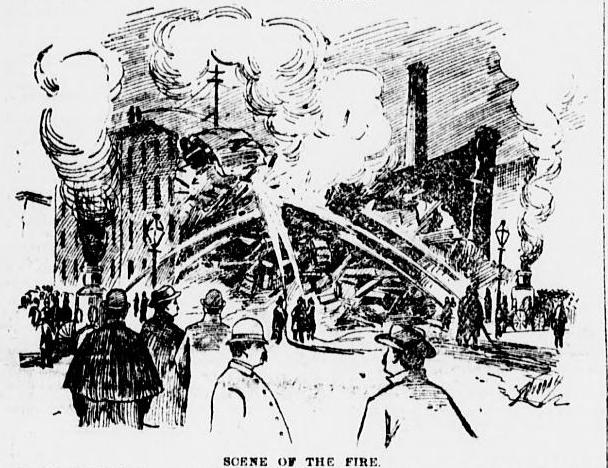
A somewhat macabre accident occurred on November 17, 1913 when Engine Company 44 responded to a multiple alarm fire in the Chelsea Hotel on West 23rd Street. Directly across the street was an undertaker's shop. As the tender of Engine Company 44 galloped to the scene, professional pallbearers were carrying the body of Frank Harris to the hearse. The New-York Tribune reported "While the fire was moving along favorably, the tender of Engine Company 44, trying to find room to settle, slapped" the hearse. The plan was to take the casket to a train, to be transported back to Toronto, Canada. But "the hearse was so damaged that the transfer to a railroad station had to be postponed," said the article.
The men of Engine Company 44 continued to show their bravery throughout the decades, too often paying the ultimate price. In January 1919 George Scanlon had had the cushy job of chauffeur for Deputy Fire Chief Thomas J. Hayes for seven years. But on January 13 he requested to be transferred to Engine Company 44. Almost simultaneously probationary fireman Joseph Schmidt arrived at the firehouse. Seven days later both were dead after a wall collapsed at afire on East 104th Street.
Fireman Joseph Flanigan went into the cellar of No. 1158 First Avenue during a blaze on July 31, 1921. As had been the case so many times earlier, firefighters were overcome by gas and smoke. But this time the 34-year old Flanigan would not survive. His body was found at the foot of a stairway in the cellar.
Multiple-alarm fires sometimes took Engine Company 44 far away from its station house. On December 16, 1931 the men responded to a highly dangerous situation in a paint factory on Washington Street. The barrels of oil and paint inside continually exploded over a period of three hours. That perilous situation was augmented by the toxic gases being released.
The Sun reported that six firefighters were injured, and "All but one of the firemen overcome were able to return to duty. Lieut. John Matthies of Engine Company 44, who collapsed in the street, was sent to Beekman Street Hospital."
Neighbors and firefighters alike were disappointed and disillusioned when the city ordered half a dozen fire houses closed in 1975--including Engine Company 44. But after transferring some of the men and laying off others, the city reversed its decision, reopening the station on Independence Day.
The New York Times began an article on July 5 saying "As holidays go, it was fairly quiet yesterday for Engine Company 44 on East 75th Street, with Sparky, the Dalmatian mascot, sunning himself on the sidewalk and half a dozen fire calls by late afternoon--mostly burning rubbish. But it certainly was not business as usual."
The men of Company 44 had hung a sheet from the facade saying "Thanks Everybody" in large hand-painted letters. The Times said "Neighbors dropped by all day to shake hands and say, 'Welcome back.'"
Firefighter Michael J. Lyons typified the valor of the company when it responded to a fire in a reputed crack house in Harlem on March 10, 1996. Lyons was directed to search for a missing woman and the thick smoke and fire required him to do so on his hands and knees in a fifth-floor hallway.
He later recalled "To my right there was a room. I saw what looked like the back of an ankle. It was right in front of my face. It turned out to be a lady. She was face down in the corner."
Lyons and two others pulled the unconscious 70-year-old to a stairwell landing and tried to resuscitate her. She was removed in critical condition to the burn unit of Jacobi Medical Center.
Michael J. Lyons's last act of bravery came on September 11, 2001. Killed in the World Trade Center attack, he left a 17-month old daughter and an another, still unborn.
After nearly 140 years in its red brick firehouse, Engine Company 44 continues to operate here. Showing the expected modernization necessary for a modern fire house, it nonetheless is a reminder of the time when the neighborhood was just developing and horse-drawn fire engines protected it.
photograph by the author



.png)


