Showing posts with label madison square. Show all posts

Wednesday, March 5, 2025

Frederick C. Zobel's 1905 13 and 15 West 24th Street


At the turn of the last century, the former occupants of the refined brownstones that lined the block of 24th Street between Broadway and Sixth Avenues had mostly moved northward.  In their place came commercial buildings.  On May 19, 1905, Andrew J. Kerwin, Jr. purchased the "two four-story dwellings" at 13 and 15 West 24th Street, as reported by The New York Times.  The combined plot was 52-feet-wide.

Kerwin commissioned Frederick C. Zobel to design the 11-story replacement on the site.  Completed in the spring of 1906, its vast, arched entrance (offset to accommodate a storefront) sat within a portico with polished blue granite columns.  Recessed within a limestone frame, a trio of tripartite windows at the second floor were separated by cast iron columns.  The stone bandcourse directly above was sumptuously carved as a sheaf of fruits.


The brick-faced midsection was introduced by three sets of modified Palladian windows, their center arches replaced with Renaissance pediments.  The two-story top section finished the design with three triple arcades.

With the building completed, Andrew J. Kerwin, Jr. quickly turned his focus to erecting another.  On July 19, 1906, the New-York Tribune reported that he had sold 13-15 West 24th Street and, "will begin the erection on May 1, 1907, of an eleven story loft building" at 27 through 35 West 24th Street.

The block overlapped with the apparel and the pottery-and-glass districts, the latter centered on West 23rd Street.  The handsome loft-and-store building at 13-15 West 24th Street attracted tenants from both industries.

Among the first to move in was Lynch & Notman, which made decorative housewares.  In its August 1907 issue, Glass and Pottery World remarked, "A glimpse into the showroom of Lynch & Notman...quickly shows the visitor that here are goods which would undoubtedly attract the attention of particular people," and cooed, "This firm is turning out some of the most exclusive and finest work possible to produce."  Among the items listed in the article were, "colonial and Russian brass candlesticks, hand-hammered and spun jardinieres and fern pans, electric portables, sconses [sic], etc., in bronze, and carved wood in antique gold finish."

On the apparel side, occupying space in 1912, for instance, were Hynard & Meehan, makers of waists and dresses.  Also in the building were Rappaport & Gottlieb, coat makers; and men's silk neckwear firm Bachrach Co.

The mix continued in the post-World War I years.  Hynard & Meehan was still here, boasting in an advertisement in 1920 that "our factory is turning out 600 to 750 charmeuse, crepe meteor and tricotine dresses made up in the latest models."  

That year, Frank M. Katz & Co. signed a lease.  On September 30, 1920, The Pottery, Glass & Brass Salesman reported that its 6,000-square-foot space "will permit of an unusually fine display of merchandise," that included, "lamps, toilet articles, baskets, etc."

Also operating here in 1920 were Max Zweigenthal, makers of "graduation dresses, georgettes, organdies, and also printed georgettes, taffetas and satin dresses," according to an ad in June; as well as furrier Abraham Keizer & Bro.; and milliner Adolph Wimpfheimer & Co.

The American Hatter, March 1922 (copyright expired)

Even after the Garment District moved to Midtown, apparel factories continued to rent space in 13-15 West 24th Street through the third quarter of the century.  By then, the Madison Square neighborhood was experiencing a renaissance.  In 1983, the upper floors were converted to sprawling residential spaces.

An advertisement for a 4,500-square-foot co-op in 2005 described it as having, "keyed elevator to private landing; dining area, renovated eat-in kitchen with center island, exposed-brick walls, marble baths, mahogany doors."  The price at the time was $3.5 million.


While the block has changed, outwardly Frederick C. Zobel's stately loft building, essentially, has not.

photographs by the author

Monday, November 21, 2022

The Lost Altar to Liberty - Madison Square


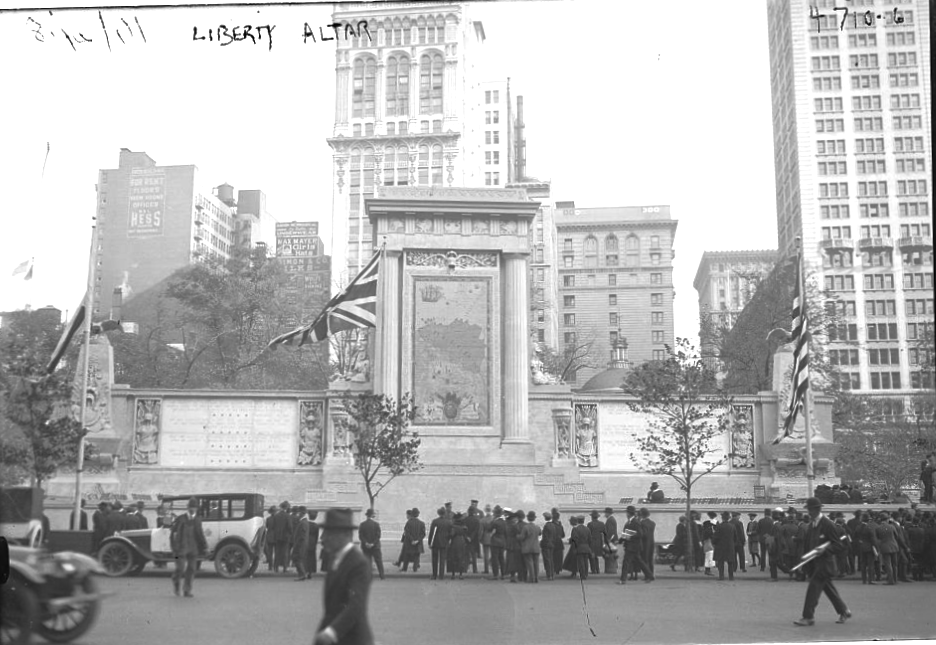
On the face of the central part of the monument was a map of the Western Front.  Architecture magazine, November 1918 (copyright expired)

American patriotism exploded following the country's entry into World War I on April 6. 1917.   Within three months, the stretch of Fifth Avenue from Madison Square to 59th Street was branded "The Avenue of the Allies," and three temporary monuments--The Altar of Liberty in Madison Square, the Arch of Victory at 24th Street, and the Arch of Jewels at the northern end--were being planned.

The Altar of Liberty, which would edge up to the sidewalk facing Fifth Avenue, was designed by Thomas Hastings, of Carrere & Hastings.  He incorporated quotations from statemen like Lloyd George, Woodrow Wilson, and Georges Clemenceau into the design.  Hastings explained the neo-Classical structure in Greater New York magazine one year later.  Interestingly, he stressed that his focus was not merely on World War I, but on civilization's fight for freedom in general, including slavery.  He said in part:

On either side of the Altar the chain armor, the shields, helmets and chains symbolize the early spirit of asceticism, mediaeval feudalism and finally slavery in our own time and country overcome by the continuous progress of civilization.  The Altar in its ensemble and in the selected quotations from men who think and men in authority, shown in the large panels at either side, is intended to signify and uphold the real moral issue that this is a war upon the very institution of war itself, to conquer and overthrow militarism in order to establish, with limited armament, reason and justice in all intercourse between nations.

The altar was dedicated by Vice-President Thomas R. Marshall on September 28, 1918.  Several thousand people crammed Fifth Avenue, and the New-York Tribune reported, "the great mass of citizens reacted to the stimulus of great events and lofty utterances by signing their names to orders for bonds--in quietly mobilizing their savings for service in the war."  It was the first instance of a series of Liberty Bond drives to take place at the Altar of Liberty.

The flags of the Allied nations fly during the dedication ceremonies on September 28, 1918.  image via the Granger Collection

There would also be specific days dedicated to each of the Allied nations along The Avenue of Allies and at the Altar of Liberty.  On October 10, 1918, The Christian Advocate explained, "Each avenue block is decorated with the flags of one of the Allied countries, and each day at noon a representative of a different nation is escorted to the altar, where he lays upon it a floral offering and makes an address, which ends with an exhortation to buy bonds."

General Gvosdenovitch speaking at the Altar of Liberty on Montenegrin Day on October 11, 1918.  from the archives of the Department of War, Washington D. C.

In 1920, Valentine's Manual of Old New York described the Avenue of the Allies and the Altar of Liberty:

The Altar of Liberty at Madison Square--an extraordinarily beautiful work of art--was the center of attraction for the crowds who came out to boost the Liberty Loan.  Fifth Avenue was decorated gorgeously.  Such richness and beauty of color was never seen before.  Each block was decorated with the colors of one particular nation of the Allies, and the avenue for the time became known as the Avenue of the Allies.

The Commonwealth, November 26, 1918 (copyright expired)

The flag-lined thoroughfare was memorialized in Childe Hassam's famous series of paintings, known as the Flag Series, in 1918.

World War I came to an end on Armistice Day, November 11, 1918.  That same day the National Sculpture Society met "to discuss ways and means to embody the Altar of Liberty into a permanent 'Victory Arch' that will remain, for all time, as a monument to America's part in the war," reported The Evening World.  The proposed rendering featured an arch of victory, atop which was a grouping of soldiers and a bi-plane, a colonnade, and a fountain and large reflecting pond complete with a submarine. 

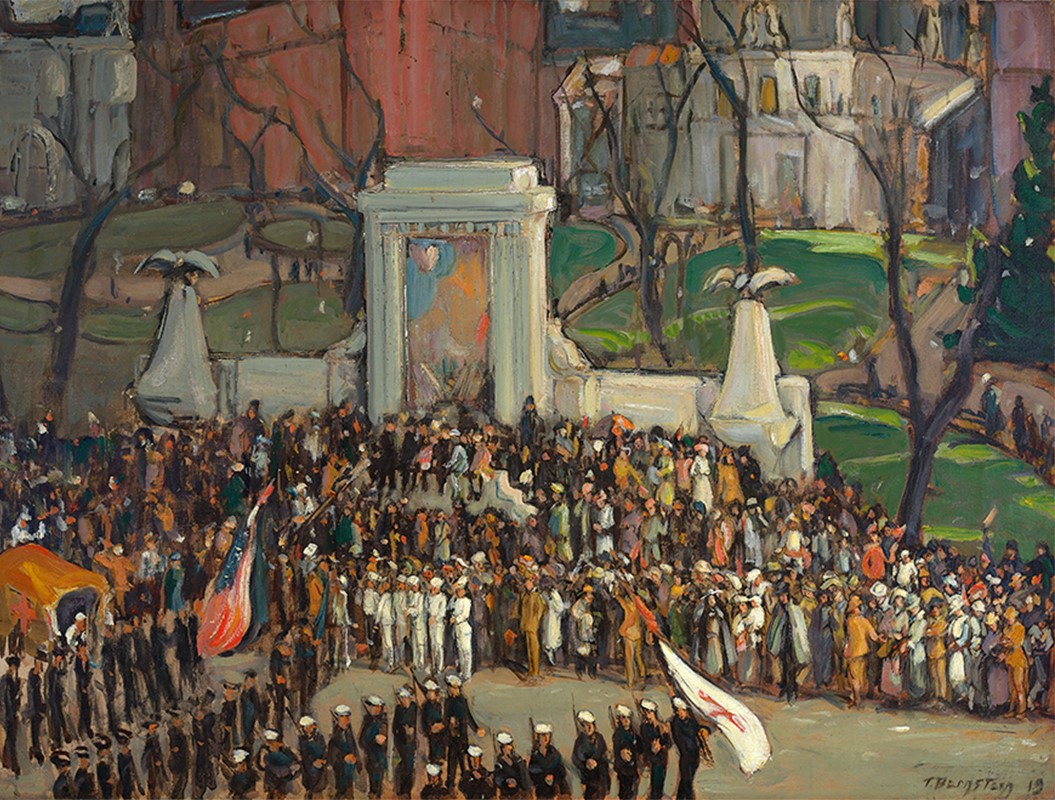
Theresa Ferber Bernstein painted Armistice Day Parade: The Altar of Liberty in 1919.  from the collection of Smith College

Plans for demolishing the Altar of Liberty proceeded quickly.  Robert Davis, a colonel with the Field Artillery in Germany, sent a plea to delay the razing through a letter to The New York Times on December 12, 1918:

I speak for a large number of us to whom has fallen the lot of garrisoning captured areas in Germany during the coming dreary Winter when I ask that you use your influence to prevent the removal of the much-read-of 'Altar of Liberty' from New York until such time as the army shall have been returned to the States.

We feel that we are as anxious to see what you have done in the States as you are to inspect the work accomplished by us here.

Davis got his wish.  As the returning American troops marched up Fifth Avenue, they paused at the Altar of Liberty.  One officer, Colonel William Hayward, echoed Thomas Hastings's thoughts on freedom to the crowd on May 2, 1919.  Hayward was the commander of the "colored" New York 15th Regiment."  Segregated from white troops, the Black regiments were always commanded by white officers.  Standing at the Altar of Liberty at noon that day, he announced, "If there is any one here who does not approve of the principles for which my men fought let them clear out of the country and don't let them buy any Victory notes.  Let those who approve those principles have the privilege of buying."

from the collection of the Library of Congress

Four months later, two million spectators lined five miles of Fifth Avenue to welcome General John J. Pershing and the famous First Division.  The Chattanooga Daily Times wrote, "It was the last great review of the war for New York and it was a fitting climax to a long series of military spectacles."  The article noted, "Perhaps the most impressive moment of the parade was when the soldiers reached the altar of liberty at Twenty-third street, where drums were muffled, colors 'dipped' and officers saluted in memory of the nation's heroic dead."

Shortly afterward, the Altar of Liberty was scrapped.  Proposals to replace it with a permanent structure were discussed for two more years.  After that, the memory of Thomas Hastings "extraordinarily beautiful work of art" faded from memory.

Many thanks to reader Doug Wheeler for prompting this post
LaptrinhX.com has no authorization to reuse the content of this blog

Saturday, September 4, 2021

The Eternal Light Flagstaff - Madison Square.


Nearly two years after the end of World War I, New York Legislative Documents noted, "No progress has been made during the past year toward a conclusion as to the form of New York City's great war memorial."  The two favored ideas being considered were a "Liberty Bridge" over the Hudson River, and the conversion of Madison Square Garden into Liberty Hall, proposed "to become the largest convention hall in the world, with a seating capacity of 20,000 people, containing a sacred Gothic Chapel and an organ that should be the greatest yet built."  The document added, "As a third alternative they recommended a Liberty Arch in the heart of the city."

As it turned out, none of those ideas would earn the approval of millionaire department store mogul Rodman Wanamaker, Chairman of the Mayor John Francis Hyland's Committee on Permanent Memorial.  (Wanamaker almost undoubtedly achieved the position through his former employee, Grover Whalen, who had been appointed Commissioner of Plants and Structures in 1918.)

Wanamaker felt strongly that the monument "should stand out by its simplicity"--the very antithesis of the three popular ideas.  It may have been that conflict that resulted in his personally footing the $25,000 bill for the project--more than $360,000 today.

Wanamaker's committee eventually approved the design submitted by Thomas Hastings, of the esteemed architectural firm Carrere and Hastings.  The Eternal Light Monument would take the form of a 125-foot tall wooden flagstaff formed from a century-old tree cut in "the virgin forests of Oregon and transported over the Rocky Mountains," according to The NYC Department of Parks.  Hastings designed a monumental pink granite pedestal that upheld the grand bronze pole base.  Paul Wayland Bartlett, who had studied under Auguste Rodin, executed the sculptural elements.


Atop the flagpole was a seven-pointed electrified star.  It was  first illuminated on Armistice Day, November 11, 1923, and the m0nument was formally dedicated on June 7, 1924.  The names of significant French battles were engraved on the east and west faces.  On the north was carved, "In memory of those who have made the supreme sacrifice for the triumph of the free peoples of the world," and on the south, in part, "Erected to commemorate the first homecoming of the victorious Army and Navy of these United States."

The Eternal Light Monument was the terminus of the annual Armistice Day parades, when tens of thousands of veterans marched from City Hall to Madison Square.  (Armistice Day marked the day and hour World War I ended--the 11th hour of the 11th day of the 11 month in 1918.)

photo via the NYC Dept of Records & Information Services

The monument was also used by the city to honor distinguished guests.   In June 1927 the Broadway motorcade of Charles Lindbergh stopped so the famous flier could lay a wreath at its base.   And a month later, on July 18, The Daily Worker reported, "Clarence Chamberlin, Richard E. Byrd and the three men who flew with Byrd to Paris came back to New York yesterday...The fliers were met at the City Hall by Mayor Walker and received the city's medals of valor.  At the eternal light in Madison Square, William H. Woodin welcomed them to the state in the absence of Governor Smith."

The Eternal Light Monument turned political around 1930, when socialists adopted it as their own symbol.  It may have started with the May Day observations in Union Square that year.  Army veterans planned a counter-protest.  The Socialist newspaper The Daily Worker wrote, "If the Veterans of Foreign Wars can scrape together enough sluggers, boss-bellycrawlers and thugs they will start their march from the Eternal Light in Madison Square."

Members of the Women's Overseas Service League pose before the monument around 1924.  from the collection of the New-York Historical Society

In 1932 veterans marched on Washington D.C. to demand government promised pension money.  Two of them, Eric Carlson and William Hushka were shot dead by D.C. police.  The deaths enraged Socialists, who organized "Huska-Carlson Day" the following year.  On July 27, 1933 protestors assembled at Rutgers Square.  The Daily Worker advised, "From there, a parade will leave for Madison Square (23rd St.) at the Eternal Light."

Every year the antithetical groups would use the monument for their widely disparate purposes.  The annual Armistice Day  parades and subsequent ceremonies went on in November, while the Socialists embraced the memorial in the spring months.  On March 6, 1934 The Daily Worker announced, "The youth section of the American League Against War and Fascism will hold an anti-war parade starting at the Eternal Light in Madison Square, where a wreath will be laid."  The banner on that wreath read, "We Will Not Support the Government In Any War It May Undertake."


Ernst Thaelmann, the leader of the Communist Party of Germany, was arrested by the German Government in 1933.  Reaction in the form of rallies and protests among the Socialist and Communist communities in America was swift.  On the night of June 13, 1934 Jack Corrigan shimmied to the top of the Eternal Light flagpole and hung a massive red banner demanding "FREE ERNST THAELMANN."  He and his comrades assured that it would remain there as long as possible by greasing the pole upon his descent and cutting the pole ropes.  On June 15 The Daily Worker reported, "While crowds gathered to watch the sight, police squads desperately tried to get up the pole, but it was greased too well for them."

In 1965 the participants in the annual ceremonies--originally composed of thousands--had greatly diminished.  photo via the NYC Dept of Records & Information Services

In 1954 Armistice Day was changed by Congress to Veterans Day, in order to honor the deceased veterans of all wars.  

In 1976 the wooden flagpole was replaced with a metal version.  By then the once massive Veterans Day ceremonies had greatly diminished.  On November 13, 1979 Judith Cummings, writing in The New York Times, said "Few New Yorkers marched in the annual Veterans Day parade yesterday on Fifth Avenue and almost as few bothered to watch it, deciding instead to take advantage of department store sales."  She went on, "Ceremonies at the parade's terminus at Madison Square Park drew several dozen onlookers, who stood quietly in chill wind to hear the speakers in front of the graffiti-scarred Eternal Light monument near 24th Street."

Part of the meager turnout was blamed on anti-Vietnam War sentiments.  But numbers grew in 1981 when national patriotism swelled with the return of American hostages from Iran.  Mayor Edward Koch announced, "Now we must not rest until they [the Vietnam MIA's] are likewise returned."

The Veterans Day ceremonies saw another increase of numbers in 1983.  Gannett Westchester Newspapers wrote on November 12, "About 2,000 present and former servicemen marched under cloudy skies in New York City's Veterans Day parade to pay tribute to America's fallen heroes, especially those killed recently in Lebanon and Grenada.  They stepped smartly down Fifth Avenue to the Eternal Light Monument in Madison Square where 32 wreaths were placed in memory of the fighting men and women of the United States."

But the numbers had waned again in 1986, when The New York Times reported "The sparse crowds at recent Veterans Day parades in Manhattan were generous compared with the smattering that turned out yesterday."  It was, nevertheless, a groundbreaking event.  The article noted, "for the first time, homosexual veterans joined the march under their own banner."  It was not entirely a welcomed change.  The article noted, "As the Gay Veterans entered the parade from 39th Street, a man slashed the banner with a knife and fled."


The luminaire, or lighted star, at the top of the flagstaff was refurbished in 2017.  Thomas Hastings's magnificent base, described in 1979 as "graffiti-scarred," has been restored.  And the Eternal Light monument continues to be the site of the annual Veterans Day ceremonies after nearly a century.

photographs by the author
no permission to reuse the content of this blog has been granted to LaptrinhX.com

Monday, May 6, 2019

The Lost American Jockey Club - Madison Avenue and 27th Street


In the foreground is a portion of a Madison Square Garden porch. photograph from the collection of the New York Public Library
The Civil War was barely over before wealthy New Yorkers turned their attention--and their money--to the sport of kings: horse racing.  Taking the reins, so to speak, was Leonard Jerome who, with other millionaires like August Belmont, founded the American Jockey Club in 1866 and then set out to erect for it a substantial clubhouse and a fashionable racecourse, Jerome Park.

On October 10, 1867 the New-York Daily Tribune wrote "The 'Jerome Day' has become with us almost as familiar as the 'Derby' in England, and though on its annual recurrence 200,000 people do not blacken the highways leading to the Course, still it summons forth a number sufficient to elevate it into the dignity of at last a New-York holiday."

The article waxed poetic.  "In those early October days, with the purple and gold of Autumn on mead and wood, and the glories of the Indian Summer enveloping the earth in their short-lived brilliancy, Mr. Leonard W. Jerome and the American Jockey Club summon us forth to witness the exhibition of all that is admirable in the American race-horse--strength and speed, and beauty and blood." 

Club members had given the 230-acre park priority over their city accommodations.  The course had opened on September 25, 1866 with Ulysses S. Grant as guest of honor.  The crowd was diverse--from millionaires and their wives to the middle class.  Harper's Weekly said "ladies of fashion, ladies domestic, ladies professionally literary, ladies of birth and culture" were there.   The members' wives were buffered within the elegant clubhouse from the less financially fortunate in the stands and infield.

Attendance at Jerome Park, at least from a feminine point of view, was more a social than sporting event.  The following year The New York Times pointed out that one-third of the 10,000 people at a race were women, "far less intent on the races than on meeting friends and having a free and easy social chat.  Not one in ten probably knew or cared a straw about the horses, and their running was merely a pleasant incident in the day's enjoyment."


Non-members in the infield at Jerome Park participate in the 1886 version of tailgating.  Even these spectators were decked out in silk top hats and other finery.  Harper's Weekly, June 19, 1886 (copyright expired)
On July 13, 1867 The New York Times mentioned "We understand that Mr. Jerome intends also to place the superb building, which he is now completing on Madison-avenue, at the command of members of the Jockey Club.  For the purposes of a first-class Club-house there is no building in the country that an compare with it; nor has there ever been an American club organized which offered so many attractions and privileges as this Jockey Club, which, although it has been organized less than a year, already numbers about a thousand members."

Jerome's choice of the clubhouse site, on the southwest corner of Madison Avenue and 27th Street, may have been a bit self-serving.  In his 1872 book Lights and Shadows of New York Life, James Dabney McCabe said of men's clubs in general, "The location of these clubs is very desirable.  They are all in the most fashionable quarter of the city, and their houses are in keeping with their surroundings.  They are elegantly furnished, and often contain valuable and beautiful works of art."

And while the American Jockey Club would, indeed, be filled with costly furniture and artworks, it was removed from the "club district" and sat among the high-class stables and carriage houses of the Madison Square mansion owners.  Among them was Leonard Jerome, whose magnificent residence was just a block away, at Madison Avenue and 26th Street.

The Italianate style, four-story clubhouse sat above a rusticated English basement.  The first floor, accessed by two sideways stoops on 27th Street, was faced in Novia Scotia stone--a light colored sandstone.  Two sturdy stone balconies clung to the Madison Avenue windows, and another appeared on the side street.  The upper floors were clad in brick and trimmed in stone.  The chamfered corner admitted more light and ventilation, and accommodated two more balconies.  

Because much of the club's business was handled in the Jerome Park clubhouse, members did not seem at all perturbed when the New York Yacht Club took most of the second floor in November 1872.  But then again, many of its members--James Gordon Bennett, August Belmont, the Schuylers and the Vanderbilts among them--were also members of the American Jockey Club.  The consolidation of clubhouses was, in fact, a convenience.

In 1873 Wood's Illustrated Hand-Book to New York advised "The New York Yacht Club is situated over the Jockey Club Rooms, on the corner of Twenty-seventh Street and Madison Avenue.  These rooms are beautifully fitted up, and contain a perfect museum of nautical curiosities, comprising some handsome pictures, and a complete set of models of all the yachts that have belonged to the club."

The Yacht Club's three rooms were, according to club historian Joseph Florimond Loubat in 1887, "comfortably and luxuriously furnished."  The reading, or "front room," overlooking Madison Avenue held magazines, newspapers and other light reading.  Here were the more than 120 yacht models.  The room behind that was furnished with sofas and writing tables, and the third room was the bar.  

In the meantime, the American Jockey Club offered what today might be called off-site betting in the Madison Avenue clubhouse.  On January 10, 1874 the New York Herald reported that "A betting book on the Belmont Stakes, to be run for at the spring meeting at Jerome Park, will be opened in a few days at the room of the American Jockey Club...Persons desirous of betting on any of the horses in the stakes will be accommodated in wagers ranging from $10 to $10,000."  That cap was a staggering amount--more than a quarter of a million dollars today.

A rush of bettors besieged the clubhouse as the running of the Belmont Stakes neared.  On June 13 The New York Herald announced "The attendance was very large at the rooms of the American Jockey Club in Madison avenue last evening, and the bidding was very spirited and excited.  The Belmont Stakes was the most important event of the evening, and it is said that $20,000 was put on this race last evening."

The club leased space to two other racing organizations as their city space by 1881.  The Coney Island Jockey Club's offices were in the basement and the Monmouth Park Association had its offices here.  By now August Belmont had taken over as the American Jockey Club's president.

The New York Yacht Club moved into its own quarters at No. 67 Madison Avenue in 1884.  Along with the yacht paintings and models, the members took along the black cat Sam, the club's de facto mascot.

Sam had wandered into the second floor rooms several years earlier while still a kitten.  The New York Times explained "In accordance with a popular superstition his advent under the circumstances was considered 'good luck,' and he was consequently made quite at home, and he remained there.  Sam soon became a general pet of the habitues, and never sought fresh pastures excepting, indeed, for a nocturnal gambol on the roof once in a while."

Sam earned his room and board.  "It is also to be said of him that, though well fed, he was an industrious ratter, and kept the building free from the ravages of the destructive rodent," said the article.

The cat was familiar with each member, welcoming them by "gracefully passing around their legs or sitting under their chairs."  He refused to sleep until the last of the member had left, no matter how late.

Relocating Sam was no easy task and it required trapping him in a bag.  Sam, like all cats, was a creature of habit and when he did not recognize his new surroundings, made a quick escape back to the old clubhouse.  But, "not finding his household gods there, [he] meekly returned to the place, and soon made himself at home."  Members were heart sick when he was found dead in his little bed two years later.

Newspapers took sides in the early 1890's when a bitter battle ensued between the New-York Jockey Club and the American Jockey Club.  One publication wrote that "the New-York Jockey Club was endeavoring to drive the American Jockey Club off the face of the earth" by holding its races on the same days as the Jerome Park events.

As Leonard Jerome had done, the New-York Jockey Club's president, John A. Morris, had constructed a magnificent track, Morris Park, in Westchester County.  The New-York Tribune said "He spent money there on the most lavish scale on the buildings and on the grounds."  

The newspaper reported in August 1893, "Mr. Morris brought about the destruction and dissolution of the American Jockey Club."  By scheduling the conflicting races, said the article, "he dealt the American Jockey club a death-blow."  The writer lamented "No other racing association ever formed in America has approached the American Jockey Club in the dignity, the substantial merit and the excellence of its membership."

The club hung on under the name of The Jockey Club and August Belmont continued as its president.  But New York State's outlawing of track betting in 1908 was a major blow.  That year the club moved into the Windsor Arcade on Fifth Avenue and the clubhouse was sold.  

On December 5 the Record & Guide reported that the Neptune Realty Co. paid $115,000 for the property; a significant $3.25 million today.  Within the year abutting properties were added to the site and in August 1909 plans for the Neptune Realty Building, designed by Maynicke & Franke, were announced.  The building survives.


Real Estate Record & Guide, August 21, 1909 (copyright expired)

Friday, November 2, 2018

The Roscoe Conkling Statue - Madison Square


photo by D. C. McJonathan

Roscoe Conkling was among the most recognized of New York's citizens in 1888.  Born in Albany on October 30, 1829, he grew up among lawyers and politicians.  His father, Alfred Conkling, was both a federal judge and a U. S. Representative; and his mother, the former Eliza Cockburn, was cousin of Lord Chief-Justice Sir Alexander Cockburn.  Noteworthy political figures who passed through the Conkling parlors included Martin Van Buren and John Quincy Adams.

Roscoe was, however, a rambunctious child and a frustration to his father, who called him a "utterly untutored" at the age of 13.  He was send off to boarding school at Mount Washington Collegiate Institute to receive disciplined instruction.  It worked.

At the age of 17 Conkling chose to study law within a Utica firm rather than continue to college.  His outstanding oratory skills and his strong views on human rights made him a recognized speaker.  At only 18 years old he spoke passionately and eloquently about the starving victims of Ireland's Great Famine.

Conkling married Julia Catherine Seymour, and was admitted to the bar in 1850.  He went on to be a district attorney, and a member of both the United States Senate and the House of Representatives.  


Roscoe Conkling from the collection of the New York Public Library
Despite his political successes and failures, Conkling became widely known for his philandering. The New York Times gleefully reported on his extramarital affairs, most notably with Kate Chase Sprague. Kate was the wife of Senator William Sprague IV and the daughter of Chief Justice Salmon P. Chase. The Times printed the scandalous story of Senator Sprague discovering the couple in his Rhode Island summer residence, then chasing Conkling with a shotgun.


Many newspapers of the 19th century were unabashedly politically biased, often conjuring up scandals to defame political figures.  Conkling's supporters wrote letters to the editor of The New York Times denouncing the articles as false and calling the Times’ journalism disreputable and irresponsible.  Nevertheless, readers clung to every word of the unsubstantiated improprieties.

Conkling was at his Wall Street office on March 12, 1888 when the Great Blizzard of 1888 struck. The storm, also referred to as The White Hurricane, was one of the most severe in recorded history. Forty inches of snow was dumped on Manhattan and sustained winds of 45 mph created snowdrifts up to 50 feet in height.

While most citizens remained sheltered in their homes, Roscoe Conkling had lingered too long in his office.  By the time he left the streets were deserted.  All the hansoms and horses had been sheltered in their stable.  Conkling set off on foot to 
The New York Club on 25th Street. He lost his way in the blinding storm, made worse because the wind blew out all of the gas street lamps.  So severe were the white-out conditions and pitch darkness that he could not find his way out of Union Square.  He wandering there for nearly half an hour.  When he finally reached the door of the club two hours after leaving his office, he collapsed, suffering from exposure. 

Somewhat embarrassed by the newspaper accounts of his travails, Conkling downplayed the attention in a letter to a friend written from his bed a few days later:

My dear sir, Bless your kind soul. You know one can’t step foot in the snow without stepping into the newspapers. I had an ugly tramp in the dark – the lights out, from Wall Street up, over drifts so high that my head bumped against the signs, and dug-outs opposite the store doors suddenly letting a wayfarer down a foot or two over snarled telegraph wires and slippery places, with a blizzard in front not easy to stand against, and so cold as to close the eyes with ice, and drifts were not packed enough to bear up, in which one sank to the waist. Bumps and falls, and strains and tugs made it quite an interesting excursion, but not one worth anyone’s while to talk about.

Conkling seemed to be recovering.  He worked on legal papers and other business from his bed.  But his condition worsened and he began talking incoherently.  On April 18, 1888 he succumbed.

Two years later a group of esteemed citizens, including former Vice President Levi P. Morton, Clarence A. Seward and Cornelius N. Bliss, raised funds to erect a statue to Conkling. They commissioned sculptor John Quincy Adams Ward, later referred to as “The dean of American sculptors,” to design a bronze statue. Julia Conkling requested that he depict her husband speaking before the Senate.  In fact, she visited Ward's studio regularly over the next three years "and the sculptor made use of her intimate knowledge of the subject and her keen judgment in matters of form," according to Every Where magazine later.

While the Park Commissioners approved the proposed statue and its design, they rejected the donors' request that it be placed in Union Square, where Conkling "had his struggle with the blizzard."  Instead, the Department of Parks landscape architect Calvert Vaux recommended Madison Square.  In 1908 Every Where magazine explained the considerations:

The question was then very naturally raised, as to how important a man must be, in order to be truthfully called a "great American" and be worthy of having his monument paced in a public square of a great city.  In a large sense the question was answered by the action of the board of park commissioners that excluded Conkling from Union Square and the company of Washington, Lincoln, and La Fayette, and placed him in Madison Square...where stand the images of Farragut, Seward and Arthur.'

There was one more hurdle to overcome.  The proposed base was deemed too large by Calvert Vaux and the Advisory Art Committee.  They accepted the statue's design "with the proviso that its lower member be reduced in size from 10 feet 3 inches to 9 feet square."   John Quincy Adams Ward was resolute that his original dimensions be preserved.  He appeared before the Park Board on October 25, 1893 to forcefully voice his opposition.  This time the board relented.

Ward represented Conkling speaking to the Senate, his thumb casually hooked into his pocket.  The admittedly large base can be clearly seen.  from the collection of the New-York Historical Society
In December 1893 the statue was unveiled with no formal ceremony, as requested by the family.  Conkling's figure, cast at the Henry Bonnard foundry in Manhattan, stood eight feet high and weighed 1,200 pounds.  The eight-foot high granite pedestal was simply inscribed "Roscoe Conkling."  Robert G. Ingersoll addressed those present and took a swipe at Conkling's earlier political enemies.  "When the hounds that barked at his heels shall all have been forgotten, [his] record will remain and take on divine tints...that will give his statue colossal proportions in his niche in the ages."

Although generally lauded as a "heroic bronze" and a dignified representation of the politician; there were, of course, criticisms.  On December 24, 1893 The New York Times hinted at flaws.  The writer lamented that Ward had not had the chance to exhibit a full-size plaster model.  "Had an exhibition been opened last Spring...the sculptor could have shown that statue and had a chance to see it away from his studio under different lighting  There can be no question that it would have been altered."

Every Where magazine was more specific in its criticisms, which focused mainly on the tailoring of the clothing.  "His Prince Albert coat falls in smooth and graceful folds to the knees, and the neck is neatly and becomingly dressed.  The trousers, however, are about two inches too long, and the inevitable dent in the left knee shows up clearly...The vest, too, appears to have been worn for some time without pressing, and is drawn up in a rather unbecoming fashion."

An early postcard clearly shows the offensive tailoring.
The critic said that, of course, a statuary likeness of a person should be faithful to the original, "but there is no excuse for carrying the matter of realism to the point where it is ludicrous and ridiculous...one cannot help wondering why the sculptor thought it necessary to array his subject in a smooth, well-fitting frock, with a crumpled waistcoat displayed beneath."

In 1942, during World War II, Franklin D. Roosevelt initiated a program to scrap bronze statues and recycle their metal into weapons of war.  He told reporters on August 7 that many bronze memorials "would serve a more useful purpose if junked."  It may have been that threat that prompted the Conkling statue to be painted brown, disguising its greenish bronze patina.

The Conkling statue was moved 20 feet in the summer of 2000, and a year later it received a full restoration as part of the Citywide Monuments Conservation Program. At a cost of $12,000 it was chemically re-patinated to its historically correct color and tone, and cleaned of dirt and corrosion.

And despite Robert G. Ingersoll's prediction that the statue would ensure Conkling's memory "in his niche in the ages," most park goers pass it without a glance; and have no idea, nor care to know, who Roscoe Conkling was.

Monday, June 11, 2018

The Lost New York House of Refuge - Fifth Avenue and Broadway


The institution grounds sat above the X that would be formed by the crossing of Fifth Avenue and Broadway later.  Valentine's Manual, (copyright expired)

In 1806, the United States Arsenal was erected near the junction of the Bloomingdale and Old Post Roads.  It would be several decades before the northern tide of the city would reach this far.  The two-story frame building was, according to the General Government, "for the purpose of an arsenal and deposit of military stores."   When the War of 1812 erupted, the Arsenal was converted to a barracks.

The reconfigured barracks building as it appeared when the Society moved in. Our Police Protectors, 1885 (copyright expired)

In 1824, the Society for the Reformation of Juvenile Delinquents was formed.  New York State law treated juvenile delinquency as a crime; however the wealthy men who formed the Society felt that reformation was a better option than incarceration.  What the wayward youth needed was religious instruction, industrial training and sufficient food, they stressed.

After the military facility was moved to Castle William, the Society for the Reformation of Juvenile Delinquents paid $6,000 for the barracks--about $157,000 today--along with the triangular plot of land in front formed by the junctions of the roads.   According to the authors of the 1918 The New York Tombs: Its Secrets and its Mysteries, "This location was then far out of town, in the midst of a rich farming district.  It consisted of about four acres."

Two stone-faced wings were added as well as a significant deterrent to escape.  The Society's report said, "A more convenient or eligible situation could not probably have been selected.  The lot of ground, 320 feet by 300, is enclosed by a stone wall 17 feet in height, and more than two feet thick."

The New York House of Refuge was opened on January 1, 1825.  The New York Tombs: Its Secrets and its Mysteries wrote, "The inmates consisted of six girls and three boys, who had been brought in by the police.  This proportion would seem to establish the fact that the women are twice as bad as the sterner sex, although we are too gallant to believe it."

The opening ceremonies included an address by District Attorney Hugh Maxwell.  He returned to the facility ten months later to check on its work.  He announced in October 1825, "I am happy to state that the House of Refuge has had a most benign influence in diminishing the number of juvenile delinquents.  The most depraved boys have been withdrawn from the haunts of vice, and the effect of the examples set them has in a great degree been destroyed."

from the collection of the Museum of the City of New York

One wing housed boys, the other was for girls.  The Society report stressed, "there is no communication between them."  Only children between the ages of 6 and 16 were accepted.

The first floor of  the "Boys' Refuge" included a dining room, common hall, superintendent's office and tailor's and shoemaker's shops.  On the second story were the hospital and dormitories.  The 132 separate rooms were not for the claustrophobic--each measuring 31⁄2 by 7 feet.  Two open aisles, 10 by 110 feet, were used as classrooms, furnished with desks and benches.  The Society noted, "In school the older and more vicious boys are separated from the younger and more innocent, and a kindergarten is maintained for the younger boys."

The report said, "The Girls' Refuge is finished in a superior manner to that for the Boys."  On the first floor were the kitchen, dining room and work rooms, as well as "a neat Parlor and Chamber for the Matron, a Committee Room, and a Laundry."  At the south end was the chapel, large enough to accommodate "140 boys, 70 girls, and 300 visitors."  The girls had their own hospital.  There were half as many dormitory rooms on the second floor than in the boys' wing.

On the grounds were a two-story stone house for the superintendent and his family, and a brick house for the assistant keeper and his family.  Boys were put to work in several shop buildings where they not only learned a trade, but provided income for the institution.  Contractors paid for the labor of the boys, provided the material and the instructors, while staff from the House were placed in each shop "to maintain discipline."

The two story "Work-House" was where 40 boys were employed making chairs.  A single-story wooden building where 30 boys worked making brass nails and saddlery was connected to a foundry building.  The girls worked within the main building.  "The principal industries here are sewing and laundry work," according to the Society report.

Other outbuildings included a wooden bakery and storehouse building, and a combined stable and carriage house.  The report noted, "A part of the ground is laid out into kitchen and flower gardens, grass plots and gravel walks.  There are four wells on the premises, of excellent soft water.  Adjoining the south wall, the Society occupies an angular piece of ground, containing about one acre as a pasture."


Cows graze in the pasture at the south portion of the grounds.  Our Police Protectors, 1885 (copyright expired)

The boys and girls who lived behind the 17-foot-high walls may have had a differing opinion to the report's assertion, "The whole aspect of the establishment is cheerful and comfortable, and it has little or none of the appearance of a prison."

Eliza Bailey, who arrived at the House of Refuge in 1836, was a typical case.  The New York Herald reported on January 7, "Eliza Bailey, a mild simple looking girl, was charged with stealing at various times from Mrs. L. St. John, No. 202 Broadway, money to the amount of eighty dollars and clothing valued at twenty more.  She confessed to the theft, but declared there was not as much money as was stated in the indictment."

Edward Pirnie arrived a week later.  The New York Herald reported on January 14, "Wm. Brown, alias 'Rise and Flutter,' Edward Pirnie, alias Prine, John Harvey, and Joseph Lawrence alias Portuguese Joe, were charged with burglary in the third degree, in breaking into the house of Mr. Walter B. Townsend, No. 33 Madison street."  The boys had made off with $14 in silverware and other articles.  They were all found guilty, "But Edward Prine was sent to the house of refuge until he could be sent to sea, being only 16 years of age."

Being "sent to sea" was the common means of solving the problem of repeat offenders.  Teen-aged crooks and incorrigibles were indentured on sailing ships.  The theory was that they would turn to a career as sailors rather than crime.  The convenient truth was that the practice got rid of a menace.  Boys at the House of Refuge who did not successfully learn a trade or were otherwise unfit for society were sent to sea upon reaching the age of 17.

Tragically, the children who ended up in the courts and subsequently in the House of Refuge were most often victims of a cruel accident of birth.  Born into poverty and often neglected or abandoned, they had little recourse other than crime.

A pitiful example came to light in the summer of 1838.  On August 1, the Morning Herald reported, "Two little girls of the age of scarcely nine years, were arraigned for stealing a basket of clothing from the side walk at Washington market.  It appeared in the course of the investigation that the step father of the children compelled them to go about town and steal whatever they could lay their hands upon; and in the default of their bringing plunder home at the close of the day, the infernal monster would scourge them with ratans over the naked flesh until the blood followed the lash."

The girls' story was confirmed by scars and recent wounds.  The article said, "The Court very mercifully committed the children to the custody of the keeper of the House of Refuge, which, by the by, is one of the most benevolent institutions in the United States."

The following year the House of Refuge burned.  A new location was procured on East 23rd Street at the river until a substantial new facility was built on Randall's Island in 1854.

In the meantime, the Old Post Road was closed on April 27, 1844 and the following year Fifth Avenue was extended from 23rd to 28th Street.  The Bloomingdale Road, or Broadway, was straightened, and no remnant of the extensive House of Refuge grounds remained.  Today the grave and monument of General William Jenkins Worth sits directly above the site of the building.


The House of Refuge sat where the obelisk marking the grave of General Worth (center) is today.  from the collection of the New-York Historical Society.