Showing posts with label hyman isaac feldman. Show all posts

Saturday, June 29, 2024

H. I. Feldman's 1949 36 East 36th Street


In 1948, real estate developer Joseph Perlbinder demolished a row of mansions at 28 through 36 East 36th Street as the site of a modern apartment building.  Completed in 1949, architect Hyman Isaac Feldman (who went professionally by his first initials) designed the 11-floor-and-penthouse structure in the late Art Moderne style.  Its entrance, capped with a wavecrest entablature, sat within the limestone base that stair-stepped from one to two floors, then to four at the center.  At the topmost floors, setbacks allowed for railed terraces.

Corner-wrapping casement windows had been in vogue for a generation; but at 36 East 36th Street, Feldman's were different.  He rounded the corners of the recessed sections, then used long, thin panes that allowed the windows to follow to gentle shape.

The cover of the 1949 real estate brochure pictured the building.  from the collection of the Avery Library of Columbia University.

Despite the relatively small size of the apartments (most had just one bedroom), the residents were well-heeled.  Among the first were Julia Green Sturges and her daughter Cary.  Julia, who was the daughter of Thomas Dunbar Green, president of the American Hotel Association, was divorced from Perry MacKay Sturges, who lived in Princeton, New Jersey.  Cary's marriage to Alan Lincoln Burns, Jr. in St. James Protestant Episcopal Church on June 17, 1950, was highly covered in the society pages.

Two months later, The East Hampton Star reported on the "very interesting house" designed by A. M. Shoemaker that residents William C. Eberle and his wife Cora were constructing in East Hampton.  Saying "Mr. and Mrs. Eberle will use the house as a summer home," the article mentioned, "Mr. Eberle is a prominent engineer who has been sent by President Truman as an adviser to various parts of the United States and South America."  Eberle was a partner in the fuel consulting firm Eberle & Leyford, Inc.

In 1949, Meyer Lansky and his second wife, Thelma Schwartz, moved in.  Perhaps because of his shady occupation (he was known as the "Mob's Accountant"), Lansky did not stay long at one address.  Since signing a lease at 411 West End Avenue in 1941, he had lived at 211 Central Park West and 40 Central Park South.  The Government, however, managed to keep up with his movements.  A year after moving in, he was subpoenaed to testify before Congress's Hearings to Investigate Organized Crime. 

The committee was not successful in obtaining much information from Lansky.  He was asked, for instance, by Senator Estes Kefauver, "May I ask you, did you bring all these books and records we asked for?"

Lansky answered, "No."

When asked why he had not complied, Lansky replied, "I decline [to answer], on the ground that it may tend to incriminate me."

Asked, "What is your business," he answered, "I declined to answer on the ground that it may tend to incriminate me."

And so it went.

Lansky would eventually die of lung cancer in Miami Beach in January 1983.


In 1951, Russian-born author Ayn Rand and her husband, actor and painter Charles "Frank" O'Connor, moved in.  The couple had met on the set of the 1927 silent film The King Of Kings and were married in 1929.

They had been living on a ranch in California. In her Ayn Rand and the World She Made, Anne C. Heller writes, "On October 24, they took occupancy of apartment 5-A.  Their furniture had preceded them by a day, but the apartment was small, and much had been left behind."  Heller describes it as:

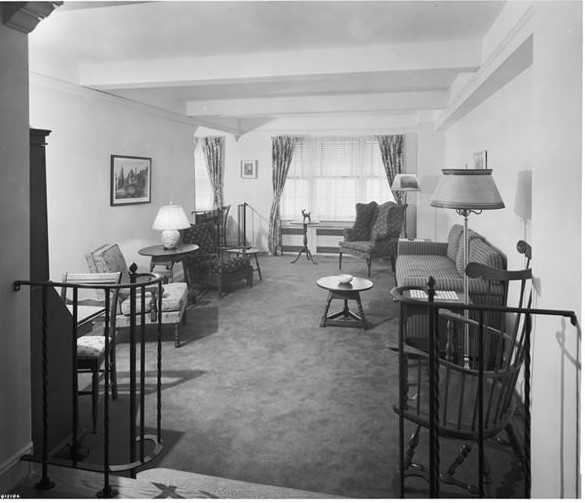
...not only relatively small but also plain.  First-time visitors, expecting Roarkian grandeur along the lines of the Neutra house, were surprised by its modesty.  An entrance foyer doubled as the dining room, with a black-lacquered table, designed by O'Connor, pushed against a mirrored wall.  Formal dinners were eaten there; otherwise, the table served as a work surface for a series of manuscript typists.  A small kitchen opened off the foyer.  The living room was small, with windows on the far wall, and was decorated by Frank with mid-century modern chairs and a black tweed sofa, glass-topped tables, and green-blue pillows and knickknacks strewn around.  There was one bedroom and a tiny study facing an air shaft, from whose single window she could see the Empire State Building, if she leaned out and peered west.

Writer and editor Evan Welling Thomas 2d and his wife Anne lived here at the time.  Born in 1920, Thomas was the son of former Presidential candidate Norman Thomas.  Evan's war memoir, Ambulance in Africa was published in 1945, the same year he joined Harper & Brothers as an editor.  

In his book, Controversy and Other Essays in Journalism 1950-1975, author William Manchester talks of meeting with Thomas here while writing his 1967 Death of a President--the book about the five day period before and after the assassination of President John F. Kennedy.  Manchester said, "it was then that I began to understand the depth of his feeling on this issue."

Among the other notable books Thomas would edit were Thirteen Days: A Memoir of the Cuban Missile Crisis by Robert F. Kennedy, and Eleanor and Franklin by Joseph P. Lash.

Charles Kurzon lived here by the early 1960s.  He was president of Charles Kurzon, Inc., which dealt in architectural and finishing hardware.  Kurzon hardware was used in important Manhattan structures like the Time & Life Building, the Lincoln Center for the Performing Arts, and the New York Coliseum.

An interesting figure residing here at the time was Nathaline Frackman.  A 1925 graduate of Columbia University, The New York Times said she "devoted her career to arranging social and business parties."  Using the pseudonym Nata Lee, she wrote The Complete Book of Entertaining, Nata Lee's Guide for Every Hostess.  She died in her apartment at the age of 74 on January 27, 1977.

The Art Moderne wavecrest patten above the entrance can be glimpsed behind the awning.

Other than replacement windows, H. I. Feldman's late Art Moderne design, which borders on mid-Century Modern, is little changed.

many thanks to reader Lowell Cochrane for suggesting this post
photographs by the author
no permission to reuse the content of this blog has been granted to LaptrinhX.com

Tuesday, May 21, 2024

H. I. Feldman's 1937 565 West End Avenue


photo via compass.com

Greatly because of the tireless work of Cyrus Clark (known as the Father of the West Side), West End Avenue never saw the incursion of commerce, like Broadway did.  Instead, by the turn of the last century, it was lined with sumptuous brick and brownstone mansions.  Those quickly, however, quickly gave way to apartment buildings as New Yorkers' taste in domestic living changed.

In 1936, the Sari Corporation, of which Mose Goodman was president, demolished five rowhouses at the northwest corner of West End Avenue and 87th Street.  Goodman hired Hyman Isaac Feldman to design a modern apartment building on the site.  Completed the following year, 565 West End Avenue was the last word in domestic architecture.  By recessing the central portions of both elevations, Feldman allowed for additional corner-wrapping windows.  Most importantly, his Art Deco design relied on color.  Bold red-orange bands contrasted with the beige brick.  The architect gave the one-story base a tiger-stripe effect with black brick against the orange.

photo via compass.com

An advertisement that offered apartments of "2, 3, 4, 5, or 6 rooms," called 565 West End Avenue a "distinctive new 20-story building.  The last word in modern planning.  Unusual layouts."  The suites featured "sunken living rooms," a popular trend.

Among the early renters was Julius Huehn, who signed a lease in 1937.  The bass-baritone had made his debut at the Metropolitan Opera in 1935 in Lohengrin.  Born in 1904, he would become known for his Wagnerian roles before enlisting in the U.S. Army Air Corps in 1944.

Julius Huehn, image via bach-cantatas.com

When the Kotzen family left town in the fall of 1939, they sublet their apartment.  Their ad provided a vivid description of the apartments.  "For Rent--Complete apartment--large living-room, foyer, kitchen, Frigidaire; beautifully furnished; radio; linen, china.  A real home."

Apartments like the Kotzens' were home to other white collar residents, like Paul M. Wald Jr., secretary of the J. S. Wald Company, Inc., a trucking firm, who signed a lease in February 1941.  

photo by Wurts Bros. from the collection of the New York Public Library

Charles Korman lived here by May 1945 when he was called to testify before the United States Congress House Committee on the Judiciary.  His testimony did not start out well.  When asked, "Now, Mr. Korman, were you ever known by any other name?", Korman replied, "No, sir."

After Special Counsel Boris Kostelanetz then asked, "Were you ever known by the name of Coleman?", Korman answered, "No, sir."

"C-o-l-e-m-a-n?"

"Yes, sir, I used to be known as Coleman."

When he was arrested two decades later on June 17, 1964, Charles Korman was still living at 565 West End Avenue.  He and Samuel (Augie) Weiss were charged with bookmaking.  The Internal Revenue Service agents responsible for the arrests said they ran "a $100,000-a-day gambling trade" from a garment center hotel.  United States Attorney Robert M. Morgenthau explained the operation, "amounted to millions each year" and that "Korman was said to have handled $35,000 a week in bets."

Astonishingly, less than a year later, on February 19, 1965, the Nassau, New York Newsday, reported that Charles Korman had been arrested again for bookmaking.  He and three cohorts ran "a thriving book making business that took in more than $5,000 a week in the city's garment district."

photo via compass.com

In the meantime, the William Pechter family lived at 565 West End Avenue in the 1940s.  Pechter was the owner of the Pechter Baking Company.  On May 14, 1943, 21-year-old Morton H. Pechter was inducted into the U.S. Army.  He obtained a medical discharge on November 9, 1944.  But his civilian life was quickly disrupted.

On May 28, 1945, military police arrested Morton Pechter at his apartment here.  He was sent to the guardhouse at Mitchel Field, Long Island, charged with "desertion, obtaining a false and fraudulent medical discharge and defrauding the Government of mustering-out pay."  (Pechter had received $210 mustering-out pay.)

Pechter fought back.  His attorney presented briefs to Judge Clarence G. Galston in United States District Court on June 21.  The New York Sun reported Pechter "claims that he received a legitimate medical discharge and that his rights as a citizen and civilian have been violated by the Military Police in arresting him, putting him back in uniform and imprisoning him."

Morton Pechter won his legal battle.  Five years later, on November 13, 1949, The Brooklyn Daily Eagle reported on his marriage to Alese Betty Cohen.  The article noted, "Mr. Pechter was graduated from Dartmouth College with the class of 1943.  He is a member of Pi Lambda Phi, Phi Beta Kappa, and was on the varsity crew while at Dartmouth.  He is associated with the Pechter Baking Company."  No mention was made of his military service.

Vera King Kramer was a former Zeigfeld Follies showgirl.  She divorced Milton J. Kramer, part owner of the Edison Hotel, in 1955.  When she moved into 565 West End Avenue, she was seeing a married, retired NYC detective, Bradley Hammond.

On December 28, 1956, the Bridgeport Post reported, "Police tentatively listed as 'suspicious' today the death of a former Ziegfeld Follies beauty in an apartment where she had been drinking with a retired detective."  The article said the 52-year-old was "in her bed, wearing pink and blue pajamas.  Her right eye was blackened and her right cheek bruised."

Remarkably, considering his professional background, Hammond's story changed repeatedly.  The New York Times reported that he said, "he had fallen asleep in the living room of Mrs. Kramer's apartment...while watching television.  He awakened at 10 A.M. yesterday, called out to Mrs. Kramer and she replied, he said."  He said he then went to his own apartment, returning at 3 p.m. to find her body.

But then, according to the Bridgeport Post, he explained away the bruises saying they "drank excessively in her lavish split-level apartment on West End avenue," Vera "fell down two stairs into the sunken living room and that he carried her to bed."  According to Hammond's second story, he then watched television until he fell asleep.  At 2:00 the next day he walked Vera's dog and an hour later discovered she was dead.

A photo of 58-year-old Bradley Hammond shielding his face from reporters was published next to a picture of Vera King Kramer in The Taylor Daily Press on December 30, 1956.

Readers across the country read the salacious details that included infidelity, sex, and possible murder.  The Syracuse, New York newspaper The Post-Standard reported, "Neighbors said the red haired Mrs. Kramer had retained much of the beauty that won her jobs in the Follies and also in George White's Scandals."  The newspaper added that she had an income of "at least $25,000 a year through alimony and investments."  (The figure would translate to about $280,000 in 2024.)  Hammond, noted the article, "had received 15 citations for heroic police work."

Somewhat remarkably, the cause of Vera King Kramer's death was officially listed as a cerebral hemorrhage.  Hammond was cleared of any suspicion.

Living at 565 West End Avenue by the late 1990s was attorney and preservationist Lori Zabar.  Born on July 16, 1954, she was the granddaughter of Louis Zabar, founder of the well-known Zabar's grocery.  She held degrees from Barnard College, the Columbia School of Architecture Historic Preservation, and the New York University School of Law.  Zabar was the first Director of the New York City Historic Properties Fund at the New York Landmarks Conservancy, and sat on the board of Landmark West.   She was the author of Zabar's: A Family Story, with Recipes.  Lori Zabar died on February 3, 2022 at the age of 67.

Jonathan Larsen, who lived at 565 West End Avenue by 2011, was the son of former Time, Inc. president Roy Larsen.  Born in 1940, he served as a correspondent and editor of Time magazine, and from 1974 to 1979 edited New Times.  From 1989 until 1994, he edited the Village Voice.

photo via compass.com

The 2010 edition of the AIA Guide to New York City likens the striking Art Deco styling of 565 West End Avenue to the famous "architecture on the Grand Concourse" of the Bronx.

many thanks to reader Lowell Cochrane for suggesting this post
no permission to reuse the content of this blog has been granted to LaptrinhX.com

Saturday, April 27, 2024

The 1940 Lindley House - 123 East 37th Street


image via streeteasy.com

On December 21, 1937, The New York Sun reported that the newly-formed 37th Street & Lexington Avenue Corporation had purchased "the three four-story houses at 296 to 300 Lexington avenue, northwest corner of Thirty-seventh Street, and the five-story house adjoining at 123 East Thirty-seventh Street."  The firm would add to these initial holdings before hiring H. I. Feldman to design a modern apartment building on the site.

Born in Chelzetz, Austria (now part of Poland) in 1896, Hyman Isaac Feldman, who went professionally by his first two initials, established his architectural practice in 1921.  During the next two decades, he focused much of his work on designing Art Deco style apartment houses in Brooklyn and along the Grand Concourse in the Bronx.  He would eventually design 2,500 apartment houses in the New York metropolitan area.

The jazzy Art Deco style that gave Feldman his start was no longer current.  His design for the Lindley House is more accurately termed Art Moderne, yet it strongly anticipates the mid-century modern style.  Faced in red brick, it rose stoically to a series of setbacks where the central section was beveled at a 45-degree angle, a trademark of Feldman's designs.  The architect gave the ground floor a neo-Federal touch by creating incised lines that suggested pilasters, and placing a cast concrete fan over the window above the entrance.

image via CityRealty.com

The Lindley House cost $500,000 to erect, or around $10.5 million in 2024.  There were seven apartments per floor through the 11th floor, five each on floors 12 through 14, and three on the penthouse level.  An advertisement in September 1940 read, "Just completed.  Drop living rooms, dining galleries, powder rooms.  Free gas.  Muzak.  Maid-valet service available."  Rents for two- or three-room apartments ranged from $67.50 to $135 (about $2,820 per month for the more expensive by today's standards).

photograph by Wurts Bros. from the collection of the Museum of the City of New York

The Lindley House filled with a wide variety of residents.  Among the first was Herbert R. Ekins, cable editor for the United Press Association.  Several early renters were in the military or recently retired.  Among them were Lieutenant William R. Ross of the U.S. Navy, Commander Jacques E. Ledure, and Captain James F. Gorman.

Captain John W. Renchard was stationed at Fort Dix, New Jersey on March 15, 1941 when he was married to Mary Lisa.  Renchard had graduated from Princeton University in 1928 and received a law degree from St. Lawrence University in 1937.  In reporting their marriage, the Daily Argus mentioned, "The couple will reside at 123 East 37th Street, New York City."

Two weeks earlier, a tragedy affected one family here.  Arthur Knox, Jr., who was in the insurance business, married Jane Elizabeth Hubbard in 1939.  He had graduated from the esteemed Phillips-Exeter Academy, and from Princeton University in 1931.  Jane was a graduate of St. Margaret's School in Waterbury, Connecticut.

In February 1941, Jane and her mother, Mrs. Giles Monro Hubbard, left on a road trip to Florida.  Near Jacksonville, North Carolina, they were involved in an accident and Jane Knox, who was 35 years old, was killed.  Mrs. Hubbard "suffered minor injuries," according to the Daily Argus.

Occupying one of the three-room penthouse apartments in 1949 was Jacqueline Coover Butcher.  Born in Sioux City, Iowa in 1916, the Waterloo Daily Courier said her "beautiful silver-blonde hair" had "started her on the road to fame and fortune."  Butcher went to Los Angeles to launch a motion picture career.  She married an advertising executive there and her future looked bright.  The Waterloo Daily Courier said, "The screen and the stage both wanted her then for her beauty and her dancing ability."

Then, in 1938, Butcher went back to Sioux City to visit her parents.  "There was an auto accident that scarred her nose and kept her in bed for a year," said the article.  "Plastic surgeons fixed it, but never good enough for the movies."  To make matters worse, her husband divorced her soon afterward.

Jacqueline came to New York, rented the apartment in the Lindley House, and, according to the Waterloo Daily Courier, "did her own [hair] styling and her own modelling and made money.  She had a wide circle of friends as any lovely, 33-year-old divorcee, can have in New York."  Butcher was said by her friends to be "an alternately moody and life-of-the-party girl."  

On April 13, 1949, she decided to dye her silver-blonde hair red.  According to friends, the results severely disappointed her.  That night she had a dinner date with Norman J. Edelmann, the New York publicist she had been seeing for about a year and a half.  She left early, saying she did not feel well.  

For the next two days, Edelmann phoned and knocked on Jacqueline's door, getting no answer.  Finally, on the night of April 15, he tried the doorknob and found the door unlocked.  "He found Jacqueline dead in a clothes closet, half sitting, half hanging from a rope noosed around her neck," reported the Waterloo Daily Courier.

The sunken living room of an apartment in 1940.  photo by Wurts Bros. from the collection of the Museum of the City of New York

 Another actress-model, Bonnie Louise Jones, moved in following her marriage to John A. Lucchese in December 1957.  Bonnie Jones worked for the Emily Brooks Agency, and The Courier of Clinton, New York said "She has appeared on television several times and has been seen on the Jackie Gleason Show, Dave Garroway's program and the Arthur Murray Show."  Lucchese was an attorney, having earned his law degree from Brooklyn Law School.

Living here at the same time was actress Charlotte Manson and her husband, singer Dick Brown.  Although Charlotte had appeared on Broadway, her success was on radio.  She had repeated roles in radio shows like Guiding Light and Nick Carter, Master Detective, and was active in commercials.  Like Bonnie Louise Jones, she also appeared on television.  According to the Long Island Star-Journal, "Miss Manson has been seen on TV in the Jackie Gleason Show and as a replacement for Bess Myerson and Betty Furness."

Charlotte Manson as Patsy with Leon Clark as Nick Carter in the 1946 radio program Nick Carter, Master Detective.  image via Mutual Broadcasting System.

On September 7, 1957, the Long Island Star-Journal reported, "Charlotte Manson, 33, radio and TV actress, remained in critical condition today in Bellevue Hospital after taking what police described as an apparent overdose of sleeping pills.  The pretty brunette was found in a coma yesterday by her mother at the actress' four room Manhattan apartment at 123 East 37th street."  After surviving what was apparently an accidental overdose, Manson suffered another serious accident almost exactly one year later.

On September 14, 1958, the actress fell down a flight of steps, fracturing her neck and paralyzing her.  Doctors told her she would never walk again.   

But five months later, on February 27, 1959, The Miami News titled an article "Radio Actress On Road Back / 'I Won't Be An Invalid,' Says Charlotte Manson."  The article explained, "Charlotte is a determined, confident fighter.  She is also an athlete.  She was a member of the Junior Olympics when she was a child and she is a competent horsewoman."  Doctors in Manhattan called her recovery "a medical miracle."  Manson and her mother had arrived in Miami so she could do "therapeutic" swimming."  The article ended saying, "After recuperative works in Miami she will return to New York, television and the stage.  Charlotte Manson doesn't know the meaning of the word quit."

The Lindley House continued to be home to professionals like Paul Barry Owen, a graduate of Phillips Andover Academy and the Massachusetts Institute of Technology.  After having been vice president in charge of real estate at the Dry Dock Savings Institution, he became head of the mortgage department of real estate firm Cross & Brown Co.  Owen died in his apartment at the age of 79 on March 22, 1971.

As Valentine's Day approached in 2010, readers wrote to The New York Times with their romantic memories.  Susan Dominus recalled that her apartment here while in her 20s was that of a "late-20th-century struggling bachelorette."  But the lobby, she said, was much different.

But the Murray Hill building that housed that apartment, grandly called Lindley House, was a prewar beauty, with a lobby of dark burnished wood and gleaming floors.  I liked first dates to meet me in that perfectly polished space, where they would make conversation with the doormen, who seemed to function at such moments as surrogate fathers.

Inside that lobby, all was hopeful possibility; pure, even glamorous in the ways of old New York.  Outside it, the unpredictable roller coaster of modern dating began.

many thanks to reader Lowell Cochrane for suggesting this post
no permission to reuse the content of this blog has been granted to LaptrinhX.com

Saturday, March 2, 2024

The 1941 Revere - 130 West 12th Street


image via streeteasy.com

In 1940, the Village Construction Corporation broke ground for the Revere Apartments, described by the New York Sun as being "designed for the occupancy of 118 families in suites of 1-1/2 to 4-1/2 rooms."  Architect Hyman Isaac Feldman designed the 12-story-and-penthouse structure with a cast stone base.  Clad in variegated brown brick, the upper floors were given verticality with piers of fluted brick, while bands of stone and brick on the upper floors stressed the horizontal.  Fenestration was highly important in Feldman's design, his wide groups of casement windows, some of which wrapped the corner of the projecting wing, acting as near-sculptural elements.
 
photo by Wurts Bros. from the collection of the Museum of the City of New York.

With the Great Depression behind them, New Yorkers happily looked for new living accommodations.  On October 22, 1941, The Sun reported that eight apartments had been leased "in the Revere, 130 West 12th street, now under construction."

Among the initial residents were newlyweds William Rose Benét and Marjorie Flack Benét.  Born in 1886, Benét received his Ph.B. from Yale University in 1907.  A poet, writer and editor, he had edited and written for the Saturday Review of Literature since 1924. 

William Rose Benét (original source unknown)

William and Marjorie married in 1941, just before moving in.  The Benéts were a sort of literary dynasty.  Marjorie, who was his fourth wife, was a children's author; William's son, James Walker Benét, was a journalist and novelist; and his sister Laura Benét and his younger brother Stephen Vincent Benét were both poets.  A year after moving into the Revere, William Rose Benét was awarded the Pulitzer Price for Poetry for his book The Dust Which is God.

Another journalist in the building was Carlo Tresca, editor of the Italian-American newspaper Il Martello (The Hammer), who lived here with his domestic partner Margaret De Silver.  According to Nunzio Pernicone in his 2010 Carlo Tresca: Portrait of a Rebel, they moved into the Revere from Brooklyn "at the insistence of Margaret, who feared for his safety traveling back and forth to Brooklyn."  Margaret had good reason to be nervous.

Carlo Tresca in 1910.  

Born in Sulmona, Italy in 1879, Tresca arrived in the United States in 1904.  He almost immediately became involved in the labor movement and headed the socialist newspaper Il Proletario.  By the time he and Margaret moved into the Revere, he was a known anti-Fascist, using his newspaper to denounce Fascism.  In 1926, he had been named by Mussolini as one of the top three Italians the dictator wanted deported back to Italy.  Tresca added to his growing list of enemies in 1938 by accusing the Soviet Union of kidnapping a dissident, Juliet Stuart Poyntz.

On at 8:40 on the night of January 11, 1943, Tresca was crossing Fifth Avenue at 15th Street when a black automobile pulled up next to him.  An assassin, rumored by some to have been Carmine Galante of the Bonanno crime family, shot Tresca in the back of the head, killing him instantly.  (The murderer was never found.)

On January 13, 1943, The New York Times opined, "The murder of Carlo Tresca removes a man who was capable of expressing and inspiring violent disagreement, but whom only an embittered fanatic could have hated."  Four days later, a memorial service was held in the Manhattan Center on 34th Street.  The New York Times reported, "Five thousand persons paid tribute to the memory of Carlo Tresca, 68-year-old Italian-born radical editor of Il Martell0."  Fifteen carloads of flowers and ten cars of police and journalists accompanied the hearse to the Fresh Pond Crematory in Queens.  "The procession passed the Tresca home at 130 West Twelfth Street and through the Italian district on the way to [the] Williamsburg Bridge," said the article.

A typical apartment in 1941.  photo by Wurts Bros. from the collection of the Museum of the City of New York.

Living in the Revere at the time was attorney and politician James A. Hatch.  Born in 1881, he had been an assemblyman and from 1934 to 1936 was a Deputy Dock Commissioner.  He was a partner in the legal firm of Hatch and Wolfe.

Resident Genevieve M. Raffe was a pioneering female in the retail business.  Born in Glasgow, Scotland, she arrived in America in 1930 and joined the Wanamaker Department Store firm that year.  Within four years she rose to buyer for the fur department of the Wanamaker's New York store, and a few years later added the Philadelphia flagship store to her buying duties.  The prominent retailer, who never married, died while living here on April 7, 1947.

In the meantime, William Rose Benét was a member of the National Institute for Arts and Letters, founded in 1898.  The exclusive organization was limited to 250 members "qualified by notable achievements in art, music and literature."  On May 16, 1947, as the venerable institution faced a crisis, members assembled at the Benét apartment.

Sculptor William Hunt Diederich's works were in the permanent collection of the Metropolitan Museum of Art and the Whitney Museum.  But, according to The New York Age on May 17, "Unlike many of his profession, Mr. Diederich to all indications is a rabid bigot."  Antisemitic pamphlets had been discovered by postal workers that were traced back to Diederich.  

At the Benét apartment, said the article, "Mr. Diedrich was asked to explain."  He gave "somewhat incoherent acknowledgements of his guilt."  William Rose Benét stressed, "It is the kind of thing that Fascist-minded people take up and use."  A press conference was immediately called "and exposed the whole dirty mess," said The New York Age, which added, "It is reassuring to find upstanding men and women like [Diedrich's] associates who hesitated not one minute in revealing him in his shameful conniving."

On May 4, 1950, Benét left the Revere to attend a meeting of the council of the National Institute of Arts and Letters at its headquarters at 633 West 155th Street.  He was walking along Broadway after leaving the meeting at 6:20 when he collapsed to the sidewalk with a heart attack.  A passerby rushed to his assistance, and he was taken to Mother Cabrini Memorial Hospital where he died.  In reporting his death, The New York Times mentioned, "Mr. Benét was the author of dozens of books of poetry, including several anthologies and novels."

A fascinating resident at the time was Dr. Hulda E. Burger, whose country home was in Sag Habor, New York.  Although she was a dentist, the Minnesota native was better known for her figure skating.  The former president of the Great Neck Figure Staking Club, she represented the United States in the Women's Singles for the North American Championship.

On October 10, 1958, The Advocate reported, "St. Vincent's Hospital has purchased The Revere, a 12-story penthouse, 125-unit apartment building."  The article noted, "The two-to-four-and-a-half room suites in the building will be used as a residence for the medical and nursing staff of the hospital."

The Revere was renamed the Martin Payne Building.  A summary of the facilities on March 10, 1982 listed 18 "on-call dormitories," 35 residential apartments for staff, one guest suite, and 64 offices.

Half a century after it acquired the property, on April 6, 2010 The New York Times reported that St. Vincent Catholic Medical Centers had voted to close the Greenwich Village hospital.  With the facility vacated, the Martin Payne Building was no longer viable.

Rudin Management Company purchased 130 West 12th Street.  On September 25, 2011, The New York Times reported the firm had "gutted it, reducing the number of units to 43 from 100."  The article added, "The building...will have a rooftop terrace and garden, and units ranging from one-bedrooms of 869 square feet to four-bedrooms of 2,837 square feet.  There will also be three duplex penthouses, starting at 3,202 square feet."

A month later, the newspaper reported, "The last of the sought-after trio of penthouse sponsor units at One Thirty West 12, the wildly popular (and sold-out) luxury condominium conversion...sold for $8,422,899, the most expensive sale of the week."  The buyer wished to remain nameless, but the other two penthouse owners were Rosie O'Donnell (who beat out actress Cameron Diaz, according to The New York Times, for her unit), and fashion mogul Andrew Rosen.

many thanks to reader Lowell Cochran for suggesting this post
photographs by the author
no permission to reuse the content of this blog has been granted to LaptrinhX.com