Showing posts with label greene street. Show all posts

Friday, March 17, 2023

Henry Fernbach's 1883 121-123 Greene Street


The Greene Street neighborhood developed a sordid reputation following the Civil War.  Brothels occupied many of the former homes and 121 Greene Street was not an exception.  At around midnight on January 17, 1862, for instance, a patron was removed after "during the act of coition, he was attacked with palsy," according to Dr. Edward C. Sequin.  (He most likely suffered a minor stroke.)   And the New York Dispatch reported on January 12, 1879, "When Justice Otterbourg ordered a complaint to be made against No. 121 Greene street, he no doubt hoped the police would get the evidence to convict.  Possibly the thing was impossible.  The surrounding neighbors could not very well go into court to complain, being in the same business."

At the time of Justice Otterbourg's frustration, things were changing in the Greene Street neighborhood.  Millinery and drygoods firms were inching northward and the old two- and three-story houses were being replaced by commercial structures.  

Julius and Adolph Lewisohn operated the millinery supply firm Lewisohn Bros., which imported and manufactured ostrich feathers, artificial flowers, "bristles, hair, vegetable fibre, &c."  In 1882 they purchased and demolished the buildings at 121 and 123 Greene Street and hired architect Henry Fernbach to design a replacement loft and store building.  Fernbach was busy in the Soho area at the time.  As a matter of fact, he was simultaneously designing the two abutting buildings as 125 and 127 Greene Street.

Construction began on June 28, 1882 and was completed nine months later--the use of a cast iron facade enabling the rapid rise of the six-story structure.  Ferbach's ornate design, a commercial blend of French Renaissance and Second Empire, featured columns with elaborate capitals (a close inspection reveals a melding of Corinthian and Ionic orders), and fluted pilasters at the ends with stylized acanthus motifs.  Each floor was defined by an intermediate cornice.  The entablature of the terminal cornice was distinguished by acanthus leaves alternating with brackets.  Prominent antefixes sprouted above the cornice.


Sharing the building with Lewisohn Bros. were the offices and showroom of the hat manufacturing firm Ferry & Napier.  It was founded by George J. Ferry in 1856 and became Ferry & Napier in 1879 when he partnered with Ernest Napier.  The factory in Newark, New Jersey employed 250 workers.  

In 1883, according to The Evening Post, Ferry became suspicious of the Newark bookkeeper James F. Bull, "because the profits of the factory fell behind what they would naturally be."  He sent Bull on vacation and then brought in the head bookkeeper, who worked in the Greene Street office, to examine the books.  He immediately discovered embezzlement.  The clever Bull had meticulously recorded the weekly payroll, and the individual figures were checked by the factory supervisor John W. Green.  What Green did not double-check, however, were the totals.  Each week Bull padded the total payroll amount by $10 to $50.  The Evening Post reported, "Ferry thinks the total sum taken will amount to between $3,000 and $4,000." (The higher amount would equal approximately $112,000 in 2023.)

Both men were fired, the supervisor "for negligence" for not discovering the scheme.   Somewhat surprisingly, after the 52-year-old Bull admitted his guilt and paid back what he could, Ferry did not press charges.

In the early 1890s Levi Bros. & Blum, which dealt in "notions and dressmaking supplies" was in the building.  For years it had been "the largest importers of high-class Notions in the country," according to The Evening World on January 19, 1894.

Also in the building at the time were two furriers, Albert Herzig, Sons & Co., and Isaac Levi.  The former employed 75 men, 60 women, and 22 girls under 21 years of age in their shop.  The staff worked 53 hours a week.

Fur Trade Review, August, 1893 (copyright expired)

In 1893 Isaac Levi took an extended buying trip to Europe, leaving brothers Adolph and Montague Berhard in charge of the New York operation.  He shipped $100,000 worth of furs from London, a significant three-and-a-quarter million in today's dollars.  A year later he told a reporter, "They did not remit any money last year, and explained that the crisis in America had prevented sales."  (That crisis was the Financial Panic of 1893.)  The excuse made sense, and Levi was unsuspecting.

He arrived back in New York at the beginning of 1894 to discover that Adolph had gone to Europe in December.  "Montague told me that my goods were all in bond, and a short time after my arrival he also left for Europe," said Levi.  "My suspicions were not even then aroused."

But in March, he visited the custom house brokers where he discovered that only half of the goods were in the warehouse.  An investigation showed that the brothers had sold much of the inventory before leaving the country.  But if the Berhards thought they could live the high life on their ill-gotten fortunes abroad, they underestimated their employer.  On May 1, 1894, The Press reported, "Isaac Levi of 123 Greene street, said yesterday: 'I caused the arrest of Adolph and Montague Bernhard in London."  The Evening World noted, "At the prisoners' lodgings a large quantity of valuable property, said to belong to Mr. Levi, was seized."  And Isaac Levi was much less forgiving than George J. Ferry had been.  "They were remanded for a week this morning in London, and will be brought back here for trial."

In 1905 Harry L. Block leased the building "for a long term of years."  His firm manufactured "ladies' and misses' skirts."  He subleased space to apparel maker Natkin & Laitin; cotton goods merchant Siegbert & Co.; and silk dealer Max Kempfer.

from Forest Leaves, 1910 (copyright expired)

Siegbert & Co. was headed by Samuel Siegbert who, according to The New York Press, "made a fortune in Prairie du Chien, Wis., and lived lavishly in a fourteen-room apartment."  That apartment, where Siegberg lived with his wife and daughter, was on the sixth floor of the Ardsley Court on Central Park West.  But his otherwise idyllic life was tortured by back pain.

On February 25, 1905, the family had breakfast together, after which Siegbert went into his study.  A few minutes later the telephone rang.  The New York Press reported, "Asked over the building telephone if any one had fallen from her apartment, Mrs. Siegbert ran to her husband's study and, finding the door locked, called for help.  The door was forced, a window was found open, and, looking down into the court behind the house, Mrs. Siegbert saw her husband's body and fell back unconscious."

Explaining that Siegbert had been "crazed by lumbago pains," the article said his gruesome plunge from the sixth floor window landed him head first on an iron fence where "one of the sharp points pierced his skull, holding him transfixed.  His neck was broken and one of his legs was fractured in two places."

Max Kempfer was the victim of an all-too-familiar crime in the Greene Street building over the decades.  In January 1908 he had 16-year-old employee Moses Neufeld arrested on grand larceny charges for stealing a large quantity of silk.  The teen still had the goods when he was apprehended.  In court on January 7, the boy's attorney asked Magistrate Kernochan permission to request that Kempfer devalue the silk from $47 to $25, "and thus reduce the charge to petit larceny," according to The Sun.  The magistrate said he was willing to allow it, but Kempfer was less sympathetic.  The Sun reported, "Mr. Kemper said he couldn't conscientiously swear to a different valuation on the silk."  Neufelt was held on $1,000 bail awaiting trial.


A new type of tenant arrived following the end of World War I.  The Peerless Doll Company operated from the building in 1918, and the following year doll maker Reisman Barron & Co., Inc, took three floors.  A notice dated December 29, 1919 called the new location "one of the largest and most complete doll factories in the city."

An advertisement in Toys and Novelties in April 1920 noted, "One entire floor is used for our head factory, which has an output of over sixty thousand head[s] per week, another is used for the manufacture of the complete doll, our third floor is used for storing all raw materials."

Dry Goods Economist, August 5, 1922 (copyright expired)

Also in the building in 1921 were the Victory Box Company, Inc., makers of cardboard boxes; and Samuel Hymes & Sons, cotton converters.  The latter firm  however, was about to cease business.

On July 16, 1921 the New-York Tribune reported that brothers Philip and Irwin Hymes had been arrested on grand larceny charges.  In a desperate attempt to keep afloat the company which their father had founded, they had defrauded two banks by providing false financial statements.  They obtained large credit lines as well as $25,000 in cash.  The two institutions filed charges after Samuel Hymes & Sons filed bankruptcy on February 5, 1921.

The Soho neighborhood was industrial and gritty in the 1950s and '60s.  The I. H. Manufacturing Co. occupied space in 121 Green Street, where it made "TV picture tube boosters and accessories, sockets for tubes, transistors and crystals."  But change was on the horizon.  The third quarter of the century saw Soho discovered by artists, who used the vast industrial lofts for studio and living space.  The store fronts became galleries and cafes.


Two views of the building in the 1980s.  Despite the abuse, the historic elements of the architecture, including the original doors, survived.  images via josephpelllombardi.com

In March 1978 the Pincar Gallery opened in 121 Greene Street.  The upper floors were converted to cooperative housing in 1988 by the architectural restoration firm of Joseph Pell Lombardi.  On June 12 that year, The New York Times mentioned, "When a building at 123 Greene Street became a residential co-op recently, the unrenovated 4,000-square-foot floors sold briskly for about $800,000 apiece."

Galleries came and went.  In the early 1990s the Sperone Westwater Gallery was here and would remain at least through 2000.  Modern Age Gallery exhibited from 1992 to about 1995, and Douglas Blau had space in 1993.  By 2014 the ground floor was shared by the Proenza Schouler boutique and Warby Parker eyeglasses, the latter opening in April 2013.


Sadly, Greene Street is too narrow for the observer to get an optimum perspective of Henry Fernbach's striking cast iron building.  It is wonderfully intact, including the delicate capitals, often the first elements to rust and fall away.

photographs by the author
LaptrinhX.com has no authorization to reuse the content of this blog

Friday, March 3, 2023

The 1883 L. Toplitz & Co. Building - 113 Greene Street


Once lined with the homes of respectable citizens, Greene Street had become one of Manhattan's most notorious red light districts by the time of the Civil War.  On March 28, 1873, the Evening Telegram reported, "Blanch Ogden, a tall, fine looking woman, the keeper of a den at No. 113 Greene street, was arraigned for keeping a disorderly house.  With her were five of the inmates, young girls, not one of them over sixteen years of age."

On March 12, 1882, Italian immigrants Michael Vozello and Francisco Sierso "quarreled," as worded by The New York Times, in the house.  "Vozello struck Sierso on the head with a billet of wood, inflicting a severe wound," said the article.  "Vozello was arrested."  It would be, perhaps, the last arrest in the disreputable place.

Within six months hat maker Lippman Toplitz purchased the lot.  He would testify a decade later, "It was a poor building on that property.  I didn't buy the building at all, only for the sake of the lot."  Toplitz was a pioneer in the commercialization of the scandalous area.  "When I bought that [property] there were quite a number of other old building[s] on that block that have since been torn down and business buildings put up."  He noted that at the time the "hat and cap trade" was moving into the area.

Architect Henry Fernbach designed what Toplitz termed, "an ordinary business building" on the site.  Modern architectural historians might disagree.  Construction began on September 28 that year and was completed six months later, on March 31, 1883.  The five-story loft and store structure had cost $32,000 to construct, or about $875,000 in 2023.  Ferbach's handsome commercial take on Romanesque Revival featured a robust cast iron storefront.  Beefy pilasters upheld an entablature decorated with a delicate floral motif and crowned by a prominent cornice sitting on rounded brackets.  Recessed, centered double doors opened into the store, while a second set led upstairs.  

White stone and black brick contrast with the red facade, while rosettes enliven the cast iron lintels.

The upper floors were clad in red brick and sparsely trimmed in stone.  Cast iron framing enabled vast grouped windows at each level, their lintels decorated with full-relief rosettes.  A Romanesque arcade at the top floor was unified by a running brick eyebrow.  The corbels of the cornice were executed in brick and the cornice in terra cotta.

L. Toplitz & Co. shared its building with E. Millen & Co., shirtmakers.  In its November 1889 issue, The Clothier & Furnisher wrote, "This house manufactures complete lines of full dress shirts, night shirts, and pajamas."  A month earlier it had reported, "Their large line of open front and back shirts, as well as their embroidered goods, are meeting with large sale everywhere."


The Clothier & Furnisher, October 1889 (copyright expired)


In 1894 Ruben, Weil & Beller, cloak makers, replaced E. Millen & Co. in the building.  The firm employed 75 men, 35 women and 10 teenaged girls, who worked 59 hours per week and 10 on Saturdays.  By now, L. Toplitz & Co. not only manufactured goods, but was also importing "children's headwear."  

A fire broke out in the basement on the evening of February 24, 1896.  Fire fighters from Engine Companies 20 and 27 responded, and quickly discovered the thick smoke created dangerous conditions.  The Press reported, "Foreman William Reilly and Firemen Maher, O'Neill, Corley and Dooley, all of Engine Company No. 20, were overcome while fighting the blaze in the rear part."   Reilly had just returned to duty after having been sick for two weeks.  He lost consciousness and was carried out of the burning building by his comrades, prompting the newspaper to say he "narrowly escaped death."

The blaze was confined to the basement and store level.  Following the repairs, Ruben, Weil & Beller did not return to 113 Greene Street.  In their place another sizable cloak maker, Baumann & Sperling, moved in.  

By the turn of the century, the operation of L. Toplitz & Co. had scaled back.  The firm employed only five men and 11 women in 1900.  In 1901 the French-based silk and chiffon firm of Descours Genthon Cie. was operating from the address, and by 1903 L. Toplitz & Co. was gone, replaced by three cloak makers:  B. Lasker, Kleinfeld & Kaufman, and Mendetz Brothers.

The elevator boy at the time was 18-year-old Frederick Stark.  On July 13, 1903, he somehow stepped into the empty shaft, plummeting four floors to his death.

In 1909 a portion of 113 Greene Street was occupied by the large cloak-making factory of A. G. Mandes.  Abutting the building to the rear was the underwear factory at 112-114 Prince Street.  On March 16, 1909 a violent explosion in the Prince Street building rocked 113 Greene Street and blew out several windows.  The Sun reported that "three hundred girls in the cloak factory of A. G. Mandes...were panic stricken, and the assistance of the police was necessary before the forewomen could get them safely down the stairs."

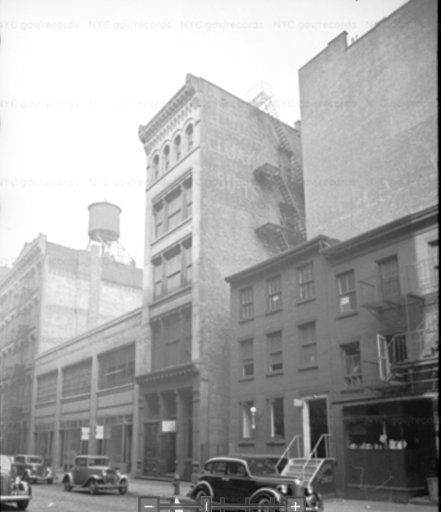
In 1941, 113 Greene Street looked almost exactly as it does today.  The house that Lippman Toplitz demolished most likely looked much like those to the right.  via the NYC Dept of Records & Information Services.

A month later Descours Genthon Cie. was rocked by a different type of upheaval.  In 1901 the firm, based in Lyons, France, had hired Alfred Schottlaender to manage the New York operation.  After he was found dead on August 17, 1908 a close inspection of the books was made.  On April 20, 1909 The Sun reported that the firm "disclosed yesterday the fact that Schottlaender...was an embezzler to the amount of $55,043.35."  That massive theft would equal nearly $1.7 million in today's money.  The firm's attorneys said, "The thefts were covered up until after Schottlaender's death by means of false cross entries and that there was absolutely no suspicion of his wrongdoing until long after he died."

Interestingly, while many of the garment firms in the neighborhood moved northward past 34th Street, 113 Greene Street continued to house apparel related companies.  In 1919 yarn merchant Barnet S. Milman leased the store and basement.  The following year the Ray Waist Co. moved in.  Already here were Morris Katz, and the Palace Waist Co.

Garment Manufacturers' Index, January 1921, (copyright expired)

As the Soho district transformed from industrial to artistic, 113 Greene Street was a pioneer in its metamorphosis.  By the 1960s upper floors had been quietly converted to artists lofts.   (It would not be until 1982 that they were officially deemed "joint living work quarters for artists" by the Department of Buildings.)


The store where Lippman Toplitz sold hats in 1883 became the Washburn Gallery in 1981.  The David Beitzel Gallery opened in 1986, and around 1991 Anna Sui established her boutique here.  It would be a Soho fixture at least until 2017.  

Anna Sui's invitation to her fall line in 2011 featured a delightful drawing of the shop.  image via The Fashion Show, 2022.

Henry Fernbach's striking 1883 structure is astonishingly intact.  Even the storefront, almost always the first to be modernized, is almost perfectly preserved.

photographs by the author
no permission to reuse the content of this blog has been granted to LaptrinhX.com

Saturday, February 25, 2023

John B. Snook's 1878 121 Spring Street


David O. Hogan lived at 90 Greene Street in the 1850's.  He made his living as a hackman, or carriage driver, and volunteered as a firefighter, or "laddie," with the Oceanus Engine Co. No. 11.  His respectable neighborhood was on the verge of serious decline.  Two decades later, John Ryan who lived next door at 121 Spring Street, was arrested for running a gambling operation in his house.  But the district was changing again at the time, as vintage homes were being razed to make way for modern loft buildings.

Catherine Lorillard Wolfe inherited $12 million (around $275 million in 2023) following the death of her father in 1872.  While she greatly used her fortune for philanthropic causes, like her father she also ventured into real estate development.  In 1878 she purchased the former Hogan and Ryan houses and hired architect John B. Snook to design a replacement store and loft building on the site.

Ground was broken on May 22 and construction was completed just six months later, on November 30, 1878.   Snook faced the building in red Philadelphia brick trimmed with sandstone.  A handsome cast iron storefront featured a robust Corinthian column at the corner and matching pilasters at either side of the store.  The entrance to the factory spaces upstairs was placed to the rear, at 90 Greene Street.  Snook's neo-Grec design incorporated stone bandcourses that connected the openings and doubled as lintels, and a bracketed cornice with a fringe-like frieze. 


The Soho district was filling with millinery firms at the time.  Wolfe's early tenants were Corn & Co., and the newly-organized Raymond J. Bennell, both hat makers; as well as A. L. Philips & Co., "cloak, furriers' and hatters' trimmings" merchants.  It was not long before Corn & Co. was the victim of burglars.

Julius Corn's firm occupied the ground floor and an upper floor.  On February 23, 1879, the New York Herald reported that George Cautine had pleaded guilty of stealing "ninety-five dozen hat bodies."  A hat merchant on Avenue A, Franz Wallehalter, was also arrested and charged with receiving stolen goods.

The following year, in November 1880, Corn & Co. filed for bankruptcy.  The Hatter and Furrier reported: 

The spacious store at 121 Spring street, corner of Greene, formerly occupied by Corn & co., has been refitted and will now be occupied by three firms:  C. H. Merritt of Danbury takes one half of the Spring street store, the other portion is rented to Adolph Wimpfheimer...The Greene street apartment is rented by Meyer Mercy of Newark, and will be used as a sample room by Frank Riley.

The magazine followed up in January, saying "C. H. Merritt, No. 121 Spring street, is making a specialty of stiff hats, with flexible brims.  Buyers are taking hold of them with eagerness."

Beginning in March 1882 a devastating financial depression swept the country that would last slightly more than three years.  Two of the tenants here would not survive it.  Raymond J. Bennell, who had borrowed $15,500 from his father-in-law in 1879 to start his business, and Meyers & Cohen both failed.

Catharine Lorillard Wolfe died on April 4, 1887 and bequeathed 121 Spring Street to her sister, Dorothea Wolfe Hoffman.  At the time the millinery industry was sharing the neighborhood with silk merchants.   Dorothea's primary tenant in 1888 was Johnson, Cowdin & Co., manufacturers of silk ribbons.  The firm's factory and mill were in Phoenixville, Pennsylvania.  

As the turn of the century approached, Sicklick Embroidery also operated from the building.  In December 1899 the firm was looking for an "experienced salesman" and "experienced applique cutters."  In both instances, the ads were titled "Bonnaz," referring to the embroidery machines invented in France in 1865 by a maker named Bonnaz.  In 1901 Sicklick Embroidery employed 7 men and 20 women, who worked 59 hours per week.

A year earlier Johnson, Cowdin & Co. had exhibited at the Paris Exposition.  Its accomplishments there smacked of today's Olympics.  The firm brought home a gold medal, three silver medals and four bronze medals.  The Report of The Commissioner-General for the United States said in part:

Johnson, Cowdin & Co. are among the few American ribbon manufacturers who take silk from reelers and spin, dye, weave, and finish their products by their own skilled operatives.  By attention to every process under one perfected interlocking organization the exhibitors are able to arrive at satisfactory results.

The judges were particularly impressed with a "brocade sash ribbon about 102 lines in width in pompadour effect, made with two and three colors."

The early years of the 20th century saw textile and apparel businesses moving into the building.  They included fabric merchants Silverman & Black; cloak and suit manufacturer Weltman, Pollack & Co.; and textile makers S. J. Hall & Son.

Silk magazine, December 1908 (copyright expired)

L. Hyman & Son, "dealers in paper, stationery, and blank books" had been located from across the street at 116 Spring Street for several years.  Then, in 1911 the firm leased the store and basement of 121 Spring Street and relocated in February 1912.  

The company was unusual in that one of the partners was a woman.  Frustratingly, because of the custom of the period, she was always referred to with deference to her gender only as Miss Hyman.  On July 25, 1914, for instance, The American Stationer wrote, "H. Z. Hyman, of L. Hyman & Son, dealers in stationery and office supplies...is expected to return from his vacation on Monday next.  Until his return Miss Hyman will continue to act as buyer."  And three months later the magazine noted, "Miss Hyman, of L. Hyman & Sons...is back at her desk, after spending a month touring New England."

The upper floors, occupied by textile dealers like Jansen & Pretzfeld, were joined by the Fordham Manufacturing Company, which took the second floor, in 1916.

American Silk-Journal, January 1912 (copyright expired)

L. Hyman & Co. was looking for delivery drivers in 1918.  Their religion-specific advertisement would raise eyebrows today: "Drivers:  (Jewish), experienced, wanted for paper and twine warehouse.  Only those having worked in such line need apply."

L. Hyman & Co. would remain in the building at least through 1921.  Other tenants in the 1920s included Ell-Jay Middy Co., apparel makers; and the Strong Machinery & Supply Company, which took space in 1927.

The New York Times, June 8, 1920 (copyright expired)

The Soho neighborhood would once again see drastic change during the third quarter of the 20th century.  In 1983 the Sonnabend Art Gallery moved into the store space, and two years later the lofts were converted to joint living-work quarters for artists. 

The Standard Casing Company occupied the ground floor space in 1941.  The building remains essentially unchanged today.  via the NYC Dept of Records & Information Services.

The Rosa Esman Gallery opened here in 1984, replaced by the O. J. Gallery 121 in 1987.  Today the audio products store of Bang & Olufsen occupies the ground floor.

The artist lofts were converted to condominiums in 1996, one per floor.  

photograph by the author
LaptrinhX.com has no authorization to reuse the content of this blog

Saturday, February 18, 2023

George H. Van Auken's 1901 78 Greene Street


The family of stock broker George Carpenter lived in the two-and-a-half story Federal style home at 78 Greene Street in the early 1840's.  The elegance of the neighborhood and the affluence of its residents were reflected in the sale of the Carpenters' furnishings when the family moved out in 1848.  The listing included a costly rosewood piano and mahogany parlor furniture.

Following the Civil War, the district became increasingly commercial.  By 1887 the former Carpenter house had been replaced with a business building owned by Sol Cohen.  He ran his seal and fur cap manufacturing business from the address.  At the turn of the century, the structure was inadequate and Cohen hired architect George Van Auken to design a replacement loft and store building on the site.

In its March 1901 issue, Cloaks & Furs announced, "The old building now occupying the premises at 78 Greene street, will shortly be removed to make room for a modern six-story loft building.  Sol Cohen, the well-known fur importer...is the owner."

Indeed the building would be "shortly" removed.  Ground was broken on March 10, 1901 and the lightning-fast construction was completed five months later on August 31.  The building had cost Cohen $30,000, or about $987,000 in 2023 terms.   Van Auken's Beaux Arts style brick-and-stone building stood out on a block almost exclusively lined with cast iron structures.  The wooden storefront within the two-story base was flanked by sturdy, rusticated stone piers.  On either side of the projecting show window were double doors--one for the store and the other to the upper floors.

The grouped windows of the second floor sat within a picture-frame-like surround of carved stone with a frothy French cartouche.  Similar grouped windows appeared in the three-story midsection.  Their expanses of glass allowed natural light to pour into the workspaces.  Van Auken alternated red brick and white limestone to create a striped effect.  A prominent stone cornice introduced the top section, where the openings were flanked by intricately-carved stone panels.  A cast metal bracketed terminal cornice crowned the design.

Working with his father was Michael L. Cohen.  In 1901 they employed ten men and two women who worked 54 hours a week in their factory making fur apparel.  Surprisingly, the Cohens moved northward within a few years.  Lofts were rented to apparel and textile firms like Frischknecht, Heilbrun Company, embroideries; F. Schmidt & Co., maker and importer of gloves, which occupied the second floor; and Weil Bros., dealers in "woolens and ducks."  (Duck is a type of canvas fabric.)

Two employees were involved in horrific incidents in 1903 and 1904.  The first involved accountant John J. Chase, who was hired by Frischknecht, Heilbrun Company in December 1902.  Described by the Brooklyn Daily Standard as "a tall man, well built, strong and robust," Chase lived in Brooklyn with his wife and three children.  On the morning of March 17, 1903, he left home, promising his 3-year-old daughter Valery that he would arrive home early to celebrate her birthday.  The article said he gave his wife 50 cents to buy her a new doll.  "Stopping only long enough to imprint a kiss on the lips of his other two children, a boy and girl, a few years older than Valery, Chase started for his work."

He walked to the elevated train station at 52nd Street.  About 50 other passengers waited on the platform with him.  As they filed onto the train, Chase lost his footing and fell between the car and the platform.  The Brooklyn Daily Standard said, "The train was in motion by this time."  Chase's right leg between the knee and thigh was pressed up against the third rail.

Passengers and train employees rushed to his aid, but he was tightly wedged in.  After he endured twenty minutes of agony,  a "wrecking car" was brought in to jack up the train enough to extract Chase.  The Brooklyn Daily Standard's headline succinctly capture the horror:  "Man Roasted To Death in 20 Minutes by 3d Rail."  Chase's death was not merciful.  He had lived through the ghastly ordeal, not dying until he reached the hospital.

At the time 25-year-old Lillian Read had worked as a "confidential stenographer and typewriter" for F. Schmidt & Co. for two years.  A native of Chicago, her position might be called an executive administrative assistant today.  The Post-Standard said, "She was attentive to her duties and is said to have performed them satisfactorily."  Her value within the firm was evidenced in her enjoying two-weeks off in the summer of 1904.

Lillian returned from that vacation on August 10.  The Post-Standard said she "appeared for business this morning as usual, but seemed to be somewhat downcast."  At noon the office staff, including her boss F. Schmidt, left for lunch.  Lillian, however, remained behind.  The article said, "Instead, she went into the private office of Mr. Schmidt, a small room partitioned off.  She locked the door and seated herself in a chair seat near the window.  Taking a bottle of carbolic acid, she drank the contents."

When Schmidt returned and found his office locked, he looked into the transom and saw Lillian slumped in the chair.  The door was broken open and she was taken to a hospital where she died.   The Post-Standard remarked, "There is much mystery as to the case of the suicide."

Other apparel companies moved into the building.  In 1909 the Powerful Clothing Company; and Priest & Reiss, both makers of waists (a popular, tailored women's blouse); and Borut Cloak Co., manufacturers of children's cloaks occupied lofts; while Reinhard Mfg. Co.'s salesroom was in the store space.  Reinhard Mfg. Co. had been incorporated in 1907 to manufacture silk ribbons.

In 1912 the South Norwalk Hat Co. moved into the building.  The firm not only manufactured men's hats, but "renovated" damaged goods.  Retailers who had damaged goods, like straw hats, brought them to South Norwalk Hat Co. for repairs.

The American Hatter, June 1912 (copyright expired)

Also in the building at the time were P. Moshkowsky & Son, makers of infants' wear; Nicholas Apfelbaum, manufacturers of women's underwear; and Tanner Souvenir Co., run by Walter S. Tanner, makers of leather goods.

In the fall of 1915, the ground floor space was used as a polling place for the Presidential election.  Hired "watchers" were common at polling sites, dispatched there to guard against voter intimidation.  This year throngs of suffragist watchers turned out across the city to ensure that no influence was being made against their cause.  The New York Times reported on October 20, "Some of the men at the polls seemed to take delight in assuming a facetious attitude toward the women watchers, declining to give serious answers to their questions."  

The need for the watchers, however, was evident.  The article reported:

For example, in the polling place at 78 Greene Street...a man, according to the suffragists, began the morning with electioneering.  The woman watcher on duty at once complained, but he did not stop.  The watcher, without wasting words, telephoned to headquarters, and within a few minutes Mrs. Frank H. Sumner arrived in an automobile, she being one of the minutewomen, ready all day long for just such emergencies.

Seeing what was going on for herself, the stalwart Mrs. Sumner got back in the automobile and drove to Police Headquarters where she made a formal complaint.  Within a few minutes a policeman arrived to move the electioneering man along.  "There was no more trouble in or around that booth," reported the newspaper.

By the Depression years, the garment district had moved northward, above 34th Street.  New types of tenants now occupied 78 Greene Street, like the hardware manufacturer Geringer and Weiss.  Working conditions at the time were difficult and The Daily Worker went so far as to describe Geringer and Weiss on January 18, 1934 as a "wholesale hardware sweatshop."  

Just having a job during the Depression was not enough to make the employees compliant.  In June 1933 The Hardware and Crockery Workers Union was organized and in January 1934 the workers of three factories, including Geringer and Weiss, walked out on strike.  The Daily Worker reported, "The shops are completely paralyzed, with the picketers refusing to permit any trucks to collect or deliver merchandise."  They demanded "better working conditions, specifically the decrease of working hours of the inside and outside men to 40 and 48 hours, respectively."

The industrial nature of the district was reflected in B & Z Steel occupying the building by the mid-1950's.  The firm dealt in "steel shelving, partitions, etc." according to a 1957 trade directory.  Three decades later, it was still here when a renovation, completed in 1985, resulted in a mixed-use building--retail, office space, and one apartment.  It was most likely at this time that a fire escape was installed, necessitating the gouging out of a portion of the cornice.  B & Z Steel now used space as a showroom.  Here metal filing cabinets, bookcases and shelving in several colors could be purchased.

The installation of a fire escape resulted in the cutting away of a third of the 1901 cornice.

By then, the Soho neighborhood had been almost completely transformed into one of Manhattan's art centers.  Visual artist Patsy Norvell worked from the building in 1991.  A pioneering feminist artist, she had founded the A. I. R. Gallery in 1972, the first in America to exhibit only women's works.

On January 2, 2007, Alison Gregor wrote in The New York Times, "B & Z [Steel] is one of the last operating businesses from the 1950s in what used to be an industrial neighborhood."  While the firm had moved its headquarters to Brooklyn, owner Robert Zeisel retained space in the building as a showroom.


Unlike so many of the Soho loft buildings, 78 Greene Street has never been converted to residential, other than the single apartment created in 1985.  Its bold red-and-white design continues to stand out among its neighbors as it did in 1901.

photographs by the author
no permission to reuse the content of this blog has been granted to LaptrinhX.com

Friday, February 10, 2023

A Remodeled Brothel - 70 Greene Street


By the mid-1850s the 25-foot-wide house at 70 Greene Street was home to sash-maker Elijah Yerks.  It was replaced by a more modern home in 1860 by Catherine M. Jones, who used it as an investment property.  Her choice of locations was, perhaps, surprising.  By now Greene street was in decline and increasingly filling with bordellos.  Greene Street had conceivably become the most notorious red light district in Manhattan.

And so, not surprisingly, 70 Greene Street became one of the district's "bagnios."  Court papers filed in October 1868 said in part:

Houses of ill-fame appear to have been selected and made to serve as places of abode for a score or more of applicants of "good moral character" upon whom citizenship purports to have been conferred.  To illustrate: No. 70 Greene street--a common bawdy-house--stands upon the files of the courts as the residence of forty-two newly-made American citizens.

It may have been the bad press, or simply the commercialization of the area that prompted Catherine M. Jones to step in.  On August 31, 1872, the Record & Guide reported that she had hired architect J. H. Coster to alter the building "from tenement to a store."  His renovations resulted in a handsome red brick structure trimmed in sandstone.  Instead of a cast iron storefront, as was becoming increasingly popular in the Soho district, Coster used stone.  His neo-Grec design included wide bandcourses that connected the openings of the upper stories.  The lintels grew less decorative with each succeeding floor--from incised scrolled carvings at the second to nothing at the fourth.  The modifications, completed in 1873, cost Jones $10,000, the equivalent of $229,000 in 2023.

An advertisement on February 4, 1873 offered lofts for rent.  "First Rate Location for offices of out [of] town buyers or a commission merchant," it said.  Commission merchants represented manufacturers whose factories were outside the city, like silk or woolen mills.  Among the initial tenants was Siegfried Swarsenski, a "manufacturing furrier," who would remain at the address for decades.

By 1880 Swarsenski had been joined in the building by another fur dealer, D. W. Gitchell.  That year in November the first of the silk merchants moved in, The New York Silk Manufacturing Company.  Firm firm's offices and showrooms were here, while its factory was in Marion, New Jersey.  

In its July 1881 issue, the Hatter and Furrier said The New York Silk Manufacturing Company "have the finest factory in the country."  The article noted the firm was "making a specialty of hat bands and bindings and have for the present season supplied a large percentage of the hat manufacturers from the great variety they produce." 

Hatter and Furrier, May 1882 (copyright expired)

By the late 1880's Siegfried Swarsenski was the last of the furriers in the building.  In 1889 Strange, Kelly & Bennett, makers of silk ribbons, occupied space; as did Simon, Israel & Co.   In 1890 Clothier and Furnisher said the latter "have a handsome store at 70 Greene street" and were "showing a very attractive line of flannelettes, flannels and materials for manufacturers of summer clothing."

Clothier and Furnisher, July 1890 (copyright expired)

In 1896 Siegried Swarsenski employed 21 men, two women, and two girls under 21-years-old.  They worked 45 hours during the week and another five on the weekend.  After being at 70 Greene Street for more than two decades, the firm relocated to University Place in 1898.

It appears Swarsenski's space was taken over by the waist manufacturer I. Silverberg & Son.  Waists were the most popular item of female apparel at the time.  The tailors blouses were worn by women of every social class.

Change to the building was about to come, however.  On December 28, 1912, the entire building was offered for lease, and in 1916 it was rented to partners Frank Mormando and Lawrence Lobesco.  The days of furs and silks was over.  The partners had just formed the American Waste Paper Co., "to deal in waste papers of all descriptions, according to The Waste Trade Journal.

The showrooms that had been deemed "handsome" a decade earlier, were converted to waste paper storage, and the storefront was altered with a loading dock.

A truck loading dock was installed at street level.  via the NYC Dept of Records & Information Services.

In 1949 the Jones estate sold 70 Greene Street.  In reporting the transaction, The New York Times noted, "The building...has been owned by one family for almost 100 years."

It continued being used for waste paper purposes for most of the century.  In 1966 the J. P. Waste Co., Inc. occupied the building.  But change, again, was coming.

In 1983, as the Soho district was rapidly becoming the artistic center of Manhattan, the upper floors of 70 Greene Street were converted to the joint living/working quarters of artists.  The loading dock was removed and that year the Friedus-Ordover Gallery moved in.  It exhibited photography, sculpture and painting.

In 1985 the Rosa Esman Gallery moved into the building.  One of its early exhibitions was "East Village Funktional," described by The New York Times as "Zany art for today."  Esman explained, "The pieces are by East Village artists and have nothing to do with modernism or post-modernism.  If anything, it's kitsch."  The Rosa Esman Gallery remained in the space through 1990.

A much different ground floor tenant arrived in 2010 when Technogym, an Italian maker of "high-concept fitness equipment," as described by The New York Times in October that year, moved in.  It still occupies the space.


The brick-and-stone building that got a 1872 maker-over after its scandalous past stands out among its cast iron neighbors on the Soho block.  

photographs by the author
no permission to reuse the content of this blog has been granted to LaptrinhX.com

Saturday, February 4, 2023

The Altered 1838 Alexander McBurney House - 79 Greene Street


Brothers Alexander and Thomas McBurney were partners in T. & A. McBurney at a time when the Greene Street neighborhood between Canal and Houston Streets was one of refined Federal style homes.  In 1838 Alexander constructed a three-and-a-half story house at 79 Greene Street.  The 25-foot-wide, brick-faced house was typical of the genteel neighborhood.  Two prim dormers would have provided extra light, height and ventilation to the attic level.

As the decade closed, T. & A. McBurney was in serious financial trouble.  Alexander took out two mortgages on his home and, according to legal documents, his mother Isabella loaned him sums of money over a period of years.  In 1842 Alexander McBurney was gravely ill.  Shortly before his death he transferred title of the Greene Street house to his mother, since he had no funds to repay her loans.

In the meantime, Thomas McBurney had filed personal bankruptcy a year earlier.  Now, to help satisfy one of his creditors, he sold "his interest or estate in the dwelling house and lot, No. 79 Greene street...for a nominal sum" to Gordon Burnham, as recorded in court papers.  There was no documentation that he or T. & A. McBurney ever possessed a portion of the real estate.  The confusion of ownership landed mother, son, and Burnham in court.  

While the legal process played out, 79 Greene Street was leased to Robert G. Nellis, who ran it as an upscale boarding house.  His two tenants in 1845 were bootmaker William M. Young, whose business was on Ann Street; and George C. Dunwell, who listed his profession as "boards," meaning that he ran a lumber milling operation.

Finally, the courts ordered that the house be sold at auction on March 4, 1846.  It continued to be run as a boarding house under widow Abby Kettlewell, the widow of George Kettlewell, and Susan Higgins.  Their boarders were professionals.  In 1853 they included John Mitchell, a partner in Mitchell Brothers gas fittings on Broadway; Henry C. Robe, a forwarder; and accountant Albert L. Winship.

In April 1861 "the three story and attic modern house No. 79 Greene street" was offered for lease.  It is possibly at this time that Nicholas Betting took over its operation.  The Greene Street neighborhood was in sharp decline.  As affluent families moved further north, a disturbing transformation took hold.  By the end of the Civil War, Greene Street would be Manhattan's most notorious red light district, lined with houses of prostitution.  Betting ostensibly ran a boarding house, at least initially. 

In the pre-dawn hours of October 29, 1867 a police officer named Casey saw a man "going up Spring-st. with a trunk on his back," according to the New-York Daily Tribune.  Suspicious, he placed John Frandrind under arrest, then returned with other officers to investigate further.  They "discovered that Nicholas Betting's house, at No. 79 Greene-st., had been forced open, and the trunk, which contained $175 worth of property, stolen."  The amount would equal about $3,300 in 2023 terms.  Faced with strong evidence, Frandrind pleaded guilty.

When Patrick Goff appeared as a witness before Judge Barnard in 1868, he described 79 Greene Street as "a common bawdy house."  By 1871 Nicholas Betting had acquire an excise --or liquor--license.  There is no evidence that he modified the house for a barroom, so he most likely presented his business as a hotel to the Excise Board.  The license allowed him to sell alcoholic drinks to his patrons.

A general clean-up of the notorious street began in the 1870s, not only because of the work of indignant reformers, but because the commercial district was pushing northward into the neighborhood.  New York's millinery industry was engulfing Greene Street by now.  Hat maker Robert White purchased 79 Greene Street and in 1874 commissioned architect J. F. Duckworth to convert it into a commercial building.  

Two years earlier, Isaac F. Duckworth had designed the magnificent 72-76 Greene Street, a cast iron "commercial palace" across the street.  It is a mystery as to whether the two architects were related or actually the same person, with the "J" simply being an oft-repeated typo.  Both had been listed as "carpenter/builder" prior to 1870, when they were listed as architects.

In either case, the transformation of 79 Greene Street would be a much less resplendent project.  Duckworth's plans, filed in November 1874, called for raising the house one story and increasing the floor space with a rear extension.  The renovations cost White the equivalent of a quarter of a million in 2023 dollars.  When completed, the Italianate style structure left no hint of the Federal dwelling.  Above the cast iron storefront, the the stone lintels and sills of the openings sat upon delicate brackets.  The handsome cast iron cornice included a paneled frieze with rosettes, flanked by two substantial fluted brackets.

White's initial tenants reflected the incursion of the millinery district into the area.  While the ground floor space was occupied by William G. Ferguson's frame shop, the upper floors were occupied by Robert White's hat manufactory; the hat shop of brothers Herman and Charles Schutter; Gore, Sparrow & Co., also hat makers; and Joseph T. Mast, dealer in "hatter's goods."

Calvin and Carlos Gore ran Gore, Sparrow & Co. with their partner David D. Sparrow.  The firm had barely moved in when it was burglarized.  On February 5, 1875, an announcement appeared in the New York Herald that read, "$250 will be paid and no questions asked for the return of the Go0ds taken from 79 Greene street the night of January 18.  Gore, Sparrow & Co."

The following decade saw apparel manufacturers move into the building.  Among the first was Julius J. Adams, a maker of ladies garments.  In August 1885, he hired 15-year-old Lizzie Swenson as a sewing machine operator.  The Sun wrote on September 19 that Adams explained, "the child had repeatedly importuned him for work, and that he employed her on the representation that her family was in needy circumstances."

Whether his hiring the teen was actually an act of kindness came into question on September 28, when the Brooklyn Daily Eagle reported that Lizzie "caused the arrest of Adams, charging him with having kissed her."  In court, Lizzie testified that on September 18, when work was over, Adams sent her out to change a dollar bill.  The Sun reported, "When she returned with the change another girl named Dora was waiting to accompany Lizzie home.  Adams sent Dora out for a package of candy, and while waiting for Dora to return, Lizzie says Adams put his arms around her and kissed her."  The embrace was apparently more aggressive than a peck on the cheek.  "She struggled to get away, and with considerable difficulty did so," said the article.''

Adams, on the other hand, accused the girl of merely seeking money.  When he received a note from his lawyer telling him of the charges, he "wrote an indignant reply, saying that he had not one cent for blackmail, but plenty for his defense."  It is unclear who won the case, but Adams, who was not only wealthy but male, had the clear advantage.

By the 1890s the building had filled with apparel firms.  Davies & Wilinski, makers of cloaks and suits, was here in 1891; and by 1893 Kohn & Baer, wholesale fur manufacturers, operated from the building.  The firm employed five men and two women that year, who worked 49 hours per week plus nine hours on Saturdays.

The Hatter & Furrier, August 1894 (copyright expired)

In its January 1895 issue, The Hatter & Furrier wrote, "Kohn & Baer, 79 Greene Street, are about winding up a most successful season in furs.  Their goods have been distributed throughout the country, in many of the best houses."  The article noted, "Kohn & Baer will make a new departure this year, going into the manufacture of cloaks and suits, as well as furs, and will have a complete line ready for January 15."

The turn of the century saw 79 Greene Street filled with apparel and dress goods dealers.  In 1901 Rudinsky Bros, makers of cloaks and suits, employed 25 men and 6 women who worked 54 hours a week.  Also in the building were Harris Siegel, a dealer in "dress goods and velvets;" and clothier Max Hurbich.

On the afternoon of July 15, 1902, Deputy United States Marshal McAveny walked into Hurbich's office and arrested him.  The Evening World reported that he "was later arraigned...on a charge of entering into a conspiracy to smuggle diamonds."  Ironically, Hurbich had just returned from Detroit, Michigan, where he testified against Louis Bush, charged with smuggling 181 unset diamonds into the country valued at nearly half a million in 2023 dollars.  Hurbich's testimony helped to convict him.  Now he was implicated and charged as an accomplice in the crime.

The building continued to house small apparel and related firms until just after mid-century, when the neighborhood was changing again.  In 1964 a renovation resulted in the "storage and sorting of rags" on the ground floor, while the upper floors were used only for storage.  

But as the century drew to an end, the neighborhood now known as SoHo saw a renaissance as artists converted lofts to studios and stores became galleries.  In 1990 the first floor of 79 Greene Street became home to Florence de Dampierre Antiques, and the second floor to Dampierre & Company, which sold contemporary decorator items.


In 1995 Agnes B. Homme, a men's apparel store opened and would remain here for a decade.  For about five years the ground floor was home to Kiki de Montparnasse described by Time Out New York as an "erotic luxury boutique...with a posh array of tastefully provocative contemporary lingerie."  In 2022 Loewe opened its two-story boutique in the space.

photographs by the author
no permission to reuse the content of this blog has been granted to LaptrinhX.com