Showing posts with label grace church. Show all posts

Wednesday, December 23, 2020

James Renwick Jr.'s 1847 Grace Church Rectory - 804 Broadway


photo by Alice Lum

Henry Brevoort's country estate engulfed 86 acres between East 9th and 18th Streets and Fifth Avenue to the Bowery.  Wealthy and apparently stubborn, when Broadway was extended to meet the Bloomingdale Road he demanded that it take a sharp bend at 10th Street so as not to intrude on his land.  And because the family house sat directly upon the proposed site of 11th Street, between Broadway and the Bowery, he prevented the opening of 11th Street throughout the 1830's.  But following Brevoort's death in 1841, his son, Henry, Jr., began selling off the family lands.

Grace Episcopal Church had been located at Broadway and Rector Street since its organization in 1808.  Rector Thomas House Taylor and his congregation were considering an uptown move, following the northern migration of its fashionable members.  Two years after Henry Brevoort Sr.'s death, the trustees bought the large plot of land at the northeast corner of Broadway and East 10th Street.

It is possible that Henry Brevoort, Jr. worked a deal into the transaction.  His nephew, 23-year old James Renwick Jr., was an engineer with a bent towards architecture.  An engineer on the massive Croton Reservoir project, completed in 1842, he was responsible for its hulking Egyptian Revival design.  He had also designed a fountain in Bowling Green.  Nevertheless, with no formal training his architectural credentials were sorely lacking.

Renwick was given the commission to design the new Grace Church.  Rev. Taylor had spent extensive time in Europe touring the great Gothic cathedrals and it was most likely he who influenced Renwick's design choice.  Gothic Revival architecture was relatively new and Grace Church would be the first significant structure in the style in Manhattan.

The masterful white marble church was completed in 1846, followed closely by the rectory.  Sitting back within a grassy yard encircled by a magnificent Gothic Revival iron fence, the charming marble house echoed the church looming above it.  Renwick's skill at design resulted in a romantic edifice that refused to be overshadowed by its cathedral-like neighbor.

Although having the appearance of a cozy cottage, the rectory was essentially a mansion.  Renwick hid the actual symmetry of the floorplan by adding different faceted bays on either side of the centered entrance.  Gothic tracery, spires and crockets, and pointed arch windows combined to form an excruciatingly picturesque structure.

The charm of the rectory was deserving of its own postcard around the turn of the last century.  from the collection of the New York Public Library

Grace Church was the second wealthiest Episcopal Church in New York, after Trinity Church.  In his 1882 New York by Gaslight, James D. McCabe, Jr. would point out, “At the morning service a greater display of wealth and fashion is presented here than at any other city church.  Grace Church has been the scene of more fashionable weddings and funerals than any other place of worship.”

Rectors of such churches were highly paid.  They and their families lived in a style similar to their millionaire congregants.  Many owned country estates and traveled to Europe or fashionable resorts in the summer months when their churches were closed.  

Rev. Henry Codman Potter was rector in 1875 when his wife, the former Eliza Rogers, planned an extended trip abroad.  She placed an ad in the New York Herald on September 30 hoping to find positions for excess servants who would not be needed in her absence:

804 Broadway, Grace Church Rectory--A lady, going to Europe, wishes to obtain situations for a cook, a seamstress and lady's maid, and a waitress, whom she can highly recommend.  Call for one week.

In 1880 James Renwick, Jr. was called back to design Grace House, a seamlessly matching 30-foot wide, three story structure that connected the church to the rectory.  The New-York Tribune reported on August 10 that it would have "a handsome white marble front, each story possessing a well-proportioned bay window.  Completed in 1881, it completed the country-like yard.

Renwick's Grace House perfectly complimented the rectory and the church.  from the collection of the New-York Historical Society.


Henry C. Potter was elected Assistant Bishop of New York on September 27, 1883 and the rectory next became home to Rev. William Reed Huntington.  He and his wife, the former Theresa Reynolds, had two daughters, Margaret and Theresa, and a son, Francis.  Like their predecessors, they moved among society's elite.

During the debutante season of 1885-86 the rectory was the scene of a glittering entertainment.  On December 30, 1885 The New York Times reported "There was a tea and reception yesterday afternoon in honor of Dr. Huntington's second daughter, Miss Theresa, at the Grace Church Rectory.  The parlors in which the guests were received were hung with evergreens and decorated with flowers.  Miss Theresa, who reached her eighteenth birthday a few days since, wore a white satin dress, with a cluster of roses at the waist and diamond ornaments."  The guest list included society names like Depew, Tiffany, Dix, Reid, Duncan, and Kingsland. 

Among Huntington's staff in 1893 were assistant ministers Rev. Hubert M. Wells and Rev. George H. Bottome.  The kind-hearted men became victims of a masterful scam artist that year.  George Stabell traveled alone to New York from Denmark in 1891 at the age of 14.  With no friends and no money, according to The Sun, "he turned his good looks, easy manners, and quick intelligence to account."  He realized that the clergy were easy marks for a sad story and lived comfortably off his scams.

One-third of the rectory was enveloped in ivy in this late 19th century stereopticon view.  from the collection of the New York public Library

In January 1893 he turned his attentions to Grace Church.  The Sun reported a month later that he told Wells and Bottome "that he had not lived an exemplary life...He admitted he had been playing the races and living a fast life.  'Now I want to reform,' said he, with tears in his eyes...'I want to be a Christian and a gentleman.  I'm out of money and have no place to eat or sleep.  Give me a chance, just one chance.'"

Moved by the repentant teen's story, Wells took him to a boarding house on West 31st Street and paid a week's rent in advance.  He gave the boy letters of recommendation to use in finding a job.

The following week Stabell returned.  He said while he had made friends at the boarding house, he still was unable to find a job.  Wells gave him $10 to pay the next week's rent (about $295 today).  The very next day the boy returned, telling Rev. Wells:

A strange thing happened last night.  When I went to my room I found there my brother, my own brother, ragged, penniless, and cold.  His hat was gone, his shoes were flapping on his feet, and his clothes were in rags.  He begged for money.  What could I do?  I bought him a ticket back to Baltimore, and with what was left I got him a pair of shoes, a hat, and something to eat.  Did I do wrong?"

Stabell had so carefully planned his story that he knew the exact amount of a ticket to Baltimore.  Wells gave him another $10.

The Sun reported, "The next day the boy was back again, this time to see the other assistant, Mr. Bottome.  It was bitter cold, and he had on no overcoat.  'I didn't tell Mr. Wells last night,' said he, 'but I had to pawn my overcoat to get my brother home.  Now I'm almost frozen without it."  He needed money to get his coat out of pawn.

At a meeting with clergy of other churches it was discovered how widely Stabell had been carrying out his scams.  The ministers had a policeman "come and talk to the boy to frighten him by threats of arrest and imprisonment."

The end to the teen's infamous career began on February 11 when he came to Wells for another $10.  "He got it on promising to return $3 of it, his necessary expenses being but $7," explained The Sun.  "By this time the clergyman had been to the boy's boarding place and discovered that instead of being busy in the morning trying to find work he was lying abed; also that he usually came home about 3 A.M."  Stabell did not return that afternoon with the $3 as promised.

That night Wells went to the boy's room and waited until 2:00 in the morning before giving up and going home.  Stabell showed up at the rectory the next morning and Wells "taxed him with treachery and deceit."  The teen "confessed, and begged for forgiveness with all the dramatic power which he possesses."  He was told to return the next day.

He returned, without the $3, and Wells and Bottomes "had a long talk with him which resulted in a conviction on their part that he was a hopeless case."  While Bottome detained him, Wells swore out a warrant at Jefferson Market Court for the theft of $3.  The Sun reported that at Stabell's arraignment, "He begged for just one more chance before he was sent to prison, but Mr. Wells had been through it all before and he declined to be deceived again."  None of the other clergymen he had duped would answer the plea-filled notes he sent from jail.  One said "He could make one believe that he was a saint in ten minutes, no matter how much appearances might be against him."

A disturbing incident occurred on April 27, 1894.  Policeman Sullivan arrested John Sullivan, described by the New-York Tribune as "a homeless, insane man, fifty years old," after he was caught "pushing his fist through the windows of Grace Church rectory."  By the time the officer arrived, he had broken several of the panes of glass.

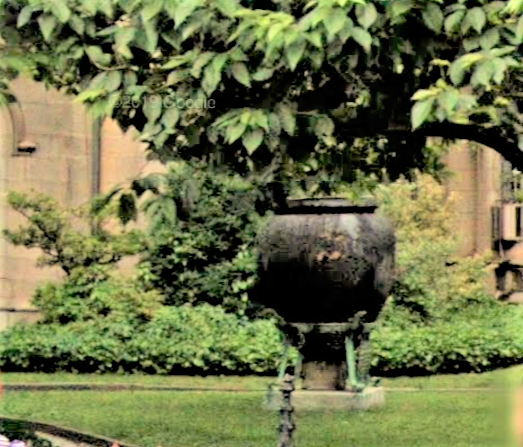
In 1899 Rev. Huntington added a notable ornament to the rectory garden--an ancient Roman jar.  In his comments in the Year Book that year he explained that when excavations in Rome were being dug for the Rectory of the Church of St. Paul, "some six of seven terra-cotta jars" dating from Nero's reign were discovered about 30 or 40 feet below the surface.  Two were brought to the surface.

When I was in Rome in 1884, the two jars, covered with ivy, were standing one on either side of the entrance to the church.  I was hard-hearted enough to urge upon Dr. Nevin, the Rector, the propriety of his showing his appreciation of all that Grace Church had done toward the building of St. Paul's by giving us one of his two jars; and he was kind-hearted enough to acquiesce in the suggestion.

When the relic finally arrived in new York a bronze mounting was created for it and it was placed in the garden where it sits today.

At around 10:00 on the night of February 7, 1900 servants discovered a man in a room in the basement.  The Sun reported, "He seemed to be very much startled, but when one of the servants returned with a policeman, he pretended to be intoxicated."  Burglar tools were found on him and he was locked up "as a suspicious person."

The incident was a precursor to a more significant incident one year later.   On the morning of April 30, 1901 a maid entered the dining room to find silverware littered over the dining room carpeting.  "It was evident to her at once," reported The New York Times, "not only that burglars had gotten in, but that they had been frightened off, without having been able to take all that they had prepared for removal."

The thieves had carefully plotted their heist down to the point of apparently watching through a dining room window to see where the maid hid the key to the silver safe.  They had entered through a basement door, as the intruder the previous year had, and stealthily crept upstairs by the light of a candle.  That they had been scared off was evidenced by the candle, a box of matches and the chisel they had used to jimmy the basement door, all of which they left behind in their haste.

Despite their rapid departure, they managed to carry off "knives, spoons, salt cellars, and other small pieces which could be stuffed into pockets or carried away under a waistcoat or coat."  The article noted "The unfortunate feature of the robbery is that Dr. Huntington lost through it a number of heirlooms, which as he explained last evening, had been in the family a long time."

The detectives and patrolmen on duty in the area received a "lecture" from Police Captain Chapman who called it "a shame that men in his precinct should have allowed a burglary to be committed in so prominent a place."

photo by Beyond My Ken

More than a century later James Renwick Jr.'s charming rectory, along with its garden complex behind the cast iron fence, is a Victorian time capsule.  The rectory warrants almost as much attention for its architectural beauty and significance as does the church beside it.

Thursday, June 4, 2015

The Gothic Revival Nos. 806-808 Broadway


In September 1852 Allen Dodworth opened his Dancing Academy in a new double-wide brownstone structure at Nos. 806 and 808 Broadway.  He and his family lived in part of the building while the magnificent Dodworth’s Hall made up the remainder. 

On September 16 The New York Times gushed “In this City of magnificent tastes, private enterprise, stimulated by boundless liberality, erects palaces, decorates and furnishes them in the style that may well be called royal, and after incurring an expense that would be deemed ruinous in plodding Europe, realizes vast fortunes by its brilliant experiments…Prosperous of a joyous temperament, and with hands open as the day, the people of New-York long ago determined that their amusements, like their business, should be conducted on a grand and magnificent scale—and they are.”

It was merely an introduction to a description of Dodworth’s new edifice.  The newspaper said Allen Dodworth “is unquestionably the occupant of the most splendid private Dancing Acadmy in this country.”

Dodworth Hall sat directly north of the Grace Church rectory which, like the church, was designed by James Renwick, Jr.   The Hall blended in with the nearby mansions—faced in brownstone and designed in the Italianate style. 

But the northward migration of Manhattan’s wealthy that had prompted Dodworth to erect his exclusive academy here continued on.    In 1861 he left Broadway, moving his high-toned hall to Fifth Avenue and 26th Street.  The Broadway venue where New York’s upper crust had heard Europe’s finest performers now offered crowds cheap amusements.

By the second half of the 1880s the Broadway blocks below Union Square filled with retail stores and shops.   The end of the line had come for Dodworth’s Hall.  In 1887 the architectural firm of Renwick, Aspinwall & Russell designed a store, office and loft building for the site. 

Completed the following year, it intentionally melded with the Grace Church complex.  Five floors of beige brick sat on a cast iron and brownstone base.  Exuberant terra cotta Gothic Revival details, pointed arches and corbels combined in a stately, nearly ecclesiastical structure.  The side wall, which would have been blank in nearly any other midblock location in the city, was as decorated as the Broadway façade, forming a romantic northern enclosure for the Grace Church lawn.


The building quickly filled with a variety of tenants.   On January 1, 1888 Robert K. Davies & Co., importers and manufacturers “of men’s furnishing goods,” moved in.  The firm, originally named John M. Davies & Co., had been started around 1850 by John M. Davies, who died in 1871 leaving an estate of more than $1.3 million.  When John M. Davies, Jr. died in 1887, the surviving son Robert carried on the business.

On April 20, 1890 The New York Times reported on the newly-formed American Book Company.   The result of a merger of four of the largest school book publishers in the country—Ivisen, Blakeman & Co., A. S. Barnes & Co.,  D Appleton & Co. of New York, and Van Antwerp, Bragg & Co. of Cincinnati—it now took space in the Broadway building.

Seeger and Guernsey’s Cyclopaedia of the Manufacturers and Products of the City of New York listed the broad array of school supplies also offered by the American Book Company.  Included were pen holders, pencils, pen racks, pen moisteners, rubber erasers, rulers, thumb tacks, school writing books, and writing books.

Three months before the American Book Company moved in, Robert K. Davies’s business had begun to crumble.  His sister-in-law had sued him for her deceased husband’s share of the business, costing the company $127,000.  Then he discovered that the business owed his father’s estate $265,000; although Davies insisted to the courts that there was no estate money in the business.

Gentlemen who had shopped at the high-end men’s store for decades were no doubt astonished when they read the headline in The New York Times on January 15, 1890 “Robert K. Davies Fails.”

A year and one day later, on January 16, 1891, Robert K. Davies suffered a massive heart attack in his home, dying instantly.

Other tenants in the building included builder H. T. Ambrose by 1894, and architect William Debus, who would maintain his offices here for several years.  In 1900 he was busy designing several Brooklyn tenement houses; and in 1901 designed Brooklyn structures for two other builders who also leased space in the building, Jacob Schauf and Louis Beer.

By now the millinery and garment districts had engulfed the area.  In 1896 Weld, Colburn & Wilckens, makers of scarves and suspenders, was in the building, joined soon by Hill Brothers ladies hat manufacturers.

advertisement from The Menorah, May 1901 (copyright expired)

In 1903 Hodgman Rubber Co. moved in.  The manufacturer and wholesaler sold “rubber surface clothing, slip-ons,blankets and hospital sheetings, druggist sundries and surgical goods, elastic bands, and coated cloths of all descriptions.”  With George F. Hodgman in the firm were his two sons, S. Theodore and Goerge B. Hodgman.

When George B. Hodgman’s health began failing in 1906, he and his wife sailed for Europe “in the hope that the change would benefit his health,” according to The New York Times on September 29.  The 61-year old businessman died in London on September 28.

Hill Brothers advertised in The Illustrated Milliner, 1902 (copyright expired)

By 1905 the building was home to Samuel W. Peck & Co., makers of boys’ clothing.  The firm manufactured its own brand, Sampeck,  An advertisement in the New-York Tribune that year boasted “the beauty of the fabric, the careful tailoring, the minutely accurate gradation in the cut of the pattern.  The grading of the pattern determines the degree of perfection in the fit.”

While Samuel W. Peck garnered a fortune in his boys’ clothing business, his luck was otherwise not as good.  He lived with his wife in the smart Ansonia Hotel on Upper Broadway.  A quiet night at the theater later turned wild when, on January 18, 1905 their chauffeur, Gustav Swanson, picked them up in their “Victoria automobile” and they headed home.  Swanson, it seems, had a heavy accelerator foot.

“As they whirled up Broadway beside a big touring car, driven by Leo Trousler,” reported The New York Times the following day, “Bicycle Policeman Bullman of the West Forty-seventh Street Station gave chase.”  In 1905 speeding automobiles were easily matched by in-shape bicyclists and Officer Bullman intended to stop the reckless drivers.

He “sprinted along behind the autos” up Broadway from Times Square to 52nd Street, where Trousler made a sharp turn directly into the path of the policeman.  Bullman “struck the touring car full tilt, pitched off his wheel and slid twenty feet along the pavement.” 

Despite his tumble, he had no intentions of letting Peck’s automobile get away.  He shouted to another officer who took up the chase.  “Kerrigan caught up with the Pecks’ Victoria at the Circle,” reported The Times.  “Mr. and Mrs. Peck accompanied their chauffeur to the West Forty-seventh Street Station, where Mr. Peck furnished bail.”

Samuel Peck's advertisement in the New-York Tribune illustrated a variety of boys' fashions -- March 24,1907 (copyright expired)

Peck’s bad luck continued on the night of October 20, 1908 when burglars blew open the safe in his Broadway offices.  In order to blow the safe, the thieves used plaster of paris to seal the cracks.  In doing so, they spilled the powder on the floor, then walked through it during their escape.

In a stunning example of early forensic detective work, the police solved the case.  The New York Times later said “it was one of the most daring that the police have had to solve in some time, and bore all the earmarks of a job done by practiced cracksmen.

“Through the marks left by the plaster of paris dust the three were traced to various houses, until they were found in Brooklyn.”

The gang of three—William Pesky, the leader, his sister Minnie, and her husband, Frank Marquette—were arraigned in the Tombs Court on November 12.  But Pesky and his lawyer had a trick up their sleeves.  The Times said that he “behaved like a maniac yesterday…and it became known that an effort will be made to prove him insane.”

Pesky’s lawyer, Moses A. Sachs, told the court that he “has been of unsound mind ever since childhood, when a bad fall resulted in injuries affecting his brain.”

On cue, Pesky launched at a witness “and grabbed for his throat, but three big court policemen threw themselves between the men and seized pesky.  He fought desperately, kicking, biting and scratching, and the policemen rolled over the floor with him, while lawyers and witnesses were scattered in all directions by the fighting men.”

In the meantime, Pesky’s sister screamed and tried to get into the fray.  Four policemen had to carry her, kicking and screaming, out of the courtroom.  No sooner had Pesky been controlled and sat on a bench, he started another violent attack.  Finally, the judge gave up and postponed the hearing until the next day.

Samuel Peck would remain in the building at least through 1914.  Another boys’ clothier,Dubbelbilt, would make No. 806-808 Broadway home around the same time, into the 1920s.  In 1918 the firm advertised its Dubbelbilt Mackinaw as “the niftiest, thriftiest coat you’ve ever seen.”

Two tenants, E. & R. Rosenberg and Al Jacobsen, ran into trouble in 1925.  The first was Jacobsen, who ran a men’s clothing store at street level.   He was the victim of a brazen robbery of seven overcoats on January 13 that year.

Just as Police Inspector Thomas M. Fay, Chief of Staff of the Detective Division, and his driver, Detective Sergeant Lines, approached the building in their unmarked car, a taxicab sped up to the curb.  “One of the occupants of the taxi hastened into Jacobsen’s shop while the driver held the taxicab door open” reported The Times.  “In a few seconds the first man returned with a bundle of overcoats, threw them into the taxi and ordered the driver to speed up.”

Detective Lines jumped out of the police car with his pistol drawn and arrested the man who had thrown the coats into the cab.  The driver sped away into the tangle of traffic with the coats in the back seat, leaving his cohort to fend for himself.

“Lines’s prisoner had to be beaten into submission,” said The Times.

An even more frightening episode occurred in the shop of E. & R. Rosenberg later that year in July.  The firm, described as “one of the largest manufacturers of men’s clothing in the country,” did not hire union help.  Reuben Rosenberg explained “We pay our employes good wages and they are satisfied with conditions under which they work.  The unions, however, warn me that I must join them or suffer the penalty.”

“The penalty” came on the afternoon of July 15.  For months union thugs visited non-union shops carrying lead pipes wrapped in newspapers, threatening workers and sometimes stealing garments.  Called “visiting committees,” their purpose was to strong arm owners into hiring union workers.  But today the visiting committee would go beyond threats.

Six armed men entered the offices just after Rueben Rosenberg had left for lunch.  Five went directly into the shop area while one held a gun on the telephone operator, Helen Cohen, and warned her not to answer the switchboard.

The five men lined up the nine workers—four of them women—against the wall and told them that “resistance would mean death.”   Held at gunpoint by two men, the terrified employees watched as the other three produced bottles of sulphuric acid which they poured over high-priced overcoats.  The thugs then ran down the stairs and into a waiting automobile.

Rosenberg valued the ruined garments at between $60,000 and $100,000.

Throughout most of the 20th century the building would continue to attract tenants in the garment trade.  In the 1930s Lubell Bros. Mfg. Co. was here, makers of boys’ shirts.  In the 1940s Criterion Shirt Band Co.; Rosenhirsch Company, importers; Spiegel Brothers Corporation; and Eastern Textiles Co. were all in the building.


In 1981, as the Noho neighborhood experienced a rebirth, the remarkable building was converted to 69 cooperative residential units.  Given the slightly-misleading name The Renwick, its magnificent ivy-covered façade survives as an integral part of the charming Gothic Revival ensemble.

photographs by the author

Thursday, July 21, 2011

James Renwick's Masterful 1846 Grace Church

Grace Church before the addition of Catherine Lorillard Wolfe's chantry in the south lawn -- photo  from the collection of the New York Public Library

According to New York City lore, Broadway swerves sharply to the northwest at East 10th Street because the wealthy and influential Henry Brevoort refused to allow the thoroughfare demolish his orchard.

The fact that his tavern stood on the site is rarely mentioned.  But for whatever reason, that Brevoort is responsible for the dramatic turn in the road is uncontested.

By 1841, when Brevoort died, his land was developing into one of the most fashionable residential neighborhoods in the city.  The parish of Grace Church at Broadway and Rector Street was rapidly growing, and in 1843 Henry Breevort Jr. sold land on the northeast corner of Broadway and 10th Street as the site of a new structure.

Whether  Brevoort had anything to do with his nephew being given the commission to design the church is unclear; however 23-year-old James Renwick, Jr. had no actual experience as an architect.  The only job he had completed to date was a fountain downtown in Bowling Green.

Rector Thomas House Taylor had spent extensive time in Europe touring the great Gothic cathedrals and it was mostly he who influenced Renwick in his design.  Gothic Revival architecture was essentially unheard of in New York at this time, with most churches designed as Greek temples.

Grace Church was completed in 1846, three years after the cornerstone was laid.  Although the main building was constructed of white marble quarried by inmates at the Sing Sing prison in Ossinging, New York, the steeple–high above street level and not so noticeable—was wooden to reduce expense.  

Its ideal location in the elbow of Broadway gave the structure dramatic visibility along Broadway looking uptown.  In 1891 Gustav Kobbe wrote, “Hardly any building in the city occupies so advantageous a position from an architectural point of view, for it faces obliquely down Broadway, effectively ending off the vista from down town.”

As seen here in around 1890, the site at the abrupt turn of Broadway provided an advantageous setting -- photo NYPL Collection

Renwick had studied copybooks and etchings of the great cathedrals to design a remarkably perfect structure.  King’s Handbook of New York City said, “Few if any of the churches surpass Grace in beauty of interior design and decoration.  It is impressive and magnificent.”

The plain, wooden steeple is evident in an 1850 print -- NYPL Collection


The year that the church was completed, construction began on Renwick’s rectory, finished in 1847.  The complex sat on a broad lawn behind a cast iron fence.  “In front of the parsonage is a pretty garden,” wrote Kobbe, “with well-kept lawn, flower-beds and shrubbery, the whole forming a most picturesque break in the line of business houses.”

In 1888, Renwick was called back to design a replacement steeple, this one in marble.  He produced a lacy stone spire that magnificently complimented the original structure; although the stone came from Vermont and, upon close examination, is noticeably whiter.

Upon inspection, the difference in color of the Vermont stone is evident -- photo by Alice Lum

The congregation of Grace Church was composed of some of the wealthiest families in the city.  It was the second wealthiest Espicopal Church in New York, after Trinity.  In his 1882 New York by Gaslight, James D. McCabe, Jr. wrote “At the morning service a greater display of wealth and fashion is presented here than at any other city church.  Grace Church has been the scene of more fashionable weddings and funerals than any other place of worship.”

Indeed, it was considered the greatest of prestige to have either a “Grace wedding” or a “Grace funeral.”   Attending the funeral of Mary Rogers Rhinelander, for instance, were Mr. and Mrs. William, K. Vanderbilt, Mr. and Mrs. Frederick Vanderbilt, Mrs. William Astor, Mr. and Mrs. John Jacob Astor, Chauncey M. Depew, M. Roosevelt Schuyler, and J. Pierpont Morgan among others of New York’s most socially elite.

Renwick's picturesque 1847 rectory -- Photo by Alice Lum

To prevent the common gawkers from ruining a Grace wedding, long awnings were erected from the entrance to the curb, with cloth panels extending to the ground.  These enabled the bride and the privileged guests to alight from their carriages and enter the church in privacy.  This highly-sought privacy scandalously collapsed, however, during the wedding of the Earl of Craven to Cornelia Martin in April of 1893.

“The disgraceful scenes which followed the opening of the side doors of Grace Church…was the main item of conversation of the ladies of fashion at luncheon and of the gentlemen of fashion at the clubs yesterday,” reported The New York Times.

Inside the church 1,500 refined guests witnessed the ceremony, while outside crowds gathered hoping to catch a glimpse of the affair.  The sextons prematurely unlocked the side doors and were rushed by the crowd, many of them jumping the fence and leaving “portions of their clothing on the pickets.”

“Ladies and gentlemen whose dress and bearing showed a certain amount of refinement and good breeding disregarded every rule of etiquette in their mad desire to see the inside of the church,” reported The New York Times.

One wealthy guest, Mrs. S. Van Rensselaer Cruger, was repulsed.  “They talked in loud, vulgar voices,” she said, “Ladies forgot the modesty of their sex in elbowing their way to the front.  Men forgot their manliness in pushing others aside, and even used the backs of the pews as a highway to reach the front, and in the crush my dress was nearly torn from me.”

But despite the spectacle of the Earl’s wedding, no nuptial at Grace Church would ever attract more attention than the 1863 wedding of General Thomas Thumb and Queen Lavinia Warren.   P.T. Barnum’s famous show attractions, whom The New York Times dubbed “The Loving Lilliputians,” were married before a mixed audience including the Civil War luminary Major General Burnside and “each and every strata of New York’s respectable society.”

photo by Alice Lum

Broadway between Union Square and 19th Street was packed with onlookers and from every window and door of nearby buildings people craned their necks.   The line of carriages dropping off wedding guests continued, unbroken, for over two hours preceding the arrival of the bride and groom.  After the ceremony, hundreds of people pursued the couple’s carriage on its way to the Metropolitan Hotel.

Renwick's graceful tracery of the rose window is unusually sinuous -- photo by Alice Lum

Gustav Kobbe pointed out that “there is an idea prevalent that [the congregation] is a self-satisfied collection of worshippers, partaking of religious stimulants in commodious and elegant quarters, and not caring very much what becomes of the souls of the rest of the world.”  On the contrary, he insisted, the church was engaged in a “vast amount of arduous mission work,” supporting its own missions, a library and reading room and a nursery.

Church member Catherine Lorillard Wolfe donated the chantry and two organs “connected by electrical machinery,” in 1879 as a memorial to her father.  Adjoining it, Grace House was erected two years later.   Wolfe additionally donated the chancel window, the altar and the lofty reredos.  Then, in 1903 architects Heins and LaFarge were commissioned to extend the chancel fifteen feet.
The chancel, donated by Catherine Lorillard Wolfe, with spires matching the main building, rises behind the elegant Gothic cast iron fencing -- photo by Beyond My Ken

Upon completion of the chantry, the rector hired Gotthelf Pach to photograph it.  When the magnesia powder was ignited to take a flash picture, the resulting explosion blew out some of the stained glass windows.
Grace House connects the Rectory to the main building -- photo by Beyond My Ken

As the 20th century drew to a close, the iron plate that anchored the iron rod running down the center of the spire, pinning the stone together, had substantial rusted.  The result was that little-by-little the steeple began leaning until, in 1993, it was at a noticeable 6-inch tilt.

As correction of the problem began, “sugaring” of the stone was apparent–the powdering away of the surface due to weather and pollution.  Architect Robert Bates supervised a $3 million restoration that included removing and rebuilding 20 feet of the steeple, repairing the leaking roof and stone reparation.

In 2011 restoration of six complex stained glass windows was completed by Michael Padovan’s Jersey Art Stained Glass Studio.

photo by Alice Lum

Grace Church sits regally at the crook in Broadway as it did in 1846, a charming and magnificent assembly of historic buildings.  It is, as the AIA Guide to New York City called it, “One of the City’s greatest treasures.”