Showing posts with label east fourth Street. Show all posts

Wednesday, July 8, 2026

Sewing Women, Socialists and Theater - 85 East 4th Street


photograph by Carole Teller

Developers sometimes lobbied the Board of Aldermen to rename a block or two upon which their new upscale homes sat.  Their goal was to create the sense of exclusivity.  In 1836, Longworth's American Almanack noted, "Part of Fourth [Street], between the Bowery and Avenue 2d, has the soubriquet of Albion-place."

Among the fashionable homes on the block was 411 Albion Place, aka 411 Fourth Street.  Erected around 1834, it was two-and-a-half stories tall above an English basement.  Clad in Flemish bond brick, its Federal design included a peaked roof punctured with two dormers.  (The address would be a moving target for letter carriers and visitors.  It was changed to 427 Fourth Street in 1850, and to 85 East 4th Street in 1864.)

Hanna Brown lived here as early as 1836.  Born in 1774, she was the widow of Adam Brown.  Hanna had moved here from 38 Rivington Street.  After living here alone with her servants several years, she began suffering what The Evening Post would call, "a lingering illness."  She died at the age of 65 on December 16, 1839.  Two days later, a one-line notice appeared in the Morning Herald:

The widow of the late Adam Brown, a highly respected and deeply lamented lady, will be buried today, from 411 Fourth street.

(The fact that only the Adam Brown's name, not Hanna's, was mentioned in her funeral notice would be highly surprising and offensive today.)

Four months later, on April 21, 1840, Hanna Brown's things were auctioned in what today we would call an estate sale.  Auctioneer E. H. Ludlow described, "splendid fashionable furniture," damask and silk window curtains, and bronze candelabras among the offerings.

The house next became home to the Graydon family.  Born in County Tyrone, Ireland around 1781, John Graydon ran a "tingood" business on Beaver Street.  He married Elizabeth Whitley around 1803 and the couple had nine children, at least five of whom lived with their parents.  John W. was an attorney; Joseph and Samuel ran a dry goods business on William Street, William was listed in directories as "merchant" at 61 Cedar Street, and Jane Graydon Sherrerd was the young widow of Archibald Sherrerd, who died in 1836, three years after their marriage.  The Graydon family's country home was in Ridgewood, New Jersery.

It was likely the Graydon's who replaced the Federal style doorway (which was now falling from fashion) with an up-to-the-minute Greek Revival example.  Engaged, fluted Doric columns upheld a substantial entablature and cornice.

The family received an unexpected package at the basement door on June 4, 1855.  The New York Times reported, "The practice of dropping babies has become almost a mania of late in the City.  Monday evening there was one found at No. 427 Fourth-street, and taken to the Almshouse."

It was likely the substantial Grayson population within the house that prompted its enlargement in 1857.  The attic was demolished and a third and fourth floor erected.  Construction was completed in 1858.  The alterations included a fashionable Italianate cornice.

John Graydon died in the Ridgewood house on January 29, 1864 at the age of 83.  His funeral was held in the Fourth Street house three days later.

In 1867, Hannah Hosier operated 85 East 4th Street as a boarding house.  Although well-to-do businessmen like John D. Billings, a lawyer, and piano maker Edington B. Decker, boarded here in 1867; Hannah seems to have catered to college students.  In 1869, six Columbia University students lived here.

Jane E. Carman took over the operation of the boarding house in 1871.  On May 18, the New-York Tribune reported, "The Boarding-House for Sewing Women has been removed from No. 262 East Broadway to No. 85 East Fourth-st."  The house doubled as the headquarters of the Young Woman's Aid Association.

On December 16, 1875, The New York Times reported that Michael Ryan had purchased the house for $14,000 (or about $424,000 in 2026).  He and his wife Agnes operated it as a boarding house and his tenants were highly varied.  Living here in 1879 were the Gantzberg family--Albert was a weaver, Bertha a nurse, and Julius a teacher--as well as Charles Laroche, who was an actor; physician Alexander Weldmann; and a tax collector and two clerks.

The Ryans sold 85 East 4th Street to Charles F. and Marie Kremer in February 1883 for $15,500.  They converted the basement level to the Second Avenue Club.  The Documents of the Senate of the State of New York described it in 1887 as a "club and coffee house."

Two years later, in March 1889, the Kremers leased the house to Paul Wilzig.  By then, the once refined neighborhood was Manhattan's center of the Socialist movement.  Within days of Wilzig's signing the lease, on March 30, 1889 the Record & Guide reported that he had commissioned architect H. W. Fabian to renovate the interiors at a cost equal to $180,000 today.  

The result was Wilzig's Hall, also known as Wilzig's Assembly Rooms.  It quickly became a favorite meeting space.  On June 23, 1891, for instance, The Evening Post reported, "The Convention of the International Machinists' Union of North America was continued this morning at Wilzig's Assembly Rooms."  And on August 31, the New-York Tribune reported, "A meeting of the new Socialist Central Union was held at No. 85 East Fourth-st. yesterday morning, and it was permanently organized under the name of the New-York City Federation of Labor."

The Kremers leased 85 East 4th Street to Robert L. Worm in July 1908.  He converted it to Casino Hall, while continuing to cater to labor and Socialist groups.  On July 30, 1909, the New-York Tribune reported, "A benefit concert and entertainment for the unemployed of this city will be given this evening in Casino Hall, No. 85 East 4th street, under the auspices of the International Brotherhood Welfare Association."

Labor disputes in the early 20th century often involved violence.  In 1910, the Cloakmakers' Union went on strike.  Rather than march in the picket lines, five workers went to Hunter, New York where they found employment.  It did not sit well with union bosses.  The New York Times reported, "When the information was received by the union, men were sent to Hunter to bring back the five members."

Herman Liberwitz was one of those workers.  When the train pulled into Grand Central Station, three of his comrades were able to escape.  Liberwitz and the other man were not so lucky.  They were brought to 85 East 4th Street and beaten by Morris Stupniker, described by the newspaper as a labor union "strong-arm man."  Herman Liberwitz was "beaten over the head with a club and died of a fractured skull the next day," reported The New York Times.  The other man was "badly beaten."

Terrified of "starkers," (the lingo for a union goon who enforced union rules, patrolled picket lines and dealt with strike breakers), workers refused to give any information to authorities.  It would be four years before detectives got enough evidence to arrest Stupniker and union vice-president Max Sigman for Liberwitz's murder in April 1914.  

A persistent Deputy Police Commissioner Frank Lord was not done.  A year later, on May 12, 1915, The New York Times reported that he "went out last night to arrest east side gangsters, who, it is alleged, have been hired to do 'strong arm work,' and even commit murder."  Indictments against 34 men, "eleven of whom were gangsters, and twenty-three labor union officials in the textile trade," had been returned. 

In the meantime, Casino Hall continued to be a popular meeting place.  On June 29, 1914, an obviously unsympathetic New-York Tribune reported, "A number of groups of anarchists and other radical people met yesterday at Casino Hall, 85 East Fourth st."

Later that year, The New York Times reported that the Anarcho-Syndicalist League of Greater New York had been formed here.  "The symbol of the new league is a representation of the pyramid and mailed-fist urn in which were placed the ashes of Caron, who was killed when a bomb exploded in his flat."

On August 4, 1921, the New York Herald reported that B. H. Cohen had leased 85 East 4th Street for 21 years.  The article said he "will remodel it into a catering building."  Cohen initially kept the name Casino Hall.  It also continued to cater to Socialist groups.

On December 16, 1922, for instance, The Daily Worker, published by the Community Party, reported on the "fifth evening of the big six-day Russian bazaar" in Casino Hall.  That night would include a concern by composer and pianist I. Arnstein.

By 1927, the name of the venue was Royal Hall.  On December 2, 1929, The New York Times reported, "The injection of communism into a mass meeting of nearly 300 subway construction workers precipitated a clash yesterday afternoon in Royal Hall."  The article said, "chairs and water classes were used as weapons as scores of workers belabored each other."  Although no arrests were made, there were "plenty of black eyes and bruised noses, and several men were cut by chair rungs."

Another name change came by the early 1930s.  On May 5, 1934, The Daily Worker reported on a "gala entertainment and party for the benefit of the victims of Austrian fascism, at Palm Casino, 85 East Fourth Street."  (Reportedly, the Palm Casino was, in fact, a speakeasy owned by Italian-born gangster Charles "Lucky" Luciano.)

image via the NYC Dept of Records & Information Services.


After decades of catering to Socialist and labor groups, a portion of 85 East 4th Street became home to the United Ukrainian Organizations of the United States around 1939.  

The space that had seen raucous meetings and celebrations for decades became a theater at midcentury.  On May 7, 1955, The New York Times reported that actor Will Geer would sponsor a tribute to the late Vernon Rice "at the Folksay Theatre, 85 East Fourth Street."  The venue became the Downtown Theatre in 1956, and to the East End Theatre around 1960.

On January 16, 1965, the New York Amsterdam News reported that the American Theatre for Poets had leased the East End Theatre, saying it "plans to remodel the theatre, enlarging the stage, and installing special new lighting and sound systems."  Once again, the theater was renamed.  On August 21, the New York Amsterdam News reported that Arise, Arise premiered "at the newly named Cinematheque East Theatre."

In the meantime, the rest of the building was known as Ukrainian Hall, home to the American-Ukrainian Heritage Society and the East Side Forum.  Appearing in the Forum in September 1967, was editor-journalist James Aronson who spoke on "1968: New Politics and Revolution?"

Less political events, of course, were held here.  On May 3, 1973, The Daily World reported on the Spring Candlelight Dance held here, sponsored by the American-Ukrainian Heritage Society.  Around 1981, Ukrainian Hall was renamed Ukrainian Labor Home.

As a boy, Denis Woychuk was brought to the Ukrainian Labor Home by his father, who was looking for work.  Years later, in 1983 and after becoming an attorney, Woychuk bought the building.  He opened the Kraine Art Gallery here and converted the theater space to the Kraine Theater.

Around 1993, Woychuck opened the Kraine Gallery Bar, aka KGB.  It was followed by a black box theater on the third floor called The Red Room.  That space was remodeled in 2013 as a speakeasy-inspired performance venue.

Sharing the building in the 21st century are the New York Neo-Futurists which, according to The WNET Group's website, "create theater that is fusion of sport, poetry and living-newspaper;" a branch of the New York Comedy Club; and the long-lasting KGB Bar.

photograph by Carole Teller

Despite its many iterations and several unsympathetic alterations like the parlor-floor entrance, it is not difficult to imagine the house when the wealthy Graydon family occupied it a century-and-a-half ago.

many thanks to artist Carole Teller for suggesting this post

Wednesday, June 17, 2026

Medicine, Socialists, and Theater - the Oft-Altered Merrill Williams House - 83 E. 4th Street


photograph by Carole Teller

In the 1830s, a few developers lobbied the city to rename a block or two upon which they had erected high-end residences.  If they were successful, the blocks acquired a sense of exclusivity.  The 1836 Longworth's American Almanack explained, "Part of Fourth [Street], between the Bowery and Avenue 2d, has the soubriquet of Albion-place."

Among the homes along Albion Place was that of stockbroker John W. Stebbins and his family.  Their Federal-style house was faced in Flemish bond brick and sat above an English basement.  Originally two dormers pierced its peaked roof.  

Interestingly, the Stebbins family listed their address as 409 Fourth Street in 1836, rebuffing the Albion Place name.  And, equally interestingly, all of the subsequent occupants followed suit.  Visitors and mail carriers, nevertheless, would have other issues with which to contend in the upcoming years.  In 1850 the address was changed to 425 Fourth Street, and in 1864 to 83 East 4th Street.

Born in 1807, John W. Stebbins was a partner with his brother H. G. Stebbins in the brokerage firm Stebbins Brothers at 50 Wall Street.  Despite his young age, he was also the president of the Mercantile Library Association.  His residency here would be short-lived.  On June 4, 1837 he died at the age of 30 "after a protracted illness, according to The Evening Post.  His funeral was held on June 6 "from his late residence 409 Fourth st., Albion Place," said the newspaper.

When the property was scheduled to be sold at auction in February 1846, it was described as:

The elegant two story and modern attic brick house, No. 409 Fourth st, having basement and entire under cellars, tea room in rear, front and back stair ways, croton water in kitchen and second floor in closets.  It is altogether a first class modern house.

The mention of Croton water was significant.  Indoor plumbing, made possible by the Croton Reservoir, was not available before 1842.  So this house was among the very first to have the luxury--not to mention the "closets" on the second floor.  Water closets, or toilets, were an expensive indulgence.

The house was purchased by Henry A. and Rosalie Heiser.  At the time, Henry ran a dry goods business on Pearl Street.  He changed course in 1851, turning to shipping.

That year was one of joy and tragedy for the Heisers.  A baby boy, Russell, was born in May 1851 and he died just before turning four months on September 8th.  His funeral was held in the parlor the following afternoon.

The widowed Dr. Merrill Whitney Williams purchased the property in 1855.  Born in 1801, he married Eliza B. Duyrea in June 1826 and began his practice the following year.  Eliza died in 1844.  Moving into the house with Williams was his only surviving child, Elizabeth Ann (known as Lizzie), who was 20 years old in 1855.  (Two children John Duryea and Harriet Emma, died in childhood.)  Also living here was Williams's unmarried sister, Emma.

Emma Williams died in the house at the age of 74 on December 1, 1867.  Her funeral was held in the parlor on the 3rd.  

The room was the scene of a much happier event four months later.  Elizabeth was married here to merchant and banker Robert Macy Gallaway on April 20, 1868.  The newlyweds started their lives together in the East 4th Street house.

Dr. Merrill Whitney Williams died on December 3, 1873 at the age of 72.  Robert and Elizabeth left 83 East 4th Street within a few months.

By the time of Williams's death, the once-refined neighborhood of upscale private residences was quickly filling with immigrants and tenements.  No. 83 East 4th Street became a boarding house.

Among the first boarders was German-born Carl Denninghoff.  Born in 1835, he came to America in 1857 and found a job as a "drug clerk."  He lost his job in 1874 and 18 months later was still unable to find work.  On October 26, 1875, the New-York Tribune reported, "He was found dead in his bed yesterday afternoon, and had left a note stating that he had committed suicide."  Denninghoff had swallowed "an overdose of morphine."

While the upper portion of No. 83 continued as a boarding house, in 1881 Charles Steckler leased the basement for the Steckler Association, a political club.  On November 19, 1882, the New-York Tribune reported that, "having refurnished its rooms," the organization had a house warming.  The article said that Frederick H. Conkling "spoke of the principles of the two great parties, and he treated at length the Jeffersonian doctrines."

The following month, Charles Steckler was presented with a $1,000 diamond ring here in "recognition of his services."  (It was a generous tribute, worth about $32,500 in 2026 terms.)

By 1885, the boarding house portion was operated by a Mrs. Betz, described by The Sun as "a stout, good-natured German woman."  In January that year, a "German cripple and a tall, good-looking German with a broad moustache" climbed the stoop with a 16-year-old German girl."  They asked Mrs. Betz if she had a room for the teen.  The two men, they explained, were Marie Probanski's cousins and they had come with her "to vouch for her respectability."  

The Sun said that Marie's "fair, pretty face and bright brown eyes at once won the landlady's heart."  The mustached man paid a week's rent and the two left.  Marie found work as a seamstress and shortly became close friends with another boarder, actress Anna Rando.  After a few weeks, Marie confided into Anna.

She said she had come from Poland the previous August to visit her father and find work in America.  He found her a job as a servant, but she "gave it up because she wasn't strong enough," explained The Sun later.  She said her father eventually became abusive over her not working and she ran away.  Whether her story was true would never be known.

At 4:00 on the morning of February 11, 1885, Mrs. Betz was awakened by noises from Marie's room.  "She found the girl vomiting violently.  Beside her bed lay a little white envelope marked 'Arsenic--Poison.'"  Marie died shortly afterward.

As the boarders were gathered around the dining room table that night, "a short, dark-bearded German burst into the room, accompanied by a stout, rosy-cheeked woman."  The man was Marie's father, Joseph Probanski, and the woman her stepmother.  They had been searching for Marie for a month.  Joseph' story was far different from his daughter's.

The tall, 27-year-old man with the moustache, he said, was Oscar Lang.  "He is a scoundrel and a married man.  I'll fix him for this," he said.  He told Mrs. Betz, "He put the girl in this house so that I couldn't find her, and meant to ruin her.  She had a good home in my house with her stepmother."

Police searched for Oscar, but were initially able to find only his brother, Paul (the "cripple" who had appeared on the stoop that first day).  Paul added to the confusion of Marie's story.  He denied that Oscar was married, and said, "Her father swore at her, and told her to leave the house if she couldn't earn money...He wouldn't have had anything to do with sheltering her if her father had acted like a father to her."

The Steckler Association remodeled the basement level again in 1885.  Calling it "a strong political East Side organization, on April 27, the New-York Tribune reported it "received their friends in their newly renovated rooms at No. 83 East Fourth-st."  The article noted, "Many prominent politicians and business men were present."

The space became Frederick Bengal's "coffee-house," around 1890.  Charles Henry Parkhurst was not so sure that coffee was the only thing being traded here.  The clergyman and reformer founded the Society for the Prevention of Crime in 1891 and in November 1893 he sent word to Captain Doherty of the Fifth Street police station "that the coffee-houses in his precinct were nothing but gambling resorts."  During the last week of November, Doherty made raids on seven such places, including that of Frederick Bengel, who was arrested.

The post-World War I years saw the neighborhood become the center of labor and Socialist groups.  No. 83 East 4th Street was home to the Unemployment Council by 1921.  On December 4 that year, The New York Times explained, "The Unemployment Council is made up of delegates from various unions."

Within a year, the Organization of the Unemployed, the United Labor Council and the Workers' Party of America operated from the building.  On March 11, 1922, The Daily Worker reported on the 15 million people starving from famine in Russia.  "Can you witness this suffering without raising a hand to help?" asked the article.  It said that a "vast relief army is being mustered in New York City" and one of the stations where donations could be left was at 83 East 4th Street.

Around 1939, the attic was raised to a full floor.  Its wall of windows was topped with a stepped parapet.  The brick was painted white and the basement and parlor floor were converted to Royal Hall, a meeting and entertainment space.  On October 31, 1943, The New York Times reported that the United Nations Folk Dance Group met here once a week.

A canvas marquee sheltered patrons of The Royal in 1941.  via the NYC Dept of Records & Information Services.

A decade later, the Royal Hall became the Royal Playhouse.  On October 30, 1953, a new play The Wedding Present by Ken Parker premiered here.

The Royal Playhouse was a short-lived venture.  In 1954, the Fourth Street Theatre opened.  It lasted until the Writers Stage Theater took over around 1960.  

In 1967, the New Dramatists Workshop operated within the building.  Two attendees of a performance of Megan Terry's Keep Tightly Clothed in a Cool Dry Place on March 23 that year were undercover officers.  In one scene, four actors--Yale University drama students--used an American flag as a blanket, threw it on the floor and rolled in it.  They were arrested for "desecrating an American flag."

On February 27, 1969, The New York Times reported that the Playwrights Unit, headed by Edward Albee, Richard Barr and Charles Woodward, had purchased 83 East 4th Street for $77,000 (about $675,000 today).  Barr and Woodward were the producers of the highly successful The Boys in the Band, and Albee was a Pulitzer Prize dramatist.  The article said, "The organization gives new dramatists an opportunity to see their scrips presented on a professional basis without the commercial pressure of paid public performances and newspaper criticism."  The theater space was now known as The Next Stage.

In 1972, the Players Workshop opened here, described by the New York Amsterdam News on October 28 as "a new performing arts center."  It offered courses and workshops in drama, dance, costume design and sewing.

A letter to the editor of The Villager printed on June 26, 1975, said that "the old Playwright's Unit theater is now operating under the name of Wonderhorse."  A product of The Alive Company, "a music-oriented performing theater group."  (The writer noted that when Wonderhorse was not in use, The Next Stage could use the space.)

Theater groups came and went.  In 1991, the New York Theatre Workshop purchased the property and moved in the following year.  (The group's principal performance venue is at 79 East 4th Street.)  No. 83 East 4th Street became a 75-seat "black box space" for readings, the organization's administrative offices, and a workshop.  The group continues in the vintage house today.

many thanks to artist Carole Teller for suggesting this post

Monday, May 13, 2024

The Lost Polhemus Grocery Store - 361 Bowery


In 1932, the steps to a second floor entrance on East 4th Street had been removed, leaving the door hoovering above the sidewalk.  photo by Charles Von Urban from the collection of the New York Public Library.

The family of Peter Valentine lived in the Federal style house at the southeast corner of the Bowery and Fourth Street in 1827.  A butcher whose shop was on Fulton Street, Valentine's frame house was two-and-a-half stories tall with prominent dormers at the attic level.   It assuredly was built with a commercial space at ground level, and the Valentines entered their upstairs space at 396 Fourth Street (later renumbered 48 East 4th Street).

By 1833, the Crumbie family occupied the building.  James Crumbie ran a drugstore downstairs, while Robert Crumbie was a printer.  In 1834, the store space was divided.  James's pharmacy now shared it with Jesse Baldwin's grocery.  

The neighborhood was high-end, its side streets lined with brick and stone mansions.  When the Harleem Rail Road Company proposed to lay a second track up the Bowery in 1834, Jesse Baldwin, Jr. joined residents and merchants in protesting.  Their petition to the Common Council read in part, "Your Petitioners are convinced, that the present single track is a very serious injury to their property, and also a great nuisance to the public, particularly on the Sabbath."

Pharmacies like James Crumbie's sold "patent medicines"--over-the-counter remedies that often touted panacea-like results.  Among the items Crumbie sold in 1837 were Beckwith's Anti-Dyspeptic Pills, an advertisement for which promised to cure (in part):

...almost every variety of functional disorder of the Stomach, Bowels, Liver and Spleen; such as heartburn, acid eructations, nausea, headache, pain and distention of the stomach and bowels, incipient Diarrhea, Cholic, Jaundice, Flatulence, habitual Costiveness, loss of appetite, sick headache, sea-sickness, &c, &c.  They are a safe and comfortable Aperient for Females during pregnancy and subsequent confinement, relieving sickness at the stomach, headache, heartburn and many of the incidental nervous affections.

In 1840, Abraham Gerrits Polhemus opened his grocery in the store and moved his family into the upper floors.  Born in 1812 in Rockland County, New York, Polhemus came from an old Dutch family.  He and his wife Phoebe had three children, including an infant, Mary, when they moved in.  Six more would be born in the house, the last being Geneva Gerrits, born in 1865.

The typesetter for this 1840 ad grossly misspelled his surname.  A. B. Wright's Commercial Directory, 1840 (copyright expired)

The Polhemus family remained here through 1875.  By then, the Bowery neighborhood had greatly changed.  Following the Civil War, saloons and music halls invaded the district.  Polhemus's decision to leave may also have been prompted by the plans to erect the Third Avenue El over the Bowery.  The project, completed in 1878, threw the shops along the street into shadow.

Polhemus leased the building.  Its upper floors were operated as a boarding house in 1876, and Isidor Isaacs ran a clothing store in the former grocery.  In 1879, Thomas Madden leased the store and opened his "first class oyster and chop house" in the space.  He paid Abraham Polhemus $12 per month in 1882, an affordable $369 by 2024 conversion.

Thomas Madden's oyster and chop house did not last long.  In January 1882, he sold everything from furniture to crockery at auction, the announcement saying, "everything must be sold and removed immediately."

Madden initiated a makeover of the space.  He renewed his lease with Polhemus in 1883 and paid $75 for his excise--or liquor--license, and opened a saloon.

Thomas Madden (who lived on West 10th Street) operated his saloon until 1894, when Charles and Annie Bauer took over the business.  (Madden and his wife Mary continued to lease the building, however.)  The neighborhood had greatly degraded by now.  Only about a block away, at 392 Bowery, was Columbia Hall, better known as Paresis Hall (a term referring to syphilitic insanity), known for prostitution and cross-dressing patrons.

The storefront was updated around 1933.  image via the NYC Dept of Records & Information Services

The Bauers' business had not been opened long before it was raided for operating on a Sunday.  In 1894, the future President Theodore Roosevelt was made a police commissioner and he initiated a string of reforms, including the raiding  of saloons.  August Albert (presumably the Bauers' bartender), was arrested on October 28, 1894.  It appears he was treated leniently by Justice Grady in the Essex Market Police Court.  The magistrate was visibly unhappy with Roosevelt's reforms.  He berated the arresting officer saying, "I want no reign of terror in Capt. Cortright's precinct because a Republican Police Commissioner is the leader of the district."

In January 1897, more than half a century after their family moved into 361 Bowery, Mary, Leonora and Ramona Polhemus sold the property to Thomas and Mary A. Madden.  They continued to rent the saloon space to the Bauers, who took over the upper floors as well around 1902, operating it as the Dewey House hotel.  (Annie Bauer was listed as the proprietor of the hotel, and the excise license was issued in her name.)

The Bauers did well financially.  In 1915, Charles was also a director in the Central Brewing Company and in the Central Cigar Manufacturing Co.  The couple's son, Ernest C. H. Bauer, helped run the business following World War I, and in 1918 held the excise license.

Prohibition brought an end to the Bauers' saloon.  The space became home to Louis Ruhe's extraordinarily unusual business around 1923.  Ruhe dealt in exotic animals, providing them to circuses and other entertainment venues.  While he operated the business end here, he obviously housed the larger animals elsewhere, as evidenced in a shipment he received in 1923.  On February 14, The New York Times reported on the unusual cargo on the Hamburg-American liner The Hansa, which arrived the previous day:

The Hansa brought a large collection of animals and birds consigned to Louis Ruhe of 361 Bowery.  The collection includes eight elephants, four camels, four zebras, four black bears, six polar bears, several llamas, 100 monkeys of various species, antelopes and 20,000 canaries.  The livestock all suffered from seasickness during the rough voyage, Captain Karl Graales, the master, said, the elephants being least affected by the rolling of the ship.

Later that year, on September 1, an advertisement in the New York Billboard read, "Male Chimpanzee.  Big Size.  Perfect Condition.  $800.00.  Louis Ruhe 361 Broadway, New York."  And the following year, an ad in the newspaper said simply, "Louis Ruhe--Animals and Snakes."

The Old Landmark tavern opened here in 1934.  from the collection of the New York Public Library

With the repeal of Prohibition, 361 Bowery once again housed a tavern, The Landmark.  When the management advertised in a pro-union newspaper, it caught the unwanted attention of Congress's Investigation of Un-American Propaganda Activities in the United States in 1939.

The venerable wooden building survived until 1948.  The one-story structure erected on the site as an extension of the abutting building at 359 Bowery survives.

LaptrinhX.com has no authorization to reuse the content of this blog

Thursday, August 11, 2022

The Remarkably Restored 1845 38 East Fourth Street


In early 1830's, the first of the aristocratic homes that would line the East Fourth Street block between Lafayette Place and the Bowery appeared.  Mary Waldron, the widow of Oliver Waldron, Jr., was a little late to the party, erecting a speculative, 25-foot-wide residence on the south side of the block in 1844-45.  The elapsed decade was reflected in the architecture.  The brick-faced house was Greek Revival in style, as opposed to its earlier Federal style neighbors.  Three-and-a-half stories above a brownstone English basement, its low-key outward appearance belied the opulence of the interiors.

Among the early residents of 372 Fourth Street (renumbered 38 East 4th Street in 1865) was Morris S. Hopper, a merchant, listed here in 1845.  In 1851 the family of Gilbert Allen occupied the residence.

Mary Waldron's estate sold the house in 1853 to Anna M. Rutgers, who leased it to the affluent Dr. William W. Dwight.  Born in South Hadley, Massachusetts, Dwight had graduated from Yale University in 1826.  He seems to have occasionally treated police prisoners, supplying the Board of Aldermen with bills "for medical attendance at the Third District Watch-House."  Dr. Dwight died on July 11, 1861 at the age of 55, and his funeral was held in the parlor the following day.

Lawrence (or Laurence) Maher and his wife, Bridget, purchased the house in 1865.  The appearance of the couple on the refined block may have caused comment over teacups in the neighboring homes.  Maher listed his occupation as "liquors," which could have meant he ran a saloon, or at best a wine and liquor store.  An incident in November 1865 suggests the former.

Thomas Moore ran a gambling parlor at 700 Broadway.  On November 14, 16-year-old Beverly Gibson had a bad stroke of luck there, losing $600 playing faro.  (It was a massive loss, equal to about $10,300 today.)   The teen had been a sailor in the Confederate Navy, and was the son of a Confederate surgeon-general.  Even worse than losing a fortune, that money did not belong to him.

Earlier, Gibson had picked William W. Smith's pocket of $920 "while walking in the street," according to The New York Times.  Suspecting the police might be after him, he boarded the Good Hope heading for California, but Police Sergeant Garland overtook the ship off Bedloe's Island and arrested the boy.  The New York Times reported, "Sergeant Garland called upon Moore and politely requested him to return the money won from Gibson, but Moore refused to comply."  Thomas Moore was also arrested, and "Lawrence Maher, of No. 38 East Fourth-street, became his surety."  (The term meant that Maher bailed him out of jail.)

Two years after the incident, the Mahers sold the East 4th Street house to Henry Iden.  (Incidentally, Laurence Maher's life would come to a gruesome end on August 11, 1880.  He and Thomas Hogan were driving "a loaded beer-wagon," according to The New York Times, when somehow both of them "fell beneath the wheels and were killed."

Iden leased the house to Lewis and Bertha Schneider, who operated it as a high-end boarding house.  Among their tenants in 1873 were Max Bottstein, a shoe merchant; and engraver Anton Hilgenreiner.

The elevated class of the Schneiders' boarders was evidenced in a court case in 1876.  Renting rooms that November were the recently widowed Eusebia Fitzgerald and her adult son, Horace.  Three weeks after they arrived, on December 16, the Los Angeles Evening Express reported, "Mrs. Fitzgerald, a wealthy lady from San Francisco, and a step-sister of Gen. Ewing of California, charged Mrs. Bertha Schneider, a boarding house keeper of No. 38 East Fourth street, with robbing her of diamond jewelry valued at $6,000."  (The actual amount was $4,000, or about $104,000 today.)

Saying that Bertha "keeps a fashionable boarding-house," The New York Times described her as "an honest-looking German woman, apparently about fifty years of age."  Eusebia Fitzgerald, said the article, "is a woman apparently a little more than thirty years old, with light yellow hair, and a face which, though fair, is not by any means beautiful."

The women faced off in court on December 16.  The New York Times said Eusebia "seemed rather nervous and excited while giving her evidence, and several times manifested a decidedly combative disposition when closely questioned by counsel."  She told the court she had come to New York to settle her husband's $800 life insurance policy.  She had shown the cash to Bertha on December 11, "and soon afterward missed it."  Three days later, she said, "Mrs. Schneider came into her room and seized her diamonds."  According to her, Bertha told her they "were perfectly safe," and she "would give them up as soon as the board was paid."  Horace Fitzgerald took the stand and corroborated his mother's story.  

Bertha's testimony, not surprisingly, was starkly different.  She said Colonel St. Martin had brought her to the house, introduced Eusebia as his sister-in-law, and paid her the first week's board.  When the second week's rent was not forthcoming, Bertha asked for it several times.  Eusebia Fitzgerald showed her several $100 bills on December 13 as proof that she had the money, and said she would pay her rent when she returned from shopping.  "She went out and when she came back she said she had lost her money," said Bertha.  Eusebia then went to Colonel St. Martin and declared Bertha had stolen her jewels.

Ellen Dillon, a servant girl in the house, appeared on behalf of Bertha.  The New-York Daily Tribune reported she "testified that Mrs. Fitzgerald offered her $500 to state that she had seen the jewel box containing $4,000 worth of property in the possession of Mrs. Schneider."  And while Eusebia had testified that she had known Colonel St. Martin "for many years," he told the court they had only met in July.  Furthermore, acquaintances of Eusebia and her late husband said that there was no life insurance policy.

The case lasted nearly a week.  Then, on December 21, 1876 Judge Bixby exonerated Bertha Schneider and dismissed that case.  The Salt Lake City Deseret News reported, "Mrs. Fitzgerald was very indignant, and threatens libel suits against the papers for writing her up so extensively."

In 1881 Ms. H. Bulliganer took over running the boarding house.  A colorful tenant that year was Professor St. Leon, who advertised in the New York Dispatch, "Professor St. Leon, late of London, Astrologer and Clairvoyant, reveals everything.  No imposition.  No. 38 East Fourth street."  His "office" fees were 50 cents, and "consultation by mail" was $1.00.

Henry Iden enlarged the house in 1883 by raising the attic to a full fourth floor.  It was purchased by tobacco merchant Jacob L. Kahn in December 1890 for $29,000--around $891,000 in today's money.

By now the once refined residential block was much changed.  Almost all of the wealthy homeowners had migrated northward.  Some of the homes were now being operated as boarding houses, others had been converted for business or razed for commercial structures.  On June 18, 1897 the New York Journal and Advertiser would note that to the east side of Kahn's house "is a saloon, and next to that a Chinese laundry."

Born in Germany, Kahn had gone into the tobacco business in 1877.  In 1895, five years after moving into the East 4th Street house, he went head-to-head with a formidable opponent, the Tobacco Trust.  The Trust was bent on monopolizing the industry, intimidating retailers to purchase only their stock.  In December 1900 The Tobacco Worker explained, "Having a large business and an extensive stock, [Kahn] found it absolutely necessary to carry the goods which were now in control of the Trust."  But he balked at being bullied, and went to extreme measures to obtain other goods.  One by one, Trust spies discovered who his suppliers were, and threatened them.  "Nothing daunted, Kahn hunted up other jobbers," said The Tobacco Worker.  "Many a night Kahn, after closing up his store for the day, would take a midnight train out of New York and start out on a hunt for cigarettes.  In this manner he succeeded, despite all the efforts of the Trust, to keep supplied."

As part of the District Attorney's investigation against the Tobacco Trust in 1897, Jacob Kahn was scheduled to testify in court.  And as the date of the case approached, he discovered he was dealing with a fearsome adversary.  On June 18, 1897 the New York Journal and Advertiser wrote, "Jacob L. Kahn, probably the most important witness for the people in the Tobacco Trust case...to prove that rebellious dealers have been persecuted by the Trust, that spies have been employed to annoy them, and that efforts have been made to break up their business, was the victim of a mysterious casualty in front of his home, at No. 38 East Fourth street, yesterday morning."

Just after midnight, as Jacob approached his stoop, he was attacked "by two thugs and was felled to the pavement."  He suffered two deep cuts to the face when he "struck the pavement with fearful force."  The attack did not dissuade Kahn, who appeared in court as scheduled.  (The weeks-long trial ended in a hung jury on June 29.  The members were so heated in their disagreement, according to The World, that "the struggle in the jury-room" required a physician to be sent in to tend to at least one of them.)

The Kahn family remained in the house for years.  By 1915 Semon Kahn was working in his father's business as a clerk.  The property was sold to Dr. Benedict F. D'Angelo in 1933.  The family would retain possession through 1967.  During that time the once-proud home was brutalized.  The stoop was removed, as was the cornice which was replaced by a brick parapet.  The parlor floor entrance was converted to a window, and the entrance moved to the former basement level.

Astounding change would come in 2007.  Two years earlier the Fourth Street Inn, LLC had leased the house.  Now, having purchased it, the concern completed a remarkable restoration of the facade, rebuilding the stoop, and recreating the Greek Revival doorway.  The Lafayette House, a 15-room inn opened in October 2007 "with no fanfare at all," according to Fred A. Bernstein of The New York Times.

The stoop, Greek Revival style entrance, and decorative ironwork were all fashioned in 2007.

Although the parapet (with a newly-added cornice) gives the house a rather high forehead, and the parlor windows, which were undoubtedly full height in 1845, have been shortened, 38 East 4th Street has essentially regained the appearance it had when the stylish broughams of the block's wealthy residents passed by.

photographs by the author
no permission to reuse the content of this blog has been granted to LaptrinhX.com

Wednesday, May 4, 2022

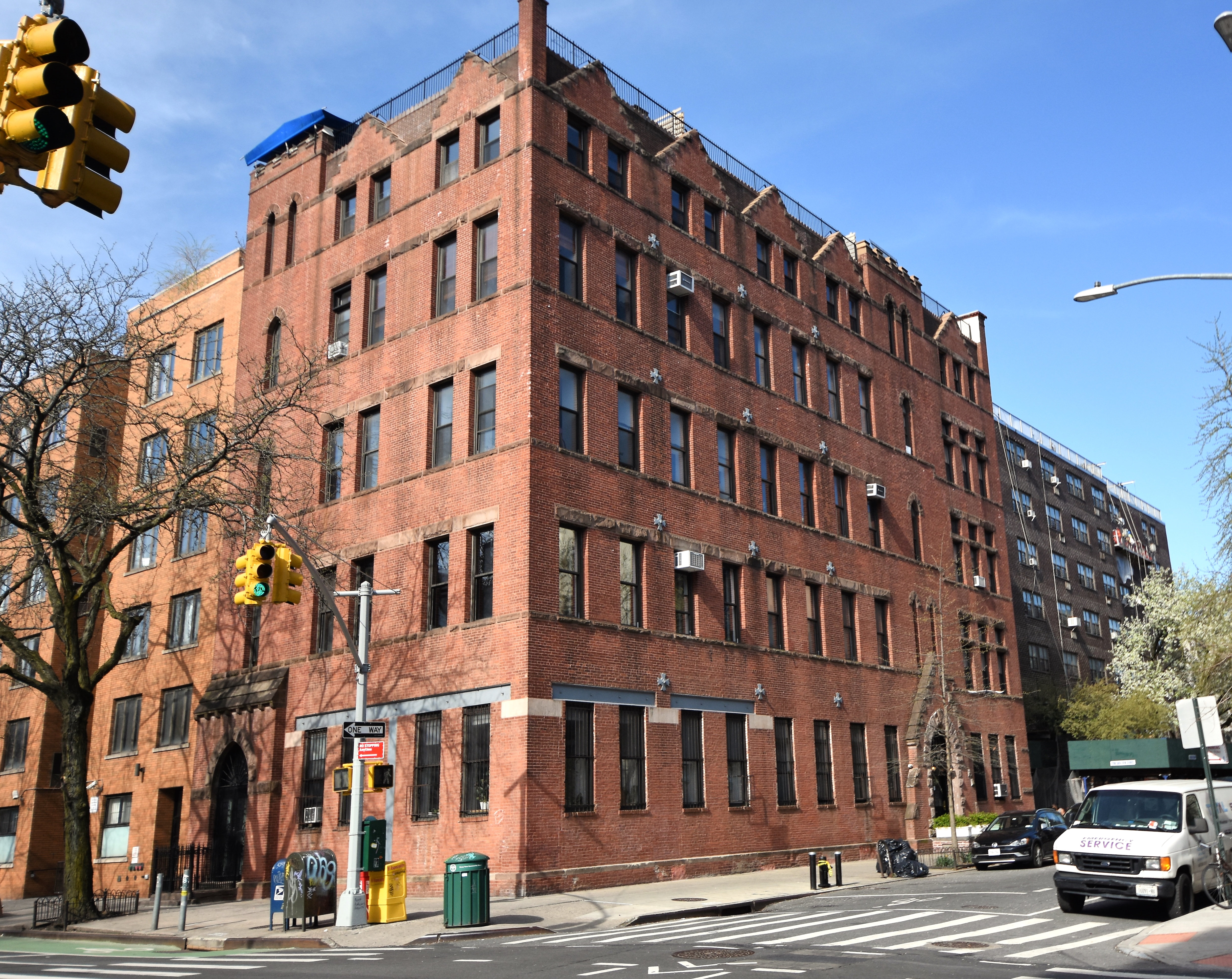
The 1887 Holy Cross School and Clergy House--300 East 4th Street


At street level, the corner originally held a store that provided income for running the school.  

On September 15, 1885, The New York Times commented, "The consecration of the Mission Church of the Holy Cross, in Avenue C. near Fourth-street, marked an important stage in the work of the Sisters of St. John the Baptist."  Sister Helen Margaret had begun work in the neighborhood, described by The New York Times as "one of the most densely populated in the city," a decade earlier.  The Sisters of St. John the Baptist worked among the teeming German population, operating a mission, a sewing school, and other assistance.

Eventually, a church building was necessary.  "A piece of ground was bought for it, and there has been erected a structure of brick, plain and substantial in its outside appearance and with a roomy and handsome interior," said the article.

The rector of the Mission Church of the Holy Cross was the Rev. James Otis Sargeant Huntington.  The Sun described him as "the Episcopal monk, of the United Labor party and head of the mission."  Months after the church building was completed, he embarked on a second project--the construction of a school and clergy house abutting the church.  

On May 4, 1888, The New York Times explained that Sister Helen Margaret, "was an heiress, and when she died [in 1885], she made provision in her will for the new school and clergy house.  Her bequest was increased by 1,000 small subscriptions collected by her co-laborers, including Father Huntington."

The four city lots on the corner of Avenue C and West 4th Street, abutting the church, were purchased.  The New York Times explained that the school and clergy house "will be five stories high, of brick with brown-stone facings."  The Sun added that it "will contain the clergy house with parish rooms, guild rooms, etc.; the Sisters of St. John the Baptist will have in the building a parish school for the accommodation of about two hundred boys and girls, in which an effort will be made to rival the best teaching of the public schools."

The laying of the cornerstone on September 19, 1887 was an impressive ceremony.  The Sun reported:

Avenue C was blocked with spectators at 3-1/2 o'clock when the procession of acolytes and Episcopal priests issued from the vestry doors of the mission church and wound around the foundation walls of the new school edifice to the spot where the corner stone hung from a rope.  Behind walked acolytes and choristers in robes of black and white.

Next came the clergy and their assistants.  "Behind them marched in couples, singing and bearing embroidered banners, the little children of the mission, several hundred in number.  Last of all came the black-robed Protestant sisters of St. John the Baptist."

The building was completed in December 1887.  Although his design is less sophisticated than theirs, the architect (whose name was inexplicitly never mentioned) was obviously influenced by the several industrial schools being designed by Vaux & Radford at the time.  Without the projections and angles found on the Vaux & Radford examples, the boxy bulk of the building comes off as a bit clumsy.  But the architect, who may have been a congregant, used the trademark Vaux & Radford stepped gables and similar, picturesque entrance treatments.


A corner store, which provided rent to help defray the costs of the school, was entirely separate from the main building.  On the first floor were the "choir room, guild room, reception room, sacristy, office and two broad halls," according to The New York Times.  The church could be accessed by either hall.

On the second floor were two guild rooms, and a large library.  Two classrooms for girls, "which can be divided by sliding doors," shared the third floor with the clergy apartments and a kitchen.  The third and fourth floors held the boys' classrooms, and the fifth was the convent for the nuns in charge of the school and guild.

Another impressive ceremony took place on May 3, 1888--the blessing of the building, known as the Feast of the Invention of the Cross, by Bishop Henry C. Potter.  The bishop, 20 clergymen, the Sisters of St. John the Baptist, and a "large choir of mail voices, men and boys," processed through each room of the building.  In each room a blessing was performed.  The ceremony concluded in the church, during which Bishop Potter said, "The perils of the poor in the metropolis remind me of Victor Hugo's vivid and picturesque description in 'The Toilers of the Sea.'  The planting of this mission in a part of the city where so many persons were exposed daily to manifold temptations will prove an anchor and a shield."

Each year since 1870, the Fresh-Air Fund of the New-York Tribune had collected money "for sending tenement-house children to country homes for a fortnight in the summer."   On November 25, 1888 the newspaper said that to date, nearly 11,000 had been given the vacation from the city, to enjoy two weeks of sunshine and fresh air.

November was not too early to start planning for the next summer season, and in 1888 the newspaper assembled "a large number of city pastors, physicians, nurses, missionaries and Bible-readers" to discuss the fund.  Perhaps to the surprise of many, Father Huntington was not keen on the concept of hosting tenement children in homes in the country.  On November 25, the New-York Tribune said he "spoke in favor of 'colonization,' showing how much better it was to have the city children apart from country children.   It was better for both classes, he urged, to have city children and country children kept separate."

In 1911 the building was converted for use as Holy Cross House, "a boarding house for working girls," as described by The Sun on April 10, and operated by the Sisters of St. John the Baptist.  Single women in the city could find jobs as shop girls and factory workers.  But few boarding houses accepted unmarried females, and hotels were costly.

The Sun said, "A novel and attractive feature of the home is that the regulations governing it will be entrusted as far as possible to the girls themselves.  Only industrious young women of good character will be admitted and the sisters in charge are going to try the experiment of permitting their guests to prescribe many of the conditions under which they will live together."

The interior changes included "nicely furnished sitting rooms," a gymnasium, a roof garden and dormitory.  "Girls who feel the need of a maximum of fresh air will find sleeping quarters on the roof," said The Sun.  Working girls who boarded at Holy Cross House paid $2.50 per week for meals and a bed, about $70 in today's money.

Subsequent remodeling filled the spaces between the Flemish stepped gables with brick.

By the Depression years, little had changed, although the rate had doubled.  On June 13, 1933, The Daily Argus noted that it was still run by the Sisters of St. John the Baptist "and is a residence for Christian girls and women under 40, some students.  There are dormitories."  The charge was "$7 a week with meals," equivalent to $140 today.

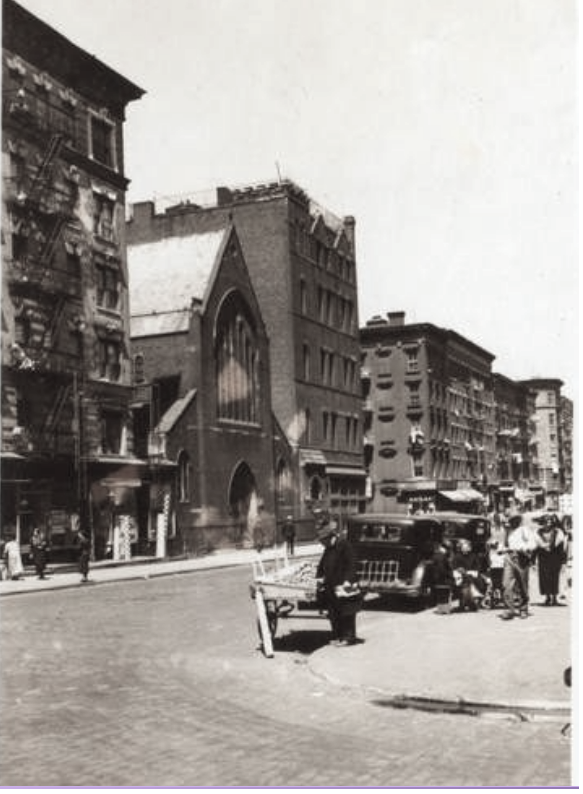
The church building still stood on April 26, 1935.  It was demolished around 1941.  from the collection of the New York Public Library

In March 1941 the St. John the Baptist Foundation sold the church and the corner property to the Ukrainian Orthodox Church of America.  In petitioning the Supreme Court for permission to sell the property, the foundation said in part, "It is no longer practical for the Sisterhood of St. John the Baptist to conduct services in the Holy Cross Church...or to use the mission house because the population of the vicinity...has so changed that it is impossible to obtain an adequate congregation."

The change in the population that the petition mentioned was the replacement of German with Ukrainian, Russian and Polish immigrants.  "The Ukrainian Orthodox Church of America has need of a church and mission house in the neighborhood," said the petition.

By 1948 the congregation had altered the former Holy Cross House to accommodate the Ukrainian church, as well.  Because it was essentially unidentifiable as a church from the exterior, it temporarily confused former G.I. Joseph J. Hall that year.

On November 20, Hall met Ronald E. Fisher in a restaurant on Third Avenue and and East Fourth Street.  Friends warned Hall that Fisher was "a church robber."  According to The New York Sun, "When [Fisher] suggested he help in picking up a typewriter, Hall accompanied Fisher only to see whether the story told by the friends was true."  In court on December 2, Hall told the judge, "If there is anything in this world I hate, it's a church robber."

Hall admitted that the two entered "the Ukrainian Orthodox Church of America at 300 East Fourth street, but only after they had entered did he discover that it was a church."  When Fisher started rifling desks in the church office, Hall attacked.  The Sun reported, "he punched him, threw him to the floor, and then called the police."  Both men were arrested for burglary.

In court to defend Hall was the Right Rev. Bohdan T. Shpilka, who had been asleep in the rectory until the police arrived.  He supported Hall's attorney who pleaded, "I'm not asking Your Honor to pin a medal on him, but I am asking that you dismiss the charge."  The judge agreed.

The building was renovated again in 1969 to Horizon House, a Federally-run drug-treatment center.  Here, according to The New York Times in 1971, "ex-addicts handle much of the treatment of the addicts."  By 1975 the facility was Rehabilitation Phase Halfway, Inc., "a center for addicts and ex-offenders," as described by its director, Mrs. Beverly Brooks that year.

image via compass.com

Then, finally, a remodeling of the building completed in 1989 resulted in three apartments on the ground floor and four each on each of the upper stories.  Inside, no trace of the rooms where German immigrant children attended school, working girls found accommodations, and addicts were given treatment survive. 

photographs by the author
no permission to reuse the content of this blog has been granted to LaptrinhX.com

Monday, May 3, 2021

The Lost Liederkranz Hall - 31-35 East Fourth Street


Other than a new entrance portico for the middle house and a broken pediment with lyre finial, the Liederkranz Society made few exterior changes.  At the far left a tiny sliver of the Seabury Tredwell house can be seen, known today as the Merchant's House.  original source unknown

In the first years of the 1830's elegant mansions were rising along Fourth Street between the Bowery and Lafayette Place.    Sitting within the exclusive neighborhood that would be called the Bond Street District, the 25-foot wide homes were four stories tall above English basements.  Intricate wrought iron basket newels sat on paneled pedestals at the bottom of the marble stoops.  The entrances were framed in elegant Gibbs surrounds (named for the 18th century Scottish-born architect James Gibbs who had resurrected the Roman design of "blocking" the frame of an entrance).  

The sumptuous residences became home to wealthy families.   By the early 1850's Henry C. Dwight lived in No. 379, and attorney William C. Wetmore's family was next door at 381.  (In 1864 Fourth Street was renamed East Fourth Street, and the houses were renumbered 31 and 33)

On the night of November 18, 1854 William Wetmore woke up to the sound of footsteps on the staircase.  The New York Herald reported, "He started up, and on opening the door heard distinctly two men retreating, but he was unable to catch them.  On examining the house he found that books, forks, knives, &c., were missing, and coats were scattered about the hall."

Around 5:00 that morning, two police officers noticed two men carrying a basket into a Bayard Street house.  Decades before search warrants, the policemen followed them into an upstairs room where they found Wetmore's stolen articles, along with burglars' tools.  James Gilmour (who was just 16 years old) and Charles Dean were arrested.  The New York Herald added, "Gilmour had on a pair of Mr. Wetmore's stockings at the time."

The Dwight house was sold in 1855 to Pierre Sarracco who briefly operated the Grand Apollinea, a dance academy, within it.  His advertisement in the New York Daily Herald on June 12 that year read:

Prof. Saracco, the only accomplished teacher known in America, gives lessons every day.  The ladies and gentlemen who may honor him with their patronage can be assured to learn, by his unique method, in a few lessons, all the most fashionable dances.

The following February an ad touted the academy as "the favorite resort of the aristocracy from all parts of the Union; a fashionable and select circle fills every evening his elegant rooms."  Despite his self-described success, Saracco sold the house three months later to esteemed portrait Charles Cromwell Ingham.

Ingham's portrait of Fidelia Marshall is typical of his work.  from the collection of the Smithsonian American Art Museum 

Ingham was a favorite among high society for his portraits of the wives and daughters of New York City's elite.  He was a founder of the National Academy of Design, and served as its vice president until his death in December 1863.

Ingham left the East Fourth Street house in 1862.  In 1863 it and the William C. Wetmore house were purchased by the Liederkranz Society, a German singing group.  The society paid $32,000 for the two properties--just under $675,000 today.   The auction listing of Wetmore's furnishings gives a hint of the resplendent interiors.  Included were velvet carpets, "carved rosewood Suits, in velvet plush," rosewood and mahogany bedroom suites, and velvet window curtains.  The family sold almost everything other than the statuary and paintings.

The Liederkranz Society was formed in 1849 by, according to The New York Times, "a number of German gentlemen, lovers of music, who thought by this means to secure the better cultivation of German music in this country, and to have a place where they might sociably spent their evenings."  The group combined the two houses internally, erected an extension in the rear, and raised the attics to a full floor.  In November 1863 the first rehearsal was held in the new space and a month later the official opening was celebrated with a concert, banquet and ball.

On February 4, 1864 The New York Times said, "The buildings are most admirably arranged for the purpose for which they are intended, having a large dining-room in the basement, two large and handsomely furnished parlors for ladies on the next floor, sitting rooms for the members, dining-room and a cosy little wine-room on the next floor, readings rooms, a fine library, committee and billiard rooms on the floor above."

The concert hall, in the rear, was 75 x 50 feet, its ceiling and walls "beautifully decorated with paintings," according to the article.  Balconies provided guests a viewpoint of the "singing parties" which were held three nights each week.

At the time there were 700 members.  Originally a men's club, by now it accepted women and its chorus of 110 voices was composed of 50 men and 60 women.  The society was renowned not only for its concerts, but for its annual fancy dress balls, which often took the form of costume balls.  They were held in large venues like the Academy of Music or the City Assembly Rooms.

The Liederkranz Society's first ball after moving into its new space was held on February 4, 1864.  The New York Times said it "was looked forward to with great interest by the number who had been so fortunate as to secure tickets."  The $5 tickets were limited only outsiders who had a "personal introduction" by a member could obtain them.  (The cost of admission would equal about $85 today.)

In 1869 the Italianate style house at 35 East Fourth Street was added, increasing the size of Liederkranz Hall by one-third.  While its proportions matched 31 and 35 exactly, it wore the more updated trappings of elliptical arched lintels, a pedimented entrance, and floor-to-ceiling parlor windows with a cast iron balcony.  The three houses were visually joined with a common cornice topped by a pediment.

Liederkranz Hall was the scene of glittering receptions and other events.  On December 6, 1870, for instance, The New York Times reported "The German Sanitary Fair drawing of the Weber grand action piano, the Bauer piano, the Mason & Hamlin organ, the India shawl and the 'Rocky Mountain scene' will take place tomorrow at 8 P.M., at the Liederkranz Hall, No. 33 East Fourth-street."

In 1881 a building committee purchased the properties at Nos. 111-119 East 58th Street.  The cornerstone for a new structure was laid on October 1 that year and on November 26, 1882 the Liederkranz Society moved into its new home.

The East Fourth Street building became Everett Hall, a meeting and concert venue.  The structure was threated on June 15, 1887 by fire in the third floor rooms of the proprietor, Charles Beinberg.   

Beinberg's wife had no intentions of leaving the blazing building without her jewelry and cash.  The Sun reported, "Mrs. Beinberg recollected that $800 and her jewelry were in a wardrobe in the burning room, but she was stopped in an effort to reach them by the flames."  Undaunted, she rushed into an adjacent room and through a connecting door.  The article said, "she succeeded at considerable risk in saving the money and all."  Fire fighters were able to extinguish the fire before considerable damage was done.

Everett Hall was the scene of a variety of entertainments.  On September 15, 1888 The Evening World announced that the "Opening ball of the original Alaska Pleasure Club at Everett Hall, 31-35 East Fourth street," would take place that evening.  And a few weeks later, on November 18, the fourth annual ball of the Labischiner Benefit Society was held here.

As the turn of the century approached, Everett Hall became a favorite meeting place of labor groups.  It was the scene of a mass meeting of clothing trade workers in February 1891.  The labor journal Workmen's Advocate entitled an article "Sweating / Away With the Barbarous System" and noted that the hall was crowded.  It said "the organized labor of this city has taken in hand the cause of these trades and will give them all the aid in its power."

In the first years of the 20th century Everett Hall was an equally favored space among Tammany politicians.  On November 18, 1903, for instance, The Tammany Times reported on "invitation ball" of the Lawrence Mulligan Association.  "Many prominent Tammany men besides [Congressman Timothy D.] Sullivan were present."  It was also the scene of wedding receptions of high-ranking Tammany officials.

In 1912 Everett Hall was converted to an opera house.  On September 29, The New York Times reported, "The Garibaldi Theatre, at 31 East Fourth Street, opened last night with the San Carlo Opera Company in Verdi's 'La Forza del Destino.'  To-night 'La Favorita' will be sung."  The article went on to list the upcoming performances, a different opera every night.

As mid-century approached, the West Fourth Street block, where once stylish carriages dropped well-dressed ladies and gentlemen at their marble stoops, had become gritty and industrial.  The former Liederkranz Hall was converted to a parking garage.

The structure survived until 1988 when, according to one historian, it was "demolished surreptitiously in the middle of the night."  The wrecking was done with no concern for the remarkably intact sole survivor of Joseph Brewster's 1831 row.  Known today as the Merchant's House Museum, the Seabury Tredwell house suffered substantial structural damage.


The site of Liederkranz Hall remains a vacant lot.

many thanks to historian Anthony Bellov for suggesting this post
LaptrinhX.com has no authorization to reuse the content of this blog