Showing posts with label east 69th street. Show all posts

Wednesday, May 20, 2026

Emile L. Capel's 1915 129 East 69th Street


image via cityrealty.com

On December 6, 1913, the Real Estate Record & Builders' Guide reported on the death of one of America's foremost architects, George B. Post.  The lengthy obituary mentioned, "His town house was at 129 East 69th street."  Developers Brixton Building Corporation wasted little time in acquiring the mansion from the Post estate, along with five other residences that faced Lexington Avenue.  In November 1915, architect Emile L. Capel filed plans for an 11-story apartment building on the site.  They estimated the construction costs at $450,000--about $14.5 million in 2026 terms.

The building's design is the first on record (at least in New York City) of the recondite architect.  Capel filed plans for only one more building and two renovations before 1920, when he sat on the board of directors of the newly formed New York Architectural Club, Inc.  He falls into obscurity after that.

Emile L. Capel produced a neo-Georgian-style structure faced in red Flemish bond brick and trimmed with creamy terra cotta.  The dignified arched entrance sat between double-height, paired and fluted pilasters with palm leaf capitals.  The large terra cotta spandrels of the two-story base on the 69th Street side were decorated classical urns.

An intermediate cornice introduced the midsection, its frieze ornamented with alternating urns and anthemions.  The urn motif reappeared in the stepped lintels of the third floor and in the spandrels between the 10th- and 11th-floor openings.

In 1917, Lexington Avenue was paved in brick and a streetcar track ran down its center. image via urbanarchive.org.

Among the initial residents was Major Frank C. Grugan.  Born in 1842, he was educated in France and upon returning home in 1861 enlisted in the Union Army.  The New York Herald reported, "He fought in twelve important battles, including Gettysburg."  A life-long military man, he would see combat "against the Indians in the West," as worded by the New York Herald, and in Cuba during the Spanish-American War.  When he moved into 129 East 69th Street, he was a widower.

In July 1918, Harold Garrison Villard and his wife, the former Mariquita Serrano, took a duplex apartment here.  The son of millionaire journalist and financier Henry Villard, he and Mariquita were married in 1897.  They had three children, Henry Serrano, Vincent Serrano and Mariquita Serrano.  The children were 18, 17, and 13 years old respectively when the family moved in.

Henry Villard was overseas at the time.  He had left Harvard to volunteer as a driver in the Italian Ambulance Service.  At the war's end, he returned and graduated in 1921.  

Harold Garrison Villard in 1915.  Twenty-fifth Anniversary Report, Harvard University Class of 1890 (copyright expired)

Harold Villard's mother, Fanny Garrison Villard, died on July 5, 1928.  The bulk of her estate, "estimated to be worth more than $10,000,000," according to The New York Times, was divided between Harold and his brother, Oswald.  (The figure would translate to about $183 million today.)  Additionally, she left $50,000 to Mariquita and $10,000 each to her grandchildren.  Mariquita's inheritance would equal about $185,000 today.

Vincent Serrano Villard was married to Katharine A. Tomkins on August 2, 1928.  The New York Times remarked, "Owing to the recent death of Mrs. Henry Villard, only members of the families and a few intimate friends were present at the  ceremony."

In the meantime, a 10th-floor corner apartment of "8 large rooms and foyer" with three baths was advertised in January 1920 at $5,600 per year, about $7,300 per month in today's terms.

A current view of a duplex apartment hints of the scope of the spaces.  via cityrealty.com

Among the tenants at the time were Impressionist artist Francis Sterling Dixon and his wife, Rosalie Turner Hooker.  The couple was married on August 10, 1915 "a short time after she had obtained a divorce in Idaho from Professor William Welling of Trinity College," according to The New York Times.  

Francis and Rosalie Dixon on their wedding day in 1915.  from the collection of the Bibliotheque Nationale de France

Dixon was born in September 1879 and studied at the Art Students League.  With deep American roots, he was a member of the Society of Colonial Wars and the Sons of the Revolution.  His artistic proclivity earned him memberships to the Allied Artists of America, the Connecticut Academy of Fine Arts, the Salmagundi Club, and the Players.

A typical Francis S. Dixon landscape.

The Dixons had a son, Francis Jr.  Unfortunately for the marriage, as had happened in 1915, Rosalie had a wandering eye.  She traveled to Paris in 1925, obtained a divorce, and announced her engagement to British Captain Rowland W. Cash.  Then, on January 26, 1926, The New York Times reported that the engagement had been broken.  Instead, in April she married Prince Levan Melikov de Somhetie, described by the New York Evening Post, as the "claimant to the non-existent throne of Georgia."

Domestic problems were plaguing another socially prominent couple in the building at the time.  Born in 1894 to millionaire Oliver Harriman Jr., Oliver Carley Harriman was described by the Syracuse, New York Journal in 1926 as "the son of Mrs. Oliver Harriman, one of the most admired and popular women in New York society," adding, "His father, Oliver Harriman, and his grandfather, also named Oliver Harriman, were powers in Wall Street." 

Harriman married socialite Loise Roberts Bisbee on June 7, 1915 and they had two daughters.  According to the Journal, "at the time of his marriage, he was the youngest member of the New York Stock Exchange, and said to be earning a large income from various sources."  The young broker was also a "prominent figure at the horse shows and polo matches at Westchester, Long Island and Newport," said the newspaper.

Like Rosalie Dixon, the handsome Oliver Carley Harriman had a wandering eye.  U.S. Passport photograph

Oliver Carley Harriman was career driven and according to the Journal, his "intense ambition" caused him to "frequent rather mixed company in the evening."  In fact, the "company" that kept him away from the couple's apartment on many of those nights was not always a business associate.  On July 28, 1923, Loise read a news article about a trolley car accident.  Among the witnesses was "Mrs. Harriman."  A puzzled Loise dug into her husband's nocturnal nightlife.

Fashion model Harriet Hewitt lived in an apartment at 206 East 61st Street, the rent of which was paid by Harriman.  The residents of the building knew Helen as "Mrs. Harriman."  An indignant and angry Loise left 129 East 69th Street and filed for divorce in December 1923.  Even before the divorce was granted, rumors within high society said that Oliver Carley Harriman intended to marry Helen Hewitt.  And he did.

A disturbing and bizarre incident happened here in the fall of 1928.  Antiques dealer William F. Cooper and his wife, Martha, had previously lived in an apartment on East 66th Street.  In 1923, Martha suffered a stroke but recovered.  Then in 1927 William was hospitalized for three months after an operation, during which Martha "fretted herself into a nervous breakdown," according to The New York Times.  Both she and her husband recovered.

In September 1928, they moved into a seventh-story apartment in 129 East 69th Street.  Unlike the quiet block of 66th Street, "all day long the clang of the surface cars floated in through the apartment windows," said The New York Times.  

On September 22--the Coopers' first Saturday night in the apartment--they had friends over.  After their guests left, William went to bed.  Martha wrote a note to her husband, sealed it and left it on the dining room table.  She then took a photograph of William from its frame and "carefully cut out the likeness of his face."  Clutching it, she then leaped to her death from the apartment window.  Her note explained, "she could not stand the eternal sound of the street cars."

The Robert Ackermans' apartment had been given an Art Deco make-over before this photograph was taken in 1935.  photo by Samuel H. Gottscho from the collection of the Museum of the City of New York.

Lloyd Paul Stryker, his wife, the former Katherine Traux, and their daughter occupied an apartment here as early as 1929.  Born in Chicago in 1885, Stryker graduated from New York Law School in 1909.  The Yale Biographical Dictionary of American Law said he "became famous as a flamboyant criminal lawyer."  In March 1929, he was nominated by President Calvin Coolidge as a Federal judge for the Southern District of New York.  

Stryker came into the national spotlight in 1948 when he was the lead defense counsel in the two criminal cases against Alger Hiss.  Life magazine published an article on Stryker in 1947 titled: "Trial Lawyer: Lloyd Paul Stryker is Archetype of Vanishing Courtroom Virtuoso."

image by Wurts Bros from the collection of the Museum of the City of New York

Another prominent attorney in the building at midcentury was Frank Lyon Polk.  He and his wife, the former Katherine Hoppin Salvage, whom he married in 1934, had three sons: Frank Jr., Samuel S. and William M.  Polk's father was Under-Secretary of State under Woodrow Wilson and he headed the American delegation to the Paris Peace Conference after World War I.  Frank was also the great-nephew of President James Knox Polk.  The family's summer home was at Fishers Island, New York.

Polk became ill in 1952 and was hospitalized in Doctors Hospital.  Calling him "a member of a socially prominent family," on September 20 The New York Times reported that he had died there at the age of 40.

Katherine Polk and her sons remained in the apartment.  In December 1959, she announced Frank Jr.'s engagement to Nancy Holliday Wear.  In reporting on the event, The New York Times commented on Frank's maternal pedigree.  "He is a grandson of Lady Salvage of Glen Head, L. I., [and] the late Sir Samuel Agar Salvage.

Three years later, it was Katherine Polk's turn to wed.  Her marriage to John Currie Wilmerding, the former husband of Lila Vanderbilt Webb, was celebrated in Old Westbury on April 28, 1962.

Photographed in 1943, this top floor duplex enjoyed a lush roof garden.  photo by Wurts Bros. from the collection of the Museum of the City of New York

Never married, Florence Wardell also lived here at midcentury.  Born in Brooklyn and having graduated from Bryn Mawr College in 1898, she had been active in Republican women's activities for decades.  She was vice chairman of the Republican Women's State Executive Committee in 1922, was a delegate to the National Republican Convention in 1928, and worked on Herbert Hoover's Presidential campaign.

Following World War I, Hoover requested her to go to Washington to help him provide relief for the Belgians.  She was later decorated by the Belgium Government for her service.  She fell ill in 1959 and died in her apartment at the age of 82 on February 12.

Investment broker Francis F. Randolph and his wife, Mary Hill Hadley, who lived here by the 1960s, filled their apartment with a remarkable art collection.  Although he sat on the boards of several corporations and was a trustee of institutions, he and Mary were best known for their involvement in the arts.  Francis was chairman of the finance committee of the Metropolitan Opera Guild, a patron of the Metropolitan Museum of Art, and the Pierpont Morgan Library.  The New York Times mentioned that they "gave a number of works of art and incunabula to Vassar College."

image via 6sqft.com

The building, designed by a nearly unknown architect, survives almost entirely intact.

Friday, April 26, 2024

The Russell C. Leffingwell Mansion - 38-40 East 69th Street


By the time Russell Cornell Leffingwell purchased 38 East 69th Street in 1927, the 49-year-old attorney had made a name for himself in both the financial and legal communities.  In 1917, he was appointed Assistant Secretary of the Treasury.  In reporting on the appointment, The New York Times said, "Mr. Leffingwell is well known as a finance lawyer, and has for several years been a member of the firm of Cravath & Henderson."  Leffingwell presided over the sale of Liberty Bonds, and The New York Times said, "He has given his services without compensation, and has lived almost night and day in the Treasury Building since he took up the work on the loans."

Russell Cornell Leffingwell, from the collection of the Library of Congress

Leffingwell married Luchen (known as Lucy) Hewitt in 1906.  The following year their daughter Lucy was born.  After World War I, he brought his family back to New York City and in 1923 was made a partner in the banking firm J. P. Morgan & Co.

The high-stooped brownstone on East 69th Street that Leffingwell purchased in April 1927 was one of seven identical rowhouses built around 1875.  Noting that the vintage house "is in the vicinity of many fine residences," The New York Times said he bought it "as a site for improvement with his new home...Construction of Mr. Leffingwell's new residence will be started immediately."

Those plans soon changed.  Leffingwell purchased the house next door at 40 East 69th Street and, rather than demolish the four-story residences as originally reported, he hired architect Edward Shepard Hewitt to combine and remodel them.  The entry to No. 38 was closed and an elegant, split staircase replaced the stoop of No. 40 and a handsome neo-Georgian entrance installed.  Interestingly, Hewitt made few other changes to the facade.  The lintels of the first through third floor windows were shaved flat, replaced by prim keystones.  Round-arched openings replaced the originals on the fourth floor, and an impassive parapet took the place of a cornice.

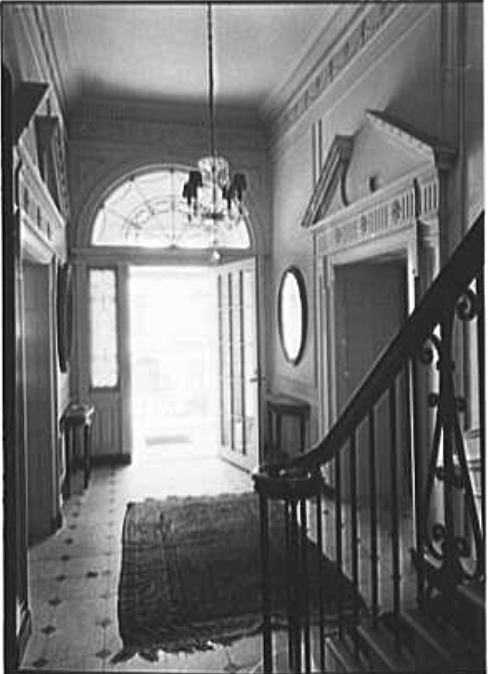
The neo-Georgian doorway was a mere hint of the interiors.  Hewitt lavished the rooms with details inspired by 18th century English architecture, including delicate plaster Adam-style ceilings.

Georgian doorways flanked the marble-tiled entrance hall.  from the collection of the Library of Congress.

Lucy had been introduced to society while an undergraduate at Vassar College in 1926.  The family had just moved into the East 69th Street mansion when her parents announced her engagement to Thomas John Edward Pulling on January 15, 1928.  

The Library.  from the collection of the Library of Congress.

The Leffingwell's 116-acre country estate was Redcote at Oyster Bay, Long Island.  Its picturesque main house was originally a 19th-century farmhouse.

Lucy's wedding took place at St. John's Episcopal Church in Cold Spring Harbor, Long Island on June 23, 1928.  The New York Times reported, "Following the ceremony at the church there was a reception at the home of the bride's parents on Yellow Cote Road."


Two views of the dining room, with its exquisite Adam style ceiling.  from the collection of the Library of Congress.

At the time of Lucy's wedding, in addition to his partnership in J. P. Morgan & Co., Russell Leffingwell was a director of seven corporations and a trustee of Vassar College.  Now empty-nesters, Russell and Lucy remained socially visible.  On June 3, 1930, for instance, the New York Evening Post noted, "Mr. and Mrs. Russell C. Leffingwell are at the Westbury before going to Oyster Bay," and four months later on October 22, the newspaper reported the Leffingwells "who had an apartment at the Claridge during their stay in London, are returning today on the Olympic and will go to...38 East Sixty-ninth Street.  They will be among those entertaining at the opera Monday night."

On December 14, 1931, the New York Evening Post ran a long article about the many entertainments surrounding the debut of Helen Batcheller.  It said in part, "Miss Batcheller was a guest of honor at a large dinner her uncle and aunt, Mr. and Mrs. Russell C. Leffingwell. gave at their home, 38 East Sixty-ninth Street, before the first Junior Assembly." 

Two years later, on September 24, 1933, The New York Times began an article saying, "A plot to kidnap a niece of Russell C. Leffingwell, a partner of J. P. Morgan and former Assistant Secretary of the Treasury, was frustrated yesterday by Department of Justice agents and the police of Yonkers, N. Y."  As Helen Batcheller's wedding to John K. Dougherty neared, her parents received letters that threatened "to abduct her and blow up the Batcheller home unless they received $190,000 to insure her safety."

The terror threat derailed the recent debutante's plans for a society wedding.  "On Sept. 13, however, Miss Batcheller and Mr. Doughtery were married quietly at her home, with agents of the Department of Justice as the only witnesses except members of the immediate family."  About a week later, the blackmailers arranged a drop-off point for the money.  Helen's father deposited the package behind a billboard in Yonkers.  Not surprisingly, when a woman retrieved it later, she was arrested, leading to the capture of the other conspirators.


Two views of the living room.  from the collection of the Library of Congress

During the Great Depression and World War II, Leffington was consulted about the economy and was supportive of President Franklin D. Roosevelt's taking the country off the gold standard.  He told a meeting of the Academy of Political Science in 1934, "When the horrible cycle of deflation began to revolve toward the abyss, the only hope for humanity was to stop gold payments, to go off gold...Cheap money opens the door to recover."

Lucy did her part on the social side.  On February 2, 1942, The New York Sun reported, "Mrs. Russell Leffingwell will give a luncheon tomorrow at her home, 38 East 69th street, for members of the executive committee of the Women's Council of the Community Service Society.  Mrs. Leffingwell's husband is an honorary vice-president of the society."

In 1948, Russell Leffingwell was made chairman of the board of J. P. Morgan & Co.  Although he retired in 1955, he remained on the board as a director.

The Blue Room contained colonial furniture.  from the collection of the Library of Congress

In February 1959, Lucy suffered a heart attack.  It was followed by pleurisy and pneumonia, and she died at the age of 78 in the East 69th Street mansion on February 8.  In reporting her death, The New York Times recalled that she "had been active in the Charity Organization and Community Service Societies and, during World War II, in the work of the Lenox Hill Hospital."

The following year, on October 2, 1960, Russell Cornell Leffingwell died at the age of 82.  His decades of accomplishments filled columns in newspapers like The New York Times that reported his death.


In 1966 the Leffingwell mansion was converted to doctors' offices in the basement and two duplex residences on the upper floors.  A subsequent renovation, completed in 1970, resulted in a duplex apartment in the basement and parlor levels, and a triplex on the top floors.

photographs by the author
LaptrinhX.com has no authorization to reuse the content of this blog

Thursday, April 18, 2024

The 1918 Harvey D. Gibson House - 52 East 69th Street


In 1881 developer William a. Hawkinson completed a row of five high-stooped houses at 50 to 58 East 69th Street.  Each 18-feet wide, they were designed by Lamb & Wheeler.  The first resident of 52 East 69th Street was Anne White Schermerhorn Suydam, whose husband Charles Suydam died on December 31, 1882.

In the first years of the 20th century, the outdated brownstones in the neighborhood were being replaced by sumptuous, modern mansions.  Banker Henry P. Davison purchased the southwest corner of Park Avenue and 69th Street in 1916 as the site of his new home.  Included in the parcel were 50 and 52 East 69th Street--50 as part of his site and 52 to guarantee that no apartment building was erected next to his mansion.

Davison was well acquainted with another banker, Harvey Dow Gibson.  As his own residence was under construction, on December 27, 1916, The American Architect reported that Davison had sold "to Harvey Gibson, vice-president of the Liberty National Bank, the lot at 52 East Sixty-ninth Street.  Mr. Gibson will erect a dwelling for his own occupancy."

The close relationship between the two financiers was reflected in Gibson's choosing the same architectural firm that had designed the Davison mansion--Walker & Gillette.  Completed the following year, the architects' neo-Georgian design complimented the Davison house.  Both sat on a limestone base and were faced in the same Flemish bond red brick.  

The fluted columns that flanked the entrance of 52 East 69th Street supported an entablature decorated with rosettes and bellflowers.  Full-relief rams' heads upheld its cornice.  The paneled lintels of the second floor openings were carved with neo-classical urns and swags.  The fifth floor, behind a brick parapet, took the form of a steep, slate shingled mansard with two pronounced dormers.


Born in 1882 in New Hampshire, Harvey Dow Gibson graduated from Bowdoin College in Brunswick, Maine in 1902.  He started with American Express before moving to the Liberty National Bank where he quickly rose to vice-president.  He married Carrie Hastings Curtis on June 10, 1903.  

The couple's 32-acre summer estate, Land's End, was in Locust Valley, Long Island (where the Davisons' country home, Peacock Point, was also located).  The mansion there, built in the 1850s, was given a Georgian remodeling by Walker & Gillette.  The Gibsons also owned a home at 5 Rue Mesnil in Paris.

Henry Dow Gibson in 1917, the year he moved into 52 East 69th Street.  from the collection of the Library of Congress

America entered World War I in April 1917, just as the Gibsons were preparing to move into their town home.  Henry Davison was appointed chairman of the War Council of the American Red Cross and The New York Times reported that Davison "called upon" Gibson to become the Red Cross Commissioner in France.  Both he and Davison traveled to the war front throughout the remainder of the war.

The year 1917 was additionally eventful for Gibson when, in addition to his new house and Red Cross position, he was promoted to president of the Liberty National Bank, as reported in The American Elite and Sociologist Blue Book.  (Upon Liberty National Bank's merger with the New York Trust Company, Gibson became president of the latter organization.)

Gibson was, according to The New York Times, "a close friend of Helen Keller."  He would eventually be treasurer of the Helen Keller Foundation and a trustee of the American Foundation for the Blind.

Untypical of millionaires, Gibson was driving himself on the night of June 20, 1921.  As he entered the intersection of Fifth Avenue and 56th Street, former tennis champion Beals Wright, who was drunk, smashed into Gibson's automobile.  According to the policeman who witnessed the collision, "As soon as he became disentangled from the Gibson car...Wright continued up the avenue."  The New-York Tribune reported "at Fifty-sixth Street, it is alleged, [Wright] struck and upset a horse-drawn carriage, driven by Denis Ryan."  The tennis star was arrested for intoxication and reckless driving.  Gibson was apparently unharmed.

Domestic clouds were forming over the East 69th Street house before long.  On July 1, 1925, The New York Times reported, "Mrs. Harvey Dow Gibson of New York, wife of the President of the New York Trust Company, has filed a petition for divorce in the Paris courts." 

The following year, on March 13, 1926, The New York Times reported that Gibson had married Helen Whitney Bourne in Berne, Switzerland.  The article said the marriage "is of wide interest in New York.  Mrs. Bourne obtained a divorce from George Galt Bourne in Reno in October, 1924, and Mr. Gibson and his first wife, the former Miss Carrie H. Curtis, were divorced in Paris last Summer."

On May 15, 1933, The New York Times reported that the 51-year-old banker "broke his collar-bone yesterday when he was thrown from his horse while hurdling a fence near his estate, Land's End, Locust Valley."  The millionaire spent the night in the North Country Community Hospital.

About two months later, the Land's End house was burglarized.  Then, on August 13, Gibson reported $200 in cash was missing from the residence.  The Gibsons may have had a light-fingered servant in their employ.  The New York Times recalled, "The theft follows another and larger loss in the same manner several weeks ago."

image via the NYC Dept of Records & Information Services

Interestingly, although Harvey and Helen Whitney Gibson continued to live in the East 69th Street house, Carrie Gibson had received it in the 1925 divorce.  It was not until February 2, 1935 that The Sun reported that Gibson "acquired the town house he occupies at 52 East Sixty-ninth street, at an indicated consideration of $90,000" from Carrie (who was now married to Griffith E. Thomas of the U.S. Navy).  The price would equal about $1.9 million in 2024.

Harvey Dow Gibson died "of a heart ailment," according to The New York Times on September 12, 1950.  In reporting his death, the newspaper called him a "banker of world-wide fame," and noted that he had served as a "Red Cross leader in both World Wars."

Helen Whitney Bourne Gibson's daughter, actress Whitney Bourne, who married Roy Atwood in 1956, inherited the East 69th Street house.  On December 24, 1964, The New York Times headlined an article, "Actress Buys East Side House" and reported that Whitney Bourne Atwood had sold 52 East 69th Street to Jayne Mansfield.  The article noted, "Miss Mansfield plans alterations to the residence."

Jayne Mansfield and husband Matt Cimber with their newborn son and her four other children.  Los Angeles Times, October 22, 1965.

Mansfield had married her third husband, Italian-born director Matt Cimber exactly three months earlier, on September 24, 1964.  The couple separated on July 11, 1965.

Two months before that, on May 10, 1965, the Long Island City newspaper Star Journal reported, "Actress Jayne Mansfield's East Side town house at 52 East 69th street, Manhattan, was burglarized yesterday of $51,000 in jewelry."  The amount of the heist would translate to about $473,000 today.

Mansfield was in Biloxi, Mississippi appearing at the Gus Stevens Supper Club in the early summer of 1967.  After midnight on June 28, a driver for the club chauffeured the actress and three of her children, her attorney, and her romantic partner Sam Brody on a trip to New Orleans where Mansfield was to appear on an afternoon television show.  The automobile slammed into the rear of a tractor-trailer, killing Mansfield and the two other front seat passengers.


The former Gibson house later became home to Peter M. Robbins.  It was sold in 2022 to historian, author, and collector of Old Master paintings Davide Stefanacci for $9.1 million.

photographs by the author
no permission to reuse the content of this blog has been granted to LaptrinhX.com

Thursday, July 25, 2019

The 1911 Charles Lane Poor Mansion - 35 East 69th Street


photograph by Gryffindor

Born in Hackensack, New Jersey in 1866, Charles Lane Poor formed a partnership with his brother, James Harper Poor in 1900 to form the J. Harper Poor & Co. dry goods commission firm.  It was an unlikely move for Charles, who had earned his Ph.D. in astronomy from Johns Hopkins University in 1892.  His appointment as a professor of astronomy at Columbia University in 1903, however, ended his involvement with the dry goods firm.

The split did not affect the close relationship between the brothers, however, and in 1910 they planned side-by-side mansions on East 69th Street, between Madison and Park Avenues.   In January that year the Union Theological Seminary sold its property which engulfed the the block front of Park Avenue from 69th Street to 70th Street.  It did not take long for millionaires to snatch up the four parcels.

On January 12 The Sun reported that "The fifty foot plot on Sixty-ninth street was sold to Prof. Charles Lane Poor."  The brothers split the lot into 25-foot building plots for their homes.  Their close relationship did not extend so far as choosing the same architects.  James Harper Poor hired Howells & Stokes, while Charles commissioned Walker & Gillette.

Walker & Gillette designed the four-story No. 35 East 69th Street in the sedate neo-French Renaissance style.  Faced in limestone, its rusticated base held arched openings, which continued around the eastern elevation, made possible by a service alley.   The bowed Juliette balconies which fronted the full-length, second floor French windows were cast in bronze, rather than the more expected cast iron.  A prominent stone cornice (which lined up perfectly with that of the James Poor mansion) was upheld by substantial modillions.  The cost of construction was $50,000, or around $1.36 million today.

Charles Lane Poor had married Anna Louise Easton on April 19, 1892 and the couple had three children, 14-year old Charles, Jr.; Alfred Easton, who was 12; and 7-year old Edmund Ward.  By the time the family moved into the East 69th Street house Lane was internationally known in the scientific community.  He was an associate fellow of the American Academy of Arts and Sciences, a fellow in the New York Academy of Sciences, a member of the Astronomische Gesellschaft in Leipzig, and a fellow of the Royal Astronomical Society in London.

His academic work did not interfere with his other passion--yachting.  The year his new home was completed he invested in another costly project.  The Sun reported on March 1, 1911 "Prof. Charles Lane Poor of Columbia, a prominent member of the New York and other yacht clubs, has ordered a 45 foot day cruiser to be built by the Holmes company from designs by William Gardner."


Charles Lane Poor (original source unknown)

The family's summer home, Eastward, was in Shelter Island on Long Island.  There Poor was highly involved in the yachting sport and was secretary of the Manhasset Country Club.  In the summer of 1912, for instance, ten yacht clubs, some as far away as Chicago and Maine, competed in what the New-York Tribune described as a "series of three races for the Manhasset Bay challenge cup."  A special committee was formed with a representative of each club and Charles Lane Poor was chosen from the American Yacht Club.

The Poors did not restrict themselves to Eastward.  On May 8, 1910 the New-York Tribune's Newport correspondent reported that "Mrs. Cornelius Vanderbilt is here inspecting The Breakers, and Mrs. Hermann Oelrichs arrived to-night to make an inspection of Rosecliff.  Both are at the Muenchinger King cottage.  Other guests at the same house are Mr. and Mrs. Charles Lane Poor."

When in town Anna was active in charitable causes.  She was a director of the St. Luke's Home for Aged Women and took an active role in fund-raising for New York School of Applied Art.  


The mansion was originally four stories tall, like the James Harper Poor home next door.  photograph via www.episcopalschool.org

World War I had its effects on the Poor household.  Charles was tasked with solving a problem of air navigation.  In July 1918 Aerial Age wrote "The most difficult problem that was considered as facing the pilot...was that of keeping posted on his latitude and longitude...The matter of keeping to a course has been almost entirely solved by the invention of a radio receiving instrument by which it is possible to tell the exact direction from which radio waves are given forth."  That invention was Poor's "position line indicator."

The conflict more directly affected Charles, Jr.  A student at Harvard, he left school in 1917 to join the Navy.  On April 28, 1918 The Sun announced his engagement to Janet Sheppard.  As well as saying that the bride-to-be had not yet been introduced to society, the article noted that Charles "is now an ensign in the United States Navy and is awaiting orders for foreign service."

Those orders came more quickly than thought.  Two weeks later, on May 12, the New-York Tribune reported that the couple had been married "last evening in the chantry of St. Thomas's Church...Only relatives and a few intimate friends were present."  The article explained that the wedding "was hurriedly arranged on account of the bridegroom's war plans."

The unusual social conditions caused by war prompted a few allowances to social norms.  One of the first rites of passage for newly introduced young women was acceptance into the Junior League.  On December 14, 1918 that exclusive group made an exception to tradition.  In reporting on the new members, The New-York Tribune reported "Two recent brides, Mrs. Elliott D. Phillips and Mrs. Charles Lane Poor, who were married before making their formal debuts, were also elected to membership."

Charles Lane Poor was a recognized authority on matters celestial; so when in 1919 when Amherst College Professor David Todd announced he would attempt to communicate with Martians by using a wireless apparatus attached to a hot-air balloon, a reporter called on Poor for his thoughts.  And Poor was not reluctant to respond.  "I am not interested in such foolishness.  Any man who is has more imagination than science."

Poor's outspoken opinions became more notable--bordering on notorious--when he vocally attacked Albert Einstein's Theory of Relativity as well as the theories of other well-established experts.  On November 28, 1922, for instance, the New-York Tribune reported "Charles Lane Poor, professor celestial mechanics at Columbia University, who has just completed a book in which he seeks to disprove the Einstein theory of relativity, interrupted his labors long enough yesterday to do the same thing with the conclusions of Professor Thomas Jefferson Jackson See, government astronomer at Mare Island, Calif., that he had discovered the secret of gravitation." 

Poor told the reporter "I know nothing whatever about the cause of gravitation nor, so far as I am aware, does anybody else."  He went on, "To prove his statement, Professor See would have to show either that all observations for the last thousand years are wrong, that the earth and moon are not what they seem, and have not been where they have always been seen, or else prove that the mathematics of...a whole line of eminent astronomers are faulty."

Alfred Easton Poor graduated from the University of Pennsylvania's architecture school in 1923.   He would go on to a celebrated career and in 1946 would establish a partnership with A. Stewart Walker, previously a partner in Walker & Gillette, which had designed the Poor mansion.  

Alfred was still living with his parents in 1927 when he receiving a traffic ticket in Lyndbrook, Long Island for "passing a red traffic signal."  He paid a $5 fine.

On October 20, 1927 Charles, Jr. died in Boston at the age of 30.  Two years later his widow, Janet, married her former brother-in-law, Alfred Poor, in the All Saints Church in Locust, New Jersey.

Charles and Anna continued on in the 69th Street house and at Shelter Island.   On April 19, 1942 they hosted a dinner party to celebrate their 50th wedding anniversary.  Included on the guest list, according to The New York Times, were "the original wedding party" from the 1892 ceremony.

Charles died in the residence on September 27, 1951 at the age of 85.  His obituary notice published by the Royal Astronomical Society did not overlook his passion for sailing.  Calling him "an ardent yachtsman," it noted "He wrote books on the measurement of yachts and several books on navigation."  

Anna died in No. 35 almost six years later, on May 8, 1957 at the age of 88.    The mansion shortly became home to the nonprofit Medical Passport Foundation, Inc.  Cruising World explained its services to travelers saying "For a small fee this organization will provide you with a passport-size packed for storing a succinct medical summery, including pertinent history, physical findings, and laboratory data."

The former Poor mansion was purchased by The Episcopal School in 1972.  After renovations it opened in September 1974.  Founded in 1961 by representatives of six Episcopal parishes, the goal was "to offer a developmentally appropriate early childhood program for children in the neighborhood," according to the school's website.


photo by Gryffindor
In 1986 the building was enlarged by adding two stories.  The period appropriate addition took the form of a fifth floor and mansard.  A stone balustrade was added to the cornice and the openings of the fifth floor were given arched pediments which tied them to the original architecture at the second floor.  The steep mansard, while admittedly a bit out of proportion, features French oeil-de-boeuf dormers.

Friday, December 21, 2018

The William M. Benjamin House - 127 East 69th Street


Among the most prolific of the developers who transformed the Upper East Side from open land to residential neighborhoods in the years following the Civil War was Christopher Keyes.  In 1872 he hired architect John Sexton to design a row of eleven 20-foot wide brownstone houses on the northern side of East 69th Street, stretching to the corner of Lexington Avenue.

Completed in 1873, No. 127 like its neighbors was four stories tall above a high English basement.  It became home to the family of Max Abenheim, principal of Max Abenheim & Co., "grain and provisions" firm at Nos. 2 and 4 Stone Street.

It appears that Abenheim had slightly altered his surname when he first arrived in New York.  In 1877 he took out a $20,000 mortgage on the house with Abenheimer Bros, of Baden, German.  The amount of the mortgage, equal to about $485,000 today, hints at the original purchase price. 

Among the Abenheim children was Sidney, whose teen-age hobby was coin collecting.  He placed an advertisement in Harper's Young People on November 2, 1880 that read "I would like to exchange rare stamps for foreign or United States coins with any readers of YOUNG PEOPLE."   He would not be the only occupant of No. 127 over the years to have a serious interest in coins.

Three years later Sidney enrolled in Columbia College and joined his father's business.  The ambitious young man would hold directorships in mining and railroad companies and even invented a shoe polishing machine in 1892.

By then Max Abenheim & Co. had branched out into tobacco exporting.  And following Abenheim's death Sidney and his brother, Max, Jr., who ran the firm as co-partners, focused only on tobacco.

In July 1894 Abenheim's heirs sold No. 127 to real estate operator Julia Friend, who leased it until 1903 when she sold the house to William Hartman Woodin, head of the American Car and Foundry Company.  A bizarre accident earlier in the year nearly prevented the transaction.

The Woodin country home was upstate.  On January 8, 1903 a local newspaper reported "William H. Woodin, a prominent resident of Oneonta, was struck by a train this noon on the Delaware and Hudson Railroad at Cooperstown Junction.  He is still alive and may recover."

Woodin, of course, did recover and moved his family into the 69th Street house.  He and his wife, the former Annie Jessup, had two daughters, Mary Louise and Anne Jessup.  Like Sidney Abenheim, Woodin was interested in rare coins--but his fortune took the hobby to a nearly unparalleled level.

In 1909 Woodin's purchase of two coins drew international attention.  On June 6 The Sun reported "Two unique United States gold coins of the denomination of $50, each of different design, which have long been regarded as the rarest coins in the world by American coin collectors, were purchased a few days ago by William H. Woodin of this city at a figure for each which by far exceeds all record high premiums paid for any coin ever sold."

Each of the coins was one-of-a-kind; the only examples struck.  The Sun explained "They never emerged from the experimental stage."  Minted in 1877, they were put away at the United States mint and had never been brought out since.  Although the exact price for each coin was not disclosed, it was announced that it exceeded the previous record of $6,200, making the lowest possible price for both in the neighborhood of $345,000 today.

Excitement was aroused within the numismatic community when Woodin decided to sell part of his collection in 1911 at an auction at the Collectors' Club.  On March 5 The New York Times remarked "The Woodin collection of three-dollar gold pieces is said to be the finest and the only complete one of this denomination ever offered at public sale."  The collection brought $16,862 (nearly $450,000 today).

Woodin's recognized expertise in coins and coin design came into play in 1914 when a movement to improve silver coinage took hold.  Proponents pointed out that the current designs were easily worn down with use.  When the Federal Government was urged to form a special committee to address the issue in December 1914, The New York Times reported "It is probable that William H. Woodin...an authority on United States pattern coins, will be the Chairman of this committee."

(Woodin, incidentally, would be appointed Secretary of the Treasury by President Franklin D. Roosevelt in 1933.)

William H. Woodin - from the collection of the Library of Congress
While her husband focused on building railroad cars and coin collecting, Annie Woodin had been busy grooming two future socialites.  In November 1911 she gave a tea to introduce Mary Louise to society.  The New York Times noted "The tea will be followed by a dinner and theatre party."

Anne's turn came in November 1914, the year that her sister graduated from Bryn Mawr College.  Anne's coming out began with an evening reception in the house on November 24, followed by "a dinner and informal dancing."

The Woodins began construction on a new summer home in Easthampton, Long Island in the spring of 1916.  The residence, designed by society architect Grosvenor Atterbury, cost the equivalent of $925,000 today.

The United States involvement in World War I and the prospect of deployment sparked a sense of urgency in many romances.  On April 14, 1918 The Sun reported that "News was received here last week of the marriage on April 6 of Miss Mary L. Woodin, daughter of Mr. and Mrs. William H. Woodin of 127 East Sixty-ninth street, to Lieut. Charles Miner, 109th Field Artillery, U.S.A."  The couple had been married near Camp Hancock, Georgia where the groom was stationed.  "Miss Woodin's engagement was not announced until a short time before the wedding," said the article.

The following year, in December, Anne would be married to Colonel Olin F. Harvey.  Nine months earlier her parents had sold No. 127 and moved to No. 752 Park Avenue.

The transaction was both convoluted and a bit sneaky.  In March 1919 the house was sold to Foot & Martin, Inc., which almost immediately resold it to "a client of Ruland, Whiting & Benjamin," one of the leading real estate firms in the city.  That client was the Etagloe Holding Company, of which William Massena Benjamin, was president (he was, as well, president of Ruland, Whiting & Benjamin).

Benjamin, using the name of Etagloe Holding Company, hired architect S. Edson Gage to completely remodel the outdated Victorian into a modern residence.  Gage removed the stoop and moved the facade forward to the property line.

The remodeled house was highly unusual among Manhattan rowhouses.  Gage produced a 20th century take on 18th century Adam style architecture  The variegated Flemish bond brick was trimmed in stone.  The design was dominated by the over-sized arch that rose from the elegant entrance.  The slightly-recessed double-doored entrance was fronted by classical columns and pilasters that upheld an entablature decorated with Adamesque swags and garlands.


Delightful Juliette balconies clung to the third floor openings.  The paneled lintels of the fourth floor windows were carved with leaves and flowers.  Behind a stone balustrade the mansard level featured brick dormers with similar paneled lintels.

Benjamin and his wife, the former Charlotte Hoffman Prime, had six children: Sarah Morris, Charlotte Prime, Elizabeth Fish, Julia Kean, Samuel Nicoll, and William Hoffman Benjamin.  Two years after moving in another son, Hamilton Fish, would be born.

William Benjamin came from a distinguished New York family, and was related to the socially and politically eminent Fish family.  His grandfather was Hamilton Fish, Secretary of State in the Ulysses S. Grant administration.  The family's summer estate was at Garrison-on-Hudson. 

While he was a member of some of the most exclusive men's social clubs--among them the St. Nicholas Society, the Union Club, the Downtown, and the St. Anthony--he seems to have been more passionate about his membership in sporting clubs.  The New York Times later said he was "a keen sportsman, particularly fond of hunting and fishing"  He was president of the Triton Club of Canada and a member of the Boone and Crockett Club, founded by Theodore Roosevelt in 1887.

Perhaps to prevent any problems with the title of the house later in life, on May 1, 1922 the Etagloe Holding Company sold No. 127 to Charlotte.  It was a move that would prove wise before very long.

In the winter of 1928 William Benjamin became ill.  In hopes that a warmer climate would improve his health, he left New York for a cruise along with Charlotte and two of their daughters.   When his condition worsened, they disembarked in San Juan where Benjamin was hospitalized.  The 54-year-old died there on February 15.

Somewhat surprisingly, the engagement of Elizabeth to William Lawrence McLane was announced by her mother just two months later.   Nevertheless, no doubt because the family was in mourning, The New York Times noted that "No date has been set for the wedding."

Julia's engagement to Lieutenant Joseph Farrell Haskell of the U.S. Army was announced in December the following year; but it was soon broken "by mutual consent."  So when Charlotte announced the couple would be married in the 69th Street house in January 1932, The Times said "News of the approaching marriage will come as a surprise to members of society."

Charlotte's life was consumed with engagements and debutante entertainments as the years passed.  The year after Julia's home wedding, Emily was introduced to society with a dinner in the house on January 6, 1933.  Charlotte then hosted her guests at a performance of the play 20th Century at the Broadhurst Theatre.

Emily's engagement to Charles Arthur Richards, Jr. was announced in January 1934; but like Julia's first engagement, it did not last.  On October 4, 1935 Charlotte announced that it had been "terminated by mutual consent."  And, like her sister, the rift was repaired.  On April 11, 1936 the date for the couple's wedding, June 5, was announced.

Sarah was next to enter the spotlight.  Her debut came in the form of a dinner and dance in the Persian Room of the Plaza Hotel on December 10, 1937.  Her engagement to Alan Anderson was announced on February 2, 1939.  Following closely behind was Mary, whose engagement to Eric Sinclaire Purdon was announced by Charlotte in August 1940.

Charlotte's maternal responsibilities were not over.  The following year the engagement of Samuel, who was now a Lieutenant in the Air Corps, to Joan Oakey was announced.  His wedding took plate the following year in Montebello, California.  The Times noted "At the reception the bride cut the wedding cake with a saber awarded to the bridegroom at Gunter Field for outstanding military achievement."

Although Charlotte Benjamin lived on to the age of 88, dying in September 1969 at Garrison, she sold the 69th Street house to Dr. Emanuel Joseph in 1944.  The physician converted the house to ten apartments, one of which, on the first floor, he retained for his own home and office.  His unmarried nurse, Frances Ormsby, occupied the topmost floor.

On the afternoon of March 11, 1946 Frances rushed into the office saying that burglars were in her apartment.  The doctor picked up a heavy iron bar and headed upstairs.   Frances had been right.  Five teen-agers were in the act of looting her apartment.

As Joseph rushed up the stairs, he encountered the boys carrying the booty in a blanket.  The New York Times reported "He told police...that he knocked two of the youths unconscious and held a third at bay with the bar."  The other two escaped.  The oldest of the trio was 15 years old.  They were declared delinquents in Children's Court and remanded to the Youth House for sentencing.

Joseph was drawn into a case of intrigue and civic spying in 1949.  Two men appeared at the house and identified themselves as telephone workers who needed to check wiring.  They were, in fact, former Treasury Department agent Edward M. Jones and former detective Kenneth Ryan, who were now working for private investigator John G. Broady.  Broady was in turn hired by Clendenin J. Ryan, an opponent of Mayor William O'Dwyer.  They installed a wiretap intended to pick up the telephone conversations from the home of Manhattan Borough President and Tammany Hall leader Hugo Rogers.

Soon afterward Detective Joseph Popp discovered a wire tap device in the Rogers house.  That led to the uncovering "of the Sixty-ninth Street listening post."  Popp cautioned Dr. Joseph to be on the lookout for any fake telephone company employees.

Only a couple hours later Ryan and Jones returned for their routine "check-up."  Despite Popp's warnings, Joseph acted naively, telling them that he had been told to watch for bogus telephone men.  Joseph later testified "They went off in a great lather."  Despite a stake-out of No. 127, the police were unable to catch the suspects in the act due to Joseph's unthinking blabbering.

No. 127 was sold in July 1954.  The former doctor's office soon became home to the Burden Littell Bureau, an organization active in promoting benefits for organizations like the Turtle Bay Music School.  It would remain in the space at least through 1962.  In the 1970's it was home to the art gallery Carlton.


A subsequent renovation in 1988 resulted in medical offices in the basement and first floor, one apartment on the second, a duplex on the third and fourth, and one apartment in the mansard level.  The altered residence has since been home to recognized names like Leigh Keno, American antiques dealer whose face became familiar to viewers of Antiques Roadshow.

photographs by the author