Showing posts with label east 28th street. Show all posts

Wednesday, April 9, 2025

Buchman & Kahn's 1926 Hoffmann Building - 79 Madison Avenue


In 1914, millionaire real estate operator Robert W. Goelet announced that he would erect a "16-story brick fireproof store and loft building" on the northeast corner of Madison Avenue and 28th Street.  Architects Warren & Wetmore projected the cost of the project at $350,000.  The firm had recently designed the new Grand Central Terminal, which was completed the previous year.

For some reason, however, the project did not go forward.  Instead, eleven years later, the 79 Madison Ave. Corp., headed by Harris H. Uris, acquired the property and hired Buchman & Kahn to design an office and loft building on the parcel.  On June 6, 1925, the New York Evening Post reported that the architects, "have placed the estimated cost at $3,500,000 for land and building."  The figure would translate to about $60.8 million in 2025.  The article noted, "The building is expected to be ready for occupancy about February 1, 1926."

Buchman & Kahn designed the 16-story building in the Renaissance Revival style.  The three-story base was faced in stone.  The first and second floors were designed as a segmental arcade, the spandrels of which were filled with deep red, veined stone.  The reeded pilasters of the third floor were decorated with carved bands.  They upheld a remarkable intermediate cornice that smacked of Egyptian lotus capitals.  It was adorned with full relief, carved rosettes.


Above the 12th floor--decorated with stone and terra cotta panels--were two setbacks, at the 13th and the 14th through 16th floors.

photograph by Sigurd Fischer from the collection of the Museum of the City of New York


The New York Evening Post remarked, "The architects have introduced every detail of modern business building design in the layout and plan, including ceiling heights of unusual liberality, [and] four freight and four passenger elevators."  The most noticeable ceiling height of "unusual liberality" was the ground floor, which was nearly double height.  It was leased to the Equitable Trust Company in January 1926.

The Hoffmann Building attracted a variety of tenants.  Initial lessees were apparel-related firms like The Rubber Reducing Corset Co. and Barton's Bias Narrow Fabric Co.  Publisher G. K. Hanchett was also an initial tenant.  The firm published periodicals like Good Hardware and Progressive Grocer.  Other early tenants were accountant Leonard Levine; the French-based fabric firm of Seydoux & Michau; and Anderson, Meyer & Co., Inc., dealers of antimony.  (Antimony is a gray metal, used in alloys.)

The Corset and Underwear Review, April, 1926 (copyright expired)

G. K. Hanchett remained in the building well into the Depression years.  Another publisher, Frederick Warne & Co., which dealt in children's books, leased space in 1944.

The second half of the century saw the tenant list of 79 Madison Avenue filling with focus-related groups.  The City Youth Board was here in the late 1950s through mid-1960s.  At the same time, the Committee for the Monroe Doctrine and the Committee of One Million Against the Admission of Communist China to the United Nations were here.  The 1970s and 1980s saw the Council for Agencies Servicing the Blind, the National Association of Social Workers, and the New York Coalition for Safety Belt Use leasing space.

Image by Wurts Bros., 1936, from the collection of the Museum of the City of New York

In the meantime, Dodd, Mead & Co. signed a lease for the eighth floor in September 1966.  The New York Times reported that the book publisher, "will use the space for new editorial, executive and business offices beginning in February."  The firm would remain for decades.

Occupying space at the time was the public relations firm Marvin Liebman Associates.  During the 1964 Presidential campaign, the firm did the public relations work for the Barry Goldwater organization.  

Two interesting tenants here as early as the 1980s were Sparkman and Stephens, Inc. and the German Wine Information Bureau.  Sparkman and Stephens, Inc. offered an upscale service--chartering more than 350 yachts including captain and crew.  According to Joanne A. Fishman, writing in The New York Times on May 30, 1982, the winter charters were mostly in the Caribbean.  In the summer months, however, they "run mostly in New England, the Mediterranean, the Baltic, off Norway, Sweden and Denmark and the English Coast."

Buchmand & Kahn placed intricate sunflower screens above the entrance doors. photograph by Sigurd Fischer from the collection of the Museum of the City of New York

As its name implied, the German Wine Information Bureau disseminated the nuances of German wines.  In November 1985, New Yorkers who were seriously interested in learning about them could enroll in the German Wine Academy here.  Its five-month seminars took the enrollees to the vineyards and wineries of the German wine regions.  The German Wine Information Bureau operated here at least through 1988.

F. Schumacher & Co. became an important tenant beginning in the late 1980s.  Established in 1889, the privately held textile firm designs and manufactures wall coverings, drapery fabrics, and other interior design elements.  When the interior of Radio City Music Hall was restored, F. Schumacher & Co. reproduced the 1931 original carpets and wall coverings.

On June 30, 1995, Newsday reported that F. Schumacher & Co. "is expanding at 79 Madison Ave. by leasing an addition 16,000 square feet to house office and showroom space."


Modernization of vintage buildings most often attack the lower floors, obliterating the original designs as mismatched storefronts are installed.  But 79 Madison Avenue happily escaped that fate.  Although the magnificent entrances have been streamlined and their ornate screens scrapped, overall Buchman & Kahn's 1926 structure survives intact.

photographs by the author

Saturday, May 23, 2020

Soon To Go--Dr. E. B. Foote's Murray Hill Publishing Co. Bldg - 129 East 28th Street


original source unknown
In the final pages of his 1872 Plain Home Talk, Dr. Edward Bliss Foote offered his medical services, saying "For the purpose of securing a permanent location, Dr. Foote has purchased the place which he has occupied for several years...[He] would take this opportunity to inform correspondents that he can not accommodate patients with board.  There are, however, hotels and boarding-houses within a convenient distance, fashionable and expensive, and unfashionable and comparatively cheap, where invalids can obtain accommodations according to their means."  Those unfashionable lodgings were farther from his home at No. 120 Lexington Avenue than the fashionable ones.

The house where Dr. Foote and his wife, the former Catherine Goodenough, lived sat amid the Italianate style homes of some of Manhattan's leading citizens.  Almost directly across the street, at No. 123, was the home of future U. S. President Chester A. Arthur and his wife Ellen, for example.  

Dr. Foote's medical office was in the basement of his brownstone residence.  A biographical article said "At his elegant office-parlors, 120 Lexington Avenue, may daily be found persons of all conditions--the rich and the poor; the dyspeptic and the consumptive; the pale-faced woman and the ruddy-faced but rheumatic-limed man; the brain-worn student and the weakly maiden--all of whom have, in most cases, tried the popular resident physician of ward or county before seeing the aid of the 'Common Sense Doctor.'"

Directly behind the house was a little, one-story frame building which Foote used as his office for his auxiliary businesses, the Murray Hill Publishing Company and "Dr. Foote's 'Sanitary Bureau.'"

From his desk in the humble outbuilding Foote cranked out his many pamphlets and books.  On December 19, 1874, for instance, an advertisement in The New York Herald promoted his Science In Story as a holiday gift.  The ad described it as:


Beaming with fun
Sparkling with pictures
Glowing with incident
and brimful of valuable information respecting the human body.  For children and adults.  by that cleverest and most fascinating of writers, Dr. E. B. Foote


Always as much entrepreneur as physician, Foote marketed a long list of "sanitary articles, instruments, medicines, etc.," from his Sanitary Bureau.  Among the items he offered in 1870 were an "eye-sharpener, or Self Sight Restorer," trusses, "scrotal supporters for gentlemen," pile compressors, shoulder braces, "impregnating syringe," and "Magnetic Catarrh Balm."


Plain Home Talk, 1872 (copyright expired)
Although he could be easily dismissed today because of his flagrant self-promotion and borderline quackish products; Dr. Foote attempted to disseminate solid and valuable medical information to the general public.  And at a time when delicate Victorian sensitivities cringed at talk of sexual intercourse, masturbation, abortion and such, Foote's books addressed the matters head-on.  He included scientific illustrations, including cross-sections of sexual organs, for instance, that inflamed moral reformers like the powerful Anthony Comstock.

Comstock was the founder and head of the Society for the Suppression of Vice and he turned his focus on Dr. Foote in 1876.  In May that year Foote was indicted "on a charge of sending improper articles through the mails," according to The New York Herald.   He was convicted based on a brochure that promoted birth control.

Undaunted, the doctor and his son, Dr. Edward Bond Foote fought back.  For the next three decades they would challenge obscenity laws in the courts, before Congress and in the state legislatures.  Dr. Foote's battle evolved to become not only a fight to discuss pertinent medical and social issues; but one of freedom of speech in general.


Dr. Edward Bliss Foote, Plain Home Talk, 1872 (copyright expired)

His controversial stance was not without personal danger.  On November 2, 1879 The New York Times reported "A stranger ran the bell of Dr. Edward B. Foote, Sr.'s office at No. 120 Lexington-avenue, yesterday afternoon, and asked for the Doctor, an eclectic physician."  The office boy ushered the man to the basement office, "supposing him to be in search of medical advise."  Two men in the front office later described him as appearing "very nervous."

As Foote entered, the patient, who was standing by the mantel, asked whether the doctor recognized him.  Foote said he did not.  "The young man immediately drew a pistol and pointed it at the Doctor's stomach.  The Doctor sprang forward and seized the pistol, and a scuffle ensued, the Doctor, who is a heavy man, throwing his antagonist down."

In the struggle the pistol went off and, eventually, Foote was able to wrench it from the man's hand.  "The discharge of the pistol does not seem to have struck the two men in the next room as anything unusual," said The Times sarcastically, "and Dr. Foote, leaving the young man lying on the floor, went up stairs to his room and laid down, after sounding a burglar-alarm."

The office boy had run onto the street to find a policeman.  When they returned the would be assailant was gone.  The Times said he "was not sufficiently well-bred to wait for the officer's arrival.  He locked the doors leading to the room and escaped through a window to the back yard, and thence to the street."  A trail of blood drops was evidence that the man had been wounded when the pistol discharged.  But he was not found.

Foote's reformist interests did not stop at obscenity laws and freedom of speech.  On June 15, 1900 the New-York Tribune announced "There will be a social meeting of the Liberal Club this evening at the home of Dr. Edward B. Foote, No. 120 Lexington-ave.  Mrs. George E. Spencer, of Alabama, will make an address.  Her subject will be 'A Plea for Woman Suffrage.'"

The Foote family's country home was in Larchmont, New York.  It was there, on October 5, 1906 that Edward Bliss Foote died at the age of 77.  In reporting on his death the New-York Tribune noted that he was the author of many books and for 20 years had edited his Health Monthly.  "Seven years ago he withdrew from practice and turned his interests over to the care of his sons, Dr. E. B. Foote, jr., and Dr. H. T. Foote."


By 1931 the Foote House (foreground) had lost its stoop and commercial spaces carved into the basement and parlor floors.  The wooden building can be glimpsed at the left.  from the collection of the New York Public Library
The Foote brothers continued to operate the Murray Hill Publishing Company from the little wooden building during the 1910's.  As the Kips Bay neighborhood changed, their childhood home was converted for business.  Remarkably, No. 129 East 28th Street was not demolished, but repeatedly remodeled to accommodate various small businesses.


In 1931 Archie's Dry Cleaner operated from the sagging structure.  from the collection of the New York Public Library
For years the M & N Smoke & Grocery store operated from the improbable survivor.  Recently the yard behind the handsome cast iron fence where Dr. Foote trod back and forth between his home and auxiliary office was trash filled.  


Then, after about 160 years of existence, a demolition permit was issued in April 2019 for the ramshackle little building with its fascinating history.

Saturday, August 5, 2017

Napoleon Le Brun's Hook & Ladder No. 7 - 217 East 28th Street


photo by Beyond My Ken
The Washington Hook and Ladder 9 operated from its firehouse at No. 217 East 28th Street prior to 1865.  One of many volunteer companies scattered throughout the city, its members were volunteers who lived in the neighborhood.  When a fire broke out, the men called "laddies" would scramble to the firehouse.  Fire companies often vied with one another to arrive at the fire first, or to become more skilled at extinguishing blazes.

The end of the disorganized system came following the devastating fire that destroyed Barnum's Museum in 1865.  The State Assembly passed the Act of 1865 that coupled Brooklyn and New York with a professional "Metropolitan District" fire department.  Washington Hook and Ladder 9 was replaced on October 11, 1865 by Hook and Ladder Company No. 7.  

Fighting fires in the crowded city was made more dangerous and difficult because of the highly flammable materials that were so often involved.  Houses and apartment buildings were lit either by kerosene lamps or gas; carriage houses and stables were filled with hay and grain; and distilleries, pharmacies and printing houses stored explosive components.

An example was the devastating blaze that broke out in Walter Briggs's large livery and boarding stable on February 13, 1879.  The New York Herald's headline read "Insatiate Flames" and the article noted "A large quantity of hay and straw was known to be stored near the very spot from which the flames were issuing."

The firefighters' valiant efforts were split between extinguishing the inferno and to saving the horses.  There were, in addition, dozens of expensive carriages and sleighs stored on the various levels of the structure.  Three firefighters were injured, one of them Washington Ryer who was briefly buried when the roof caved in.

Tragically, while the firefighters managed to save the building from complete destruction, 70 horses, some of them quite valuable, were lost.

The same year of the Brigg's stable fire Napoleon LeBrun was appointed official architect for the New York City Fire Department.  A year later, after his son Pierre joined him, his firm became N. LeBrun & Son.  By 1895 when he stepped down, he and his son would be responsible for designing 42 fire department structures.

Among their last jobs was the refurbishing of Hook and Ladder 7's firehouse in 1893.  The remodeling was so extensive that the Fire Departments 1894 report called it a "new building, rebuilt for Hook and Ladder Company No. 7."

The result was signature LeBrun.  The stone-clad base followed the expected firehouse arrangement--a centered truck bay flanked by a doorway and window.   The sparse decoration at this level relied on two carved shields with flowing ribbons below the dentiled cornice.

The upper two stories were faced in variegated Roman brick trimmed in limestone.   A common feature in LeBrun designs was the central plaque, inscribed with pertinent construction information (the mayor, commissioner, etc.), flanked by decorative rondels that announced the date.  Splayed lintels above the second floor windows and voussoirs above the third were executed in brick and enhanced with scrolled keystones.  The pressed metal cornice featured an intricate frieze and a double row of brackets, the topmost of which terminated in lions' heads.

The members of Hook and Ladder No. 7 had scarcely settled into the refurbished firehouse before a frightening blaze broke out in a tenement house at No. 74 Pearl Street on the night of January 2, 1894.  Fireman John P. Howe jumped from the moving truck and ran ahead to rescue the tenants.

John P. Howe was one of many members of the Company who earned medals for bravery.  The Evening World, May 24, 1895 (copyright expired)

The Evening World reported "While carrying out Bridget Maloney an invalid, his hands and face were burned, but notwithstanding this Howe returned and saved Mrs. Eliza Keenan and her daughter Lillie."

Howe was involved in a nearly unbelievable act of heroism exactly two years later to the day.  Fire erupted in the Geneva Club on Lexington Avenue, an organization of hotel employees.  Several members lived in the upper floors of the three-story building.

John Howe was driving the truck and as he pulled up to the scene, according to the New-York Tribune, "There were faces at the windows of the upper floors where the occupants had been cut off from escape to the street.  The lower rooms were all aflame."

The article noted "The spirited horses he was handling scarcely came to a halt before Howe had sprung from the truck."  He banged on the door of the house next door and rushed upstairs to a window.  He stretched his body across the gap between the buildings to reach Max Henshel, "who was at the window of the burning house begging for help."

Fireman Pearl held Howe's legs so he would not tumble down the gap between the buildings.  Henshel was safely pulled through the window.  Next came August Lang.  And then Frederic Schmidt appeared.  Behind him smoke and flames were enveloping the room and the Tribune said "he was desperate."

"Before Fireman Howe could get himself properly balanced to reach for the imperiled waiter, the latter sprang from the window ledge and threw his arms around the fireman's neck.  The man's weight dragged Howe from the window-ledge, and it seemed certain that both men would be dashed to death on the pavement."

But Howe held on, and Pearl, still clutching his legs, "reached out and, by an almost superhuman effort, succeeded in drawing Schmidt through the window.  He then helped Howe in."

In the meantime the other members of Hook and Ladder 7 were busy rescuing other residents.  Steward Bergmann was stuck on the roof of the rear extension with his wife and child.  They were carried down on a ladder by firemen.  Two other occupants, a man and a woman, had jumped to the roof of the porch.  Adelaide Junker suffered a sprained ankle; but both were carried down by fire fighters.

Hook and Ladder 7 responded to one of New York's greatest disasters in the early 20th century--the January 27, 1902 dynamite explosion being used in the construction of the subway on Park Avenue.   Hundreds were injured, several killed and damage to buildings extended for blocks.

Fireman James Francis Kiernan found construction foreman Tubbs in the ruins.  As he carried the man out, a second explosion occurred.  The Evening World reported "The young fireman's arm was broken and he was blown four feet into the air, but he kept his head and got Tubbs safely out of danger."

Amazingly, according to the newspaper, this was just one of "a dozen escapes from death and [he] has saved a great number of lives."  His cat-like defiance of death earned him the nickname "Lucky Jim."

The Evening World deemed Kiernan's luck complete in landing a pretty wife.  September 29, 1902 (copyright expired)

Later that year the same newspaper reported on his upcoming wedding, saying his luck continued in managing to win the hand of Kathryn Rose Tynan.  Kathryn, explained the newspaper, worked in a 23rd Street department store "and has such a reputation for beauty that she has attracted general attention among patrons of the store."

Press coverage routinely lauded Hook and Ladder 7 for its heroism and expertise.  But that was not the case on February 22, 1903.  A storm had covered the city streets in deep snow.  Clearing the roads was, obviously, much more labor intensive than today.  On the 21st when the firefighters were called to a blaze, only the avenues had been cleared.

The company's truck was pulled by three powerful horses, but they labored through the deep snow, becoming stuck several times on East 47th Street.  The New-York Tribune reported that they "were badly used up" when they once again got stuck just before reaching Third Avenue.

The driver's solution was to whip them "furiously."  When the horses still could not pull the truck from the snow, he climbed down "and lashed them from the front."  The newspaper said "The lashing of the horses caused a crowd to gather, and several women and men expostulated with the firemen.  They paid no attention, however, but continued to lash the rearing animals."

By coincidence, the Fire Department's chief veterinarian, Chief Shea, was heading downtown on the Second Avenue streetcar and saw what was going on.  He ordered the men to stop, "and then patted and petted the animals until they recovered their good nature."

He then put the firemen to work.  "They used their utmost strength to start the heavy truck, and succeed[ed] in doing so."

The company's truck was pulled by three powerful and handsome horses.  The elevated train tracks in the background are, possibly, the Third Avenue el.  photo via old-picture.com
It would not be many years, however before the horses were gone and Hook and Ladder 7 received its "Automobile Hook and Ladder Truck."  Then in the spring of 1915 the fire department would have to replace it.

On February 17 that year Fireman Harry Flynn was driving the truck "at full speed" down Second Avenue to a fire on 19th Street.  A streetcar driver, hearing the sirens, panicked and stopped short.  To avoid a collision Flynn swerved and disaster followed.

The Evening World reported "The rear wheel of the big truck struck an elevate railroad pillar.  The wheel was slewed around so that the axle was parallel with the body of the truck.  Flynn was hurled to the ground, but was not hurt."  It was the end of the shiny fire equipment.  "The truck was put out of commission."

The year 1920 exemplified the heroics and the dangers of the job.  On February 3 the men responded to a tenement fire on Fourth Avenue.  Fireman Thomas Costigan found Agnes Butcher unconscious on the fourth floor and carried her to safety; and James Tubridy "forced his way" into the rear of the building to rescue "two hysterical girls," as described by The New York Herald.

A week later the company rushed to a fire in the Oliver Film Company on February 7.  Motion picture film was made of celluloid, a highly flammable material that burned quickly and produced an extremely hot flame.  When burned it produced poisonous gases and toxic smoke.  Fireman James McMahon was overcome and was carried unconscious from the second floor.

And the following month, on March 8, the men faced an especially tricky blaze.  Fire broke out in a middle car of a 10-car train on the Third Avenue Elevated.   An aerial ladder was extended to the fire, but the men could not pour water on it until the electricity to the tracks was turned off.   In the meantime residents, whose homes were mere feet from the tracks, worried that the delay would allow fire to spread.

Like most fire companies, Hook and Ladder 7 had a mascot.  And theirs in 1937 was iconic--a black-spotted Dalmatian named Smoky.   The New York Times noted on April 21 "Smoky, who is 3 years old, rides to fires on his company's truck and recognizes his company's alarm signal, jumping to his station like a veteran, according to his master, Fireman Robert Riley."

But on April 20 that year Smoky embarked on an adventure.  He strolled out of the firehouse and headed east to Madison Avenue.  Apparently the headquarters of the American Society for the Prevention of Cruelty to Animals looked inviting, so he dropped in.

The Times reported he "made himself at home in the lobby."  He stayed there until officials tracked down his owners through his license tag.  Society agent Tom McQuade then "escorted him home."

Members of the company would continue to receive commendation for their service throughout the decades.  In 1951 Fireman Jacob H. Soffel, for instance, was awarded a medal for bravery.

Rather surprisingly, given the small scale and age of the building, Hook and Ladder Company 7 continued on in the 1893 firehouse until August 6, 1968, when it moved in with Engine Company 16 at No. 234 East 29th Street.

The firehouse was converted to photo studios and offices on the first and second floors, with a single-family duplex above.  Then, in 1995, it was converted as the New York City Center of the Self Realization Fellowship, a religious movement founded by Paramahansa Yogananda, the author of Autobiography of a Yogi.

In renovating the structure, the group preserved LeBrun's stately exterior, so that it appears generally little changed from when Hook and Ladder Company 7 proudly moved back into its updated home in 1893.

many thanks to reader Hubert M. Cunniffe for suggesting this post

Saturday, August 30, 2014

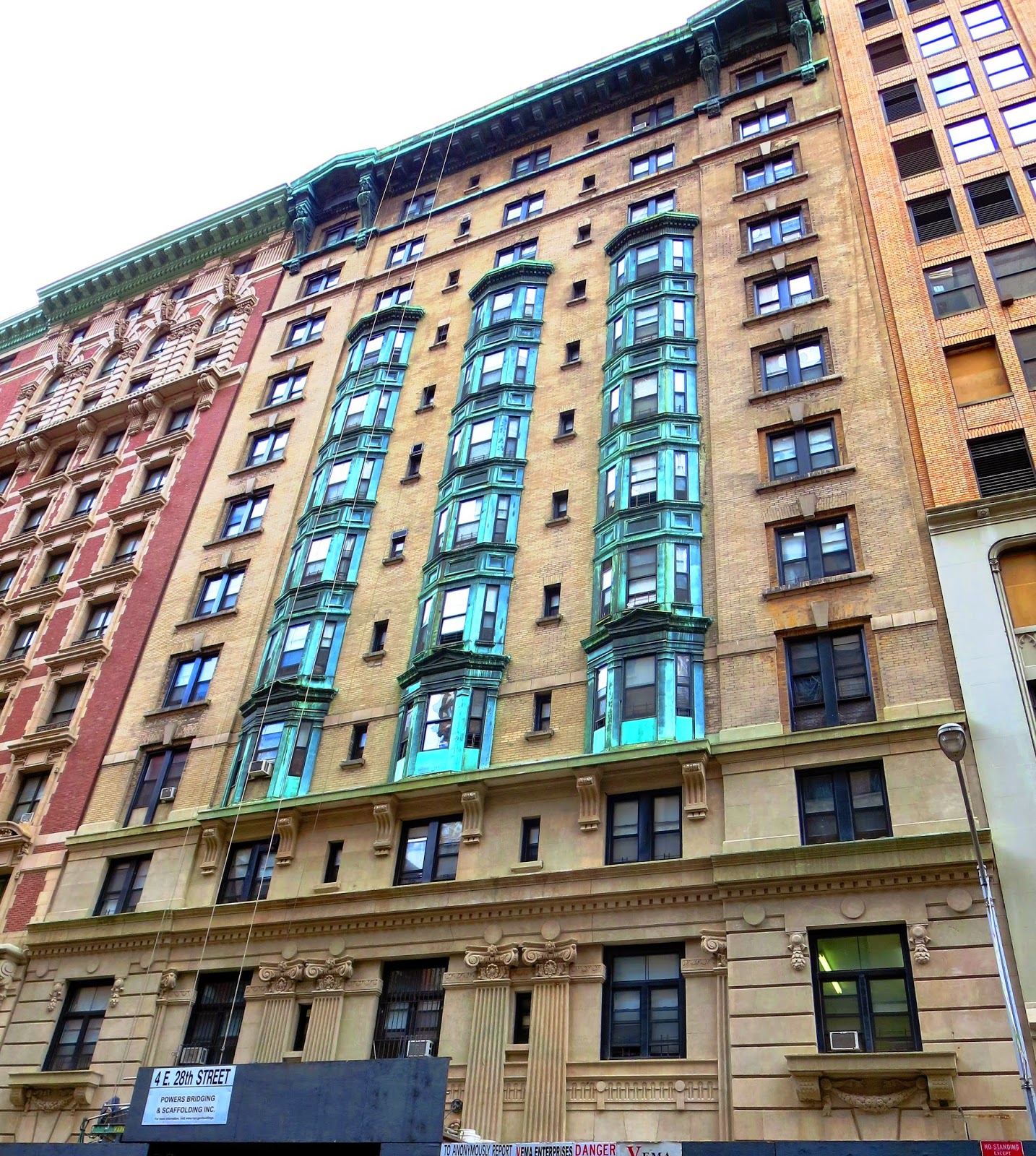
The 1904 Hotel Latham -- No. 4 East 28th Street


By the turn of the century Manhattan’s wealthiest citizens had all but abandoned Fifth Avenue south of 34th Street.  High end retailers like art galleries and dressmakers took over the mansions not yet razed and replaced by commercial structures.  The side streets—like 28th Street between Fifth and Madison Avenues—rapidly saw the rise of high-end hotels.  These were as much apartment buildings as they were lodging houses for travelers.

In 1904 L. George Forgotston climbed on the bandwagon with plans for an upscale hotel stretching from No. 4 through 8 East 28th Street.  His would be just one of several Beaux Arts-style hotels lining the block opposite the still-fashionable St. Leo’s Church.

Forgotston commissioned architect Augustus N. Allen to design his Latham Hotel.  Twelve stories tall, it was surprisingly restrained at a time when hotel facades dripped with carved festoons and frothy ornaments.  Instead Allen’s two-story limestone base featured formal fluted Ionic pilasters.  The sole ornamentation of the brick façade above were the copper-clad bays which not only added dimension; but caught any wafting summer breeze.


Allen turned to an innovative building material for the upper floors.  Rather than the expected red or yellow clay brick his were a grayish color.  This was due to their composition—what the Real Estate Record & Builder’s Guide termed “sand-lime brick.”  A mixture of lime and sand, the bricks were pressed into shape by heavy machinery, then hardened under pressure in large cylinders.  The Guide noted “Its appearance is said to be very pleasing.”

As with all the hotels in the neighborhood, the Latham offered permanent and transient accommodations.  At lobby level was the Café Thomas and by 1907 it had become a destination spot.  What to Eat, in January 1907, said the café “is the headquarters of buyers for great mercantile houses in other parts of the country.  It has an interesting collection of prints and views reminiscent of old New York.  This restaurant is also a favorite resort of women shoppers.”
 
A postcard of the lobby showed marble walls and leather tufted furniture.
That year Mrs. J. P. Case was staying at the Latham and on April 11 her mother, Mrs. Sarah E. Anderson arrived from Baltimore to join her.  The following morning Mrs. Case woke after dreaming that something horrible had happened to her mother.  The Evening World reported later that day, “So strong was her premonition that Mrs. Case ran to her mother’s room and tried to arouse her.”

Tragically, Sarah Anderson had died of a heart attack.  “The shock undid the daughter,” said the newspaper.  Mrs. Case threw open a window and screamed for help.  Her shrieks caused guests in the nearby Prince George Hotel to flock to their windows.  She was put in the care of the Latham’s in-house physician, Dr. Bellamy.

“Mrs. Case was in a highly nervous state from her experience, and for a time it was feared she would be critically ill.  She responded to restoratives but Dr. Bellamy was obliged to remain by her for the rest for the night,” said The Evening World.

A 1909 advertisement lured tourists and businessmen -- New-York Tribune, June 6, 1909 (copyright expired)
A year later broker James R. Collins and his wife moved into the Latham.  They had previously been living in a suite of rooms at the Plaza where, according to the New-York Tribune “Collins spent his money lavishly.”

In May 1908 the Collins’ hotel bill there had risen to $250—in the neighborhood of $6,500 today.  The couple moved out, leaving a check for $125 as partial payment, and secured rooms in the Latham.  The problem was that the check was no good.

The New-York Tribune noted “Collins, it is said, was once wealthy.”  Apparently those days were over.  The Plaza management filed a complaint and on July 15, 1908 the Latham Hotel suffered an untidy scene when Collins was led out in handcuffs.

The Hotel Latham had much to offer.  As its advertisements boasted, it was just one block from Madison Square Garden, “one door from Fifth Avenue,” and was touted as fireproof.  There were 300 rooms which ranged in price from $1.50 a day and up, to $2.00 per day and up for rooms with private baths.

In the dining room a painted border depicts children in various seasons.

Perhaps the Latham’s most curious resident in the pre-World War I years was Marion Hamilton-Grey.  The young man “represented himself to be heir to the Dukedom of Hamilton in Scotland,” reported The New York Times on January 21, 1910. 

Police Inspector McCafferty received word that Hamilton-Grey, a suspected con artist, had recently come to New York.  McCafferty traced him to the Hotel Latham.  But the guest had recently left, leaving an outstanding bill of $10.50.  That bill was settled by the St. George’s Society, the inspector learned.  The Times explained that, according to E. D. Langley of the Society, “the young man represented himself as a nephew of Col. Hamilton-Grey of the British Army in India, and had declared that he had an allowance of $4,000 a year, but that this was being held up temporarily abroad because of trouble he had had with the executors of his father’s estate.”  The St. George’s Society paid the hotel bill and gave the man a furnished room on West 24th Street.

Inspector McCafferty now took Detectives McKenna and Cassassa to the 24th Street address where they found “their quarry” near 8th Avenue. When the detectives told Hamilton-Grey they wanted to talk to him, they were startled when they heard the response.

“Why, you’re no man.  You’re a girl!” Cassassa said after hearing the voice.

“Well, what’s the harm in that?  I never said I wasn’t.”

Now in custody, the 19-year old girl said she had been born in Punjab, India.  Her father had been Colonel Hamilton-Grey and she was orphaned at the age of four.  An “old friend in India had advised her to adopt men’s clothes as an easier means of making her living, and she had followed his advice for the last ten years,” said The Times.

“The girl made a handsome youth in her boy’s clothing.  Her brown hair was clipped short like a man’s and she wore a gray suit, gray slouch hat, and gray overcoat with a gray stock.  She had black patent leather shoes and wore blue spats over them,” reported the newspaper.

The fine wardrobe resulted in her being charged with “masquerading in men’s clothing.”  She had her suspicions concerning who set the police on her trail.  “I wouldn’t be surprised to learn that a wealthy widow of Newark was behind this,” she said at the police station.  “She fell in love with me and never forgave me when I wouldn’t marry her.”

Despite down-on-their-luck guests like Collins and Hamilton-Grey, the Latham continued to see well-to-do residents.   Among them were John Gilbert Gulick, his wife, and their son Earl.  On October 19, 1913 the New-York Tribune’s society page noted that they “have returned to the city from their summer home at Lake Hopatcong and are at the Prince George.  They will take possession of their apartments at the Hotel Latham to-morrow for the winter.”

Charles Vail, Vice President of the Transcontinental Freight Company rented rooms here in 1913—but his purposes were less upstanding that those of the Gulicks.  On the evening of December 12 that year he entered the hotel with a suitcase.  When he appeared in the lobby half an hour later he was in “faultless evening dress and accompanied by a tall, blonde woman,” according to The Evening World nearly a year later on November 20.

What the wealthy executive did not realize was that his wife, Emma, had a private detective trailing him.  After the couple had dinner at the Hotel Imperial, they returned to the Latham.  

The detective had checked the register where they were signed in as “Mr. and Mrs. Vail, Chicago.”  With Vail and the blonde upstairs, he summoned Emma.  She brought several witnesses with her and they commenced a raid on Room No. 1102.

The detective testified in the subsequent divorce case, “The woman pulled the bedclothes over her face, but wasn’t quick enough for Mrs. Vail, who struck her.  Then she went after her husband.”

Caught red-handed—or red-faced, anyway—Vail was directed to pay his now-former wife $100 a month alimony. 

The protruding bays extended along the side wall.

By now World War I was raging in Europe.  Far from the fighting, the Hotel Latham felt the effects.  Many of the tourists who stopped at the hotel were European and a large percentage of those were German.  By the end of 1915 the hotel had to close.

On November 25, 1915 the New-York Tribune reported that the hotel “will close its doors at noon to-morrow, according to an announcement made last night by Albert Pratt, the manager…The European war is given as one of the contributing causes to the failure.  Many German patrons since the war started have failed to put up at the hotel.”

The same day The New York Times reported that “Guests were notified last night that they would have to seek other quarters, and all employes received notice that their service would terminate tomorrow.”

The extremely short notice given to hotel residents resulted in tragedy for one elderly man.  Lawrence Peterson had been living here for a year and a half.  His father had been the owner of Peterson’s Magazine of Philadelphia, by now out of publication.  Mary Casey, proprietress of the Hotel Latham, told a reporter “he was the sole heir to an estate amounting to about $10,000,000.”

Petersen’s finances, however, were tied up in a trust and its executor, G. F. Kean, gave him only a few dollars a week.  Now forced to find new accommodations, the old man was panic-stricken.  The stress of his situation finally became too much.

The Times reported on November 26 “An old man, well dressed, but penniless, stumbled into the lobby of the Home Club, an apartment house at 11 East Forty-fifth Street, last night and told an elevator boy to summon a doctor because he felt he was reaching his end.”  The newspaper said “As the Hotel Latham was about to close by order of a bankruptcy referee he said he did not know where to go.”

The elevator boy suggested calling a taxi, but Peterson said he did not have a penny to pay for one.  Before a doctor could arrive, Peterson had died of a heart attack. 

Peterson had earlier pleaded with Mary Casey.  “He said he was more than sixty years old and that nobody would give him a home if he were put out of the Latham…It is believed at the hotel that this circumstance aggravated the heart trouble which caused his sudden death,” said The Times.

Within a year the hotel was back on its feet.  Like every hotel, the Latham had its share of heartbreaking stories.  Around the first of November in 1916 Brooklyn Union Gas Company employee B. L. Graham checked in.

In the first years of the 20th century the leading cause of death in the United States was tuberculosis.  Around 110,000 Americans died each year from the disease, and those diagnosed were normally whisked away to be isolated in sanatoriums.  A few months earlier Graham had been diagnosed with the deadly illness.

Late on the night of November 2, when Graham had not been seen coming or going for some time, Manager Max Hoestmann sent a porter to check on him.

“The porter opened the door with his master-key,” reported The Evening World.  “On the bed he found Graham’s lifeless body.  He clasped tightly the picture of his wife.  By the bed was an automatic pistol with one chamber empty.”

Graham had shot a bullet into his head.  The newspaper described the photograph of “a remarkably handsome young woman in evening dress.  She was sitting.  A string of pearls hung gracefully about her neck.”  On the reverse Graham had written:

God keep and make happy this girl—the sweetest and most wonderful woman in all the world.

Following the war’s end the Latham remained a respectable hotel for years.  In 1920 Margaret Prescott Montague stayed here as her motion picture Uncle Sam of Freedom Ridge opened at the three Manhattan theaters.  Montague told reporters that the purpose of her film was “to express the idea of the League of Nations, and, more fundamentally, to impress upon all the ideas of atonement and resurrection.”

The Depression years saw a change to the Latham and to its neighborhood.  Called by Rider’s New York City Guide a “quiet family hotel” in 1923, by 1931 it attracted a more sordid clientele.  On the evening of March 31, 1931 several men including a former vice squad policeman, Richard E. Ganley, were playing poker in one of the rooms.  Suddenly three men broke into the room with drawn guns and ordered the poker players to line up against the wall.

Ganley, however, pulled his service pistol and fired at the leader of the gang, William Horowitz.  What ensued was described by the Brooklyn Standard Union on April 10 as “a gun battle.”  When it was over, 53-year old Albert Shaw, one of the card players, lay dead.  Howoritz, badly wounded, was captured in the hotel lobby and charged with murder.

One of the Latham’s most renowned residents was photographer William Henry Jackson.  He was 99 years old when he fell and hurt himself here on June 26, 1942.  He was highly responsible for the creation of Yellowstone National Park when his photographs of the magnificent landscapes were presented to Congress in 1872.  Four days after his fall he died in Midtown Hospital and he was buried in Arlington National Cemetery.

But the most notorious guest of all would be Rudolf Abel who lived here in 1957.  FBI agents shadowed the man, finally knocking on his door at 7:02 on the morning of June 21.  In a search of the room the agents found a hollow shaving brush and hollow pencils, used for hiding microfilm; cameras for producing “microdots;” and other Cold War Era espionage paraphernalia.  He was arrested as a Soviet spy.

Five years later, in February 1962, the United States government exchanged Abel for Francis Gary Powers.  Powers had been shot down over Russian in a U-2 spy plane, creating an incident reported globally.

The respectable days of the Hotel Latham were already over and things would get worse before they got better.  By 1983 the city was using the building as a home for “displaced families.”  There were 25 homeless families living in the hotel that year.  On August 31 Philip Shenon of The New York Times described “At the Latham, in the light of bare bulbs and short white strands of neon lights, rats crawl across the floors, and paint peels on the walls.  Roaches, water bugs and ants crowd the sinks.  Toilets frequently do not work, and repairs are slow.  Halls and stairwells reek of mildew, urine, and marijuana.”

On January 25, 1988 one man was fatally shot and four others wounded in a gun battle over illegal drugs.  The bodies fell to the sidewalk directly in front of the Latham Hotel.

Two other hotels of the period survive alongside the Latham.
Today the once-proud Hotel Latham has been rescued by businessman and philanthropist Carl Celian Icahn.  Now called the Icahn House, East, the renovated facility houses the homeless and provides medical care.  Considering its sometimes harsh past, the exterior appearance of the Hotel Latham is astoundingly unchanged since 1904.

photographs taken by the author

Friday, February 21, 2014

The 1879 St. Anthony Club -- No. 29 East 28th Street

An unfortunate street level renovation destroyed much of Renwick's structure.

In 1862, when Manhattan’s exclusive gentlemen’s clubs buzzed with the talk of civil war, a new sort of club was established.  The Red Room Club was organized “for the promotion of literature and art, by establishing and maintaining a library, reading-room, and gallery of art, and by such other means as shall be expedient and proper for such purposes.”  There were already several literary and artistic clubs in the city; but this one required that its prospective members have something more than money.  They had to have a college diploma.   In 1865 the organization was incorporated as the University Club and a distinctive new genre of men’s club had been realized.

At the time, the Delta Psi fraternity, founded at Columbia University, was 19 years old.  Before long the Delta Psi Society was formed, a clandestine society of rites and mystery.  As the second half of the century progressed, the growing number of university-based clubs—among them the Princeton, Hamilton, Yale and Dartmouth Clubs—was supplemented by purely fraternity-related clubs. 

Later, in 1893, James Grant Wilson in his The Memorial History of the City of New-York would explain “One peculiarity of these [fraternity-based] societies is that the number of resident and non-resident members is nearly equal, the out-of-town representation being perhaps the greater.  Members of the Greek-letter societies throughout the country join the clubs in the metropolis as a matter of pride, and these thus become the national headquarters of the fraternities.”-

According to the New-York Tribune, it was Delta Psi which was the first “of the Greek letter societies to establish in New-York a club which presents many of the features of the other social clubs in the city.”  James Grant Wilson described it as a “secret order.”

In 1879 the highly-regarded architect James Renwick, Jr. would design the Delta Psi Society’s clubhouse at No. 29 East 28th Street.  The organization chose the location well.  Just a block and a half from Fifth Avenue, the site was firmly in a neighborhood of fashionable residences.  The new clubhouse would replace the former home of the wealthy Simon DeWitt Bloodgood.

The completed clubhouse, clad in red and cream-colored brick with terra cotta trim, stood full three stories high over an English basement.  A mansard roofed fourth floor, tiled in slate, was punctuated by two cast metal dormers.  Bandcourses of terra cotta or brick separated the floors, and brick quoins ran up the sides and around the openings.  A dramatic cluster of three windows surmounted by a grand terra cotta arch created a focal point.  Between the third floor windows a shield was carved with the Greek letters of Delta Psi.
The fraternity's Greek letters were originally carved in the stone shield.

The expanse of windows at the second floor were there for architectural purposes only.  They were non-functional inside.  The Sun’s Guide to New York noted that “This is the oldest and probably the wealthiest of the college fraternity clubs in this city…Not only is membership restricted to members of the Delta Psi fraternity, but no non-member is even allowed to pass the threshold of the club-house.  The club rooms are on the first floor, and the windowless floor above is the chapter-room of the Columbia College chapter to the Delta Psi fraternity.”

The New-York Tribune side-stepped criticism and called the building “a house unique in appearance and in style of architecture.”   The Real Estate Record and Builders’ Guide was more direct.  Five years after the structure’s completion the Guide wrote that the Delta Psi lodge “is composed of red and yellow brick, and is not without good points of design.  But the color treatment is exactly and exquisitely wrong, the two colors being transposed, so that it is the negative of a much better building than itself.”
A high stoop originally led to the first floor entrance, above today's especially unattractive restaurant marquee.

By 1889 the Delta Psi Society had renamed itself the St. Anthony Club.  On March 31 of that year the New-York Tribune reported on what little was known of the arcane interiors of the clubhouse.  “Those who are not permitted to wear the mystic St. Anthony cross, with its shield of blue enamel, its Hebrew letters and its skull and bones, know little of the interior of the heavily bolted club-house of Delta Psi.  Its members say that it contains many of the comforts and conveniences of an ordinary club, but that it lacks restaurant and dining-room facilities.  The large meeting-room is furnished in Egyptian style.  The lodge-rooms of the Columbia chapter of Delta Psi are in the building.  They are handsomely decorated in pure Egyptian from designs imported from Thebes.”

At the time of the Tribune’s report, the St. Anthony Club had about 300 members.  On the roster were some of the most prestigious names in Manhattan—Cyrus W. Field, Jr., Stuyvesant Fish, Nicholas Fish, Schuyler Hamilton, Jr., Mark Hopkins, Edward De Peyster Livingston, Valentine Mott, Gouverneur W. Morris, and  James W. Roosevelt among them.

By 1894 the St. Anthony Club had outgrown its 15-year old clubhouse.  On June 16 of that year the architectural firm of Heins & LaFarge submitted plans for “a three-story brick and stone extension.”  The rear addition cost the organization $15,000—around $400,000 today.

The secretive and high-toned club stayed out of the headlines—good or bad—for decades.  But in 1904 it was pulled into a shocking scandal that rocked New York society.  Wealthy wine merchant Frank de Peyster Hall had been a member since 1878.  He was President of the F. de Peyster Hall Company and lived nearby at No. 113 West 28th Street in what The Evening World called “luxurious surroundings.”   Hall held memberships in other exclusive men’s clubs including the New York Yacht and the Calumet Club.

The unmarried millionaire sometimes stayed overnight at the Calumet Club and nighttime activities resulted in his being asked to resign.  Like all men’s clubs, young boys were employed as bellboys to handle messages and tend to the incidental needs of the members.   When club officers heard of the “gossip of bellboys” the youths were questioned.  Club attendants said that “over a long period of time” the “boys were afraid to go to Hall’s room while he was living in the club.”

This led to an investigation by discreet private detectives.  A young detective was placed in the Calumet Club as a bellboy.  “On the strength of his evidence the manager of the detective agency, according to the club officials, went to Mr. Hall, handed him a resignation blank and asked him to fill it in,” reported The Evening World some months later.

The sensational facts of Hall's “disgraceful practices” were kept from the public and Hall’s resignation was reported to be due to his unhappiness with the way the club was managed.  But little by little rumors leaked out.  By September 1904 his business partners heard the story and he was forced to resign.  Several members of the Calumet were also members of the St. Anthony Club and the scandalous tale was repeated in the hushed halls of No. 29 East 28th Street.

On October 5, in an effort to control the “ostracism both socially and in business circles” he was enduring, Frank De Peyster Hall sued Alfred H. Bond, president of the Calumet Club, and George A. Carmack, secretary of the New York Yacht Club. Charging the men with slander, he sued each for $50,000.

Hall’s attempt to save face backfired.  As attorneys prepared their cases, newspapers were told that at least “seven witnesses, all of whom are boys” would testify.  To make matters worse, Bond sent a message to Hall’s lawyers saying, according to The Evening World, “that he desired no further publicity, but that if the suit were pressed he would lay the evidence in his possession before the District-Attorney, which the object of beginning criminal proceedings.”

Frank De Peyster Hall, once eminently successful and respected, had his back to the wall.  Pederasty in 1904 was not only a despicable crime; it was damning.  If his case went to trial, Hall would be shamed and ruined.

On October 10 The Evening World reported “It was Hall’s custom to take his breakfast in his room every morning at 8.45 o’clock.  Malvina Morse, the negro maid, took the breakfast to the room at the usual hour to-day.  The door was slightly ajar.  She knocked, but receiving no reply she entered.

“The sight that greeted her eyes caused her to drop the tray and rush into the passage with a scream of horror.  Hall was lying dead on the floor alongside the bed.  There was a bullet wound in his head and a pistol clasped in his right hand.”

The disgraced club member had taken the only way out he could conceive of.

After a quarter of a century in the clubhouse, the St. Anthony Association looked to move northward.  On July 4, 1912 the club purchased the mansion of Edith S. Logan, widow of John A. Logan, at No. 17 West 56th Street.  Edith Logan accepted the 28th Street clubhouse as partial payment.

With few alterations, Edith Logan converted the clubhouse to commercial space.  On May 27, 1915 The Times noted that she had leased the building to W. E. Morgan.  Two years later she was ready to sell.

On May 13, 1917 The Times said “the realty market closed yesterday with a few scattering sales, interesting among which was the sale of the old four-story and basement dwelling at 29 East Twenty-eighth Street.”  The newspaper reported that Edith Andrews Logan’s buyer “will make extensive alterations and occupy the structure for his own business.”

In 1921 the house was headquarters for a possibly naughty operation.  On July 2 that year an advertisement appeared in Publishers’ Weekly:  “WANTED—Salesmen, thoroughly acquainted with French publications.”

By the 1940s the building had been converted, informally, to apartments and it appears that in October 1940 a young artist who signed his name “M. Rothkowitz” first took an apartment here.   He would go on to be better known as Mark Rothko.

By 1945 the Federal World Government, Inc., a “non-profit membership organization,” had its headquarters in the building.  Also known as the World Federalists, USA, in September 1945 it released to the press a letter sent to President Truman.  The message, signed by former Supreme Court Justice Owen J. Roberts and 38 leaders in the business, labor, education, literary and education fields, stressed “the establishment of a democratic ‘world government’ as the best means of controlling the atomic bomb.”

The Federal World Government, Inc. would stay in the house for just one more year.  In June 1946 it purchased the brownstone house at No. 31 East 74th Street which it dubbed World Government House.”

When Theodore Stuart Weshner and his wife moved into their second floor apartment in the building in the 1950s, the brownstone stoop had probably already been removed.  Known familiarly as Skip, Weshner was a stereo enthusiast.  He installed 46 loudspeakers in his living room—the once-sedate space which in the 1880s was Delta Psi’s top secret meeting room.  But his obsession with musical purity went further.

Meyer Berger, reporting in The New York Times on November 18, 1956, “The quest for pure music from recordings has led men into odd designs and compelled them to the use of all manner of gadgetry, but Theodore Stuart Weshner…has opened a seemingly fantastic new approach.  He manipulates his living room walls.”

In the 12-foot high space Weshner installed pivoting seven-foot panels, one foot wide; thus creating false walls.  “One side of each board in this giant louver is surfaced with celotex, to act as an absorbent of speaker sound waves; that’s the front wall’s soft side,” explained Berger.  “If Skip wants to add brilliance to high-range notes from the speakers, he pivots all the boards so their hard, or painted sides, face into the room in an unbroken wall.  If he wants light, rather than music, he pivots the louver units so that they face end in.”

Today James Renwick’s late Victorian clubhouse, squashed between two soaring commercial towers, is a bit grimy.  A Chinese restaurant operates from the former English basement.  But the integrity of the design above shines through—“unique in appearance and in style of architecture.”


photographs taken by the author