Showing posts with label east 26th street. Show all posts

Friday, November 28, 2025

The Hiram Dixon House - 117 East 26th Street


In 1851, the family of Edward F. Saxton, a stockbroker, leased the newly-built house at 91 East 26th Street (renumbered 117 in 1867).  One of a long row of identical, high-stooped Italianate residences, it was three stories tall above the basement level and faced in brownstone.  The iron railings of the stoop matched the balcony that fronted the parlor window.  A simple, molded frame embraced the double-doored entrance, and the elliptically arched openings sat upon bracketed sills.  Each of the homes had its own pressed metal cornice with robust scrolled brackets.

The following year, agent Edward B. Kinshimer advertised three of the houses, including No. 91, for rent.  He wrote, "they have baths, ranges, gas &c. and all is in good order.  Rents $750."  The figure would translate to about $2,500 per month in 2025.

Samuel Hanna, a baker, moved his family into the house and would remain through 1854.  Then, on February 19, 1855, Kinshimer advertised 19 East 26th Street for sale, noting its "location genteel."  The ad was answered by the multi-faceted Hiram Dixon.

Dixon had served in the Revolutionary War and was a member of the Veteran Corps of 1776.  He was a member of The American Institute of the City of New York, described by The New York Times in 1860 as "including many of the ablest and best men the City and country afford."  

Although he listed his profession in 1857 as an accountant with the Adams Express Company, he had additionally been "a professor of penmanship for many years," according to The New York Times in 1860.  Groups sought out Dixon for his remarkable penmanship to create elaborate Victorian documents like testimonials and proclamations.  One commission came from the New-York Typographical Society in 1865 when Dixon was hired to pen a "handsome testimonial" for the society's former president, William McCrea.  When the document was exhibited in August, The New York Times remarked, "The penmanship, executed by Mr. Hiram Dixon, of the Adams Express Company, is a rare specimen of art."

Dixon's expertise in calligraphy was so well-known that when the U.S. Government charged Henry Williams with stealing a letter from the mail and forging the signature on a $3,000 note inside, Hiram Dixon was "called as [a handwriting] expert," according to The New York Times on January 26, 1860.

In 1868, Rev. Jesse Ames Spencer moved in.  Born in June 1816, he began working in a printing office at the age of 14.  He graduated from Columbia in 1837 and from the Episcopal General Theological Seminary in 1840.  In 1869, he was elected professor of Greek language and literature at the College of the City of New York.  He and his wife, the former Sarah Jane Elizabeth Loutrel, had seven children.

Rev. Jesse Ames Spencer, (original source unknown)

A prolific author, he published numerous books, many of them about history.  While living here, he finished his four-volume History of the United States from the Earliest Period to the Death of President Lincoln, and published Greek Praxis: Or, Greek for Beginners; and The Young Ruler Who had Great Possessions, and Other Discourses.  

The house was offered for rent in August 1872.  It received a long term resident starting in 1874 with Dr. Allan McLane Hamilton.  Born in October 1848, Hamilton was the grandson of Founding Father Alexander Hamilton and of Louis McLane, former Secretary of the Treasury, Secretary of State, and two-time U.S. Minister to the United Kingdom.  His privileged childhood was reflected in his autobiography, Recollections of an Alienist, in which he recalls, "my Thanksgiving dinner [was] taken yearly with Mrs. John Jacob Astor, the mother of 'Willie' Astor."

Hamilton was a newlywed when he moved into 117 East 26th Street.  He married Florence Rutgers Craig on May 25, 1874.  At the time, he was "connected with the Board of Health" and was "Professor of Nervous Diseases in the Long Island College Hospital," according to The New York Times on June 27 that year.  The couple's only child, Louis McLane Hamilton, was born here in 1876.

Dr. Allen McLane Hamilton, from the collection of the Library of Congress

Dr. Hamilton was an alienist, or what today is known as a psychiatrist.  He specialized in suicide, and the effects of blows to the head to mental health, and often testified in criminal cases.  Despite his expertise in psychiatry, he was appointed by the Health Department as a "sanitary inspector."  That side job earned him $1,600 per year in 1876, or about $47,000 today.  Sanitary inspectors investigated the conditions of tenements and houses within impoverished neighborhoods.

Dr. Hamilton almost assuredly knew Dr. Evert S. Warner, who moved into the house in 1881.  On July 1 that year, The New York Times reported that Evert was one of "a corps of 50 physicians for service among the tenement-house population during the heated term."  Warner was a resident physician at Bellevue Hospital.

On the evening of January 24, 1896, Dr. Warner became involved in a bizarre incident.  At around 8:30, a man knocked on the door of 117 East 26th Street.  "The Doctor was asked to call at the offices of the gas company," said The Sun.  The Consolidated Gas Company's building was nearby at 26th Street and Fourth Avenue (Park Avenue South today).  Half an hour earlier, a drama had begun to play out.

The Sun reported that a closed cab had "rapidly" driven along East 26th Street to the gas company building.  "It was followed by a second cab, which stopped immediately behind it.  Three men jumped out of the second cab and hurried over to the first one."  As one of the men unlocked the door of the gas company's offices and turned on the lights, the others "opened the door of the first cab and lifted out a dead man."  They carried it into the building and the cabs drove away.

Dr. Warner arrived at the office where one man asked, "Is it a fact that this man is really dead?"

The Sun recounted, "Dr. Warner examined the corpse, and replied: 'The body's cold.  He has been dead some time.'"

All four men at the scene, including the dead man, Captain William J. Collins, were employees of the gas company, Collins being its head bookkeeper.  The men had left work that night and got as far as the Brooklyn ferry when Collins became ill.  He ordered a cab to take him back to the gas company building.  Concerned, his coworkers followed.  Collins apparently died en route.

As was common, the Warners took in a roomer.  On June 18, 1897, an advertisement in The New York Times said, "117 East 26th St.--A pleasant, nicely-furnished room in physician's house."

In 1941, the original ironwork and balcony of the house next door was intact.  via the NYC Dept of Records & Information Services.


By 1901, the house was home to Dr. Ellice Murdoch Alger and his wife, the former Louise Stevenson.  Alger was an instructor in diseases of the eye at the New York Post-Graduate Hospital.  He was a co-founder of the National Society for the Prevention of Blindness.

The Algers remained until about 1908, when it appears the residence was being operated as a rooming house.  Then, in its April 1913 issue, The Smith College Monthly reported, "Jean Cahoon is running a tea room for business women in New York."  The Sun reported that M. Jean Cahoon had leased the building "for a term of years...for a tea house."  Cahoon called her cafe The Noonday.

The Noonday was relatively short-lived.  The house was leased in 1915 and returned to a rooming house.  It was leased by architect and artist C. Bertram Hartman around 1922.  His daughter, Rosella M. Hartman, was listed as an artist here the following year.

In the late 1920s, writer Dorothy C. Heligman lived here.


Before World War II, the Italianate ironwork was removed.  Other than that loss, the exterior of the former Dixon house is greatly intact.  It is a single family home today.

photographs by the author

Thursday, August 28, 2025

The Elizabeth Benedict House - 119 East 26th Street


Unlike its identical neighbor, the brownstone facade of 119 East 26th Street has been painted.

Two families--the Jewells and Keanes--shared the newly built brownstone-clad house at 93 East 26th Street in 1851.  (It would be renumbered 119 in 1867.)  It was one of a row of identical, high-stooped Italianate residences and rose three stories tall above the basement level.  The iron railings of the stoop matched those of the parlor balcony.  A simple, molded frame embraced the double-doored entrance, and the elliptically arched openings sat upon bracketed sills.  Each of the homes had its own pressed metal cornice with robust scrolled brackets.

Presley B. Jewell was a painter and Patrick A. Keane was a shipjoiner (a craftsman who installed wooden components like decking and cabinetry in ships).  Patrick's wife, Mary Ann Keane, died here on December 18, 1852 and her funeral was held in the parlor on the 20th.

Despite their proletariat professions, the Jewells and Keane lived in upscale surroundings.  When the furnishings were sold at auction on April 27, 1853, they included parlor furniture "made to order," a "splendid 6-1/2 octave piano made by Nunn & Clark," china tea and coffee sets, and "rich crimson curtains."

The house was next leased by French-born Valiente Parfirio.  An author and historian, he would publish Reformes dans les Iles de Cuba et de Porto-Rico (Reforms in the Islands of Cuba and Puerto Rico) in Paris in 1869.  The Parfirio family rented spare rooms.  An advertisement in the New York Herald in 1854 offered, 

A gentleman and wife, or a few single gentlemen, can find pleasant rooms, with the comfort of a home, at 93 East Twenty-sixth street.  French and English spoken in the family.

The house was sold at auction on February 11, 1859.  The announcement described, the "very desirable and elegant house" as having, "plate glass in windows, stained glass entering third room, mahogany doors, baths, wash tubs and other modern improvements."

Thomas H. and Mary C. Geraty purchased the property, and their son, Thomas Jr., was born shortly afterward.  The infant contracted croup early in 1860, and died on February 16.  His miniature coffin sat in the parlor until his funeral on February 18.

The house saw at least two occupants over the next seven years.  Then, around 1867, Elizabeth Benedict purchased it.  Many widows operated their homes as boarding houses, but Elizabeth (the widow of Benjamin Benedict) seems to have been financially secure.  She spent her summers away from the city.  On May 5, 1870, Elizabeth advertised, "The neatly furnished house No. 119 East Twenty-sixth street to let until October."  She charged $225 per month, about $5,420 in 2025 terms.

Elizabeth Benedict remained here for more than two decades, selling it in February 1890 to John J. Emery for $13,500 (about $466,000 today).  Emery resold the house to Gustav and Gertrude Romer four years later.

The Romers leased it to a Mrs. Hall, who operated it as a boarding house.  Also living here were her daughter and son-in-law, Genevieve and Frank Allen.  Allen was described by The Morning Telegraph as, "an expert accountant and bookkeeper."  He earned $3,500 a year, a comfortable $133,000 today.  He married Genevieve Hall ( whom the newspaper said was "a small and pretty blonde") in 1884 and, according to The Morning Telegraph, "they took up the struggle of life together and lived happily."  

In fact, not everything had been happy within the marriage.  According to Allen, his wife "was a very jealous woman, and, much to his sorrow, she began to suspect that he paid attention to other women," said The Morning Telegraph.  She demanded a divorce, but Allen would not consent and spent "thousands of dollars in fighting her actions."  Allen insisted he was "guiltless of any misconduct" and "always conducted himself with extreme propriety and took great pains not to arouse the jealousy of his suspecting wife."

Around 1897, Maskel Phelps took a room in the house.  Ironically, before long it was Frank Allen who suspected hanky-panky.  The following year, he arranged for a friend, Lewis Lawrence, to obtain a room in the house "as a spy."  Lawrence later admitted he, "took up his lodgings there for the express purpose of trapping Mrs. Allen for the benefit of the husband."

With the resulting evidence, Frank Allen moved out and on August 30, The Morning Telegraph reported, "Allen charges his wife...with misconduct with Maskel Phelps."  He told a reporter, "that instead of his being a wrongdoer it is his wife who has been misconducting herself, and that her conduct has become unendurable to him."

A less controversial resident was Paul Jursch, who sat on the School Board and was appointed a commissioner of deeds in 1901.  He would remain at least through 1903.  

Another boarder at the time was Dr. Martin Downey.  He was summoned to appear before the president of the Board of Health on June 17, 1903 to explain his failure "to report cases of scarlet fever" as required by the Sanitary Code.

Gustav and Gertrude Romer sold the house to Arthur P. Holland in November 1908.  He leased it to banker Herbert Seymour of Brown Brothers & Co.  A bachelor, he shared the house with his unmarried sister, Gertrude Seymour.  Seymour's financial and social status was reflected in his memberships in the New York Yacht and the Calumet Clubs.  Herbert Seymour suffered a heart attack on June 6, 1912 and died in the house ten days later.

In 1941, the Italianate stoop railings and parlor balcony survived.  via the NYC Dept of Records & Information Services.

At some point after mid-century, the iron balcony was removed and the stoop railings updated.  In the early 1970s, the A.C.T. Family Center, a therapy clinic for parents and teenaged children, occupied space in the house.  An advertisement in Newsday in 1971 explained in part:

Parents, teen-agers, and a work-team of two counselors sit down together in a living room atmosphere in a comfortable Manhattan town house and talk it out--not as a "case" being "treated," but as fellow human beings seeking honest communication and workable solutions.


A renovation completed in 1988 resulted in two duplex residences in the house.

photographs by the author

Wednesday, June 18, 2025

The Joseph Peabody House - 125 East 26th Street


Merchant Joseph Peabody and his family moved into the newly completed house at 77 East 26th Street in 1859.  (The address would be changed to 125 in 1865.)  One of a row of identical brownstone-faced homes, each was just 14-feet-wide and rose three stories above a high English basement.  Their Italianate design included understated molded entrance frames and handsome cast metal cornices.  Early photographs reveal fashionable Italianate-style iron balconies at the parlor level.

In the rear yard was a small house which the Peabodys rented to the William D. Robinson family.  Robinson was a clerk in the Custom House and his son, Edmund R., was an attorney.  The Robinsons' pet strayed off shortly after moving in.  An advertisement in the New York Daily Herald on November 12, 1859 read, "$5 Reward--Lost, a small white Scotch Terrier.  Whoever will return him to No. 77 East Twenty-sixth street, or to the cashier's office Custom House, will receive the above reward."  (The reward would equal $195 in 2025.)

Although the Peabodys' home was not grand, they sometimes moved within fashionable circles.  When the 19-year-old Prince of Wales visited New York City in 1860, a "Grand Ball" was held in the Academy of Music.  Among those invited were Joseph Peabody and his wife.

It appears that William D. Robinson purchased the property in 1866.  Edmund now occupied the main house and William the rear.  When Edmund moved to 258 Fourth Avenue in 1868, William and his wife moved into the primary house.  That same year Charles E. Strong, an attorney, listed his address here, occupying the rear building.  

The Robinsons, like their neighbors, maintained a small domestic staff.  On September 17, 1878, they advertised, "Wanted--An excellent cook; Must do the washing for a small private family.  125 East 26th st."  That their cook did double-duty as a laundress reflected the Robinsons' social and financial status.  Cooks in the mansions closer to Fifth Avenue were often the most highly paid among the staff and asking them to do anything other than prepare meals would be insulting.

William D. Robinson died in 1880.  Shortly afterward, the Collector of the Port of New York, Chester A. Arthur (later President of the United States), discovered $5,000 in gold coin missing from the office of the cashier of the Custom House.  In March 3, the Congressional Record noted that the missing funds were "without the default or negligence of the collector or of the late William D. Robinson, cashier."

Following the Robinson family, the house was occupied by Marco Leon Stevens y Voisin, "or plain Stevens Voisin," as described by The New York Times.  An exporter, importer and commission merchant, Voison arrived in New York in 1877.  The newspaper said, "Mr. Voisin was chiefly engaged in the export trade with Mexico," and noted:

Mr. Voisin's residence at No. 125 East Twenty-sixth-street is a stone-front, three-story dwelling.  As a bachelor he would have no need for so extensive an establishment were it not that it was his habit when the Mexican trade was booming to entertain his customers there, frequently having half a dozen of them at his house at a time.

The 45-year-old began experiencing business difficulties in 1885.  The New York Times explained that because of the "high rate of exchange, his Mexican customers [were] displaying not only no inclination to purchase American goods, but a very decided repugnance to paying the $25,000 or $30,000 which they owed him on old accounts."  The past due amounts that his Mexican customers owed him would top $1 million today.

Voisin's diminished cash flow crippled his ability to pay his creditors.  Then, in the fall of 1886 he gave Brown, Wood & Co. two checks amounting to $5,634.57.  When the firm deposited them on October 6, they bounced.  The bank notified Detective C. B. McDougal and the next day he visited Voisin's office at 45 Leonard Street.  He was told that Voisin had left for lunch.  McDougal waited, but Voisin did not return.  A week later, on October 12, The New York Times reported, "although a watch has been kept since then on his warehouse and his residence at No. 125 East Twenty-sixth-street, he has not been seen."

Detectives entered the house only to find that the former "richly furnished" rooms had been stripped bare.  Also missing was "a French actress" who had been living with Voisin.  The New York Times reported, "several of his creditors still have faith that he is only suffering from 'panic' and will turn up and straighten out his affairs in a day or two."  That did not happen.

(Interestingly, lawyer Charles E. Strong was still occupying the rear house at the time.)

Anna P. O'Connor lived here in 1890 when she was shopping in the White, Stokes & Allen store at 185 Fifth Avenue on October 16.  She suddenly felt a hand in her pocket and turned to see a "shabbily dressed man at her side," as reported by The Sun.  Bernard St. John Gisbey was arrested as a pickpocket and he, Anna O'Connor, and the salesman who had been waiting on her appeared in court on October 29.

The Sun described Gisbey as being "of slight figure, with an intelligent face.  His curling hair and moustache are brown."  Under questioning, the 35-year-old explained he was English and had had a good education.  He was ordained as a minister of the Congregational Church, but after a few years, "I resigned my charged because my religious views had undergone a change."

Gisbey thought that he could start anew in the United States, "believing that a man of my education could readily find employment."  That proved illusive and after a while, Gisbey was moneyless and homeless.  He tearfully told the court, "I did steal this purse, and I am overcome with sorry and shame.  I was driven to theft by actual hunger...I was not always as I am."  Gisbey was convicted and The Sun said he, "may be sentenced to State prison for five years."

As late as 1941, the original two-over-two windows survived.  image via the NYC Dept of Records & Information Services.

The house was sold in July 1893 and it became home to Augustus Porter Barnard.  An engineer, he graduated from the School of Mines of Columbia University in 1868.  He remained here until the turn of the century, at which time the neighborhood was seeing an incursion of commerce.

That change first came to 125 East 26th Street in the spring of 1905.  On March 19, an announcement appeared in the New York Herald:

Mrs. Hudson, formerly 1 West 100th st., is now located at 125 East 26th st., and is prepared to give her personal attention and thorough instruction in manicuring, hairdressing.  Marcel wave, facial, scalp, neck and general massage; anatomy taught; diplomas; addresses furnished of my graduates, who average $35 weekly; their success proves their ability; start now, start right and YOU will be successful.  Mrs. Hudson, 125 East 26th.

The post-World War I years saw several offices within the house.  In 1921, the architectural offices of Maynicke & Frank were here, and the following year the headquarters of the engineering firm Dwight P. Robinson & Co., occupied space.


Through it all, little changed to the exterior of 125 East 26th Street, other than the removal of the balcony.  In 1941, it was returned to residential use.  A renovation resulted in two duplexes--in the basement and parlor floors, and another in the top two.  That configuration survives.

photographs by the author

Thursday, March 13, 2025

The Joseph Sibbel Studio - 214 East 26th Street


Around 1852, Harned & Rothery, housesmiths, moved its operation into the three-story, brick-faced factory at 180 East 26th Street (later renumbered 214).  Originally, a window sat between two bay doors on the ground floor.  In the rear yard was a stable. 

Housesmiths forged the ironwork used in construction.  By 1857, the firm dropped the term, now listing itself as Harned & Rothery Foundry.  By then it had expanded into the buildings at 126 through 132 East 26th Street.  It remained until January 1860, when an auction was held that included, "a large quantity of Pig Iron, Wrought Iron, Cast and Wrought Scrap Iron, Wooden and Iron Patterns, Wooden and Iron Flasks, and various other articles of value to housesmiths and iron-founders."

The building became home to Alexander Stewart's and Edward M. Corbett's carriage factory.  Theirs were not the usual vehicles turned out in carriage shops.  Stewart & Corbett manufactured miniature, "children's carriages," as well as hobby horses and perambulators.  On February 11, 1869, Stewart & Corbett advertised for additional help: "Wanted--At 214 East 26th st., between 2d and 3d ave, men and women trimmers for children's carriages; also a few handy boys."

On Christmas Eve that year, a fire broke out in the factory.  The Philadelphia Age reported it damaged "the building, stock, and tools largely.  The amount of loss cannot yet be ascertained, but it is heavy and is well covered by insurance."

The former stable building in the rear yard was occupied by Edward Crockett, "bone manufacturer."  (The term referred to makers of bone buttons.)  Less than two months after the Stewart & Corbett fire, on February 5, 1870, the New York Herald reported that a fire had damaged Crockett's building.  The damage was slight, and police suspected the fire was "of incendiary origin."

By 1872, Edward M. Corbett had a new partner and the company was renamed Corbett & Coe.  At 1:00 on the morning of April 27 that year, Police Officer Byrne noticed "something wrong with the grating in front of Corbett & Coe's children's perambulator manufactory," according to the New York Herald.  A century before hand-held radios, police summoned help from nearby officers by rapping their nightsticks on the pavement.  Officer McDonald responded to the alarm.  Byrne's sharp eye upset the plans of two notorious burglars.  The article said the two policemen searched the building and discovered William Davis, "better known as 'Billy Doherty,'" and James S. Smith, "alias Jimmy Mundo," hiding inside.

Corbett & Coe left East 26th Street around 1877.  When Pierrot Julien purchased the property from the bank on December 31, 1879 for $6,000, it was described as a "three-story brick shop and three-story brick stable in rear."  The price would translate to $189,000 in 2025.

Within a decade, the property was transformed to an artistic center.  German-born sculptor Joseph Sibbel established his studio here by 1888.  Born on June 7, 1850, Sibbel worked exclusively in ecclesiastical work, creating statues and carved decorations for churches.

Joseph Sibbel at work in his studio on Our Lady Comforter of the Afflicted for St. Francis Xavier College Church.  from the collection of the Saint Louis University Archives.

By 1893, Anton Kloster was listed here (possibly operating from the rear building).  He designed and sculpted or carved church furnishings, like altars.  Anton would increasingly focus on designing church buildings, and by 1901 had turned his business over to Charles B. Kloster and devoted himself solely to designing architecture.  (The 1918 Byzantine Revival-style Church of St. Anselm and St. Roch in the Bronx is attributed to Anton Kloster.)

The Lithuanian Weekly, March 11, 1901 (copyright expired)

Working with Joseph Sibbel was Joseph Lohmüller, who exhibited his sketch for the grouping Holy Family on the Way to Egypt in the Architectural League of New York's annual exhibition in 1906.  In his 1916 German Achievements in America, Rudolf Cronau explained that Sibbel and Lohmüller,

...were very prolific during the latter part of the 19th and the beginning of the present century in beautifying the cathedrals and churches of America with reliefs and Biblical scenes and the statues of Madonnas, Martyrs, Saints and Apostles.


Christian Art, December 1908 (copyright expired)

Also listed here in 1906 and working cooperatively with Sibbel was Munich-born artist Gustav Kinkelin.  The two worked together in the decorations of St. Patrick's Catholic Church in Lowell, Massachusetts, for instance.  Joseph Sibbel designed and executed the marble altar, and Kinkelin did the mural work.

One of the murals executed by Kinkelin in St. Patrick's Cathedral in Lowell.  image via johncanningco.com
Sibbel's main altar for the same church.  image via st.patricklowell.org.

Joseph Sibbel died on July 10, 1907.  The Joseph Sibbel Studio continued here under Lohmüller and Armin Sibbel as late as the mid-1920s.  

At mid-century, the occupant of the venerable building was much less artistic.  It was home to the Johnson Electrical Corporation, a wiring contractor.  

The two entrances and central window survived in 1941.  image via the NYC Dept of Records & Information Services.

In 1964, Country Floors, Inc. occupied the ground floor.  The shop imported floor and wall tiles from Italy, France, Spain and Portugal.  Change came when a renovation completed in 2019 resulted in two apartments within the venerable building.

photograph by the author

Friday, June 30, 2023

The Jacob Wrey Mould House - 123 East 26th Street


When Jacob Wrey Mould arrived in New York from Britain in 1852, the 27-year-old architect had already established a name for himself.  He had studied with influential architect Owen Jones, known for his theories on ornament, color and patterning.  The two spent two years studying the Alhambra in Spain, a period that fostered Mould's appreciation for Moorish style architecture and vivid colors.  It resulted in his co-designing the Turkish Chamber in Buckingham Palace.

The young architect moved into a house on East 17th Street near fashionable Union Square Park.  Having designed ornamentation for London's 1851 Great Exhibition, he was  now commissioned to design details of the New York Crystal Palace, scheduled to open in 1853.  Although, according to Adolf K. Placzek in his 1982 Macmillan Encyclopedia of American Architects, Mould was considered "eccentric" and "ill-mannered," his career soared in New York.

He was hired to work shoulder-to-shoulder with Calvert Vaux and Frederick Law Olmsted on the design of Central Park and is responsible for some of its most notable ornaments--Belvedere Castle, the sumptuous carvings of Bethesda Terrace, and several bridges, among them.


Victor Prevost captioned this 1862 photo, "View of Willowdell Arch With the Team That Created Central Park Standing on the Pathway Over the Span."  pictured (L-R) are Andrew Haswell Green, George Waring, Calvert Vaux, Ignaz Anton Pilat, Jacob Wrey Mould, and Frederick Law Olmstead. Photos of the New Central Park, 1862 (copyright expired)

In 1859, two years after being hired as Assistant City Architect, Mould moved into the newly-built brownstone-faced house at 75 East 26th Street (renumbered 123 in 1865).  One of a row of identical homes, its narrow Italianate style included gently arched openings and understated architrave framing of the double-doored entrance.  Three stories tall above a high English basement, it was crowned with a ornamental cast metal cornice.

In addition to his Central Park work, by the time he purchased the East 26th Street house, he had designed the remarkable All Souls' Church on Park Avenue, and the interiors of the John A. C. Gray mansion on Fifth Avenue.  The Crayon described his color choices for that residence as "bold as a lion."

from A Description of the New York Central Park, 1869 (copyright expired)

The first shot in the Civil War was fired on April 12, 1861.  Seemingly tepid to the Union cause, an editorial in The New York Times on June 1 was titled, "Problem of the Negro Fugitives," and asked, "what shall we do with fifty or a hundred thousand?"  Jacob Wrey Mould gave his opinion (somewhat racist by a 21st century perspective) in a letter to the editor the same day that said in part:

Set them to constructing roads, to assist on earthworks, utilize them into transporters of provisions, or hospital attendants.  They are acclimated, and used to labor under a sun that will pour down disease and disaster on our hitherto unaccustomed Northern troops.  Nor could their loyalty be a very questionable point.  Whatever their previous attachment to their masters, their love for Liberty would transcend it, and they would pretty speedily recognize the fact that they were assisting in behalf of a Power destined most assuredly to work out that Liberty for them "to the full."
                                I am, Sir, yours respectfully,
                                Jacob Wrey Mould
                                No. 75 East Twenty-sixth street, N.Y.

Mould would have another issue to deal with that year.  It became known that he was living with a woman in the East 26th Street house.  Cohabitation without the solemnity of marriage was associated with the lower classes and, even then, was scandalous and disdainful.  He was ostracized by his friends and society in general.  But while he was personally disgraced, his career went on unaffected.

Mould was appointed Architect-in-Chief of Central Park in 1870.  In 1874, he traveled to Lima, Peru to design a public park commissioned by railroad builder Henry Meiggs.  He would not return until 1879.  In his absence, Minnie A. Madison, a widow and most likely his housekeeper, was listed as the resident of 123 East 26th Street.  

On June 16, 1886, The Sun reported, "Jacob Wrey Mould was one of the most accomplished architects in the United States in his branch of the art.  He died on Monday night of heart disease at his late residence, 123 East Twenty-sixth street."  Mould would have been 61 years old in two months.

Throughout the 1890s, the former Mould residence was home to Professor O. B. Douglass.  A physician and educator, he taught at the Post-Graduate School and was associated with the Manhattan Eye and Ear Hospital.

The stoop railings date from the late 1880's or 1890's, after Mould's death.  The originals would have looked like those in the background next door.

In July 1900, 123 East 26th Street was sold to Wright Barclay, who operated it as a boarding house.  It became home to professionals like Willis G. Braley, who was a commissioner of deeds in 1905.  

But not everything going on in the house was respectable.  On February 20, 1907, detectives were brought to the house by Morton Woodman of Fall River, Massachusetts.  He complained that he had been swindled out of his recent inheritance--a significant $6,500 in cash, or about $193,000 in 2023.  The New York Times reported, "He had met a man in a cigar store to whom he told of his $6,500 awaiting to earn something.  His new acquaintance told him that he had tapped the wires and could always win on the races.  Woodman was taken to a poolroom where he played a dollar and won five."  Convinced, Woodman drew his entire savings and, "Then he went with the men to 123 East Twenty-sixth Street, where he lost his fortune.”  Police and detectives broke down the door and found five men, "with racing sheets, charts, and a large quantity of 'phony money,'"  according to The New York Times.

Charles W. Akberg purchased the property from Wright Barclay in 1909.  His much more respectable boarder was Dr. Charles Kirtland Stillman, a 1900 graduate of Brown University.  He lived and practiced here in 1910.


In 1936, an office was installed in the basement level, possibly for another doctor, and the upper floors remodeled.  If Mould decorated his home--and there is little chance that he did not-- it was most likely at this time that his irreplaceable work was lost.  The configuration lasted until 1960 when the basement office was replaced by an apartment.  The upper floors, where one of America's greatest architects once lived, remain a private residence.

photographs by the author
many thanks to reader Ted Leather for prompting this post
LaptrinhX.com has no authorization to reuse the content of this blog

Friday, September 30, 2022

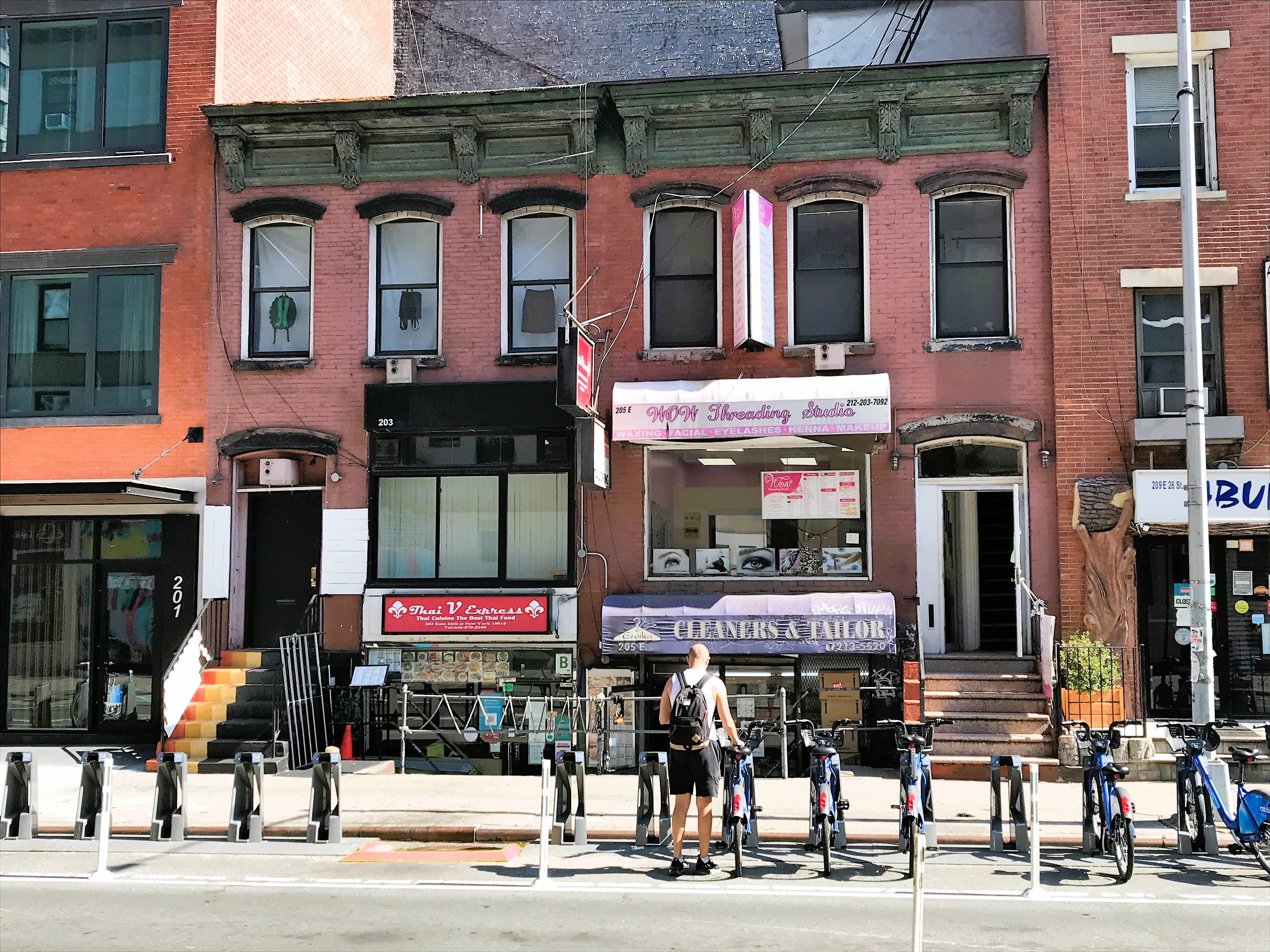
Battered Survivors - 203 and 205 East 26th Street


Around 1850 two modest, mirror image houses were completed on East 26th Street, just east of Third Avenue.  The working class, immigrant neighborhood was known as the Gas House District because of the sprawling Metropolitan Gas Light Company's gasworks between East 22nd and 23rd Street, from First Avenue to Avenue A.  Residents also shared the neighborhood with lumber yards and a stone-and-lime yard, as well as the notorious Gas House Gang.

Despite their gritty surroundings, the houses boasted handsome Italianate detailing.  The elliptically arched openings wore molded brownstone lintels.  Paneled fascia boards enhanced the cornices, upheld by foliate brackets.  Both houses had a store in the basement level.  

Frederick H. Ahrens, an "ink man," operated his business at 113 West 26th Street (renumbered 203 in 1867) by 1853.  He lived at 330 Third Avenue where he also ran a grocery store.  By 1857 both this store and the one next door at 115 were home to Francis Ripperger's shoe store (one, perhaps, for men's shoes and the other for women's and children's).   Interestingly, he lived at 330 Third Avenue, the same tenement in which Frederick H. Ahrens lived.

Living above the store at 113 in 1857 was Jacob V. Hutschler, who ran a saloon at 339 Third Avenue.  He would remain here at least through 1863.  His next door neighbor at 115 was in the same business.  George Tator's saloon was on East 24th Street.

Despite what must have been tight conditions, Tator took in two boarders.  In 1865 two school teachers lived here.  Alexander Morehouse taught in the boy's department of School No. 20 on Chrystie Street, and Augusta S. Van Noy taught at School No. 19 on 14th Street.

The same was true next door by the mid-1870's.  An advertisement in March 1876 offered a "nicely furnished parlor and bedroom" for $6 per week, or a "second story front room" for $4, "meals if desired."  The rent for the more expensive accommodations would equal about $165 per week in today's money.

The store space in 203 East 26th Street was home to Herman Kahn's grocery store by the early 1880's.  On July 22, 1882 Mary Moakley came in and asked for a quart of peas and three lemons.  The New York Dispatch said, "She was so far pregnant that she could scarcely walk."  Mary Moakley's bill was 15 cents.  Kahn gave her the items, and briefly walked outside.  When he returned she demanded, "I gave you a dollar bill.  I want my change."

The New York Dispatch reported, "No bill was given him or his clerk.  He sent out for a policeman, took the basket from her, and she waited till the policeman came."  The article added, "The officer was long in coming, and she could have escaped, but for her condition."

Both Moakley and Kahn told their stories to a magistrate.  The New York Dispatch wrote, "She was not believed in the Police Court, nor in the Sessions."  For attempting to steal 15 cents worth of peas and lemons, and 85 cents in change, she was sentenced to 10 days in City Prison.

In the meantime, Michael Sweeney had lived in 205 East 26th Street since the early 1870's.  His store at 352 Third Avenue was listed as "butter" in 1873, but by 1879 he had branched out to include teas.  He sold the house to the James Hall family in the mid-1880's, around the time he changed his business once again, to a liquor store.

Living with James Hall and his wife, the former Frances Sweeney, were nephews Michael, Thomas, George, Matthew and John Brannelly.  The boys were the sons of Frances's sister, Bridget Sweeney Brannelly, and Patrick Bernard Brannelly.

Another Irish immigrant, Patrick Curley, rented a room in 1889.  When a friend, James Giblin, applied for a Civil Service job that year, Thomas Brannelly and Patrick Curley testified to his good character.

James Hall died on February 20, 1888, and John F. Brannelly died on October 10, 1894 at the age of 22.  Both funerals were held in the East 26th Street house.

Living next door the year of John Brannelly's funeral was Ellen Burke, who also came from Galway, Ireland.  The unmarried woman was looking for work in 1895, advertising, "Chambermaid and seamstress--or assist with growing children; best city references.  Miss Burke, 203 East 26th st."

A year before placing that ad, Ellen had been disturbed by a window display across the street.  On May 2, 1894 The Press reported, "At No. 202 East Twenty-sixth street, near Bellevue Hospital, is the surgical instrument shop of Eyers & Co., who have a large consignment of male and female skeletons and skulls on exhibition.  The skeletons are in various stages of articulation, and two of them are in the shop windows.  One of them is by no means a cheerful looking object, as the cartilage has been left sticking to the ribs."

Ellen Burke got together with her neighbors to write a protest letter to the Board of Health.  Among those who signed the petition was Michael Sweeney, who had lived next door, and 500 girls employed in a nearby factory.  The article said the workers wanted the skeletons removed so "they will not spoil the girls' midday lunch or give them a nightmare."  John Drake, of Eyers & Co., called the protestors "silly" and said "a nice, fresh skeleton is no more objectionable than a coffin or red flannel underwear in other shop windows."

Never married, Ellen Burke died at 203 East 26th Street on July 23, 1903.  Her funeral was held in the house two days later. 

Living with the Brannelly's that year was blacksmith William P. Black.  He "caused some excitement in Madison Square Park last night," said The Sun on November 16, 1903.  The article explained, "Black, who was drunk, made a remark to a woman which she resented."  Upon being reprimanded by the woman, Black "pulled a big revolver from his pocket and began to dance around, waving it over his head."  People in the park fled in panic.   They drew the attention of Policeman O'Connor, who rushed to the park.  When Black saw the officer's drawn firearm, he put his away.  The Sun said, "O'Connor had no trouble in locking him up."

George E. Brannelly's funeral was held in the parlor on January 11, 1907.  The 30-year-old had died two days earlier.  Following his funeral, a solemn requiem mass was held at St. Stephen's Church on East 28th Street.

In 1911 a grocery store occupied the lower level of 203 East 26th Street and by 1917 the house was described as a tenement, a term applied to almost any multi-family dwelling.  It was the scene of a disturbing incident on the morning of January 10, 1917.  The New York Herald reported that school children passing by, "saw a young woman topple and fall headlong in the hallway."  

Two young girls rushed to her aid, and when they realized she was unconscious, sent a boy to get help.  Policeman Rider recognized the stains on her lips and fingers as iodine.  Josephine De Leon did not live in the house, but on First Avenue.  She had simply ducked into the open door of 203 East 26th Street to swallow the poison.  The 18-year-old was revived at Bellevue Hospital, where she said this was her third attempt to die.  "She explained that her life was a history of trouble, and that she would be better dead," reported the New York Herald.  The article noted that the quick actions of the school children had saved her life.

In 1983 both houses retained their parlor floor windows.  via the NYC Dept of Records & Information Services.

Beginning around 1925 the store at 203 East 26th Street was home to the King Cole Sound Service.  An advertisement that year offered "standard, portable, motion picture equipment, operators for entertainment in churches, home, &c."  The store remained in the space at least through 1947.


Both houses were renovated in 1986, resulting in store space in the cellar and first floors, and one apartment each above.  While the little houses with their varied histories have been sorely abused, they manage to retain their charm.

photographs by the author
no permission to reuse the content of this blog has been granted to LaptrinhX.com

Saturday, September 17, 2022

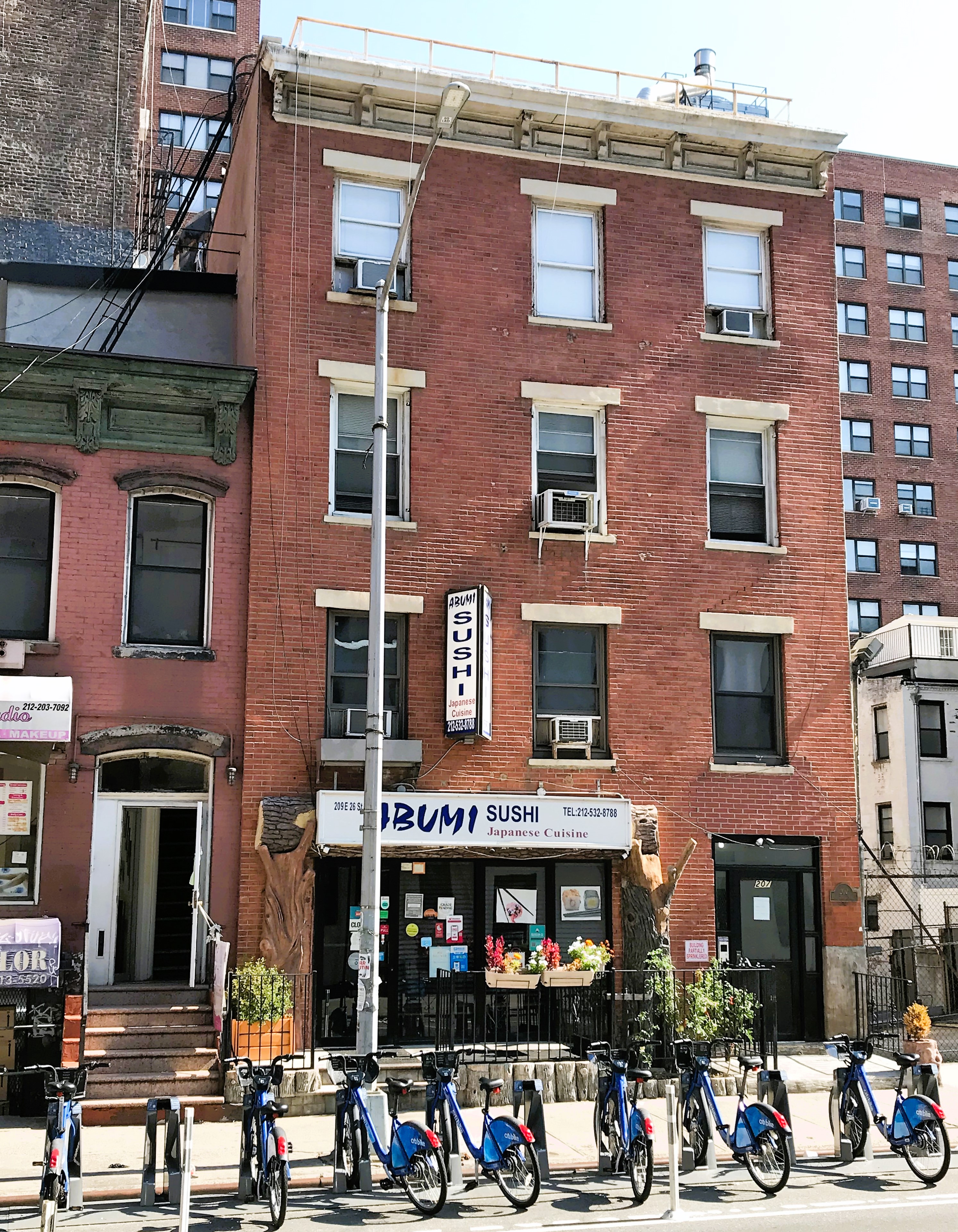
The Henry G. Tiemiear House and Grocery - 207 East 26th Street


Around 1855 Henry G. Tiemiear moved into the upper floors of the recently-completed house and store at 119 East 26th Street (renumbered 207 in 1867).  Faced in red brick, the Italianate style structure was three stories tall above the store level.  The working class Gas House District (so-called because of the nearby Manhattan Gas Works) in which it stood was reflected in the straight-forward design.  The only decoration was the paneled fascia below the simple bracketed cornice.

The grocery Tiemiear opened on the ground floor was one of two he owned, the other being two blocks away on East 24th.  Boarding with his family in 1855 and 1856 was R. B. Mooney, a butcher who was quite likely an employee of Tiemiear.  He was, as well, a volunteer fire fighter, a member of the Metropolitan Hose Co. No. 39 on Third Avenue.

By the Civil War years, the house was being operated as a boarding house.  An typical advertisement in March 1865 read, "To Let--A Pleasant and neatly furnished front Room on the first floor in a respectable locality."

Throughout the ensuing decades the building was home mostly to working class Irish immigrants.  Living here in 1872, for instance, were James Bracket, a real estate agent; policeman Matthew Campbell; Michael O'Meara, a carpenter; and Samuel Thurman, who was in the tin business.

A surprising resident in the early 1890s was John Cairns, described by the New York Herald as "a Scotchman about thirty-three years old, tall, manly looking and frank in manner."  On January 2, 1896 the newspaper noted, "Cairns lives with his wife and one child, two years old, in modest rooms in a flat house at No. 223 East Thirty-second street.  Until six months ago his home was at No. 207 East Twenty-sixth street."

Years earlier Cairns's father had obtained a job in the Burden Iron Company in Troy, New York.  John learned bookkeeping, and got an office job with the company.  His performance was so notable that in 1889 millionaire owner Isaac Townsend Burden made John Cairns his personal secretary.  It was a highly responsible position and an astounding rise in station for the young immigrant.

The New York Herald said, "He, and he alone, of all the household, it is said, has often had in his keeping the keys of the safes.  He has known the combination of the locks which secure the silver closets, and has been trusted with many such details, with which even Mr. Burden himself was not familiar."  And yet, Cairns continued to live in modest boarding houses like this one.  

On December 28 The Richmond Item reported, "Isaac Townsend Burden, the multi-millionaire, and one of the leaders of the four hundred, and his wife, lament the loss of $70,000 worth of diamonds and uncounted stocks and bonds, which are easily convertible into cash.  The goods was taken from the safe in the private residence about last midnight, while the family was awake."  Naturally, Cairns came under intense police scrutiny.

Burden, however, refused to suspect Cairns, and a week later still insisted to the New York Herald that "his faith in the man is absolutely unshaken."  The newspaper added that police could find "no flaw in the honest record and seemingly sterling character of John Cairns."  Investigators were sent to 207 East 26th Street.  According to the newspaper, the boarders "speak of him and his wife only in terms of respect."  The mystery was never solved.

The working class status of the residents of 207 East 26th Street was reflected in their advertisements seeking jobs.  In February 1899 Bernard Foicarelli placed one that read, "Boy, 15 years old, like to learn horseshoeing," and the following year "J. P." wrote, "Man.  Care for horse, cow; owing to sickness lost place [i.e. former job]; good, competent man; board, room; terms suit employer."  John Crown lived here in 1906 when he advertised, "Bartender (24) wishes steady position."

Lawrence Halleran had had a job as a city tugboat engineer since 1889.   On June 15, 1904 his tugboat was on the East River when the pleasure sidewheeler the General Slocum caught fire with 1,348 German women and children on aboard, headed for a picnic.  The tug's captain headed for the burning vessel, The Farmer reporting, "Halleran carried eighteen of the excursionists to the tug."  The Trenton Evening Times said, "his hair was burned off and his face blistered."  He was hailed as one of the heroes of that terrible day on which 1,021 perished and received a Carnegie medal.

Grace Corbett had found a job working in a nearby Chinese laundry.  She and another woman, Agnes Reynolds, may have been valuable as interpreters if the other staff did not speak English.  Chinese immigrants had been suffering from intense prejudice for decades, starting with the Chinese Exclusion Act of 1882.  On the night of January 29, 1906, Grace Corbett must have been terrified when, as reported by The New York Times, "A crowd of 500 men and boys invaded a Chinese laundry kept by Sam Lee and Ching Foy at 211 East Twenty-sixth Street last night.  They broke down the door, smashed the windows, and scattered the laundry packages in the street.  Then they chased the Chinaman over the back fence."  When police arrived they found Grace Corbett and Agnes Reynolds cowering in the shop.

Lawrence Halleran was still living at 207 East 26th Street on July 25, 1909 when he and three friends went to Rockaway Beach for the day.  They boarded the Manhattan-bound train at 5:20 and stood on the rear platform.  The train was going about 45 miles per hour and Halleran's hat blew off.  In an attempt to grab his hat, he leaned "far out to the side of the tracks, and his head struck a post," reported The Farmer.  "He was dashed from the platform and thrown to the mud of the flats."  When his body was recovered, his Carnegie medal hung around his neck.

Another resident, Margaret (known as Mollie) Herbst, was walking past the boarding house at 147 East 26th Street on the night of February 12, 1911 when saw a horrific incident unfold.  A few hours later she was in night court with a kitten cat in her arms, testifying against Thomas Murphy, an electrical worker.  She told the judge, "I was passing this man's house and I heard a kitten wail.  I looked up and saw him deliberately drop this kitten out of the third story window."

According to The Sun, Murphy "said the cat was persistent in showing a preference for his room."  He explained the accident to the judge saying, "I chase her out day after day.  Last night I tried to shoo her out and she jumped out the window."  The magistrate found the testimony of Molly Herbst much more believable and held Murphy in $100 bail for trial.  The Sun said, "Miss Herps [sic] left court with the kitten in her muff."

Molly named the cat Pinkey.  Despite her care, it had suffered multiple injuries, including a broken leg, that proved too great for her home nursing.  Five months later, on July 30, she walked into the East 22nd Street police station and told Lieutenant Gregg that Pinkey was dead.  The Sun reported, "Lieut. Gregg showed some concern, as it is a turbulent neighborhood.  Later he learned that Pinkey was a cat that had been resuscitated by Mrs. Herbst, so he called up the Health Department."

Molly Herbst had no intention of Pinkey's being disposed of by the Health Department, and left before it arrived.  The Sun said she "put into the fist of Philip Lombardi, a youth of the region, one dime to insure a respectable interment for the kitten, and the Gas House district mourned."

Olaf Termansen and his wife were living here in January 1919 when he lost his job.  He tried repeatedly to find another, with no success.  The couple's dwindling finances and his inability to find a new position affected him greatly.  On March 19 The Evening World reported that he suffered from "the strange delusion that people he passed on the street were laughing at him."  It became too much for him to bear.

That afternoon his wife came home to find him "sitting in a rocking chair, a strip of rubber tied to his lips and the gas turned on."  (The rubber tubing was connected to the gas lighting fixture.)  According to the newspaper, his wife "told the police their savings had been used up and the wolf was already through the door of their cramped two rooms they called home."


The house-and-store building continued to operate as a rooming house until 1961, when it was remodeled into apartments, one per floor above the store.

photograph by the author
no permission to reuse the content of this blog has been granted to LaptrinhX.com