Showing posts with label east 13th street. Show all posts

Friday, July 3, 2026

The 1888 Fairchild Publishing Bldg - 10 East 13th Street


photograph by the author

Although the millionaires of lower Fifth Avenue had already begun moving northward by 1887, the news that John Glass intended to erect a six-story "brick warehouse" at 6 through 10 East 13th Street, just steps from the storied thoroughfare, must have shocked many.  Glass had 
hired 43-year-old architect Gilbert A. Schellenger to design the structure.  On February 4, 1888, the Real Estate Record & Builders' Guide reported that the project would cost Glass $75,000--or about $2.6 million in 2026.  Construction was completed by the end of the year, and in December Glass sold the building to Eugene A. Hoffman, garnering a satisfying profit.  Hoffman paid $170,000 for the new building.

Schellenger had created an industrial take on the Renaissance Revival style.  Faced in red brick above a cast iron base, the midsection was divided into three three-bay-wide sections by full-height piers.  A Tuscan inspired arched corbel table ran below the sixth floor.  Schellenger compensated for the stoic appearance of the lower floors with ornate terra cotta ornaments, a frieze with a robust chain motif, and a crenelated parapet.

photograph by Wurts Bros. from the collection of the Museum of the City of New York

Hoffman sold the property to the Butterick Publishing Company in 1896.  The firm was a household name among American housewives.  In 1863, Ebenezer Butterick had created the first graded sewing patterns, and three years later his sewing machine company began making women's dress patterns.  In 1867, he published the first issue of the Ladies Quarterly of Broadway Fashions.  The business became an enormous success with 100 branch offices in the United States and Canada.

Butterick Publishing Company hired architect Lansing C. Holden to make renovations at a cost of $30,000.  The alterations apparently affected only the interiors.  Court documents later explained that the building was "used and occupied as a storage warehouse [and] at no such times manufacturing or printing machinery was installed, operated or used therein."

On March 1, 1905, Butterick Publishing Company leased the building to the Carey Printing Company, also known as The Carey Press.  Founded in 1898 by Peter M. Carey, the firm specialized in posters, advertising materials and weekend newspaper supplements.  On December 10, 1906, for instance, Walden's Stationer and Printer reported, "The Cary [sic] Printing Company, 6 East Thirteenth street, is printing a very handsome calendar for the new year, which will be worked by the three color process."

The Burr McIntosh Monthly, December, 1908 (copyright expired)

Employees of The Carey Press were union members, a wise decision by the firm's management during the a time of tense labor relations.  In its April 1912 issue, The Typographical Journal reported about the contract Vechten-Waring Company, "a non-union printing firm," had landed with Crerand's Publications, including Crerand's Cloak Journal.  The article said that Vechten-Waring's superintendent had boasted "of his ability to turn out work with any kind of workmen."  That contract was short-lived.  The Typographical Journal said, "The first essay at the job was so rotten that the Crerand people canceled the contract and turned the work over to the Carey Press...a first-class union office."

In the spring of 1914, The Carey Printing Company merged with Friedman Print and moved to Tenth Avenue.  Two years later, on December 2, 1916, the Record & Guide reported that Butterick Publishing had sold 6-10 East 13th Street to Fairchild Brothers.  "The property will be altered for the purposes of the purchasers," said the article.

Fairchild Brothers was founded in 1892 by Edmund, Arthur and Louis E. Fairchild.  In 1910, it published the first issue of Women's Wear Daily, a trade journal that would become a must-read for businessmen and designers involved in the fashion business.  The American Printer explained, "Its volume of business having increased with remarkable consistency, a larger plant was made necessary, hence the purchase of the Butterick building."

A month after buying the building, on January 6, 1917, the Record & Guide reported that Fairchild Press had hired architect Charles E. Birge to make $50,000 in renovations.  The figure would translate to a staggering $1.3 million today.  As was the case with the Butterick Publishing remodeling, the changes were all inside.

On February 5, 1917, The American Printer reported that the former Butterick Building was "being completely remodeled," adding "The entire structure will be occupied by the Fairchild Press, printers of the Women's Wear and Daily News, daily trade papers, and the Men's Wear Director."


An all-male staff works in the editorial offices, while all-female typists work in another part of the Fairchild Publishing building.  photos by Wurts Bros. from the collection of the Museum of the City of New York

Fairchild Publications operated from East 13th Street for three decades before the firm's astonishing success necessitated larger quarters.  On January 30, 1946, The New York Times reported, "Plans for a printing plant at 3-9 East Twelfth Street and 6-10 East Thirteenth Street to cost $1,000,000 were filed yeterday...by Fairchild Press, Inc."  Those plans were not entirely fulfilled and Fairchild moved to East 12th Street and 6-10 East 13th Street was spared.

The building became home to Bruns, Kimball & Co., distributors of yachts, marine engines and motorboats.   It was established in 1900 and heretofore been operating steps away at the corner of Fifth Avenue and 13th Street.

Yachting Magazine, 1932

On January 10, 1947, The New York Sun reported on Bruns, Kimball & Co.'s "twenty-six-foot Marlin sport fishing cruiser."  The article said it was "among the first of the post-war boats to be produced in quantity" adding:

The Marlin, in addition to being at the motor boat show, also is on exhibit at the Bruns Kimball & Co. display rooms, 10 East 13th street, along with a fleet of other cruisers, fishing boats, sailboats, outboards and dinghies.  Kermath inboard engines also are displayed, as they have been for the past thirty-five years that the firm has represented the manufacturers.

Motorboats and yachts were replaced by bicycles by the mid-1970s.  The Stuyvesant Bicycle shop now occupied the ground floor.  It added an innovative item to its stock in 1977, a "roller" that enabled apartment owners to transform their  regular bikes to stationary bicycles.

Stuyvesant Bicycle and the other tenants in the building would have to find new accommodations in 1979 when a renovation began to convert 6-10 East 13th Street to residences.  While preserving its cast iron pilasters, the ground floor was given a modern re-do.  Platform-like balconies were added to the facade and the parapet removed.  

image via miradorrealestate.com

Friday, May 12, 2023

The Edward C. Chapin House - 220 East 13th Street


In 1851 the family of Edward Colton Chapin was living in the recently completed home at 128 East 13th Street (renumbered 220 in 1868).  Four stories tall, the brownstone-fronted house was one of a row of identical Ango-Italianate style residences, their entrances sitting above short, five-step stoops.

Born in 1814, Chapin was a silk goods merchant at 76 Chambers Street.  He married Nancy Ann Reed on April 23, 1839, and the couple had two children when they moved into the 13th Street house: Anna Maria, born in 1840; and Edward Lucius, born two years later.  (Ella Jane, who was born in 1845, had died at the age of two).  Another daughter, Helen R., arrived on November 17, 1856.

In 1856 the family left for an extended trip, most likely to Europe.  An advertisement in the New York Herald on August 1 offered: "Handsome brown stone house to let--No. 128 East Thirteenth street, between Second and Third avenue; contains all modern improvements, and is in a fine neighborhood; rent $900."  The rent was affordable by today's standards, equal to about $2,475 per month in 2023.

Cuban-born Don Dominigo De Goicuria signed the lease.  He was at the time embroiled in a heated conflict with William Walker, the American who had taken the presidency of Nicaragua by force and reinstituted slavery there.   De Goicuria had initially hoped that Walker would assist him in freeing Cuba from Spanish control.  But, realizing that Walker was interested in conquering Central America and had no interest in Cuba, De Goicuria turned on him.  In a letter written to The New York Daily Times from the East 13th Street house on November 22, 1856, De Coicuria said in part:

I therefore denounce Mr. Walker as a man wanting in the first element of every kind of ability, viz. of Good faith; I denounce him as wanting in ordinary sagacity and discretion; I denounce him as false to the interests as well of Cuba as of the United States.

In 1864 Edward Chapin changed professions from silk to starch.  He became an agent for the Oswego Starch company on Fulton Street.  Nancy Reed Chapin died on November 17, 1867 at the age of 53.  Five years later Chapin married Caroline W. Booth on April 14, 1872.

The family moved to 228 East 12th Street and rented 220 East 13th Street to Rev. Thomas Gallaudet.  He had been chosen by the Society of the Church Mission to Deaf Mutes of St. Ann's Church to organize a home "for elderly and ill deaf-mutes."  The choice of the house assuredly was influenced by Jane Middleton, who moved in with her widowed mother Ann.  Jane had worked for William Chapin, Edward's brother, at the Ohio State School for the Blind from 1845 to 1846.

Jane Middleton, who worked for free, became the superintendent of the Home for Aged and Infirm Deaf Mutes, working closely with Gallaudet.  In June 1873 the Phrenological Journal reported that the home "is now ready to receive all deaf mutes who have become unable by disease or old age to support themselves.  By thus bringing them together they can much better receive that religious instruction and pastoral care which they so much need."

The Church Mission to Deaf-Mutes, 1893 (copyright expired)

During its first year the home housed nine residents, four men and five women.  The mission paid Chapin $1,350 per year in rent in 1876 (about $36,000 today), and relied totally on donations for its operation.  By then it had accumulated a meager building fund of $5,000 for a permanent home.

A reporter from the New York Herald visited on November 13, 1878.  He explained, "Every year the inmates of this modest mansion  hold a reception and fair, and an interesting occasion it is."  He was greeted by Rev. Gallaudet, who walked him through the rooms and explained the home's operation.

As you can imagine, there are few people more helpless than aged and infirm deaf mutes.  They can do nothing for their own support and they require a great deal of care...But when we provided them with a home they are a remarkably cheerful set of people.  Two of the women we have here are nearly blind as well as deaf and dumb.

Upstairs, the journalist was shown through the "old men's quarters."  He wrote, "Some were reading, some were talking, and one old man was coloring pictures that he had copied from the illustrated papers.  His art was not high art, but it pleased him as well as though it was done with the dexterity of a Gerome."  In the parlor, the old women "were grouped around one of their number who was telling off an interesting tale from the ends of her fingers."   The article ended with the journalist speaking of himself in third person:

With singular sensations the reporter glanced around him upon the gay silence that pervaded the place, and the opening paragraph in one of the essays of Elia came to his mind:--"Wouldst thou find a refuge from the noises and clamors of the multitude?  Wouldst thou enjoy at once solitude and society?'...Go then to a reception of deaf mutes."

On March 26, 1889, The Evening Telegram reported, "The Church Mission to Deaf Mutes is doing a good work...The Mission House, at No. 220 East Thirteenth street, has been discontinued."  The mission had opened the Gallaudet House for Aged and Infirm Deaf Mutes on a 156-acre farm near Poughkeepsie.
 
The neighborhood around 220 East 13th Street, touted in 1856 as "fine," was in noticeable decline by now.  The house was operated as a boarding house, home to residents like Henri Dagerbert, here in 1902.  He was a Commissioner of Deeds for the city.

Not all of the boarders were as respectable as Dagerbert, however.  Living here that spring was 21-year-old Frederick Henratty who was hiding out from police.  On April 16 he went to his mother's home in Brooklyn and stole jewelry belonging to her and his two sisters valued at $480 (a considerable $15,600 in today's money).  Included in the loot were a pair of diamond earrings and two diamond rings.  The earrings alone were valued at $180.

On May 26, 1902, The Brooklyn Daily Eagle reported, "He disappeared on that day, and ever since detectives have been after him."  Then, the day before the article, Henratty's brother-in-law William Tighe "saw him having a good time in the Bowery, Coney Island."  He had him arrested.  The earrings were traced to a Manhattan pawnshop, but the rest of the jewelry was gone.

By 1912 220 East 13th Street had declined from a boarding house to a furnished rooming house.  Resident Nunzio Spataforo was arrested for an even more egregious crime than Henratty's on November 13, 1912.  In the first decades of the 20th century, New Yorkers were terrorized by anarchist groups like the Black Hand, which used violence to push their ideologies.  The New-York Tribune reported that Spataforo had been arraigned in the Essex Market Court that morning for "throwing a bomb in the moving picture theatre at No. 178 First avenue."

William Kary rented a room here in 1932.  On January 14 The New York Sun reported, "five hoodlums got away, though not far, with a truck loaded with $25,000 worth of silk last night.  They stopped it, hauled the driver from his seat, beat him and made off with the truck on the outskirts of Paterson [New Jersey]."  By the following morning, four of the men had been arrested, including the 21-year-old William Kary.  After being identified in a line-up, the gang confessed to a series of robberies and hold-ups in Long Island.

In 1953 there was a total of 16 furnished rooms in the once-proud house.  The deterioration of the neighborhood was reflected in an incident on October 11, 1964.  The New York Times reported on fatal stabbings of men who attempted "to sell diluted narcotics."  The article continued, "The latest victim, who was unidentified, was found dead at 6:20 A.M. in the outer lobby of a tenement at 220 East 13th Street."

An hour later 37-year-old Filipe Rivera was arrested when he was found near the crime scene with bloodstained clothing.  He admitted to the murder saying, "the victim had tried to sell him diluted narcotics," according to The New York Times.


By the last decades of the 20th century the neighborhood was on the upswing.  In 1980 220 East 13th Street was converted to apartments, one per floor.  The exterior of the Chapin house shows the abuse of the last century.  And yet, only a little imagination is required to envision it as it was when the well-to-do Chapin family moved in around 1850.

photographs by the author
no permission to reuse the content of this blog has been granted to LaptrinhX.com 

Thursday, April 27, 2023

Billy Madden's Athletic Hall - 120 East 13th Street


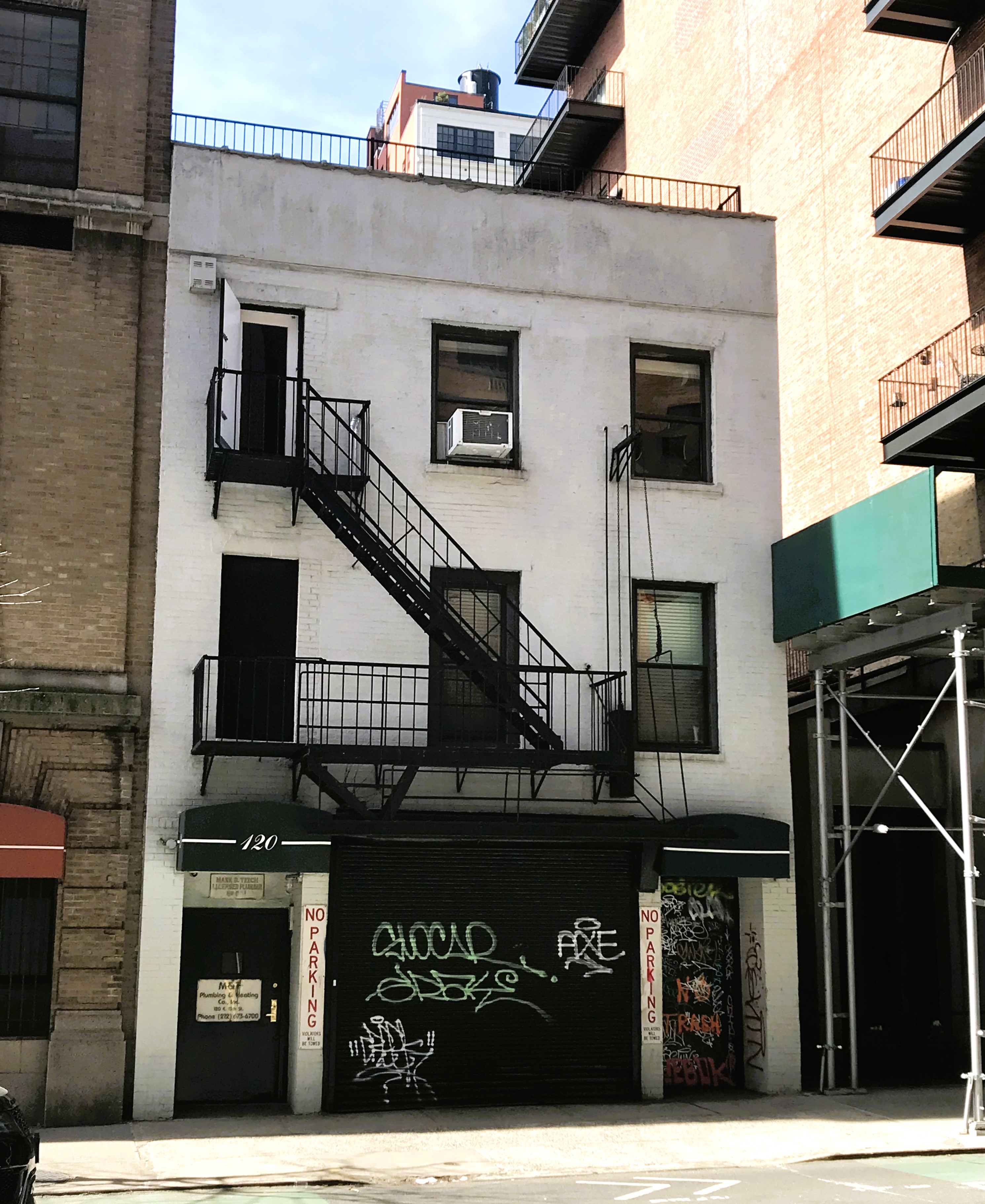
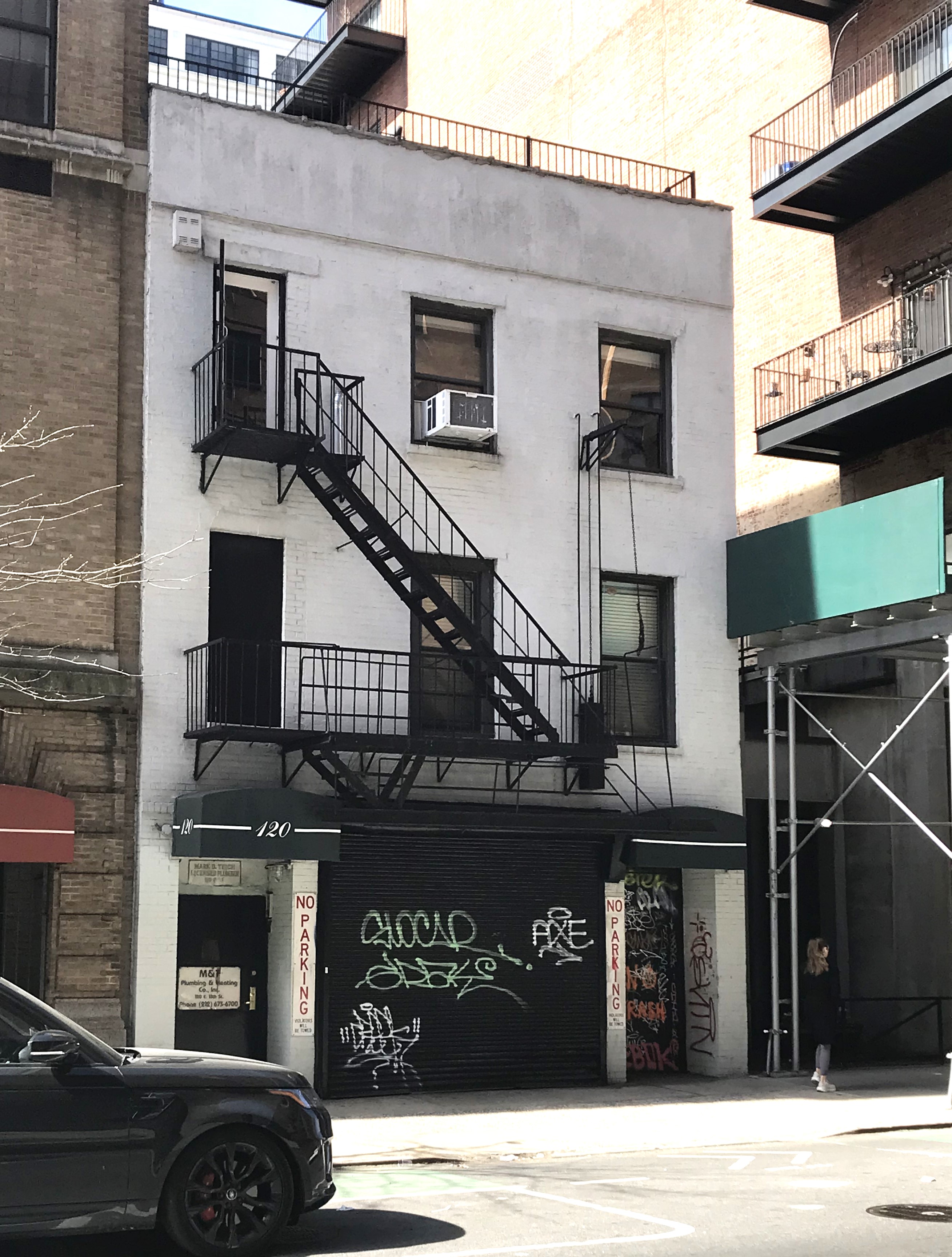
In the 1850s piano maker Peter A. Meeks lived in the brick-faced house at 94 East 13th Street (renumbered 120 in 1868).  Following his death, the estate entrusted the management of the property to real estate broker and builder John B. Marcella.  He testified decades later, in 1899, that he "altered and repaired" the building in 1864.

Because Marcella was a builder, he most likely did not use an outside architect.  His renovations resulted in what today would be called a mixed-used structure that essentially followed the designs of a stable--a wide bay at ground level flanked by an entrance and a window.  The upper floors held residential spaces.  And, in fact, a livery stable may have originally occupied the first floor.  On June 25, 1871, The New York Times reported, "Yesterday Henry Bergh arrested Thomas Quinn, of No. 120 East Thirteenth-street, for driving a white horse with a large raw sore under the saddle."  (Henry Bergh was the founder of the American Society for the Prevention of Cruelty to Animals.)

If there was a stable at 120 East Thirteenth Street when Thomas Quinn was arrested, it was gone the following year when May Bayersdorfer ran his auction business from the ground floor.  He liquidated furniture and such and on May 10, 1871 auctioned the contents of a 14-room house, including "elegant Piano, rich black walnut Chamber Suits, marble top Bureaus and Tables," and other high-end furnishings.

Living upstairs in the late 1870's was Frederick W. Brown, a clerk in the city's Topographical Engineer's office.  He earned $2.50 per day in 1877, or about $1,334 a month in 2023 (assuming he worked only five days a week).  

Actors George T. Ulmer and his wife, Lizzie May lived here in 1879.  George T. Ulmer had been a drummer boy in the Civil War and first appeared on stage in Boston in 1868 with the Selwyn stock company.  

Nelson A. Primus's portrait of Lizzie hangs in the National Portrait Gallery.

Lizzie's success and popularity was reflected in the fact that she had posed for a large portrait two years earlier.  In January 1877 the Evening Express of Boston reported, "Mr. N[elson]. A. Primus has just finished a life-size oil painting of the beautiful and accomplished little actress, Lizzie May Ulmer.  It is pronounced by critics to be the finest painting ever seen in Boston."  Lizzie reprised her role as Moya in Dion Boucicault's drama The Shaughraun on May 17, 1879 while living here.  

Within a few years the reputation of 120 East 13th Street was slipping.  George A. Greene had converted the ground floor to a "concert saloon."  The Board of Excise revoked his liquor license in 1883 based on a petition of nearby residents who complained of the "disorderly character of Greene's place."   In August Greene protested, claiming in court that the majority of the signers were unfamiliar with his business.

Interestingly, when the case came up again on September 10, only Greene and his dozen witnesses appeared.  Policeman Thomas Raymond, who had charged on August 26 that he had been served liquor on a Sunday morning while in uniform, now denied he had made the statement.   When the Society for the Prevention of Crime was called forth to "substantiate the charges made in their report," no members appeared in court.  And the society's lawyer avowed that "no complaint had been made against Greene by the society."

Henry Burroughs lived upstairs when he was arrested on March 4, 1884 with Patrick Green.  The Daily Graphic said, "The two men are well known in criminal annals."  They were detained by Roundsman (i.e., foot patrolman) Devery "as suspicious persons."  At the police station they were found to be carrying a burglar's jimmy and each had a loaded revolver.  The article recalled, "Eleven years ago Burroughs was arrested for burglary, and during the trial of his case in the Court of General Sessions slipped off his handcuffs and dashed out of the room.  He was arrested, however, and served a term in the State Prison."

A major change had come to the ground floor two months earlier.  On January 2, 1884 The Sporting Life announced, "Billy Madden has opened a saloon at 120 East Thirteenth st., N.Y., with boxing and dancing room attached."  Originally called Madden's Sporting House by the press, it later was named Billy Madden's Athletic Hall.

The well-rounded Madden was well-known as a champion boxer, trainer and manager, but he was as well an author, playwright, and sports promoter.  Born in London in 1852, Madden had competed until January 1877.  Then, according to the National Police Gazette on September 13, 1884, "he made up his mind that it was not a very profitable business, and he took to teaching the manly art.  Among his pupils are some of the wealthiest as well as the most proficient gentlemen, including George Jay Gould, G. P. Moroisini, W. E. Conner, Gladwins and many others."  Among his stable of professional boxers were John L. Sullivan, Jake Kilrain and Jack Dempsey.

Billy Madden.  The National Police Gazette, September 13, 1884 (copyright expired)

On September 13, 1884 The National Police Gazette called Madden, "the best trainer, second and judge, and shrewdest manager in the world.  He can always be seen at his popular sporting house, 120 East Thirteenth street."

A month prior to that article, The New York Clipper had reported, "Madden's Athletic Hall...was filled with admirers of boxing on the evening of Aug. 4. gathered to witness the competitions between amateurs for the lightweight medal in the tournament for valuable prizes then inaugurated by him."  A shrewd marketer, Madden had guaranteed a good turnout both in competitors and boxing fans by announcing two days earlier that he would be awarding the winners with "gold medals of elegant design."

Later that year Madden held a benefit for another "trainer of pugilists, pedestrians, and wrestlers," Bob Smith.  The New York Dispatch said the New Year's Eve event would include "sparring and wrestling by all the champions."

Days before the New Year's Eve benefit, Madden had sold Athletic Hall to one of his boxers, Jack Dempsey.  On December 18 the Boston Globe reported that the boxer had bought the "sporting resort" and "will endeavor to become expert in mixing drinks."  The pugilist-turned-bar-owner held an inauguration event on January 12, 1885.  In his 2019 biography Nonpareil Jack Dempsey, author Joseph S. Page says:

A large crowd paid the one-dollar admission and came out to drink, see the bouts and to help christen the newly-relaunched establishment.  Dempsey would put on several evenings of fight cards in January, during which the Nonpareil played a variety of roles, from host to referee to timekeeper to pugilist.

Billy Madden remained, helping Dempsey run the operation and acting as referee.  On January 22, for instance, ten days after the opening, Bill Glynn failed to appear for a bout against Jim Fell.  The National Police Gazette reported that Dempsey stepped in, and gave a blow-by-blow account of the match:

It was a slashing affair for four rounds.  In the last round Fell dashed at Dempsey and planted several blows on his ribs.  Dempsey got home with the left and right, the latter's fist landing on Fell's ear.  Then they wrestled, and Fell thought he had Dempsey on a hip-lock.  The latter wriggled out of the lock, however, and both went to the floor together.  They arose and resumed the contest, and after a sharp exchange Dempsey succeeded in rushing Fell back to the edge of the stage near the dressing-room and in a wrestle threw him.  Billy Madden then stopped the bout, and both shook hands good-naturedly.

The Athletic Hall closed before 1891 and the little building was converted to factory space.  That year it held the offices of The Astoria Veneer Mills.  It advertised, "This company make a specialty of the manufacturing of Poplar and Walnut Lumber for the use of the Piano and Organ Trade."

The building was purchased in 1893 by Alfred Dolge, who simultaneously moved his large piano felt making factory into the nearby building at 110-112 East 13th Street.   Dolge made renovations to 120 East 13th Street for the firm's offices.  

Dolge's substantial operation--he had created the town of Dolgeville, New York around his main factory--came to a crashing end in 1898.  The firm failed that summer, and on June 10 120 East 13th Street was sold in foreclosure to Adolph Sietor, who held the mortgage, for $2,000 (about $67,400 today).

The building once again became home to an auction house, run by Louis Levy.  On November 25, 1902, he advertised a "mortgage sale" of "two pool tables complete, formerly at No. 34 West End Avenue."  It seems likely that the pool tables had been repossessed by Alfred B. Marx & Bro.  The pool table manufacturers were listed at the East 13th Street address at the time, apparently operating from the upper floors.

Susan Stein purchased 120 East 13th Street in 1918.  She immediately hired the architectural firm of Gronenberg & Leuchtag to design a four-story garage on the site.  The American Machinist reported on March 7, that the proposed building would cost her $30,000 to construct.

But Susan Stein changed her mind.  On August 23, 1919 the Real Estate Record & Guide reported she had sold 120 East 13th Street and the vacant lot next door at 118 to the Star Box Lumber Co. for $30,000.  The article noted, "The buyer will alter the property for business use."

Star Box Lumber used the vacant lot, as well, for its business.  When this photograph was shot in 1941, the cornice was still intact.  via the NYC Dept of Records & Information Services.

In 1943 the Rolley Realty Corporation, which owned the loft building at 110-116 East 13th Street, purchased 120 and the empty lot at 118.  The purchase was quite likely to ensure that no towering building would be constructed on the site, blocking air and light to 110-116 East 13th Street.  

The little battered building continued to see industrial use.  In the 1950s it was home to the Conopac Corp., makers of "dry filling machines," and the following decade the Mitchell Offset Plate Service, Inc. occupied it.


A renovation completed in 2007 resulted in a plumbing and heating contractor's shop on the ground floor, offices on the second, and two apartments on the third floor.  At some point during the 20th century the cornice was removed and the brick painted white.  The innocuous little structure, unwilling to give up any hint of its colorful past, draws no attention from passersby.

photographs by the author
no permission to reuse the content of this blog has been granted to LaptrinhX.com 

Thursday, April 13, 2023

Home to Jazz Legends - 204 East 13th Street


For 220 years a pear tree that Peter Stuyvesant had brought from the Netherlands in 1647 stood at the corner of 13th Street and Third Avenue.   A severe winter storm toppled the venerable tree in February 1867.  Just feet away from the site at 204 East 13th Street--and still sitting on Stuyvesant-owned land--was a four-story house where widow Elizabeth Burke lived.  Its life-span would be much shorter than that of the pear tree.

In April 1875 Mary R. Stuyvesant sold the leasehold on the 23-foot-wide property to Philip J. Seiter for the equivalent of $12,700 in 2023.  What he paid for the building is unclear.  A builder, Seiter replaced the private house with a five-story flat-and-store building.

The structure's neo-Grec design went beyond the expected.  While the cast iron storefront with its paneled pilasters was overall unexceptional, it was topped by an exuberant, projecting awning-like cornice of deep corbels that was most likely painted in vivid colors.

The upper floors were faced in red brick and trimmed in sandstone.  The carved architrave frames of the openings, the details of the sills and lintels, and the robust cornice--with its paired brackets and modillions, stylized anthemions and pendant pinecone finials--would have stood out in any section of town.


The building was what was known as a "single flat," meaning there was just one apartment per floor.  Each had  six rooms  and a bath.  An advertisement for the "first flat" (or second floor apartment), noted "all improvements," suggesting the building had running water (albeit not hot) and gas lighting.  Two of the tenants in 1876 were William Lanawette, a "costumer" at 830 Broadway; and David Pearl, who dealt in quilts.

The ground floor became G. Konigsberg's auction house.  Along with household goods, he liquidated commercial fixtures.  On September 12, 1877, for instance, he advertised "A first class marble bar, 22 feet long; cost $400; sold low."  And a few days later, on September 18, he announced:

G. Konigsberg, auctioneer, sells to-day, at 10 o'clock, and continues the sale this week, at his salesroom, 204 East 13th st., Furniture, Carpets, Bedding, Stoves, Crockery, Radiators, Marble Counters, &c.

The auction gallery gave way to a grocery store in the 1880s.  It closed in 1887 and the space became home to Lynott's tailor shop, which catered greatly to female patrons.  An advertisement in September 1892 sought a "tailor, to sew and take measures; one who understands ladies' work preferred."

The rent for a six-room and bath apartment in 1898 was advertised at $40 per month.  That amount would convert to approximately $1,350 today.

The building passed from Philip Seitzer to his wife Barbara A. Seitzer.  Following her death, in July 1898 Henry J. Seitzer sold the leasehold to Caroline B. Kirk.  The Kirk family would manage the property until 1905 when Cornelia D. Earle took  over the leasehold.

By then the store was a Chinese laundry.  Hing Kee had signed a three year lease with Caroline B. Kirk in 1903.  In the meantime, the four apartments continued to be rented to what were apparently respectable, working class families.  No untoward publicity ever seems to have come from the address.

The remarkable storefront cornice can be seen in this detail from a 1941 tax photograph.  image via the NYC Dept of Records & Information Services.

As the East Village neighborhood evolved as ground zero for American jazz and blues music in the 1960s, two jazz greats made 204 East 13th Street their homes--tenor saxophonist Booker T. Ervin Jr. and pianist Randy Weston.  The two men knew one another well, and even recorded together.

Born on October 31, 1930 in Denison, Texas, Booker T. Ervin Jr. had learned music from his father, who played trombone with jazz musician Buddy Tate.  Ervin and his wife, the former Jane Wilkie, moved to New York City in the spring of 1958 with their two children, Booker and Lynn.

Booker T. Erwin Jr. from the cover of his 1964 album The Song Book

During the mid-1960s he led his own quartet, recording on the Liberty-Blue Note and Prestige labels.  In addition to Randy Weston, other musicians with whom he recorded were Sonny Stitt, Roy Haynes, Dexter Gordon, and Charles Mingus.  In 1960 and 1961 he appeared at the Newport Jazz Festival.

Far too soon, Booker T. Erwin Jr. died at Bellevue Hospital of a kidney ailment on August 31, 1970.  The composer and saxophonist was just 39 years old.

At the time, Randy Weston and his wife Fatoumata Mbengue had been gone from 204 East 13th Street for two years, having moved permanently to Morocco in 1968.   Born in Brooklyn in 1926, Weston studied piano and took dance lessons as a child.  Upon returning to Brooklyn following his stint in the military during World War II, he managed his father's restaurant, which was a haunt of several jazz musicians.  Although trained as a classical pianist, the music of Thelonious Monk, Duke Ellington and Count Basie, among others, would change the course of his art.

Randy Weston, photo by Brianmcmillen

He formed his own group and released their first recording in 1954, Cole Porter in a Modern Mood.  DownBeat magazine's International Critics' Poll the following year voted him the New Star Pianist.  His personal style shaped a new type of jazz, The New York Times journalist Giovanni Russonello calling him in 2018, "an esteemed pianist whose music and scholarship advanced the argument--now broadly accepted--that jazz is, at its core, an African music."

The 1875 cast iron front and entrance door to the upper floors made their cinematic appearance in the 1976 film Taxi Driver.  In it, character Matthew "Sport" Higgins (played by Harvey Keitel), the pimp of actress Jodie Foster's character Steensma, interacts with Robert De Niro's Travis Bickle in several scenes. 


At some point in the second half of the 20th century, the unique store cornice was removed--a tragic architectural loss.  But otherwise, despite two significant fires--one in 2018 that damaged the top floor, and another in March 2020 that spread through the third and fourth floors--the building's rich, spirited detailing is beautifully intact.  Nevertheless, because the building is not landmarked, there is no guarantee that preservation will continue.

photographs by the author
LaptrinhX.com has no authorization to reuse the content of this blog

Saturday, March 11, 2023

The 1863 No. 143 East 13th Street


An expert on toxicological chemistry, Dr. Bernard L. Budd lived in the high-stooped house at 143 East 13th Street in the 1850s and early 1860s.  The demographics of the neighborhood were changing in the first years of the Civil War, however, as throngs of immigrants swarmed into the Lower East Side and East Village.  Dr. Budd's house was demolished and replaced by a four-story flat-and-store building in 1863.  

The prim Italianate style structure was faced in warm red brick above a cast iron storefront.  One of the first multi-family buildings in the area, 143 East 13th Street held two apartments per floor above the stores that flanked the centered residential entrance.  The upper-floor openings wore crisp metal lintels and sills, and a handsome foliate-bracketed cornice with  a paneled fascia crowned the design.

Among the original tenants was the Wines family.  Young Edward Wines was inducted into the Union Army on March 15, 1865.  Happily for him, the war ended just over three weeks later, on April 9.

One of the first commercial tenants did not remain long.  On September 7, 1865 an advertisement in the New York Herald offered:

For Sale--The Good Will and Lease of a good paying business, established for years; duties light; no night work; will be sold cheap.  Apply during this week at 143 East Thirteenth street, near Third avenue, in the office.

It appears that the business that demanded light duties and no night work was a real estate firm.  It was taken over by the office of Pierce & Martin that year.  Apparently a start-up business, on September 30 it advertised:

Wanted--Houses and parts of houses to rent.  Also unfurnished Rooms, on first or second floor, for small families.  Those having such will please address or call at the Real Estate and General Agency Office, 143 East Thirteenth street, between Third and Fourth avenues.  

                                                                    Pierce & Martin.

The partners were unexpectedly progressive for the period.  The following month it advertised an opening for a traveling saleswoman.  Noting that she should be "a young lady with good address" for the "highly respectable business," the ad promised that "board and travelling expenses" would be paid.

The other commercial space was home to the store and office of The Society for the Employment and Relief of Poor Women.  Founded in 1844 by women of various Unitarian churches, its purpose was:

...to prevent, in a measure, the pauperism which forms so painful a feature in the community; to supersede the daily alms-giving, which, instead of benefitting, only lends to deepen the degradation of this class by depriving them of a healthful self-dependence; to elevate them to the rank of independent laborers, and insure them a fair compensation for their work.

To that end the Society provided an employment office for women looking for domestic work, and a store where the goods made by underprivileged women were sold.  Women "who are willing to labor at plain sewing, &c.," were given instruction on needlework and made "dressing gowns, slippers, underclothing, &c." either in their homes or in the basement of All Souls' Church on Fourth Avenue and 20th Street.  

The carriages of affluent women stopped at the door of the Society.  Here they either shopped for reasonably-priced, well-made garments, or made their requests for domestic help.  The Society advertised available "cooks, chambermaids, waitresses and girls for general housework."  It recruited for specific positions as well, advertising in 1872 for:

A respectable American girl to take care of children and assist in chamberwork.  Apply at the Employment Society store, 143 East 13th st.

The upper floor tenants brought little attention to the building until the colorful Eleanor F. Bishop (known as Ellen) moved in in 1871.  Accustomed to much more luxurious living arrangements, she was involved in a highly-publicized and acrimonious separation from her husband, Nathaniel C. Bishop, a retired real estate agent.  Ellen was Bishop's second wife.  According to the St. Louis Post-Dispatch, he had a "large private fortune."

The residential entrance features one etched glass panel.

It is unclear what went wrong in the relationship, but Ellen tried repeatedly to divorce Bishop.  It appears that Bishop fought her merely out of spite, certainly not because he wanted to save their marriage.  On December 31, 1871 her motion "to punish [Bishop] for contempt" was denied.  But she was resolute.

The following year, on August 7, the New York Herald reported on her latest suit that charged her husband with abandonment and sought support.  The article noted, "The case has already been prominently before the public, in consequence of the complainant having made six different attempts...to procure a divorce."

Still married to Ellen, on March 30, 1874 Nathaniel C. Bishop died at the age of 78 in his fashionable home on West 44th Street.  The St. Louis Post-Dispatch reported, "Before his death, he expressed a wish that his wife should not be permitted to enter the room in which he lay dead, or to participate in any way in the funeral ceremonies."

Ellen was refused entrance to her deceased husband's bedroom by the housekeeper.  The St. Louis Post-Dispatch reported, "Finding that she was balked in the attempt to see the body of her dead husband she determined to exercise exclusive control over the arrangements for the funeral."  What followed was a macabre test of wills between Ellen and her step-daughter by Bishop's first marriage.

Determined to have control over Bishop's funeral, she blocked the burial following the ceremony arranged by his daughter, insisting on a private burial the following day.  "The undertaker was nonplussed, as was also the clergyman, and likewise the persons present," said the article.  Finally, she said she would consent if she were provided a private carriage to Greenwood Cemetery.  "Those present agreed, at last, to submit to her demand, as the delay had been provoking, besides destroying all the solemnity of the occasion."

Things became more circus-like at the gravesite.  Ellen had chosen a receiving vault, however Bishop's grave in the family plot next to his first wife had already been dug.  "Mrs. Bishop was obstinate," said the St. Louis Post-Dispatch.  "The spectators were terrified at her vehemence," said the article.  To stop the burial, "she jumped into the grave forthwith."  Ellen remained in the grave until she was satisfied that the body was placed in the receiving vault.

Eleanor Bishop was not done yet.  A month later, on April 23, the Vermont Citizen reported that Nathaniel Bishop's body, "whose burial at New York, last month...[caused] so much excitement," had been exhumed.  Eleanor ordered the exhumation in order to have an autopsy performed.  She declared her husband had been poisoned.  The autopsy showed no traces of poison.

Ellen Bishop was by no means typical of the working-class tenants within the building.  Families living here in 1873 paid $10.50 per week, a rather pricey $245 by a 2023 conversion.  

One of the residents found a creative way to earn extra money the following year.  That June the Great Comet of 1874 (known today as the Coggia comet) became visible to the naked eye.  People around the world craned their necks towards the sky at night for months to see the marvel.

Parisians view the Great Comet of 1874.  original source unknown.

The resourceful tenant placed an advertisement in The New York Times on June 20 that read:

The Comet plainly and beautifully seen every clear evening, from 9 to 10, through a good telescope, on the top of No. 143 East 13th st., one door west of 3d av. for 25 cents.

Living in one of the second floor apartments at the time was the family of John Johne, an engraver.  Near tragedy occurred on the night of May 4, 1875 when a breeze blew a window curtain into the open flame of a gas jet.  The fire spread rapidly, quickly engulfing the Johnes' rooms.  By the time Hook & Ladder Company No. 3 extinguished the blaze, the equivalent of $38,200 today in damages had been done to the building and furnishings.

By the mid-1880s one of the shops was home to Philip Hafner's tailor shop.  Born in Dreieichenhain, Germany, he and his wife, Magdalene, lived in one of the apartments above the store.  

At around 1:30 on the morning of January 15, 1888, undercover Detective Sergeant McCarty noticed three known burglars--James "Jersey" Hogan, William Drinkhouse, and John Francis--on the Bowery.  McCarty casually followed them into a saloon and sat near enough to eavesdrop.  The New York Times reported, "Over their beer he heard enough to convince him that they were about to attempt a robbery at Thirteenth-street, near Third-avenue."

McCarty engaged another detective named Rogers, and went to East 13th Street where they waited in a dark cellar doorway.  Before long the trio approached Hafner's tailor shop.  One stood on the corner as a look-out.  The detectives watched as the other two forced open the wire doors and then used a skeleton key to enter the shop.  The detectives then crossed the street and waited for the patrol officer to come along so all three perpetrators could be arrested.  Instead, it was Hafner, just arriving home, who appeared and "stepped up and looked at the door."  He was immediately "pounced upon by the detectives," according to The New York Times.  Hafner yelled out, drawing the attention of the patrol officer.  The article said, "the patrolman rushed up, and explanations were made."  Hafner and the policemen now entered the shop.

The New York Times reported, "The thieves, who had been alarmed by the outcry, were found trembling in a closet."  The men had packed up $600 worth of cloth to cart away.  In their possession were various skeleton keys and two jimmies.  Their accomplice got away.

The Hafners, incidentally, remained in the building for decades.  Magdalene died at the age of 78 in her apartment on August 7, 1914.

In the last decade of the century the gradual decline of the neighborhood was reflected in a few of the tenants.  On March 19, 1892 Richard Lindsey was arrested with three others on complaint of reformer Anthony Comstock.  Accused of being "policy men" (operators of illegal gambling operations), Comstock said, "These men, or men of their kind, ruin the city."

Three years later two tenants, John Powers and William Srank, were arrested for a much less egregious crime.  They were caught peddling spectacles without a license in Long Island City.

On May 31, 1896 The World began an article saying, "Interesting in the extreme is the case of three-year-old Rudolph Hertel, who began to smoke tobacco when eight months old, and before he was a year old was a confirmed smoker."  The boy was the only son of Frederick Hertel and his wife, who lived here.  Neither of the parents smoked, but according to the article, when the "small and pretty" baby was born, "Friends of the family dropped in and offered the baby puffs of their pipes and cigars, just to see what it would do."

The Hertels were amused that the baby enjoyed smoking and continued to entertain guests with the display.  "One old man in particular was persistent in his efforts to have fun with the smoking infant.  He came to the home every Sunday afternoon, and always brought an extra stock of cigars with him."  When "Rudie" was nine months old, his parents realized "the alarming fact that their boy was a confirmed smoker."

By the time he was a toddler, Rudolph's addiction affected his health.  He became jaundiced and Dr. William E. Bullard diagnosed an enlarged liver and heart problems.  "The physician declared that if he was not compelled to stop [smoking] the little boy would die in a very short time," said The World.  

All efforts to break his habit failed, until Rudie began expressing the desire to wear trousers.  His parents gave him an incentive--stop smoking and earn pants.  The ruse worked.  The boy chose trousers over cigars.  Nevertheless, his mother told a reporter from The World, "I dread to think of what may happen when my little boy reaches the age when I cannot keep constant watch over him, but I can only trust in his determination to stick to the promise he made never to smoke again."

Rudie Hertel on the day before and after giving up cigars.  The World, May 31, 1896 (copyright expired)

At the time, Jean A. Le Roy ran his Acme Exchange from one of the commercial spaces.  Opened in 1894, it was among the first film exchanges to sell kinetoscope supplies and film.  Le Roy also did repair work.  

In 1896 Le Roy branched out into a new area.  In its May 23, 1896 issue, The Electrical World reported, "Mr. J. A. Le Roy, 143 East Thirteenth Street, is making portable Rötgen-ray outfits, which, no doubt, will be interesting information to those who desire to carry on experiments in this line.  The outfits are complete and include everything necessary to produce the rays; also a fluoroscope."  The equipment was an early form of x-ray machinery, developed in Germany by Wilhelm Rötgen.

An article in The Electrical Engineer that year said, "The action of the heart has been plainly seen with the instruments he furnishes, also the bone of the body, the liver and the denser organs have been readily traced.  Owing to these facts the demand for the very best apparatus has become imperative."  The Acme Exchange remained in the space into the first years of the 20th century.

Living here in 1921 was James "Frisco" Rogers, one of three men who were called by police "modern highwaymen."  The trio used stolen cars to drive to Long Island where they conducted armed robberies.  They were captured on September 24, 1921, The New York Times noting, "the police expected their arrest to clear up some of the many recent hold-ups by motor bandits on Long Island roads."

In 1967 the eastern store was leased to Cornell Edwards, who established his Flower Stall in the space.  The shop would be a fixture in the neighborhood for decades, and when Virginie Alvine-Perette featured Edwards in her 2008 documentary Twilight Becomes Night lamenting the disappearance of neighborhood stores, he became a local luminary of sorts.  Cornell Edwards was still running the Flower Stall in 2011 when he died at the age of 79.

In the meantime, the western shop was home to Melissa Howard's Stock Vintage.  Founded in 2006, the store sells vintage men's clothing and accessories dating from the turn of the last century through the 1970s.  The shop still operates from the space.


Looking as if it were plucked from an Edward Hopper painting, after 160 years little has changed to 143 East 13th Street.  Most remarkably, the storefront--always the first element to be remodeled--remains intact, including the three original sets of double doors.

photographs by the author
no permission to reuse the content of this blog has been granted to LaptrinhX.com