Showing posts with label charles wright. Show all posts

Friday, March 15, 2019

The 1876 Grosvenor Buildings - 385-387 Broadway


The ground floor is hidden behind a construction barrier in 2019.


By the mid-1850's the section of Broadway around White Street was no longer residential; the remaining brick houses now altered for business.  On March 31, 1857 an advertisement in the New-York Daily Tribune offered "To Let - 385 Broadway - Warerooms near White-st.; fine rooms on first floor, fashionable side; with easy entrance, suitable for Tailors, Fancy Goods, Milliners, &c."

The titles to that building and the one next door at No. 387 were held by Matilda Ann Grosvenor by the early 1870's.  At least one additional structure sat on a rear lot.  Matilda had been married to Jasper Grosvenor, a well-known banker and partner in the steam locomotive manufacturing firm Rogers, Ketchum & Grosvenor.  He died in 1857.

At 6:30 on the evening of November 28, 1874 fire broke out at No. 385.  The ground floor of the three-story structure was home to dress trimmings merchant S. Rothkopf; the second held the workrooms of the Celluloid Novelty Company, makers of "jet jewelry;" and the third floor and attic were leased by G. Weil & Livingston, pocketbook makers.  Before the fire was extinguished it had spread to all three floors and caused considerable damage.  The New York Times placed the loss at $2,000 (almost $45,000 today).  

The damage most likely prompted Matilda to demolish both buildings and lay plans for a modern loft and store replacement.  She and her daughter, Charlotte Matilda Grosvenor, commissioned architect Charles Wright to design two mirror-image structures on the site.  Construction was begun in 1875 and completed the following year.  Although separate buildings which retained their individual addresses, Wright successfully designed them to appear as one.

A commercial take on the recently-popular French Second Empire style, the cast iron facade included simple engaged columns between each opening.  The the rounded corners of the rectangular windows gave the impression that they were slightly arched.  Wright distinguished the buildings with an aggressive bracketed cornice with a pediment that announced "Grosvenor Buildings / 1875."

The buildings filled mostly with tenants associated with the drygoods and apparel industries.  Among the earliest was Benno Klopfer, corset manufacturer.  Two commercial sewing machine firms moved into No. 385 in the 1890's.  The Singer Mfg. Co. marketed machines specifically for apparel manufacturers--its corset stitching machines, button sewing machines, and glove stitching machines were only a few of the models available in 1890.  At the same time the National Machine Co. was in the building,   It too, marketed manufacturer-specific machines, like its boot and shoe sewing machine.

Seeger & Guernsey's Cyclopaedia of the Manufacturers ad Products of the United States, 1890 (copyright expired)

Diehl & Co., whose showrooms were also in No. 385 in 1890 was seemingly unrelated to the apparel industry.  Their listings vaguely offered "motors, electric."  The firm's appearance signaled what would be an overall change in the tenant list.  

Within the year the Central Labor Federations of New-York, Brooklyn, and Hudson County, N.J. was leasing space for its headquarters.  The group sought to coordinate individual unions and achieve cooperation among them.  Following a meeting here on July 12, 1891, The New York Times reported "A special committee reported that it had had a conference with the members of the Pool Brewers' Association and hoped that the old quarrel between the association and the Journeyman Brewers' Union would be amicably settled."

By 1894 the ticket agency of the Union Pacific Railroad opened.  It would be the first of several such offices.  By 1897 H. B. McClellan, agent for the Wabash Railroad operated in the building.  One of his advertisements that year was entitled "Are You Going West?" and continued, "If so the Wabash R. R. offers special inducements to travelers in the way of low rates, equipment, speed, train services, etc."  Indeed, all classes of tickets entitled the holders to meals in the dining cars and "Reclining Chair Cars."


Those ticket offices would be joined by The Seaboard Air Line Railway offices in 1901, and passenger agents E. V. Stratton and A. W. Ecclestone by the following year.  McClellan was still in the building that year; and Ecclestone would remain at least through 1909.

Matilda Grosvenor died on January 20, 1885.  The Grosvenor Buildings were among the real estate passed on to Charlotte, who had married Frederick L. Goodridge.  He died in 1897 and Charlotte on March 3, 1902.  Her vast estate, including Manhattan real estate holdings such as the Grosvenor Buildings, was divided among her five children.

In the pre-World War I years the buildings were home to umbrella maker B. O. Wright & Co.; Harvey & Watts Company, manufacturers of canes and handles; and The Remington Typewriter Company, makers of typewriters, billing machines and "adding typewriters."

Luggage & Leather Goods, January 1913, (copyright expired) 

The newly-formed Iona Sales Co. moved into the building in 1913.  The firm purchased left-over stock and sold it to foreign markets.  An advertisement in The Clothier & Furnisher in April 1917 announced "We pay highest cash prices for unsalable merchandise.  Shoes, clothing and furnishings."

The American Telephone and Telegraph Company opened its employment offices at No. 387 around 1925.  The firm hired only females as operators; its advertisement in The Daily Star on October 2 the following year read:

GIRLS
FOR LONG DISTANCE
CENTRAL OFFICE

NO EXPERIENCE NECESSARY
SALARY PAID WHILE LEARNING
STEADY WORK
PLEASANT SURROUNDINGS
CAFETERIA ON PREMISES

EXTRA PAY FOR
EVENING AND NIGHT WORK


In June 1927 the company had sweetened the job description.  It sought "girls aged 16 to 27" and promised that "long distance telephone work, establishing telephone connections with other cities thousands of miles away is interesting and fascinating."  And now there were "an opportunity for a vacation" and "meals on premises at low cost; comfortable rest rooms for use during relief periods."

American Telephone and Telegraph's employment offices would remain in the building until about 1930.

Across the nation the Great Depression years saw an increase in thefts, both large and small, and other criminal activities.  On January 16, 1934 The New York Times reported that three teenagers, Margaret Daroczy and Helen Gallic, both 18, and 19-year-old Fred Ware, had been arrested for attempting to pass $20 counterfeit bills.  The girls "had attempted to pass a bill to the stationer at 385 Broadway."  They were unsuccessful and were caught when Ware later tried to pass one at a liquor store uptown.

In the building at the time was the Union Pencil Company, Inc., which would remain at least through 1946; and the offices of the cigar manufacturing firm of Teijeiro & Garcia.  The Grosvenor buildings continued to reflect the varied industries of the neighborhood throughout the bulk of the 20th century.  In 1941 Irving A. Mendelsohn, textiles, took a floor in No. 385, for instance; and as late as 1992 a textile firm was in the first floor.

But in 1986 the new Project III Ensemble Theater leased space here.  Its first production was Gunter Grass's play Flood which opened on June 1.  The New York Times drama critic Walter Goodman was impressed.  By 1999 the building was home to Soundance Theatre, a performance arts venue.


In 2018 the entire building was vacated and the ground floor hidden behind a construction shed.  The outcome of the ongoing renovation work is unclear at this time.

photographs by the author
many thanks to reader Ted Leather for requesting this post

Wednesday, December 5, 2018

The 1874 Acker, Merrill & Condit Stable -- 134-136 West 10th Street


At noon on April 16, 1873 the "Valuable Plot of Ground with buildings" at Nos. 134 and 136 West 10th Street was sold at auction.  There was only one dwelling on the 40-foot wide property.  It was a commodious 25-foot wide brick house which appears by the description (two story, attic and basement) to have been a Federal style structure.  In the rear was a two-story brick stable.

The free-standing house with its grassy yard had been at one time home to a well-to-do family.  That was in evidence when the furnishings were auctioned 12 days later.  The listing included "Rich double and single Parlor Suits, Carpets, Mirrors, Paintings, Engravings, carved black walnut Bedsteads and Bureaus, best hair Mattresses," and such.

At the time Acker, Merrill & Condit Co. owned and operated several high-end grocery stores.  The term "grocery" had little to do with the word we commonly use today.  Acker, Merrill & Co. catered to the carriage trade and stocked a dizzying array of goods--wines, confectioneries, gourmet foods and delicacies, cigars, and personal items.  Founded in 1820, its main competitor now was the equally well-known Park & Tilford.

Nearly a year to the day after the furnishings of No. 136 West 10th Street were removed, Acker, Merrill & Co.'s architect, Charles Wright, filed plans for a three-story brick stable on the site.  Before construction was completed later that year the plans were reworked to include a fourth floor.  Wright's handsome Italianate stable was faced in red brick and trimmed in stone.  The architect distinguished the openings with scalloped lintels with dropped ends and placed delicate brackets below their sills.  The bracketed cornice upheld a triangular pediment which announced the construction date.

The symmetry of the design--upset only by the double-wide hay loft opening at the third floor--was carried on to the street level where two wide carriage bays and two doorways were in perfect balance.

The capacious facility housed Acker, Merrill & Condit Co.'s delivery trucks and horses.  Life for the work animals was hard, occasionally requiring them be placed a discounted prices.  On July 19, 1877, an advertisement appeared in The New York Herald that read "For Sale Cheap--Three horses.  Apply at 134 West 10th st., New York."

Nearly 35 years after building the stable, Acker, Merrill & Co. sold it to Charles F. Hickey of Brooklyn.  Or at least they attempted to.  The firm gave Hickey a $30,000 three-year mortgage on the property--in the neighborhood of $825,000 today.   A year before the term was up, Hickey renewed the entire amount.

Eventually, Acker, Merrill & Co. seems to have given up on Hickey and on December 27, 1918 The Sun reported that it leased the building to the Peerless Trucking Company.   At the time motorized trucks were slowly replacing horse-driven drays on the streets of New York.   By the summer of 1922 Peerless Trucking & Transfer Co. was ready for a total change-over.  At "10 a.m. sharp" an auction was held in the 10th Street stable to liquidate the outdated equipment and the horses.

The auction announcement listed 27 "good work horses," 28 trucks of different types, 22 sets of single and double harnesses, 32 blankets and "all stable utensils."  The auctioneers guaranteed "These horses are young and acclimated and used to all kinds of hard work.  Anyone in need of a first-class work horse should not miss this opportunity."

The old stable continued life as a trucking depot and then as a garage by the late 1960's.  Then, in 2006 it received a remarkable makeover.  The ground floor was converted to a "community facility" while the upper floors became a total of seven apartments.  Among the building's high-profile residents were actor Kiefer Sutherland.

Half of the street level space became home to the Village Preschool Center.  According to its website the facility, for children between 2 to 5 years of age, offers daily French lessons, science, music, and "reading readiness" activities.   "Our graduates are extremely prepared, academically and socially," the website says, "to move on to kindergarten."


The sympathetic remodeling and restoration of the 145-year old livery stable preserved an important component of the historic fabric of this charming section of the Village.

photographs by the author

Thursday, December 26, 2013

Nos. 31 and 33 Great Jones Street


photo by Alice Lum

The Bond Street neighborhood vied with St. John’s Park as the most exclusive neighborhood in Manhattan for several decades.  But as the first shots of the Civil War were fired in 1861, change was underway.  No. 31 Great Jones Street was the home of the Decline family (an ironic surname considering the fate of the neighborhood).  On May 1, 1861 Mrs. Decline opened her parlor to the ladies of the Surgical and Medical Relief Association “for the purpose of cutting out and preparing flannel and other shirts for the use of the Army.” 

The Decline family would not be in their refined Federal-style brick residence many more years.  On November 11, 1870 The New York Times reported on the proposed three-story “store-house” on the site of the Decline house; now owned by the Board of Fire Underwriters.

The Association of Fire Insurance Companies had organized Fire Patrols in 1835.  Unlike fire departments, which focused on extinguishing the fires; their goal was to protect and salvage valuable property exposed to fire and water damage.  Working alongside one another, the roles of fire fighters and fire patrols were often confused by the public.

Now the Board of Fire Underwriters set architect W. E. Waring to design a new station house for Patrol No. 2.  The company had been organized in 1855 and already had seen three homes.  Waring produced a handsome red brick building with the expected vehicle bay and flanking doors of a firehouse.  Gently-arched brownstone lintels with foliate brackets distinguished the upper openings.  Then Waring capped it off with an impressive galvanized iron cornice with a central rounded pediment, cast foliate brackets and paneled frieze.

The building was completed in 1871 and Patrol No. 2 moved in with its cumbersome array of equipment.  Fire fighters were concerned with putting the fires out.  The Patrol was concerned with protecting property and their list of apparatus reflected that goal.  Hayden’s Annual Cyclopedia of Insurance in the United States inventoried the company’s equipment.  It was “supplied with two wagons and five horses; also portable fire extinguishers, oiled canvas covers, axes, and other necessary implements, with a code of signals, telegraph, etc.  In addition it has a steam fire engine and two powerful hand pumps for draining water from cellars.”

Right behind the New York Board of Fire Underwriters in replacing old structures on the block was the Willcox & Gibbs Sewing Machine Company who purchased the long-standing Samuel W. Parmly stable at No. 33 next door almost simultaneously.  The manufacturer might have felt cheated in paying the commission to architect Charles Wright, who nearly duplicated Waring’s Patrol No. 2 building .   The three-story Italianate structure was completed in 1871 and was a near carbon-copy, right down to the ambitious galvanized iron cornice and pediment.

Close inspection reveals a few, insignificant, differences in the otherwise identical buildings -- photo by Alice Lum
The sewing machine company had been founded in 1859 and incorporated in 1866.  The firm used the new Great Jones location for manufacturing and, judging from the stable-like bay doors, to house its delivery wagons and horses.  The administrative offices were nearby at No. 658 Broadway.

For some reason the location and the building did not fit the company’s needs; and only eight years after completion Wilcox and Gibbs offered the building to the New York City Fire Department “for a company location,” as noted in The City Record on January 22, 1879.   Fire Department headquarters hesitated on the offer, marking it on city documents as “laid over.”

The building was finally sold in 1889 to Bernard Beinecke and his partner Joseph Hesdorfer.   Beinecke’s life story read like a Horatio Alger tale.  An immigrant, he began driving a butcher cart, eventually working up within the company.  When he bought his employer’s business with Hesdorfer in 1872, the firm became Beinecke & Company.  Before his death in 1932 the former butcher cart driver would hold directorships in two banks and have helped to develop the Plaza Hotel.

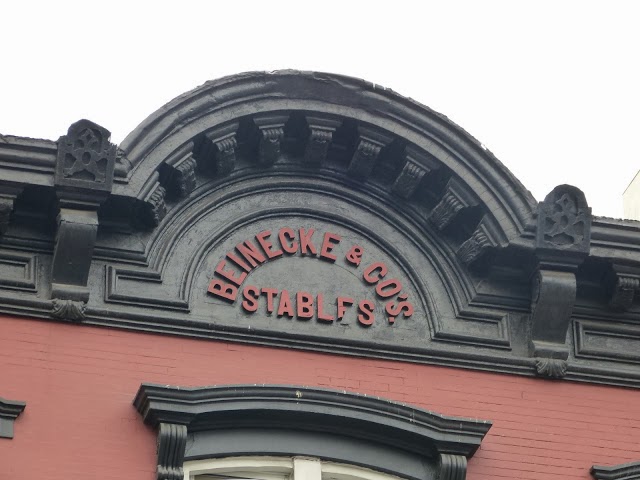
The sewing machine building was now used by Beinecke’s butcher business for its delivery stables.  Bernard Beinecke addressed the blank half-circle in the pediment by adding cast letters announcing “Beinecke & Co’s. Stables.”

The meat purveyors quickly established who owned the building -- photo by Alice Lum
The Fire Patrol and the butcher stables coexisted side-by-side through the turn of the century.  At some point the fire patrol building had been acquired by the Wagstaff family who owned substantial amounts of real estate.  On March 7, 1900 an auction of the Wagstaff estate property was held and family member Mary A. Wagstaff purchased the building for $33,500—about $750,000 today.  In reporting the sale the New-York Tribune noted that the building was “occupied by Fire Patrol No. 3.;” an apparent typo.

Fire Patrol No. 2 shows off its dress uniforms and steam engine in 1904 -- photograph "The Tammany Times" December 24, 1904 (copyright expired)

In 1907, the Patrol moved on to No. 84 West 3rd Street and the New-York Tribune reported on the lease of “the entire building” by “Colonel Alfred Wagstaff to Micheal W. Spelecy” for ten years.  Spelecy and his wife, Kate Buckley, lived in the building and leased space to various commercial tenants.

The ten-year lease was obviously renewed.  Michael Spelecy died in the apartment here on October 14, 1923 and his funeral was held in the building on Wednesday morning at 10:00, October 17.  Kate remained here until at least 1929.

At that time there was at least one other residential tenant, a Ford repair shop on the ground floor, and Louis Milstein’s millinery-making shop in the building.  Milstein would find himself in hot water seven years later when the 61-year old hat maker was embroiled in the “ashcan hat” racket.

In 1936 the Millinery Stabilization Committee began a crackdown on manufacturers who recycled used hats.  They would pay scavengers one to five cents for hats and caps found in ashheaps and garbage cans, then rehabilitate them to be sold as new.   The New York Times explained that “The law provides that when an old headpiece has been redyed, reblocked or retrimmed and is offered for sale again, a printed linen tag saying it is second-hand must be sewed inside.”

Some milliners sidestepped the label, garnering large profits in doing so.  Estimates were that in New York City alone 1,200 dozen “ashcan hats” were being sold daily to unsuspecting customers.  On November 10, 1936 Louis Milstein was arrested from his shop at No. 31 Great Jones Street.  He pleaded guilty and was charged a fine of $50.

In the meantime No. 33 was used by trucking firms and auto repair companies.  In 1945 the two buildings were connected internally.  After moving into No. 31 in 1970, the Joseph Scott Trucking Company cleverly added its name to the blind arch of the parapet—matching the old lettering that Barnard Bienecke had applied next door in 1889; including the tongue-in-cheek "stables." 

Few passersby would suspect that the lettering was added in 1970; not 1870 -- photo by Alice Lum
In 1999 a restaurant, Five Points, opened in the former Fire Patrol No. 2 stables.  Where the company’s five horses munched hay and oats, trendy NoHo patrons now munch on what New York Magazine called “boldly passionate” Med-American food.

Prior to the paint job, the contrast between stone and brick was vivid.  Note the delicate rope molding -- photo by Alice Lum

The near-twin buildings have been slathered in barn red paint, masking the once vivid contrast of red brick and stone trim; yet the outward appearance of these two utilitarian structures is largely—and pleasantly--unchanged.

Tuesday, November 26, 2013

The Sadly-Stunted No. 913 Broadway


Brothers Peter and Robert Goelet were two of Manhattan’s wealthiest citizens in the second half of the 19th century.  As the refined residential stretch of Broadway between Union Square and Madison Square gradually turned commercial; the men purchased property being abandoned by wealthy residents moving northward.  By either razing or renovating the homes to business purposes, the Goelet brothers took advantage of the changes taking place and multiplied their wealth in the process.

Gilbert Coutant had a three-story residence constructed in 1838 at No. 913 Broadway.  A wealthy grocer and lumber merchant who was also known as a “Tammany fixer,” Coutant and his family would live in the house for only eight years.  In 1846 he sold the building to Peter Goelet.

Now the brothers waited for the appropriate time to improve their property.

Three decades later the time was right.  Nearly all the grand homes of this section of Broadway had been replaced or renovated as commercial buildings (except for, oddly enough, Peter Goelet’s own mansion on Broadway at 19th Street, just a block south of the Coutant home).  The brothers demolished the 36-year old house and commissioned architect Charles Wright to design an up-to-date mercantile building on the site.

Wright turned to the recently popular neo-Grec style in designing his building, using equally-popular cast iron for the façade.  A short flight of steps led from the sidewalk to the first floor.  Above it all an ambitious cornice with pointed finials announced the address in giant cast iron numbers.

Immediately upon the structure’s completion the haberdashery firm Union Adams & Co. took it over.  On November 23 the store opened, a block north of the elegant Lord & Taylor dry goods store.  Union Adams kept its original store at No. 637 Broadway opened through Christmas, offering customers the option of either venue for gift buying.
On November 21, 1874 Union Adams & Co. announced its opening "on Monday Next."  The New-York Tribune, (copyright expired)

On December 11 The New York Times opined that “At no previous Christmas season have the thousands of patrons of Union Adams & Co. had such an excellent opportunity of making their purchases, for Mr. Adams has very recently opened his new store, at No. 913 Broadway, between Twentieth and Twenty-first streets, with the finest stock of gentlemen’s furnishing goods ever yet exhibited in the City, and the old, well-known store at No. 637 Broadway is still in its pristine glory, and will remain open until after the holidays.  Then Mr. Adams will remove all his immense stock of wholesale and retail goods to his future business house at No. 913 Broadway, on what is known as ‘The Ladies’ Half-mile.”

The article praised Adams’ taste in robes and smoking jackets, focusing on those “made of cashmere, heavily embroidered with silk, in a variety of patterns in the Indian style.”  Shoppers could browse among driving mufflers, scarves and neckties, silk handkerchiefs (“now so much used”), hosiery, shirts, gloves, canes, umbrellas, walking sticks and American and French jewelry.

Calling the store’s stock of hosiery the “foremost in this department,” The Times writer turned to the shirts.  “The same may be said of the shirt and embroidered shirt bosom department, which has all the marvels of the fine needle-work of the nuns of France and Italy.”  The gentleman patron could choose among a wide variety of gloves:  “kid, castor, buckskin, reindeer, seal, bear, of even kangaroo skin.”

Despite the newspaper’s glowing reviews of Union Adams & Co., the store lasted only two years in its new home.  In 1876 McGibbon & Co. moved in.  Founded in 1866, the firm imported linens and upholstery goods from European manufacturers.  New York’s Leading Industries remarked that at No. 913 Broadway, “they carry what is without doubt one of the largest and best selected stock of goods of their line in the city.  It comprises linen and cotton shirtings, pillow-case linens, linen sheetings of all widths, table damasks, bleached and unbleached, table cloths in every size, napkins, doylies, towels, embroidered sheets and shams, quilts, cotton and silk comfortable, blankets, handkerchiefs, etc.”

An advertisement in The Christian Union focused on the curtain department, December 1874 (copyright expired)
Among the five floors of fabrics were upholstery goods, as well.  “In upholstery their stock is equally complete, comprising worsted and silk coverings, woven jute fabrics, mohair, and all silk plush, all the fashionable tapestry and Turcoman curtains, raw silk portiers, etc., etc.  Their stock of lace curtains is complete, also table covers and shade materials in full and fresh assortments.”

For those households lacking a seamstress, the firm would custom-make linen items and embroider them to order.

McGibbons & Co. employed 75 people and was deemed by Illustrated New York: the Metropolis of To-Day in 1888 to be “the only exclusive Linen and Upholstery house in the United States, and has a national reputation.”

The renowned quality of McGibbons goods was enough to cause Anna Beach Appleton to hatch a scheme in 1894.  She was living in the home of two sisters, Mrs. McDonald and Miss Maynard, at No. 172 East 74th Street.  Realizing that she was unable to come up with the money for her board, she visited McGibbons & Co.   Anna chose a pile of linens valued at $39, then casually mentioned to the clerk that she was the sister of ex-Judge Beach. 

With so reputable a brother, she was allowed to walk out of the store with her expensive goods (the $39 worth of linens would equal about $1000 today).  Anna went home, paid off her board bill with crisp new linens, and everyone was happy.  Until McGibbons & Co. looked for its payment.

On January 24, 1894 Mrs. Anna Beach Appleton found herself in the Jefferson Market Police Court on the charge of obtaining goods on false pretenses.  Her landladies were in court, as well, to testify about the linens-for-board swap she had concocted.

“Justice Ryan then ordered the women to return the linen to McGibbon & Co.,” reported The Times.

As it turned out, McGibbon & Co. was the least damaged in Anna Appleton’s charade.  “Mrs. Apppleton is also charged with obtaining on false pretenses $70 worth of goods from Adams & Co. and $300 worth from Stern Brothers,” said the newspaper.

New York is a city of change and by 1896 the grand emporiums of Broadway were already beginning to inch further towards Midtown.  That year McGibbon & Co. opened its second store at No. 9 West 42nd Street in the fashionable area of mansions and high-end shops.  An advertisement advised shoppers “The latter place will be found very convenient to ladies residing up town or out of town.”

It was the first hint that McGibbon & Co. was considering leaving its Broadway building.  Then, on January 10, 1898 the New-York Tribune ran an advertisement that announced “Our Removal Sale” that “embraces other goods than Linens, which have been well received by customers.”

By August of 1899 McGibbon & Co. was gone.  Louis Cohen & Co., manufacturers and retail furriers, took the second floor; which, said the Fur Trade Review, “they have attractively fitted and furnished, for the greater convenience of their retail department.”

The following month New York society was preparing for the fashionable Horse Show.  Louise Cohen & Co. advertised “An exceptional line especially gotten up for the coming event in very smart effects.”  The ad listed “Smart coats in Broadtail, Persian Lamb and Seal, Plain and with combinations of Chinchilla, Rusisan and Hudson Bay Sable.  Plain coats from $120.00 upward, with combinations from $165.00 upward.”
Advertisement--The Sun, December 3, 1905 (copyright expired)

Ladies desiring to show off expensive stoles and wraps could choose from “neck pieces in Alaska sable, blue fox, sable fox, blue lynx, black lynx, chinchilla, mink, ermine, Persian lamb, Hudson Bay and Russian sable, and silver fox.”

Peter Goelet had died in 1879, leaving No. 913 Broadway to his sister, Hannah Goelet Gerry.  In 1890 she had the building updated—removing the stairs and installing a more modern storefront at street level.

Hannah Goelet Gerry removed the entrance stairs.  By November 20, 1924 when this photograph was taken, a cafeteria was operating at street level -- from the collection of the New York Public Library
By 1902 the high-end millinery importer Florette was also in the building.  The firm also had a Paris shop and offered stylish headwear to Manhattan’s carriage trade.  In offering “model hats, tailored hats and bonnets” in The Illustrated Milliner in 1902, Florette promised that “individuality will predominate.”

Sharing the building with the other upscale tenants was the Frederick Jewelry Company. 

The high-end retailers would remain in the building for several years.  But by the time of the Great Depression the exclusive shops had all moved up Fifth Avenue.  In 1932 No. 913 was purchased for $30,000—although it was assessed that year for $82,000.  The new owners had a startling renovation in mind.
No. 913 would have been similar to the highly-altered 3-story house next door.  By the time this photo was taken it was the last remaining of the once-residential buildings.  No. 913 has been altered to include "arcade" shop windows where the former cafeteria was.  photo from the collection of the New York Public Library


Two years later, on November 23, 1934, Charles F. Noyes announced that he had leased the building to gift and novelties merchants Rubenstein Merchandise Company.  But there would be changes made.  "The property at present consists of a five-story which will be made over into a two-story structure," reported The Times.

Noyes hired architect William F. Staab to alter the building.  The top three floors were chopped off, resulting in a stubby two-story structure with little evidence of the original cast iron emporium.  Staab installed a single-paneled parapet to cap the renovated building and modernized the sidewalk level.

In the 1940s it was home to the Northern Straw Works, Inc.; manufacturers of “hats.”

By the mid-1980s the neighborhood was reviving and in 1986 the former retail space became a restaurant, Indian Oven II; the first in a series of restaurants.  Before the century’s end it would house Bar Zil, then in 1997 Theodore, a restaurant named for Theodore Roosevelt.
One sliver of Charles Wright's cast iron design survives--somewhat miraculously.

The first floor is still a restaurant today.  At this level any trace of Wright’s emporium where wealthy gentlemen purchased reindeer gloves and later well-dressed women shopped for French linens has long ago disappeared.  But above, somewhat miraculously, the 19th century lives on where the cast iron façade survives nearly unblemished.

non-historic photos taken by the author