Showing posts with label charles Buek and co.. Show all posts

Tuesday, February 24, 2026

The Peter K. Wilson House - 56 West 87th Street


An unfortunate coat of white paint covers the beige brick of the upper floors, seen in the neighboring house to the right.

On December 20, 1890, the Real Estate Record & Guide opined, "It would not be unjust to others to state that no firm of builders in New York City is better known than that of Chas. Buek & Co."  The article added, "Messrs. Buek & Co. always draw the plans for their own buildings, the firm being architects as well as builders."  Two months later, on February 21, 1891, the journal reported on the firm's next project, saying that Charles Buek & Co. "will shortly commence the erection of six four-story brick and limestone front dwellings on the south side of 87th street, 100 feet east of Columbus Avenue."

Charles Buek & Co. designed the row, which stretched from 48 to 58 West 87th Street, as three mirror-image pairs.  Nos. 56 and 58 shared a split stoop, the steps of which branched off to the east and west half way down.  Like its architectural sibling, the Romanesque Revival design of 56 West 87th Street featured rough-cut stone at the basement and parlor levels and beige brick at the upper floors.  A blustraded oriel dominated the second floor and a triple arcade at the third wore a continuous stone eyebrow.  A full-width, brick-faced gable fronted the slate shingled mansard.

The 20-foot-wide residence became home to the family of Peter K. Wilson.  A widower, Wilson was born in Scotland on August 27, 1825 and came to New York City at the age of 15.  By the time he was 21, he had started his own business, and in 1867 went into partnership, creating J. B. McBurnie & Co.  (It was described by the Dry Goods Reporter as "manufacturers and importers of laces, embroideries and white goods.") Upon his partner's retirement, Wilson renamed the firm P. K. Wilson.  He established the first American-owned lace factory in France, and was awarded the grand cross of the Legion of Honor from the French Government for promoting trade between the two countries.

Peter K. Wilson, Dry Goods Economist, December 20, 1913 (copyright expired)

Living with Peter Wilson in the West 87th Street house were his two single children, Samuel M. and Agnes Elizabeth, and his married son, William B. and his wife.  When Samuel joined his father's firm, the name was again changed--now to P. K. Wilson & Son.  Later William entered the business as general manger.

The Wilsons maintained a small domestic staff.  In April 1893, they were searching for two replacements.  Their advertisement in the New York Herald read, "Wanted--A cook, who is a good laundress, in a small family; also a girl to do chamberwork and waiting; German or Swede preferred."

The drawing room was the scene of Agnes Elizabeth's marriage to William Sanford Boyden on December 21, 1898.  

Around Thanksgiving 1913, Peter Wilson retired at the age of 89.  Two weeks later, on December 9, he died in the West 87th Street house of pneumonia.  In reporting his death, the Dry Goods Reporter remarked, "Mr. Wilson had long been regarded as an expert on laces and embroideries."  Somewhat surprisingly, his funeral was not held in the drawing room, but at the West Park Presbyterian Church.  

William B. Wilson and his wife continued to occupy 56 West 87th Street.  By 1914 they had changed from horse-drawn vehicles to an automobile and that year William owned a Renault.

Wilson sold the house in March 1924 to Baron Gennaro Mario Curci.  Born in Rome on September 19, 1888, he relocated to New York City in the mid-1910s.  Trained in voice at the Royal Academy of Rome, Curci ran his operatic vocal coaching studio in the house.

The New York Courier, March 1925 (copyright expired)

In its September 1924 issue, the Musical Advance announced, "Maestro G. M. Curci, the well-known vocal teacher and operatic coach, has removed to 56 West 87th Street, where he has resumed his individual teaching and classes, and is prepared to receive applications from those wishing to study with him."

Gennaro Mario Curci, Musical Courier, October 31, 1918 (copyright expired)

Curci branched into playwriting and in 1928 his play Barbara was produced in Naples and Havana.  It earned him first prize in a competition arranged by Le Cronache Letterarie e Teatrioli, a theatrical review of Naples.  On June 17, 1929, The New York Times reported, "Mme. Annie Mork, Finnish actress, who has been visiting in this country, was the guest of honor Saturday at a reception and supper given by Baron Gennaro M. Curci at his home, 56 West Eighty-seventh Street...She will appear [at the Abo Theatre in Abo, Finland] in September in the title role of 'Barbara,' by Baron Curci."

It had not taken long for Broadway producers to take notice.  A week before that article, The New York Times reported that William H. Leahy had announced that Barbara would be staged on Broadway "early next October."

Before long, it was Curci himself who was before audiences.  Motion picture director David Burton met him at a social function and was impressed with his voice and stature.  He cast him in a leading role in the 1935 film The Melody Lingers On.  It changed the vocal coach's life.  Curci went on to be a character actor in more than 30 feature films.  His new career took him from West 87th Street to Hollywood and by 1941 No. 56 was home to wine dealer Emil Marak.  

The natural brick can be seen in this 1941 image.  via the NYC Dept of Records & Information Services.

In the 1960s, the house was operated as unofficial apartments.  In the summer of 1967, a two-and-a-half-room apartment was rented to Gary Spring, who was only 19 years old.  Spring's actual home was in Bayside, Queens.  The Long Island Star-Journal explained that the teen did not intend to live here, but rented it "because the 'heat on dope parties in Queens" was getting too intense.  

Spring was the leader of eight youths who were involved in the selling and using of marijuana, LSD and other drugs.  Spring's plan of hiding his operation in a Manhattan apartment did not work.  The Long Island Star-Journal said that two Narcotics Squad detectives infiltrated the ring by one of them "posing as a beatnik and another by posing as a Queens College student."

A 2:00 on the morning of June 21, 1967, detectives raided the apartment and arrested eight youths, including Gary Spring.  Seven were charged with possession of marijuana and loitering "for the purpose to buy or use narcotics."  Spring was charged with additional charges of "possession of LSD and maintenance of a place for the purpose of using narcotics."


An official conversion completed in 1969 resulted in 2 apartments each on the lower three floors, and four furnished rooms on the top floor.  A renovation in 1992 returned 56 West 87th Street to a single family home above a basement apartment.

photographs by the author

Tuesday, April 19, 2016

Chas. Buek's No. 42 Riverside Drive


The vast fifth floor terrace came after a devastating 1920 fire.
Architect Charles Duggin was actively developing the east side of Manhattan in the years following the Civil War with his partner James Crossman.   A young, promising architect, Charles Buek worked for the partners as they designed rowhouses for Manhattan’s middle and upper classes.  When the firm dissolved, Buek established his own practice, as Charles Buek & Co., and took Charles Duggin with him as partner.   Now not only did Charles Buek act as both architect and developer; by the turn of the century he would be the principal in the Charles Buek Construction Company as well.

Buek designed and erected speculative residences throughout the city.  In 1897 he turned his attention to the Upper West Side’s answer to Fifth Avenue—Riverside Drive.  A year earlier prolific architect Clarence True had started construction of high-end Elizabethan Revival mansions which filled the block between 76th and 77th Street.   But for some reason one plot, No. 42, was not included.

Buek purchased the plot amid the True houses and in 1897 started construction.  His design was a liberal mixture of historic styles, deemed “Eclectic Renaissance” revival.  Engaged Tudor-style columns flanked the offset doorway.  A swelled four-story bay vied for attention with a double-height angled bay above the entrance.   The fourth floor featured a full balcony over the angled portion and a charmingly diminutive balcony which clung to the rounded bay.  Above the sumptuous copper cornice was a red-tiled roof with elaborate conical dormers.


The 40-foot wide mansion was completed in September 1898 and on October 9 Charles Buek, promoting himself as “architect and owner” advertised it.  Calling it “this magnificent five story American basement Mansion,” he boasted of its “spacious drawing room in ivory, enamel and mahogany; library in old mahogany, dining room in quartered oak, besides imposing entrance hall, reception and billiard room.”

The house contained ten family and five servant bedrooms, along with five bathrooms, “all richly tiled and fitted with exposed nickelled plumbing.”  The latest in residential convenience was the “electric elevator stopping automatically at every story.”

It would be six months before Buek attracted a buyer; but finally on April 6, 1899 The New York Times reported he had sold No. 42 to William L. Brown.   Brown evidently had no plans to live in the mansion; but used it as rental income.

Among his tenants in the next few years were F. H. Cooper, who signed a lease “for a long term of years” in April 1903; and William Douglas, whose wife gave a musical on March 10, 1906.  But by the time of Mrs. Douglas’s entertainment, the house was no longer being used as a private home.  She had initiated what would be a decades-long tradition by opening the Riverside Drive Boarding and Day School in the mansion.

In 1907 William Brown leased No. 42 to Howard D. Miner and his wife, the former Katherine White.  The couple ran The Graham School—New York City’s oldest private school for girls.  Founded in 1816, it could boast illustrious instructors throughout the years like Elihu Root.  Highly exclusive, its students ranged from primary through college preparatory age and came from the wealthiest families in the East.

The Miners, of course, lived in the house along with their resident students.  It was here on November 26, 1912 that Katherine, only 35 years old, died.  Howard continued with the school, now taking on Katherine’s sister, Mary Josephine White, as assistant principal.

In 1913 the Graham School initiated what some stodgier socialites thought was rather pointless—postgraduate courses.  But the school explained “Many girls finish their regular school work, graduate, do not go to college, and wish a certain amount of advanced study adapted to the older and more developed mind.”

The Sun, on September 14, 1913, explained that female students were not expected to have the academic backgrounds of young men—the understanding of Greek and Latin, for instance.  “But to-day fortunately the classics are also available without the hampering medium of language acquisition.  Good translations from the Greek and Latin are used, and thus, for example, one may become acquainted with the Greek tragedians in substance without the laborious effort of studying Greek.”
 
Buek's many details, like these charming cherubs gazing down, are easily overlooked.
The Graham School left around 1916 and William G. Osgoodby leased the house.  As well as his residence, he used it as headquarters for his somewhat shady International Motor Club, Inc.  He had come up with the idea in 1914 and advertised to motorists that for a “reasonable” fee they could join for life.  He promised that among other benefits was “the club’s influence if they were arrested for overspeeding.”

The initiation fee was $25 and dues ranged from $12 to $250 (the highest amount translating to more than $6,000 today).   His money-making scheme, with “several branches in Massachusetts,” came to a screeching halt on May 23, 1918 when Assistant District Attorney Kilroe knocked on the Riverside Drive door.

The New-York Tribune said that the Assistant D. A. was “acting on information obtained in an anonymous letter.”  After interrogating Osgoodby about the operations of the “club,” his suspicions were confirmed.   The money was going directly into Osgoodby’s pockets.

“Osgoodby, Mr. Kilroe said, admitted that with the exception of about $5, he got most of the initiation and due fees,” reported the Tribune.  Osgoodby was not prosecuted, but he promised “to cease soliciting new members here”

When Henrietta Brown sold the house in February the following year it was assessed at $76,000.  The Sun reported “The buyer is a businessman from New Jersey who will occupy it after extensive alterations.”

That New Jersey businessman was Charles M. Schweinert, president of A. Schrader’s Sons, Inc., makers of pneumatic tire valves.   The 48-year old entrepreneur, indeed, did extensive alterations.   The year-long “fitting up,” as the New-York Tribune described it, would cost Schweinert $150,000.

While renovations were going on, other upscale residents of the block were loudly complaining to the City about the city dump at the river’s edge at 79th Street.  Every evening rubbish was burned there and neighbors protested about “the offensive odor and danger,” according to the New-York Tribune.  The newspaper noted “complaints brought nothing…except an explanation from the Street Cleaning Department that the rubbish had to be burned because there were not scows enough to handle it.”

Finally, early in April 1920, Schweinert, his wife, Mary, and their daughter Marjorie were able to move into the redecorated mansion with their domestic staff.  They had been in the house about three weeks when their dinner was interrupted at about 7:10 on the night of April 24.

The New-York Tribune reported “Suddenly a white-faced maid burst into the room and, heedless of the shocked remonstrances of the butler, cried to Mrs. Schweinert, “Please, ma’am, there’s a gentleman at the door and he says the house is afire and he has sent in an alarm.”

The family rushed onto the sidewalk, only to see the entire top floor of their home in flames.  It appeared that embers from the trash fires below the park had landed on the roof, starting the blaze.  As the family stood in shocked disbelief, they watched the top three floors of their newly-redecorated home destroyed. 

Schweinert told a reporter that between fire and water damage, “all the renovating which he had accomplished at such expense of money and patience, was a wreck.”

Despite the disheartening turn of events, Schweinert rebuilt the mostly gutted mansion.  The former tiled roof with its conical dormers was replaced with a flat-faced upper story featuring a series of large arched openings.  The new design resulted in a spacious top-floor terrace.

Schweinert retired in 1922.  In November 1926 he and Mary traveled to London, checking into the fashionable Savoy Hotel.  There, on New Year’s Eve Charles M. Schweinert died at the age of 57.

Mary Schweinert and Marjorie (now married) inherited the bulk of Schweinert’s estate, the gross amount of which was $1.16 million.  Mary lived on in the Riverside Drive mansion, the Schweinert summer estate in Brielle, New Jersey, and a house in Miami.   But it was apparently a lonely life for the widow and she would be drawn into scandalous law suit before very long. 

In July 1927 Edith Jacobs, a young private secretary, met Joseph J. Gottman, a medical student.  A romance ensued and by October they were engaged.  Edith gave her future husband $14,000 of her savings to help him pay for medical school and expenses.

And then Mary Schweinert came along.  When Gottman broke the engagement, Edith sued Mary, alleging “that although Mrs. Schweinert knew Gottman was engaged to the plaintiff she won him away from her by giving him presents, entertaining him at her home here and in New Jersey and Miami, Fla., and took him abroad with her.”

The suit, filed in May 1932, sought the $6,400 Gottman had not yet repaid.  Edith had no expectations that her former fiancé could ever pay the debt since, thanks to Mary, he had “forsaken a gainful occupation.”  She also asked for $250,000 damages to help heal her broken heart.

By now Mary Schweinert was apparently spending less and less time in Manhattan.  The year following the law suit, she converted the Riverside Drive mansion into 12 apartments; keeping one for herself.  She was still living here in 1938 when she went to the Marlborough-Blenheim Hotel in Atlantic City .

On the night of June 5 she entered the Apollo Theatre on the Boardwalk.  Having paid for her ticket, she pressed her handbag under the arm on which she carried her coat.  Later, when she stood up to leave, she realized her handbag was missing.  A search of the theater was made, but the bag was gone.

In the handbag, according to Mary, were not only her platinum spectacles, but five pieces of jewelry valued at $30,000.  Why she would be carrying around jewelry worth half a million dollars by today’s standards was not explained.

Throughout the decades the tenant list in No. 42 Riverside Drive included some celebrated names.  In 1939 opera and concert artist Mme. Grete Stueckgold leased an apartment.  Following Bella Chagall’s death, artist Marc Chagall took an apartment with his daughter; and in the 1950s motion picture and television actor Paul Valentine lived here.


Despite a drywall ceiling, the entrance hall (above) reminds the visitor of the mansion's former grandeur.  Other areas did not survive so well.  photographs by CitySpade
In 2001 the mansion received another renovation resulting in 11 apartments.  Tragically, while the entrance hall retains a hint of the mansion’s former glory, most of the 1920 interiors have been stripped bare.
non-credited photographs by the author

Saturday, December 26, 2015

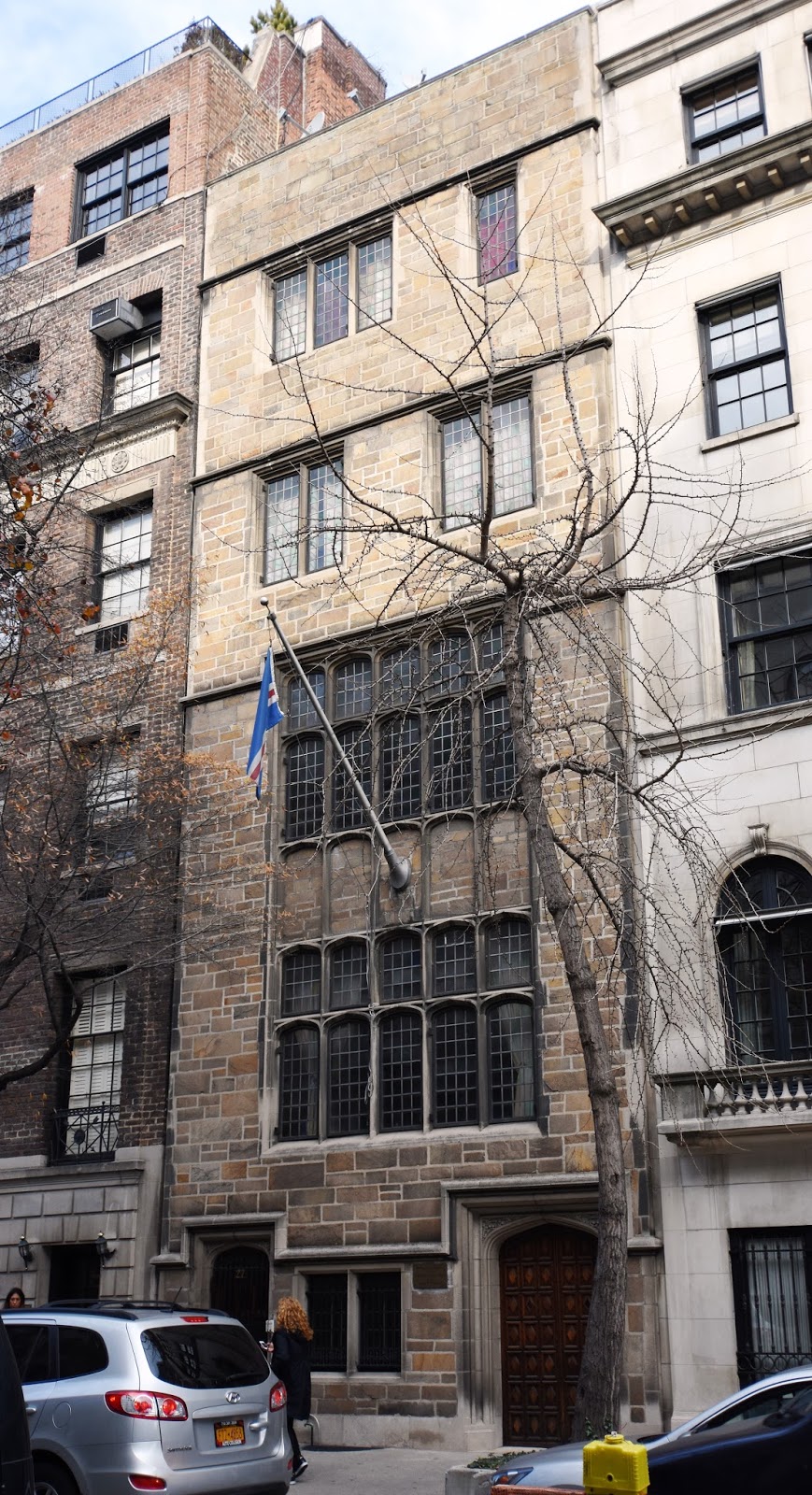
The Albert Strauss Mansion -- No. 27 East 69th Street


photograph by the author

Charles Buek & Co. often maximized its profits by eliminating one step of the speculative real estate process—acting as both the developer and architect.  Such was the case in 1885 when the firm began the project of five brownstone-fronted rowhouses on East 69th Street, between Madison Avenue and what would become Park Avenue three years later.

The houses, Nos. 21 through 29, were completed in 1886.  Four stories tall with expected high brownstone stoops, they attracted well-to-do professionals, like Samuel Riker who purchased No. 27.

The 55-year old lawyer and his wife, the former Mary Anna Stryker, had five children: John, Anna, Henry, Samuel and Julia.   The family maintained a summer estate, Fairview, at Corona, Long Island.  As was expected of well-heeled homeowners, Riker filled the 69th Street house with a valuable art collection, including paintings by Albert Bierstadt, Daubigny, and William Hart.

Riker’s impressive library included rare examples of first editions and documents.  Perhaps his most prized possession was the collection of political papers amassed by George Washington.  It included “all the treaties of peace, alliance and commerce between Great Britain and other powers from that signed at Munster in 1648 to the treaties signed in Paris in 1783,” according to the New-York Tribune years later.

Riker also served as Treasurer of the Good Samaritan Dispensary.  The object of the charitable organization was “The giving [of] medical aid and advice to the indigent in the city of New York.”

The wedding of daughter Julia in St. Bartholomew’s Church on the afternoon of April 6, 1892 most likely prompted a few raised social eyebrows.  The groom was her first cousin, Richard Riker, son of Samuel’s brother, John H. Riker.  It resulted in a complex tangle of Riker surnames to be sorted out in the reporting of the ceremony; however society columnists diplomatically avoided mentioning the close family ties of the bride and groom.  Instead they focused on the gowns of the bridal party and the “handsome scarfpins of diamond bowknots” worn by each usher, a gift of the groom.

Following the ceremony the reception was held in the 69th Street house.

Other Riker marriages would soon follow.  Samuel Jr. was married to Frances M. Townsend on November 18, 1896; and brother John Lawrence Riker married Carrie Duncan Leverich on December 12, 1900.  John’s wedding was on Long Island and the reception held at the family’s country estate.

Unfortunately for Julia, her marriage did not last.  Nine years later, on September 5, 1901, she was back in St. Bartholomew’s where her wedding to wealthy attorney Frank Denham Harmon “was celebrated very quietly.”  Now the newspapers felt free to mention that “her first husband was her cousin.”

This marriage ended tragically.  On July 22, 1907 Julia and Frank were staying at the Hotel Thorndike in Boston.  They invited two friends, Thomas B. Lucie and Edward D. Ditmars along on a day trip to Nantasket Beach.  The party left in the Harmon automobile (described by a Boston journalist as a “ponderous thirty horse power machine”) which was driven by chauffeur John McCarthy.

They had nearly reached the beach and were traveling through the village of Hingham, Massachusetts when disaster struck.  A special report to The New York Times explained “They were traveling along a straight level roadway at a thirty-five-mile gait.  When nearly opposite Thaxter Street a wagon emerged upon the highway, the horse at a brisk trot.”

McCarthy sounded his horn and the wagon driver, Beverly Pearson, tried to stop; but the automobile struck the horse, killing him instantly, and throwing Pearson out of the wagon.

The collision caused the tires to burst and the limo skidded another 20 feet where it caught on the streetcar tracks, and overturned.  Frank Harmon and Ditmars were pinned underneath and the other three passengers were thrown out.  “Wounded and bleeding” the three rushed back to the wreckage.

“Mrs. Harmon ran to the automobile and vainly strove to get it from her husband,” said the article.  A farmer, Fred W. Spring ran to help and two other cars headed for Boston soon stopped.  Working together they were able to upright the vehicle.

Although two Hingham doctors soon arrived, Harmon died on the roadside.  His skull was fractured in two places.  Julia spent the night in the Boston hotel and accompanied her husband’s body back to New York the following day.

John Lawrence Riker became ill in March 1909.  With little warning, he died soon afterward in the Presbyterian Hospital on Thursday, March 25.  His funeral was held in the Riker house on East 69th Street.

The door of the house would be hung in crepe again two years later.  Samuel Riker died in the house at the age of 80 on Sunday night, November 19, 1911.  His funeral was held in the parlor three days later.

At the time of Riker’s death, No. 27 East 69th Street was valued at $75,000; in the neighborhood of $2 million today.  His net estate of three-quarters of a million dollars would translate to about $18 million in 2015.

The year that Samuel Riker died Albert and Lucretia Strauss commissioned the architectural firm of York & Sawyer to update their aging house at No. 325 West 75th Street.  The $18,000 in alterations included “partitions, skylights, change stoop.”  The Strausses, the architects, and the Riker house would all come together within a few years.

But in the meantime, Mary Anna Stryker Riker continued to live in the 69th Street house.  Samuel’s brother, Richard, and his wife had both died by 1914.  So that year when their daughter Margaret Moore Riker planned her wedding to Henry Pratt McKean of Philadelphia, Mary Riker offered her house for the event.  The wedding took place on the afternoon of Wednesday, December 2 and the New-York Tribune noted “The house was decorated with white chrysanthemums and palms.”

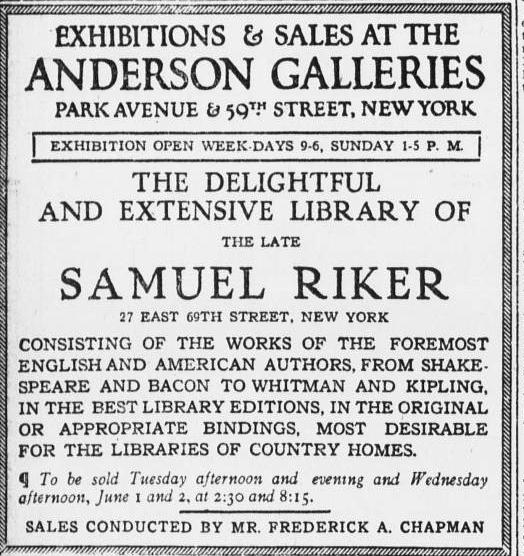
Mary Riker died in the house on Thursday, July 17, 1919.   Within the next few months the Riker heirs began emptying the family home.  In June a two-day auction sold off their father’s prized library.  A. S. W. Rosenbach purchased the George Washington documents for a staggering $4,000, bringing the total sales to $14,595.

The New York Herald, May 30, 1920 (copyright expired)

The house which had been home to the Riker family for three and a half decades was sold to Albert and Lucretia Lord Strauss.  As was customary, Strauss put the title in his wife’s name.  The pair set to work bringing their architecturally outdated home into the 1920s.

York & Sawyer was commissioned to transform the old brownstone into a modern mansion.  On February 4, 1922 The American Contractor reported that the planned alterations would cost about $50,000.

The completed renovations resulted in a neo-Tudor fantasy clad in ashlar fieldstone.  Grouped, multi-paned windows dominated the second and third stories.  The main entrance and the service door were joined by a continuous square-headed drip molding.

Somewhat a financial prodigy, Strauss had entered the College of the City of New York at the age of 15.  After graduating, he joined the international banking firm of J. & W. Seligman & Co.  He was 32 when he married Lucretia Mott Lord in 1896.  He became a partner in Seligman & Co. in 1901.


Albert Strauss -- Munsey's Magazine May 1918 (copyright expired)
During the war years he served on the Treasury Department’s War Trade Board and on the Federal Gold Export Committee.  At the war’s end he advised President Woodrow Wilson on financial matters relating to the transitioning of peace and served as a Treasury representative at the Paris Peace Conference.

By the time they purchased the 69th Street house, the Strauss daughters, Anna, Katharine and Marjorie, were adults; but still the unmarried Katharine and Anna moved in with their parents.

Albert Strauss died unexpectedly of pneumonia in Atlantic City on Wednesday, March 27, 1929.  Two days later, the East 69th Street house was the scene of his funeral, attended by only the immediate family and close friends.

Except for a total of $12,500 in bequests to three employees, Albert’s entire estate went to Lucretia.  She stayed on in the house with Anna and Marjorie.

The Strauss women were little affected by the Depression.  Their daily routines included, of course, dressing for dinner.  It was a routine that was unexpectedly upset on the evening of November 20, 1931 when Anna was nearly ready to go down to the dining room.

She opened her bureau drawer and noticed that a string of pearls valued at $10,000 and a platinum bracelet worth $60 were missing.  She distinctly remembered placing them there the night before when she returned home from the opera.  The police were called and “detectives said the jewels apparently had been stolen by a sneak thief,” reported The Times the following day.  “They did not determine how the burglar gained entrance to the house.”

Lucretia Lord Strauss died in the house on February 6, 1935 at the age of 68.  Her estate of just under $3 million included the house which was valued at $95,000.

Katharine had married business executive Henry J. Mali in 1929 and the couple was living at No. 55 East 72nd Street. Within the year the Malis would move into No. 27 East 69th Street and Anna would go to No. 136 East 65th Street.  Their aging uncle Frederick Strauss, who had been a partner in of J. & W. Seligman & Co. with Albert, moved in with the Malis.  Frederick died at the age of 72 of heart disease on August 11, 1937.

Katharine and Henry Mali would continue to live in the house for years, the couple routinely appearing in the social columns. 

Katharine was deeply concerned about death with dignity and was instrumental in the introduction of the living will.  In 1955 she joined the board of directors of the Euthanasia Society of America, and became president of the Euthanasia Educational Council in 1969 (the name was changed to Concern for Dying in 1978).  She was on the board of Planned Parenthood as well.  She died at the Mali country home in Winchester, Connecticut at the age of 78 in June 1980.

Henry died in the Manhattan home on June 8, 1987.

No. 27 East 69th Street remains a single family home, unchanged since the remarkable make-over of 1922.