Showing posts with label Ritch and Griffiths. Show all posts

Friday, February 18, 2022

Ritch & Griffiths's 1861 27 Mercer Street


image via premierequities.com

In 1866 the trustees of the estate of Charlotte Gomez contracted the architectural firm of Ritch & Griffiths to design a commercial building at 27 Mercer Street, between Canal and Grand Streets.  The neighborhood, only a generation earlier, had been residential, but it was quickly transforming into one of factories and stores.

The architects, who were recently responsible for designing elaborate buildings like the Emigrant Hospital on Ward's Island, and the Labor Exchange at Castle Garden, would now produce a much humbler structure.  Completed in 1867, the  three-story building was faced in granite above the cast iron storefront.  Twenty-four feet wide, its simple Italianate design looked as much like a converted house as a new loft and store building.

Unlike the large, cast iron-fronted structures rising throughout the district, 27 Mercer Street could accommodate only a handful of tenants.  Among the early occupants was Martin V. B. Travis, who operated a "notion business."  
Notions merchants offered a variety of goods, many of which were related to sewing, like ribbons, buttons, and buttons.  But other small items, like collar stays, pocket knives and mirrors were also offered.  

By the mid-1870's silk fabrics dealer George B. Skinner & Co. had its salesroom  here.  The firm's mills were in Yonkers, New York where it made textiles, the names of which are alien to today's seamstresses: "tram, organzine, fringe silk, sewing silk, and machine twist."

The company shared the building with Patterson Dyeing & Finishing Co., run by Claude Greppo.  It dyed piece goods at its dyeworks in Patterson, New Jersey.

The first years of the 1890's saw Jackson Brothers, makers of furs and fur trimmings, here.  Julius and Moritz Jackson employed ten men, four women, and three teens--one boy and two girls--in 1892.  They worked 58 hours per week and eight hours on Saturdays.

In the summer of 1893, Joseph Stiner & Bros. pressured the brothers for an outstanding debt of $2,375.  The Evening World said, "The Jacksons begged for time," and explained that they had just shipped more than $4,000 of goods to various clients.  And an inventory showed the firm had more than a third of a million in today's dollars worth of furs in stock.

Suspicious, however, the creditors wrote to one of the supposed customers and "were informed the firm had not bought the amount of goods represented, and did not owe Jackson Brothers what appeared on the books," according to Fur Trade Review.  When Steiner & Bros. filed for an attachment of the Jackson Brothers inventory early in September, according to The Evening World, "the Jacksons represented that they would settle with Steiner & Bros. if given until after the celebration of the Hebrew New Year, which began the next day.  They represented that as orthodox Hebrews they could do no business during that sacred festival."

Steiner & Bros. should have been wary of the excuse, given that the brothers' factory operated on the sabbath every week.  When the sheriff visited the Mercer Street premises early in September, he found that the Jacksons had fled in the night, taking the furs and leaving an empty loft.  On September 15, The Evening World reported, "The Sheriff has closed up the place of business of Jackson Brothers, manufacturers of furs at 27 Mercer street...on allegations that they had disposed of their property."  A manhunt for the fugitives was launched across several states.

Four days later the brothers were under arrest in Boston.  They were charged with fraud and extradited to New York City.

Following the disgraced Jackson Brothers in the building was Frank & Co., cloak manufacturers.  The tiny firm of Louis Emanuel, which made curtains, was here at the turn of the century.  Emanuel's staff of just three men worked 59 hours per week.

A major change came in 1916 when the Nicholas Doddato Company leased the building.  The Waste Trade Journal announced that the firm, "now occupy a three-story building, thoroughly equipped for the handling of their business."  That business was the scrap business.  The Doddato family dealt in "rags, bagging, cotton and wool waste, paper stock, [and] strings."

That tradition continued after 1925 when the building was sold to Rose Tuzio and her daughter, Victoria Mastronardi.  Victoria's husband, Andrew, took over the first floor for his waste paper business, while their existing tenants used the top two floors for theirs.

A horrific accident occurred on January 31, 1939.  Two years earlier Morris Dell 'Olio and his son had moved their waste paper business into the rear half of the upper floors.  The front half was occupied by a tenant named Derico, who was in the same business.

That morning Dell 'Olio and his son were unloading materials from a truck and hoisting them to the third floor.  Court papers later explained, "The hoist was operated by pulling a rope and it was necessary for the person operating the hoist to continue pulling the rope until such time as he desired to stop the hoist."  Dell 'Olio was unloading about seven or eight bags of heavy waste material into a sling, which he would then send up to his son.

For about five or six months, Dell 'Olio had complained to Andrew Mastronardi that the rope was in bad condition.  His concerns were warranted.  As bags, weighing about 700 pounds, were nearly at the third floor, the rope broke, sending them crashing directly onto Dell 'Olio.

While Dell 'Olio was not killed, he was seriously injured and sued the landlords.  In court, Andrew Mastronardi said that since Dell 'Olio knew the rope was in bad condition, he could have stood away from the spot directly underneath the load.  The jury did not agree and awarded Dell 'Olio $1,000 (about $18,600 today).

The Mastronardis' bad luck continued.  Late on the night of June 9 that year, fire broke out.  It developed into a two-alarm blaze, and by the time it was extinguished, according to The New York Sun, "the place was wrecked" and one firefighter injured.

The discovery of what is now known as the Soho district by artists in the third quarter of the 20th century changed the personality of 27 Mercer Street.  In 2006 Fringe Central was in the building, where tickets to the New York International Fringe Festival could be purchased.   Started in 1996, it is the largest multi-arts festival in North America, attracting world-wide companies.

The store space became home to Surface to Air in 2011.  It was the first store for the sportswear line that had been available in stores like Barneys New York and Bloomingdale's for years.
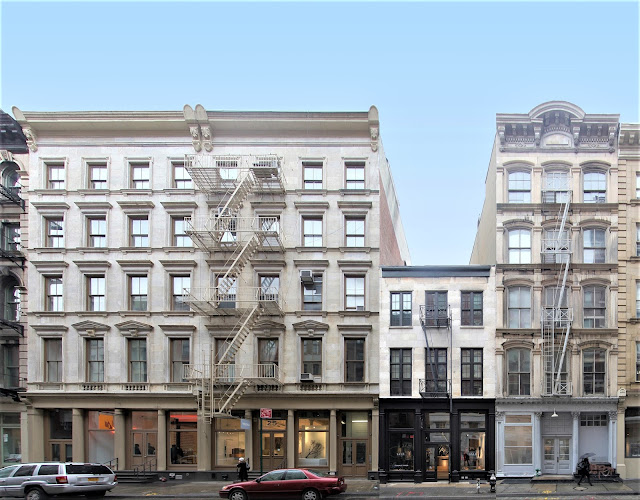
image via dxastudio.com

The little building that had stood in the shadows of its neighbors for 160 years was converted to a residential triplex in 2016-17, designed by the architectural firm GDSNY.

The days of waste paper and rags were over in 2016.  image via gdsny.com

Curbed New York called 27 Mercer Street "very Soho-glamorous" and described the five-bedroom space as having "wide white oak hardwood floors, imported natural stone, and marble; fancy appliances; an excess of slightly; and 'dueling terraces."  The unfinished residence went on the market in 2016 for $16.5 million.

no permission to reuse the content of this blog has been granted to LaptrinhX.com

Monday, December 14, 2015

The Lost St. Luke's Hospital -- W. 54th Street and Fifth Avenue


Architects' and Builders' Guide published a rendering of the building in 1868 (copyright expired)
On March 16, 1853 The New York Times reported that the Board of Aldermen had received a request from the managers of St. Luke’s Hospital, “asking permission to sell the lots conveyed to them by the Corporation two years since” and using the proceeds to purchase a larger lot uptown. 

The plot in which the hospital was interested, indeed, further uptown.

St. Luke’s Hospital had been founded seven years later, in 1846, by the pastor of the Church of the Holy Communion, Rev. William Augustus Muhlenberg.  It was operated by the church's Sisterhood, established in 1845, and was described in The Charities of New-York, Brooklyn and Staten Island by Henry J. Cammann and Hugh N. Camp:  “It is simply a body of Protestant Christian women, drawn together by a common motive, and bound together by a common aim.  No vows of any kind bind the Sisters to their work or to each other, but after a trial of six months they engage for a term of three years, which they may renew or not at pleasure.”

The hospital was incorporated on April 25, 1850, and now planned its modern, expansive facility.   It purchased the entire block of West 54th Street from Fifth to Sixth Avenues.  The location was chosen not only for the inexpensive real estate, but because the remote, high location provided an abundance of sunshine and fresh air.

The area was almost entirely undeveloped.  Three blocks to the south was the large Catholic Orphan Asylum and at 44th Street was the Colored Orphan Asylum.  Otherwise, the rutty dirt road known as Fifth Avenue was essentially barren above the Croton Reservoir at 42nd Street.

The cornerstone of what The New York Times anticipated would be “a splendid and spacious edifice” was laid on Saturday, May 6, 1854.  A crowd of around 300 had traveled to the site on an unusually cold spring day.  The officials of the hospital assured the assemblage that funds would not be wasted on frivolities.

“The managers have gone to no outlay in mere architectural ornament—relying for any beauty of structure on symmetry and proportion—which they are sure will be such that the hospital will present no unsightly object among the buildings likely to grace this part of the City.”  The Times gave a near-apology for the materials.  “The material will be of brick, but will be so treated by the architect as to ensure a good effect.”

That architect was Jonathan (known as John) W. Ritch, of the firm Ritch & Griffiths.   His three-story Italianate design smacked of the institutional buildings being designed by James Renwick, Jr. for the city on Blackwell’s Island.  The central section was dominated by the chapel, which was flanked by two four-story towers.  Expansive wards branched off to either side—the western ward for men, the eastern for women.


Floorplans from An Account of St. Luke's Hospital, 1860 (copyright expired)
At the time of the cornerstone laying the cost of the completed structure, including furnishings, was estimated to be $150,000—about $4.4 million in 2015.  Because only half of that amount had been raised, the hospital would be constructed in sections.  “They will therefore proceed with the erection of two-thirds of the building as planned, in the confidence that when that much is done they will have the means of completed the whole,” said The Times.

Rev. Muhlenberg took the opportunity to chide New Yorkers for not having yet contributed.  “Perhaps they are waiting until they are assured we are in earnest, and this day’s demonstration may be all that is wanting to bring their names to the subscription list.” 

By the time half of the building was completed and the chapel opened on June 22, 1857, the cost had risen to $200,000.  Half of that amount had been raised.   Less than a year after the chapel opened, the hospital was completed and on May 13, 1858 it opened its doors to patients.

Although St. Luke’s was affiliated with the Episcopal Church, its 200 beds were available to all creeds.  Its charitable approach to medical care was evidenced by the cost of a private room.  Patients who preferred not to stay in a common ward paid $3.05 per week; yet the cost to the institution was $4.65.

An 1863 stereopticon slide reveals the undeveloped Fifth Avenue neighborhood -- from the collection of the New York Public Library

The hospital filled not only with the sick, but with victims of a variety of sometimes bizarre accidents.  Lyke Flynn was a laborer, working in the creation of Central Park, when he was struck “by a large stone which fell upon him from a derrick,” reported The New York Times on October 22, 1858.  He did not survive.

Another laborer, 60-year old William Simmons, “was precipitated from a scaffold at a house in Fifty-fifth-street” where he was working on February 7, 1860.  He, too, died of his injuries.  And Mary Brown, a servant of a family on East 83rd Street, was standing in the yard of that house in October that year as construction workers blasted for the foundation of a building across the street.  A stone flew into the air, crashing down on Mary’s head.

The Times reported “As soon as the contractor having charge of the work heard of the injury which had resulted from his carelessness he fled to escape arrest.”  Mary was taken to St. Luke’s where “the physician in whose care she has been placed considers her recovery impossible.  Her skull is fractured.”

The Civil War changed day-to-day operations in St. Luke’s as half of its 200 beds were devoted to wounded soldiers.  On July 9, 1862 The Times noted that hundreds of “poor fellows, who, a few short months, or it may be weeks ago, left their homes, sound and stalwart, hopeful and reliant, to do battle for the flag under which they were born, or to which they owned allegiance.  They come back to us diseased, mutilated, overwrought in mind, and body, demanding from all in whose power it may be to aid them every attention that time, thought and money can bestow.”

One of those soldiers in 1862 was Corporal James Marchall, the color bearer of the 2nd New Jersey Regiment who was injured in the battle of Gaines’ Mill.  Refusing to allow the flag to be taken by the enemy, he buried it where he knew he could go back and retrieve it.  He was taken prisoner shortly afterward, with his thumb shot off.  After being imprisoned in Richmond for some time he was released and ended up in St. Luke’s.

A different type of war victim would be brought here the following year when the bloody Draft Riots erupted on the streets of New York.  Eighteen-year old Francis McCade did not survive the gunshot he received on the corner of 36th Street and Ninth Avenue on July 14, 1863, for instance. 

One policeman after another was brought in after being assaulted by the mob.  Officer Bennett was knocked down three times before he stopped fighting.  Unconscious, he was robbed of everything “save his drawers” according to newspapers.  The mob left him for dead and he was taken to the Dead House.  When his wife visited his body several hours later, she realized he had a heartbeat.  He was brought to St. Luke’s.

Office Travis was pursued by the rabble, one of which had a pistol.  Travis turned on him, knocked him down and secured the weapon; but the crowd was on him before he could use it.  “He fell beneath a score of clubs, was stamped, jumped upon, and otherwise terribly assailed; his jaw was broken, his teeth knocked out, his head terribly cut, and he left for dead, after being stripped of every article of clothing, even to shirt and stockings.”

A score of other police officers were brought in; including Officer Didway who was beaten so badly that his eye was forced out of the socket.

The Rev. Dr. Muhlenberg was not only an accomplished orator and minister; he was a poet and hymn writer.  In reaction to the horrors of the war, he wrote “The President’s Hymn” as Thanksgiving approached in 1863.  The hymn sought the quick restoration of “Liberty and Peace.”  The editor of The New York Times sent a copy to Abraham Lincoln, asking his permission on behalf of Dr. Muhlenberg to use the title.  He received a telegram from the Secretary of State a few hours later which said the President had replied “Let it be so called.”

Around 1865 one house, owned by wealthy merchant William P. Williams, had been constructed on West 54th Street.  from the collection of the Museum of the City of New York
Things returned to normal after the end of the war and physicians at St. Luke’s Hospital returned to treating ill and injured citizens.  On the afternoon of September 9, 1867 Robert Goliver attempted to jump off the front platform of a moving Sixth Avenue street car.  He fell under the car and a wheel passed over his foot, cutting it badly.  Two weeks later John McDonough fell from the third floor of a newly-constructed building at 54th Street and Third Avenue.  He fractured his skull and sustained other injuries.

The hospital served 1,027 patients in 1868, 172 of which were children.  Patients who could afford to paid $7 a week while here, including all necessary medication and treatment (an enviable fee of about $120 in 2015 dollars).  Children paid $4.

Muhlenberg’s assistant pastor at the time was a Southerner, Fleming James.  He was in Baltimore in 1869 visiting a clergyman when, according to James, “he was suddenly called upon to read the burial service” of John Wilkes Booth.  For the past four years the assassin’s body had been moved from place to place for various identifications; and finally had been released to his family for burial.

James explained in July “As he was just going out of town, he requested me to do it for him.  I consented, having but a few moments for reflection, and seeing no good reason for refusing.”  Fleming James officiated at the burial of America’s most hated citizen.  Reaction from the press and the community in general was scathing.

On June 30, 1869 Fleming James resigned his position with St. Luke’s Hospital over the uproar.  His letter of explanation insisted that his “Southern feelings had nothing to do with the matter.  I acted wholly from a sense of duty at the time.  I need scarcely say that I have no sympathy with the assassination of which the deceased was guilty.”

Dr. Muhlenberg was especially aware of the children in the hospital at Christmas time.  On Christmas Eve 1870 he reminded those assembled in the chapel that Christmas was a “peculiarly the children’s day.”  Following the service, visitors went to the children’s ward where The Times said “most of the children are cripples.”

The room was unlit except for the 100 candles on the Christmas tree.  “The kind visitors passed from couch to couch, speaking words of comfort to the little sufferers, and wishing them a merry Christmas.”  The group sang a few hymns.

“When these were concluded, the tree was stripped of its rich treasures, and each child was presented with several nice presents,” said the newspaper.

On the night of April 8, 1877 Dr. William Augustus Muhlenberg died at the age of 80.  The Times said “Now that he is gone, people will begin to realize the gap which his absence makes in a large community busy with its own affairs.”    His funeral was held in the chapel of St. Luke’s Hospital on the afternoon of April 11.

An omnibus pauses by the impressive 54th Street gate posts.  photographer unknown, from the collection of the Museum of the City of New York

The extraordinary ability of St. Luke’s Hospital’s physicians and surgeons was exhibited in the case of Lucy Osborn.  In 1874 the 19-year old was working in a button factory in New Medford, Connecticut.  Her hair was “arranged in long, luxuriant curls” and as she bent over the revolving shaft of the button machine on September 23, her hair became caught.  The New York Times later reported “Her face was wrenched down close to the shaft, the hair refused to give way, and the entire scalp was taken clean off.”

When local doctors could not help her, she was brought to St. Luke’s on December 1, 1874.  It was the beginning of a complicated procedure of skin grafts to replace her scalp.  Dr. Weir applied ointments designed to aid production of new tissue for 27 days.  Then “little pieces of thin skin, not larger than a millet-seed, were carefully taken from the arm of a healthy man, and 25 of these were grafted on the head of Lucy.”   Some of the tiny grafts grew; most were rejected.  But the doctor persistently pushed on. 

As the news of Lucy’s case was publicized, donors came forth.  The New York Times reported “Several prominent clergymen of the City contributed grafts, and portions of the skin of many fashionable ladies furnished a nucleus for the scalp which Lucy Osborn now wears.”

On July 17, 1880, more than six years after the procedure was started, The New York Times reported “The new scalp which has been built up for Lucy Osborn is hard, white, and glossy.  There are no pores in the tissue, and it can never bear hair.”  But, the newspaper said, “Lucy is in the best of health and spirits, and expects to have a completely reconstructed scalp soon.”

By now the neighborhood around St. Luke’s Hospital had filled with the mansions of Manhattan’s wealthiest citizens.  The real estate value of the block had soared.  On October 24, 1891 The Real Estate Record &  Builders’ Guide reported “It has been definitely settled upon that St. Luke’s Hospital is to move.”

George Maccullough Miller, President of the hospital, told a Guide reporter “We are now placing our property on the market for sale.  Our price is $2,500,000.  We prefer to sell it as a whole.  There are thirty-two lots.”

A few days later the Record & Guide opined “Real estate on that avenue sells for very high prices, not because it is suited to be the site for hospitals, but because custom has made it desirable for the residences of the rich…Quite a fashion has set in of late for millionaires to build very expensive residences on upper 5th avenue; and there must be enough of them left to absorb this last remaining and very desirable property.”

There was interest in the property, but no one seemed willing to purchase the entire plot.  The exclusive Union Club negotiated for the Fifth Avenue corner and it seemed for awhile that the hospital officials would sell that plot. 

Then on June 3, 1893 The Record & Guide reported that Charles A. Seymour & Co had purchased the entire property for $2.4 million.  The firm had already negotiated the sale of certain parcels. 

When Robert L. Bracklow took this photograph around 1890, the hospital building's days were numbered.  from the collection of the Museum of the City of New York
 St. Luke’s Hospital relocated to 113th Street between Amsterdam Avenue and Morningside Drive in 1896.  The old structure was demolished and one by one lavish homes rose on the block, anchored by McKim, Mead & White’s grand University Club on the Fifth Avenue corner, completed in 1899.


The University Club sits at the corner of Fifth Avenue, while down the block newly constructed mansions can be seen.  from the collection of the Library of Congress.