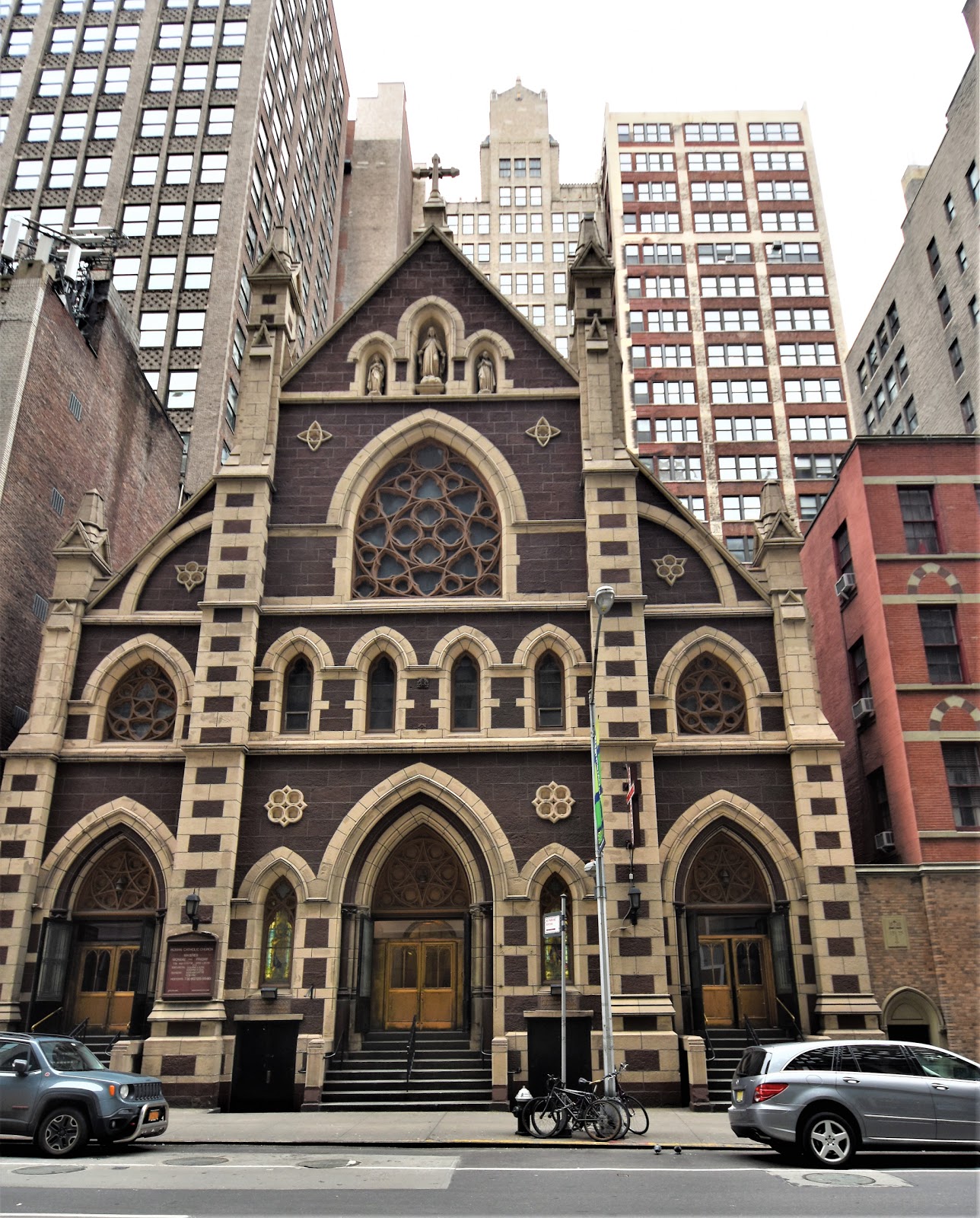
By the 1850s urban pioneers had ventured north of 34th Street along Sixth Avenue and Broadway where they lived in modest three-story brick-faced houses, some with shops at street level. Among them was a small group of Episcopalians who formed the Church of the Holy Innocents in 1854.
The congregation worshiped from a small wooden building on West 37th Street between Broadway and 7th Avenues. There is no clear description of the church. In 1864 The Church of the People announced:
Free Church of the Holy Innocents--Sunday next, the 1st Sunday after Trinity, is the tenth anniversary of the opening of this church, in West Thirty-seventh-street, near Broadway, and of the Rector's Institution. The anniversary sermon will be preached in the morning.
By the time of that announcement, the district was seeing significant development. In 1866 Archbishop John McCloskey recognized the need for a new Roman Catholic parish to serve the growing population. He appointed Rev. John Larkin to establish the parish and, interestingly, he not only set his sights on the building of the Church of the Holy Innocents, but on its name.
According to The Evening World later, Father Larkin purchased the "small frame structure which had been occupied by a Protestant Episcopal congregation. The cost of this and several adjacent lots, which Father Larkin purchased at the same time, was about $130,000." The Episcopal parish moved slightly north to Sixth Avenue and 41st Street.
Archbishop McCloskey officiated at the dedication services on December 16, 1866. The New York Herald noted "Forty days' indulgence was granted by the Right Reverend Bishop to all persons assisting at the ceremonies."
The most common form of church fund raising was a bazaar, or fair, where homemade goods like needlework and baked goods were sold. The Church of the Holy Innocents was no different. On April 24, 1867 The New York Herald reported on one of the events. The "grand fair and festival to aid in the funds" of the church was held in the "large hall on the corner of Thirty-fourth street and Eighth avenue." The article noted "The rooms were handsomely decorated and the display of articles to be disposed of was arranged with that degree of taste and neatness which always distinguish the handiwork of the gentler sex."
Archbishop McCloskey was back on June 20, 1869 for the laying of the cornerstone of the new building "in the presence of a vast concourse of people," as reported by The New York Times. The pomp and ceremony of the ritual--the procession of priests and acolytes, and the blessing of the stone by the Archbishop ("vested in cope and mitre, and bearing his crosier")--were abruptly ended by a cloudburst.
The church had hired Irish-born architect Patrick Charles Keely to design its new structure. He worked almost exclusively for the Roman Catholic Church and would eventually design more than 600 of its churches. Similar to several of his Gothic Revival designs, The Church of the Holy Innocents was clad in brick trimmed in New Jersey brownstone and light-colored sandstone from Ohio. The alternating use of the two stones created a colorful effect.
Keely used modern technology inside, creating the gallery columns from cast iron. "From the caps of these will spring arches of wood to support the roof," said The New York Times. "It is estimated that the church, when finished, will comfortably seat 1,500 people."
The dedication was held on February 13, 1870. After pointing out that "the altar is of white marble," and that the nave "is lighted by seventy-six beautiful stained glass windows," The New York Times simply opined "The general appearance of the church is extremely pretty."
The cost of the construction was about $100,000; bringing the total project to more than $3.6 million in 2018. Part of the expense was the superb fresco mural of the Crucifixion above the white marble altar. It was executed by Constantino Brumidi, who was simultaneously working on the decoration of the United States Capitol Building.
 |
| image via The Monuments Conservancy |
Not in the budget, apparently, was a new organ. A month later, on March 28, The New York Herald reported "In spite of the weather a large number of sinners assembled at the Church of the Holy Innocents, where the sermon and singing were fine, but where, we sincerely regret to record it, the organ, being afflicted with the asthma, with difficulty contributed its quota of wind."
 |
| A charming detail is the design of the brass door pulls, now worn with decades of use, in the form of praying medieval monks. |
Although the church was considered, according to The Evening World, "one of the largest and handsomest of its kind in the city," its congregation was composed mostly of working-class Irish who clung tightly to their roots. And so when Irish-born boxer John C. Hennan died in October 1873 it was not surprising that his funeral was held here.
Heenan died in Green River, in the Wyoming Territory, on his way to fight in San Francisco. His body was transported by train on the long journey back to New York. When it arrived at Grand Central Depot on November 1, The New York Herald remarked "although the face was somewhat discolored, it was readily recognizable." The newspaper said the Church of the Holy Innocents was "decorated last evening with flowers" including "massive floral contributions in the shape of anchors and harps."
Meanwhile the church continued to undergo improvements. Three weeks after Heenan's funeral a new alter was dedicated, and on November 9, 1879 a "remarkably fine" new organ, as described by The New York Times, replaced its asthmatic predecessor. Built by George Jardine & Sons, the instrument cost $15,000--about a third of a million dollars today. That evening a concert was held with several of the well-known organists of New York and Brooklyn taking part.
The heavily Irish personality of the Church of the Holy Innocents played out even in its own organist. Rosa d'Erina not only played the organ, she was a popular singer, known as the "prima donna of Erin" and "The Irish Song Bird." Born in Armagh, Ireland, she made her debut as a singer in October 1869 in London, before coming to New York in 1870.
Father Larkin's own pro-Irish temperament was revealed on Sunday March 2, 1884 when he denounced Dion Boucicault's play, The Shaughraun from the pulpit. He told his congregants that the play "lowered the Irish church and was a disgrace to the Irish people." Specifically, he said, "the play represented the Irish priests as so depraved in taste as not to know the difference between whisky and the milk in their tea," and that in a scene depicting a wake, "the Irish people are represented as dancing and having a good time."
A much more sobering protest by Father Larkin and his parish was staged on June 21, 1887. For seven years, between 1845 and 1852, the people of Ireland suffered mass starvation and disease, known then as The Great Famine or the Great Hunger--better known today as the Irish Potato Famine. Upwards of a quarter of the Irish population died--estimated by modern statisticians at between 1,000,000 and 1,500,000 people. Irish-Americans watched in disbelief as it appeared that the British Government refused to step in with aid.
Queen Victoria's Jubilee was celebrated on June 21, 1887. Newspapers world-wide were filled with descriptions of the fireworks, parades, and festivities. On June 22 The Salt Lake Herald printed a full page covering the events. It included the paragraph:
Heenan died in Green River, in the Wyoming Territory, on his way to fight in San Francisco. His body was transported by train on the long journey back to New York. When it arrived at Grand Central Depot on November 1, The New York Herald remarked "although the face was somewhat discolored, it was readily recognizable." The newspaper said the Church of the Holy Innocents was "decorated last evening with flowers" including "massive floral contributions in the shape of anchors and harps."
Meanwhile the church continued to undergo improvements. Three weeks after Heenan's funeral a new alter was dedicated, and on November 9, 1879 a "remarkably fine" new organ, as described by The New York Times, replaced its asthmatic predecessor. Built by George Jardine & Sons, the instrument cost $15,000--about a third of a million dollars today. That evening a concert was held with several of the well-known organists of New York and Brooklyn taking part.
The heavily Irish personality of the Church of the Holy Innocents played out even in its own organist. Rosa d'Erina not only played the organ, she was a popular singer, known as the "prima donna of Erin" and "The Irish Song Bird." Born in Armagh, Ireland, she made her debut as a singer in October 1869 in London, before coming to New York in 1870.
Father Larkin's own pro-Irish temperament was revealed on Sunday March 2, 1884 when he denounced Dion Boucicault's play, The Shaughraun from the pulpit. He told his congregants that the play "lowered the Irish church and was a disgrace to the Irish people." Specifically, he said, "the play represented the Irish priests as so depraved in taste as not to know the difference between whisky and the milk in their tea," and that in a scene depicting a wake, "the Irish people are represented as dancing and having a good time."
A much more sobering protest by Father Larkin and his parish was staged on June 21, 1887. For seven years, between 1845 and 1852, the people of Ireland suffered mass starvation and disease, known then as The Great Famine or the Great Hunger--better known today as the Irish Potato Famine. Upwards of a quarter of the Irish population died--estimated by modern statisticians at between 1,000,000 and 1,500,000 people. Irish-Americans watched in disbelief as it appeared that the British Government refused to step in with aid.
Queen Victoria's Jubilee was celebrated on June 21, 1887. Newspapers world-wide were filled with descriptions of the fireworks, parades, and festivities. On June 22 The Salt Lake Herald printed a full page covering the events. It included the paragraph:
New York, June 21--A solemn requiem mass was celebrated in the Church of the Holy Innocents this morning, for the repose of the souls of 150,000 Irish, who died of starvation during the reign of Queen Victoria. Rev. Dr. John Larkin acted as celebrant.
Four days later the Illinois newspaper The Ottawa Free Trader chimed in. "In New York while the Englishmen and their friends were drinking toasts with the liveliest felicitations, at the Church of the Holy Innocents a 'mass for the repose of the souls of Irish victims of Victoria's reign' was held; and while the jubilee anthem pealed forth at Metropolitan Opera House, the Dies irae, dies illa was sung in the church!"
That same year an $8,000 renovation was done. The facade was remodeled and the interior updated, including painting the cast iron columns to resemble marble. On January 24 The Evening World reported "During the past year the interior of the church has been redecorated, the walls and ceiling having been repainted and frescoed. The ceiling has been ornamented with a double row of handsomely executed panels representing different saints. In addition to this the stonework of the entire front of the church has been rechiselled, the result being that the whole building has been renovated and within and without it has the appearance of a new structure."
 |
| A turn of the century post card depicted the remodeled facade. A veneer of brownstone had been applied to the original brick facing. To the right is the church school and rectory. |
The church was once again the scene of the funeral of a famous Irish boxer, Joe Coburn, on December 8, 1890. The Evening World reported "The assemblage that crowded the Church of the Holy Innocents this morning was like none that had ever filled it. Long before 10 o'clock, the hour set for the funeral services, athletic looking men in twos and threes turned into Thirty-seventh street from Broadway or Seventh avenue, and reverently entered the sacred edifice."
The article admitted that many of the pugilistic mourners were not especially devout. "The place seemed strange to them and they to the place...They were rather hard-faced men [who] wore expensive but too massive jewelry, and their garments were of louder tone than fashion would permit, but they were earnest and had come to pay their last call on all that remained of their old-time friend and companion, Joe Coburn."
Less then three weeks later there would be another funeral, equally crowded, but this one would have no flashy suits. After serving as pastor for 29 years, Rev. John Larkin died of pneumonia at the age of 69 on December 20. His funeral was held the following Tuesday, just two days before Christmas Day.

Father Larkin's replacement was another Irish priest, Michael C. O'Farrell. While its congregants were mostly working class, the Church of the Holy Innocents brushed with the upper class after a messenger boy knocked on the door of the rectory just before midnight on April 25, 1897. In his mansion at No. 244 Madison Avenue, the massively-wealthy Theodore Havemeyer was dying.
Although his wife, Emily, was a practicing Catholic and their children had been brought up in the faith, Havemeyer had never embraced religion. Now on his deathbed he had second thoughts. It may have been that no other priest would perform the last-minute conversion, but for whatever reason the unlikely choice of the Church of the Holy Innocents and Father O'Farrell was made.
O'Farrell traveled to the Murray Hill mansion and baptized the millionaire just in time. Now a confirmed Catholic, his funeral was held in St. Patrick's Cathedral. The gesture was not lost on the Havemeyer family. When Theodore's son, Charles F. Havemeyer died the following year at his Long Island summer estate, a funeral was performed there, then a second service was held in the Church of the Holy Innocents. The church would also be the scene of Frederick Christian Havemeyer's wedding to Lillie Travers on July 21, 1906.
Until the church was debt-free it could not, by Roman Catholic law, be consecrated. That finally came to pass on February 12, 1901. Archbishop Michael Corrigan officiated at the pontifical mass. The elaborate ceremony included a string orchestra, a double quartet and chorus.
By the time of the consecration the residential neighborhood around the church was becoming more and more commercial. In 1895 James Gordon Bennett had moved his New York Herald into its stunning new building on Herald Square nearby. In July 1901 Roland H. Macy announced he would commence construction of his massive Macy's department store engulfing the block between 34th and 35th Streets, from Broadway to Seventh Avenue. As entire blocks of rowhouses were destroyed, the congregants of the Church of the Holy Innocents were displaced.
By 1910 there were not enough students to fill the church's school. On October 1 the Real Estate Record & Builders' Guide noted that the church had leased the five-story building at No. 130 West 37th Street "formerly used as the school house" to Philip Levey "who will alter the same for mercantile purposes."
With stores, factories and the theater district engulfing the church, Holy Innocents slowly became more important for workers than residents. It eventually became known as The Actor's Church. It was the scene of thespian weddings, such as that of vaudeville player Earl J. Riegler and Agnes E. Lynch on February 3, 1913.
Office and factory workers routinely filed into the church for communion at lunch time. Ironically, one of those who arrived at noon on January 19, 1921 was a fireman. As Harry K. Ness knelt at the chancel rail, smoke seeped into the sanctuary.
A fire, believed to have been caused by defective wiring, had broken out in the basement and spread to the vestry room. Ness rushed out of the church and called in an alarm. His company, Engine No. 26, was just around the corner and soon had the blaze under control, although there was considerable damage to the vestry room. "Also a quantity of religious vestments were scorched," reported The Evening World.
On August 1, 1932 fire broke out in the 41-story Ritz Tower at No. 113 East 57th Street. While firefighters from several companies battled the blaze, fumes from the paint shop in the basement caused a massive explosion. As their comrades rushed in to remove the injured, a second explosion occurred within three minutes of the first. Eight firemen were killed either immediately or as a result of injuries later. For years afterward an annual memorial mass was held in the Church of the Holy Innocents for the lost fire fighters.
The once free-standing mid-Victorian church was crowded in by commercial structures in the 20th century. The parish continued to serve the Garment District workers and to offer community relief. Following the devastating 1970 typhoon that struck the Philippines, the Church of the Holy Innocents held a traditional Filipino midnight folk mass on Christmas Eve to raise funds for the victims.
In 2007 Pope Benedict XVI rolled back some of the restrictions of the Second Vatican Council. Once again Catholics had the right to celebrate the Latin Mass. Rev. Thomas Kallumady, then pastor of the Church of the Holy Innocents, responded by offering one Latin Mass per week. It was so well received that by 2010 Latin Mass was being offered daily.
By now decades of candle and incense smoke and clumsy restorations had left Constantino Brumidi's magnificent altar fresco damaged and dirt-covered. Conservator Christiana Cunningham-Adams, a specialist in Brumidi work, began the first phase of restoration, which included stopping the painting's disintegration. Then in February 2011 the firm of Parma Conservation was brought in to work with Cunningham-Adams to remove varnish, grime, and over-painting. A five-member team and a full laboratory was established on site to restore the mural.
The article admitted that many of the pugilistic mourners were not especially devout. "The place seemed strange to them and they to the place...They were rather hard-faced men [who] wore expensive but too massive jewelry, and their garments were of louder tone than fashion would permit, but they were earnest and had come to pay their last call on all that remained of their old-time friend and companion, Joe Coburn."
Less then three weeks later there would be another funeral, equally crowded, but this one would have no flashy suits. After serving as pastor for 29 years, Rev. John Larkin died of pneumonia at the age of 69 on December 20. His funeral was held the following Tuesday, just two days before Christmas Day.

Father Larkin's replacement was another Irish priest, Michael C. O'Farrell. While its congregants were mostly working class, the Church of the Holy Innocents brushed with the upper class after a messenger boy knocked on the door of the rectory just before midnight on April 25, 1897. In his mansion at No. 244 Madison Avenue, the massively-wealthy Theodore Havemeyer was dying.
Although his wife, Emily, was a practicing Catholic and their children had been brought up in the faith, Havemeyer had never embraced religion. Now on his deathbed he had second thoughts. It may have been that no other priest would perform the last-minute conversion, but for whatever reason the unlikely choice of the Church of the Holy Innocents and Father O'Farrell was made.
O'Farrell traveled to the Murray Hill mansion and baptized the millionaire just in time. Now a confirmed Catholic, his funeral was held in St. Patrick's Cathedral. The gesture was not lost on the Havemeyer family. When Theodore's son, Charles F. Havemeyer died the following year at his Long Island summer estate, a funeral was performed there, then a second service was held in the Church of the Holy Innocents. The church would also be the scene of Frederick Christian Havemeyer's wedding to Lillie Travers on July 21, 1906.
Until the church was debt-free it could not, by Roman Catholic law, be consecrated. That finally came to pass on February 12, 1901. Archbishop Michael Corrigan officiated at the pontifical mass. The elaborate ceremony included a string orchestra, a double quartet and chorus.
 |
| This photo, most likely taken at the time of the consecration, reveals the brass and art glass electric and gas chandeliers and the vividly-colored encaustic floor tiles. photo by Byron Company from the collection of the Museum of the City of New York |
By the time of the consecration the residential neighborhood around the church was becoming more and more commercial. In 1895 James Gordon Bennett had moved his New York Herald into its stunning new building on Herald Square nearby. In July 1901 Roland H. Macy announced he would commence construction of his massive Macy's department store engulfing the block between 34th and 35th Streets, from Broadway to Seventh Avenue. As entire blocks of rowhouses were destroyed, the congregants of the Church of the Holy Innocents were displaced.
By 1910 there were not enough students to fill the church's school. On October 1 the Real Estate Record & Builders' Guide noted that the church had leased the five-story building at No. 130 West 37th Street "formerly used as the school house" to Philip Levey "who will alter the same for mercantile purposes."
With stores, factories and the theater district engulfing the church, Holy Innocents slowly became more important for workers than residents. It eventually became known as The Actor's Church. It was the scene of thespian weddings, such as that of vaudeville player Earl J. Riegler and Agnes E. Lynch on February 3, 1913.
Office and factory workers routinely filed into the church for communion at lunch time. Ironically, one of those who arrived at noon on January 19, 1921 was a fireman. As Harry K. Ness knelt at the chancel rail, smoke seeped into the sanctuary.
A fire, believed to have been caused by defective wiring, had broken out in the basement and spread to the vestry room. Ness rushed out of the church and called in an alarm. His company, Engine No. 26, was just around the corner and soon had the blaze under control, although there was considerable damage to the vestry room. "Also a quantity of religious vestments were scorched," reported The Evening World.
On August 1, 1932 fire broke out in the 41-story Ritz Tower at No. 113 East 57th Street. While firefighters from several companies battled the blaze, fumes from the paint shop in the basement caused a massive explosion. As their comrades rushed in to remove the injured, a second explosion occurred within three minutes of the first. Eight firemen were killed either immediately or as a result of injuries later. For years afterward an annual memorial mass was held in the Church of the Holy Innocents for the lost fire fighters.
The once free-standing mid-Victorian church was crowded in by commercial structures in the 20th century. The parish continued to serve the Garment District workers and to offer community relief. Following the devastating 1970 typhoon that struck the Philippines, the Church of the Holy Innocents held a traditional Filipino midnight folk mass on Christmas Eve to raise funds for the victims.
In 2007 Pope Benedict XVI rolled back some of the restrictions of the Second Vatican Council. Once again Catholics had the right to celebrate the Latin Mass. Rev. Thomas Kallumady, then pastor of the Church of the Holy Innocents, responded by offering one Latin Mass per week. It was so well received that by 2010 Latin Mass was being offered daily.
By now decades of candle and incense smoke and clumsy restorations had left Constantino Brumidi's magnificent altar fresco damaged and dirt-covered. Conservator Christiana Cunningham-Adams, a specialist in Brumidi work, began the first phase of restoration, which included stopping the painting's disintegration. Then in February 2011 the firm of Parma Conservation was brought in to work with Cunningham-Adams to remove varnish, grime, and over-painting. A five-member team and a full laboratory was established on site to restore the mural.
 |
| photo via Conservation & Design |
In 2014 the Church of the Holy Innocents was the only New York City church to offer a daily traditional Latin Mass. But that seemed to be coming to a close when that spring an archdiocesan panel recommended that the church be closed. It triggered an unexpected act of defiance and retaliation.
In May a visiting priest, Rev. Justin Wylie, addressed the congregation, saying they should "be obedient," but to also speak their minds rather than being "turned out like squatters." Within two weeks the New York Archdiocese removed him from his job at the Mission of the Holy See at the United Nations.
Congregants of the Church of the Holy Innocents waited, concerned that their parish church would be shuttered. Then, on October 26, Cardinal Timothy M. Dolan announced the names of the 31 churches which would be closed. The Church of the Holy Innocents was not on the list--it was, as worded by The New York Times, "spared."
The Church of the Holy Innocents, once a comforting refuge for struggling Irish immigrants, is now a quiet oasis in the gritty, bustling Garment District where the devout and art lovers alike can view a recently-restored American art treasure.
photographs by the author
In May a visiting priest, Rev. Justin Wylie, addressed the congregation, saying they should "be obedient," but to also speak their minds rather than being "turned out like squatters." Within two weeks the New York Archdiocese removed him from his job at the Mission of the Holy See at the United Nations.
Congregants of the Church of the Holy Innocents waited, concerned that their parish church would be shuttered. Then, on October 26, Cardinal Timothy M. Dolan announced the names of the 31 churches which would be closed. The Church of the Holy Innocents was not on the list--it was, as worded by The New York Times, "spared."
The Church of the Holy Innocents, once a comforting refuge for struggling Irish immigrants, is now a quiet oasis in the gritty, bustling Garment District where the devout and art lovers alike can view a recently-restored American art treasure.
photographs by the author


.png)


