Showing posts with label Napoleon Le Brun. Show all posts

Wednesday, October 11, 2017

Engine Company 16 - 223 East 25th Street


photographs via www.elliman.com
When the loose network of volunteer fire companies was disbanded in 1865 as the professional Metropolitan District fire department was formed, it was a melancholy day for many of the veteran "laddies."   Among the 41 members of the Lexington Engine Company, No. 7 were a barber, two butchers, a ship-joiner, a horse shoer, and a carriage maker.   On September 18, 1865 the fire department announced that their old fire house at No. 223 East 25th Street would become home to the newly-formed Metropolitan Steam Fire Engine Company No. 16.

When Engine Company 16 took over the building the Kips Bay area was still relatively undeveloped.  But the flurry of construction in the first years following the Civil War brought tenements, stores and small factory buildings.   In the early 1880s the fire department was scrambling to build new firehouses and update or replace the old ones to keep up with the expanding city.

In 1879 Napoleon Le Brun had become the official architect for the fire department.  The following year his son, Pierre, joined him to create N. Le Brun & Son.  The firm filed plans on August 1, 1882 for a replacement fire house for Engine Company 16.  The three-story structure was projected to cost $18,000, or in the neighborhood of $436,000 today.

The completed structure followed the typical fire house pattern.  The cast iron base was dominated by the central truck bay.  The two upper floors were clad in red brick.  As was often the case with their less opulent fire houses, N. Le Brun & Son relied on terra cotta and creative brickwork for decorative effect.  A knobby quilt of terra cotta tiles filled the spandrels above the second and third floors, and the dog-tooth pattern brick filled the arches of the top floor openings.   Above a frieze of floral terra cotta tiles was an unusually deep bracketed cast metal cornice.

As with all fire companies, No. 16 responded to an array of calls.   The fire on the night of July 10, 1899 was especially memorable.  It broke out in the Infants' Pavilion of Bellevue Hospital, described by The New York Times as "ramshackle."

Around 11:00 Miss Abbe, the head of the four nurses in the ward, entered the darkened room to check on a sick baby.  The hospital's location near the East River and the summer heat necessitated the cribs being covered in mosquito netting.  While Miss Abbe tended to the baby, her candle fell over setting fire to the netting.

The Times reported "With a puff the whole netting burst into flames.  The blaze jumped to either side, ran along from crib to crib, and caught the bed linen.  Miss Abbe stood her ground heroically and pulled at the blazing material until her hands were seriously burned."

By the time Engine Company 16 could respond the fire had spread to the adult wards.   Here, too, the mosquito netting quickly caught fire and a civilian, Albert Stone who was a former fireman, rushed in to help, tearing down the netting as Engine Company 16 attacked the flames.  Unfortunately some of the patients were burned.  The Times reported "The injury to the patients may be serious." 

The work of fire fighters, by nature, put their lives at risk.  On May 3, 1903 Engine Company 16 responded to a fire in the four-story boarding house at First Avenue and 15th Street.   When the truck arrived 50-year old Henry Williams was trapped on the upper floor and flames could be seen in his room from the street.

Twenty-four year old William McNally scaled a ladder to the window.  The New-York Tribune reported "As McNally got to the top a sheet of flame burst out of the window."  The fire fighter paused, then jumped inside.  A few moments later he appeared with McWilliams in his arms.  The crowd watching from the sidewalk broke into cheers.

Their jubilation was soon crushed.  Just as McNally started to climb out of the window, he was overcome and both he and McWilliams fell back into the burning room as "another sheet of flame leaped from the window."

Firefighter James C. McEvoy clambered up the ladder.  He reappeared in the window with McNally, half conscious, whom he managed to get to the ground.  Now Engine Company 16's foreman, McGarrity, and firefighter Lang headed up for the other victim.   They found McWilliams unconscious and dragged him to another window where there was a fire escape.  On the way down, McGarrity's foot got wedged in a triangular space of the fire escape.  Lang continued down with McWilliams while McGarrity struggled to escape as the flames closed in.

By the time firefighters freed his foot by using crowbars and hammers it was too late.  McWilliams died on the way to Bellevue Hospital.  Both McNally and McEvoy suffered severe burns.

McWilliams's widow would receive half his salary as a pension.  But the following year there was a question about whether Mark Kelly's widow would receive the same compensation.

On February 7, 1904 fire broke out in the western part of downtown Baltimore.  It quickly outstripped the abilities of the Baltimore Fire Department and calls for help were sent out to other cities.   New York's Acting Fire Chief Kruger received a telephone call saying "that Baltimore's men were worn out and needed all the help they could get," according to the New-York Tribune.

Before dawn the following morning nine engines and a hook and ladder truck along with 105 firemen, including the men of Engine Company 16 headed south.  The Tribune noted "It was the first time within the memory of old firemen when the department had been called on to send the fire fighters so far outside the city."

Ballation Chief Howe telegraphed Chief Kruger at 5:30 a.m. on February 9 saying "We are now combating the fire on the water front.  All our firemen are in good condition and working hard."

Among those men was Engineer Mark Kelly, of Engine Company 16.  The frigid February winds off the Baltimore harbor made the work even more grueling.  The Evening World later pointed out "He had been on constant duty for twenty-two hours without being relieved at the Baltimore fire."

The inferno was finally extinguished; but not before 1,500 buildings and some 140 acres of Baltimore were destroyed.  The men of Engine Company 16 returned home on the night of February 9.  When they arrived Kelly was so ill he had to be helped home.  He had contracted pneumonia due to exposure.

Kelly was already a hero who had distinguished himself in more than two dozen fires and was credited for saving several lives.  His condition did not improve and on February 26, 1904 The Evening World ran the headline: NOTED FIRE HERO MARTYR TO DUTY.

Kelly received an impressive department funeral.  But then his comrades turned their attention to his pension.  Widows of firefighters who died of natural causes were eligible to $25 a month, as opposed to the one-half salary for line of duty deaths.  Kelly earned $1,600 a year so the difference to his widow and three children would be significant.

The Times reported "Kelly's fellow-firemen believe that the widow will be allowed half his salary as a pension, since the disease he contracted was a direct result o his exposure while performing his duty."   The nation responded as well, The Insurance Times noting "Few public funds created more sympathy or support than did that raised for the widow of the brave New York fireman, Mark Kelly, who lost his life through his hard work in connection with the Baltimore fire."

In July 1906 the department's architect Alexander Stevens filed plans to renovations to the 25th Street station house, including "new reinforced concrete floors and installing iron staircases."  The $15,000 improvements were intended "to increase the floor stability."

The heavy engine of Company 16 was pulled by three strong horses.   The firefighters riding on the front of the vehicle were expected to use what today would be called seat belts.  The importance of the safety feature became tragically obvious on the afternoon of March 28, 1910.

Fireman Joseph White was the driver that afternoon when the company responded to a grocery store fire on First Avenue.   In his haste, White failed to strap himself in.  The engine headed east, but "when the wheels struck a deep rut at First avenue and 23d street White was pitched forward to the pavement between two of the three galloping horses and then crushed under the wheels of the engine."  The horses galloped on until a group of civilians were able to bring them to a halt. 

White never regained consciousness and died within ten minutes.  Ironically, the fire, described by the New-York Tribune as "a trifling affair," caused a mere $25 in damages.

The rules of the Fire Department expressly prohibited drinking alcohol while on duty.  Fireman Walter J. Hicks cleverly devised a way around the rules--for a while, anyway.  His undoing cam when Captain Martin Morrison was talking to Assistant Foreman Slowey outside the fire house on August 10, 1911.  They noticed a small boy with a can "such as is generally used to carry beer from saloons," as explained by The Times, go into the house next door to the station.

The newspaper reported that Morrison's suspicions were raised and he sneaked up to the top floor of the fire house with Slowey as a witness, "but stopped on the stairs when his head was on a level with the floor."  Peeking through the banisters, he saw Hicks staring at the skylight.  Suddenly the skylight opened and the can of beer was lowered down on a cord.  "Hicks grasped it and drank its contents with signs of great satisfaction."

Morrison and Slowey quietly went downstairs, but returned later for the evidence.  They confronted the imbibing firefighter who said he "knew nothing about the can."  Nevertheless, The Times explained "the evidence was so strong against him that he was required to give up five day's pay."

The company's motorized truck can be glimpsed through the open bay doors around 1935.  photographer unknown, from the collection of the Columbia University Libraries, Information Services

Engine Company 16's horses had been replaced by a motorized truck by 1924, when the city was plagued by an arsonist.   When they arrived at a blaze at 23rd Street and Second Avenue at 4:40 on the morning of August 20, it was the latest in more than 100 fires had been purposely set.  The man leaning against the fire alarm box post at that hour of the morning raised the suspicions of Fire Captain Amanuel Goldsmith.  He detained him, then turned him over to Patrolman Murphy.

The young man would not answer the question as to whether he had set the fire.  Instead he rambled on about himself, saying his name was Kenneth Karick and was a horse trainer and former jockey.   While he claimed he had just arrived from Saratoga "with a large sum of money," he had no cash on him "and was unable to tell them what had become of it," according to newspaper accounts.

After much questioning, he finally confessed.  His name was actually George C. Custow, and he told a judge he had "an uncontrollable impulse to set fires" and that he "got a wonderful thrill" watching the firemen and fire apparatus. The 26-year old's father blamed his "aberrations" on "an attack of infantile paralysis which left him a cripple in 1916."

By the 1960s the old fire house was inadequate for modern equipment.  In 1968 Engine Company 16 moved into the newly-built fire house at No. 234 East 29th Street with Hook and Ladder Company 7.

Five years later the city announced the 25th Street fire house would be sold at auction, with an opening bid of $24,000.  The 500 bidders quickly drove the price up, until the Ninth Church of Christ, Scientist won it with a bid of $217,000.   Even the city's Department of Real Estate was surprised, a spokesman saying "we never thought it would go as high as it did."

The second floor was slightly remodeled for worship space, leaving the original pressed tin ceiling intact.  On the top floor one can envision Captain Morrison peeking through the banisters at a beer-drinking fireman.  photographs via www.elliman.com

The church made expected renovations to the building, removing the truck bay doors and remodeling the interiors.  The group remained in the building until 2017 when it offered the property for $7.3 million.

Saturday, August 5, 2017

Napoleon Le Brun's Hook & Ladder No. 7 - 217 East 28th Street


photo by Beyond My Ken
The Washington Hook and Ladder 9 operated from its firehouse at No. 217 East 28th Street prior to 1865.  One of many volunteer companies scattered throughout the city, its members were volunteers who lived in the neighborhood.  When a fire broke out, the men called "laddies" would scramble to the firehouse.  Fire companies often vied with one another to arrive at the fire first, or to become more skilled at extinguishing blazes.

The end of the disorganized system came following the devastating fire that destroyed Barnum's Museum in 1865.  The State Assembly passed the Act of 1865 that coupled Brooklyn and New York with a professional "Metropolitan District" fire department.  Washington Hook and Ladder 9 was replaced on October 11, 1865 by Hook and Ladder Company No. 7.  

Fighting fires in the crowded city was made more dangerous and difficult because of the highly flammable materials that were so often involved.  Houses and apartment buildings were lit either by kerosene lamps or gas; carriage houses and stables were filled with hay and grain; and distilleries, pharmacies and printing houses stored explosive components.

An example was the devastating blaze that broke out in Walter Briggs's large livery and boarding stable on February 13, 1879.  The New York Herald's headline read "Insatiate Flames" and the article noted "A large quantity of hay and straw was known to be stored near the very spot from which the flames were issuing."

The firefighters' valiant efforts were split between extinguishing the inferno and to saving the horses.  There were, in addition, dozens of expensive carriages and sleighs stored on the various levels of the structure.  Three firefighters were injured, one of them Washington Ryer who was briefly buried when the roof caved in.

Tragically, while the firefighters managed to save the building from complete destruction, 70 horses, some of them quite valuable, were lost.

The same year of the Brigg's stable fire Napoleon LeBrun was appointed official architect for the New York City Fire Department.  A year later, after his son Pierre joined him, his firm became N. LeBrun & Son.  By 1895 when he stepped down, he and his son would be responsible for designing 42 fire department structures.

Among their last jobs was the refurbishing of Hook and Ladder 7's firehouse in 1893.  The remodeling was so extensive that the Fire Departments 1894 report called it a "new building, rebuilt for Hook and Ladder Company No. 7."

The result was signature LeBrun.  The stone-clad base followed the expected firehouse arrangement--a centered truck bay flanked by a doorway and window.   The sparse decoration at this level relied on two carved shields with flowing ribbons below the dentiled cornice.

The upper two stories were faced in variegated Roman brick trimmed in limestone.   A common feature in LeBrun designs was the central plaque, inscribed with pertinent construction information (the mayor, commissioner, etc.), flanked by decorative rondels that announced the date.  Splayed lintels above the second floor windows and voussoirs above the third were executed in brick and enhanced with scrolled keystones.  The pressed metal cornice featured an intricate frieze and a double row of brackets, the topmost of which terminated in lions' heads.

The members of Hook and Ladder No. 7 had scarcely settled into the refurbished firehouse before a frightening blaze broke out in a tenement house at No. 74 Pearl Street on the night of January 2, 1894.  Fireman John P. Howe jumped from the moving truck and ran ahead to rescue the tenants.

John P. Howe was one of many members of the Company who earned medals for bravery.  The Evening World, May 24, 1895 (copyright expired)

The Evening World reported "While carrying out Bridget Maloney an invalid, his hands and face were burned, but notwithstanding this Howe returned and saved Mrs. Eliza Keenan and her daughter Lillie."

Howe was involved in a nearly unbelievable act of heroism exactly two years later to the day.  Fire erupted in the Geneva Club on Lexington Avenue, an organization of hotel employees.  Several members lived in the upper floors of the three-story building.

John Howe was driving the truck and as he pulled up to the scene, according to the New-York Tribune, "There were faces at the windows of the upper floors where the occupants had been cut off from escape to the street.  The lower rooms were all aflame."

The article noted "The spirited horses he was handling scarcely came to a halt before Howe had sprung from the truck."  He banged on the door of the house next door and rushed upstairs to a window.  He stretched his body across the gap between the buildings to reach Max Henshel, "who was at the window of the burning house begging for help."

Fireman Pearl held Howe's legs so he would not tumble down the gap between the buildings.  Henshel was safely pulled through the window.  Next came August Lang.  And then Frederic Schmidt appeared.  Behind him smoke and flames were enveloping the room and the Tribune said "he was desperate."

"Before Fireman Howe could get himself properly balanced to reach for the imperiled waiter, the latter sprang from the window ledge and threw his arms around the fireman's neck.  The man's weight dragged Howe from the window-ledge, and it seemed certain that both men would be dashed to death on the pavement."

But Howe held on, and Pearl, still clutching his legs, "reached out and, by an almost superhuman effort, succeeded in drawing Schmidt through the window.  He then helped Howe in."

In the meantime the other members of Hook and Ladder 7 were busy rescuing other residents.  Steward Bergmann was stuck on the roof of the rear extension with his wife and child.  They were carried down on a ladder by firemen.  Two other occupants, a man and a woman, had jumped to the roof of the porch.  Adelaide Junker suffered a sprained ankle; but both were carried down by fire fighters.

Hook and Ladder 7 responded to one of New York's greatest disasters in the early 20th century--the January 27, 1902 dynamite explosion being used in the construction of the subway on Park Avenue.   Hundreds were injured, several killed and damage to buildings extended for blocks.

Fireman James Francis Kiernan found construction foreman Tubbs in the ruins.  As he carried the man out, a second explosion occurred.  The Evening World reported "The young fireman's arm was broken and he was blown four feet into the air, but he kept his head and got Tubbs safely out of danger."

Amazingly, according to the newspaper, this was just one of "a dozen escapes from death and [he] has saved a great number of lives."  His cat-like defiance of death earned him the nickname "Lucky Jim."

The Evening World deemed Kiernan's luck complete in landing a pretty wife.  September 29, 1902 (copyright expired)

Later that year the same newspaper reported on his upcoming wedding, saying his luck continued in managing to win the hand of Kathryn Rose Tynan.  Kathryn, explained the newspaper, worked in a 23rd Street department store "and has such a reputation for beauty that she has attracted general attention among patrons of the store."

Press coverage routinely lauded Hook and Ladder 7 for its heroism and expertise.  But that was not the case on February 22, 1903.  A storm had covered the city streets in deep snow.  Clearing the roads was, obviously, much more labor intensive than today.  On the 21st when the firefighters were called to a blaze, only the avenues had been cleared.

The company's truck was pulled by three powerful horses, but they labored through the deep snow, becoming stuck several times on East 47th Street.  The New-York Tribune reported that they "were badly used up" when they once again got stuck just before reaching Third Avenue.

The driver's solution was to whip them "furiously."  When the horses still could not pull the truck from the snow, he climbed down "and lashed them from the front."  The newspaper said "The lashing of the horses caused a crowd to gather, and several women and men expostulated with the firemen.  They paid no attention, however, but continued to lash the rearing animals."

By coincidence, the Fire Department's chief veterinarian, Chief Shea, was heading downtown on the Second Avenue streetcar and saw what was going on.  He ordered the men to stop, "and then patted and petted the animals until they recovered their good nature."

He then put the firemen to work.  "They used their utmost strength to start the heavy truck, and succeed[ed] in doing so."

The company's truck was pulled by three powerful and handsome horses.  The elevated train tracks in the background are, possibly, the Third Avenue el.  photo via old-picture.com
It would not be many years, however before the horses were gone and Hook and Ladder 7 received its "Automobile Hook and Ladder Truck."  Then in the spring of 1915 the fire department would have to replace it.

On February 17 that year Fireman Harry Flynn was driving the truck "at full speed" down Second Avenue to a fire on 19th Street.  A streetcar driver, hearing the sirens, panicked and stopped short.  To avoid a collision Flynn swerved and disaster followed.

The Evening World reported "The rear wheel of the big truck struck an elevate railroad pillar.  The wheel was slewed around so that the axle was parallel with the body of the truck.  Flynn was hurled to the ground, but was not hurt."  It was the end of the shiny fire equipment.  "The truck was put out of commission."

The year 1920 exemplified the heroics and the dangers of the job.  On February 3 the men responded to a tenement fire on Fourth Avenue.  Fireman Thomas Costigan found Agnes Butcher unconscious on the fourth floor and carried her to safety; and James Tubridy "forced his way" into the rear of the building to rescue "two hysterical girls," as described by The New York Herald.

A week later the company rushed to a fire in the Oliver Film Company on February 7.  Motion picture film was made of celluloid, a highly flammable material that burned quickly and produced an extremely hot flame.  When burned it produced poisonous gases and toxic smoke.  Fireman James McMahon was overcome and was carried unconscious from the second floor.

And the following month, on March 8, the men faced an especially tricky blaze.  Fire broke out in a middle car of a 10-car train on the Third Avenue Elevated.   An aerial ladder was extended to the fire, but the men could not pour water on it until the electricity to the tracks was turned off.   In the meantime residents, whose homes were mere feet from the tracks, worried that the delay would allow fire to spread.

Like most fire companies, Hook and Ladder 7 had a mascot.  And theirs in 1937 was iconic--a black-spotted Dalmatian named Smoky.   The New York Times noted on April 21 "Smoky, who is 3 years old, rides to fires on his company's truck and recognizes his company's alarm signal, jumping to his station like a veteran, according to his master, Fireman Robert Riley."

But on April 20 that year Smoky embarked on an adventure.  He strolled out of the firehouse and headed east to Madison Avenue.  Apparently the headquarters of the American Society for the Prevention of Cruelty to Animals looked inviting, so he dropped in.

The Times reported he "made himself at home in the lobby."  He stayed there until officials tracked down his owners through his license tag.  Society agent Tom McQuade then "escorted him home."

Members of the company would continue to receive commendation for their service throughout the decades.  In 1951 Fireman Jacob H. Soffel, for instance, was awarded a medal for bravery.

Rather surprisingly, given the small scale and age of the building, Hook and Ladder Company 7 continued on in the 1893 firehouse until August 6, 1968, when it moved in with Engine Company 16 at No. 234 East 29th Street.

The firehouse was converted to photo studios and offices on the first and second floors, with a single-family duplex above.  Then, in 1995, it was converted as the New York City Center of the Self Realization Fellowship, a religious movement founded by Paramahansa Yogananda, the author of Autobiography of a Yogi.

In renovating the structure, the group preserved LeBrun's stately exterior, so that it appears generally little changed from when Hook and Ladder Company 7 proudly moved back into its updated home in 1893.

many thanks to reader Hubert M. Cunniffe for suggesting this post

Wednesday, October 19, 2016

The 1887 Engine Co. 55 -- No. 185 Lafayette Street


On April 10, 1886 the Board of Commissioners announced it would accept bids for "for furnishing the materials and labor, and doing the work required for construction and erecting" the firehouse for Engine Company No. 55 at No. 173 Elm Street.  The once residential neighborhood of half a century earlier was now filling with factories and warehouses.

Napoleon LeBrun & Son was the official architectural firm of the Fire Department.  The 1880s saw a flurry of firehouse construction as the city planned new stations in developing areas and modernized several existing houses.  Although Napoleon LeBrun & Son would be remembered for their exciting, individual firehouse designs, for several years during this period they recycled one Queen Anne model.

Engine Company No. 55 was completed in 1887.  Its facade was textured by diapered brickwork, highlighted with terra cotta ornaments, and trimmed in stone.  Three stories of brick sat upon a cast iron base dominated by the wide, paneled double bay doors.  The firehouse was strikingly similar to several others--like Engine Company No. 54 on West 47th and Engine Company No. 15 on Henry Street.
When completed in 1887, the firehouse was flanked by low, residential structures. The top floor was lopped off around 1898.  from the collection of the New York Public Library
The firefighters of Engine Company 55 dealt not only with blazes in the low frame buildings from the first half of the century; but with hard to fight fires in the taller loft structures.  An example was the fire which broke out in the five-story building at No. 59 Spring Street on May 24, 1888.


Hugh McGinnis hired older Irish women to work in his "rag warehouse."  Ten were sorting rags on the top floor at 11:00 that morning when, as worded by the New-York Tribune, "a fire broke out almost under their noses."  The panicked women ran as the floor filled with smoke,

Seven women made it to the street safely.  Three others were less lucky.  The Tribune reported "Bridget O'Mara of Leonard-st., went down as far as the third-story and then tried to slide down a rope in the hoistway.  She lost her hold about sixteen feet from the ground and fell the rest of the way, breaking a rib and receiving serious internal injuries."

The central panels of the cast iron pilasters were like gently folded fabric; while the capitals were in the form of stylized flames.

By now Engine Company No. 55 was on the scene.  Firefighter Edwin Ford ran up through the flames.  He found Catharine Sullivan, her dress on fire, trying to escape to the roof.  He carried her to the roof of an adjoining building, then down the stairway to the sidewalk.  The newspaper said "She had been burned dangerously about the face and limbs."

Another worker, Mary McCarthy, had jumped from the window to the roof of the building at the rear.  Although she suffered only a sprained wrist and went home; Bridget O'Mara died at St. Vincent's Hospital later that night and a hospital spokesperson said that Catherine Sullivan, too, would probably die.

Only five years after the building's completion, in October 1892 the Board of Estimate and Apportionment budgeted funds for a new site "for Engine Company 55, now at 173 Elm Street near Broome Street."  The move was no doubt in anticipation of the proposed extension of Lafayette Place to Elm Street, and the simultaneous widening of Elm.

That ambitious civic project began in 1897 when the city condemned and demolished the buildings between Jersey Street and Great Jones Street in the way of the Elm Street project.  On July 7, 1898 The New York Times reported "Bids were opened for a new fire house at Broome and Elizabeth Streets, for Engine 55, which must move from Elm Street because of the widening of the street."

Elm Street was now part of the newly-formed Lafayette Street, taking the new address of No. 185 Lafayette Street.  Rather astonishingly, after Engine Company 55 moved out the city moved the facade back to the new property line.  It was no doubt at this time that the top floor was lopped off. The cornice, the band of terra cotta rosettes, and the brick corbelled brackets were all carefully lowered to make the alterations seamless.


The city retained possession of the old firehouse, maintaining it according to Fire Commissioner Adamson in 1914, "solely as sleeping quarters for Deputy Fire Chief Thomas R. Langford."  Three years later the city clumped No. 185 Lafayette Street with several other properties to be traded "for undeveloped land at Inwood Hill owned by private parties," according to The Sun on May 19, 1917.

Converted for business use, the ground floor of No. 185 was an automotive repair shop by 1923; and at mid century was the "surplus store" owned by Elias Ziegler.  By the turn of the 21st century the Soho neighborhood around No. 185 Lafayette Street saw the repurposing of old lofts and warehouses into residential spaces and trendy shops.  In 2004 the old firehouse was converted to a ground floor studio and a single apartment above.


In 2009 fashion and celebrity photographer Terry Richardson paid $3.3 million for the 2,800-square-foot residence.  Through it all the building retained the signature touches which make it immediately identifiable as the work of Napoleon LeBrun.

photographs by the author
many thanks to reader Benjamin George Friedman for suggesting this post


Saturday, January 23, 2016

Engine Company No. 13 -- No. 99 Wooster Street


Before 1865 New York City’s fire fighting was done by a disorganized collection of volunteer companies.  When a fire broke out, young men from the neighborhood called “laddies” would scramble to the fire house.  Nearby fire houses would often vie with one another to arrive at the fire first, or to become more skilled at extinguishing it.  The volunteer groups gained a reputation as rowdy, boisterous gangs whose fire houses were essentially social clubs.

In the 1840s the Ward family lived in the house at No. 99 Wooster Street.  Brothers James and Samuel shared an office at No. 270 Spring Street—James was a doctor and Samuel a druggist.  Their widowed mother, Sarah, rented out a room in the house to carpenter Asher Clapp.

But in 1853 the house was gone, replaced by the firehouse of the volunteer Oceanus Engine Company No. 11.   An 1859 roster reflected the blue-collar occupations of its men—including butcher, coach-maker, hackman, carpenter, oysterman, housesmith, hatter, cartman and stair-builder among them.

Fire department historian George W. Sheldon described the company’s elaborately-decorated Victorian engine in his 1888 The Story of the Volunteer Fire Department of the City of New York.  “Painted dark blue, black, and gold; the back represented the burning of Troy and death of Achilles; drawn by 37 men, in same uniform.”

The devastating fire that destroyed Barnum’s Museum in 1865, along with pressure on the State Assembly by reformers, resulted in the Act of 1865 that coupled Brooklyn and New York with a paid, united “Metropolitan District” fire department.  On November 2 that year it was announced that the Metropolitan Steam Engine Company No. 13 “with horses” had taken over the old Oceanus firehouse.  W. H. Wilson was appointed foreman, earning him a salary of $800 a year.  The company received a new engine and tender the following year.

By 1881 the old Oceanus house was both outdated and inadequate.  The city opted to update the old structure.  Two years earlier Napoleon LeBrun became the official architect of the New York City fire houses.  In 1880 his son Pierre joined him in the business, creating the firm N. LeBrun & Son.

Now, in March 1881 the firm filed plans for a $10,500 make-over, including “interior alterations” and a one-story brick extension to the rear.  Two months later the project was expanded with another $7,500 added to the plans.  On June 25 the Fire Department requested proposals “for doing the work and furnishing the materials required in the demolishing and rebuilding of the front and two gable walls of the house of Engine Company No. 13, No. 99 Wooster Street.”

LeBrun & Son followed the typical firehouse pattern in what was essentially the rebuilding of the old structure.  Its cast iron base was dominated by the centered truck bay.   The upper stories were clad in red brick, trimmed in stone and terra cotta.  At the second floor a wide floor-to-ceiling opening allowed hay and other supplies to be hoisted up and inside.   While some of Napoleon LeBrun’s firehouses would border on the opulent; No. 99 Wooster Street was more utilitarian in design—its most striking feature being the quilt of floral terra cotta squares below the cornice.

Firefighters of Engine Company No. 13 pose with their well-shined equipment.  The ground floor would house at least six horses, the tender and the engine.  from the collection of the Museum of the City of New York

While Engine Company No. 13 may have had a relatively undistinguished firehouse, the crew itself stood out.  On November 12, 1887 the Mayor himself decorated Captain Daniel Lawler with the Stephenson gold medal in Union Square.  The award was “for having the best disciplined and most efficient company in the department.”  The Sun reported that the firemen’s “wives, daughters and sweethearts” were on hand; and that “Their nickel buttons shone like new silver quarters, and their gloves were white as snow.  Back of them were the ‘machines’ with which they run, burnished to the highest attainable degree of brightness.”

Terra cotta tiles, interrupted by by a splayed brick lintel, were the highlight of the design.
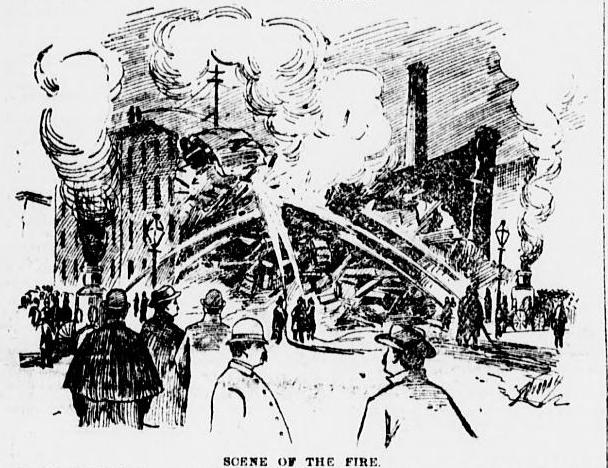
Those machines and fire fighters would see terrifying blazes over the years.  And the bravery of the men of Engine Company 13 would often entail their risking their lives.  On January 20, 1893 an enormous fire destroyed the Rowland Storey & Sons’ storage warehouse at Washington and King Streets.

The following day The Evening World reported “The smoke was fearfully dense, although the fire had not ascended above the first floor, and the men had learned that there was oil stored in the warehouse, but they pressed on undismayed.”

Assistant Foreman Van Horne recounted “We were just about to cut a hole in the roof when we heard a dull thud and felt a trembling something like an earthquake.  The boys knew what that means and scooted.  The next second the west wall began to bulge and everybody yelled.”

Injured in the building collapse were Captain Daniel Lawler and firefighter Michael Wall.

The Washington Street collapse was depicted in The Evening World the following day (copyright expired)

Lawler would be back in the hospital following another conflagration on November 5, 1895.  The fire destroyed two bank buildings at Bleecker Street and Broadway and damaged others.  The intense heat drove firefighters back and some were overcome by the smoke and heat.  Cable cars on Broadway were stopped. 

The New-York Tribune reported “The firemen inside the building had barely got to work when a stairway which was above them and had been weakened by the fire fell suddenly.  Several of the men were caught under the falling stairway and were hurt.”

Among those injured was Fireman George Coleman, of Engine Company No. 13; but 38-year old Lawler “required more attention than any of the other patients last night on account of the multiplicity of his wounds,” said the newspaper.

On the night of May 11, 1903 Lieutenant George J. Irving was looking out of a top floor window at the firehouse when suddenly a window on the fifth floor of the factory building next door, at No. 97, blew out.  Several other fire fighters were standing in front of the firehouse as thick smoke poured out of the building.

Upstairs, on the seventh floor, petticoat manufacturer Benjamin Lustgarten and two of his employees, Max Weissner and Benjamin Lerner, were still at work and were trapped.  Lieutenant Irving ran to the roof of the firehouse and dropped a rope to the firefighters on the sidewalk, who tied a scaling ladder to it.

Irving hoisted it up and, floor by floor, ran the ladder up to the men who were gasping for fresh air.   Soon other firefighters were on the roof with ladders and “Irving handed the men down to the firemen, who took them to the roof of the firehouse and to the street.”  Although Lustgarten was partially overcome by smoke inhalation, he was revived.

Fire fighters here discovered another blaze on the block just after midnight on April 10, 1920.  Fire had started on the second floor of the large factory building at Nos. 116-118 Wooster.   As a “rescue party” led by Lieutenant Kilbride started up the fire escape in the rear of the building, windows on the upper floors blew out from the intense heat.  Sharp shards of glass showered down on the men, all of whom were injured, most seriously Fireman John Millward whose left wrist was slashed.

He was attended to in the engine house by the Department physician who “stopped the flow of blood from severed veins by means of a tourniquet,” reported the New-York Tribune.  As the other injured firemen were treated, their fellow fire fighters continued to fight the blaze—requiring a second and then a third alarm.

When the last sparks were extinguished, the damages to the building were estimated at around $50,000—around $600,000 today.

Prohibition was the indirect cause of a nearby fire on December 6, 1921.  A private watchman saw flames coming from a grocery store in the ground floor of a tenement two blocks away at No. 101-103 Thompson Street at 4:30 a.m. and ran to the firehouse.

According to The Evening World the following day, when the men got there, they found “several members of the twenty-four families in the six-story building on the front fire escapes, insisting on going to the street by the ladder route”  The fire had not blocked any of the hallways or stairs, but the residents refused to leave by any means other than ladders.  So a separate unit, Truck No. 20, was summoned to run up ladders and those firemen assisted “to the street all who felt the necessity of being rescued.”

When fire fighters entered the cellar below the grocery store they found several liquor stills, and “three barrels of what appears to be hooch.”  The Evening World said “A policeman was left at the store to get an explanation from the owner who, according to the sign, is G. Del Guidice.”

The newspaper took the opportunity to express its frustration with the residents.  “There was no reason for anyone leaving, as a few gallons of water extinguished the fire before it had done much damage.”

One of the men at the fire that night was Lieutenant John J. Schoppmeyer, who had already had a brave and colorful past.  He was a veteran of both the Spanish-American and Boxer Wars, and had served as a member of the New York City Police Department for a year before becoming a firefighter.

Six months after the Thompson Street fire, he was with Engine Company No. 13 at a dangerous blaze at No. 10 Jane Street on July 17, 1922.  Inside the warehouse were not only shipments of German toys and “much rubber;” but large quantities of the chemicals used to make the flash powder used by photographers.

As firefighters battled the blaze, the chemicals ignited, causing an explosion that blew the roof off the building.   At least 30 persons—firefighters, police and spectators—were injured.  The body of John Schoppmeyer was found crushed under the debris.

Before the lieutenant’s casket was removed from his home on West 175th Street, 115 members of the Fire Department band filed past to pay their respects.  Schoppmeyer had helped organize the group a few years earlier.   As the coffin was taken into the Church of the Incarnation on St. Nicholas Avenue, more than 500 policemen and firefighters lined the way.   Lt. John J Schoppmeyer received full military and department honors.

The Victorian firehouse on Wooster Street could not accommodate modern motorized vehicles and was decommissioned.  In 1971 it was altered to accommodate the Gay Activist Alliance and a gay community center.  The group named the building “The Firehouse.”

Founded by dissident members of the Gay Liberation Front two years earlier, the Gay Activist Alliance sought to “secure basic human rights, dignity and freedom for all gay people.”  Its means to achieve that goal were highly controversial.  Using loud, disrupting demonstrations called “zaps,” it disrupted public events and political speeches.  Certain public dissatisfaction with the group culminated on October 15, 1974 when the Wooster Street headquarters was destroyed by an arsonist.


In 1988 the old firehouse was renovated to retail space throughout.  N. LeBrun & Son’s startling makeover of 1881 survives surprisingly intact—a relic of a time when horse-drawn steam engines clattered through the Soho streets.

photographs by the author

Thursday, August 27, 2015

Engine Company 56 (now 74) No. 120 West 83rd Street


In 1895 The New York Times ran a three-page article on the Upper West Side with the headline “West Side Is Itself a Great City.”  The newspaper recalled “It will be seen that by 1882, when building operations began on an extensive scale, the State and the city and the individual property owners, singly and collectively had secured for the West End everything that would make it the most healthful, the most beautiful in its location, and the most comfortable part of the city in which to reside.”

This rapid development following the Financial Panic of the 1870s resulted in the need for new police stations, schools, and fire stations.  The City scrambled to keep up, as did Napoleon Le Brun.  In 1879 Le Brun became the official architect of the New York City fire houses.  A year later his son Pierre joined him in the business, creating the firm N.  LeBrun & Son.  Their fire house work focused as much on design as function and each one of the resulting structures was a visual pleasure.

In 1888 the firm began work on the station house for Engine Company 56 at No. 120 West 83rd Street.  The five-story firehouse was completed the following year—a masculine mix of Romanesque Revival and Renaissance Revival elements.  Typical of firehouse design, the truck bay was flanked by a door and a window matching in proportion.  Le Brun decorated the bay with medieval motifs and surrounded it with hefty brownstone blocks.

Two stories of red brick were separated from the fourth by a stone bandcourse.  Stone piers—like engaged colunettes--ran up the sides and curved gently into the brickwork.  Their rounded form was echoed in the bull-nosed bricks that softened the corners of the openings.  The fourth floor vied for attention with its single arched opening, accentuated by a lushly-carved eyebrow and broken cornice.  The top story hid behind the ambitious gable as a slate-covered mansard.


Captain Michael J. McNamara was put in charge of organizing the new Engine Company.  Born in Ireland in 1849, his family brought him to America when he was still an infant.  He joined the Fire Department in 1873 and had been promoted to Captain on December 1, 1886, just three years before the station was completed.

He filled the open positions with two engineers, James Claire and William Massey; and seven firefighters: Michael Dinan, Charles Calahan, Robert Geddis, Richard Hyde, William Lumbolster, John Linck and John Douglass.  Engine Company 56 and the other new Upper West Side houses helped out with blazes throughout the city.  The Times noted “They do not ‘run’ to every fire.  But a second or third alarm finds one or the other responding to it.”

Such was the case on the Fourth of July 1898 when, as reported in The Times, “The energies of the Fire Department were taxed to the utmost yesterday in answering the frequent calls to fires in all parts of the city, due generally to the careless handling of firecrackers or other explosives.”  The Lenox Livery Stable on East 75th Street was in flames and when the third alarm was sounded, Engine Company 56 responded.

In the 19th and early 20th century, getting to the fire was often as dangerous as fighting it.  Engine 56 would not make it to the Lenox Livery Stable that night.  Its horse-drawn truck sped through Central Park to the East Side.  “At Madison Avenue the engine got between two underground trolley cars and was overturned.  The driver was heavily thrown but not seriously hurt.”  Captain McNamara was seriously injured, including a broken left leg and was taken to the Presbyterian Hospital.  “The engine was disabled,” reported the newspaper.

McNamara recovered and returned to the job.  In 1905 he received the New York Daily News medal as the city’s most popular fire captain—receiving a landslide 800,000 votes compared to the second place 300,000.  The newspaper said “every man, woman, and child on the upper west side knew him and were fond of him, especially the children.”

A year later, William J. Sullivan was assigned to Engine Company 56.  On May 8 that year he and another firefighter, John J. Sheridan of Engine Company 39, were off duty and walking together along Third Avenue.  In the four-story building at No. 1224 was the bakery of John Storck, whose family lived in the apartment above.  Just before the firemen arrived, a breeze pushed a curtain into a burning gas jet, setting it on fire.

The blaze swept rapidly through the apartment, noticed by Sullivan and Sheridan from the street below.  They rushed into the building, saving at least six residents.  John Storck was asleep and Sullivan had to break into the locked door.  “Picking the aged man up, they dragged him into the hallway just as the flames broke through into the bedroom, and carried him downstairs into the street,” reported The Times.

Just as a fire engine pulled up, Mrs. Pollock, who lived on the third floor, implored Sheridan to “Save my baby!”  Sheridan ran back into the fire and smoke engulfed building.  On the third floor he found a fox terrier, which he grabbed up, then crawled through the smoke until he felt the body of an infant in a chair, wrapped in a blanket.  Just as the flames broke through the flooring, he “beat a retreat” to the street, cradling the baby and the dog.

Once on the sidewalk he realized that “my baby” was the fox terrier.  The infant he had rescued was a baby doll.  “That’s one on me,” Sheridan said.

In 1907 the City commissioned architect Edward L. Middleton to make “improvements” to Engine Company 56.  His updating was confined to the interior, leaving Le Brun’s façade untouched.

After 22 years in command of Engine Company 56, Michael J. McNamara retired on February 1, 1911, the longest serving captain in the Fire Department.  A dinner in his honor was held at Healy’s restaurant, attended by the Fire Commissioner Rhinelander Waldo and other City officials.

At the time of McNamara’s retirement, an idea had surfaced to alleviate the boredom of firefighters sitting in their station houses with little to do other than wait for an alarm.  By 1912 a “traveling library” was instituted by the City that provided books to the station houses.  That year a report noted that Engine Company 56 had gone through 383 volumes.

The motorizing of fire trucks did not necessarily alleviate the danger of the crowded Manhattan streets in responding to fires.  The call to a blaze at 94th Street the Riverside Drive on the night of June 29, 1926 ended tragically.   Engine Company 56’s truck was speeding along West 83rd Street, its bells sounding, as Henry Nolan drove his motorcycle south on West End Avenue.

“Nolan did not hear the clanging gong of the fire apparatus in time to avoid the accident,” reported The Times the following morning, “although both he and the driver of the truck made valiant efforts to avoid a collision.”

Firefighters were riding on the sides of the truck.  As the motorcycle hit the fire truck, it became entangled in it and was dragged almost to Riverside Drive before the apparatus could be stopped.  The jolt when the truck hit the curb as its driver, Fireman Mathew Moran, tried to avoid the collision, sent the six firemen hanging onto its sides flying onto the pavement.

Fireman William L. Moran died in Roosevelt Hospital of a fractured skull.   Three others also suffered fractured skulls; Joseph Cunningham’s face was so badly damaged that he was removed to Reconstruction Hospital; and the others received serious lacerations and injuries.  The motorcycle driver received a fractured skull, as well.

With World War raging in Europe in 1940, the United States sought to beef up its military.  Frustrated Army recruiters found that a large percentage of New York City men were unfit for service.  On November 26 four Army induction centers examined 415 men.  They reported “nearly one-fourth of the selective service men from New York City and its environs examined yesterday for induction into the Army were found to be physically incapable of military service.”

Among those examined was 27-year old firefighter Arthur Papp of Engine Company 56.  He was fit; but Fire Commissioner John J. McElligott fought his induction.  McElligott filed a claim “for occupational deferment” saying Papp “was more useful to the community now as a fireman than as a soldier.”

Colonel Arthur V. McDermott, the director of the New York City selective service, was little moved.  He explained to the press “that nobody—not even men in services as essential as those of the fire and police—would obtain blanket deferments of service.”  Papp’s case was submitted to the local board for consideration.

Their decision did not take long.  On November 28, just two days later, it announced that Fire Commissioner McElligott’s request “has been rejected.”

By 1944 Engine Company 56 added another function when a Fire Department surgeon, Dr. Harry M. Archer, was brought on staff.  The Company now did ambulance runs as well.

The 83rd Street station became Engine Company 74 when that company moved from its old home at No. 207 West 77th Street.  The everyday valor of firefighters was tragically displayed when the Company lost six of its men--Matthew Barnes, John Collins, Kenneth Kumpel, Robert Minara, Joseph Rivelli Jr. and Paul Ruback--in the attack on the World Trade Center on September 11, 2001.


Le Brun & Sons’ charismatic firehouse survives on an architecturally eclectic block; a snippet from a time when the Upper West Side was considered by some as a “great city” in itself.

many thanks to Sean Khorsandi for suggesting this post
photographs by the author