Showing posts with label Columbus circle. Show all posts

Monday, April 24, 2023

The Lost Majestic Theatre - Columbus Circle at 59th Street


The gently curved structure conformed to the rounded shape of Columbus Circle.  from the collection of the New-York Historical Society

At the turn of the last century, the Upper West Side was fully developed.  Mass transit had been extended northward into the district now filled with lavish homes and apartment buildings.  Residents, who already enjoyed shops and social clubs in the relatively new neighborhood, saw entertainment venues beginning to arrive.  In 1902 developers E. D. Stair and A. L. Wilbur broke ground for a lavish new theater on the western side of Columbus Circle, between 58th and 59th Streets.

Designed by John H. Duncan, the crescent-shaped Beaux Arts style structure gently followed the curve of Columbus Circle.  Four stories tall, the ground floor held two restaurants, one for men and the other for ladies.  The main entrance was protected by a glass-and-iron marquee.  Above it a broken pediment was fronted by a carved lyre, a symbol of entertainment.  Directly above was a round window surmounted by a carved female portrait and palm fronds.  But stealing the show was the tower, carved with a dramatic figure of a winged male and topped by a domed roof and electric-lighted finial.

photo by Byron Company, from the collection of the Museum of the City of New York

Inside, patrons found themselves in a grand lobby with a double staircase, marble wainscoting, and white columns.  The auditorium, which could seat 1,584, was inspired by European opera houses, and featured two balconies and two sets of box seats.   On either side of the proscenium were trumpeting figures and gilded eagles.  The state-of-the-art 80-foot-wide stage was equipped with all the latest mechanics necessary for elaborate productions.  And it would be tested on opening night with the new play based on L. Frank Baum's book The Wizard of Oz. 

photo by Byron Company, from the collection of the Museum of the City of New York

On January 11, 1903, the New-York Tribune reported, "January 16 is the date set for the opening of the new Majestic Theatre, with a performance of 'The Wizard of Oz,' in which Montgomery and Stone, as the Scarecrow and the Tin Woodman, play leading parts."  And on Monday, January 19, 1903 Theatrical Notes hinted that this would be no run-of-the-mill production:

"The Wizard of Oz" will wave his magic wand before the gaze of New Yorkers for the first time on Tuesday night next, when he begins his reign at the Majestic Theatre, 59th street and Broadway, or what is known as the Grand Circle.  "The Wizard of Oz" is described as an entertainment compounded of the most attractive elements of smart up-to-date musical comedy, extravaganza and old-fashioned Christmas pantomime.

The lavish production featured a jaw-dropping on-stage tornado scene, an all female poppy field, and vaudevillian Fred Stone as the Scarecrow whose "boneless" performance made him more famous than he already was.  Audiences came back multiple times and the play prompted a flurry of sales of Baum's book, phonograph records, sheet music and piano rolls.  The Wizard of Oz played for nine months.

Dorothy meets Glinda after having crash-landed in Munchkinland.  from the collection of the New York Public Library

On October 14, 1903 The New York Times wrote, "The great success of 'The Wizard of Oz' at the Majestic has caused a good many persons to wonder how the management could follow it with an attraction that by contrast would not seem 'stale, flat, and unprofitable.'  Well, 'The Babes in Toyland' is not stale, it is not flat, and it certainly will prove highly profitable."  Once again the Majestic debuted a new extravaganza suitable for family fare.   The article said "'Babes in Toyland,' had its first production before an audience that for two hours and a half took everything that came its way and then greedily cried for more."  The critic from The Evening World pronounced, "Scenically and musically, though not humorously, 'Babes in Toyland' outshines 'The Wizard of Oz.'"

A much more somber event took place the following month.  On November 8, 1903 it was the scene of the memorial service for Emma Booth-Tucker, daughter of the founder of the Salvation Army, killed in a train crash on her way to Chicago.  The New York Times reported, "The theatre was crowded, and not a few wept as Capt. Norma Durand sang 'She Died at Her Post."

The success of Babes In Toyland fostered a close relationship between Victor Herbert and the Majestic Theatre.  Plays were outlawed on Sundays, but concerts were not.  Starting in 1904, Victor Herbert gave weekly concerts, continuing at least through 1905.  On December 5, 1904 The New York Times said, "The popularity of the Victor Herbert Sunday night concerts at the Majestic Theatre was demonstrated again last evening by an audience that filled the house, and that applauded each number on the programme."

In February 1906 the management staged what unnecessarily became a controversial production, Abyssinia.  The all-Black musical featured music by Will Marion Cook and Bert A. Williams.  The Freeman reported on March 17, "Shipp and Rogers' 'Abyssinia,' with music by Will Marion Cook, is scoring at the Majestic in Broadway and 59th street, and is indeed a worthy achievement of Negro ideals, playwrights and performers."  

Unfortunately, not all white critics were pleased with a play written and played by Blacks.  Charles Darnton, writing in The Evening World, compared Bert William's performance of the song "Nobody" as being "reminiscent of the howl of a pensive coyote across a lonely prairie (prairies are always lonely), an asthmatic calliope getting up steam for the circus parade, or Marie Dressler getting her second wind."  Another, Alan Dale, accused the actors of "trying to be too much like white people."

The Freeman's critic, Sylvester Russell, lashed back on May 19, 1906.  He wrote in part, "If color is the ground upon which white critics build their nests, it is up to the black critic to throw rotten eggs...Let this be the last time that otherwise critics of New York will overlook art for the mere mortification of color."

Robert Warwick and Virginia Harned were the lead actors in the 1907 production of Anna Karenina here.  For some reason or other, before the October 5 show the two "had a lively discussion," as worded by The New York Times, "over the presence of mind of men and women in moments of excitement."  Warwick believed that women "had no presence of mind" in emergencies, while Harned insisted they were more dependable than men.  As fate would have it, the debate would be solved on stage.

During the third act, Warwick, was on stage when a actor playing a servant entered and accidentally overturned an oil lamp.  The New York Times reported, "in an instant the entire top of the table was ablaze."  Warwick realized something was wrong by the murmurings of the audience.  The article said, "Glancing quickly around, he saw that the actor who impersonated the servant was doing his best to put out the fire, but without success."  The action on stage stopped and the audience was now focused on the fire.

Virginia Harned, as Anna Karenina, was not to appear on stage yet.  Nevertheless, she jumped into action and entered the scene.  She whispered to Warwick, "get the cushion from the chair!"   He did so, and in a moment smothered the fire.  The actress saved the scene and proved her point.

Frank McKee and William Harris leased the venue in 1911.  The New-York Tribune reported on August 25, "with the beginning of their lease of the Majestic Theatre at 59th street and Broadway it will be renamed the Park Theatre.  This is due to their desire to apply an historic name to a New York theatre."  Indeed, there had been a Park Theatre in New York City since 1798.

The Park Theatre opened with The Quaker Girl on October 23, 1911.  It ran for 240 performances.  Before long, however, The Park Theatre was staging vaudeville.  Eva Tanguay, known as the Queen of Vaudeville, opened here on March 24, 1913.  She headlined what the program called "cyclonic vaudeville."  The New York Times remarked, "there was no doubt that she won her audience completely."

The sometimes naughty Eva Tanguay.  from the collection of the New York Public Library

The Park Theatre began showing motion pictures in 1913, starting with a controversial film, The Inside of the White Slave Traffic.  Produced by the Social Research Film Corporation and endorsed by the Sociological Fund of the Medical Review of Reviews, it dealt with a serious problem at the time--abduction and forced prostitution.  Not all New Yorkers were convinced of its educational value.  The New York Times reported on December 20 that complaints had "flowed" into Police Headquarters.

On December 19 the theater was raided and closed down.  The Park's manager, Alfred P. Hamburg, was charged with showing a picture "of a character likely to impair the morals of young girls."  The action drew the wrath and indignity of women like Alva Belmont, Carrie Chapman Catt, and the associate editor of Harper's magazine.

photo by Byron Company, from the collection of the Museum of the City of New York

A month later, on January 18, 1914, The New York Times reported that Kinemacolor had taken over the lease of the Park Theatre.  The article said, "The Kinemacolor people aim to make the Park in the moving-picture world what the Princess theatre is to the legitimate--a theatre of thrills for the silent drama."  The venue opened with the four-reel film Sin, and silent shorts of "Ethel Barrymore and her children at home," a comedy, The Note in the Skirt, and "a trick picture which contains the very highest art known to the producers in this sort of work," said The New York Times.

The stint as a silent movie theater was short lived.  On July 19, 1914 The New York Times reported on the opening of the play The Garden of Paradise.  The article described the production as "a vast spectacular offering."  The following fall, the famous actress Mrs. Patrick Campbell appeared here in George Bernard Shaw's Pygmalion.

In 1917, the Park Theatre turned to opera and operettas, staging The Pirates of Penzance in November 1918, for instance.  The following year, on October 12, the New-York Tribune reported "Von Suppe's 'Boccacio' is the opera which will open the Society of American Singers' third season at the Park Theatre to-morrow evening."

Change came again in the fall of 1922.  On September 16 the New-York Tribune reported, "'Burlesques--Girls, Travesties, Laughs.'  Presented last night at the Park Music Hall by the Minsky Brothers...At the Park Music Hall the Minsky Brothers spell it 'burlesques.'  They declare that the final letter makes a difference."  The article said the brothers "have made a brave start to build a permanent institution in Columbus Circle."  The New York Times noted, "The theatre recently underwent complete renovation, and its interior was almost entirely rebuilt...at an expense of $62,000."

But the Minsky's Park Music Hall did not survive.  On August 2, 1923 The New York Times reported that William Randolph Hearst had purchased, remodeled and redecorated the venue, renaming it the Cosmopolitan Theatre (most likely after his popular magazine of the same name).  Now a motion picture theater, perhaps not coincidentally it opened with the film Little Old New York starring Marion Davies, Hearst's mistress.  More coincidentally, however, it was accompanied by Victor Herbert and his orchestra.

In 1925 Hearst turned the operation over to Florenz Ziegfeld who hired architect Joseph Urban to update the interiors.  On January 11 The New York Times reported, "Mr. Ziegfeld will convert the former Park Theatre to the drama again...The late Park, which is now Mr. Hearst's Cosmopolitan, will be opened in four weeks or so with 'The Comic Supplement' as its attraction."  The deal was always intended to be temporary, however.  The article noted that Hearst was in the process of erecting the Ziegfeld Theatre for the impresario on Sixth Avenue.

The Ziegfeld Theatre opened in February 1927.  The Cosmopolitan continued, without the famous Ziegfeld, to stage plays and operettas.  In May that year Gilbert and Sullivan's Ruddigore opened.  In February 1928 Robert Warwick was back to star in William Gillette's Sherlock Holmes; and in December 1929 the melodrama Damn Your Honor opened.  That would be the last production for some time to come.  The Cosmopolitan closed its doors and did not reopen until 1931, once again a motion picture and vaudeville venue.

After undergoing several more incarnations--the legitimate Theatre of Young America in 1934, the Park Theatre again in 1935, the International Theatre in 1944, and the Columbus Square Theatre in 1945--the the building sat vacant until early 1949 when it was acquired by the National Broadcasting Company as a television studio.  It opened with the premier of the Your Show of Shows starring Sid Caesar and Imogene Coca.

The end of the line for the building came with Robert Moses's "Slum Clearance" of Columbus Circle.  In 1954 he assembled the Slum Clearance Committee, of which he was chairman.  The New York Times noted on July 5, 1954, "Columbus Circle is not, of course, the only project" in his slum removal vision.  Also included were "Morningside-Manhattanville, West Park, Harlem, North Harlem, Corlears Hook, Fort Greene and Pratt Institute."  But it was Columbus Circle--and the Majestic Theatre--that was first in his crosshairs.

The Majestic Theatre in the course of demolition (lower left).  The New York Times June 22, 1954

The New York Times, June 15, 1954

In his 2015 book Blue-Collar Broadway - The Craft and Industry of American Theater, Timothy R. White notes, "As in many other Moses projects, wrecking crews got to work before local leaders understood what was happening."  The "stately playhouse," as described by White, was razed to make way for the New York Coliseum, designed by Leon and Lionel Levy.

from the collection of the Library of Congress.

That structure was replaced in 2003 by the current Time Warner Center.

no permission to reuse the content of this blog has been granted to LaptrinhX.com 

Tuesday, September 15, 2015

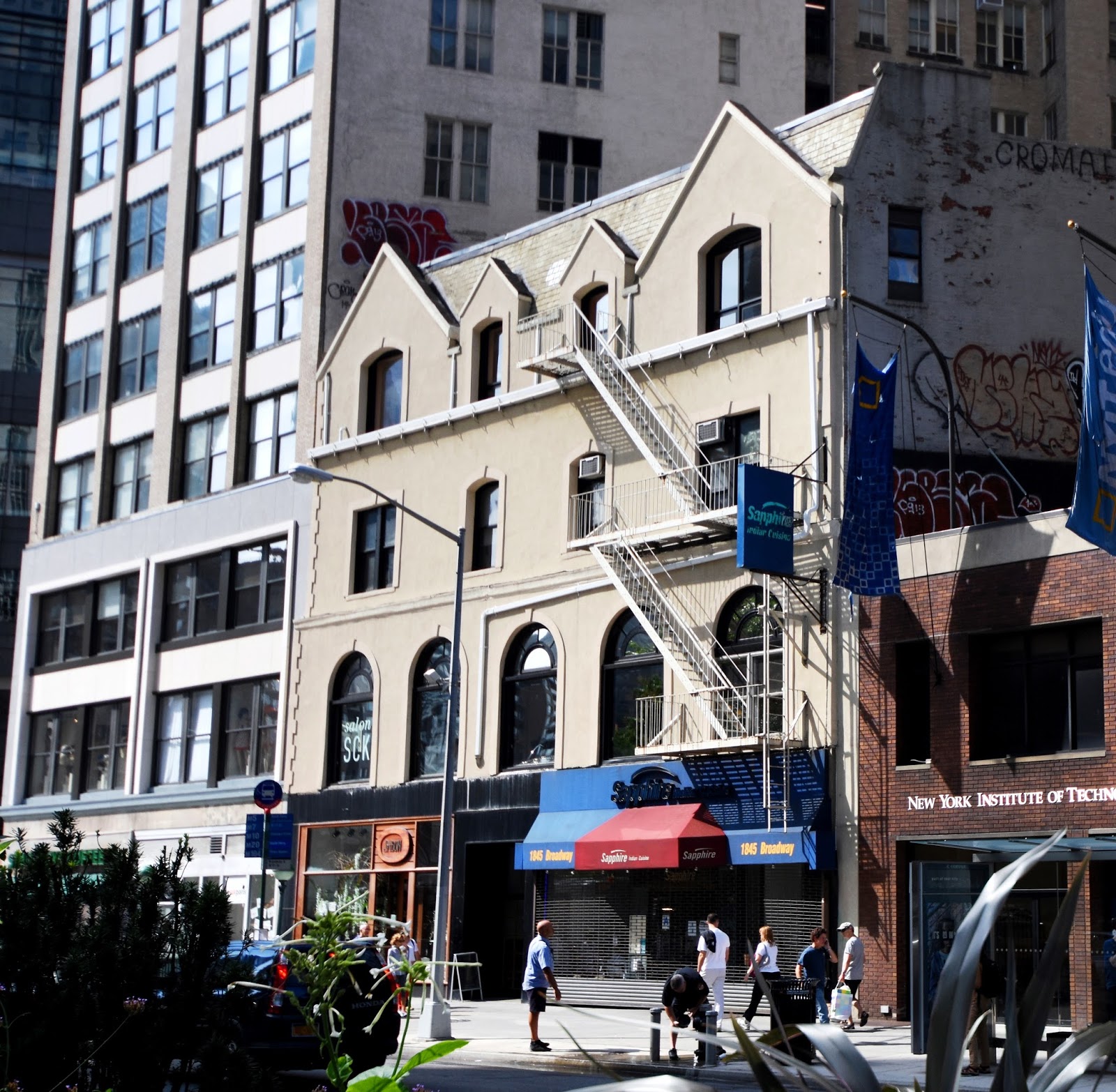
Hardenberg's Nos. 1845-1847 Broadway


On September 1, 1883 The Real Estate Record and Builders’ Guide reported on two planned four story rowhouses at Nos. 26 and 28 Fifth Avenue.  The upscale homes would be constructed by Dr. J. H. Gautier following the designs of architect Henry J. Hardenbergh.

The townhouses were not the first, and certainly not the last, time the two men worked together.  Five months earlier, construction had begun on an intimate apartment building on The Boulevard, the extension of Broadway north of 59th Street.

The four-story brick structure, at Nos. 17 and 19, sat just steps away from the entrance to Central Park.  Hardenberg produced a charming Queen Anne building that pretended to be mirror-image private homes.  Sharp gables provided a serrated roofline before a slate-shingled mansard.  Arched openings and balconies contributed to the pleasing design.

Among the first tenants was wealthy broker James M. Selover.   His brother, Major Selover, was described by The Sun as “at one time a power in Wall street, and still one of its interesting characters.”  On March 24, 1887 the Major became suddenly ill in the office of DeMott & Durant.  The Sun reported that “The Major was taken to the home of his brother.”

Also living in the apartment house at the time was P. S. Mayer, who sold butcher fixtures.
Two years later James M. Selover was in Chicago on business.  He died there at the Leland Hotel on October 18, 1889.  

When the Gaultier estate sold the building to the Upright Realty Co. in March 1906, The Boulevard had been renamed and the address was now Nos. 1845 and 1847 Broadway.  At the time of the sale it was still being operated as an apartment house.  Among the tenants was Margaret Windt, a dealer in soda fixtures, and real estate operator Charles F. Deshler.

But by 1909 the Upright Realty Co. had remodeled the building for commercial purposes.  In December that year it leased the property “to a client for occupancy,” according to the Record & Guide, for 21 years at a total rent of $500,000.

By now the stretch of Broadway from Times Square to approximately 72nd Street was known as “Automobile Row.”  Former carriage builders were now concentrating on the manufacture and sale of motor vehicles; and they aggregated along Broadway.   Nos. 1845-1847 Broadway became home to the Colt-Stratton Company, the east coast distributor of Dodge motorcars; and to the New York Automobile Dealers’ Association.  Part of the ground floor was leased to Louis Martin, the restaurateur best known for his Café de l’Opera on Broadway at 41st Street, and his partners the Bustanoby brothers (who operated the Café des Beaux Arts on West 40th Street), and George W. Rector.

In March 1920 Russell L. Engs, the owner of Cole motor cars, purchased the building for $400,000.  Six months later, the restaurant gave up sharing space with an auto showroom.  Although the New-York Tribune noted the building “is famous as a restaurant,” the cafe moved into the space next door at No. 1849 in November that year. 


The Sun, February 5, 1919 (copyright expired)
The Automobile Dealers’ Association had established its annual Orphan’s Automobile Day in 1904.  The 1919 event treated approximately 5,000 children to a day at The Bronx Exposition and Amusement Park.  The New-York Tribune noted “Each year some man prominent in the automobile industry acts as ‘daddy’ of the day for youngster and pays for the feeding of them.  This year, W. C. Durant, of the General Motors Corporation, will have that honor.”

The newspaper played on the guilt of vehicle owners when it reported “Although there have been many donations of cars and trucks, there is still a great shortage, but it is believed that owners of cars and trucks will rally to the call to provide transportation.”  It added “Otherwise many of them will have to stay at home.”

In the 1920s the building, seen partially at left, retained its balconies and French doors.  Another automobile concern operates next door.  from the collection of the New York Public Library.
On October 9, 1920 members of the Automobile Dealers’ Association met for a luncheon here.  The industry was plagued with price reductions and there were fears that factories would grind to a halt.  Ned Jordan gave the members a pep talk of sorts.

“If you have faith in this country, how can there be any stoppage of production at this time?  It is impossible for a business of such great proportions to b affected by a temporary lull.”  Jordan pointed out that in 1910 there were 181,000 passenger cars in the country.  In the first six months of 1920 there were more than a million, and he predicted that number would double by January 1.

The relatively small building may have proved inadequate as an automobile showroom as the industry grew.  In 1925 architects Chas. N. Jhinston & Bros. were commissioned to renovate it to, rather ironically, a restaurant and stores on the lower level and offices above.

In 1941 the United States Army and Navy Union were upstairs while the ground floor was operated as a funeral home by Feeney Sons Chapels.   The following year the School of Creative Movement moved in.  The dance school created the Garrison Auditorium here where dance recitals were held.  In February 1942 the school presented a “studio demonstration of recreational work, percussion exercise, advanced body mechanics, elementary and advanced composition.”  The school would remain in the building for at least a decade.

As the middle of the century arrived, space was taken by a variety of tenants like the Employees Union Local 115 of the C.I.O. which took a full floor in October 1953, and Alien Communications, Inc., distributors of audio systems.

While half of the ground floor continued to house a restaurant, the other was home to Francis Fischer’s jewelry store.  In April 1950 a man walked in and looked over the selection of watches.  Seemingly tepidly interested, he promised Fischer that he would come back later to decide on his purchase.

A week later the same man returned at around 9:30 in the morning.  But his approach had changed.  He pulled a pistol from his pocket and ordered Fischer to open the safe.   The terrified jeweler said “There’s no money there—it’s in my pocket,” and handed over $75.

The thief insisted that he open the safe.   But Fischer was either too nervous or was reluctant to open it.  He insisted “I can’t open it.”  The frustrated robber struck him over the head with his gun and snatched a watch from the counter.  He ordered Fischer on the floor and ran out, escaping in a waiting car.  The jeweler was treated for cuts and bruises at Roosevelt Hospital.

By 1965 Fischer’s jewelry store was run by Felix Klein as Coliseum Jewelers Company.  Among the tenants upstairs was Camera Mart, Inc., specialists in movie, television and photography equipment.  On July 9 that year the 54-year old Klein suffered a similar episode to that of Francis Fischer 15 years earlier.

As Klein opened his shop at 8:30 that morning, two men pounced, striking him over the head with an ash tray stand.  The men escaped with $2,000 worth of jewelry.  Like Fischer, he was treated at Roosevelt Hospital for head wounds.

Two months later, when plans to construct the 45-story office building across Broadway on Columbus Circle were disclosed, Felix Klein was eager to announce his support.  He told a reporter “Soon more people will be working here.  This will be a busier street and there will be less chance of crime.  Can you imagine what it will mean to have thousands of people working across the street?”

The dance studio in the upper floors became an Arthur Murray’s Dance Studio in the 1970s.  Posters in the mirror-lined room here promised students in 1971 “We Teach You to Be Somebody.”

In the meantime the restaurant space at street level had become home to Martin’s Bar and Restaurant.  It was the scene of a shocking murder on December 29, 1980.  Although 63-year old house painter Charles Passiglia lived in Glendale, Queens, he was a regular at Martin’s.  There were approximately 20 other patrons there that night as he sat on a stool at the bar at around 9:10.

A man entered with a shotgun concealed in a plastic bag.  He walked up to Passiglia and fired one shot into his head.  As Passiglia slumped, then fell to the floor, the other patrons ducked for cover.  According to police “The whole thing took about four seconds.”

Two customers ran out onto Broadway after the gunman and saw him jump into a waiting Cadillac which drove south on Ninth Avenue.  Police told reporters “Nobody could understand it.  They all said he was a nice, quiet, guy.”

The dance studio went through a series of incarnations including the Darvash Ballet Studio, the Stepping Out Studio that offered classes in “Ballroom Olympics,” and Paul Pellicoro’s Dancesport, offering ballroom and Latin classes.


In 1999 the restaurant space became Sapphire, an Indian restaurant still operating in 2015.   Although Hardenberg’s quaint brick apartment building is heavily altered, its survival on this stretch of Broadway, lined with towering office buildings, is just short of miraculous.

 photographs by the author

Wednesday, February 12, 2014

The 1913 Maine Monument -- Central Park

photo by Alice Lum

American public opinion against Spain in regard to its rule over Cuba was already heated in February 1898, mostly because of the agitation and yellow journalism of publishers like Joseph Pulitzer and William Hearst.  When Cuban riots protesting the new government broke out in Havana, President William McKinley ordered the USS Maine to protect American citizens and interests.
At 9:40 p.m. on February 15 a colossal explosion blew apart the Maine, killing 266 sailors.  Although there was no clear evidence that the catastrophe was anything but an accident and McKinley urged calm, journalists like Hearst were less forgiving.  Both he and Pulitzer printed sensational accounts of “atrocities” committed by the Spanish.  On April 11, a reluctant William McKinley declared war on Spain.

Remnants of the destroyed USS Maine in Havana Harbor -- photo Library of Congress

Just four days after the tragedy, William Randolph Hearst began a patriotic drive to erect a monument to the lost sailors.   His New York Morning Journal began a fund drive and immediately the public responded.  Benefits were staged and collections were initiated in schools, theaters, social clubs and political groups.
On February 28 the Executive Committee of Theatrical Managers held a meeting in the Knickerbocker Theatre “to consider some plan for giving benefit performances throughout the country to secure money for a monument to be erected in memory of the officers and men who lost their lives on the battleship Maine,” reported The New York Times. 
Manhattan’s socially elite rubbed shoulders with theater folk in the Metropolitan Opera House on Sunday evening, March 20, for a similar entertainment.  The performers ranged from stage actress Marie Dressler to comic vaudevillians Weber and Fields, from Shakespearean great Madame Helena Modjeska to entire opera companies including the Broadway Theatre Opera  Company, the Whitney Opera Company and the Castle Square Opera Company.
As an addition lure to the blockbuster event, the promoters titillated the public with a teaser.  “The theatrical managers who have the affair in charge promise a startling surprise, which, however, they refuse to divulge before the entertainment,” reported The New York Times.
To ensure the greatest receipts, tickets were not priced; but sold at auction.  On March 14 the Opera House was filled as the patriotic fervor of the cause took hold.  As patrons filed in for the auction they were “kept in good humor by the stirring strains from Innes’s Regimental Bank.”  Even those who would be performing joined in the bidding.  The first box sold was to Weber and Fields who paid a hefty $250.  By the time the last seat was auctioned, $5,000 had been raised for the monument fund—about $136,000 in today’s dollars.
Fund raising and other logistics would drag on for years.  In the meantime the two men commissioned to create the monument were hard at work.  Architect Harold Van Buren Magonigle had won the commission of designing the enormous memorial over 45 other submissions.  He would work hand-in-hand with sculptor Attilio Piccirilli who would execute the many sculptural elements.  Piccirilli, along with his five brothers, would later be responsible for the beloved New York Public Library lions.  In 1913 Magonigle and Piccirilli would work together again on the Riverside Park Firemen’s Monument.
Four years after fund-raising was begun, the Real Estate Record and Builders’ Guide succinctly reported on June 14, 1902 that the suggestion to place the Maine Monument in Longacre Square was approved by the Municipal Art Commission.  The site, later to be renamed Times Square, was perfect.  The New-York Tribune explained, “The site then approved was at the junction of Broadway and Seventh avenue, at 45th Street, and was an irregular triangle in form.”  It was almost custom-made for the monument that would take on the basic shape of a ship.

The original design did not get approval from the Municipal Art Commission -- American Architect & Building News, July 28, 1900 (copyright expired)
But as the designs were worked and reworked, someone forgot about the monument.  “Through some oversight, however,” the New-York Tribune reported on July 8, 1910, “this space later was given for a public comfort station.”  The perfect site for the lofty Maine Memorial had been taken over by a toilet.
In 1908 application was made to situate the planned memorial at the Merchants’ Gate to Central Park.  By now more than $100,000 had been raised through public donations.  The Municipal Art Commission was quick to strike down the idea.  “The Columbus monument is now the central feature of the circle and should so remain.  It is impossible to place the Maine Monument, which is over sixty feet in height, in such close proximity to the Columbus column without dwarfing the latter and greatly detracting from the effect of both,” announced president Robert W. de Forest.  The commission was also concerned about pedestrian maneuverability.
Finally, on July 7, 1910, both the design for the Maine Monument and its location were approved by the Municipal Art Commission.  Highly esteemed Commission members Charles F. McKim, Daniel C. French and Frederick Dielman had made “minor changes” to the designs and it was now deemed acceptable.  Unexpectedly, the Commission changed its mind on the Central Park entrance site.  The New-York Tribune reminded readers the site in 1908 “was disapproved on the ground that, as then proposed, the monument would interfere with the circulation of pedestrians.  But it is now possible to take the monument further back in the park and thus entirely overcome this objection.”
“The sculpture will be executed in Knoxville marble,” said the newspaper, “with the exception of the crowning group, which will be of bronze.”
Another two years passed as Magonigle and Piccirilli toiled on the monument.  On February 15, 1912—14 years after the explosion in Havana harbor—the cornerstone was laid.  The New York Times noted, “It will cost about $175,000, most of which was collected by popular subscription from more than a million men, women, and children.”
On November 30, 1912 the Real Estate Record and Builders’ Guide noted, “The marble sculptures for the Maine monument will be on view in the Picirilli studios, at 467 East 142d street, from noon to 6 p.m., on Saturday, Nov. 30, and Sunday, Dec. 1.”  The long process of erecting a monument to the lost sailors was finally coming to an end.

A canopied reviewing stand is in place and gigantic American flags are positioned over the monument in preparation for the unveiling on Memorial Day 1913 -- photograph Library of Congress

Six months later, the groundwork was well underway for the unveiling.   In May preparations were made for the arrival of the entire Atlantic fleet—21 battleships.  The participation of another ship, the cruiser Cuba, required deep consideration by legislatures.  The fact that it was not an American vessel was less touchy than its biracial crew.
On May 15, 1913 The New York Times reported, “The House today voted $5,000 for Cuba’s participation in the Maine Monument exercises in New York.  An amendment which was passed by a vote of 33 to 29 provides that the company of soldiers to be sent shall include both whites and blacks.”
As the unveiling neared, a police guard was placed at the monument.  The Sun explained, “The policeman on duty yesterday said he had been instructed to look out for mischievous boys who might deface the monument.”
Fittingly, on the afternoon of Memorial Day 1913, the monument was unveiled in what The Editor and Publisher and Journalist called a “brilliant spectacle.”  The newspaper said “citizens by unnumbered thousands, some the most distinguished in the country, stood with bared heads while 15,000 soldiers and sailors stood at present arms.”

Thousands of sailors and soldiers stand by while little George Hearst, in a white sailor suit, prepares to unveil the monument -- photo Library of Congress
After James Grant Wilson, president of the monument committee, had finished speaking, William Randolph Hearst’s young son, George, dressed in a sailor suit, tugged on the lanyard.  The flags veiling the monument slowly pulled apart and simultaneously the Brooklyn Navy Yard band struck up the National Anthem.  At the same time 252 saluting guns from the Navy boats in the harbor went fired.
photo by Alice Lum

Former President William Howard Taft was the principal speaker and for the first time he openly voiced his opinion that “the Maine had been blown up from the outside by a hostile hand.”  The Sun said, “Mr. Taft spoke of Cuba as our foster child and as she errs in the childhood of her history we must bear with her.”
The monument was both impressive and complex.  A 40-foot-high pylon (reduced from the originally planned 60-feet) was inscribed with the names of the men lost on the USS Maine.  “It is flanked by two colossi,” reported Editor and Publisher, “representing the Atlantic and the Pacific oceans…the Atlantic typified by a young man in the fullness of his strength, the Pacific by an old man half slumbering.”  The allegorical sculptures were over 14 feet tall.
The Pacific Ocean was depicted as a sleeping, elderly man -- photo by Alice Lum

At the foot of the pylon was a sculptural grouping entitled The Antebellum State of Mind: Courage Awaiting the Flight of Peace, and Fortitude Supporting the Feeble.  The figures were about double life-size.  Above the grouping was the inscription “To the Valiant Seamen who Perished in the Maine—By Fate Unwarned, in Death Unafraid.”
The foremost grouping was entitled The Antebellum State of Mind:  Courage Awaiting.  A sculptured ship’s prow supported the figure of a young boy “holding wreaths of olive and laurel, suggesting the new era inaugurated in Cuba through the Spanish war,” explained Editor and Publisher.  In the rear was another grouping, The Post-Bellum Idea: Justice Receiving Back the Sword Entrusted to War.

The marble ship originally floated in the pool of a fountain fed by two dolphins -- photo Library of Congress
Atop the pylon a gilded bronze figure of Columbia Triumphant in her seashell chariot was pulled by three enormous sea horses.  The bronze used in the casting of the sculpture was taken from the recovered canon of the USS Maine.  It is generally accepted that New York sculptors’ favorite model of the period, Audrey Munson, posed for the figure of Columbia.

Three gilded bronze seahorses pull the seashell chariot of Columbia -- photo by Alice Lum

Despite its impressive monumentality, not all critics were pleased with the design.  On July 15, 1916 the Real Estate Record and Builders’ Guide complained, “The Maine monument is as regards composition not entirely successful.  The extreme animation of the silhouette conveys nothing of that sense of repose which a monument should symbolize and the naval emblems (sea horses) and figures are too excitedly grouped.”
The critic was pointed in his assessment.  “There is a lack of dignity in this monument that gives the impression that it is essentially a paper design.  On the drawing board beautifully drawn and exquisitely rendered it could not fail to charm; but the designer did not achieve his purpose, having failed to give sufficient character to the executed mass.”

Art critic Helen Henderson, in her A Loiterer in New York, fired back.  "Civic indifference towards sculpture reached a sort of climax with the unveiling of the Maine Monument and the more than usually stupid snap-shot criticisms of the press roused a storm of protest from the sculptors of the country, demanding intelligent criticism as the first step towards advancement in every phase of public betterment."  Saying that "The Maine Monument suffered more than most from a perverse misconception of its intention, from certain railing criticisms and heedless witticisms," she noted that "sculptors have rallied to the defense of Piccirilli, and claimed for him the consideration deserved for his 'high-minded consecration, and skill in the handling of marble, heretofore unknown in this country.'"
Despite the contention, the patriotic fervor that was responsible for the monument clung on.  The same year that the Record & Guide panned the design, the U.S. Army took advantage of the symbolism by erecting a recruiting tent next to the monument.  The Evening World remarked on April 6, 1916, “You boys that mother didn’t raise to be soldiers had better keep away from Columbus Circle for the next eight weeks of your Uncle Sam will get you if you don’t watch out.”

Similarly, politicians and activists over the next few decades used the monument as a backdrop for speeches and rallies.  A disgusted Nellie Candall Sanford fired off a letter to the editor of the New York Times in April 1922 protesting as the Maine Monument being used as “a rostrum and billboard combined.”  In particular she complained of one orator.  “That the speaker’s remarks were mischievous, unpatriotic and thoroughly un-American is perhaps beside the question, but I submit that the Main Monument is a tribute to our honored dead and not a platform and billboard for any propaganda whatever.”
Only six years after its unveiling the monument showed signs of neglect and disrepair.  The Evening World published an editorial deriding the Park Commissioners for allowing the inscriptions to become nearly illegible due to weathering.  An embarrassed Park Commissioner Philip Berolzheimer responded, “I am glad The Evening World called attention to the condition of the monument.  It is a fine thing to have people take a real interest in the show things of the city, particularly when they have been erected as memorials for worthy deeds.  I will take steps at once to see that the carving on the monument is again brought out plainly and any other necessary repairs made.”
For years an annual memorial ceremony was held at the monument.  Wreaths were laid, speeches given, and veneration given to the lost sailors of the USS Maine.  But, as The Lookout magazine said in 1913, the same year the monument was unveiled, “in a busy, careless city the average person so soon forgets.”
photo by Alice Lum

Today thousands pass by the marble monument every day.  Few pause to read its inscriptions and even fewer remember the human disaster that launched a war.