Wednesday, November 24, 2021

The 2nd Cemetery of Congregation Shearith Israel - 72-76 West 11th Street


In 1654, fleeing intense religious prosecution in their homelands, 23 Spanish and Portuguese Jews arrived in New Amsterdam.  It must have seemed that they had gone from one intolerable situation to another.  The colony's Director-General, Peter Stuyvesant, was openly anti-Semitic and the year the group arrived he wrote to the Dutch West India Company asking that "the deceitful race, — such hateful enemies and blasphemers of the name of Christ, — be not allowed to further infect and trouble this new colony."  Stuyvesant was no doubt crestfallen when the Dutch West India Company allowed them to stay.

The 23 settlers would form the seed of Congregation Shearith Israel.   In 1656 they requested permission to establish their own burying ground, rather than share New Amsterdam's common graveyard.  The location of the "little hook of land" granted to the Jews outside of the high wooden wall is unknown today.

In 1683, land was purchased for a new cemetery at what is today named St. James Place.  It is known as the First Cemetery of the Spanish-Portuguese Synagogue, or the Chatham Square Cemetery.

By 1804 that cemetery, too, was filled.  A plot of land on Greenwich Lane (later Greenwich Avenue) was purchased from John Agnew on May 1.  More than a century later, The Sun recalled that the "large burying ground stretched along the upper bank of Minetta Brook."  The cemetery, known as the Second Cemetery of Congregation Shearith Israel, opened in 1805, the first congregant interred being Wolfe Polack.


Ten years earlier, a yellow fever epidemic had broken out in Philadelphia.  The disease spread swiftly and eventually 5,000 people, one-tenth of the population, would succumb.   In July 1795, the first yellow fever death in New York City came.  Within a single week in August twenty-one victims died.  Around the time of the cemetery's opening, panic was such that those who could afford to leave the city did so, moving to the fresh air of remote hamlets like Greenwich Village.  The Jewish population was not immune to pernicious disease.  The New York Times later reported, "Many interments were made here during 1822, when the number of deaths in the City from yellow fever was very large."

The famous Commissioners Plan of 1811 laid out the streets and avenues, and placed West 11th Street through the Spanish-Portuguese Cemetery.  The thoroughfare that had existed only on paper suddenly became real in 1830.  On April 16, the Commissioners of Estimate and Assessment published their appraisal of "the loss and damage sustained by the owners" of the land and properties required for the opening of West 11th Street from Broadway to Greenwich Lane.  The Evening Post reported that the opening "took portions of two cemeteries--one belonging to the Jews, and the other to the Presbyterian Church."

Knowing that the cemetery was soon to be decimated, on June 2, 1829 Congregation Shearith Israel acquired land from Horatio Wilkes on West 21st Street between Sixth and Seventh Avenues for a new burying ground.  That cemetery was opened on August 17, 1829 and the first interment, that of Mrs. Judith Lopez, took place on November 6 that year.  The last burial in the 11th Street cemetery was that of Israel Phillips, on January 6, 1833.

In the months and weeks before construction of West 11th Street began, many of the bodies in the 1805 cemetery were reinterred in the 21st Street grounds.  But, according to The New York Times, others were simply crowded into the remaining little triangular plot.  On May 18, 1879 the newspaper recalled, "A great many bodies that were dug up at the opening of the street were reburied in the south-west corner, which is now all that remains of the old burial-ground, and of which every foot is supposed to be occupied by humans remains."


By the time of that article, the forgotten little cemetery was showing the first signs of neglect.  In 1875 The Jewish Messenger noted, "The ground is covered with a sparse growth of grass, and there are a couple of trees.  It is in fairly good condition, but by no means presents as nice and clean an appearance as the Oliver Street [Chatham Square] and Twenty-first Street burying grounds."  Interestingly, it was an Irish immigrant rather than the congregation itself, who rescued the neglected parcel.  In 1882 the New York Chronicle explained:

All that remains of the second cemetery...is a parcel of ground in the shape of an obtuse triangle, on the south side of Eleventh street, near Sixth avenue.  It contains about fifty square feet.  In the centre is a pyramidal monument bearing the names of Joshua and Jacob Canter, and the date 1822.  It is surrounded by a number of tombstones.  The cause of the curious shape of this cemetery is that when Eleventh street was opened all but the southeast corner of the property was cut away.  Since then it has been allowed to run to waste, until recently Mr. Callanan, the owner of adjoining property, built a fence around it and fixed up the grounds.

The Joshua Canter mentioned in the article, was a well known portrait and landscape painter and art teacher.  He, like Jacob Canter, were most likely victims of the 1822 yellow fever epidemic.  

Once sitting in a field, in 1925 the little cemetery was hemmed in by apartment buildings.  photographer unknown, from the collection of the Museum of the City of New York

Another grave belongs to German-born Ephraim Hart (originally Hirz, he changed his surname when he arrived in Philadelphia around 1780).  Having fought in the Revolution, he became an elector of Congregation Shearith Israel on April 2, 1787.  One of New York City's most successful merchants, he helped organize the Board of Stock-Brokers, today's New York Stock Exchange.  His gravestone reads:  "Ephraim Hart / Pennsylvania / Pvt Capt. Henry Graham's Co. / Rev War / July 16, 1824."

Broken and eroded headstones are in desperate need of preservation.

As Mr. Callanan had done, the Congregation Shearith Israel has refocused interest in restoring the more than two-century-old cemetery.  Its West 11th Street Project Committee, formed in 2013, hired architect-conservator firm Rachel Frankel Architecture, as part of the ongoing restoration/preservation effort.


photographs by the author
LaptrinhX.com has no authorization to reuse the content of this blog

Tuesday, November 23, 2021

The 1887 Graystone Apartment - 100 West 74th Street


Among the few professions in which women could prevail in 19th century New York was real estate.  One of them was Margaret Brennan who bought and sold properties throughout the city for decades beginning in the early 1870's.  In 1886 she hired the well-known architectural firm of Thom & Wilson to design a five-story flat building with stores at the southwest corner of Ninth Avenue (later Columbus Avenue) and West 74th Street.

Construction was completed the following year.  The architects had given the building an architectural split personality.  The Columbus Avenue side, lined with stores at ground level, was faced in red brick and trimmed in stone.  Its neo-Grec design included recessed panels in the chimney backs and a prominent parapet above the cornice.  The residential side was Renaissance Revival in style, faced in rough-cut stone and touting carved lintels and decorative panels, and an impressive entrance above a short stoop with beveled glass double-doors beneath an arched overlight with the building's name painted in gold lettering: The Graystone.


The stores filled with a variety of tenants.  One was another female professional, M. M. Gill, who opened a second office of her New York branch of the London and Lancashire Fire Insurance Co. here.  On May 20, 1898 The Record & Guide wrote "From time to time we have noted the successes scored by women who have become workers in the real estate world, and now we take pleasure in calling attention to the successful work done by a woman who makes a special of fire insurance.  Eight years ago Miss M. M. Gill established the business...A year ago Miss Gill opened a second office at No. 294 Columbus avenue, corner of 74th street, which owing to its central location and business-like management, promises to be as successful as the 3d avenue office."

Another commercial tenant was Carter & Robertson, a pharmacy in No. 288.  It had apparent good success with a particular patent medicine.  One of the proprietors said in a testimonial in The Evening World in 1894, "The sale of Paine's celery compound is improving wonderfully.  I have heard customers say that they found it an excellent remedy, women particularly, who are sufferers from nervous difficulties."  

Philip Schwartz operated his shoe store in another space at the time.  He personally made the shoes that were sold in his shop.

The residents of The Graystone were financially comfortable.  Among the first to move in were the widowed Mrs. MacArthur, her four-year-old son, and her mother, Olive M. Winston.  The women had one servant.  Rent on their apartment of six rooms and a bath in 1897 was $40--or about $1,270 per month today.  

The population of the MacArthur apartment was increased by one in January 1898.  Olive Winston's son, Walter, was required to be away from his wife for months at a time.  She found a "paramour," as described by the courts, and bore him a child.  (A physician determined paternity based on the time of conception, when Walter was absent.)  During the divorce proceedings, Olive came forward and petitioned for custody of the little girl, despite the fact that she was almost assuredly not related to the child.  That a respectable Victorian grandmother would seek to care for a bastard child was startling.    The judge ruled in her favor.

In 1899 a 27-year-old dentist from Ohio moved in and established his office here.  A bachelor, Zane Grey had graduated from the University of Pennsylvania School of Dentistry in 1896 and filled his spare time in the summer months playing semi-professional baseball for the Orange Athletic Club.   Sitting at the kitchen table in his apartment here he tested his skills at his true passion--writing.

Zane Grey as he appeared in 1895. (original source unknown)

Zane Grey slipped easily into New York and Brooklyn social circles.  When Jane Kenyon Salisbury and Harold Winchester Chapman were married on December 18, 1900 The Brooklyn Daily Eagle called it "among the weddings of the year" and "most notable."   The eight ushers came from as far away as Boston and Chicago and included "Dr. Zane Grey of the borough of Manhattan."

Earlier that year Grey had been canoeing on the Delaware River where he often fished with his brother, R. C.  During that trip he met 17-year-old Lina Roth, known to her friends as Dolly.  The dentist-writer fell head over heels.

On January 29, 1902 he sent Dolly a bill on his office stationery which bore the heading "Zane Grey, D.D.S.  100 West Seventy-Fourth Street, New York City."  He charged her $86 million dollars for:

18 months torture, unrest, dissatisfaction, trouble, hard work
for loss of many nights sleep
for loss of peace of mind
for loss of heart
for loss of ability to admire any other girl
for inclination to depreciate myself
for a constancy I never dreamed I possessed
for the sweet, blind, tumultuous feeling that allows no rest

He ended his invoice saying, "In consideration of the fact that I must be paid at once, if you have not the money I will accept your soul--no less."

A few months later, in May, Grey was interviewed by a reporter from The New York Times regarding the proposal to raise the speed limit on motorcars from 8 to 10 miles per hour.  He was adamant in his opposition.  "I was nearly killed by an auto yesterday, and hereafter I shall carry a gun.  Nothing but a bullet could have caught this one."

That month was an important one for the young dentist.  Grey's writing had been routinely rejected by New York publishers.  Finally, his first article "A Day on the Delaware" appeared in the May issue of Recreation Magazine.  The following year he finished his first novel, Betty Zane.  In 1904 Grey left his apartment where his literary career had begun and the following year he and Dolly were married.

Other tenants in The Graystone included policeman John G. Hayes and his wife, Caroline.  He retired in 1898 and began collecting his pension of $480--about $15,300 per year in today's money.  Following his death in 1901 the city cut the pension by more than half, giving Caroline an annual income of $143.22.   She remained in the apartment at least through 1905.

At the time, Solomon Weisbaden (who went by Sally) ran his business from the store at 294 Columbus Avenue.  It was a bizarre combination of jewelry store and optometry office.  On June 1, 1905 Dr. William F. Arnold brought in a pair of gold-rimmed bifocals to be repaired.  Arnold was a retired naval surgeon and he had lost the sight in one eye in the Philippine-American War.  The New York Times explained "To preserve the sight of his remaining eye, Dr. Arnold declares, he was compelled to wear spectacles with lenses ground according to a complicated formula."

Sally Weisbaden found himself in court just two weeks later.  Arnold sued him for the equivalent of $90,000 today, charging that he "ignored the instructions and prescription and improperly adjusted the lenses, so that the sight of Dr. Arnold's remaining eye was impaired, making it impossible for him to attend to his ordinary occupations."

In 1915 the shop that had been home to Weisbaden's jewelry and "oculist" business became the embroidery store of Eugene Coussa.  Other stores were occupied by Charles Ericson's plumbing shop, and Naiman & Siegel's novelty store.

In 1917 Eddie Root, described by The Sun as "a widely known bicycle racer," was in France serving in the aviation section of the U. S. Army.  His wife, Florence, remained in their Graystone apartment.  At around 11:00 on the night of September 8 she was at the corner of St. Nicholas Avenue and 125th Street when an automobile occupied by four men pulled over and offered to take her home.

Unthinkable today, she accepted.  She was driven into Van Cortlandt Park "despite her protests," according to The Sun.  They stopped the car in a dark area where the four men attacked her.  The article said "She fought them off, but they seized a diamond pin valued at $500 and $28 in bills which was in her stocking.  The men left her in a dazed condition on the sidewalk in front of Shanley's restaurant in Yonkers."  Based on Florence's descriptions, four men were arrested two days later.

In December 1919 resident Mrs. J. Gould found a dog roaming the street and took it in.  It turned out to be Lady, the "Belgian police dog valued at $3,500" owned by silent film actress Jeanette Horton.  After several days the actress answered Mrs. Gould's ad and offered her $5 as a reward.  It was not enough, according to Mrs. Gould, who took her to court.  She complained that "during the several days she had it, it destroyed $200 worth of property."

Jeanette Horton posed with Lucy in the courtroom.   Daily News, December 17, 1919 (copyright expired)

Charles Ericson's plumbing shop remained in the Columbus Avenue space into the 1920's.  Other commercial tenants included Kelly Brothers Moving company here in the 1940's.  During the last quarter of the 20th century trendier shops appeared, including the antiques store Coccabahi at No. 292 in the 1970's.  New York Magazine described owner Jeffrey Weiss's offerings as "motley, mostly turn-of-the-century stock."

The Great American Cone Works sold ice cream served in hand-rolled cones from 286 Columbus Avenue in the early 1980's.  It was replaced by Big Steve's Ice Cream by 1985.  Disaster struck on the night of October 24 that year.  The New York Times reported on "a woman" who joined the "long line of ice cream addicts" that night.  She had her heart set on a scoop of cookeo flavor.  The article said "her hopes were cruelly dashed by the harassed young man behind the counter.  'Hey, I hope everyone here knows that we only have peppermint!  And I can't even guarantee you'll get that!'"

"The cookeo woman went ice cream-less into the night," said the article.  Manager Robert Terhune explained that the shortage happened because the store stopped making its own ice cream on site and was getting it from other Steve's stores.  "He promised it wouldn't happen again."  Apparently, the store fulfilled the promise and it remained in the space at least through 1991.

Other stores in the late 20th century included The Last Wound-Up, a toy store featuring reproduction wind-up toys; Il Cantone Restaurant and Wine Bar in 294, and Forza clothing store in 288.  

Actress and model Cindy Guyer opened the "elegant" restaurant, as described by The New York Times food critic Florence Fabricant, Guyer's in 286 in 2016.  In 2020 the sushi restaurant Kissaki partner with Guyer's to share the space.


In the meantime, a renovation completed in 2007 enabled a duplex apartment to be created on the fifth floor and the new penthouse level, unseen from the street. 

photographs by the author
LaptrinhX.com has no authorization to reuse the content of this blog

Monday, November 22, 2021

The Lost Columbia College - Murray Street and Broadway


from the collection of the New York Public Library

King's College was chartered in 1754 with the Archbishop of Canterbury among its governors.  The first president, Dr. Samuel Johnson conducted the first class of eight men in the vestry room of Trinity Church.

Trinity Church was highly involved in the institution and in 1754 presented the trustees part of a large tract of land granted it by Queen Anne.  The King's College portion included the land between Murray and Barclay Streets, and from Broadway to the North (i.e., Hudson) River.   On July 13, 1756 the cornerstone was laid for an impressive edifice on the portion bounded by New Church Street (the "New" was later dropped) and Broadway, and Murray and Robinson Street (later Park Place).  Historian Preserved Smith described the location as "in the suburbs of the capital."

Years later an article in the June 1918 edition of Gas Logic recalled, "At the time of the laying of the corner-stone a dinner was given at the famous tavern, then new, the Province Arms.  The Lieutenant-Governor and the governors of the college and the students were assembled there and proceeded to the college grounds.  After the ceremony of laying the stone they all returned to the tavern, where an elegant dinner was served."

Construction was completed in 1760.  The Georgian style structure faced Murray Street and was 180 feet wide and 30 feet deep.  Michael E. Newton, in his Alexander Hamilton, The Formative Years, notes:

It housed a large hall on the ground floor where students ate meals, heard lectures, and attended religious services.  Immediately above that was an equally large library that housed some fifteen-hundred volumes, mostly legal and theological books, along with various historical and biological "curiosities."

The upper floors held study areas and sleeping rooms.  In 1763 the new president, Dr. Myles Cooper wrote:

The College is situated on a dry, gravelly soil, about one hundred and fifty yards from the bank of the Hudson River, which it overlooks; commanding, from the eminence on which it stands, a most extensive and beautiful prospect of the opposite shore and country of New-Jersey, the City and Island of New-York, Long Island, Staten Island, New-York Bay with its islands, the Narrows forming the mouth of the harbor, etc.  And being totally unencumbered by any adjacent buildings, and admitting the purest circulation of air from the river, and every other quarter, has the benefit of as agreeable and healthy a situation as can possibly be conceived.

The 1776 map of Major Holland, Surveyor General, shows the location of the college (upper left).  Historical Guide to the City of New York, 1906 (copyright expired)

When the colony was rocked by revolution, the president of the school fled to England and the students were evacuated from the building.  The 1894 General Catalogue of Columbia College recalled, "In April, 1776, at the request of the Committee of Safety, the College was prepared for the reception of the Continental troops; the students were dispersed; and the Library and apparatus were removed to the City Hall.  During this interval the exercises of the College were suspended."  The building was used as a hospital and barracks.

The school sat on the northern hem of the city.  from the collection of the New York Public Library

In 1784 the school reopened, but under a new name.  King's College was now Columbia College.  The first graduate of the newly-christened institution was future Mayor and Governor DeWitt Clinton. 

Graduation ceremonies were important events.  The Gazette of the United-States noted that present at the graduation on May 8, 1789 were "The President--His Excellency the Vice-President--the Senate, and House of Representatives of the United States--The Governor and principal Officers of this Republic."  The article touched on the importance of the institution within the fledgling country:

The late public commencement...is an happy presage to the future character and prosperity of this country, that its youth, when in pursuit of literary attainments, do not confine their attention to the dull paths of mere scholastick [sic] study, but acquire some general and useful ideas respecting commerce, police and ethics.  Under such regulations, may we not hope to be successfully furnished with patriots and legislators, who will come forth into public life, endowed with such knowledge...as will render them both the ornament and safeguard of our rifing republic?

By 1817 the building was not only in need of repair, but its growing enrollment had made it inadequate.  The New York Herald later recalled, "In 1817, steps were taken for the repair of the old edifice, which was in a very dilapidated condition, and for the erection of additional buildings.  In 1820 the proposed alterations and additions were completed."

The 1820 renovations included additions at both ends.  from the collection of the New York Public Library

As the school's centennial approached, on July 22, 1853 The New York Times remarked, "Endowed largely by a munificent grant, (part of the endowment of Trinity Church), she is not strictly a Church College; though her President must always be a churchman, and although the majority of her Trustees, and her Faculty, have generally been Episcopalians, yet in every Board of Trustees, Presbyterian, Dutch Reformed and Baptist denominations have been represented, and at one time, even the Jews."  By now the school had more than 125 students and its library contained 16,000 volumes.

At the time of the article, the once bucolic area around Columbia College was increasingly being hemmed in by business buildings.  On January 30, 1857 The New York Times reported on the sale of the Columbia property, calling it "the largest sale of fine City property that has taken place for some time."

The trustees had purchased the former Deaf and Dumb Institution on 50th Street near Fourth (later Park) Avenue.  On April 1, 1857 The New York Times remarked, "There is a lively time now in the College building, preparatory to a change of quarters."  The article noted, "By the terms of the late sale of their property, the College may hold possession until the 10th of May, but they are anxious to get away as soon as the alterations now going on in the up-town edifice are completed."

from the collection of the New York Public Library

On May 15 the New-York Daily Tribune remarked, "Now the College buildings, from whose classic walls many of our brightest intellects have gone forth into the world and signalized themselves in the various professions and pursuits of life, have been doomed."  The venerable structure was demolished by the end of August and replaced by modern loft buildings.

LaptrinhX.com has no authorization to reuse the content of this blog

Saturday, November 20, 2021

The 1929 Governor Clinton (Stewart) Hotel - 371-377 Seventh Avenue


The hotel had just opened when this photograph was taken.  photo by Irving Underhill from the collection of the Museum of the City of New York

On April 16, 1928 The New York Times reported that Harris, Forbes & Co. and R. W. Halsey & Co. were offering $5 million in bonds as the initial financing to erect a hotel at Seventh Avenue and West 31st Street.  The article noted, "The entire cost of building the hotel is estimated at more than $9,300,000."  The massive price tag would top $140 million today.

The venture was a brave one.  While thousands of passengers arrived in New York City every day across the street at Pennsylvania Station, the massive Hotel Pennsylvania had operated a block to the north since 1919--the largest in the world at the time.  Like it, the proposed Hotel Governor Clinton would have an underground passage to the train station.

The architectural firm of Murgatroyd & Ogden was awarded the commission to design the 31-story structure.  George B. Post & Sons was brought in as "consultants."  Their striking design was a romantic melding of Romanesque and Northern Italianate styles.  Construction took "a year and a day," according to The New York Times.  Shops lined the ground floor, directly below high arched windows flanked by large bronze lanterns.  At the third floor corners, charming Juliette balconies clung to the facade.  Inside were 1,200 rooms, "all with baths."  

Each room was also outfitted with a "servidor," a full-length cabinet with a door on the inside of the room and one on the corridor side.  Staff could pick up clothing for pressing, or shoes for shining, for instance, and return them without bothering the guests. 


The hotel was named for George Clinton, the first Governor of New York State and Vice President of the United States under Presidents Thomas Jefferson and James Madison.  It was designed, according to an announcement, to accommodate "the traveling public and the mercantile centre of which it is a part."   The hotel opened on August 19, 1929.  The New York Times reported that from the 20th to 30th floors, some suites opened onto "private balconies equipped with awnings and piazza furniture."

The two-story main lobby was outfitted with French limestone pilasters, "supporting a gold and colored decorative paneled plaster ceiling, these panels being recalled in the terrazzo floor," said by The Architectural Forum in February 1930.  On the ground floor were the Grill Room with a dance floor, and a coffee shop.

The Art Deco chandeliers strayed from the otherwise Italian motif of the lobby.  The Architectural Forum, February 1930

The magazine said the second floor Governor's Room was "executed in the early Colonial style," with two-tone gray walls, curtains of "wine color," and three crystal chandeliers.  Also on the this level was the Florentine dining room, with its vaulted ceiling.

A detailed Adams style ceiling graced the elegant Governor's Room.  The Architectural Forum, February 1930.

Nearly two weeks later a dinner in the Governor's Room formally marked the opening.  Among the guests that evening were Governor Franklin D. Roosevelt, former Governor Alfred E. Smith, and Mayor James J. Walker. 

A "typical bedroom."  The Architectural Forum, February 1930.

Somewhat surprisingly, on August 20, 1929, the day after its opening, the owners of the Governor Clinton announced, "Additional land has been purchased and plans for an 800-room addition, with frontage to Thirtieth Street, is to be erected shortly."  The plans by Murgatroyd & Ogden had been filed five months earlier.  In March 1929 the owners said the extension "will conform in height and architectural design to the thirty-one-story structure now being completed."

photo by Samuel H. Gottscho, The Architectural Forum, February 1930

The Governor Clinton could not vie with the Hotel Pennsylvania's large ballroom and big bands.  The Governor's Room was a favorite, however, for banquets and other events.  In February 1930, for instance, 150 delegates from 39 national Jewish organizations held a conference here that resulted in resolutions denouncing the religious persecution of Jews in Soviet Russia.  

The Florentine Dining Room on the second floor.  The Architectural Forum, February 1930.

In 1944 United Seamen's Service held "the best picture in the new photo contest" here.  The photographs had to be of "the American merchant marine or related subject taken in this country," said The New York Times.  And in May that year the Men's League in Aid of Crippled Children, Inc. held its contest of students "who have shown the greatest ability to overcome physical handicaps."  The winners were awarded $100 scholarships.


The Grill Room (above) and a corner of the Coffee Shop.  The Architectural Forum, February 1930.

In the years before a convention center would host such events, in March 1954 the American Toy Fair was held here, with more than 1,400 displays.  The hotel was the scene of the Pug Dog Club of America Pug Show in February 1961.

Later that year the hotel would play a part in a highly unusual suicide.  Morris Weingarten, who lived in Miami Beach, checked into the Governor Clinton in September.  Soon afterward he went to the Riverside Memorial Chapel on Amsterdam Avenue, and made funeral arrangements for himself and paid for a cemetery plot.  Then, about a month later on October 23, he sent a note to a friend in the Bronx, Arthur Gleberman, telling him "to take care of his personal effects."  Alarmed, Gleberman rushed to the hotel where he and an employee forced open the door to Weingarten's room.  The 67-year-old was found dead in the bathtub.

Early in 1964 a group calling itself Young Citizens for Johnson was formed, with headquarters in the hotel.  On February 5 chairman Victor L. Anfuso, Jr. described the group to The New York Times as a "grassroots movement formed in the belief that President Johnson, like his predecessor, the late President Kennedy, symbolizes the spirit of youth."  

A postcard depicted the updated 1960's interiors.

The group received a happy surprise visit four months later.  President Lyndon B. Johnson was in town on June 6.  The New York Times reported, "on his way from the West 30th Street heliport...his motorcade made an unscheduled stop at the Governor Clinton Hotel, where he greeted a shouting crowd of admirers.  About 200 members of Young Citizens for Johnson were among several thousand persons jammed behind police barricades."  The article noted, "Although the President stopped for only a few minutes, he managed to shake the hands of hundreds on both sides of Seventh Avenue before he went on to the dedication ceremony."

The shops and marquee had been modernized in 1966.  photo by Thomas Davis.

A month prior to that incident, the hotel had had less flattering publicity.  The Liverpool Red Devils soccer team was staying at the Governor Clinton Hotel during a 10-game tour of the Untied States and Canada.  When captain Ronnie Yeats and his roommate, Ian St. John, returned to their room on May 9, they found it had been broken into and their cameras and other items were stolen.

Later that year the Governor Clinton Hotel was converted to a residential hotel, the Penn Garden.  An advertisement in the Barnard Bulletin in October 1970 touted "Student Housing from $90 per month," and urged, "Join the College Crowd."  The ad said, "We match guys and guys, gals and gals, in spacious One and Two Room Air-conditioned accommodations, each with private bath and TV."  The rent included weekly maid service, student discounts on dining and nearby shops, and "quiet study rooms."

In 1974 the building was renamed the Southgate Towers.  And in 2004 it was returned to a transient hotel, the Affinia Dumont.  Among the updated amenities, at least in one suite, was a private gym.  On October 26, 2004, The New York Times said that the suite's adjoining space was "fully equipped with several Life Fitness machines, free weights, medicine balls, stretch mats and bands, and a sauna and bathroom...The suite, including the private gym, goes for $499 a night."  It was perfect for former New York Yankees pitcher Richard "Goose" Gossage who stayed in the suite that year.

In 2005 The New York Times called the Affinia Dumont "one of the city's best-kept hotel secrets."  Saying it was "designed for jock-minded business travelers," journalist Denny Lee noted, "But cost-conscious tourists will find that it suits their needs as well."

photo via stewarthotel.com

Another incarnation came in 2016 when the Affinia Dumont became the Stewart Hotel.  The updated rooms appeal to the modern traveler, while the vintage spaces like the Governor's Room have been little altered.  

LaptrinhX.com has no authorization to reuse the content of this blog
many thanks to reader Andrew Cronson for prompting this post.

Friday, November 19, 2021

George F. Pelham's 1900 No. 262 West 22nd Street


In 1848 W. Wright purchased the empty lot at 262 West 22nd Street for $1,500 (about $50,000 in today's money) and erected a three-story house for his family.  In the rear yard was a smaller structure which William Wright used for his building business at the end of the century.

The Engineers' List, January 1900 (copyright expired)

When developers Joseph L. Buttenweiser and Osias Kanner purchased the property in July 1900 the Real Estate Record & Guide noted "it has been used by the [Wright] family since that time."  

Architect George F. Pelham was commissioned to design a six-story "store and flats" to replace the old buildings.  The total outlay of the project, including the property and the construction costs, would equal about $1.42 million in today's dollars.

An especially high basement level would accommodate the two store spaces below the sidewalk level.  The upper floors were faced in beige brick and lavishly trimmed in terra cotta.  Pelham's Renaissance Revival design fell just short of the over-the-top decoration the marked so many of the flat buildings of the period.  It included dignified Renaissance-inspired elements like classical pediments and Corinthian piers; yet had no shortage of showy adornments like portrait keystones, grimacing grotesques and snarling lions' heads.

In an interesting game of real estate hot potato, Kanner sold his interest in the project to Buttenweiser in 1900; and then on June 14, 1901 Buttenweiser sold the completed building to Theresa Sandberg.  In 1904 she transferred title to Louis Sandberg, presumably her husband or son, who in turn transferred the property back to Joseph L. Buttenweiser.

The building filled with respectable working class tenants.  One family, however, seems to have been unable to pay the rent and skipped out, leaving their furnishings behind.  An advertisement in The Evening Telegram on August 29, 1905 offered "For sale--Contents five room flat cheap."  Prospective buyers were directed to see the janitor.

The advertisements of tenants seeking work sheds light on the their various professions.  A rather oblique ad in June 1906 read simply: "Young Man, 21; first class penman.  B. Strauss, 262 West 22d st."  J. Rogers was clearer in her advertisement on September 18, 1908.  "Neat, reliable girl permanently as first class chambermaid; would assist in pantry."

A tenant named Peterson, a professional musician, was also looking for a job later that year.  His succinct ad read "Violinist and viola player wishes engagement; will travel."

Arthur Mooney and his family lived in the building at the time.  The 18-year-old played amateur sleuth in May 1907 after reports that Gertrude Mooney (no relation to Arthur) who lived nearby at 41 West 24th Street, had gone missing.  Arthur made careful note of the girl's description and set out to find her.

On May 28 he found her walking along 14th Street.  Every detail of the girl matched the description he had carefully read.  The Brooklyn Standard Union reported "He called to a passing policeman and had the girl arrested.  She protested, but Mooney displayed so much persistency that she was locked up at the Tenderloin station."

At the station house the 16-year-old girl insisted her name was Eleanor Lefevre, but she "begged the officers not to notify her parents in Brooklyn, as she had told them she was going to a dance instead of Manhattan."  Indeed, Mooney, described by the newspaper as "the enthusiastic amateur detective," had made a mistake.

Things did not end so well for Eleanor, either.  Despite her pleas, "a message was sent and her father arrived and in no gentle frame of mind [he] hurried the girl to her home."

Like the Mooney family, the Patrick Nolan family had originally come from Ireland.  He was a member of The Friends of Irish Freedom, an organization founded to assist in any movement to help obtain Irish freedom from England. 

In January 1917 the Luna Theatre screened the Vitagraph film Whom the Gods Destroy.  It had been decried by The Friends of Irish Freedom as being anti-Irish and so Nolan and another member, Edward Moore, set out to disrupt the screening.  They were arrested and charged with "interrupting" the show.

The incident prompted Vitagraph's general manager to sent a letter to the officers of The Friends of Irish Freedom "asking them not to condemn a picture which they have not seen" and offering a private showing.  On the other hand, he firmly told reporters that the company "will spare no effort to protect to the fullest extent of the law, any exhibitors who are annoyed or threatened for showing 'Whom the Gods Destroy.'"

Patrick Nolan exemplified the tenants whose working class status often prompted them to activism.  Differences between labor and management--often regarding brutal work conditions, long hours and low pay--sometimes erupted into violence.  Garment workers rioted in the Garment District the first week of January 1927; and again two weeks later, on the 24th.  The New York Evening Post entitled an article "Police Clubs Rout Garment Rioters / Warring Union Factions Battle With Gaspipes and Pool Cues on 8th Avenue" the following day.  Among those arrested in the melee was Nicholas Perdick, who lived at 262 West 22nd Street.

At the time, the labor unions were often backed by Communist and Socialist groups.  The Government kept close tabs on members, publishing names of Communist Party members, like Stanley Bray, living at 262 West 22nd Street in 1936, and William P. Mikacles in 1940.

One of the stores at mid-century was home to Joseph Robin's frame shop.  His advertisement in Popular Photography magazine in 1947 touted "Photo mounts.  Variety folder and easel types. All sizes.  Beautiful wedding and baby albums.  Salon mats.  Wood and metal frames."

By 1953 artist James Russell Goetz rented an apartment in the building.  His broad talents earned him listings as an illustrator, etcher, engraver and fine art painter.  By now he had been exhibited in the National Academy of Design, the Seattle Art Museum, the Pennsylvania Academy of Fine Arts, and other respected institutions.

Changing times were reflected in the arrival of the shop of Sound Probe, Inc. around 1972.  Self-described as "stereo surgeons," its advertisement in New York Magazine that year read "Graduate engineers heal ailing components."

In 1986 the building was renovated, resulting in four apartments per floor.  But it was Michael Brown's court case against the landlord that year that drew attention to the address.  New York City's gay population was undergoing siege from the AIDS epidemic and men who lost their life partners to the scourge often faced discrimination from families and landlords.  

In 1976 Brown had moved into Robert Hayes's one bedroom apartment here.  The men paid $161 per month on their rent-stabilized apartment.  Eight years later, in February 1985, Hayes died of AIDS.  Because Brown was not a family member and his name did not appear on the lease, the landlord, Bruce Kafenbaum, issued an eviction notice.

But Brown fought in court and on April 21, 1986 Justice Helen E. Freeman of the State Supreme Court ruled that "a gay life partner has the same right as a family member to a vacancy lease under the rent stabilization law."  It was a significant win for the gay rights movement.


George F. Pelham is best remembered today for his 1920's romantic neo-Tudor apartment buildings and residences.  But his somewhat quirky flat house on West 22nd Street is worth a pause to appreciate the host of faces staring back.

photographs by the author
LaptrinhX.com has no authorization to reuse the content of this blog

Thursday, November 18, 2021

The Rev. Robert Travis House - 312 West 11th Street


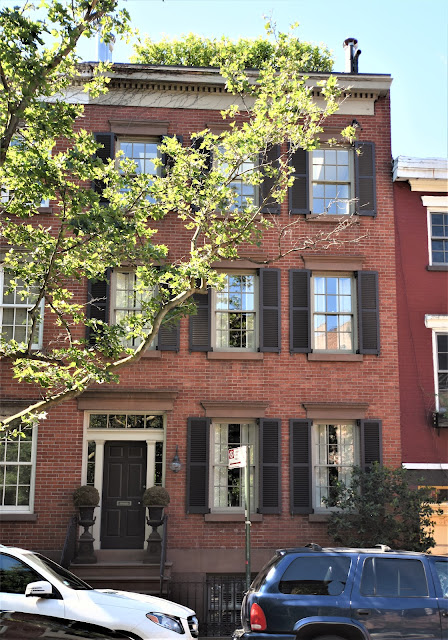
In 1842 Nicholas Brinckerhoff purchased building plots on West 11th Street, between Hudson and Greenwich Streets, and began construction on three brick-faced homes--the middle one for himself.  The Greek Revival style houses rose three stories above brownstone-clad English basements.  Like the Brinckerhoff house next door, 312 West 11th Street had a handsome entrance with narrow sidelights and a four-paned transom.  A wooden cornice with delicate dentils completed the design.

The house was home to William Shuart, a tax collector, and his family until 1848.  It was then purchased by Rev. Robert Travis.  He and his wife, the former Sarah Forbes, had married on June 14, 1825 in Massachusetts.  The couple had two sons, Edward F. and Robert, Jr., both of whom were attending Columbia College when they moved in--Edward was a senior and Robert a sophomore.

Both sons entered religious life.  Robert, Jr. was ordained around 1850 and became assistant to Rev. David Moore at The Church of the Ascension on Staten Island.  He was in charge of the chapel of the main church.   By 1858 he was appointed rector of Trinity Church in Jersey City, New Jersey.  His brother served as a lay deputy in that church.

Despite the considerable commute, Robert, Jr. lived with his parents at least through 1860.  The family took in one boarder at a time, at least two of them rather surprising within a minister's household.

In 1855 and '56 Hill Bassford, who operated a baths, lived with the family.  More expected was their next boarder, Elizabeth Borbridge, who was a dressmaker.  But in 1860 they took in Patrick Anderson, who ran a saloon nearby in the section of West 11th Street that was still called Hammond Street at the time.

Rev. Robert Travis, Sr. died in 1866.  Robert Jr. and his mother remained in the West 11th Street house until her death on New Year's Eve, 1868 at the age of 70.  

James N. Quackenbush and his family moved into the house in the early 1870's.  The operator of a "planing," or carpentry, firm, he also sat on the Board of Managers of the New York Bible Society.

By 1876 312 West 11th Street was owned by Elisha Bloomer and was being operated as a boarding house.  The wide variety of residents that year were real estate agent Theodore Fenwick; William H. Reilley, a binder; George Topf, who ran a beer saloon; and George Waterman, who was in the ice business.

Bloomer owned a dizzying number of rental properties in Greenwich Village, including the former Brickerhoff house next door and at least a dozen other houses in the neighborhood.  In November 1888, following his death they were sold at auction.

The new owner continued to operate 312 West 11th Street as a boarding house, however the names of the new tenants appeared in newsprint for unwanted reasons.  

On November 20, 1895 a 28-year-old boarder, Carrie Lewis, committed suicide in her rooms.  The Poughkeepsie, New York newspaper The Evening Enterprise, reported that she "died from the effects of rat poison, which she had swallowed with suicidal intent."

A year later, on November 22, 1896, Henry Barbour was arrested as he walked out of a pawn shop on Hudson Street.  Edward Cobb ran a dancing academy on Bleecker Street.  Among the costumes kept there were men's dress suits.  The previous afternoon Cobb was heading up the stairs to open the academy and passed Henry Barbour, who was carrying a bundle, coming down.

It was not until about a half hour later that Cobb realized someone had broken into the school and that two of the men's suits were missing.  When caught, Barbour resolutely professed his innocence.

"I came by the coats honestly," he insisted.  "I got them from a man named Mike Corcoran, who used to work at the academy, who gave them to me as security for a loan."

Barbour's story fell apart when Edward Cobb said he had never heard of the man.

In 1902, according to The Jersey City News, "Quite a lot of smuggling has been done in tobacco from the Dutch steamers and the customs authorities are very anxious to break it up."  Before the ships docked, smugglers rowed out in the darkness to offload the valuable cargo.

At 8:00 on the morning of December 1 that year John Degnan, who lived at 312 West 11th Street, and a cohort, Joseph Van Damme, were driving a tarp-covered wagon when they were stopped by Patrolman Entwistle near the entrance of the ferry house on Exchange Place.  Asked what they had in the wagon, they said they were carrying vegetables.  Suspicious, Entwistle pulled back the tarp where he found ten bags of tobacco.

The Jersey City News wrote, "The men could not give a satisfactory account of where they had obtained the goods and were arrested."  When they appeared before Judge Hoos, they "refused to tell where they had got the tobacco or by whom they were employed."  Their stiff bail was more than $9,000 in today's money.

James Dolan received more honorable press coverage in 1918.  The young corporal was fighting in France when, on September 26 his regiment became part of the Meuse-Argonne offensive.  The 47-day battle resulted in more then 350,000 deaths, including 26,277 Americans.  His name was listed in the New-York Tribune on December 18 as one of the "New York men who took part in desperate fighting."  The following year, on August 21, he was awarded the Distinguished Service Cross.

Despite being operated as a boarding or rooming house throughout most of the 20th century, 312 West 11th Street was never divided into apartments.  

It was purchased by Charlie and Robin Whitehouse in 1995.  They used the basement level as the office for their travel agency until 1999.  In 2002 they spent $160,000 to renovate the space to the Ground Floor Theater.  On October 20, 2002 Trish Hall, writing in The New York Times, explained:

Robin Whitehouse may be sorry she said it, because it's not a sentiment many New York theater producers often express, but she really likes to give new comers a chance.  That's why she named her nonprofit stage company FatChance Productions, and that's why she has transformed the bottom floor of her house into a theater.


Robin and her business partner, Ben Hodges, staged FatChance Productions projects in the theater, and also rented it to production companies without their own space.  Hall described it as "intimate and flexible, with black walls and ceilings and very little else that is fixed."  The Ground Floor Theater could accommodate an audience of up to 60.  It is now called the Next Stage Theater.

photographs by the author
LaptrinhX.com has no authorization to reuse the content of this blog