 |
| photo by Alice Lum |
Jarvis Morgan Slade learned his trade in the architectural offices of Edward H. Kendall. After opening his own business at 346 Broadway, Slade began making his mark on New York architecture.
In 1875, the 23-year-old architect was given the commission by the New York Real Estate Association to design a store and loft building for the successful soap manufacturer, David S. Brown. The Association was organized by textile merchants to ensure that the textile district remained intact. It had leased part the former grounds of the New York Hospital, and the proposed David S. Brown store would stand on the newly-extended Thomas Street on the property.
The soap company had been doing business since 1808 and, while not a national brand, did extensive business throughout New York and its neighboring states. The firm produced a range of products from “Blizzard Soap,” a laundry flake; “David’s Prize Soap,” a toilet soap; and “Brown’s Barber Soap,” a shaving soap used in the ubiquitous shaving mugs in barber shops and homes.
By the time Slade began designing the new store, David S. Brown had two factories--on First Avenue and on Chrystie Street--a retail space at 299 Broadway, and headquarters on Peck Slip.
In 1875, the 23-year-old architect was given the commission by the New York Real Estate Association to design a store and loft building for the successful soap manufacturer, David S. Brown. The Association was organized by textile merchants to ensure that the textile district remained intact. It had leased part the former grounds of the New York Hospital, and the proposed David S. Brown store would stand on the newly-extended Thomas Street on the property.
The soap company had been doing business since 1808 and, while not a national brand, did extensive business throughout New York and its neighboring states. The firm produced a range of products from “Blizzard Soap,” a laundry flake; “David’s Prize Soap,” a toilet soap; and “Brown’s Barber Soap,” a shaving soap used in the ubiquitous shaving mugs in barber shops and homes.
By the time Slade began designing the new store, David S. Brown had two factories--on First Avenue and on Chrystie Street--a retail space at 299 Broadway, and headquarters on Peck Slip.
 |
| The design includes diagonally-laid brickwork and a Venetian-inspired arcade--photo by Alice Lum |
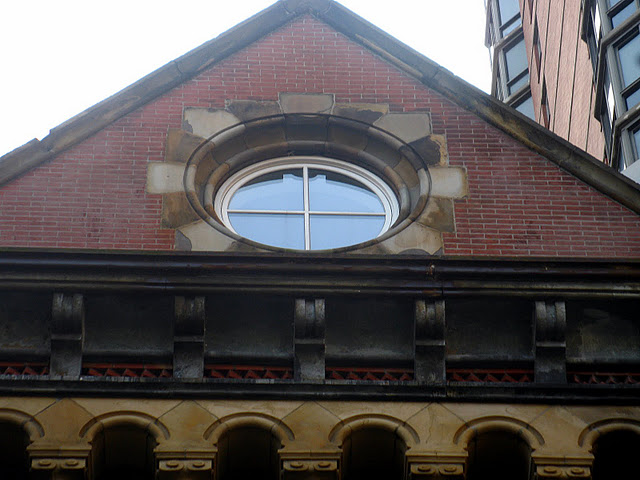
Completed in 1876, the young architect’s soap store building is a delight. The influence of contemporaries such as Jacob Wrey Mould—responsible for much of Central Park’s fanciful architecture—Charles Eastlake and John Ruskin, combined with Slade’s own remarkable flair, resulted in a colorful Victorian Gothic treasure. Polished granite columns, a cast iron base, Venetian-style arches, carved sandstone and intricate brickwork merged in the romantic design. A slate-tiled mansard roof was fronted with a steep brick gable with a large, circular window framed by radiating stones of alternate shades.
 |
| photo by Alice Lum |
The romantic and effervescent building was, no doubt, influential in Slade’s receiving many subsequent commissions. Tragically, within seven years after designing 8 Thomas Street, the promising architect would be dead at the age of 30.
David S. Brown & Co. owed its success not merely to a good product, but to masterful marketing. In 1888, when the city of Albany, New York, celebrated its bi-centennial, the company took advantage of the potential publicity. Anthony Bleecker Banks remembered in his Historical Memoirs (printed that same year):
David S. Brown & Co. owed its success not merely to a good product, but to masterful marketing. In 1888, when the city of Albany, New York, celebrated its bi-centennial, the company took advantage of the potential publicity. Anthony Bleecker Banks remembered in his Historical Memoirs (printed that same year):
David S. Brown & Co., of New York, manufacturers of satin gloss soap, had a very large and costly covered wagon that was a perfect gem. During the procession samples of the soap were thrown among the crowd and eagerly grabbed by the hoodlums, who, as a member of the Bi-centennial committee suggested, certainly needed a little soaping.
 |
| At just 23 years old, the architect melded various materials into a masterful whole; causing us to wonder what would have come from his drafting board if he had not died so early -- photo by Alice Lum |
Current Advertising, in 1897, remarked that the company did no magazine advertising, “Yet, these people have one of the largest and most profitable soap manufacturing businesses in the country.” The secret, according to the magazine, was premiums.
They were the originators of the plan of giving away premiums for the return of soap wrappers or trademarks, and they give away almost everything you can think of in the line of jewelry, silverware, watches, clocks and the like.
Especially successful were the free children’s books, which were “gaily colored and profusely illustrated.” Along with familiar rhymes and fairy tales (revamped to work the soap products into the stories), were promises of tantalizing toys available for soap wrappers.
“Young folks have a way of getting what they go after and if they have to have soap wrappers in order to get what they want there is not likely to be peace in the household until that particular brand of soap is used exclusively,” noted Current Advertising.
When Theodore Roosevelt’s Rough Riders were a main subject of conversation, David S. Brown produced its Rough Rider Soap to capitalize on the craze.
By 1898, David S. Brown was gone from 8 Thomas Street and the wholesale woolen firm W. S. Taylor & Bloodgood was doing business here. At the time, the neighborhood was still primarily home to textile firms. A decade later, in 1908, George R. Gibson Co., manufacturers of “faultless canvas roofing,” moved in, above the Café Renel, which occupied the ground floor.
 |
| The ground floor, where David S. Brown soap products had been displayed, became a French cafe -- photo by Alice Lum |
The day after Christmas in 1910, the Bustanoby brothers—Andre, Jacques, Pierre and Louis—announced their intentions to install a quaint French cafe where bars of soap were once sold. The brothers, who were born in the Basque country of France, already owned three restaurants, including the Café des Beaux Arts on West 40th Street and the Chateau des Beaux Arts in Huntington, Long Island. They had made a mark in the restaurant and entertainment world serving haute cuisine and featuring singers like Lillian Russell.
Having purchased the Café Renel, they intended “to fit it up in the style of the old French taverns of the eighteenth century,” according to The New York Times. Pierre Bustanoby explained, “The guests will sit at old oaken tables, surrounded by great casks of wine.” Some, he reported, “date back to 1789.” The new café would be called the Cabaret des Beaux Arts.
The venture would be short-lived. The brothers had a severe falling out, with Louis leaving the business to run a restaurant in the Flatiron Building. He sued his brothers, accusing them of trying to drive him out of the business.
By the end of 1912, the Cabaret des Beaux Arts was no more.
On March 17, 1948, shock waves hit the New York real estate market when former Manhattan Borough President Samuel Levy and real estate mogul Charles F. Noyes purchased nearly three entire downtown blocks from the Society of the New York Hospital. Included in the transaction was 8 Thomas Street.
The hospital had owned the land and any buildings erected upon it since the English Crown granted it in 1772. The two men paid a total of $3.3 million-- the price of a single high-end apartment today--for the real estate. The New York Times announced that the investors intended to add another $1.7 million to their investment, since many of the properties "will be reconstructed or improved with a new building."
Luckily, 8 Thomas Street was spared. In 1984, the building was converted to two floor-through art studios, each with a separate floor for living space; and a ground floor restaurant.
Having purchased the Café Renel, they intended “to fit it up in the style of the old French taverns of the eighteenth century,” according to The New York Times. Pierre Bustanoby explained, “The guests will sit at old oaken tables, surrounded by great casks of wine.” Some, he reported, “date back to 1789.” The new café would be called the Cabaret des Beaux Arts.
The venture would be short-lived. The brothers had a severe falling out, with Louis leaving the business to run a restaurant in the Flatiron Building. He sued his brothers, accusing them of trying to drive him out of the business.
By the end of 1912, the Cabaret des Beaux Arts was no more.
On March 17, 1948, shock waves hit the New York real estate market when former Manhattan Borough President Samuel Levy and real estate mogul Charles F. Noyes purchased nearly three entire downtown blocks from the Society of the New York Hospital. Included in the transaction was 8 Thomas Street.
The hospital had owned the land and any buildings erected upon it since the English Crown granted it in 1772. The two men paid a total of $3.3 million-- the price of a single high-end apartment today--for the real estate. The New York Times announced that the investors intended to add another $1.7 million to their investment, since many of the properties "will be reconstructed or improved with a new building."
Luckily, 8 Thomas Street was spared. In 1984, the building was converted to two floor-through art studios, each with a separate floor for living space; and a ground floor restaurant.
 |
| photo by Alice Lum |
When the building was converted again in 2007 to condominium residences, a $1.6 million exterior restoration and full interior renovation was conducted by Ashnu International Corp. Today, the remarkable work of Jarvis Morgan Slade, the architect who died too young, remains what the AIA Guide to New York City called “an elaborate confection.”
Another favorite of mine, about which I'd always been curious. Thanks.
ReplyDeleteGlad to know there's someone else who is as taken with this building as I am. What a beauty!
ReplyDeleteExcellent Posting Good Job. By Regards Wholesale Printing
ReplyDeleteVery cool building! I love those polished Romanesque columns. I found this especially interesting because, prior to reading this posting, the only Jarvis M. Slade designed building I was aware of was "Castle Rock," the hilltop William Henry Osborn mansion in Garrison, NY. And I never would have guessed those two buildings were both the work of the same architect.
ReplyDelete